The Month I Stopped Paying for Their Lies
The first time my mother told me to leave my own house, she did not raise her voice.
Chapter 1
The Month I Stopped Paying for Their Lies
The first time my mother told me to leave my own house, she did not raise her voice.
That was the part that stayed with me.
She stood in the center of my kitchen with one hand resting on the marble island I had paid extra to install, her silver bracelet tapping lightly against the stone. Her face was calm. Almost bored. As if she were not throwing me out, but correcting the placement of a chair.
“Then go,” she said.
My younger brother, Nolan, leaned against the refrigerator with a half-empty bottle of sparkling water in his hand. His wife, Paige, sat at the breakfast table scrolling through her phone, one leg crossed over the other, her diamond anklet catching the afternoon light. My stepfather, Martin, did not look up from the television in the living room. He simply increased the volume, letting a baseball commentator fill the silence where a father should have been.
I stood by the back door holding two grocery bags so heavy
the plastic handles had carved red lines into my fingers.
Inside the bags were the things they had asked for.
Organic milk for Paige because regular milk made her “bloated.”
Gluten-free crackers for Nolan because he was “trying to reset his body.”
Blood pressure medication for Martin because he had forgotten to refill it.
Imported tea for my mother because the cheap brand “tasted like dust.”
And diapers for Nolan and Paige’s baby, who had been “just visiting for a few weeks” eight months ago.
I had worked eleven hours that day. I had taken three client calls from my car because Nolan had turned my office into what he called a “creative recovery space,” which mostly meant a room where he played video games and complained about capitalism. I had paid the mortgage, the electric bill, the phone plan, the groceries, the insurance on Nolan’s SUV, Paige’s dental emergency,
Martin’s physical therapy, and my mother’s private Pilates sessions because she said movement was the only thing keeping her sane.
The total came to just over nine thousand dollars a month.
That number did not include the cost of silence.
Silence when they used my card without asking.
Silence when Paige moved my clothes from the primary closet because she “needed more hanging space.”
Silence when Nolan sold the antique writing desk my grandfather had given me because he said it looked “too sad” in the nursery.
Silence when my mother told relatives that I was “difficult, but useful.”
Silence when Martin called me selfish for asking him not to smoke near the baby.
That afternoon, I had asked one simple question.
“Can I have my office back by the end of the month?”
No shouting. No accusation. No dramatic speech. Just a tired woman standing in her own kitchen,
asking for one room in the house she paid for.
Paige laughed first.
It was quiet and pretty and cruel.
Nolan rolled his eyes. “Mara, seriously? The baby’s routine depends on that room now.”
“It was my office,” I said.
My mother’s mouth tightened. “Family changes priorities.”
“My priority is being able to work,” I said. “Since I’m the only one paying for everything.”
The kitchen went still.
That was the sentence I was never supposed to say.
My mother turned slowly. Her name was Evelyn Vale, and she had always known how to make disappointment look elegant. At fifty-four, she was still beautiful in a cold, polished way, with smooth blond hair, pearl earrings, and the kind of posture that made every room feel like a courtroom.
“You think money makes you superior?” she asked.
“No,” I said. “I think paying the mortgage gives me the right to use one room.”
Nolan snorted. Paige looked up from her phone, suddenly interested.
Evelyn stepped closer.
“This house only became a home because we came here,” she said. “Before us, it was just you rattling around alone with your bitterness.”
I looked past her into the living room. Martin kept watching television.
Nobody corrected her.
Nobody said, Actually, Mara bought this house after working twelve years for it.
Nobody said, Actually, Mara took us in when we had nowhere stable to go.
Nobody said, Actually, maybe we should stop taking from her like she is an open wallet with a pulse.
So I said it myself.
“This house is mine.”
My mother’s eyes hardened.
“Then maybe you should enjoy it alone,” she said. “If you hate sharing with family so much, leave.”
The grocery bags slipped from my fingers.
A carton of blueberries rolled across the floor. One split open near Nolan’s shoe. Tiny dark berries scattered across the tile like beads from a broken necklace.
No one moved to pick them up.
I waited for someone to laugh and say she had gone too far. I waited for Martin to turn down the television. I waited for Nolan to remember all the nights I had worked late so his daughter could sleep under my roof. I waited for Paige to look even mildly embarrassed.
Nothing.
My mother lifted her chin.
“Well?” she said.
I looked around the kitchen, and something inside me finally stopped begging.
Not broke.
Stopped.
There is a difference.
Breaking is loud. Stopping is quiet. It is the moment a door closes so gently you barely hear it, but suddenly the air on the other side is unreachable.
I wiped my palms on my coat.
“All right,” I said.
Evelyn blinked. “All right what?”
“All right.”
I walked upstairs while they watched me as if they expected me to slam doors and cry. I did neither. I packed my laptop, passport, client files, two sweaters, my grandmother’s gold ring, and the folder of documents I had been slowly removing from the house for three months.
Because the truth was, I had already begun leaving.
Three months earlier, a tax notice addressed to a company I did not own had arrived at my house.
Vale Ridge Holdings.
At first, I thought it was junk mail. Then came another notice. Then a certified envelope. Then a debt collection letter with Nolan’s name buried in the paperwork and my home address listed as the business location.
When I asked Nolan about it, he laughed too loudly.
“Relax. It’s just an LLC idea. Nothing serious.”
When I asked my mother, she told me I was paranoid.
“You always assume people are taking advantage of you,” she said. “That is why you’re lonely.”
That night, I opened a private mailbox downtown.
Two weeks later, I moved my business address there.
One month later, I met with a realtor named Celeste Moreno at a small café near Union Station and said, “I need to sell my house without my family knowing until it’s unavoidable.”
Celeste did not flinch.
She was a woman in her forties with sharp eyes, a calm voice, and the energy of someone who had heard every version of betrayal and learned not to gasp.
“Then we prepare quietly,” she said.
So we did.
We photographed the house while everyone was gone for a Sunday brunch they had charged to my card. We reviewed the mortgage. We checked the title. We planned the listing date. I rented a small apartment across town under a six-month lease and moved my most important things one carload at a time.
By the time my mother told me to leave, I had already packed my freedom in pieces.
I slept that night on the floor of my new apartment with no furniture except an air mattress, a lamp, and a mug I had taken from the kitchen because it was the only one nobody else liked.
At 6:30 the next morning, I called Celeste.
“I’m ready,” I said.
“Are you safe?”
That question almost undid me.
Not “Are you sure?”
Not “Will this be messy?”
Not “What about them?”
Are you safe?
I looked around the bare apartment, at the gray dawn coming through the blinds, at my laptop sitting on a cardboard box.
“Yes,” I said. “For the first time in a long time.”
By noon, the house went live.
By 2:15, the sign was on the lawn.
By 3:02, Nolan called me fourteen times.
I did not answer.
At 3:19, Paige texted:
Mara, this is insane. We have a baby.
At 3:24, Martin left a voicemail:
Your mother is beside herself. You need to fix this before people find out.
At 3:41, my mother sent one sentence:
You have always been ungrateful for what I gave you.
I stared at that message for a long time.
What she gave me.
Not love. Not safety. Not honesty.
What she gave me.
As if my life had been a transaction from the beginning.
The offer came fast. All cash. Above asking. Ten-day close. The buyer wanted the house empty.
My family panicked in stages.
First came outrage. Nolan threatened to sue me, though he could not explain for what. Paige cried into voice messages about stability. Martin warned me that “women who destroy families end up alone.”
Then came bargaining.
Nolan said he could start paying something “soon.”
Paige said she would help clean if I delayed the sale.
Martin said my mother’s health could not handle sudden change.
Finally, my mother called from a blocked number.
I answered because I wanted to hear what voice she would use when guilt failed.
“Mara,” she said softly.
I stood by the window of my apartment overlooking the parking lot. Rain had started tapping against the glass.
“Yes?”
“You are making a mistake.”
“No,” I said. “I made one when I let you stay.”
Her breathing changed.
“You don’t mean that.”
“I do.”
“I raised you better than this.”
The sentence moved through me strangely, like a key turning in a lock I had never noticed.
“Did you?” I asked.
Silence.
Then she said, very quietly, “Be careful what you dig up when you’re trying to bury your family.”
The call ended.
For two full minutes, I stood completely still.
That sentence did not sound like anger.
It sounded like fear.
Closing day arrived under a pale winter sun. The house was finally empty. Nolan had left holes in the garage wall where his exercise racks had been. Paige had abandoned three bags of baby clothes in the hallway. Martin’s ash smell still clung to the den. My mother had taken nearly everything decorative, including the brass mirror from the entryway and the blue porcelain bowl my grandmother used to keep by the stairs.
But she left one thing.
A small wooden music box sat on the windowsill in the old office.
I had not seen it in years.
It had belonged to my grandmother, Elise. When I was little, she used to wind it up before bed. The song was soft and sad, and she would tell me, “Some truths sleep until someone is brave enough to wake them.”
I had always thought that was just something old women said.
Celeste arrived with a clipboard for the final walkthrough. We moved room by room, checking for damage. The house felt larger without them in it. Not peaceful. Just hollow, like a stage after the actors have fled.
When we reached the office, I stopped.
The wall behind the built-in shelves looked wrong.
A narrow rectangle near the bottom corner was slightly lighter than the surrounding paint. Not obvious. Not unless you had once spent hours staring at that wall during late-night work calls, trying not to cry while your family laughed downstairs.
“Celeste,” I said, “do you see that?”
She crouched beside me.
“A panel?”
My pulse climbed into my throat.
I took a flat screwdriver from the kitchen drawer and slid it under the edge. The paint cracked. The panel lifted.
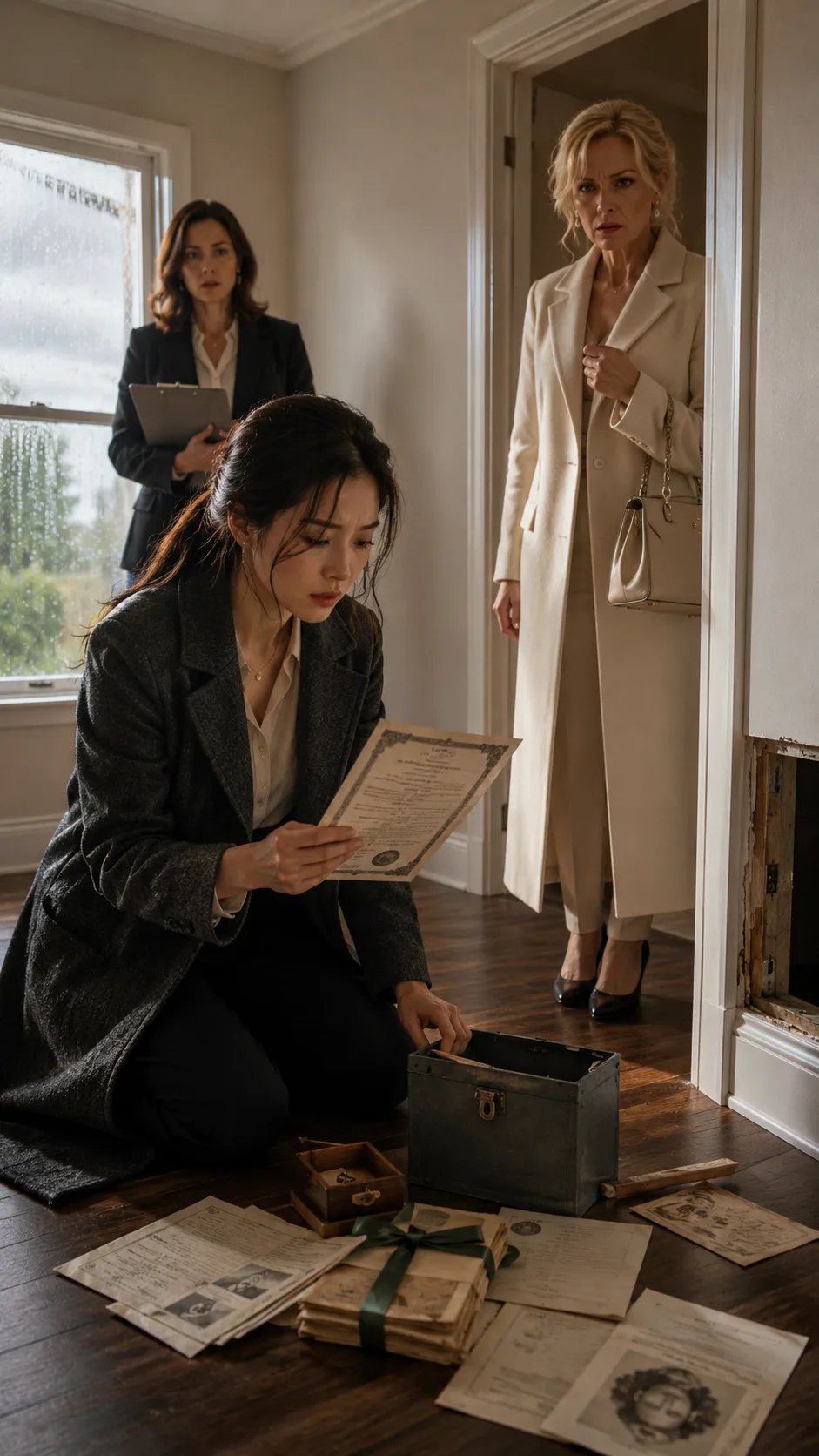
Behind it was a small metal box.
For a moment neither of us spoke.
Then Celeste said, “Mara, don’t touch anything else until you know what that is.”
But I had already seen the keyhole.
And I had already remembered the music box.
My hands shook as I picked it up from the windowsill. The bottom felt loose. I turned it over and found a tiny brass key taped beneath the velvet lining.
Celeste whispered my name.
I unlocked the metal box on the office floor.
Inside was a birth certificate.
My birth certificate.
But not the one my mother had shown me when I applied for college. Not the copy she kept in her filing cabinet and guarded like a crown jewel.
This one was original.
Mother: Clara Bennett.
Not Evelyn Vale.
Father: Unknown.
My ears rang.
Underneath were guardianship papers. Temporary guardianship granted to Evelyn Vale, maternal aunt of minor child Mara Bennett, following the death of Clara Bennett.
Aunt.
Not mother.
Aunt.
The room tilted.
I reached for the next document because some wounded part of me still wanted the papers to explain themselves kindly.
They did not.
There were letters from an attorney. Bank statements. A trust account in my name. Insurance settlement records after my biological mother’s accident. Notices sent when I turned eighteen. Notices sent when I turned twenty-one. Notices sent again when withdrawals from the account were questioned.
All addressed to me.
All hidden.
At the bottom of the box was a bundle of letters tied with a faded green ribbon.
The first envelope said:
For Mara, when she is old enough to ask why love felt expensive.
The handwriting belonged to my grandmother Elise.
I opened it with fingers that no longer felt attached to my body.
My dearest Mara,
If you are reading this, then the truth has either been given to you late or found by you alone. I am sorry for both.
Your mother’s name was Clara. She was bright, stubborn, funny, and too trusting of people who envied what they could not become. She loved you from the moment she knew you existed.
Evelyn promised to raise you as her own after Clara died. I wanted to believe her. I was sick, and I had no strength left to fight the court. But I knew my daughter Evelyn. I knew how easily she could confuse possession with love.
So I made copies.
I made records.
I hid what I could.
The money left for you was never meant to make you obedient. It was meant to make you free.
I pressed the letter against my chest and made a sound I did not recognize.
Celeste knelt beside me, her professional calm gone.
“Mara,” she said gently, “we need a lawyer.”
By evening, I sat in an attorney’s office downtown with the metal box on the conference table.
His name was Julian Price. He was neat, serious, and careful with silence. He read for almost half an hour before speaking.
“Evelyn Vale was your temporary guardian,” he said. “I see no finalized adoption record here.”
“So she lied,” I said.
“Yes.”
“And the trust?”
His jaw tightened.
“It existed. It appears substantial. There were withdrawals over many years. Some labeled education, housing, medical support. But several were transferred into accounts connected to Evelyn, Martin, and possibly your brother.”
“He’s not my brother,” I said.
The sentence came out before I could soften it.
Julian looked up. “Biologically, no. Legally, depending on certain records, perhaps not either.”
I laughed once.
It sounded broken.
“All these years,” I said, “I kept trying to be a good daughter.”
Julian closed the folder.
“Mara, based on what I see, you were not treated as a daughter. You were treated as access.”
The word landed harder than shouting.
Access.
To money.
To a house.
To credit.
To guilt.
To a version of myself small enough to keep feeding them.
Two days later, my mother came to my apartment.
I did not tell her where I lived. She found it anyway.
She stood outside the building in a cream coat, blond hair pinned neatly, sunglasses hiding her eyes though the sky was cloudy.
I came down because I wanted to see her face when she understood the box was no longer hidden.
She looked me over first, as if checking whether I had become someone she could still control.
“You look tired,” she said.
“I found the panel.”
Her expression did not change.
But her hand tightened around her purse strap.
“I don’t know what you mean.”
“I found Clara’s birth records. Elise’s letters. The trust statements.”
A car passed behind her, tires whispering over wet pavement.
For once, Evelyn had no immediate answer.
I stepped closer, not enough to threaten, just enough to stop being the child she trained.
“You told me I was difficult to love,” I said. “You told me family meant sacrifice. You told me I owed you everything.”
Her mouth trembled with anger, not remorse.
“I took you in.”
“You took the money that came with me.”
Her eyes flashed.
“You have no idea what I gave up.”
I nodded slowly.
“No,” I said. “But I know what you took.”
For a second, I saw something raw beneath her polished face. Not guilt. Not grief.
Fear.
“You’ll ruin us,” she whispered.
I thought of the blueberries scattered across my kitchen floor. The office stolen from me. The years I spent mistaking exhaustion for duty. The mother I never knew. The grandmother who hid the truth because she knew one day I might be brave enough to find it.
“No,” I said. “I’m going to tell the truth. Whatever it ruins was already built on a lie.”
Evelyn stared at me as if I had become a stranger.
Maybe I had.
Or maybe, for the first time, I had become myself.
The house closed that Friday.
The money hit my account just after lunch.
I did not celebrate. Not exactly.
I went to the river with Clara’s photograph, the one Julian found attached to an old court file. She was twenty-seven in the picture, smiling into sunlight, dark hair blowing across her cheek. I looked like her. Not completely, but enough to make my knees weak.
I sat on a bench until the sky turned gold.
Then I took out my phone.
There were thirty-seven missed calls from numbers I had blocked. Four emails from Nolan. Two from Paige. One message from Martin that simply said:
This has gone too far.
I deleted it.
Then I opened a new contact.
Julian Price.
I typed:
File everything.
Before I could lose courage, I pressed send.
The river moved quietly in front of me, carrying light across its surface in broken pieces.
For years, I had believed love meant keeping everyone else afloat while I drowned politely.
But that was not love.
That was training.
And now, finally, the lesson was over.
THE END.
Chapter complete
You have reached the end of this chapter.
Continue reading
A few more worlds to get lost in after this chapter.




