The clasp on my grandmother’s necklace had always been stubborn.
Chapter 1
The clasp on my grandmother’s necklace had always been stubborn.
It was a tiny thing, no wider than the edge of a fingernail, but it required patience. My grandmother used to sit me in front of her vanity, lift my hair with one hand, and work the clasp with the other while I tried not to breathe too hard. She smelled like rose cream and old letters. She never rushed jewelry. She said anything that touched the throat should be treated with respect.
“You don’t wear a promise like decoration,” she told me once.
I was twelve then, too young to understand why a diamond pendant could make an old woman’s hands go still. I only knew she never let anyone else touch it. Not my mother. Not my cousins. Not the housekeeper who polished her silver frames every Friday.
When she died, the necklace came to me in a navy velvet box with my name written on a cream
card.
Eleanor.
No last name. No explanation. Just my name in her narrow handwriting.
I kept the box in a private safe behind a loose panel in my dressing room. Adrian knew the safe existed because husbands notice locked things when they believe marriage makes every lock partly theirs. He did not know the code. At least, that was what I told myself for three years.
The first time I noticed the velvet box had shifted, I convinced myself I had moved it.
The second time, I opened it.
Empty.
The space inside still held the faint imprint of the necklace, a pale curve in the satin lining where the diamonds had rested for decades. For a while I stood there with the box open in my hand and the house quiet around me. Downstairs, the dishwasher hummed. Somewhere in the hallway, the air conditioning clicked on.
Small sounds.
Too
normal.
I closed the box and put it back exactly where it had been.
That evening, Adrian came home late with his tuxedo jacket over one shoulder and the smell of expensive hotel soap on his skin. He kissed my cheek near the kitchen island. Not my mouth. Not my forehead. My cheek, like a social obligation.
“You’re up,” he said.
“I couldn’t sleep.”
He dropped his keys into the marble bowl beside the door. One key slid over the rim and landed on the floor. He looked at it, then left it there.
I watched him walk to the bar cart.
“My grandmother’s necklace is missing,” I said.
His hand paused above the decanter. Only for a second. Then the glass stopper came out with a soft pop.
“Which necklace?”
I waited.
He poured too much bourbon.
“The only necklace she left me.”
He gave a small laugh, the
kind that made the person hearing it feel childish for being serious. “Eleanor, you misplace things when you’re stressed.”
“No.”
He turned then. “No?”
“I don’t misplace things in a locked safe.”
The bourbon touched his lips. He swallowed once, slow. “Then call the insurer.”
“I did.”
That was the first time his face changed.
Not much. Adrian had spent years learning how to keep rooms from reading him. Boardrooms, galas, donor dinners, press events. His family’s money had taught him how to smile without offering anything.
But his eyes moved.
Just once.
Toward the hallway.
Toward the stairs.
Toward the room with the safe.
I set the empty velvet box on the counter between us. He looked at it like it had insulted him.
“Why would you leave something like that lying around?” he asked.
“In my safe?”
“You should have told me it was that valuable.”
“I did.”
His mouth tightened.
There are moments in a marriage when a sentence does not break anything by itself, but it shows you where the fracture has been hiding. That sentence did that. Not because he had lied. Adrian lied often in polished, manageable ways. A meeting ran late. A client needed dinner. His phone died. Victoria was excellent at handling scheduling.
No.
It was because he had made the missing necklace my carelessness before he even pretended to help me find it.
I took the box upstairs.
The next morning, I called the insurance broker myself. Mr. Dawes had handled my grandmother’s estate and still spoke to me like I was standing beside her.
“Mrs. Vale,” he said, “I’m sorry, but the certificate remains active under your name.”
“Can you send me the full documentation?”
“Of course.”
“And the serial number?”
There was a brief paper sound over the phone.
“Yes. The pendant stone and clasp both have matching micro-engraved serial marks.”
“Send everything.”
“Is there a problem?”
I looked at the empty velvet box on my vanity.
“Not yet.”
For two weeks, I said nothing.
That was not because I had no proof. It was because proof without timing is only a private wound.
Adrian became careful around me. Careful, not kind. He stopped leaving his phone face-up. He showered before dinner. He asked me twice whether I had invited anyone to the Helms Foundation charity ball, which was not a question he normally cared enough to ask.
Victoria’s name appeared in conversation more often by disappearing from it.
His assistant.
His right hand.
His impossible-to-replace organizer.
A woman with smooth brunette waves, sharp red lipstick, and a talent for standing one step too close in photographs. I had seen her beside Adrian at business lunches, behind him at press events, near him in hotel lobbies where she always seemed to be carrying a folder.
The first time I met her, she told me my dress was “brave.”
The second time, she said Adrian hated wasting time on sentimental things.
The third time, she touched my arm at a fundraiser and said, “You’re so lucky. He handles everything for you.”
I remembered that line.
The charity ball was held in the west ballroom of the Carlisle Meridian, the kind of hotel where even the flowers looked disciplined. White roses in tall glass cylinders. Crystal chandeliers. Gold chairs arranged around auction tables with silent-bid cards laid at exact angles.
I arrived at eight fifteen.
Alone.
Adrian had texted at seven forty-two.
Meet me inside. Don’t wait.
No apology. No explanation.
At the entrance, a photographer raised his camera. I turned slightly so he could take the picture without getting too much of my face. The flash went off. Behind him, a woman in emerald satin checked the donor board for her name.
The ballroom smelled like perfume, wax, and chilled champagne.
I had dressed carefully. Navy satin gown. Diamond studs. Hair pinned low. No necklace.
The absence felt deliberate against my throat.
A waiter passed with glasses of champagne. I took one and did not drink.
From across the room, I saw Adrian first.
Black tuxedo. Perfect posture. One hand in his pocket. Smile directed at a silver-haired donor from Geneva.
Then the donor stepped aside.
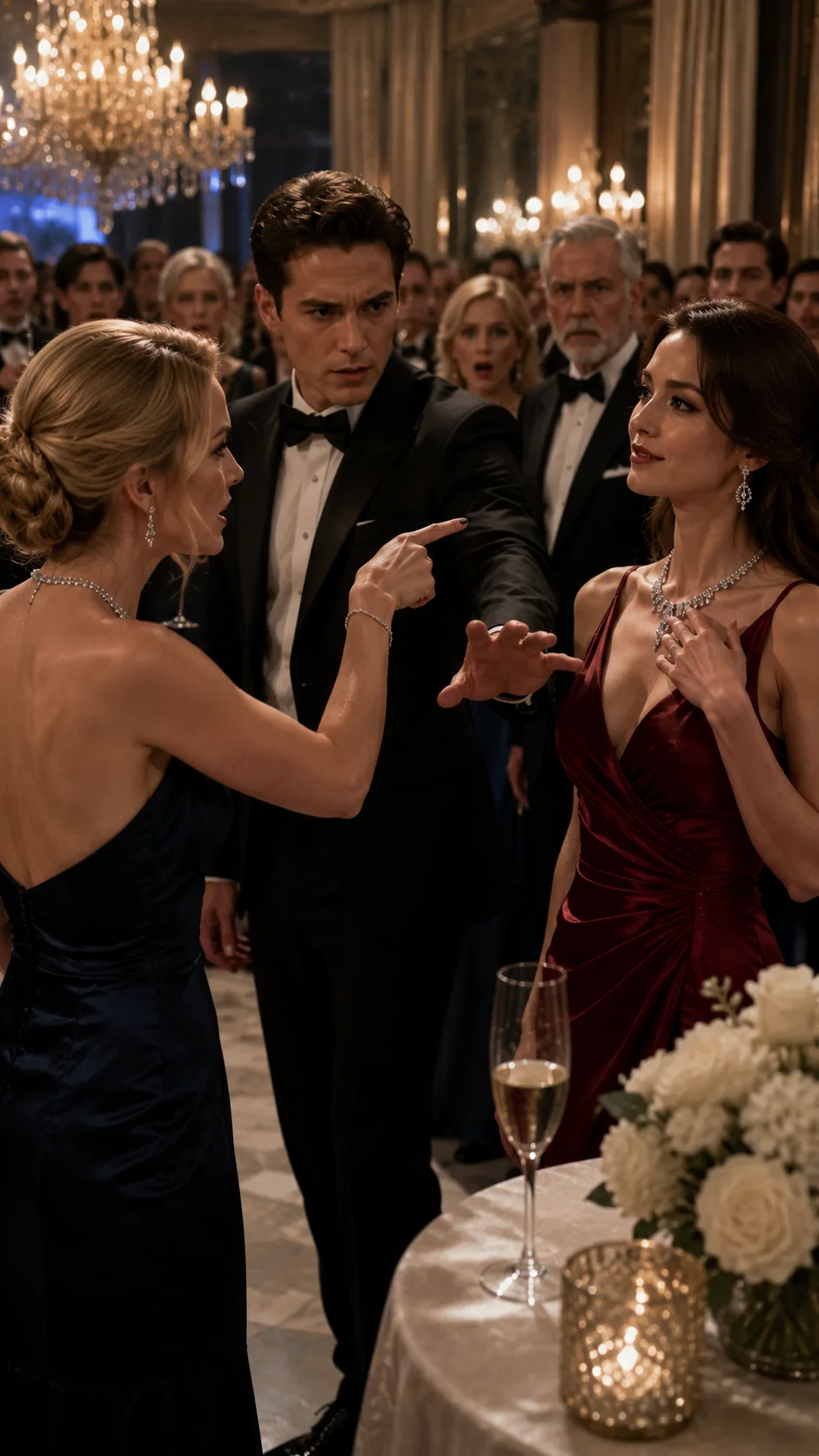
Victoria stood under the largest chandelier in a red gown cut to show her collarbones.
My grandmother’s necklace sat at her throat.
For a moment, the room became too detailed.
The chandelier’s crystals trembling slightly from the air vents. The condensation on a champagne flute. The gold thread on Victoria’s gown catching light near her hip. Adrian’s left thumb moving once against the seam of his pocket.
The pendant lay exactly where it had rested on my grandmother’s skin in every photograph.
Same drop.
Same old-cut diamond.
Same narrow clasp.
Victoria saw me looking.
She smiled.
Then she lifted her hand and touched the pendant, not as if checking it.
As if presenting it.
A woman beside me said something about the auction catalog. I did not turn.
Adrian followed Victoria’s gaze and found me. His expression did not collapse. Men like Adrian did not collapse in public. They adjusted. His smile stayed on his mouth, but everything behind it shifted.
He excused himself from the donor and crossed the marble floor.
Not quickly.
Too quickly would have admitted something.
“Eleanor,” he said when he reached me. “You made it.”
I looked past him.
Victoria did not move. She stayed under the chandelier with that necklace bright against her throat.
“Where did she get it?”
Adrian’s hand came to my elbow. Light. Public. Decorative.
“Not here.”
I looked down at his fingers until he removed them.
“Where did she get it?”
His jaw worked once.
A waiter drifted too close with a tray. Adrian’s eyes flicked toward him, and the waiter moved away.
“You need to lower your voice.”
“I haven’t raised it.”
That bothered him more than shouting would have.
Victoria approached with a champagne glass she had barely touched. She came slowly, hips steady, shoulders open, every step chosen for witnesses. The room had not yet stopped, but attention was bending toward us in small increments.
A donor turned his head.
A woman near the auction table stopped writing her bid number.
The string quartet continued near the far wall, but one violinist glanced up.
Victoria stopped beside Adrian, close enough to make the shape of the evening clear.
“Eleanor,” she said. “You look beautiful.”
“No.”
Her smile thinned.
“No?” she repeated.
“No, we’re not doing that.”
Adrian’s hand lifted again, not touching me this time, only placed in the air between us. A barrier made of politeness.
Victoria’s fingers rose to the necklace.
“You’re staring,” she said.
“I know what I’m looking at.”
Adrian leaned closer. His voice dropped. “You are making a scene.”
“Not yet.”
That landed.
His eyes hardened.
Victoria gave a soft laugh, the kind meant for nearby listeners more than the person addressed. “If this is about the necklace, Adrian gave it to me. I didn’t realize old jewelry could cause such a reaction.”
Old jewelry.
Something sharp passed through my hand, but my fingers stayed loose around the stem of my champagne glass.
Adrian looked at her.
Too fast.
That was the mini twist. Not the necklace. Not the lie. His glance.
He had not told her enough.
Victoria believed the insult was safe because she believed the theft was a gift. She believed he had the right to give what he had given. She believed I would retreat from humiliation the way society trained wives to retreat from their own instincts.
She had not seen the certificate.
Adrian had.
“Victoria,” he said.
One word.
A warning.
She ignored it. Pride does that when the room is watching.
“It was a gift,” she said again, louder this time. “Maybe you should ask your husband why he wanted me to have it.”
There it was.
A line thrown like glass across marble.
The ballroom finally shifted.
Not dramatically. No collective gasp. Real rooms do not behave that neatly. They fracture in pieces. Three conversations stopped near the bar. Someone set a champagne glass down too hard. The auction host, a heavyset man with silver hair and a red pocket square, paused mid-sentence at the microphone.
Adrian stepped in front of me.
“Enough.”
His voice had sharpened, but he still smiled faintly at the guests over my shoulder, trying to stitch the evening back together with his face.
I looked at him.
He had once told me that reputation was not about truth. It was about who made the first believable statement.
He had made his.
Victoria stood in my necklace and said it had been a gift.
Now the room was waiting for mine.
I placed my untouched champagne glass on the nearest table.
The sound was small.
Adrian heard it.
“Eleanor,” he said, lower now. “Do not embarrass me here.”
That sentence did something useful.
It told everyone whom he was protecting.
Not me.
Not the truth.
Himself.
I looked at Victoria’s hand on the diamond pendant.
“Take off my necklace,” I said.
Her smile came back, almost triumphant. “Your necklace?”
“My grandmother’s necklace.”
Adrian’s face lost another fraction of color.
Victoria turned slightly so the pendant caught the chandelier light. “Then you should have kept it better.”
A woman behind her inhaled through her teeth.
Adrian moved again, blocking the space between us with his body. Not fully. Just enough to make himself the center. He always did that when a room turned dangerous.
“Say one more word,” he said, “and you humiliate yourself.”
My hand went to my clutch.
His eyes followed it.
That was the second crack.
He knew.
Maybe he did not know I had brought the certificate. Maybe he only knew I had brought something. But he knew enough to stop looking at my face and start looking at my hand.
“No, Adrian,” I said. “I’m done protecting you.”
The auction host lowered the microphone.
The quartet stopped.
The last note hung in the chandelier light, thin and unfinished.
I opened the clutch.
Adrian’s hand dropped from the air. His fingers curled once, then opened.
“Put that away, Eleanor.”
The command came too late.
Inside the clutch was a folded insurance certificate, a printed appraisal photograph, and a copy of the police report I had filed that morning. The report had no accusation attached to it yet. Only a missing item. A value. A description. A serial number.
Timing.
I pulled out the certificate first.
Victoria watched the paper, then Adrian.
For the first time, her smile did not know where to go.
“You stole from my safe,” I said.
Adrian’s mouth opened.
Closed.
No denial came out.
That silence did more than any confession would have.
I laid the certificate flat on the champagne table. The paper did not stay flat at first; one corner lifted slightly, and I pressed it down with two fingers. It was absurd, that corner. Annoying. Real. In the center of a ruined marriage, I found myself smoothing paper.
Then I placed the appraisal photo beside it.
The image showed the necklace against a gray background. Same pendant. Same old-cut diamond. Same clasp.
The room leaned without moving.
“Read the serial number,” I said.
The auction host blinked once, then stepped closer. He was not a lawyer. He was not security. He was simply the nearest respectable man with a microphone and no idea where to put his hands.
He looked at the certificate.
Then at the necklace.
Then at the photograph.
Adrian reached for the paper.
I did not pull it away.
A retired judge from the foundation board placed her hand on the table edge before Adrian could touch it.
“Let him read,” she said.
Four words.
The room changed owners.
Adrian’s hand stopped.
Victoria’s fingers tightened around the pendant as though she could hide it by holding it. The diamond flashed between her knuckles.
The host cleared his throat. “The certificate lists a micro-engraved serial mark on the clasp and pendant setting.”
His voice did not belong to him anymore. It belonged to the room.
Adrian said, “This is ridiculous.”
No one looked at him.
That was the first punishment.
The judge leaned closer. “The photo matches.”
Victoria turned to Adrian. Not with anger. Not yet. With calculation. A woman measuring the distance between what she had been told and what the room had just heard.
“You said it was yours,” she said.
Adrian’s eyes cut to her.
Wrong move.
Everyone saw it.
I reached into my clutch again and removed the small velvet box. The original one. Navy. Worn at the corners. My grandmother’s card still tucked inside the lid.
Eleanor.
I opened it and set it beside the certificate.
Empty.
A photographer near the entrance lowered his camera. Even he understood enough not to lift it.
“The necklace was reported missing this morning,” I said. “With that serial number.”
Adrian stepped closer, voice thin at the edges. “You filed a report?”
I looked at him. “Before I knew who was wearing it.”
That sentence found him cleanly.
His face did not fall apart.
His control did.
One hand went to his pocket. Then stopped. He had nowhere to put it. No phone call to make. No assistant to instruct. No donor to charm. No version of the story that could outrun a certificate, an appraisal, a report, and a woman wearing the evidence under a chandelier.
Victoria removed her hand from the necklace as if it had burned her.
The pendant swung once against her collarbone.
Small.
Bright.
Unforgiving.
The host looked at Adrian now. So did the judge. So did the donors. Their attention had shifted, and with it went the only power Adrian had ever trusted.
The room was no longer asking whether I was being dramatic.
It was asking why he had been silent.
I pointed once to the certificate, then to the diamond at Victoria’s throat.
“That necklace was never yours to give.”
Nobody moved.
Then Victoria’s hand dropped fully to her side.
Adrian’s mouth opened. He looked at me, then at the document, then at the necklace, as if one of them might change out of pity.
“Eleanor, don’t—”
He stopped.
Because there was no sentence after that.
Not one that helped him.
The charity host stepped back from the table. The microphone in his hand made a dull thud against his jacket button. He looked at the judge, and the judge looked at me.
“Would you like security?” she asked.
Adrian laughed once.
It had no sound in it.
“Security?” he said. “For what?”
Victoria turned her head away from him.
That was the answer.
A security director near the ballroom doors began walking toward us. Not rushing. Men like him never rushed unless someone was bleeding or paying. He moved with the calm of a person who had already decided which guest was becoming a problem.
Adrian saw him coming.
His shoulders changed.
Not enough for strangers, maybe. Enough for me.
The hand that had blocked me all evening lowered to his side. The other one adjusted his cufflink, though it was already straight. He had always done that before important conversations. A tiny reset. A way to make his body remember status.
This time it did not work.
Victoria unclasped the necklace with stiff fingers.
The clasp resisted.
Of course it did.
For a few seconds she fought with it while everyone watched. The same small stubborn mechanism my grandmother had handled with care now caught in the hands of the woman who had worn it like conquest.
No one helped her.
When it finally opened, she removed the necklace and held it out.
Not to me.
To Adrian.
That was her mistake.
The judge spoke before I could.
“No,” she said. “Place it on the table.”
Victoria’s face tightened. She placed the necklace beside the certificate and the empty velvet box.
The diamond lay there under the chandelier light, no longer decorating anyone’s throat.
Mine again.
But not the same.
The security director stopped beside Adrian. “Sir.”
One word. Professional. Final.
Adrian looked at me as if I had arranged his humiliation with too much precision.
Maybe I had.
“You planned this,” he said.
I picked up the necklace carefully and placed it back into the velvet box.
“No,” I said. “You brought it here.”
He had nothing ready for that.
The ballroom resumed in pieces after they escorted him into the side corridor.
Not fully. A room cannot return to charity after watching theft dressed as romance. The auction continued because rich people prefer structure after scandal. The host’s voice shook through the next lot, a weekend at a vineyard in Tuscany. Someone bid far too high. Everyone clapped too quickly.
Victoria disappeared into the ladies’ room and did not come back.
Adrian called me seventeen times before midnight.
I did not answer.
At home, the house looked untouched. The same marble bowl by the door. The same keys. The same hallway lights Adrian had chosen because they made the art look warmer. His jacket was still over the back of a chair in the library.
I walked upstairs in my navy gown and placed the velvet box on my vanity.
For a long time, I did not open it.
My phone vibrated again.
Adrian.
Then a message.
You don’t understand what you did tonight.
I set the phone face-down.
A minute later, another message came.
We can fix this before it becomes legal.
That one almost made me smile.
Almost.
The police report already had an update by morning. The hotel provided security footage. The insurer confirmed the serial number. Victoria’s attorney sent a statement claiming she had accepted the necklace in good faith. Adrian’s attorney sent nothing for two days, then requested a private settlement discussion.
I declined.
Not loudly.
Not dramatically.
I declined through counsel, in writing, with the same calm he had always mistaken for weakness.
The divorce papers came first.
Then the charity board removed Adrian from the Helms Foundation advisory committee.
Then his company announced he was taking a temporary leave to “address personal matters.”
Temporary.
Another polite lie.
Victoria left his firm within the week. People said she had been misled. People said she had known. People said many things, because scandal feeds best when everyone can decide which version flatters them.
I did not correct them.
Some stories do not need defending once the serial number is read aloud.
Three months later, the necklace came back from inspection. The clasp had been cleaned. The setting checked. The diamonds polished. The jeweler placed it in the same navy velvet box and slid it across the counter to me with both hands.
“Beautiful piece,” he said.
“Yes.”
“Would you like to wear it out?”
I looked at the mirror behind him. My throat was bare. For years, that bare space had felt like grief. Then absence. Then proof.
I opened the box.
The clasp was still stubborn.
My fingers handled it slowly.
Respectfully.
When it finally clicked, the pendant settled against my skin, heavier than I remembered and exactly where it belonged.
Outside, the afternoon light caught in the glass door.
I walked through it alone.
The necklace did not feel like decoration.
Chapter complete
You have reached the end of this chapter.
Continue reading
A few more worlds to get lost in after this chapter.