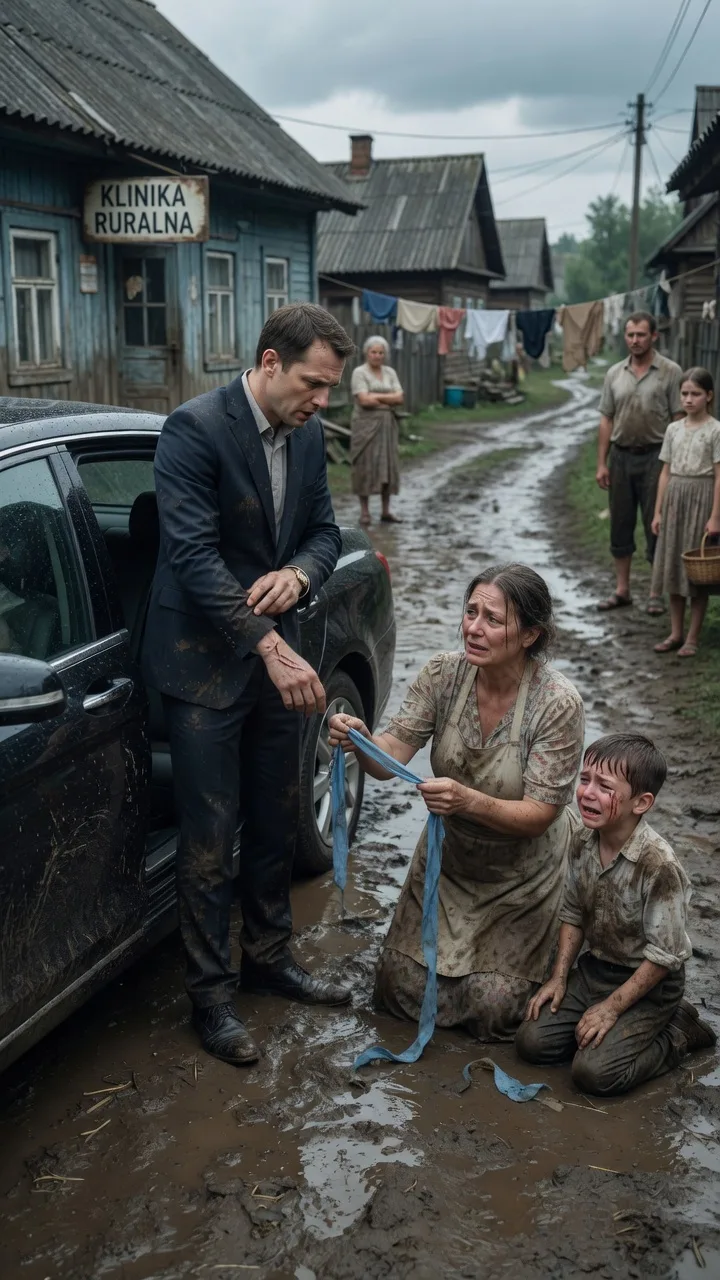
The black luxury car should never have stopped in Briar Hollow.
Chapter 1
The black luxury car should never have stopped in Briar Hollow.
People in that village were used to rich men passing through without seeing them. Their cars rolled over the broken road, splashed mud against the wooden fences, and disappeared toward the hills where the private resorts stood behind locked gates.
But that afternoon, the rain had just ended, and the road had turned soft and brown. Laundry hung heavy from ropes between crooked houses. Chickens pecked near puddles. Children ran barefoot beside the ditch.
Then the black car came.
It was long, silent, and polished like a piece of night. Its tires moved slowly over the muddy road, careful not to slide. Behind the wheel sat a driver in a black cap. In the back seat sat Adrian Vale, one of the wealthiest men in the country.
He was thirty-five, elegant, and known for never wasting time. His dark blue suit cost more than half the village houses. His watch
could have paid for the old clinic’s roof. His shoes were so polished they reflected the gray sky.
Adrian had not come to Briar Hollow for kindness.
He had come to inspect land.
His company planned to buy the entire village, tear it down, and build a private mountain retreat for wealthy tourists. The villagers had refused to sell for months. Adrian thought they were being stubborn.
“They’re sitting on mud and calling it home,” his assistant had told him that morning.
Adrian had said nothing.
But when the car entered the village, he looked through the window and saw women carrying water buckets, old men repairing broken fences, and children playing beside puddles.
For some reason, his chest tightened.
He ignored it.
The car stopped near the old clinic because a wooden cart blocked the road ahead. Adrian opened the door before the driver could move.
“I’ll walk,” he
said.
His polished shoe touched the mud.
The villagers stared.
No one spoke.
Adrian stepped out, adjusting his jacket. His assistant hurried behind him with a folder full of purchase contracts.
“This will only take a few minutes,” the assistant said. “Once they understand the compensation package, they’ll sign.”
Adrian looked at the clinic.
The sign was old, faded, and swinging in the wind.
BRIAR HOLLOW CLINIC
Something about the building pulled at him. He had never been there before, yet the sight of the cracked steps and green door made his fingers curl slightly.
Then a child laughed.
Adrian turned.
A little boy was running beside the road, chasing a tin toy car tied to a string. He was about six years old, thin, barefoot, and covered in mud up to his knees. His dark hair stuck to his forehead from the rain.
“Careful!” someone shouted.
The boy looked
back too late.
His foot slipped.
He crashed hard into the mud beside Adrian’s car.
Dirty water splashed up across Adrian’s expensive shoes.
The assistant gasped. “You little—”
Adrian raised one hand.
The assistant stopped.
The boy sat in the mud, stunned for one second. Then his face twisted, and he cried out.
“Mom!”
The word echoed across the village road.
A woman hanging wet laundry dropped the cloth from her hands.
She ran barefoot through the mud so fast she nearly fell. Her dress was faded. Her apron was patched at the pocket. Her hair was tied messily at the back of her neck, strands loose from work and rain.
She reached the boy and dropped to her knees.
“It’s okay,” she whispered, wiping mud from his cheek. “I’m here. I’m right here.”
The boy grabbed her sleeve and cried into her shoulder.
Adrian stood frozen.
The mud on his shoes no longer mattered.
The woman did not look at him at first. She only held the child, checking his hands, his knees, his face. Her fingers trembled, but her voice stayed gentle.
The villagers watched from the roadside.
Adrian stared at the boy.
Something in the child’s eyes bothered him.
Not fear.
Not innocence.
Recognition.
The boy had Adrian’s eyes.
Same deep gray color. Same heavy lids. Same sharp line beneath the brow.
Adrian swallowed.
“Is he yours?” he asked quietly.
The woman stopped moving.
Her hand remained on the boy’s cheek.
For a moment, even the wind seemed to pause.
Then she slowly looked up.
The moment her eyes met Adrian’s face, her skin changed color. Her lips parted slightly, but no words came out.
“Ma’am?” Adrian said.
She looked down at his wrist.
Adrian had adjusted his sleeve without thinking, brushing mud from the cuff of his jacket. The movement exposed a thin white scar on the inside of his wrist.
The woman stared at it.
Her breathing changed.
Adrian noticed.
“What is it?” he asked.
She did not answer.
Instead, she reached into the pocket of her worn apron.
The assistant stepped forward. “Sir, we don’t have time for this.”
But Adrian didn’t move.
The woman’s fingers closed around something inside her pocket. She pulled it out slowly.
A faded blue ribbon.
It was old. Almost gray at the edges. Carefully folded. Preserved like something too painful to throw away.
Adrian looked at it.
His face went still.
“No…” he whispered.
The woman held the ribbon between trembling fingers.
“You were wearing this,” she said.
The villagers went completely silent.
Adrian stared at the ribbon like it had crawled out of a grave.
“I wore that…”
His voice was barely there.
The woman’s eyes shone, but she did not cry. Not yet.
“You were bleeding when they brought you here,” she said, nodding toward the clinic. “You were small. Maybe five. Maybe six. You wouldn’t let go of that ribbon.”
Adrian stepped back once.
Mud sucked at his shoe.
“My family told me I was born in the city.”
The woman looked toward the black car, then at the assistant holding the contracts, then back at Adrian.
“Your family told many stories.”
Adrian’s jaw tightened.
“What are you saying?”
The woman pulled the little boy closer.
The child had stopped crying. He looked up at Adrian with those same gray eyes, confused by the silence around him.
The old clinic sign creaked above them.
The woman finally said the words she had buried for decades.
“Your family paid us to never tell you the truth.”
The assistant’s folder slipped slightly in his hand.
Adrian turned toward him.
“Did you know?”
The assistant looked away.
That was enough.
Adrian’s breathing became uneven. His eyes moved from the woman to the clinic, then to the boy in the mud.
“My parents are dead,” he said. “You’re accusing dead people.”
“No,” the woman replied. “I’m telling a living man what was done to him.”
A murmur passed through the villagers.
An old man stepped forward from the clinic doorway. He wore a brown coat and leaned heavily on a cane.
“Her name is Mara,” the old man said. “Her mother worked here when they brought you in.”
Adrian looked at him.
The old man lifted his chin toward the clinic.
“You were found after the bridge collapse. Your real parents died that night. The Vale family’s car arrived before the police. They had lost their own child months earlier. Same age as you. Same hair color.”
Adrian’s face hardened.
“Stop.”
The old man did not stop.
“They took you from this clinic before sunrise.”
Mara closed her hand around the ribbon.
“My mother tried to report it,” she said. “Two men came that night. They put money on our table. Then they told her my younger brother would disappear if she spoke again.”
Adrian’s eyes snapped back to her.
“You were a child?”
“I was eight.”
“And you remember me?”
Mara nodded.
“You kept crying for your mother. You wouldn’t let the nurse touch your wrist because of the cut. My mother tied this ribbon around your hand so you would stop pulling the bandage off.”
Adrian looked down at his scar.
For years, he had been told it came from falling down the marble stairs in his family mansion.
A clean story.
A rich story.
A lie.
The little boy touched Mara’s arm.
“Mom,” he whispered, “is he mad at us?”
Adrian looked at him.
The boy’s lower lip trembled. Mud covered one side of his face. His small hand gripped Mara’s apron like it was the only safe thing in the world.
Adrian crouched slowly.
His expensive suit bent awkwardly in the mud.
The villagers stared as the richest man they had ever seen lowered himself to the child’s level.
“What’s your name?” Adrian asked.
The boy hesitated.
“Leo.”
Adrian’s eyes flickered.
His middle name was Leo.
No one had ever called him that except his mother in childhood dreams he could never explain.
Mara saw his reaction.
“You chose that name?” Adrian asked.
Mara looked down.
“My mother told me it belonged to someone we failed.”
The words struck harder than shouting.
Adrian stood again, but his legs seemed weaker.
The assistant cleared his throat.
“Mr. Vale, we should leave. This is clearly emotional manipulation. These people are trying to stop the acquisition.”
Adrian turned slowly.
The assistant froze.
“Open the folder,” Adrian said.
“Sir?”
“Open it.”
The assistant obeyed.
Inside were contracts. Eviction schedules. Development plans. Maps marked with red boundaries that swallowed every house, every road, every garden, every grave.
Adrian took the folder.
Then he looked at Mara.
“How much were they offered?”
Mara blinked.
“What?”
“For the village. For the land.”
She looked at the villagers. No one answered.
Finally, the old man said, “Not enough to start over.”
Adrian stared at the papers.
Then he tore them in half.
The sound cracked through the road.
The assistant lunged forward.
“Sir, those are signed board documents!”
Adrian tore them again.
And again.
Paper fell into the mud like dead leaves.
The villagers watched without breathing.
Adrian walked to the open car door and removed his phone. His hands were dirty now. Mud stained his sleeve. He didn’t seem to notice.
He called someone.
“Cancel the Briar Hollow acquisition,” he said.
A voice crackled on the other end.
Adrian listened for three seconds.
Then his voice dropped.
“No. I’m not delaying it. I’m ending it.”
The assistant’s face went pale.
Adrian looked at the clinic.
“And send a legal team. I want every record connected to my adoption, the bridge collapse, and the Vale family payments pulled tonight.”
He ended the call.
Mara was still kneeling in the mud with Leo.
Adrian approached them carefully, as if one wrong movement could break the air.
“I don’t know what I’m supposed to say,” he admitted.
Mara looked up at him.
“For thirty years,” she said, “I wondered if you became cruel because they stole you… or because you chose to forget where you came from.”
Adrian absorbed that without defending himself.
Then Leo reached out with one muddy hand.
Not fully.
Just a little.
Adrian looked at the hand.
His polished shoes were ruined. His suit was stained. His company was about to explode into scandal.
But the child had his eyes.
And the woman kneeling in the mud held the only honest piece of his childhood.
Adrian took Leo’s hand.
The boy’s fingers were small and cold.
Mara watched them, her face unreadable.
Adrian looked at the faded blue ribbon in her hand.
“May I see it?”
For a long moment, she didn’t move.
Then she placed the ribbon in his palm.
The second it touched his skin, Adrian saw flashes he had spent his whole life calling dreams.
Rain against glass.
A woman singing.
A bridge.
A scream.
A small hand gripping blue cloth.
Then nothing.
He closed his fingers around the ribbon.
Behind him, the assistant stepped back toward the car, already dialing someone.
Adrian heard him whisper, “We have a problem.”
Adrian turned.
“No,” he said.
The assistant lowered the phone.
Adrian looked at the villagers, at the clinic, at Mara, at Leo.
“You have a problem.”
That evening, the black luxury car left Briar Hollow without Adrian inside.
He stayed.
For the first time in his life, Adrian Vale walked the muddy village road without anyone opening a door for him.
And beside him walked a little boy with his eyes, holding the hand of a woman who had carried the truth longer than anyone should have to.
By sunset, the rain began again.
Mara stood under the clinic roof while Adrian looked at the old building one last time.
“What will you do now?” she asked.
Adrian held the faded blue ribbon carefully in his hand.
“I’ll find out who I was,” he said.
Then he looked at Leo.
“And I’ll find out who he is to me.”
Mara didn’t answer.
But for the first time that day, she didn’t step away.
And in the wet silence of Briar Hollow, Adrian understood something the Vale mansion had never taught him.
Blood could be stolen.
Names could be changed.
Records could be buried.
But sometimes truth waited in the poorest place on earth, tied to a faded blue ribbon, held by the hands of someone who never forgot.
Chapter complete
You have reached the end of this chapter.
Continue reading
A few more worlds to get lost in after this chapter.




