Lily Ashford was carrying twelve crystal glasses when her mother corrected the angle of a dying white rose.
Chapter 1
Lily Ashford was carrying twelve crystal glasses when her mother corrected the angle of a dying white rose.
“Not that one,” Victoria said.
The florist froze with both hands inside a silver vase. Around them, the ballroom glittered with candles, champagne towers, and women in silk dresses pretending not to watch. Lily stood beside the sideboard with the glasses balanced against her wrists. One glass had a lipstick mark from the tasting table. It was a small red crescent near the rim.
Too bright.
Victoria plucked the rose out by the stem and dropped it into the trash beneath the table. The bloom hit the plastic liner with a soft, wet sound.
“Guests notice decay,” she said.
The florist nodded too quickly. Lily watched the woman fix the arrangement with shaking fingers. Nobody else moved. Not the footmen. Not the caterers. Not even the quartet tuning their instruments near the French doors.
The Ashford house had trained people well.
It had trained Lily first.
She set the glasses
down exactly two inches apart. She knew because her mother had taught her to measure with her thumb when she was ten. Two inches between crystal. One inch between silver. No fingerprints on polished wood. No raised voice in front of donors. No questions when adults closed doors.
Especially no questions.
Across the ballroom, her father sat in a wingback chair near the fireplace with a folded blanket across his knees. Mr. Ashford had once crossed rooms like they belonged to him. Now he touched the stem of his water glass as if checking whether it was real.
His hand shook.
Lily noticed because she noticed everything in that house. Her mother noticed what looked ugly. Lily noticed what looked wrong.
Mia came through the service door with a tray of champagne. She moved carefully between the guests, her black maid’s dress pressed clean, white apron tied twice at the
back. She gave Lily a quick look.
Not a smile.
A warning.
Lily lowered her eyes before Victoria could see.
Mia had worked at the mansion for eight months. Long enough to learn which floorboards creaked outside the study, which guest rooms had broken window locks, and which family members said thank you when nobody important was nearby. Lily had said it on Mia’s second day, after Mia caught a glass pitcher before it shattered on the marble.
Mia had said, “You’re not like them.”
Lily had answered, “Don’t say that here.”
That was the first honest thing between them.
Tonight, the Ashford Foundation charity gala filled every room below the second floor. Doctors, lawyers, investors, and old friends stood under the chandeliers with champagne in their hands and their names printed on cream cards. The official purpose was children’s hospital funding. The real purpose was Victoria.
It was always
Victoria.
She stood near the grand piano in black satin, one hand resting against her diamond necklace, laughing with the mayor’s wife. Her hair did not move. Her lipstick did not fade. When a waiter bumped a chair leg near her, she turned only her eyes toward him.
The waiter went pale.
Lily picked up an abandoned napkin and folded it into a square. Then she saw her father raise his hand toward his water glass again. The butler reached him before she could.
“Your medicine, sir.”
The pill cup was small. White plastic. Ordinary.
Her father looked at it for a long second.
Victoria looked across the room.
He swallowed.
Lily’s fingers tightened around the napkin. The cotton wrinkled under her thumb.
The quartet began the first song. Guests turned toward the donation display. Victoria raised her glass. Everyone smiled.
Behind the service door, something metal crashed against stone.
A tray.
Then Mia ran across the hallway.
No tray. No composure.
Just her white apron twisted in one hand and her face turned toward Lily like a person reaching for a locked door.
Then she vanished past the stairs.
The music kept playing.
The butler appeared thirty minutes later with his hands folded behind his back.
That was the first crack.
He did not approach Victoria at once. He waited near the edge of the ballroom until she finished speaking to two donors from the Westbridge Trust. Then he bent toward her ear. Lily stood close enough to hear only the end.
“Gone, madam.”
Victoria did not turn her head.
“Her things?”
“No coat from the staff room.”
“Bag?”
“Still there.”
Victoria’s fingers circled the stem of her champagne glass. She looked toward the service hall, then at the donors, then at Lily.
Only Lily.
The butler stepped back.
Victoria lifted her glass and tapped it once with her ring. The sound carried through the ballroom, bright and thin. People stopped speaking in little pockets. First the women near the piano. Then the men by the donation table. Then the mayor’s wife, who looked pleased to be near an announcement.
Victoria smiled.
“I apologize for the interruption,” she said. “One of the staff has left her shift without permission.”
A few guests made small faces. Not concern. Inconvenience.
Victoria let the silence sit.
“Please don’t worry. Girls like that often disappear when work becomes difficult.”
A man near the fireplace laughed.
Then others followed.
Small laughs. Safe laughs.
Lily kept her hands at her sides. Her nails pressed half-moons into her palms.
Her father did not laugh. He stared at his empty pill cup on the side table.
Mia’s bag was still in the staff room. Her coat was still on the hook. Her shoes had been polished that afternoon because Lily had seen her sitting by the back staircase with black polish on one finger.
Mia would not run barefoot into the night.
Not from that house.
Lily moved toward the hallway, but Victoria’s eyes found her before she reached the door.
“Lily.”
One word.
The ballroom turned with it.
Lily stopped near the carved archway. A waiter carrying canapés stood too close behind her and held his breath. Victoria crossed the room slowly, her black gown sliding across the marble without a sound.
“Stay where our guests can see you.”
“I was checking the staff hall.”
“No.”
“It sounded like—”
“No.”
The second no landed harder.
Victoria touched Lily’s shoulder with two fingers, as if brushing dust from fabric. The gesture looked tender from across the room. Up close, her nails pressed through the silk of Lily’s pale dress.
“We do not chase servants during a donor event.”
Lily looked toward the staircase.
Victoria’s fingers tightened.
“Smile.”
So Lily smiled.
The waiter behind her lowered his tray. One pastry slid slightly against the silver.
Nobody picked it up.
Pressure grew in pieces after that.
A woman from the hospital board asked where the young maid had gone. Victoria said, “Temporary staff can be dramatic.” A lawyer from the family firm asked if any valuables had been removed. Victoria said she had already handled it. The butler reappeared twice and received instructions without speaking above his breath.
Lily listened.
She had learned how to listen in rooms where she was expected to decorate the silence.
At the donation table, Victoria spoke to Mr. Granger, the family attorney, about “making the transition easier.” Lily heard those words because Victoria’s voice changed when money entered a room. It became lighter. Cleaner. Like a knife wiped before dinner.
Her father sat near the fire. His eyelids looked heavy. The blanket slipped from one knee.
Lily crossed to him with a glass of water.
“Dad.”
He blinked at her.
“There you are.”
“I’ve been here.”
He looked around the ballroom as if the walls had moved. “Your mother said you went upstairs.”
Lily’s hand stopped on the glass.
“I didn’t.”
He frowned at the pill cup.
A small tremor passed through his fingers. Lily picked up the cup before he could knock it over. There was a smear on the rim, not from his mouth. A pink line. Faint but visible.
Lipstick.
Victoria’s shade.
Lily looked across the room. Her mother was laughing with the mayor’s wife again, one hand against her black satin waist, red mouth perfect.
Mini twist.
Not loud.
Not dramatic.
Just a lipstick mark where it should not have been.
The same red Lily had seen earlier on a tasting glass. The same red that marked every crystal Victoria used and abandoned. The same red, maybe, that could have touched Mia’s apron if Mia had been grabbed close enough.
Lily slipped the pill cup into a folded napkin.
Her father looked at her hand.
“Don’t give that to her,” he said.
“What?”
He blinked again.
“To Victoria.”
The napkin seemed to grow heavier.
“Why?”
He moved his mouth, but no words came. From across the ballroom, Victoria turned. She had not heard them. She did not need to. Her eyes dropped once to Lily’s hand.
Then to the napkin.
Then back to Lily’s face.
Lily tucked the napkin into the small beaded purse hanging from her wrist.
A choice.
A bad one.
The butler came beside her so quietly that she almost dropped the water.
“Miss Ashford.”
“Yes?”
“Your mother would like you at the front table.”
His eyes did not meet hers.
“Now.”
Victoria had gathered six guests near the donation display. Mr. Granger was there too, holding a leather folder. Lily’s father had been helped from his chair and placed near the table, his water glass beside him. The donors leaned in, eager for family theater disguised as philanthropy.
Victoria placed a hand on the back of his chair.
“My husband has decided,” she said, “to step back from certain foundation duties.”
Mr. Ashford looked at the table.
“He has been unwell, as you know.”
The mayor’s wife made a sound of concern. Her pearl bracelet clicked against her glass.
Victoria continued.
“We are preparing updated documents. A cleaner structure. Less strain for him.”
Mr. Granger opened the folder.
Lily felt the napkin inside her purse against her wrist.
Her father had told her, years before, that no document should ever be signed in a room full of people who wanted something from it. He said that while teaching her how to sign birthday cards, of all things. Blue ink. Clear name. Never sign blank paper. Never sign under pressure.
Now his hand rested beside a gold pen.
Victoria bent near his ear.
“Just one signature tonight,” she said.
He did not reach for the pen.
The guests watched.
Lily stepped forward.
“Dad should rest.”
Victoria looked at her.
“He is resting.”
“You said the documents were being prepared.”
“They are.”
“Then why the pen?”
The mayor’s wife looked at her husband. Mr. Granger closed one side of the folder with his thumb.
Victoria did not raise her voice. She never had to.
“Lily, this is not a school debate.”
A few guests smiled into their glasses.
Lily felt heat climb under her skin, but her hands stayed still.
Her father touched the pen.
Then stopped.
His gaze moved past Victoria to the hallway behind her. Something in his face changed. Not much. A flicker. A small retreat into himself.
Lily followed his gaze.
At the far end of the hall, near the staircase, the service door stood ajar. A strip of white cloth was caught against the lower hinge.
An apron string.
Mia’s apron.
Victoria saw Lily looking.
Her smile thinned.
“The staff corridor is closed,” she said.
“To guests?” Lily asked.
“To you.”
The room heard that.
A glass touched a table too hard. Someone cleared his throat. Mr. Granger looked at the floor.
Victoria placed the gold pen into her husband’s hand.
He stared at it.
Lily turned away from the table.
“Excuse me.”
Victoria’s voice followed her. “Lily.”
But Lily kept walking.
The service hallway smelled of lemon polish and hot butter. Behind her, the music began again, too loud. She passed the pantry, the staff room, the laundry chute. Mia’s bag sat under the bench, exactly where it always was. Brown canvas. One strap repaired with blue thread.
Her coat hung above it.
Her shoes were gone.
No.
Not gone.
One shoe lay beneath the laundry cart, black polish still fresh on the toe.
Lily picked it up. The leather bent in her hand.
At the end of the hall, the apron string disappeared up the back stairs.
She climbed.
Each step groaned in a different place. She knew which ones to avoid. Second from the bottom. Seventh. Last before the landing. Her mother had once made the housekeeper wax these stairs three times because a guest had called them dull.
At the second-floor landing, the string dragged toward the master suite.
The door was not fully closed.
Lily paused outside it.
Downstairs, Victoria’s laugh rose over the music.
Lily pushed the door open with two fingers.
The master bedroom smelled like cedarwood, perfume, and old roses.
Lily stepped inside and closed the door without letting it latch. The room was too perfect. Her mother’s black evening gloves lay parallel on the vanity. Her father’s reading glasses rested beside a medical journal he had not been strong enough to read for weeks. A silver tray on the nightstand held two water glasses, one untouched, one half empty.
A chair had been dragged a few inches from its usual place.
That was enough.
Lily crossed the room and crouched beside it. Under the armchair, where the gold fringe touched the carpet, a corner of white fabric showed.
She pulled.
Mia’s apron came loose with a scrape against wood.
There was a red lipstick stain near the collar.
Lily spread the apron across her knees. The fabric smelled like soap and dust. One tie had been torn. The hem sat wrong, thicker on one side than the other. Lily ran her thumb along the seam until she found the hard shape inside.
A USB drive.
She looked toward the door.
No footsteps.
She used the small scissors from her mother’s vanity tray to cut the stitching. The USB fell into her palm. Black plastic. No label. One edge scratched as if it had been hidden before.
Lily stood.
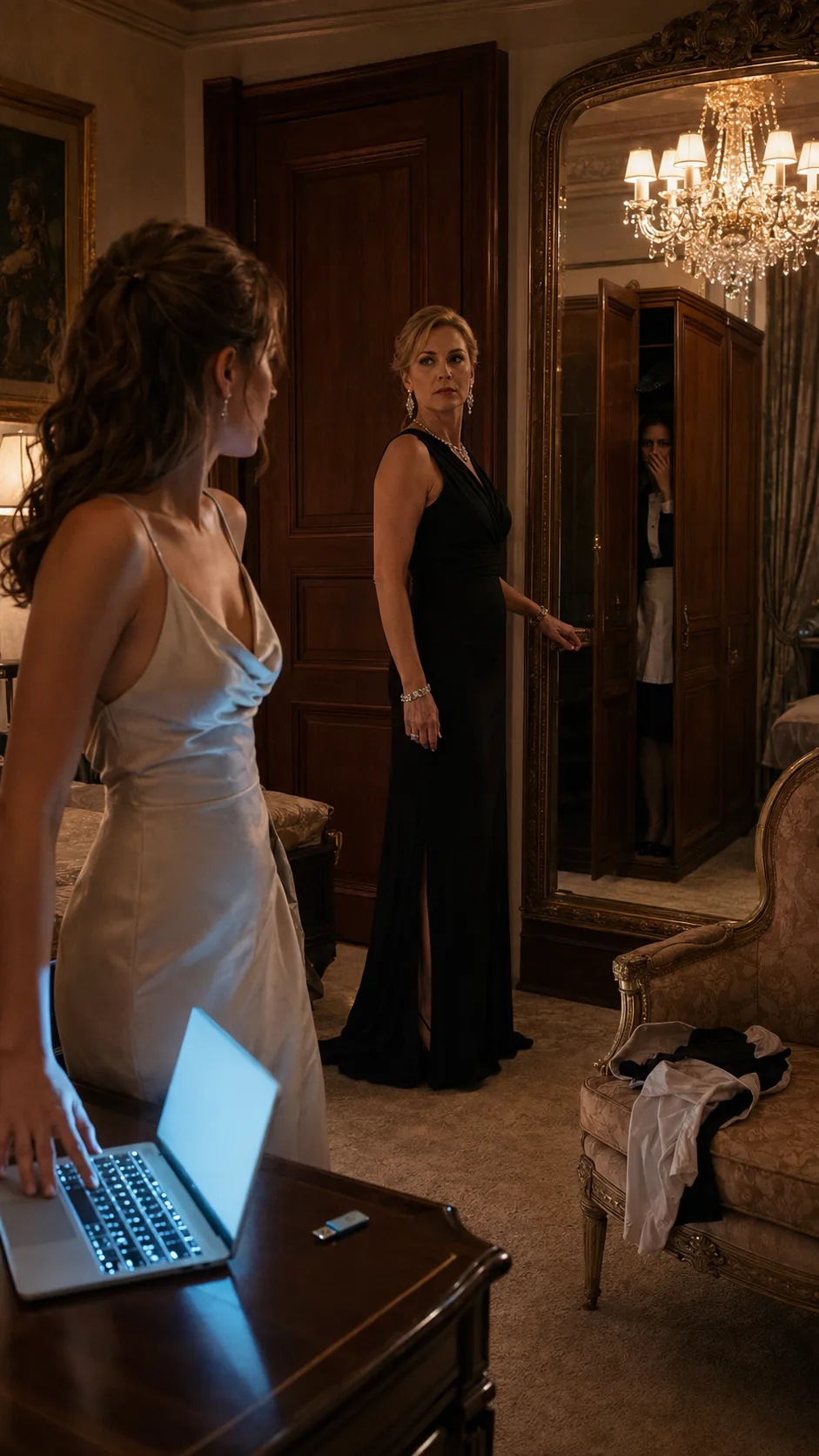
The writing desk sat beneath the tall window, polished so well that it reflected the chandelier above. Her mother’s laptop was closed there. Victoria never used passwords at home because she believed fear worked better than locks.
Lily opened it.
The screen lit her hands blue.
She plugged in the USB.
A folder appeared.
One file.
No name. Just a date from three weeks earlier.
Lily clicked.
The video opened on her father’s office. The angle was low, hidden somewhere near the bookshelf. Victoria stood in front of the safe. Beside her was a man Lily had never seen before, older, thin, wearing a gray suit and medical gloves.
He held a small brown bottle.
Victoria’s voice filled the room.
“Not enough to kill him.”
The man twisted the bottle cap.
“Enough to slow him down.”
“He has an appointment with Granger next Thursday. He plans to update the will.”
The man looked toward the office door.
Victoria leaned closer to him.
“He cannot have time to update his will.”
The laptop fan began to hum.
Lily gripped the edge of the desk.
On-screen, the man placed the bottle into Victoria’s hand.
“Half dose in the morning. Full at night.”
“And memory?”
“Confusion. Fatigue. Tremors. It will look like decline.”
Victoria turned the bottle between two fingers.
“How long?”
“Long enough.”
The video kept running. Papers shifted. The safe opened. Victoria removed a file with her husband’s name embossed in gold.
Lily reached for the USB, then stopped.
She needed it to keep playing. She needed the sound. She needed proof outside her own mouth.
The bedroom door slammed shut.
The sound cracked through the room.
Lily turned.
Victoria stood against the door, one hand still on the handle. Her black gown looked darker in the bedroom than it had downstairs. Diamonds trembled at her ears from the force of the door.
“What are you watching, dear?”
The video continued behind Lily.
Victoria’s recorded voice filled the space between them.
“He plans to update the will.”
Lily moved sideways, one hand reaching behind her for the laptop lid.
Victoria lifted one finger.
“Don’t.”
Lily stopped.
The laptop screen glowed against the wall. The man in the video crossed behind Victoria’s recorded body. Paper scratched against wood.
Victoria stepped away from the door.
One step.
Then another.
Lily backed toward the desk until the edge pressed into her hip. Her hand found the USB still plugged into the side of the laptop. She closed her fingers around it but did not pull.
Victoria’s eyes dropped to the apron on the floor.
The red lipstick stain showed plainly under the chandelier.
“That girl has always touched things that did not belong to her.”
Lily looked at the apron.
“Mia saw you.”
Victoria smiled.
“Mia saw very little.”
“She recorded you.”
“And hid it badly.”
The laptop speakers crackled. On-screen, Victoria said, “He would not have time.”
The room changed around that sentence. The furniture stayed where it was, the lamps still burned, the mirror still held the chandelier in gold and glass, but the pretty bedroom no longer looked like a bedroom. It looked like a locked box.
Victoria stopped three feet from Lily.
“Mia should not have been curious. Neither should you.”
Lily’s fingers tightened on the USB.
Victoria held out her hand.
“Give it to me.”
Lily did not move.
“You will not leave this room with that.”
Downstairs, applause rose through the floor. The guests were still gathered. Her father was still near the gold pen. Mr. Granger was still holding the folder. The house was full of witnesses who had learned not to witness anything.
Lily looked at the door behind Victoria.
Too far.
Victoria followed her gaze and moved slightly, placing her body between Lily and the exit.
“You have always mistaken silence for weakness,” Victoria said.
Lily’s hand shifted along the desk. Her fingers touched the laptop trackpad.
The video paused.
The sudden silence made Victoria’s smile widen.
“Good girl.”
Lily’s thumb slid again.
Not pause.
Volume.
The video restarted louder.
Victoria’s recorded voice filled the bedroom.
“He cannot have time to update his will.”
Victoria’s smile broke at one corner.
Her eyes went to the laptop. Her hand moved toward it. Lily pulled the computer closer, but the cord snagged on the desk lamp. The lamp shook. A porcelain dish rattled. One pearl earring from the vanity rolled to the floor.
Small sound.
Huge room.
Victoria stepped fast.
Lily stepped back.
Her shoulder hit the edge of the tall mirror frame.
The mirror.
Lily saw the room behind Victoria.
The closed door. The wardrobe. The carved wooden panels. The half-open gap between the wardrobe doors where there should have been darkness.
There was a face.
Mia.
She was inside the wardrobe, body folded into the narrow space between hanging gowns and cedar shelves. One hand covered her mouth. Her other hand clutched the torn front of her uniform. The whites of her eyes caught the chandelier light.
Lily did not turn her head.
Victoria was watching her too closely.
Mia shook once. Not a full shake. A tiny refusal of movement, as if her body had forgotten how to be still without making sound.
Victoria reached for the laptop again.
Lily lifted it from the desk.
The power cord pulled free. The screen stayed lit.
The video kept playing.
“Half dose in the morning. Full at night.”
Victoria stopped.
For the first time that night, she looked toward the mirror.
Not at the wardrobe.
At Lily’s reflection.
Lily moved before Victoria could follow her eyes.
She stepped sideways, away from the desk, holding the laptop open against her body like a tray of fire. The screen faced the room. The recorded image showed Victoria in the office with the brown bottle in her hand.
Victoria reached for the laptop.
Lily jerked back.
The laptop speakers blared.
“It will look like decline.”
Victoria’s hand froze in the air.
From the hallway outside, someone knocked.
“Madam?”
The butler.
Victoria did not answer.
The knock came again.
“Madam, Mr. Granger is asking for you.”
Lily looked at the door. The butler was outside. Maybe alone. Maybe near enough to hear. Maybe already hearing.
Lily raised her voice.
“Come in.”
Victoria turned.
“No.”
The door handle moved.
Victoria grabbed it first and held it shut.
Lily pressed the laptop volume key again.
The video grew louder.
“Confusion. Fatigue. Tremors.”
The butler went silent outside the door.
Then another voice came from the hallway.
Mr. Granger.
“Victoria?”
Victoria’s fingers curled around the handle. Her shoulders lifted once and dropped. The diamonds at her ears no longer trembled. They hung still.
Lily saw Mia in the mirror lower her hand from her mouth.
One inch.
Then another.
The wardrobe door moved.
A thin creak crossed the room.
Victoria heard it.
Her head turned, not fully, just enough.
Mia stepped out of the wardrobe.
Barefoot.
One shoe missing.
Her white apron gone. Her uniform wrinkled. Her mouth pressed shut so hard the skin around it turned pale.
Victoria let go of the door handle.
The door opened from the outside.
The butler stood there first. Mr. Granger behind him. Behind Mr. Granger, two guests had come up the stairs, their glasses still in their hands. The mayor’s wife stood halfway down the hall, one hand on the banister, pearls against her throat.
Nobody spoke.
The laptop video continued in Lily’s hands.
Victoria stood between the door and the mirror. For once, she blocked nothing.
Mr. Granger looked at the screen.
Then at Victoria.
Then at Mia.
The old lawyer’s leather folder slid slightly under his arm.
Victoria took one step back.
Her heel touched the edge of the rug and caught. She corrected herself, but not before everyone saw it.
Mia lifted one hand and pointed at the laptop.
“She said he wouldn’t last the week.”
Her voice scraped.
Victoria turned toward her.
“Mia.”
The name sounded like a warning.
Mia flinched but stayed where she was.
Lily placed the laptop on the center of the writing desk and turned the screen outward, toward the open door, toward the hallway, toward the people who had laughed downstairs when a maid disappeared.
The recorded Victoria held the brown bottle in perfect focus.
No one laughed now.
The bedroom stayed open.
That was the strangest part.
All Lily could see was the open door and the people beyond it, standing in the hallway as if the mansion had pushed them there and refused to let them leave. The mayor’s wife still held her champagne glass. The bubbles had died inside it. Mr. Granger’s folder hung loose in one hand. The butler stared at the carpet near Mia’s bare feet.
Downstairs, the quartet stopped mid-song.
A cello note faded under the floor.
Victoria stood near the mirror with one hand against the carved frame. She did not touch Mia. She did not reach for Lily. Her eyes kept moving between the laptop and the hallway, measuring exits that were no longer hers.
Lily’s father arrived last.
Two staff members helped him to the doorway. The blanket was still over one shoulder. He looked smaller under the bedroom lights, but his eyes were clear enough when they found the screen.
The video had looped back to the beginning.
Victoria appeared again in his office.
“Not enough to kill him.”
Someone in the hallway set down a glass too quickly. It tipped against the wall and rolled in a half circle before stopping.
Mia stood behind Lily now. Not hiding. Not fully steady either. Her fingers held the back of Lily’s chair as if the wood might vanish.
Mr. Granger closed his folder.
“Do not sign anything,” he said.
Her father looked at the gold pen still in his hand. Nobody had noticed he was carrying it.
He dropped it onto the carpet.
No bounce.
Victoria looked at him then.
“Charles.”
He turned his face away.
Lily unplugged the USB and wrapped it inside a clean handkerchief from the desk drawer. She handed it to Mr. Granger. He took it with both hands.
The butler stepped aside from the doorway.
No one told him to.
Victoria remained by the mirror, her black gown reflected behind her like smoke.
Lily bent to pick up Mia’s missing shoe from beneath the vanity stool.
She placed it beside Mia’s bare foot.
By morning, the charity gala existed in fragments across phones.
A clip of Victoria standing in the master bedroom. A clip of Mr. Granger carrying the laptop downstairs. A clip of guests leaving without their coats because the police had blocked the front hall. None of the videos showed the whole truth. They never do. But they showed enough.
Victoria’s name disappeared from the foundation website before noon.
By the end of the week, the Ashford family firm issued a careful statement about “urgent legal review,” “medical interference,” and “cooperation with authorities.” The hospital board returned the donation check unsigned. Mr. Granger’s office filed emergency protections over Charles Ashford’s estate, foundation control, and medical decisions.
Victoria did not return to the mansion.
Her lawyers said she was staying elsewhere. The newspapers said investigation. Lily said nothing.
Mia stayed in the guest room beside the east stairs for three nights because she refused to sleep below ground in the staff quarters. Lily did not ask her to explain. She brought tea. Then clean socks. Then the brown canvas bag from the staff room.
On the fourth morning, Mia came downstairs wearing her own clothes.
Jeans. Gray sweater. One black shoe repaired with blue thread.
The other shoe had been ruined.
“I don’t want charity,” Mia said.
Lily placed an envelope on the kitchen table.
“Then don’t take charity.”
Mia did not touch it.
“It’s wages. Back pay. Legal support. And a new phone.”
Mia looked at the envelope for a long while.
The kitchen clock clicked above them. Someone had left a spoon in the sink overnight. It had dried with a ring of tea around it. In the old Ashford house, that would once have been a crime worthy of a staff meeting.
Lily picked up the spoon and washed it herself.
Mia watched.
Then she took the envelope.
Charles recovered slowly. Not neatly. Some mornings he remembered everything. Some afternoons he called Lily by her grandmother’s name and apologized to the window. The new doctor changed his medicine. The tremor eased. The fog thinned in pieces.
He never sat by the ballroom fireplace again.
He asked for his chair to be moved to the library, where the light was softer and no one could place a pill cup beside him without Lily seeing it.
The ballroom stayed closed for two months.
When it opened again, Lily removed the donation display, the champagne tower, and the white roses from the entrance table. She kept one crystal glass from the night of the party. The one with the red lipstick mark. She sealed it in a box and gave it to Mr. Granger.
Guests notice decay.
Her mother had said that.
Now Lily did too.
Months later, Lily walked through the master bedroom alone. The room had been stripped of Victoria’s perfume bottles, satin gloves, and silver trays. The ornate mirror still stood against the wall. In its reflection, the wardrobe doors were open and empty.
Lily did not close them.
She left the room with the door wide open.
Let it see itself.
Chapter complete
You have reached the end of this chapter.
Continue reading
A few more worlds to get lost in after this chapter.




