Mara Solis noticed the missing spoon before anyone noticed her.
Chapter 1
Mara Solis noticed the missing spoon before anyone noticed her.
It was one of the silver dessert spoons from the west cabinet, the set with the tiny Armand crest pressed into the handle. One spoon missing from a table of forty-two settings should not have mattered. In the Armand house, it mattered enough to ruin a girl’s morning.
She found it under the edge of a linen napkin, half-hidden beside a crystal glass no one had polished properly.
Mara picked it up with the corner of her apron, breathed once through her nose, and set it back in line with the others.
Perfect.
That was the first rule in the Armand mansion.
Everything had to look perfect.
The ballroom had been awake since dawn. Florists moved through the room with white roses and pale gold ribbon. Men on ladders checked the chandeliers. The musicians’ chairs were arranged in a crescent near the marble columns. Every mirror had been wiped until
it reflected more light than the room seemed to own.
Tonight was the Armand Winter Ball.
Not just a party.
A declaration.
Celeste Armand had explained that to the staff three days earlier without raising her voice. She stood in the center of the servants’ hall in a cream suit, her pearls resting perfectly at her throat, and looked at each of them as if she were choosing which one might disappoint her first.
“No accidents,” she said. “No conversations with guests. No lingering. No personal items visible. This house does not forgive carelessness.”
Her eyes had paused on Mara.
Not long.
Long enough.
Mara had lowered her gaze.
She was good at that.
For three years, she had worked in the Armand mansion without asking why Madame Armand watched her like a locked drawer she did not trust. Mara cleaned guest rooms, carried trays, pressed napkins, remembered allergies, refilled
glasses before wealthy men realized they were empty, and disappeared before anyone had to thank her.
She had one small room above the laundry wing, a narrow bed, two uniforms, and a wooden box under the mattress where she kept the things she could not afford to lose.
A faded photograph of her aunt Inés.
A library card.
Three letters she had never mailed.
And a silver locket.
The locket had belonged to her mother. That was all Aunt Inés had ever told her.
“Keep it close,” Inés used to say. “Not because it is expensive. Because it is yours.”
Mara touched it now through the pocket sewn inside her apron.
Still there.
Good.
A footman named Tomás came up beside her with a tray of folded place cards.
“West balcony table is wrong,” he said. “Madame changed it again.”
Mara took the cards from him. “Which names?”
“Duchess Alvara
away from Mr. Rivas. Apparently they hate each other this year.”
“They hated each other last year.”
“Yes, but last year they enjoyed it.”
Mara almost smiled.
Almost.
Then the doors opened at the far end of the ballroom, and every member of staff straightened.
Celeste Armand entered with her son.
Lucien Armand had been away for six months.
That was what the staff said. Paris. Geneva. Milan. Business, mostly. Armand shipping, Armand hotels, Armand investments. Men like Lucien never simply traveled. They appeared in cities, moved money, shook hands, and returned with newspapers writing careful things about them.
Mara had seen him only a handful of times before.
Never close.
Never long.
Still, the room changed when he entered.
Not because he demanded it. That would have been easier to dislike. He moved quietly, in a dark suit, one hand in his pocket, his attention passing over the flowers, the orchestra chairs, the servants carrying crystal, the light on the marble.
Then his gaze stopped on Mara.
Only for a second.
Her fingers tightened around the place cards.
Celeste noticed.
Of course she noticed.
“Lucien,” she said, “the Spanish minister arrives at nine. I want you beside me when he enters.”
Lucien did not answer immediately. His eyes were still on Mara, not with desire, not with arrogance, but with a strange, sharpened confusion.
Mara looked down first.
She always did.
“Yes, Mother,” Lucien said.
Celeste’s mouth softened into something meant to look like approval.
Mara turned toward the west balcony table and carried the place cards away.
Behind her, she heard Lucien speak again.
“Who is she?”
The room did not stop.
But Mara did.
Only inside.
A beat passed before Celeste answered.
“One of the maids.”
“She has a name.”
“She has work.”
Mara kept walking.
The place cards trembled once in her hand.
By seven, the mansion no longer belonged to the people who kept it standing.
Cars lined the drive. Women stepped out in silk and velvet. Men adjusted cufflinks beneath the glow of the entrance lamps. Perfume moved through the halls in expensive waves. Laughter rose under the chandeliers, bright and sharp, like glass tapped too hard.
Mara carried champagne.
That was her position for the first hour. Left side of the ballroom, near the south columns, moving between guests without catching attention.
“Not that one,” a woman said when Mara offered a tray. “The other girl knows how much to pour.”
Mara lowered the tray and moved on.
A man in a white dinner jacket snapped his fingers without looking at her.
She gave him a glass.
He took two.
No thank you.
No glance.
Fine.
She preferred invisibility. It had edges she knew how to manage.
Across the room, Lucien stood beside his mother while guests came to him in waves. He accepted handshakes, kissed cheeks, listened to men speak too loudly about markets and women speak too carefully about marriages. He seemed made for it. Tall, composed, beautiful in the careless way of men who had never worried whether their shoes looked worn.
But twice, Mara caught him looking at her.
Not at the tray.
At her.
The second time, she nearly walked into a guest.
The champagne shifted. One glass chimed against another.
A woman in emerald silk turned.
“Careful.”
Mara dipped her head. “Forgive me.”
The woman looked at her apron, then her face. Something in her expression cooled.
“You’re new?”
“No, madam.”
“How odd. I don’t remember you.”
Mara did not answer.
That was another rule.
The guests forgot you. You did not remind them.
Near the staircase, Celeste watched the exchange with a stillness that made Mara’s skin tighten beneath her collar.
Then someone laughed.
Not loudly. Not kindly.
It came from a group near the orchestra. Three young women and one man with a narrow face and a glass he had not earned by kindness. Mara recognized him as Rafael Veyra, a family friend who visited often enough to treat the staff as furniture.
“There she is,” he said as Mara passed. “The quiet one.”
Mara kept moving.
Rafael stepped into her path.
“Don’t run away. I only wanted champagne.”
She lifted the tray.
He took a glass and leaned close enough that she could smell brandy.
“Do you speak?”
“When required, sir.”
The women laughed.
One of them said, “That means no.”
Rafael tilted his head. “What is your name?”
“Mara Solis.”
“Solis,” he repeated. “Pretty. Almost too pretty for the uniform.”
Mara’s hand tightened under the tray.
A shadow fell beside her.
Lucien.
Rafael straightened too quickly.
“Lucien,” he said. “We were only teasing.”
Lucien looked at the glass in Rafael’s hand, then at the space between him and Mara.
“Then you’re finished.”
Rafael smiled without showing his teeth. “Of course.”
Lucien did not smile back.
Mara lowered her gaze. “Thank you, sir.”
“Lucien.”
Her eyes lifted before she could stop them.
He held her gaze for half a second too long.
Then Celeste appeared.
She did not hurry. Celeste Armand never moved as if anything had power over her.
“Mara,” she said.
Mara turned. “Madame.”
“The north salon needs fresh glasses.”
“Yes, Madame.”
Lucien’s jaw changed. Barely.
Mara saw it.
Celeste saw Mara see it.
The look Celeste gave her then had no anger in it.
That made it worse.
Mara left the ballroom.
In the north salon, the air was cooler. The noise from the ball came through the walls as a softened pulse. Mara set down the empty tray and pressed both hands against the edge of the service table.
One breath.
Then another.
She should have stayed invisible.
A maid who became memorable became vulnerable.
She checked the locket in her apron pocket.
Still there.
Her thumb found the familiar rounded edge through the fabric.
Aunt Inés had never liked the Armand name. Mara knew that much. Any time a newspaper mentioned them, Inés changed the subject. Any time Mara asked why her mother had once worked near this family, Inés shut the cupboard too hard or remembered bread in the oven.
“Some houses eat girls,” Inés had said once.
Mara had been fourteen.
She had not understood.
Now she worked inside one.
By nine-thirty, the first dance began.
The ballroom floor cleared in perfect circles. Couples moved under the chandeliers, tuxedos and gowns turning like expensive machinery. Mara stood near the wall with a tray of water glasses and watched because watching was safer than thinking.
She loved music.
That was her private shame.
Not shame because it was wrong, but because it was useless. Poor girls did not need waltzes. They needed rent paid on time and shoes that did not split in rain. Still, when the orchestra played, Mara’s feet knew things her life had never taught her.
She had discovered it as a child in her aunt’s kitchen.
A radio. A cracked tile floor. A soup pot steaming on the stove.
Music would begin, and Mara would move.
Not well, she thought then.
Just naturally.
Aunt Inés would watch from the table, face unreadable, hands folded around a cup of coffee gone cold.
“You dance like her,” she said once.
“Like who?”
Inés had stood and turned off the radio.
“No one.”
Mara never asked again.
Across the ballroom, Lucien danced with a woman in silver. He moved correctly. Gracefully. But his face was elsewhere. At the end of the dance, he bowed, released his partner’s hand, and walked away from the circle of guests waiting for him.
Celeste touched his sleeve.
He stopped.
She spoke low.
He listened.
Then he looked past her.
At Mara.
No.
Mara’s fingers went cold around the tray.
Lucien crossed the ballroom.
The guests noticed before he arrived. Their heads turned in small increments. Conversation thinned around him. The orchestra, between pieces, waited.
Mara lowered her tray slightly.
“Sir?”
Lucien stopped in front of her.
His face was calm.
His eyes were not.
“Will you dance with me?”
The question moved through the room faster than sound.
A glass clicked against teeth.
Someone gave a short laugh and swallowed it too late.
Mara stared at him.
“Me?”
“Yes,” he said. “You.”
Celeste went white near the staircase.
“Lucien.”
The warning carried.
It was meant to.
Mara looked at the guests, then at Lucien’s hand. No glove. Open palm. Certain.
“I shouldn’t.”
“Neither should I,” he said. “But I’m tired of obeying ghosts.”
The words landed somewhere beneath her ribs.
Ghosts.
Mara did not know why that word reached for the locket inside her apron.
A woman nearby laughed.
“She’s staff.”
Lucien turned his head.
“She has a name.”
No one laughed after that.
The orchestra waited with bows lifted.
Mara knew what would happen if she refused. Celeste would remove her quietly before midnight. By morning, there would be no room above the laundry wing, no wage, no reference, no explanation.
She knew what would happen if she accepted.
Worse.
Lucien’s hand remained there.
Mara set the tray on a side table.
The sound of silver meeting wood seemed too loud.
She placed her hand in his.
His fingers closed around hers.
Not tightly.
Enough.
The first violin note rose.
They stepped onto the marble floor.
For three seconds, Mara heard everything.
A woman’s breath.
The shift of a skirt.
Rafael Veyra muttering something under his breath.
Celeste’s pearls clicking softly as she descended one step.
Then Lucien moved.
Mara followed.
Her body knew before her mind could object.
Step.
Turn.
Glide.
The room widened around them.
Lucien’s hand rested at her back with formal precision, but his fingers changed pressure before each turn, each shift, each small command. Mara answered too quickly. She felt it. He felt it. Their feet moved as if they had practiced for months behind locked doors.
But they had never touched before.
The guests waited for the failure.
It did not come.
Mara felt the music enter her spine.
The marble under her shoes became a floor she had known all her life. The chandeliers blurred into gold. Lucien’s face stayed close enough for her to see the small crease between his brows.
“You’re shaking,” he said.
“So is everyone else.”
His mouth changed.
Not quite a smile.
A wound remembering how.
They turned past the orchestra. One violinist missed half a note and recovered. Mara’s skirt brushed Lucien’s leg. Her apron, plain and white, moved among satin gowns like a flag no one had prepared for.
Lucien guided her into a turn.
She knew it before he made it.
He stopped breathing for half a beat.
Mara knew because she had stopped too.
“Where did you learn to dance like this?”
Her foot nearly faltered.
The room tilted.
“I didn’t.”
“That’s not possible.”
She looked at him then. Really looked.
There was no mockery in him. No rich man’s curiosity. Something else watched her through his eyes. Something older than tonight.
He lowered his voice.
“Then how do you know every step before I make it?”
Mara’s lips parted.
A clap cracked across the room.
Once.
The orchestra died mid-note.
Silence.
Celeste Armand stood at the edge of the ballroom floor.
“That is enough.”
Lucien did not release Mara.
“No.”
The word shocked the guests more than the dance had.
Celeste’s chin lifted. “You forget yourself.”
“I forgot myself years ago,” Lucien said. “Tonight I remembered.”
Mara pulled her hand from his.
Cold rushed into the space where his fingers had been.
“Please,” she said. “Don’t do this because of me.”
He turned to her. “I’m doing it because of the truth.”
Celeste’s face tightened.
“The truth?”
Lucien faced his mother, and the ballroom seemed to lean toward him.
“Why does Mara dance like Sienna?”
The name fell hard.
Sienna.
Mara did not know the name at first.
Then she did.
Not as memory. As inheritance.
A name sealed inside half-finished stories. A name Aunt Inés had never said unless she thought Mara was sleeping. A name written once on the back of an old photograph before the ink had faded.
Sienna Reyes.
Her mother.
Mara stepped back.
The room moved around her in fragments.
Celeste’s hand on the banister.
Lucien’s face turning toward her.
A woman covering her mouth.
Rafael no longer smiling.
Mara’s voice came from somewhere dry.
“I need to go.”
No one blocked her.
They gave her a path, these people who had not given her space all night unless she carried something for them.
She turned.
Her apron brushed against her skirt.
Something slipped from the pocket.
A small silver locket struck the marble.
The sound was tiny.
The effect was not.
Mara froze.
Lucien looked down.
Celeste’s hand closed around the banister so hard her knuckles paled.
Too fast.
Lucien saw it.
Mara saw him see it.
“No,” Mara said, but it was too quiet to stop anything.
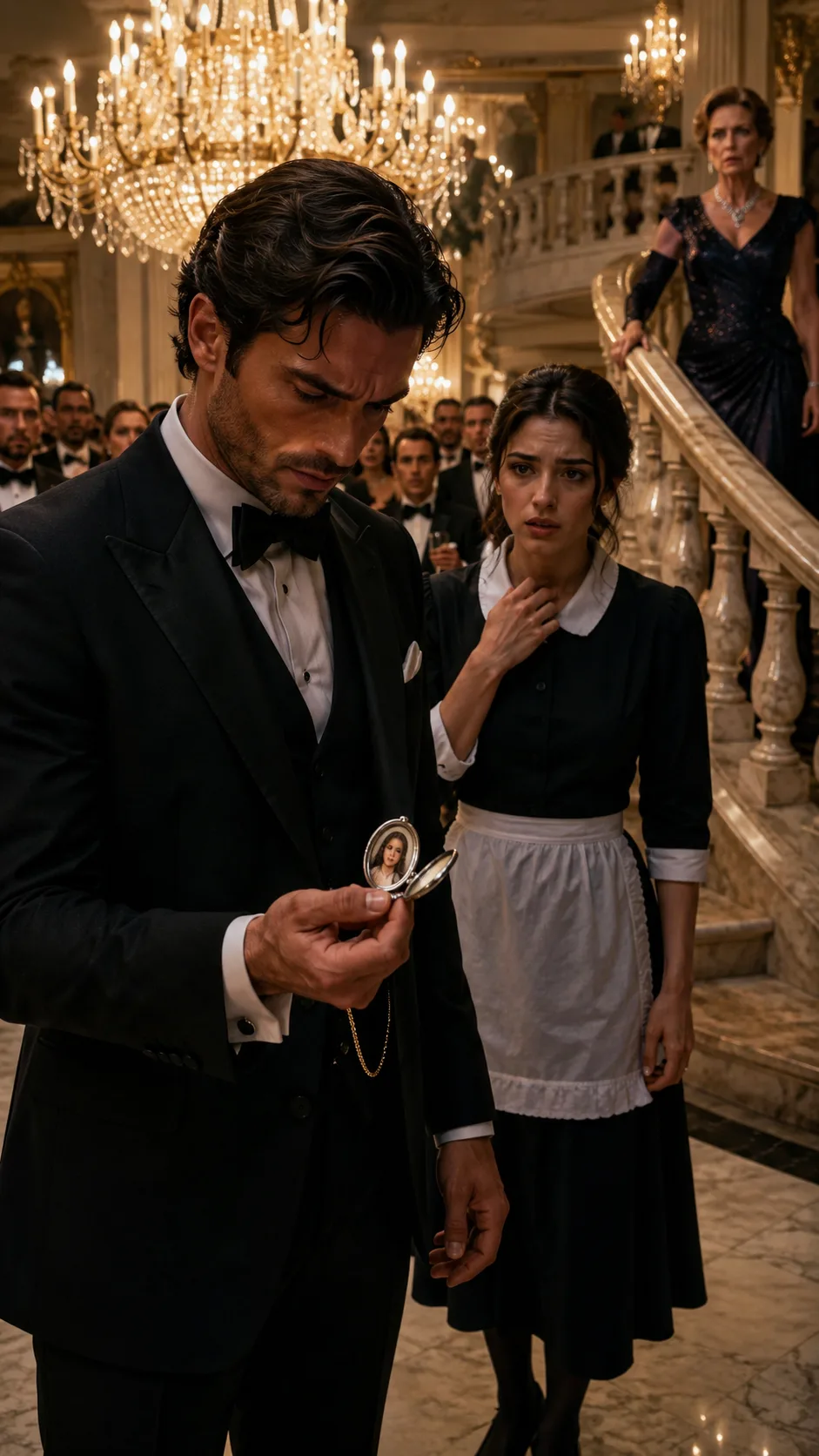
Lucien bent and picked up the locket.
The chain dangled from his hand, catching chandelier light. For one strange second, Mara remembered Aunt Inés sitting at the kitchen table, rubbing that same chain between her fingers while rain tapped against the window.
Lucien opened it.
His thumb shook.
Inside was the little painted portrait Mara had seen a hundred times and never fully understood.
A young woman with wild curls.
Laughing eyes.
A face that looked like Mara’s in certain angles and like no one’s when the light was wrong.
Lucien went still.
On the other side, the inscription shone faintly.
For my little star, when she is old enough to dance.
Mara swallowed.
“That belonged to my mother.”
Lucien looked up at her.
“Your mother?”
The ballroom had no air left.
Mara’s fingers curled into the front of her apron.
“Her name was Sienna Reyes.”
Celeste closed her eyes.
Just once.
But every person near the staircase saw it.
Lucien turned slowly toward her.
“You told me Sienna died alone.”
Celeste opened her eyes.
For the first time all night, she did not look like the woman who owned the room.
She looked like someone standing inside a locked room after hearing the key turn from the other side.
Mara took one step back, but her heel struck the edge of her fallen tray. Silver rattled. No one moved to pick it up.
Lucien held the locket in his palm.
His voice was low.
“You knew.”
Celeste looked at the portrait. Not at him. Not at Mara.
The silence stretched until it became unbearable.
“Yes,” she said.
The room broke open.
Not with screams. With sound trying to become speech everywhere at once. Guests turned to one another. Someone said Sienna’s name. Someone else said impossible. A man near the wall swore under his breath. One of the musicians lowered his violin into his lap.
Lucien did not move.
Mara did.
She reached for the locket.
Lucien’s hand opened at once.
She took it from him carefully, as if the little hinge might snap under the weight of every eye in the room.
“My aunt said my mother died before she could tell anyone about me,” Mara said.
Her voice did not rise.
That made people listen harder.
“She said the Armand family would never want the child of a servant.”
Celeste’s mouth moved.
No sound came.
Lucien looked at his mother.
“Why?”
Celeste lifted one hand to her pearls.
A gesture Mara had seen many times. At dinner. During staff inspections. Before dismissals. Whenever Celeste needed a second to turn cruelty into elegance.
This time, the gesture failed.
“She was going to ruin you,” Celeste said.
Lucien’s face changed.
A small change.
Dangerous.
“Sienna?”
Celeste’s gaze snapped to him. “You were eighteen.”
“I loved her.”
“You were a boy.”
“I loved her.”
The second time, no one mistook it for youth.
Celeste stepped down from the last stair. Her gown whispered against marble.
“She was pregnant,” Celeste said.
Mara’s hand closed around the locket.
Lucien’s eyes went to Mara, then back.
Celeste continued because stopping now would have made her human.
“She came to me the morning after your birthday. She said she needed to see you. She said she had to tell you something before your father sent you to Geneva.”
“You sent me away that afternoon.”
“Yes.”
The word landed without apology.
Lucien took one step toward her.
Celeste did not step back.
“I was protecting you.”
“From my child?”
Mara’s breath caught.
The ballroom went silent again, but differently this time. The first silence had been scandal. This one had teeth.
Celeste’s eyes flicked toward Mara.
One glance.
Enough to answer.
Lucien looked at Mara.
Not as a maid.
Not as a stranger.
As if the room had split beneath them and left them standing on opposite edges of the same grave.
Mara’s voice came out flat.
“You’re saying he was my father.”
Celeste said nothing.
Mara looked at Lucien, but Lucien could not give her an answer. Not yet. His face had emptied of every polished thing society had given him.
Only the man remained.
Celeste turned toward the guests.
“This discussion is private.”
No one moved.
Rafael Veyra let out a breath that sounded almost like a laugh.
Lucien turned on him.
“Leave.”
Rafael blinked. “Lucien—”
“Everyone.”
The authority in his voice was not loud. It did not need to be.
For once, the guests obeyed like staff.
They drifted toward the doors in clusters, carrying the story with them before the night had even ended. The musicians packed without instruction. The minister left without saying goodbye. A woman in silver forgot her wrap on a chair.
Within minutes, only the household remained.
Staff at the edges.
Celeste on the marble floor.
Mara near the fallen tray.
Lucien holding nothing now, his hand still curved as if the locket remained there.
Celeste looked around at the ruined room.
“You have destroyed this family tonight.”
Lucien laughed once.
There was no humor in it.
“No. You did that fourteen years ago.”
Mara looked down at the locket in her palm.
For my little star.
The words had always sounded sweet before.
Now they sounded like a door someone had nailed shut from the outside.
“What happened to her?” Mara asked.
Celeste did not answer.
Lucien did.
“She came to the gates the night I turned eighteen,” he said.
His voice had gone rough at the edges. “There was rain. She was weak. I thought she was sick. She kept saying I would find her someday.”
Mara’s fingers tightened.
“She said that?”
Lucien nodded once.
“I thought she meant I would find someone like her. Or find my way back to who I had been with her.”
Mara looked at the portrait.
No.
Not portrait.
Evidence.
“She meant me.”
Lucien closed his eyes for one second.
When he opened them, he looked at Celeste.
“You let me hold her while she died, and you still said nothing.”
Celeste’s face hardened in the old way, the familiar way, the way the entire household knew.
“She was already dying.”
“But she was not alone until you made her alone.”
That struck.
Mara saw it.
Celeste’s mask cracked at the mouth first.
“She refused money,” Celeste said. “She refused the doctor I sent. She refused to disappear quietly.”
“Disappear,” Mara repeated.
Celeste’s eyes moved to her.
For the first time, Celeste looked directly at the girl she had watched for three years.
Mara expected hate.
She found fear.
“You look like her,” Celeste said.
The words were almost an accusation.
Mara stood straighter.
“I know.”
Celeste flinched.
Small.
But real.
Lucien stepped between them, not blocking Mara, not protecting her like she was weak, only placing himself where he should have been years ago.
“You knew she had a child,” he said.
Celeste’s hand trembled once before she folded it into the other.
“Her sister took the baby before I could decide what to do.”
Mara’s stomach turned.
Before I could decide.
As if Mara had been a misplaced spoon. A table setting. A problem in the wrong room.
“You mean before you could erase me too,” Mara said.
No one corrected her.
The ballroom’s gold light looked colder now.
Tomás stood near the servants’ entrance with one hand over his mouth. An older housekeeper crossed herself. Somewhere outside, a car started and rolled down the drive, carrying the first version of the scandal into Barcelona.
Lucien looked at Mara.
“I didn’t know.”
She believed him.
That was the worst part.
It would have been easier if he had been cruel. Easier if he had looked away. Easier if the Armand blood had shown itself as arrogance, dismissal, denial.
But he looked like a man who had found a daughter in the same instant he lost a mother.
Mara closed the locket.
The tiny click echoed.
“I need to leave.”
Lucien stepped back at once.
Celeste’s head lifted. “You cannot simply walk out with that story.”
Mara looked at her.
“Watch me.”
No one stopped her.
She crossed the ballroom in her maid’s uniform, past the white roses, past the empty champagne glasses, past the floor where she had danced like a ghost returning through another woman’s body.
At the servants’ door, she paused.
Not for Celeste.
Not even for Lucien.
She looked back at the chandelier light spilling over the marble and thought of her aunt’s kitchen, the cracked tile, the radio, the soup pot, the woman who had known too much and still tried to give Mara a childhood.
Then she left.
The air outside was cold enough to sting.
Mara walked down the side path instead of the main drive. Her shoes were not made for gravel. Her uniform was too thin for the night. Behind her, the ballroom still glowed through the windows like a jewel locked inside glass.
“Mara.”
Lucien’s voice reached her before his footsteps did.
She stopped near the fountain.
Water moved quietly over stone.
He did not come too close.
Good.
“I won’t ask you to stay,” he said.
She kept her hand around the locket in her pocket. “That would be wise.”
“I won’t ask you to forgive what my family did.”
“That would be impossible.”
He accepted that with a nod.
For a while, they stood under the winter trees, two strangers tied together by a dead woman neither of them had been allowed to mourn properly.
Finally, Lucien took something from his jacket pocket.
Not a check.
Not a card.
A small photograph.
Mara did not reach for it.
He held it out anyway.
“She gave this to me when we were seventeen,” he said. “I kept it hidden in a book for fourteen years.”
Mara looked.
Sienna Reyes sat on a low garden wall, laughing at someone outside the frame. Her curls were loose. One shoe had slipped halfway off her foot. There was a smudge of paint on her wrist.
Mara’s throat tightened, but no sound came.
“She painted suns in the corners of notebooks,” Lucien said. “She hated pears. She said rich houses were lonely because no one inside them knew how to laugh.”
Mara took the photograph.
Her fingers touched the edge where time had softened the paper.
A tiny useless detail sat in the corner of the image: a white cat behind Sienna, caught mid-yawn on the garden wall.
For some reason, that was what made Mara look away.
“She never got to know me,” she said.
“No.”
“You never got to know me either.”
Lucien’s jaw tightened once.
“No.”
Mara slid the photograph into her apron pocket beside the locket.
“What happens now?” he asked.
She almost laughed.
Not because it was funny.
Because men like Lucien were used to asking that question and receiving maps.
Mara had no map.
Now she had a dead mother, a living father, a grandmother who had treated her like a stain on the carpet, and a city full of people who would know her name before sunrise.
“I go home,” she said.
“To your aunt?”
Mara nodded.
Lucien looked toward the gate.
“I can drive you.”
“No.”
He did not argue.
That mattered.
Mara took three steps, then stopped.
She turned back.
“There is one thing.”
“Anything.”
The word came too quickly.
She heard the guilt in it.
She chose not to use it.
“Do not let her bury my mother twice.”
Lucien looked through the lit windows at the woman still standing inside the ballroom.
Then he looked back at Mara.
“I won’t.”
Mara believed him less than before.
But more than nothing.
She walked to the gate alone.
By morning, the story had already escaped.
The maid. The dance. The locket. The dead servant girl. The Armand heir. The hidden child. The great Celeste Armand exposed beneath her own chandeliers.
By noon, Mara’s room above the laundry wing had been emptied and packed by Tomás, who delivered her suitcase personally with red eyes and no speech.
By evening, Lucien Armand announced an investigation into his own family’s estate records, medical payments, staff dismissals, and the night Sienna Reyes died.
Three days later, Celeste Armand left Barcelona for the family house in Girona.
No farewell.
No public statement.
No apology.
A week later, Mara received a sealed envelope.
Inside was a letter from Lucien.
Not long.
He wrote that he would not ask for a place in her life before she chose whether he deserved even a doorway. He wrote that Sienna’s grave had been moved from the neglected edge of a municipal cemetery to a plot under her own name. He wrote that the inscription on the stone had been taken from the locket.
Beloved Sienna Reyes.
Mother of Mara.
Never alone.
Mara read the letter twice.
Then she folded it and placed it in the wooden box under her bed.
Beside Aunt Inés’s photograph.
Beside the locket.
Beside the picture of Sienna laughing with one shoe half-off and a yawning white cat behind her.
That night, Aunt Inés turned on the old kitchen radio.
Neither of them said anything.
The music came thin through the speaker, scratched by age and weather.
Mara stood by the sink with her sleeves rolled up, washing a chipped blue cup. Her feet found the rhythm before she told them not to.
Aunt Inés watched her from the table.
This time, she did not turn the radio off.
Mara set the cup down.
One breath.
Then she danced.
Chapter complete
You have reached the end of this chapter.
Continue reading
A few more worlds to get lost in after this chapter.




