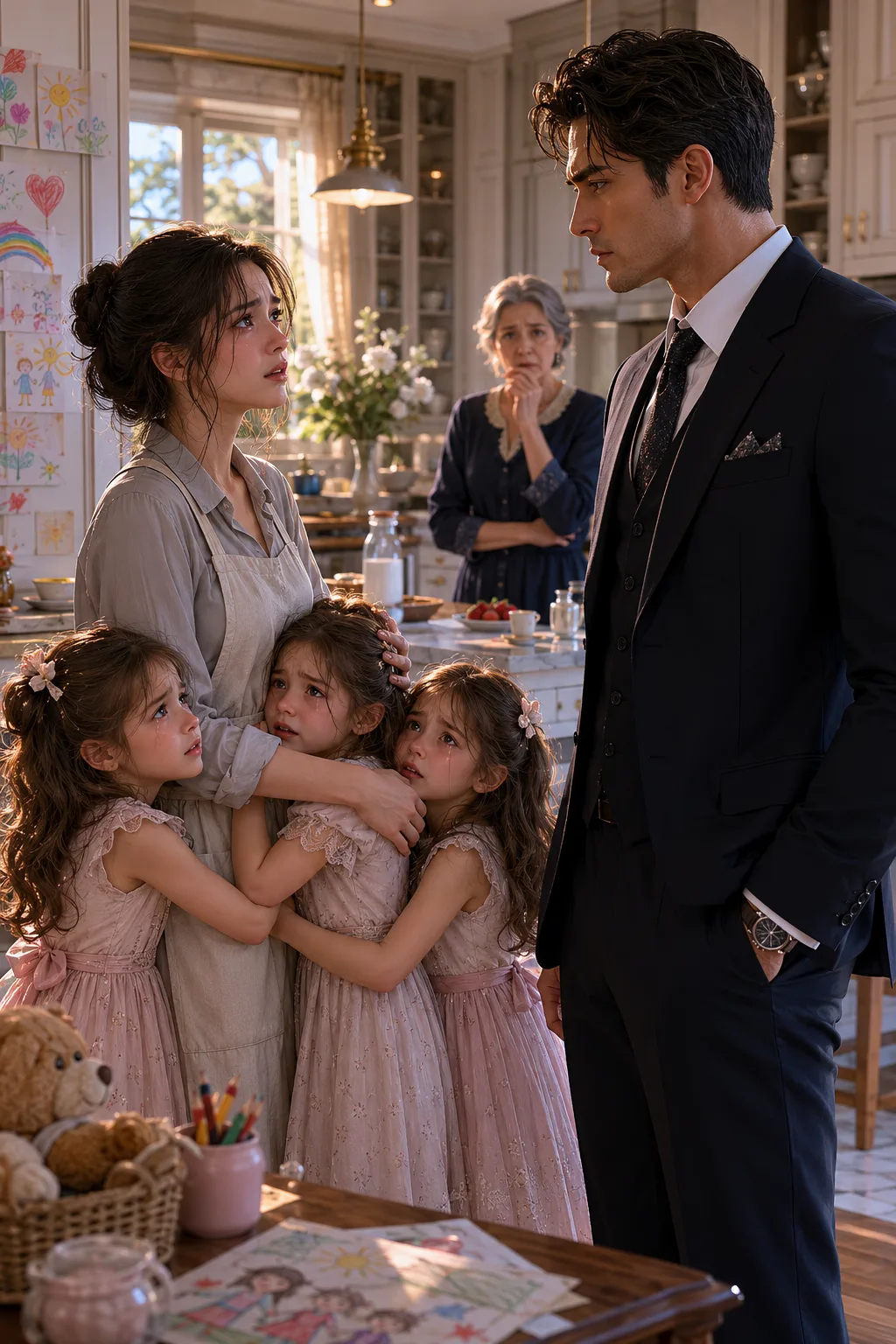
The Mafia Father Heard His Triplets Sing Again, Then Nearly Lost Them to His Own Pride
Chapter 1: The Song His Pride Almost Silenced
Dominic Moretti came home two days earlier than anyone expected.
Chapter 1
Dominic Moretti came home two days earlier than anyone expected.
No warning call reached the estate. No assistant informed the kitchen. No driver was told to announce him at the gate. Dominic had never believed in announcing himself, not in business, not in war, and certainly not in his own home.
The black iron gates opened before his armored car fully stopped. Rainwater still clung to the tires from the long road out of the city, and the gray afternoon hung heavy over the Long Island estate like a curtain that had never been lifted.
The mansion stood at the end of the private driveway, massive and pale against the dark sky. Marble steps. Tall windows. White columns. Gardens trimmed with almost military precision. To strangers, it looked like wealth. To enemies, it looked like power. To Dominic, lately, it looked like a tomb with lights on.
For fourteen months, silence had lived there.
Not peace.
Not calm.
Silence.
It
hid behind the velvet curtains. It sat at the long dining table where no child laughed anymore. It floated through the nursery corridor. It pressed itself against the bedroom doors at night. It followed Dominic from room to room whenever he was brave enough to stay home for more than a few hours.
He used to understand silence.
In his world, silence meant loyalty. Silence meant a man knew when to keep his mouth shut. Silence meant fear had done its work.
But the silence of his daughters was different.
It was not loyalty.
It was not obedience.
It was not fear of enemies.
It was grief.
Lucia, Valentina, and Mia had been five years old for only three months, yet their eyes looked older than some of the men Dominic sent into dangerous rooms with loaded guns and fake smiles. They were triplets, identical to strangers but painfully different
to anyone who had ever truly watched them. Lucia observed everything before reacting. Valentina asked questions with her eyes even when her mouth refused to form words. Mia used to be the loudest, the smallest, the first to run barefoot into trouble.
Used to.
Before Isabella died.
Before the house split into a before and an after.
Before Dominic carried three sleeping girls out of a hospital waiting room while a doctor told him his wife was gone.
Before Lucia stopped speaking first, then Valentina, then Mia, as if their voices had followed their mother into the ground.
Fourteen months.
Doctors had come. Specialists had come. Therapists with soft voices and expensive degrees had sat on carpets with puppets and picture cards. Dominic had paid for all of it. He had paid so much that no one dared accuse him of doing nothing.
But money had only filled the house
with professionals.
It had not brought back the sound of his children.
He stepped from the car as one of the guards rushed forward with an umbrella.
Dominic waved him away.
The rain was thin now, almost mist. It touched his black coat and darkened his hair at the temples, but he did not care. He had spent the last forty-eight hours inside back rooms where men lied politely, threatened quietly, and smiled only when they meant harm. He was tired of voices.
He wanted silence.
Or maybe, if he had been honest, he wanted the kind of silence he could control.
The front door opened before he reached it. Rosa stood inside, startled, one hand pressed to her chest. She had been with the Moretti family since Dominic was barely older than a boy. She had watched him become a man people feared. She had watched him marry Isabella in a church full of white roses. She had watched him carry his daughters through that same doorway when they were newborns wrapped in pink blankets.
And she had watched him become less human after his wife’s death.
“Mr. Moretti,” she said, recovering quickly. “We didn’t know you were returning today.”
“I know.”
His tone was not cruel, but it carried the weight of command. Rosa stepped aside.
Dominic entered the foyer. The house smelled faintly of lemon polish, old wood, and rain brought in on his coat. Somewhere upstairs, a clock chimed once. Everything looked exactly as it always did: polished floors, large floral arrangement, perfect staircase, no shoes out of place, no toys scattered across the entry.
Too perfect.
Too dead.
He removed his gloves slowly.
“Where are the girls?”
Rosa hesitated.
That hesitation sharpened him.
“Rosa.”
“They’re in the kitchen wing,” she said. “With Clara.”
Dominic frowned.
“The new housekeeper?”
“Yes.”
Eight weeks earlier, Rosa had asked permission to hire extra help. Dominic had approved it with the distracted indifference of a man signing a paper about garden repairs. He remembered a file. Clara Reyes. Twenty-six. No criminal record. Good references. Worked in private homes before. Took night classes. Needed steady employment.
Nothing remarkable.
He had seen her a few times from a distance: dark hair tied back, simple clothes, careful movements, eyes lowered but not weak. She had greeted him once near the staircase. He had nodded and forgotten her voice seconds later.
“Why are my daughters in the kitchen with staff?”
Rosa’s fingers tightened around the cloth she was holding.
“They like being there lately.”
Dominic studied her.
“Lately?”
Before Rosa could answer, a sound drifted down the hallway.
Dominic went still.
It was faint at first. So faint that for one strange second he thought his exhaustion had done something to his mind. Then it came again, small and uneven, floating through the corridor from the west side of the house.
A child’s voice.
Dominic’s hand froze on the glove he was removing.
Another voice joined it.
Then a third.
Not speaking.
Singing.
The world narrowed around him.
The foyer vanished. Rosa vanished. The rain on the windows vanished. Dominic stood with his breath caught somewhere behind his ribs, listening to three fragile voices stumble through a melody he had not heard in more than a year.
His daughters were singing.
No.
It was impossible.
Lucia, Valentina, and Mia had not spoken a full sentence since Isabella’s funeral. They had not called him Daddy. They had not asked for milk. They had not cried loudly enough for their grief to have shape. When nightmares woke them, they shook silently. When frightened, they clung to each other. When happy—if happiness ever crossed their faces—it disappeared before it became sound.
Yet now their voices trembled through the house like something returning from the dead.
Dominic walked toward the sound.
He did not run. Men like him did not run. But each step carried more urgency than the last. Past the sitting room. Past the portrait of Isabella holding the girls as babies. Past the carved doors leading to the formal dining room where the silver remained untouched most nights.
The song became clearer near the kitchen.
It was a simple children’s song, one Isabella used to sing while brushing their hair after bath time. The girls had never sung it correctly even then. Lucia always started too early. Valentina insisted on changing the tune. Mia shouted the last word with her whole body.
Now they sang it softly, brokenly, as if testing whether the world would punish them for making sound.
Dominic stopped in the kitchen doorway.
Sunlight had slipped through a break in the clouds and poured across the room in warm gold. The kitchen was not arranged with its usual strict perfection. There were ribbons on the table. Flour on the counter. Three little cups of milk. A plate of sliced strawberries. Crayons scattered near a crooked paper butterfly taped to one cabinet. A small blue dress lay folded over the back of a chair.
And there, in the middle of it all, stood Clara Reyes.
She wore a gray house dress and a white apron dusted with flour. Her dark hair had partly loosened from its bun, soft strands brushing her cheek. She was not dressed like a mother. She was not standing like a servant either. She stood like a safe place.
Mia sat on her hip, one arm wrapped around Clara’s neck.
Valentina stood on a chair, clapping carefully to the song with serious concentration.
Lucia leaned against Clara’s side, holding the edge of her apron as if it were a lifeline.
Clara sang with them, low and gentle, never louder than the girls, never pulling the song away from them. She watched them not with surprise, not with triumph, but with the tender patience of someone who had been waiting outside a locked door and finally heard it open.
Dominic did not move.
For one impossible moment, he felt something he had almost forgotten.
Joy.
It rose in him so violently that it hurt. He wanted to call their names. He wanted to cross the room. He wanted to fall to his knees, gather them all into his arms, and beg them to sing again, louder, forever.
His daughters were not gone.
Not completely.
They were still inside themselves.
Then Mia laughed.
It was small, bright, and real.
Dominic’s throat closed.
“Again, Clara,” Mia said, pressing her face against Clara’s shoulder. “Sing it again.”
Clara.
Not Daddy.
The joy twisted.
It did not vanish all at once. It curdled slowly, poisoned by something Dominic would later be ashamed to name.
Jealousy.
His youngest daughter had spoken. She had laughed. She had asked for another song.
And the first person she reached for was not him.
Clara smiled down at Mia. “Only if Lucia starts this time.”
Lucia shook her head, but her mouth curved shyly.
Valentina giggled.
Dominic’s hand closed around the edge of the doorway until his knuckles whitened.
The scene before him should have been a miracle. Instead, some brutal part of him saw it as a theft.
This woman had been in his house for eight weeks.
Eight weeks.
Dominic had spent fourteen months trying to bring his daughters back. He had hired the best therapists. He had imported specialists. He had bought toys from Europe, ponies, musical boxes, dresses, books, dolls that blinked and spoke in three languages. He had built a glass playroom overlooking the garden because one doctor said sunlight might help. He had done everything a man with unlimited money could do.
But he had not known how to sit on the floor and wait.
Clara had.
He had not known how to sing softly without demanding an answer.
Clara had.
He had not known how to make grief feel less dangerous.
Clara had.
And because Dominic could not bear the truth that rose inside him, he reached for anger instead.
“What is this?”
His voice cut through the kitchen.
The song died instantly.
Mia stiffened in Clara’s arms. Valentina climbed down from the chair too quickly and nearly lost her balance. Lucia’s hand tightened around Clara’s apron, her face closing like a door.
Clara turned.
For half a second, fear crossed her face. Not fear for herself—Dominic knew that look well enough—but fear that the girls had been startled back into silence.
“Mr. Moretti,” she said carefully. “You’re home early.”
“I asked what this is.”
The warmth drained from the room.
Rosa appeared behind him at the hallway entrance, pale.
Clara lowered Mia slowly to the floor, but Mia immediately hid behind her skirt.
Dominic saw it.
His own daughter hiding from him.
He should have stopped then. He should have understood that the fear in Mia’s body was not disrespect. It was injury. It was proof of how carefully he needed to move.
But Dominic had spent too many years turning pain into control.
“The girls were singing,” Clara said. “They started on their own.”
“I heard.”
His voice was cold.
Lucia stared at the floor. Valentina held her own hands so tightly her fingers turned pink. Mia buried half her face in Clara’s apron.
Clara noticed all of it. Dominic noticed that she noticed, and somehow that made him angrier.
“You were hired to help clean the house,” he said. “Not to perform therapy. Not to interfere with my daughters. And certainly not to encourage emotional scenes without permission.”
Clara blinked.
“Permission?”
“Yes.”
Her mouth parted slightly, then closed. She looked at the girls, then back at him.
“They were happy,” she said quietly.
The word struck him.
Happy.
As if happiness had happened in his home and no one had asked him first.
“They are my children.”
“I know that.”
“Do you?”
The question came out sharper than he intended, but he did not pull it back.
Clara’s eyes changed. Something steady entered them.
“Yes,” she said. “I know they are your children. That’s why I didn’t force them. That’s why I sat with them day after day without asking them to speak. That’s why I let them come to the kitchen when the rest of the house felt too quiet.”
Dominic stepped farther into the room.
“The rest of the house is quiet because this family has suffered a loss.”
Clara’s expression softened, but her voice did not.
“No. The house is quiet because everyone here is afraid to breathe too loudly around your grief.”
Rosa whispered, “Clara…”
Dominic turned his head slightly.
The warning was enough to silence Rosa.
But Clara did not lower her eyes.
A servant who would not lower her eyes.
Another insult, his wounded pride decided.
“You think you understand grief because you tied ribbons and sang songs?”
“No,” Clara said. “I understand that children cannot live inside a mausoleum.”
The room went still.
Dominic heard the refrigerator hum. Rain tapped faintly against the far windows. Somewhere, one of the girls sniffled.
His voice dropped.
“Be careful.”
Clara swallowed. He saw the movement in her throat. She was frightened now. Of course she was. Everyone with sense was frightened when Dominic spoke like that.
But she remained between him and Mia.
That was the part he would remember later.
She remained.
“I am being careful,” Clara said. “With them.”
Something hot and ugly moved through him.
“With them,” he repeated. “As if I am the danger.”
Clara did not answer.
She did not need to.
The silence did it for her.
Dominic looked at Mia, still clutching Clara’s skirt. He looked at Valentina, who had gone completely rigid. He looked at Lucia, whose lips had pressed into a thin line as if she were physically holding her voice inside.
He had walked into a miracle and turned himself into the threat.
For one brief second, shame broke through.
Then pride crushed it.
“You’re dismissed,” he said.
Clara stared at him.
“Excuse me?”
“You heard me. Pack your things. You leave before dinner.”
Mia made a sound so small it barely reached the air.
“No.”
Dominic flinched, but his face did not change.
Clara’s eyes filled.
“Mr. Moretti, please don’t do this in front of them.”
“You should have thought of that before you forgot your place.”
Rosa stepped into the kitchen.
“Dominic, stop.”
He turned on her.
Rosa had stood beside him at his worst moments. She had cleaned blood from his cuffs when he was twenty-three and foolish. She had held Isabella’s veil on the wedding day. She had carried bottles at 3 a.m. when the triplets were infants and everyone in the house was too exhausted to think.
But even Rosa was not allowed to challenge him in front of staff.
“Do not,” he said.
Rosa’s face trembled with anger.
“No. This time, I will. Those girls spoke because of her. They laughed because of her. You cannot punish the first light that entered this house simply because it didn’t come from your hands.”
Dominic’s jaw flexed.
“This is my house.”
“Yes,” Rosa said. “And you are filling it with fear.”
The words landed hard enough that even Clara looked at her.
Dominic did not shout. He almost never shouted. His quiet was worse.
“Take Clara upstairs. Help her pack.”
Rosa looked at the girls.
Lucia had begun to cry without sound. Tears slipped down her cheeks, but her mouth stayed closed. Valentina pressed both hands over her ears. Mia was openly sobbing now, pulling at Clara’s apron with desperate little fingers.
Clara knelt.
Dominic forced himself not to look away.
“Mia,” Clara whispered, “sweetheart, breathe with me.”
Mia shook her head violently.
“No go.”
Clara’s face broke.
“I’m sorry.”
“No go, Clara.”
Valentina rushed forward and grabbed Clara’s sleeve. Lucia followed slowly, as if her legs had forgotten how to move. Soon all three girls were around Clara, clinging to her as if Dominic had ordered a wall to be torn down while they were still leaning against it.
“Girls,” Dominic said, harsher than he meant to.
They all flinched.
Clara looked up at him then.
Not with hatred. Hatred would have been easier.
She looked at him with devastation.
“You are making them lose her again,” she said softly.
The word her did not need a name.
Isabella filled the room.
Dominic’s face went cold to protect what was breaking underneath.
“Enough.”
Clara stood slowly. She kissed each girl’s head. Lucia first, then Valentina, then Mia, who would not let go until Rosa gently pried her hands loose.
“I didn’t leave because I wanted to,” Clara whispered to them. “Remember that. You did nothing wrong.”
Mia screamed when Clara walked away.
Not a long scream. Not theatrical. Just one torn sound that made every adult in the kitchen freeze.
Dominic had faced gunfire with less shock.
Clara stopped at the doorway but did not turn around. If she had, she might not have been able to leave.
By sunset, she was gone.
And the house returned to silence.
At dinner, the girls did not come downstairs.
At breakfast, their plates remained untouched.
Dominic sat at the head of the long table, staring at three small chairs. Rosa served coffee without speaking to him. He hated that he noticed her silence. He hated that the house felt different now, not because Clara had left, but because something fragile had collapsed and everyone knew he was responsible.
“Bring them down,” he said.
Rosa did not move.
“Rosa.”
“They are awake,” she said. “They will not come.”
“They are children.”
“Yes,” Rosa replied. “Not soldiers.”
Dominic looked up sharply.
Rosa met his eyes.
For a moment, he considered reminding her who employed whom. But the thought tasted bitter. Rosa had given more to his family than most blood relatives. Threatening her would not make him powerful. It would only prove how small he had become.
He stood and went upstairs.
The girls’ bedroom was at the end of the east corridor. Isabella had chosen the wallpaper herself: pale cream with tiny gold stars. Dominic remembered arguing that stars were unnecessary, that children did not care about wallpaper. Isabella had laughed and said, “They will care because I care.”
He stood outside the door for several seconds before knocking.
No answer.
He opened it slowly.
The room was bright, clean, and unbearable.
Three beds. Three dolls. Three small pairs of slippers aligned near the rug. The girls sat together on Lucia’s bed, pressed shoulder to shoulder. When Dominic entered, Mia climbed into Valentina’s lap though they were the same size. Lucia stared at him with Isabella’s eyes.
“Good morning,” Dominic said.
No one answered.
He stepped inside.
“I thought we could have breakfast together.”
Silence.
He tried to soften his voice.
“I know yesterday was upsetting.”
Lucia’s stare sharpened.
She said nothing.
Dominic sat carefully on the edge of the nearest chair. He had negotiated with men who wanted him dead. He had stared down federal agents. He had entered rooms where every smile concealed a weapon.
But he did not know how to speak to three silent five-year-old girls.
“I did not mean to frighten you.”
Mia turned her face away.
The movement was small. It destroyed him anyway.
“I am your father,” he said, and hated how desperate it sounded.
Lucia slid off the bed.
For a moment, he thought she was coming to him.
Instead, she walked to the little table near the window, picked up a crayon, and drew something on a piece of paper. Her hand moved quickly, angrily. Then she carried the paper to him and placed it on his knee.
Dominic looked down.
It was not a good drawing. She was five. But he understood it immediately.
Three small girls stood on one side. A woman with dark hair stood beside them. A tall black figure stood on the other side, one arm stretched out like a wall between them.
The black figure had no face.
Dominic’s chest tightened.
“Lucia…”
She took the paper back before he could say more, tore it once down the middle, and returned to her sisters.
He sat there for another minute, maybe two.
Then he stood and left because he did not trust himself to speak.
That afternoon, he drank in his study.
Not enough to lose control. Dominic never allowed that. Just enough to soften the edges of the day. The whiskey burned, but it did not warm him.
Rosa entered without knocking.
He looked up.
“You’re becoming bold.”
“I’m becoming honest.”
He laughed once, without humor.
“That is dangerous in my house.”
“No,” Rosa said. “Silence is dangerous in this house. We have all tried it your way. Look what it has done.”
Dominic set down the glass.
“You think this is simple.”
“I think it is simpler than you make it.”
“My wife died.”
Rosa’s face softened.
“Yes.”
“I buried the only woman who ever saw me as something other than a weapon.”
“Yes.”
“I wake every day in a house that still smells like her perfume in rooms she hasn’t entered in fourteen months.”
Rosa’s eyes filled.
“I know.”
Dominic’s voice roughened.
“No, you do not.”
Rosa stepped closer.
“I do not know what it is to lose Isabella as a wife. But I know what it is to love those girls while watching their father disappear into grief and call it business.”
His eyes flashed.
“I did not disappear.”
“You slept in hotels to avoid hearing them cry.”
The words hit too close.
“You sent doctors into rooms you would not enter. You sent gifts with your driver. You stood outside their bedroom door and walked away if they made no sound because you were afraid silence meant they blamed you.”
Dominic stood.
“Enough.”
“No,” Rosa said, voice shaking now. “Not enough. You fired Clara because the girls needed her. You saw your daughters trust someone else and treated that trust like betrayal. But children do not belong to you like territory. Love does not become smaller because it includes another person.”
Dominic’s hands curled at his sides.
“She is a stranger.”
“She was a stranger. Then she showed up every day. That is how children learn who is safe.”
He looked away.
Rosa’s voice lowered.
“Lucia spoke last night.”
Dominic turned back instantly.
“What did she say?”
Rosa hesitated.
“Tell me.”
“She said, ‘Daddy made Clara disappear like Mommy.’”
The room seemed to tilt.
Dominic did not move.
Rosa wiped her cheek quickly, as if embarrassed by her own tears.
“They are five years old. They do not understand death the way adults do. They only know someone they loved was there, then gone. And yesterday you taught them that love can be taken away by your anger.”
Dominic sat down slowly.
For a long time, he said nothing.
Then, very quietly, he asked, “Where did Clara go?”
Rosa held his gaze.
“Home.”
“Where is home?”
“I won’t tell you if you intend to frighten her.”
Dominic almost took offense.
Then he realized she was right to ask.
“I need to apologize.”
Rosa studied him with the caution of someone who had seen too many storms pretend to pass.
“Apologies are not commands, Dominic.”
“I know.”
“No, you don’t. Not yet. But perhaps you can learn.”
The next morning, Dominic did not go to the city.
That alone unsettled the house.
Men called. Dominic ignored them. His assistant sent messages marked urgent. Dominic replied to none. A meeting with a judge’s private secretary was canceled. A shipment issue at the docks was handed to Marco. Two captains requested instructions and received only one sentence: handle it without me.
For the first time in years, Dominic Moretti stayed home with nothing to hide behind.
He watched breakfast from the doorway.
The girls sat together again. They ate only because Rosa coaxed them gently. No one spoke. Mia kept looking toward the kitchen entrance as if Clara might appear if she stared long enough.
Dominic did not enter.
He wanted to. Every instinct told him to step in, take control, fix the scene by force of presence.
Instead, he stayed back.
Later, he called Marco into the study.
Marco Bellini was not the kind of man people noticed twice unless Dominic wanted them to. Quiet, broad-shouldered, loyal, with eyes that missed little. He had worked for Dominic for twelve years and knew when a request was business and when it was personal.
“Find Clara Reyes,” Dominic said.
Marco nodded.
“Quietly.”
Another nod.
“And bring me everything.”
By evening, Marco returned with a folder.
Dominic opened it but did not immediately read. For some reason, the idea of seeing Clara reduced to papers made him uncomfortable. He had done this to enemies without blinking. But Clara had held Mia while she sang. Clara had stood between his anger and his child.
Still, he read.
Clara Reyes. Twenty-six. Born in Queens. Mother dead. Father disabled after a construction accident. Younger brother, Mateo Reyes, eighteen. Arrested five months earlier for armed robbery of a jewelry courier. Awaiting trial. Public defender overloaded. Evidence thin but damaging. Clara working two jobs before Rosa hired her: morning diner shifts and evening cleaning. Night classes in early childhood development temporarily paused because of legal fees.
Dominic turned a page.
There was a photograph clipped to the file.
Clara, younger, standing beside a teenage boy with the same dark eyes and stubborn chin. Mateo. They were smiling in front of a small apartment building. Clara’s arm was around his shoulders. Protective even then.
Dominic stared at the photo longer than he expected.
“What else?” he asked.
Marco shifted slightly.
“The robbery looks wrong.”
Dominic looked up.
“Wrong how?”
“Too clean. The kid was picked up fast. Witness identified him too easily. No recovered weapon. No money found. Security footage missing from one camera but not the others.”
“Who benefited?”
Marco’s mouth tightened.
“Sal Varrone’s crew.”
Dominic leaned back.
Sal Varrone was not powerful enough to concern Dominic directly, but he was irritating enough to exist. A small-time predator with big ambitions, feeding on neighborhoods where people had no money to defend themselves. Dominic had considered crushing him twice and postponed it both times for larger concerns.
Now one of Varrone’s lies had reached into his home.
“Clara never mentioned this,” Dominic said.
“No.”
Of course she had not. Clara had not tried to bargain with her pain. She had not used her brother to gain sympathy. She had simply come to work, cared for his daughters, and been thrown out for succeeding where he had failed.
Dominic closed the folder.
“Find the witness. Find the footage. Find who got paid.”
Marco nodded.
“And Clara?”
Dominic looked toward the window. Outside, the garden was dark.
“I’ll go myself.”
Clara worked mornings at a diner on a corner in Queens where the sign flickered and the coffee was too strong.
Dominic arrived at seven.
He did not bring his usual convoy. Only Marco waited outside in the car. Dominic entered alone.
The diner was narrow, warm, and crowded with workers beginning their day. Men in paint-splattered pants. A woman in scrubs. Two older men arguing about baseball. No one looked twice at Dominic at first, which was rare enough to feel almost absurd.
Then Clara saw him.
She stood behind the counter holding a coffee pot.
Her face went still.
Not afraid. Not exactly.
Guarded.
Dominic sat in the last booth.
Clara did not come to him immediately. Another waitress served him coffee. He ordered nothing else. For two hours, he watched Clara work. He watched her smile at an old man who complained about toast. He watched her tie a child’s shoelace near the door when the mother’s hands were full. He watched her rub her wrist when she thought no one was looking, tired from carrying too many plates.
She did not look at him once.
At nine-thirty, her shift ended.
She removed her apron, spoke briefly to the cook, and left through the side door.
Dominic followed, stopping a respectful distance away in the alley beside the diner. Rainwater dripped from a fire escape above them.
“Clara.”
She kept walking.
“I need ten minutes.”
That made her stop. She turned slowly.
“You already took eight weeks from me. Then you took three children from me in eight minutes. I don’t owe you ten more.”
Dominic accepted that because it was true.
“No,” he said. “You don’t.”
She looked surprised despite herself.
He stepped no closer.
“I came to apologize.”
Her laugh was soft and bitter.
“Men like you apologize when they want something.”
“Yes.”
At least that was honest.
Clara’s eyes hardened.
“What do you want?”
“My daughters back.”
Pain moved across her face before she could hide it.
“They were never gone.”
“I know that now.”
“Do you?” she asked. “Or are you saying it because they stopped speaking again?”
Dominic looked down.
Cars passed beyond the alley. Somewhere nearby, a delivery truck backed up with a shrill beeping sound. The city continued, indifferent to the fact that Dominic Moretti was standing in the rain being judged by a woman he had fired.
“I was jealous,” he said.
Clara said nothing.
He forced himself to continue.
“I came home and heard them singing. For one moment, I was happy. Then Mia said your name, and I felt…” He stopped, disgusted with himself. “I felt replaced.”
Clara’s face changed, not softening, but listening.
“I have commanded men my entire adult life,” Dominic said. “I know how to make fear obey. I know how to make enemies step back. I know how to make a room go silent. But I did not know how to make my daughters feel safe enough to speak. You did. And instead of being grateful, I punished you for showing me my failure.”
Clara blinked quickly.
“You didn’t just punish me.”
“I know.”
“You punished them.”
His throat tightened.
“I know.”
“Mia begged.”
“I hear it every night.”
“Lucia thinks you make people disappear.”
Dominic closed his eyes briefly.
“Rosa told me.”
Clara looked away, jaw tense.
For a moment, neither spoke.
Then Dominic said, “I am helping Mateo.”
Clara snapped back toward him.
“What?”
“Your brother. He was framed. My lawyers are reopening the case. Marco is already finding the missing evidence.”
Her expression flashed from shock to fury.
“You investigated me?”
“Yes.”
“To use my brother against me?”
“No.”
“How am I supposed to believe that?”
“You shouldn’t,” Dominic said. “Not because I ask. Believe what happens. Mateo’s case moves forward whether you return or not.”
Her lips parted slightly.
“I don’t want your money.”
“I know.”
“You think everyone has a price.”
“I used to.”
“And now?”
“Now I think some debts cannot be paid. Only honored.”
Clara looked at him for a long time.
The rain grew heavier. It darkened the shoulders of his coat and dampened the loose hair near her temples. Neither moved toward shelter.
Finally, she said, “What exactly are you asking?”
“Come see them.”
Her face tightened.
“I can’t survive saying goodbye to them again.”
“Then don’t say goodbye unless you choose to.”
“That house is not safe for me if your pride can throw me out whenever it hurts.”
Dominic nodded slowly.
“You’re right.”
Again, surprise flickered through her anger.
“So?”
“So the terms change,” he said. “You do not return as a servant who can be dismissed in anger. You return only if you want to, with a contract that protects you, with authority over their daily care, and with the right to leave if I violate your trust again.”
Clara stared.
“You’d give me authority?”
“For their care. Not my business. Not security. Not anything beyond them. But yes.”
“Why?”
“Because they trust you.”
“And you hate that.”
“I did.” He breathed in. “Now I want to deserve what you already have.”
Her eyes glistened.
“They love you, you know.”
The words struck him with unexpected force.
Dominic almost laughed from pain.
“They hide from me.”
“They hide from your anger. Not from you.”
He held onto that distinction like a drowning man touching wood.
Clara wiped rain from her cheek.
“One visit,” she said. “For them. Not for you.”
Dominic bowed his head once.
“That is more than I deserve.”
“It is.”
Three days later, Clara returned to the mansion.
Dominic had wanted to send a car. Clara refused. She arrived in a yellow taxi with a small bag over her shoulder and her hair tied back. No uniform. No apron. Just a navy dress, simple shoes, and guarded eyes.
The girls saw her from the upstairs window.
By the time Rosa opened the front door, the triplets were already halfway down the stairs.
“Mia, slow down!” Rosa cried.
But Mia did not slow.
She ran across the foyer with Lucia and Valentina close behind. Clara dropped to her knees just in time, and the three girls crashed into her arms.
The sound that came from them was not quite speech at first. It was sobbing, laughing, breathing, broken syllables. Clara held all three as best she could, pressing kisses to their hair.
“I’m here,” she whispered. “I’m here.”
“You went away,” Mia cried.
“I know, sweetheart.”
“Daddy made you.”
The foyer froze.
Dominic stood near the study doors.
He had promised himself he would not interfere with their reunion. He had promised he would let Clara be the center because that was what the girls needed. But Mia’s words pulled him forward.
He stopped several feet away and knelt, making himself smaller.
“Yes,” he said.
The girls turned.
Dominic looked at Mia first, then Valentina, then Lucia.
“I made Clara leave. I was wrong.”
Lucia stared at him suspiciously.
“You were mad.”
“Yes.”
“At Clara?”
“Yes.”
“Because we sang?”
Dominic’s face tightened.
“No. That is what it looked like. But no. I was angry because I was hurt and jealous, and I acted like those feelings were more important than you.”
Valentina frowned through tears.
“What is jealous?”
Dominic swallowed.
“It means I saw that you loved Clara, and instead of being happy that someone helped you, I felt afraid you did not need me.”
Mia’s lower lip trembled.
“We need you.”
Those three words nearly ended him.
Dominic looked down.
“I want to believe that,” he said softly. “But more than that, I want you to feel safe needing me.”
Lucia stepped closer to Clara.
“Will you yell again?”
“I might get angry again someday,” Dominic said carefully. “Adults do. But I will not send away someone you love because of my anger. And if I frighten you, I will apologize. Not with gifts. With words. And then with better actions.”
The girls were quiet.
Clara watched him, measuring every word.
Rosa stood near the staircase with tears on her face.
After a long moment, Mia pulled away from Clara and walked toward him.
Dominic did not open his arms too wide. He let her decide.
Mia stopped in front of him.
“You made the song stop,” she whispered.
His voice broke.
“I know.”
“Can it come back?”
Dominic looked past her at Clara.
Then back at his daughter.
“I hope so.”
Mia studied him with the unbearable seriousness of a child who had already lost too much.
Then she placed one small hand on his cheek.
“You have to sing too.”
Dominic gave a shaky laugh.
“I don’t know your songs.”
“We teach you.”
Lucia approached next, slower. Valentina followed, holding Lucia’s hand. Dominic remained kneeling as his daughters came close enough to touch him.
When they finally leaned into his arms, he closed his eyes.
He did not hold them tightly. He had learned something. Love was not a grip. It was a shelter.
Clara returned that week.
The house changed slowly.
At first, Dominic’s men did not know what to do with the new rules. No shouting near the family wing. No armed guards outside the girls’ bedroom unless necessary. No business meetings in the breakfast room. No sudden visitors without Rosa’s approval. No one spoke to Clara as if she were furniture.
One guard made that mistake only once.
Dominic heard him call her “the help” under his breath.
The man was transferred before sunset.
Not beaten. Not threatened. Simply removed.
That, too, was change.
Dominic began coming home for dinner.
The first night, the girls did not speak to him much. Lucia answered by pointing. Valentina whispered only to Clara. Mia watched him constantly, as if checking whether he might disappear into anger again.
Dominic accepted it.
He sat at the table and listened.
On the second night, Valentina asked him why his hands had scars.
Rosa nearly dropped a spoon.
Clara went very still.
Dominic looked at his daughter and said, “Because I made dangerous choices when I was younger.”
“Bad choices?”
“Some.”
“Do you still?”
He looked at Clara, then back at Valentina.
“I’m trying not to.”
Valentina considered that.
“Clara says trying means doing it again after messing up.”
“She’s right.”
Mia leaned over her plate.
“You mess up a lot?”
Dominic almost smiled.
“More than I used to admit.”
Lucia spoke then, barely above a whisper.
“Mommy said sorry when she messed up.”
The table fell silent.
Dominic’s chest tightened.
“Yes,” he said. “She did.”
“You didn’t.”
“No,” Dominic said. “But I will now.”
Lucia nodded once, as if filing that away for future judgment.
It was not forgiveness.
It was a beginning.
Weeks passed.
Dominic learned that children healed in circles, not straight lines.
Some mornings, the girls filled the kitchen with questions. Some afternoons, they fell silent again. Sometimes Mia crawled into his lap without warning. Sometimes she refused to let him touch her. Valentina became obsessed with rules and asked whether people could leave if they promised not to. Lucia drew pictures of houses with open doors.
Clara helped him understand each thing without making him feel absolved.
“She asks about rules because she wants the world to make sense,” Clara told him one evening.
They stood in the kitchen after the girls had gone upstairs. Rain tapped gently against the windows. The same kitchen where he had destroyed their first song now smelled of cinnamon and warm milk.
Dominic leaned against the counter.
“And Lucia?”
“Lucia watches doors because she believes love leaves through them.”
He closed his eyes.
“And Mia?”
Clara’s voice softened.
“Mia tests people. She comes close, then runs. She wants to know if you’ll still be there when she comes back.”
Dominic opened his eyes.
“How do I prove that?”
“Be there.”
“That sounds simple.”
“It is simple,” Clara said. “It just isn’t easy.”
He looked at her.
In the warm kitchen light, she looked tired. Not weak. Never weak. But tired in the way people become when life has asked them to be strong too often.
“Mateo’s hearing is next Thursday,” he said.
Her face changed immediately.
“You heard?”
“I spoke to the attorney.”
“I told you not to pressure them.”
“I didn’t. I asked for the truth to move faster.”
Clara folded her arms.
“That sounds like pressure.”
“Probably.”
For the first time since returning, she almost smiled.
“Dominic.”
He liked the sound of his name in her voice more than he should have.
“I know,” he said. “I’m learning.”
The hearing changed everything for Clara’s family.
The false witness recanted. The missing security footage appeared after a man connected to Varrone decided prison was less frightening than Dominic’s attention. The case against Mateo collapsed in front of a judge who looked deeply irritated to have been used by men he considered beneath him.
Mateo walked out just after noon.
Clara stood outside the courthouse with both hands over her mouth. When her brother appeared, thinner than his photograph but free, she ran to him so fast she nearly fell.
Mateo caught her. They held each other on the courthouse steps while reporters shouted questions neither answered.
Dominic watched from beside the car.
He did not approach until Mateo looked over Clara’s shoulder.
“You Moretti?”
Dominic nodded.
Mateo’s jaw tightened.
“I don’t know whether to thank you or be scared of you.”
“Both would be reasonable,” Dominic said.
Clara gave him a look.
Dominic added, “But today, neither is necessary.”
Mateo studied him.
“My sister says your daughters are good kids.”
“They are.”
“She says you’re trying.”
Dominic glanced at Clara.
“I am.”
Mateo nodded slowly.
“Then don’t make her sorry she believes that.”
The old Dominic would have made a young man regret speaking to him that way.
The new Dominic simply said, “I won’t.”
That night, Clara stayed late at the estate.
Not because she had to. Because the girls begged her to. Mateo came too, nervous at first, then smiling awkwardly when Valentina demanded to know if jail food was worse than broccoli. Rosa scolded her. Mateo laughed and said yes, much worse, which satisfied Valentina completely.
Dominic watched from the doorway as the kitchen filled with voices.
Not loud. Not perfect. But alive.
He remembered the kitchen on the day he had returned early. The song. His jealousy. Clara’s wounded face. Mia’s scream.
Some mistakes did not vanish because time passed. They remained, not as punishment, but as instruction.
Later that evening, after Mateo left and Rosa took the girls upstairs, Dominic found Clara in the garden.
The rain had stopped. The air smelled of wet soil and roses. Isabella’s roses. Clara stood near the stone bench beneath the old magnolia tree, arms wrapped lightly around herself.
Dominic stopped several steps away.
“Are you all right?”
She nodded.
Then shook her head.
Then laughed softly at herself.
“I don’t know.”
“That seems honest.”
“My brother is free,” she said. “The girls are speaking. This house feels less haunted. I should feel happy.”
“And do you?”
“I feel afraid to trust it.”
Dominic understood that too well.
“So do I.”
She looked at him.
He stepped closer, but not too close.
“I used to think fear was useful,” he said. “If people feared me, they obeyed. If enemies feared me, they stayed away. If my own heart feared something, I buried it before it could weaken me.”
“And now?”
“Now my daughters flinch when I raise my voice, and I know fear is not the same as respect.”
Clara’s eyes softened.
“That’s a hard lesson.”
“I learn slowly.”
“You learn painfully.”
“Usually.”
A small silence passed between them. Not empty. Not cold. Something gentler.
Clara looked toward the dark windows of the girls’ room.
“They love you,” she said again.
This time, Dominic believed her a little more.
“I love them.”
“I know.”
“I loved Isabella.”
“I know that too.”
He swallowed.
“I was angry at her for dying.”
Clara did not speak.
The confession stood between them, raw and ugly.
Dominic looked down at his hands.
“I never said that aloud. Not even to a priest. Especially not to a priest. But I was. I would stand outside the girls’ room and hear nothing, and all I could think was that Isabella would have known what to do. She would have made them laugh. She would have known which one needed to be held and which one needed space. She left me with three broken hearts and no map.”
His voice roughened.
“Then I hated myself for thinking it. So I turned the hate outward. At the house. At work. At anyone who looked too closely. At you.”
Clara’s eyes glistened.
“She didn’t leave you on purpose.”
“I know.”
“But grief doesn’t always care what we know.”
He looked at her then.
“No. It doesn’t.”
A light flicked on upstairs.
Both of them looked up.
Mia’s small face appeared at the window, then vanished. A moment later, Lucia and Valentina appeared too, all three pressed close to the glass, waving dramatically.
Clara laughed.
Dominic lifted one hand.
The girls disappeared again.
“They’re supposed to be sleeping,” Clara said.
“They are terrible criminals.”
“Clearly inherited from your side.”
Dominic looked at her, startled.
She smiled.
Small. Real.
It did something dangerous to his chest.
But Dominic had learned not to grab at beautiful things simply because they appeared.
So he only said, “Thank you.”
“For what?”
“For standing between my anger and my daughter.”
Her smile faded, but not into sadness.
“I would do it again.”
“I know.”
“That should tell you something.”
“It does.”
“What?”
“That my daughters chose well.”
Clara looked away, but he saw the emotion cross her face.
By spring, the estate no longer felt like a tomb.
The girls planted sunflowers along the back garden wall because Clara told them Isabella had loved yellow flowers. Dominic remembered that too, though he had forgotten until Clara said it. Isabella used to buy sunflowers for the kitchen even though they were too tall for most vases. She said they looked ridiculous in rich houses, which was why she loved them.
Dominic ruined three pairs of expensive shoes helping with the planting.
Valentina informed him this was the cost of being useful.
Lucia labeled each small patch with drawings because Clara warned that written names might wash away in the rain. Mia insisted one flower belonged to Mommy and one to Clara and one to Daddy and one to Rosa and one to Mateo and three to herself because she was the smallest.
“You are not the smallest by enough to get three,” Lucia argued.
“I had sadness,” Mia said solemnly. “I need extra.”
No one argued after that.
One afternoon, Dominic came home to find music again.
This time, he stopped outside the garden instead of entering immediately.
The girls were singing near the sunflowers. Clara sat on the grass with them, clapping softly. Rosa stood on the patio pretending not to cry. Mateo leaned against the wall, smiling like a man still surprised by freedom.
Dominic listened.
The song was the same one from the kitchen.
The first song.
Lucia saw him first.
For a second, Dominic feared the music would stop.
It did not.
Lucia kept singing.
Valentina waved him over mid-verse. Mia patted the grass beside her as if summoning a disobedient dog.
Dominic walked to them slowly and sat down.
The grass dampened his trousers. He did not care.
Mia leaned against his side.
“You sing now,” she whispered.
“I told you, I don’t know the words.”
“Yes, you do. You listen all the time.”
He looked at Clara.
She raised her eyebrows.
Coward, her expression seemed to say.
Dominic Moretti, feared across half the city, cleared his throat and sang badly.
The girls burst into laughter.
Not polite laughter. Not fragile laughter.
Real laughter.
Dominic forgot the words immediately, which made them laugh harder. Clara covered her mouth. Rosa cried openly now. Mateo turned away, shoulders shaking.
Dominic should have felt embarrassed.
Instead, he felt free.
That evening, after dinner, the girls asked for the story of their mother.
Not the safe version. Not the polished version adults told at funerals.
They wanted details.
“What did Mommy sound like when she laughed?” Valentina asked.
Dominic sat in the nursery armchair with all three girls on the rug before him. Clara stood near the door, ready to leave them privacy, but Mia ordered her to stay.
“Like she was surprised by happiness,” Dominic said.
Lucia frowned.
“What does that mean?”
“It means she would start laughing softly, then suddenly laugh louder, like even she didn’t expect it.”
Mia smiled.
“Did she sing good?”
“Better than me.”
“That is easy,” Valentina said.
Dominic nodded seriously.
“Very easy.”
The girls giggled.
Lucia hugged her knees.
“Did she get mad?”
“Yes.”
“At you?”
“Often.”
“Why?”
“Because I was stubborn.”
Clara made a sound that might have been a cough.
Dominic ignored her.
“And because sometimes I thought protecting people meant making all their choices for them,” he added.
Lucia thought about that.
“Like with Clara.”
Dominic’s chest tightened.
“Yes. Like with Clara.”
“Mommy would be mad.”
“Yes,” he said. “She would.”
“Then sorry to Mommy too.”
Dominic looked toward the window.
The evening sky was soft purple.
“You’re right.”
He lowered his head.
“I’m sorry, Isabella.”
The girls grew quiet.
It could have been strange. It could have felt foolish. But in that room, with three children listening and Clara standing near the door with tears in her eyes, the apology felt like something long trapped had finally been released.
Mia crawled into his lap.
“Mommy heard.”
Dominic wrapped one arm around her.
“I hope so.”
“She did,” Mia said with the confidence only children and saints possess.
Months continued to pass.
Dominic did not become harmless. The city still knew his name. Men still lowered their voices when he entered certain rooms. Business still carried shadows, and his life did not transform into innocence because his daughters sang.
But the house changed him where the world could not see.
He learned to knock before entering the girls’ room.
He learned that gifts did not replace time.
He learned that apologies had to be repeated through behavior.
He learned that Clara’s quiet corrections often saved him from becoming the man grief had tried to make of him.
And he learned that love, when allowed to grow freely, did not weaken authority.
It made authority unnecessary in the places that mattered most.
One year after Isabella’s death anniversary had passed for the second time, Dominic held a small memorial in the garden.
No black clothes. Clara suggested white and yellow. Rosa cooked Isabella’s favorite lemon cake. Mateo brought paper lanterns. The girls picked sunflowers and placed them in a vase too short for them, exactly the way Isabella used to.
At sunset, they stood together near the garden wall.
Dominic held Mia’s hand. Lucia stood beside Clara. Valentina leaned against Rosa. Mateo remained a little apart, respectful but included.
Dominic looked at the faces around him.
A year earlier, he would have called this weakness. Too many people close. Too many emotional risks. Too many soft places for enemies to target.
Now he understood.
This was not weakness.
This was what all his power had failed to build.
A family.
Lucia stepped forward holding a folded drawing. She placed it beneath the sunflowers.
Dominic saw it only briefly before the wind moved the corner.
Three girls. A woman with dark hair. A tall man. Another woman beside them. A grandmotherly figure. A young man. A yellow sun above them all.
This time, the tall black figure had a face.
Dominic looked at Lucia.
She looked back.
Then, quietly, she said, “You can be in the picture now.”
He had no defense against that.
Clara turned away, wiping her cheek. Rosa whispered a prayer. Valentina pretended not to cry. Mia simply hugged his leg and announced, “Daddy is leaking.”
Dominic laughed through the pain.
“Yes,” he said. “Daddy is leaking.”
The girls found this hilarious.
When the laughter settled, Clara began the song.
The same song.
The one Isabella used to sing.
The one Clara had brought back.
The one Dominic had almost destroyed.
Lucia joined first. Then Valentina. Then Mia.
After a moment, Rosa sang too.
Mateo followed awkwardly, off-key.
Finally, Dominic joined.
His voice was low, imperfect, and rough at the edges. But it was there.
The sun dipped behind the garden wall. The mansion windows glowed gold. A breeze moved through the sunflowers, turning their faces toward the last light of the day.
Dominic looked at his daughters and understood something he wished he had known sooner.
A man could command silence.
But he had to earn a song.
And in the garden of the house he had once filled with fear, his daughters sang like forgiveness was not a single moment, but a door left open.
This time, Dominic did not close it.
THE END.
Chapter complete
You have reached the end of this chapter.
Continue reading
A few more worlds to get lost in after this chapter.




