filled every room with songs and arguments and questions became three small shadows moving through a mansion too large for grief. They ate when Rosa asked them to eat. They slept when exhaustion won. They followed each other everywhere, holding hands like children trying not to fall from the edge of the world.
Doctors came.
Specialists came.
Child psychologists came with soft voices and expensive degrees. Speech therapists brought puppets, picture cards, breathing games, reward charts, music therapy toys, and folders full of explanations. Dominic paid every bill before anyone asked. He flew in experts from Boston, London, Zurich. He built a sensory playroom. He hired a private teacher trained in childhood trauma. He bought every instrument Alessandra had once said the girls might like.
Nothing worked.
The girls remained silent.
And Dominic, who could force judges to delay hearings, bankers to answer midnight calls, rivals to disappear from negotiations, and politicians to smile when they hated him, could not make his own daughters say his name.
At first, he tried.
For a while, he went into the nursery every night. He sat on the edge of their beds, his large hands useless in his lap, and tried to speak gently.
“Lucia,” he would say, looking at the oldest by three minutes, the one who used to correct her sisters with the seriousness of a tiny queen. “Tell Daddy what you need.”
Lucia would stare at her blanket.
“Sofia,” he would say to the middle child, who had once asked why the moon followed their car. “Did you draw this?”
Sofia would press the paper to her chest and turn away.
“Mia,” he would whisper to the youngest, who had been the loudest before grief swallowed her voice. “Little star. Look at me.”
Mia would close her eyes.
After weeks of that, something inside Dominic began to break in a way he could not control. He hated the helplessness. He hated the way their silence accused him without saying a word. He hated entering their room and seeing Alessandra in every curl, every eyelash, every trembling chin.
So he did what many powerful men do when love becomes too painful.
He became busy.
He told himself it was necessary. The family business needed him. The legitimate companies needed leadership. The old loyalties needed management. Enemies circled whenever they sensed weakness. His daughters needed protection, and protection required money, influence, and fear.
That was the lie he used to survive.
In truth, Dominic stayed away because the mansion hurt.
He stayed away because every quiet hallway reminded him that he had not been able to save his wife.
He stayed away because his daughters’ silence made him feel like a stranger in the only home where he had ever wanted to belong.
So when he stood up in the middle of that meeting and said, “We are done,” no one questioned him.
The attorney stopped speaking at once.
Dominic’s driver was called.
By four-twenty in the afternoon, his black car rolled through the gates of the Moretti estate.
The rain had not started yet, but the air felt heavy. The sky above Long Island was low and gray, pressing down over the trees. The mansion rose at the end of the drive, pale stone and tall windows, beautiful in the way a museum was beautiful when everyone inside it was dead.
Dominic stepped out before the driver could open the door.
A guard near the entrance straightened.
“Sir. We weren’t expecting—”
Dominic walked past him.
The front doors opened silently.
Inside, the foyer smelled faintly of lemon polish, cold marble, and expensive flowers replaced every morning by staff who knew better than to ask if anyone enjoyed them. Dominic handed his coat to no one. He carried his briefcase in one hand and moved across the foyer with the quiet authority of a man the house had been trained to obey.
Then he stopped.
Something was wrong.
No.
Not wrong.
Different.
He stood beneath the crystal chandelier and listened.
At first, he heard only the familiar sounds of the mansion. A distant vacuum. Water running somewhere. Wind pressing against the windows. His own breathing.
Then the sound came again.
Small.
Thin.
Impossible.
Dominic’s fingers tightened around the handle of his briefcase.
It was a voice.
A child’s voice.
He did not move.
Another voice joined it, uncertain and soft, following the first as if afraid to be alone.
Then a third.
Dominic felt the floor tilt beneath him.
The sound came from the direction of the kitchen.
Not the formal dining room. Not the music room where the expensive piano sat untouched. The kitchen.
A song floated down the hallway, fragile as dust in sunlight.
Dominic knew the melody before his mind accepted what he was hearing.
Alessandra’s song.
The lullaby she used to sing during storms.
The song she hummed when one of the girls woke from a nightmare. The song she sang badly in the car because Lucia would shout, “Mama, not that part!” and Sofia would cover her ears dramatically and Mia would giggle until she hiccupped.
Dominic had forbidden the staff from playing that song after the funeral.
He had not announced it like an order. He had simply heard a maid humming it once, turned his head, and looked at her. After that, no one hummed it again.
But now the song was alive inside his house.
His daughters were singing.
Dominic walked toward the kitchen.
Each step made the voices clearer.
Lucia’s voice was careful, trying to follow the words exactly.
Sofia’s voice drifted in and out, more hum than lyric.
Mia’s voice was the smallest but brightest, rising at the end of every line as if surprised by itself.
Dominic’s throat closed.
Fourteen months of doctors.
Fourteen months of silence.
Fourteen months of going to sleep with old videos playing on his phone because recordings were the only place his daughters still sounded alive.
And here, behind one kitchen door, was the miracle he had stopped believing in.
He reached the doorway and did not enter immediately.
The door was partly open.
Through the narrow space, he saw the kitchen bathed in the last dull gold of afternoon. It was the warmest room in the house, not because it was expensive, though everything in it was. The counters were white marble. Copper pans hung above the island. The stove was imported from France. But the warmth came from small disorder.
A bowl of flour sat open on the counter.
Three tiny handprints marked the dusting near it.
A wooden spoon lay beside a folded dish towel.
A purple butterfly drawing had been taped to the wall near the breakfast nook. It was crooked, one corner curling away from the paint.
And in the middle of the kitchen stood Elena Marquez.
The new housekeeper.
Dominic barely knew her.
He knew she was young, somewhere in her late twenties. He knew Rosa had hired her two months earlier after two maids quit because the Moretti mansion felt “too sad.” He knew Elena arrived early, worked quietly, and did not gossip with the staff. He had seen her in passing perhaps five times: carrying laundry, polishing the banister, placing clean towels outside the girls’ room.
She was not invisible, exactly.
But Dominic had made a habit of not looking too closely at people who made his life function.
Now he looked.
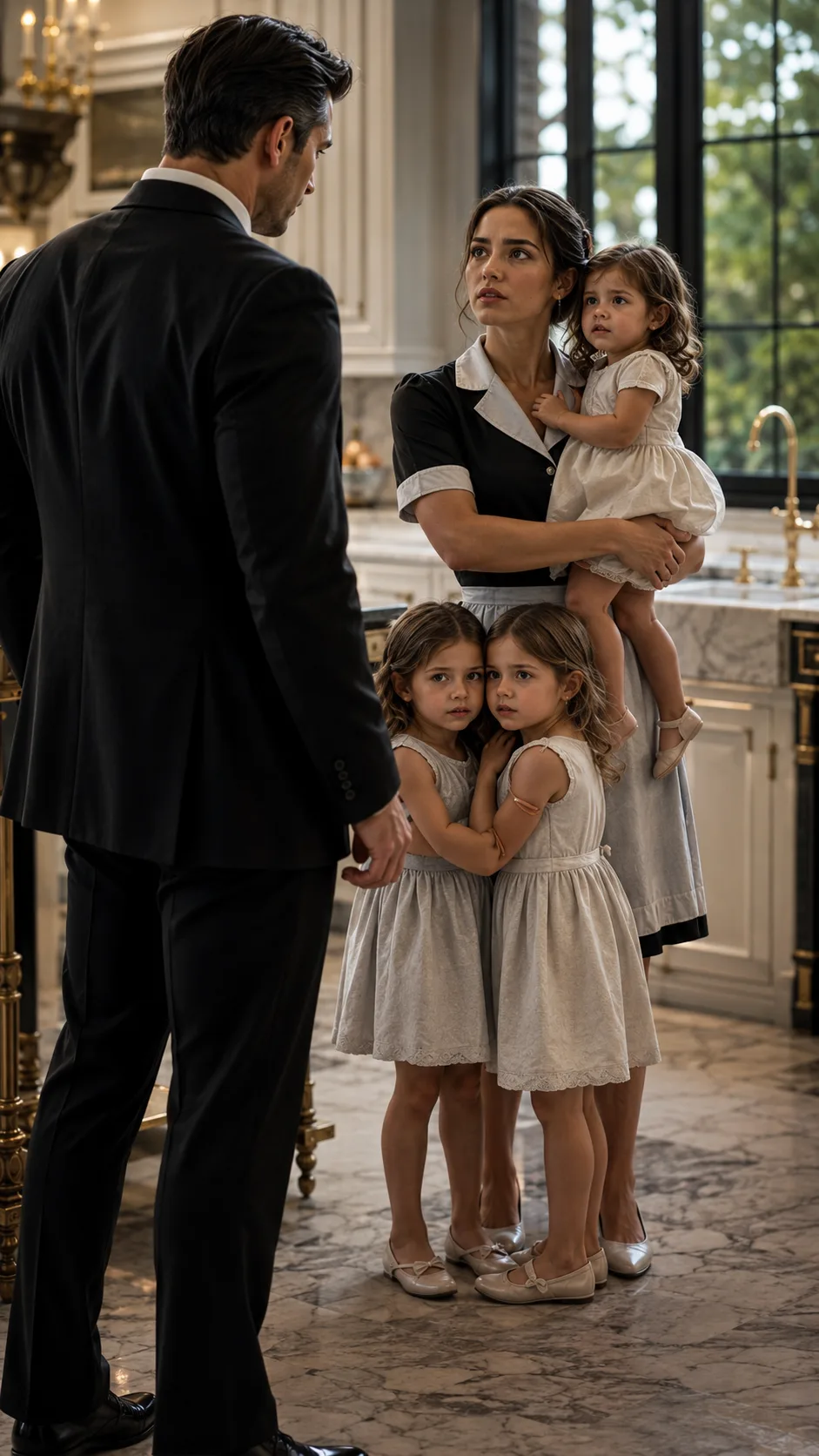
Elena stood near the kitchen table in a simple navy dress and white apron, her dark hair tied at the back of her neck. Her sleeves were rolled to the elbow. There was flour on one wrist. Mia sat on her hip, one small arm wrapped around Elena’s shoulders. Lucia stood on a chair, conducting with a wooden spoon. Sofia sat cross-legged on the table despite every rule in Dominic’s house, clapping softly off-beat.
Elena was singing with them.
Not loudly. Not professionally. Just gently, like someone offering her voice as a bridge.
The triplets followed her.
Dominic forgot how to breathe.
Mia laughed when Elena pretended to forget a word.
Sofia corrected her in a whisper.
A whisper.
Lucia turned in delight and said, clearly, “No, Miss Elena, that part goes higher.”
Dominic’s briefcase slipped from his hand.
It hit the floor with a dull thud.
The song stopped.
All four faces turned toward the door.
For one second, no one moved.
Dominic stood in the doorway, tall, dark-suited, pale with shock.
Lucia’s smile vanished first.
Sofia slid off the table so quickly her foot caught on the edge.
Mia tightened both arms around Elena’s neck.
Elena lowered the child slightly, but Mia clung harder.
“Mr. Moretti,” Elena said.
Her voice was calm, but Dominic saw the fear pass through her eyes.
The miracle trembled in front of him.
He could have stepped forward carefully. He could have knelt. He could have said, “I heard you singing.” He could have said, “I am so proud of you.” He could have said, “Thank you, Elena.”
For one heartbeat, he almost did.
Then Mia turned her face into Elena’s shoulder, hiding from him.
Not from a stranger.
From him.
Her father.
Something inside Dominic twisted.
The joy cracked open, and beneath it was shame so sharp he could not bear to touch it.
His daughters had spoken.
But not to him.
They had sung.
But not for him.
They had returned to life in the arms of a housekeeper while he stood outside the door like an intruder.
And because Dominic Moretti had spent his whole adult life turning pain into power, shame into command, fear into anger, he did it again before he could stop himself.
“What is this?” he asked.
The question came out cold.
Lucia stepped down from the chair and moved closer to Sofia.
Elena held Mia carefully, then set her on the floor. Mia immediately hid behind her skirt.
“We were baking,” Elena said softly. “The girls were helping.”
Dominic looked at the flour, the spoon, the table, the chair Lucia had been standing on.
“They were standing on furniture.”
“They were safe.”
“They were singing.”
Elena’s expression changed. She seemed to think he understood.
“Yes,” she said, and her voice warmed with something like wonder. “They were singing.”
Dominic stared at his daughters.
“Since when?”
No one answered.
His gaze moved back to Elena.
“Since when?” he repeated.
Elena inhaled carefully.
“A few weeks.”
The words were quiet.
They struck him harder than shouting.
A few weeks.
His daughters had been speaking for a few weeks.
Not to him.
Not in front of him.
Not because of the doctors he paid.
Because of Elena.
“Who knew?” Dominic asked.
The kitchen door opened wider behind him.
Rosa appeared in the hall, her face white.
“Dominic,” she said, using his name only when she was frightened enough to forget rules. “Please. Listen before you—”
“Who knew?” he said again, without turning.
Rosa swallowed.
“I knew.”
Dominic’s face hardened.
“Elena told me after Mia said her first word,” Rosa continued quickly. “We didn’t hide it to hurt you. We were waiting for the right moment.”
“The right moment,” Dominic repeated.
His voice had gone dangerously quiet.
Elena stepped forward half a step, still between him and the girls.
“They were fragile,” she said. “The first time Mia spoke, she cried afterward for twenty minutes. The first time Sofia hummed, she hid under the table because she thought she had done something wrong. Lucia would only whisper if nobody looked directly at her. They needed time.”
Dominic’s eyes narrowed.
“You decided that?”
“I watched them.”
“You are not their mother.”
The words fell into the room like glass.
Elena flinched.
Rosa closed her eyes.
The girls went still.
Dominic heard what he had said only after he said it, but pride kept him from taking it back.
Elena’s face lost color. For a moment, she looked as if the sentence had touched some wound of her own. Then she straightened.
“No,” she said. “I am not.”
Her voice was still respectful, but no longer soft.
“I am not their mother. I am not trying to be. But children do not stop needing comfort because the person who loved them most is gone.”
Dominic took one step into the kitchen.
“Be careful.”
Elena’s chin lifted slightly.
“I have been careful every day since I came into this house.”
“You were hired to clean.”
Mia made a small sound behind her.
Elena’s eyes shone, but she did not look away.
“Yes,” she said. “I was hired to clean. So I cleaned the rooms no one entered. I folded the clothes no one noticed were too small. I washed the cups left untouched outside the nursery door. I picked up toys your daughters carried from room to room because they were too afraid to leave anything behind.”
Dominic’s jaw clenched.
Rosa whispered, “Elena…”
But Elena was no longer speaking only as an employee.
She was speaking as the only adult in the room brave enough to touch the truth.
“I sat near them because they sat alone,” she continued. “I hummed because silence was swallowing them. I let them point before they could speak. I let them cry without asking why. I let them be angry without calling it disrespect. And one day Mia asked for water. One word. One tiny word. After that, Sofia asked if rain hurt the sky. Lucia asked if people in heaven can hear songs.”
Dominic’s face changed.
For a moment, the father broke through the boss.
“They asked that?”
Elena’s voice softened despite herself.
“Yes.”
He looked at Lucia.
Lucia stared at the floor.
The old guilt rose inside Dominic, massive and suffocating.
He did not know what to do with it.
So again, he reached for the weapon he knew best.
Control.
“You should have told me immediately.”
“They were not ready to be watched.”
“They are my children.”
“Yes,” Elena said. “And they are not business you can manage by force.”
The kitchen became silent.
Every staff member within hearing distance seemed to stop moving.
Dominic looked at Elena as if he could not believe she had dared to speak.
No one spoke to him this way.
Not in his house.
Not in his city.
Not anywhere.
But Elena did not step back.
Behind her, Mia’s small fist gripped the apron. Lucia and Sofia stood pressed together, watching their father as if he were a storm gathering inside the room.
Dominic saw their fear.
For one second, it slowed him.
Then jealousy, grief, and humiliation rose like fire.
“You think you understand my family because you sang a song in my kitchen?”
Elena’s lips parted.
“No. I think they needed someone to sit with them long enough to hear them.”
“And you believe that gives you a place here?”
“I believe they gave me one.”
Dominic’s eyes darkened.
It was not the sentence itself.
It was the truth inside it.
His daughters had given Elena a place he had not earned.
“You are fired,” he said.
Rosa gasped.
Lucia lifted her head.
Sofia’s eyes filled instantly.
Mia stepped out from behind Elena.
“No.”
It was barely above a whisper.
But it was a word.
Dominic froze.
Mia stared at him with wide, wet eyes.
“No,” she said again, stronger this time.
Dominic could not move.
His daughter had spoken to him.
And the first word she had given him in fourteen months was a plea against him.
Elena turned quickly and knelt.
“Mia,” she whispered, her voice trembling now, “sweetheart…”
Mia threw both arms around Elena’s neck.
“No go.”
Sofia began to cry silently, tears sliding down her cheeks without sound.
Lucia clenched her hands into fists.
Dominic stood like a man watching his own house burn from the inside.
Elena held Mia, her face breaking.
Then she looked up at him.
The fear was gone now.
Only pain remained.
“You can send me away,” she said quietly. “I have been sent away before. I know how to leave places I love. But do not do this to them. Do not make them think every person who makes them feel safe will be punished for it.”
Dominic said nothing.
Because if he spoke, he might have begged.
And Dominic Moretti had forgotten how to beg without turning it into an order.
Elena slowly loosened Mia’s arms.
“You are brave,” she whispered to the child. “All three of you. You were brave before you spoke, and you are brave now.”
Mia shook her head.
Elena kissed the top of her curls, then stood.
Dominic watched every movement like it was happening far away.
Rosa stepped forward.
“Dominic, don’t.”
He did not answer.
Elena untied her apron with shaking hands and placed it on the counter. The small square of white cloth looked ridiculous there, surrounded by marble and copper and all the expensive emptiness of the Moretti kitchen.
Then she walked toward the door.
As she passed Dominic, she stopped.
Her voice was low enough that only he and Rosa could hear.
“Your daughters did not choose me instead of you,” she said. “They reached for the hand that was there.”
Then she left.
Mia screamed.
Not a loud tantrum.
Not a spoiled child’s protest.
A raw, broken sound that tore through the kitchen and seemed to strike every wall in the mansion.
Dominic turned, instinctively reaching for her.
Mia recoiled.
That stopped him more completely than any gun ever could have.
Lucia wrapped her arms around her sister. Sofia stood between them and Dominic with a courage far too large for her small body.
“Bring her back,” Lucia said.
Dominic stared.
Lucia’s voice shook, but she held his gaze.
“Bring Miss Elena back.”
He could not answer.
Because the command came from his child.
Because it was deserved.
Because he had wanted his daughters to speak for fourteen months, and now that they finally did, their words condemned him.
Rosa moved past him and gathered the girls carefully.
She did not ask Dominic’s permission.
No one did.
By evening, the mansion had become silent again.
But it was not the same silence.
The old silence had been grief.
This one was judgment.
Dinner was served at seven because the household ran on routine even when hearts broke inside it. The girls sat at the long table in the smaller dining room. Their plates held pasta, vegetables, and small pieces of chicken cut exactly the way they liked. None of them ate.
Dominic sat at the head of the table.
He had faced judges who hated him, rivals who wanted him dead, senators who owed him favors, and men who would betray their own brothers for money. He had never felt as helpless as he did looking at three untouched plates.
“Lucia,” he said.
She looked at Rosa.
“Sofia.”
Sofia stared at her lap.
“Mia.”
Mia pushed her plate away.
Dominic’s hand tightened around his fork.
Not in anger.
In panic.
He had ordered armies of men to move with less effort than it took to say, “I am sorry.”
But the words would not come.
After dinner, the girls went upstairs without kissing him goodnight.
That was when Dominic understood something had truly changed.
Before Elena, the girls had been silent because grief had stolen their voices.
Now they were silent because he had taught them not to trust him with those voices.
He went to his study.
The room was dark except for the fire. Shelves of leather-bound books lined the walls, though he had read almost none of them. A locked cabinet held documents few men in New York would survive knowing about. On the desk sat a framed photograph of Alessandra with the triplets as newborns.
Dominic picked it up.
Alessandra had been sitting in a hospital bed, exhausted and radiant. Her hair was loose around her shoulders. She held two babies while Dominic, younger and less haunted, held the third with both hands as if she were made of glass.
He remembered that day.
He had been terrified.
Alessandra had laughed at him.
“Dom, she is your daughter, not a bomb.”
“She is too small.”
“She is perfect.”
“I don’t know how to hold her.”
Alessandra had looked at him then, soft but serious.
“You learn by staying.”
Dominic lowered the photograph.
The words returned now with a cruelty time had saved for him.
You learn by staying.
He had not stayed.
A knock came at the study door.
Rosa entered without waiting for permission.
She had worked for his mother before she worked for him. She had known Dominic when he was a thin, angry boy pretending not to be scared of his father. In another house, another lifetime, she had bandaged his knuckles after fights and slipped extra food to him when punishment dinners were withheld.
She was the only employee alive who could enter his study that way.
“Elena is packing,” Rosa said.
Dominic did not turn.
“She should be gone by morning,” Rosa continued. “Unless you stop being a fool before then.”
Dominic’s eyes lifted.
Most people would have died before speaking to him like that.
Rosa did not care.
“She crossed a line,” he said.
“No,” Rosa replied. “She stood on one because you were about to step over it.”
He looked back at the photograph.
“She hid my daughters from me.”
“She protected them from being turned into proof that your money finally worked.”
Dominic’s face hardened.
“That is not fair.”
Rosa stepped closer.
“Fair?” she asked. “You want fair? Those babies lost their mother. Then they lost their father to meetings, locked doors, and grief dressed up as business. Elena sat on the floor with them for hours while you were gone. She learned which spoon Mia would use. She learned Sofia only sleeps if the closet door is cracked. She learned Lucia keeps her mother’s ribbon under her pillow. She did not steal them, Dominic. She showed up.”
The words hit like fists because they were true.
Dominic poured a drink.
He did not take it.
“I pay for everything they need.”
Rosa’s expression softened, but her voice did not.
“You pay for everything except the one thing they kept asking for without words.”
“What?”
“You.”
Dominic closed his eyes.
The fire snapped softly.
Outside, the rain finally began, tapping against the study windows like impatient fingers.
After a long silence, Dominic asked, “Where is she?”
“The small guesthouse by the east garden. I asked her to stay until morning.”
He turned sharply.
“You asked her?”
“Yes.”
“Why?”
“Because I still have hope you are not as stupid as grief has made you.”
For the first time that day, Dominic almost laughed.
It hurt too much, so he did not.
Rosa moved toward the door.
“Go to her,” she said. “Not as her employer. Not as a Moretti. Go as the father of three little girls who need you to become someone safer than your pain.”
The guesthouse sat beyond the east garden, near the old greenhouse Alessandra had loved. Rain silvered the path. Dominic crossed without an umbrella. By the time he reached the door, his hair was damp and his suit jacket darkened at the shoulders.
Light glowed behind the curtains.
He knocked.
For a long moment, nothing happened.
Then the door opened.
Elena stood on the other side wearing a plain gray sweater over her dress. Her hair was loose now, falling around her face. Her eyes were red, but she held herself with dignity.
“Mr. Moretti.”
Not Dominic.
Not sir.
Mr. Moretti.
The distance was deserved.
He looked past her and saw one small suitcase open on the bed. A folded apron lay beside it. On the wooden table was a drawing.
Purple butterfly wings.
His throat tightened.
“Did Mia give you that?” he asked.
Elena did not turn.
“Sofia.”
He nodded.
Rain whispered around them.
“I came to apologize,” Dominic said.
Elena’s face did not change.
“To me,” he added. “And then to them.”
Her fingers tightened on the doorframe.
“Do you know what you are apologizing for?”
The question would have offended him from anyone else.
Tonight, it saved him from giving an easy answer.
He stood in the rain and thought.
“I punished you,” he said slowly, “because my daughters trusted you.”
Elena watched him.
“I was jealous,” he continued. The word tasted bitter. “Not because you did something wrong. Because you did something I failed to do.”
Her eyes softened a little, but only a little.
“I spoke cruelly,” he said. “I used your position in this house to make you small because I felt small. And I frightened them.”
Elena looked away.
The last sentence was the one that mattered.
“Yes,” she said. “You did.”
“I know.”
“Do you?” Her voice sharpened. “Because Mia asked me tonight if voices make people leave.”
Dominic went still.
Elena’s eyes filled again.
“She asked if singing was bad. Sofia asked if she should have stayed quiet. Lucia said she made you angry because she stood on a chair. Do you understand what that means? They just found their voices again, and now they think their voices caused the punishment.”
Dominic felt something inside him cave in.
He had thought himself wounded when Mia hid from him.
He had not yet understood the wound he had given them.
“I will fix it,” he said.
Elena shook her head.
“No. That is your problem. You keep thinking love is something you can fix by force.”
He had no answer.
Elena stepped onto the small porch, pulling the sweater tighter around herself.
“I grew up in a house where adults yelled and then brought gifts,” she said. “Flowers after broken plates. Candy after insults. Money after fear. Everyone called it apology because the shouting stopped for a while. But children know the difference between regret and change.”
Dominic listened.
The rain fell harder.
“My father was not a criminal,” Elena continued. “He was a mechanic. He worked until his hands split in winter. My mother cleaned hotel rooms. We were not important people. When my father died, the world did not pause the way it did when your wife died. No one came with specialists. No one offered private grief counselors. My mother folded herself smaller every day until she vanished even while sitting in front of me. My little brother stopped talking too for almost a year.”
Dominic looked at her then.
“Your brother?”
“Miguel.” Her mouth tightened. “He was nine. Everyone said he was stubborn. Defiant. Damaged. But he was just afraid that if he spoke, pain would become real.”
Dominic’s voice lowered. “How did he start again?”
Elena’s eyes moved toward the dark garden.
“I sat with him after school every day and read the same comic book aloud. For three months. He never answered. One day I skipped a line on purpose, and he corrected me.” She gave a small, sad smile. “That was his first word after our father died. ‘Wrong.’”
Despite everything, Dominic smiled faintly.
Then Elena’s expression hardened again.
“After that, I learned silence is not empty. Sometimes it is full of things children cannot carry alone.”
The sentence stayed between them.
Dominic thought of the nursery. The untouched toys. The therapists. The way he had looked at his daughters, waiting for sound like a verdict.
“I don’t know how to do this,” he admitted.
It was perhaps the most honest sentence he had spoken in years.
Elena looked at him for a long time.
“No,” she said quietly. “You don’t.”
Dominic accepted it.
“But I want to learn.”
“That is not enough.”
“What is?”
“Staying when it hurts. Listening when they say something you do not want to hear. Not making their healing about your guilt. Not punishing the person they trust. Not demanding to be first just because you are their father.”
Each sentence landed cleanly.
Dominic nodded once.
“If you stay,” he said, “it will not be as a servant expected to disappear. I cannot ask you to help my daughters and treat you like furniture.”
Elena’s face changed slightly.
“I am not asking for a title.”
“I know.”
“I am not asking to become something I am not.”
“I know.”
“And I will not stay if you make me the enemy again when your pride hurts.”
Dominic looked at the open suitcase.
“No,” he said. “You should not.”
The rain softened.
After a moment, Elena asked, “What do you want from me?”
Dominic almost said, Help me.
But he understood now that even that could become a burden.
So he said, “Come with me while I apologize to them. Not to protect me. To protect them if I do it wrong.”
For the first time, Elena seemed uncertain.
“They may not want me there,” she said.
“They will.”
The nursery was lit by one small lamp shaped like a moon.
Rosa sat in the rocking chair, half-asleep, when Dominic and Elena appeared in the doorway. She opened her eyes, looked at them both, and said nothing.
Lucia, Sofia, and Mia were awake in the large shared bed they refused to stop using. Three small faces turned toward the door.
The moment they saw Elena, all three sat up.
Mia began to climb out of bed.
Elena lifted one hand gently.
“Stay warm, little star.”
Mia froze, trembling.
Dominic stood behind Elena for a second, then moved carefully into the room.
Not close to the bed.
Not towering over them.
He sat on the floor.
The movement surprised everyone.
Dominic Moretti, feared by men twice his size, sat on the nursery carpet with his wet hair, ruined suit, and empty hands.
He looked smaller there.
Human.
“I need to say something,” he said.
The girls watched him with guarded eyes.
Elena stayed near the door.
Rosa rose quietly and moved beside her.
Dominic took a breath.
“I was wrong.”
Mia blinked.
Sofia looked at Lucia.
Lucia’s chin lifted.
“When I heard you singing today,” Dominic continued, “I was happy. So happy I did not know what to do with it. Then I saw you with Miss Elena, and I felt something ugly.”
He swallowed.
“I felt jealous.”
The word was strange in a nursery.
But it was true.
“I wanted to be the one who helped you speak. I wanted to be the person you trusted first. And when I realized I was not, I got angry. Not because you did anything bad. Not because Miss Elena did anything bad. Because I was ashamed.”
Lucia’s eyes moved to Elena, then back to him.
Dominic forced himself to keep going.
“I hurt you because I did not know how to hold my own hurt. That is my fault. Not yours.”
Mia’s lower lip trembled.
“You yelled,” Sofia whispered.
Dominic nodded.
“Yes. I yelled.”
“You said she has to go,” Lucia said.
“I did.”
“Because we sang?”
“No.” His answer came quickly, then softened. “No, sweetheart. You singing was beautiful. It was the most beautiful thing I have heard since your mother was here.”
At the mention of Alessandra, all three girls went very still.
Dominic’s voice broke.
“I miss her too.”
For fourteen months, he had avoided saying that sentence in front of them. He thought naming his grief would make theirs worse. Now he understood that his silence had left them alone with it.
“I miss your mother every day,” he said. “Sometimes I miss her so much I become angry at the whole house. At the music. At the pictures. At myself. And sometimes I stayed away because looking at you reminded me of her, and it hurt.”
Elena lowered her eyes.
Rosa wiped her cheek.
The girls listened.
Dominic’s hands curled against his knees.
“That was not fair to you. You should never have had to lose your mother and then feel like your father disappeared too.”
Lucia’s face crumpled.
It was quiet at first. Then she covered her mouth with both hands and sobbed.
Dominic did not move toward her.
Every instinct in him wanted to grab her and hold her until she stopped hurting. But Elena’s words returned.
Do not make their healing about your guilt.
So he stayed where he was.
Lucia climbed out of bed by herself.
She crossed the carpet slowly, carrying a blanket behind her like a wounded princess. She stopped in front of him.
“You didn’t come to breakfast anymore,” she said.
Dominic’s eyes burned.
“I know.”
“Sofia saved you the yellow cup.”
Sofia turned red and looked down.
Dominic looked at the middle child.
“You did?”
Sofia nodded once.
“I thought if your cup was there, you would come.”
Dominic covered his mouth with one hand.
He had been threatened in alleys, courtrooms, boardrooms, and prison yards. Nothing had ever hurt him like that.
“I am sorry,” he whispered.
Mia slipped out of bed next.
She walked to Elena first, took her hand, then slowly pulled Elena toward Dominic.
“Say sorry to Miss Elena,” Mia said.
Dominic looked up at Elena.
There was no pride left in him now.
Only the raw truth of what he had done.
“I am sorry,” he said. “I spoke to you with cruelty after you gave my daughters kindness. I used your job against you. I made you feel replaceable in front of children who needed to see that love is not thrown away when someone is afraid.”
Elena’s eyes filled.
“I accept your apology,” she said softly. “But trust will take longer.”
Dominic nodded.
“It should.”
Sofia looked at him.
“Is Miss Elena staying?”
Dominic did not answer for Elena.
He looked at her.
Elena knelt so she was level with the girls.
“I will stay,” she said, “if this house stays gentle.”
Mia nodded very seriously.
“I will tell Daddy.”
Despite tears, Lucia let out the smallest laugh.
Dominic heard it and almost broke.
Not from sorrow this time.
From hope.
That night did not heal everything.
Real healing never happens as cleanly as people wish it would.
The next morning, Lucia did not run into Dominic’s arms. Sofia still stopped talking whenever too many adults entered a room. Mia still woke crying from dreams she could not explain.
Elena stayed, but she did not pretend nothing had happened.
For days, she was polite with Dominic but careful. She did not scold him. She did not flatter him. She simply watched whether his apology became behavior.
At first, Dominic failed often.
He came home early and expected gratitude. The girls hid behind Rosa.
He asked Lucia three questions in a row, and she stopped speaking for the rest of the afternoon.
He praised Sofia too loudly for saying “good morning,” and she burst into tears.
He tried to lift Mia when she cried, but she pushed at his chest and reached for Elena.
Each failure burned.
Each time, Dominic had to choose whether to become angry or learn.
Elena helped him, but never in a way that allowed him to feel powerful.
“Sit lower,” she told him one evening when he stood in the playroom doorway like a guard.
He sat.
“Stop staring at her mouth when she speaks. It makes her feel tested.”
He looked away.
“Do not ask if she remembers the accident. Let her bring memories when she is ready.”
He nodded.
“Do not reward every word like it is a trick.”
He frowned. “I am proud.”
“I know. But they are not performing.”
He closed his mouth.
Slowly, awkwardly, Dominic began to change.
He stopped asking, “Did you speak today?”
Instead, he asked, “May I sit here?”
Sometimes the answer was no.
He learned to accept no without making the room colder.
He came to breakfast.
At first, he sat at the table while the girls ate in silence. Then Mia pushed the yellow cup toward him, the same one Sofia had saved for months. Dominic drank from it every morning after that, even though it was plastic and ridiculous in his large hand.
He learned the songs.
Badly.
Lucia corrected him.
Sofia laughed once when he mixed up two lines.
Mia climbed into his lap during a thunderstorm and whispered, “Sing the wrong part again.”
He did.
Elena watched from the doorway and smiled when no one was looking.
The mansion changed in small ways first.
The formal sitting room became a pillow fort on rainy afternoons.
The music room opened again.
Alessandra’s piano was tuned.
Rosa cried the first time Sofia pressed one finger to a key and did not run from the sound.
Drawings appeared on the refrigerator, then on walls, then in Dominic’s study. At first, his staff quietly removed them, assuming he would not want crayon pictures near business documents.
Dominic found one missing and demanded it be returned.
After that, no one touched the drawings.
A purple butterfly remained taped beside the kitchen window until the edges curled and faded. Dominic eventually had it framed. Elena protested that it was just a child’s drawing.
Dominic said, “No. It was the first sign of life.”
He hung it in the hallway outside the nursery.
But change inside the mansion did not erase the world outside it.
Dominic Moretti’s life was not simple, and his enemies did not vanish because his daughters began singing.
One evening in late autumn, Dominic returned from a meeting to find Elena in the library, helping Lucia choose a book. Sofia sat on the rug sorting colored pencils. Mia slept curled on the sofa with a blanket over her knees.
It was the kind of ordinary scene Dominic had once believed impossible.
Then his phone rang.
He glanced at the screen and his expression changed.
Elena noticed.
Dominic stepped into the hall.
His voice was low, controlled, dangerous.
“No. Not near the house.”
Silence.
“I said not near the house.”
Another pause.
“Then remind him what happens when my family is mentioned.”
He ended the call.
When he turned, Elena was standing in the library doorway.
Her face was serious.
“That was not business,” she said.
Dominic slid the phone into his pocket.
“It was nothing you need to worry about.”
She looked past him toward the girls.
“Do not do that.”
His eyes narrowed slightly.
“Do what?”
“Decide what everyone is allowed to know because you think secrecy is protection.”
Dominic almost snapped.
Then he stopped.
Old habit.
New choice.
He exhaled.
“Someone from my old world heard rumors that the girls are speaking again.”
Elena’s face tightened.
“And?”
“And some men think personal information is leverage.”
“Are the girls in danger?”
“No,” Dominic said immediately. Then, more honestly, “Not if I handle it.”
Elena studied him.
“What does handling it mean?”
Dominic’s expression closed.
“Elena.”
“No. If this house is supposed to be safe, safety cannot depend on everyone pretending not to hear the truth.”
He looked toward the library.
Lucia had noticed them whispering. Her book was open, but her eyes were on Dominic.
He lowered his voice.
“I will not bring violence into this house.”
Elena held his gaze.
“That is not the same as saying violence will not follow you to it.”
For a long moment, neither spoke.
Dominic had no clean answer.
He had built wealth with legal companies and illegal fear. He had inherited old debts, old loyalties, old bloodlines of power. He had told himself he kept the darkness outside the gates.
But Alessandra had died on a wet road after asking him to leave a meeting early because one of those old debts had required his attention.
The darkness had already reached them once.
That night, Dominic did not sleep.
At dawn, Elena found him in the kitchen, sitting alone beneath the purple butterfly.
He looked exhausted.
“I am leaving some things behind,” he said.
Elena stood still.
“What things?”
“People. Deals. Obligations that should have ended years ago.”
“Can you?”
Dominic looked at the window, where morning light touched the glass.
“I don’t know.”
It was the answer of a man who had stopped lying to himself.
“But I will try.”
The process was not clean.
Men came to the house for meetings and left angry. Lawyers worked through the night. Accounts shifted. Partnerships dissolved. Dominic sold properties no one knew he owned and cut ties with men who had once believed themselves permanent.
Rumors moved through the city.
Some called him weak.
Some called him distracted.
Some said the death of his wife had finally ruined him.
Dominic did not answer them.
He came home for dinner.
That was his answer.
Through it all, the girls grew louder.
Not all at once.
Not every day.
But enough.
Lucia began telling stories again, though all of them included a lost queen who returned as a star.
Sofia asked questions that made adults pause.
“Can a house be sad?”
“Do songs remember people?”
“If Daddy was scared, why did he look angry?”
Mia sang most often. She sang to dolls, to rain, to the dog Dominic finally allowed them to adopt, and once, quietly, to Dominic himself when she thought he had fallen asleep in the playroom chair.
Elena remained the center of their small world in ways Dominic no longer fought.
Sometimes jealousy still flickered.
When Mia ran to Elena first after falling.
When Sofia showed Elena a drawing before showing him.
When Lucia asked Elena to braid her hair “like Mama used to.”
But Dominic learned to recognize jealousy before obeying it.
He would feel the old heat rise, then force himself to look at what was actually happening.
His daughters were not replacing him.
They were building a family from the pieces grief had left behind.
There was room for Elena because love had made room.
Winter came early that year.
Snow fell over the Moretti estate in December, softening the gates and hiding the harsh lines of the walls. On the first snowy morning, the triplets ran to the windows screaming, actually screaming, with delight.
Dominic woke to the sound and ran from his room in alarm.
He found all three girls jumping near the nursery window while Elena laughed and Rosa cried openly into a tissue.
“What happened?” Dominic demanded.
Mia turned, cheeks pink.
“Snow, Daddy!”
Daddy.
Not whispered.
Not forced.
Not accidental.
The word struck him in the chest.
He walked to her slowly.
“Yes,” he said, voice rough. “Snow.”
She grabbed his hand and pulled him toward the window.
“You have to see.”
He looked outside, though he did not care about the snow.
He looked at her hand in his.
That morning, they built a snowman in the garden.
Dominic was terrible at it.
Lucia judged the structure unacceptable. Sofia insisted snowmen needed emotions. Mia put one of Dominic’s expensive scarves around its neck before he could object. Elena stood nearby with mittens, laughing when Dominic tried to roll a snowball and crushed it with too much force.
“You cannot intimidate snow into cooperation,” she said.
Dominic looked at her.
The girls laughed.
And for a moment, beneath the white sky, he saw what life might have been if loss had not turned him into stone.
Later that day, they held a small ceremony for Alessandra’s birthday.
Dominic had avoided the date the previous year. He had locked himself in his study, refused dinner, and left the girls to Rosa because he could not bear the sound of their quiet breathing.
This year, Elena helped the girls bake a vanilla cake.
It leaned to one side.
The icing was uneven.
There were too many candles because Sofia insisted Mama deserved “all the light.”
Dominic carried the cake to the garden himself.
They gathered near the bench Alessandra had loved, under the bare branches of the old magnolia tree. Rosa placed a small framed photograph beside the cake. Elena stood slightly behind the family, giving them space.
Lucia noticed first.
“Miss Elena, come here.”
Elena shook her head gently.
“This is for you and your daddy.”
Sofia frowned.
“But you know the song.”
Mia reached back.
“You have to help Daddy. He sings wrong.”
Dominic looked at Elena.
There was a time he would have felt the sting of that invitation. A time he would have heard it as proof that he was not enough.
Now he heard it correctly.
His daughters were not choosing Elena over him.
They were inviting her into the circle because she had helped them survive long enough to make one.
Dominic held out his hand.
Elena hesitated.
Then she joined them.
They sang Alessandra’s song.
The same lullaby from the kitchen.
The same fragile miracle Dominic had almost destroyed.
At first, the girls sang softly.
Then louder.
Rosa joined.
Elena joined.
Finally, Dominic sang too.
His voice was low and imperfect. He missed a word. Mia giggled through her tears.
“Wrong, Daddy.”
“I know,” he said.
He did not mind being corrected.
When the song ended, Lucia placed the purple butterfly drawing’s twin, a new one she had made, beside her mother’s photograph.
“For Mama,” she whispered.
Sofia added a folded note with no words, only colors.
Mia pressed one candle into the snow.
“So she can find us,” she said.
Dominic knelt beside them.
For the first time in fourteen months, he spoke to his wife aloud without breaking.
“I am trying,” he said softly. “I am late. But I am trying.”
The wind moved through the branches.
No answer came.
But the girls leaned into him, one by one.
That was answer enough.
Months passed.
Spring returned to the estate slowly, first in the garden, then in the house. Windows opened. Music became normal again. The kitchen remained the heart of the mansion, not because of its marble counters or imported stove, but because that was where the first song had returned.
Dominic changed the staff rules.
No one was to treat the girls like porcelain.
No one was to speak of them as broken.
No one was to report every word they said as if collecting evidence.
They were children.
They were grieving.
They were healing.
Those three truths could exist together.
Elena no longer worked as a housekeeper.
Dominic offered her a formal position as the girls’ care companion and education assistant, with salary, benefits, privacy, and authority no one in the house could undermine. Elena refused the first version because it sounded too much like he was trying to buy forgiveness.
He rewrote it.
She accepted the third version after Rosa approved it.
“I do not work miracles,” Elena warned him.
Dominic looked toward the kitchen, where Mia was singing to the dog while Sofia explained to Lucia why clouds probably had feelings.
“No,” he said. “You remind people they are allowed to heal.”
Elena did not answer.
But she smiled.
On the anniversary of Alessandra’s death, Dominic feared the silence would return.
He woke before dawn, expecting the old weight, expecting the house to close around him.
Instead, he found Lucia standing outside his bedroom door in pajamas.
She held the yellow cup.
“I made you coffee,” she said.
The cup contained mostly milk, sugar, and something that smelled only vaguely like coffee.
Dominic took it with both hands.
“Thank you.”
“Sofia says it is terrible.”
“I’m sure it is.”
“Mia says you have to drink it because love is hard.”
Dominic laughed.
A real laugh.
It startled both of them.
Lucia smiled.
Then her eyes filled with tears.
“I miss Mama today.”
Dominic set the cup down and knelt.
“So do I.”
“Can we miss her together?”
He opened his arms, not grabbing, only offering.
Lucia stepped into them.
Sofia and Mia appeared moments later, as if they had been waiting around the corner. They joined the hug without asking. Dominic held all three daughters carefully, not like a man afraid they would vanish, but like a father learning the shape of trust.
Elena found them there later.
She did not interrupt.
She simply stood in the hallway with Rosa, both women silent.
But this time, silence was not grief.
It was respect.
That evening, Dominic brought the girls to the kitchen.
The purple butterfly drawing still hung framed nearby.
He placed three wooden spoons on the table.
Lucia picked one up.
“What are we doing?”
Dominic cleared his throat.
“I thought perhaps you could teach me the song properly.”
Mia gasped in theatrical horror.
“All of it?”
“All of it.”
Sofia narrowed her eyes.
“You have to listen.”
Dominic looked at Elena, then back at his daughters.
“Yes,” he said. “I do.”
So they taught him.
Line by line.
Wrong note by wrong note.
When he made mistakes, they corrected him.
When they corrected him, he did not become angry.
When his voice broke on Alessandra’s favorite part, Elena quietly continued until he could join again.
Outside, rain began tapping against the windows.
The same weather that had once made the mansion feel haunted now made the kitchen warmer.
Dominic looked around the room.
Lucia standing on a chair again, this time with permission.
Sofia clapping the rhythm.
Mia on Elena’s hip, exactly as she had been the day he came home early.
Elena watching him with eyes that no longer feared what his grief might do.
Rosa pretending not to cry near the doorway.
And Dominic understood at last.
The miracle had never been that his daughters spoke again.
The miracle was that when they did, someone was finally willing to listen.
He had nearly destroyed that miracle because he wanted to own it.
Now he only wanted to protect it.
Not with fear.
Not with money.
Not with locked gates or armed men or a name that made strangers lower their voices.
With presence.
With patience.
With humility.
With love that stayed.
Mia touched his cheek.
“Daddy,” she said, “you’re not singing.”
Dominic looked at his youngest daughter.
Then at Lucia.
Then at Sofia.
Then at Elena.
He smiled, and for once, the smile did not hurt.
“I’m listening first,” he said.
Lucia nodded, satisfied.
“That’s good.”
Then the girls began again.
Their voices rose through the kitchen, imperfect and bright, filling the mansion one room at a time.
This time, Dominic did not stand outside the door.
He was inside the song.
THE END.