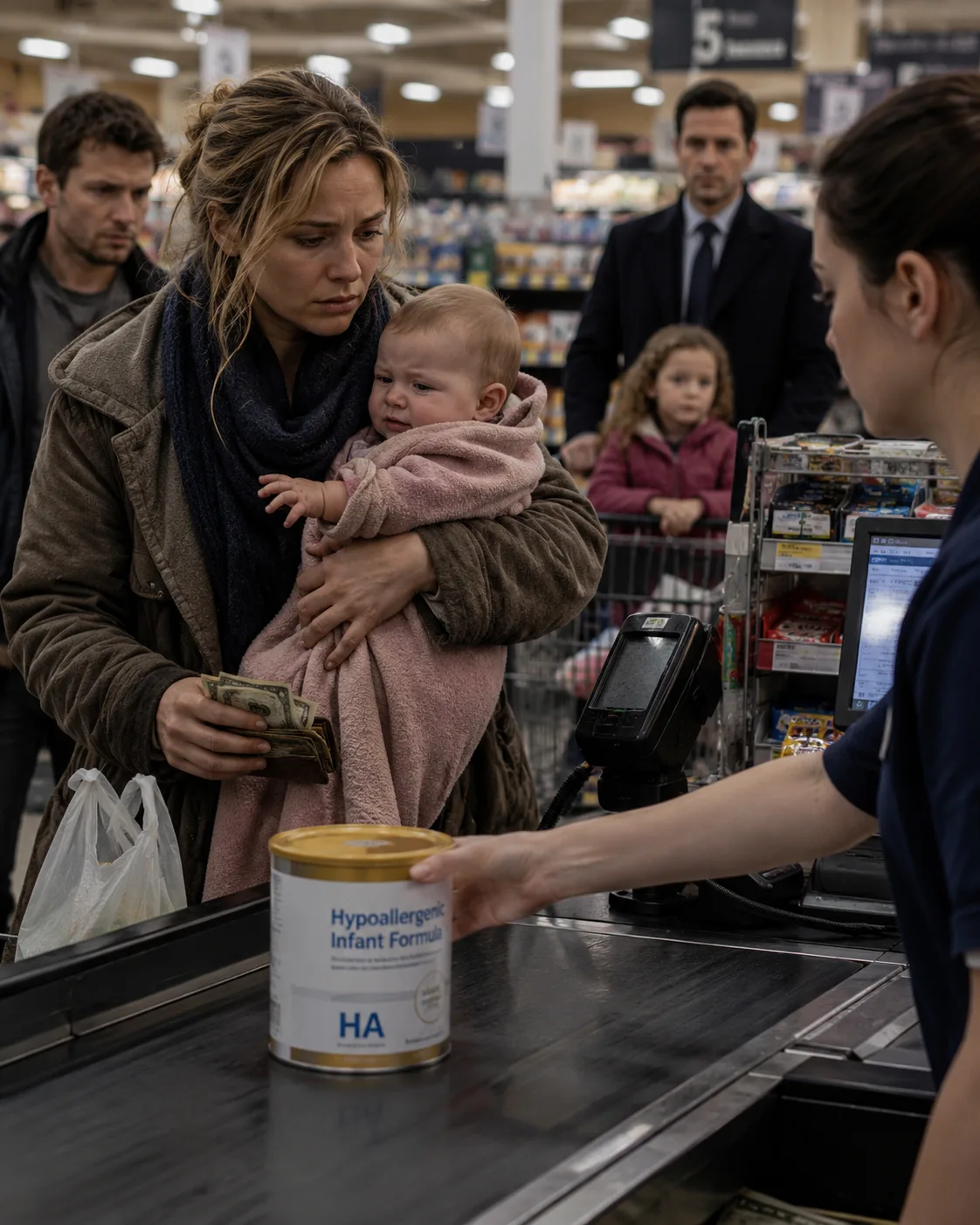
The Lonely CFO Bought Formula for a Freezing Single Mother, Then Discovered Her Grandfather Had Saved His Father in Iraq
Mara Ellison counted the money three times before she stepped into the baby aisle.
Chapter 1
Mara Ellison counted the money three times before she stepped into the baby aisle.
The first count had been at the kitchen table, with Rosie sitting in her high chair, chewing the corner of a soft plastic spoon while the radiator clicked like an old man clearing his throat. Twenty-three dollars and forty-eight cents. Mara had stacked the bills by size, then lined the coins beside them in little towers, as if making the money neat could make it enough.
The second count had been on the bus, under the yellow overhead light, with her fingers hidden inside her coat pocket so no one would see how little she had.
The third count happened in the MegaMart baby aisle, beside shelves full of diapers, wipes, pacifiers, bottles, and brightly colored promises that all seemed designed for mothers who did not have to do math before feeding their children.
Twenty-three dollars and forty-eight cents.
The formula was forty-one ninety-nine.
Mara stood still.
Rosie shifted against
her hip, wrapped in a faded pink blanket that had once belonged to Mara’s neighbor’s granddaughter. The blanket had a small burn mark near one corner and a row of tiny yellow ducks along the edge. Rosie’s cheeks were pink from the cold, her little nose damp, her fingers curling and uncurling near Mara’s scarf.
“Almost done, baby,” Mara said.
Her voice came out steady.
That surprised her.
The formula sat on the middle shelf, exactly where it always was. Hypoallergenic. Soy-based. Doctor recommended. The only brand that did not turn Rosie’s skin red and rough. The only one that did not make her cry until her tiny body shook from it.
Mara reached for the can, then stopped with her hand halfway there.
The price tag looked too white under the fluorescent lights.
$41.99.
She closed her eyes for half a second.
Not enough.
She had already put back
the chicken broth. She had already put back the eggs. She had stood for nearly a full minute holding a small bag of apples before choosing the cheaper bruised ones, the kind sold in a loose plastic sack with one or two soft spots hidden underneath. Bread, oatmeal, apples, formula. That was supposed to be it. A week of stretching. A week of making it work.
It did not work.
Rosie made a small broken sound, not quite a cry. Mara tightened her arm around her.
“I know.”
She took the can anyway.
The metal felt cold through her glove.
At the checkout lane, the cashier barely looked up. She was young, maybe nineteen, with a messy bun, chipped pink nail polish, and gum tucked in one cheek. She scanned the bread. The oatmeal. The apples. Then the formula.
The register beeped.
Mara watched the total climb.
Forty-seven eighty-three.
She
knew before the cashier said anything. The number was there on the screen, bright and final.
Mara opened her wallet.
A ten. Two fives. Three ones. Quarters. Dimes. A receipt from the pharmacy. A bus transfer. A photo of Rosie from the hospital nursery, still wearing the little striped cap, still unaware of rent, late fees, winter, or the weight of a mother’s empty wallet.
Mara placed the money on the counter.
The cashier counted without expression.
“You’re short.”
Mara nodded once.
Her throat did not move right.
“I’ll take off the formula.”
The cashier reached for the can.
The movement was ordinary. That was the worst part. She did not hesitate. She did not look at Rosie. She did not look cruel either. She simply put her hand around the can and slid it away, back toward the side of the register where unwanted items collected: a frozen pizza sweating through its cardboard, a bottle of shampoo, a toy truck with a red clearance sticker.
Mara’s hand twitched.
She almost reached for it.
She did not.
Behind her, a man in a gray jacket exhaled through his nose, sharp enough for the whole line to hear.
Mara lowered her eyes.
Rosie started crying.
Not loud. Not yet. Just a thin, tired sound that made Mara’s ribs tighten around nothing.
The cashier bagged the bread and oatmeal.
“Eleven forty-two.”
Mara pushed forward the money she could spend. The cashier gave back coins without looking at her.
Mara gathered the plastic bag, shifted Rosie higher, and turned from the checkout lane. The man behind her had already moved up, already unloading frozen dinners and beer and a pack of batteries. His cart bumped the back of Mara’s boot.
“Sorry,” he said, not sounding sorry.
Mara kept walking.
She passed the automatic doors. Warm air pushed at her back, then vanished. The parking lot opened in front of her, wide and white, covered in fresh snow under sodium lights. Cars sat in rows, their roofs buried, their windshields fogged. The bus stop shelter stood at the far edge of the lot, small and open on one side, its plastic walls scratched by years of weather and initials carved by bored teenagers.
Mara walked toward it with Rosie pressed to her chest.
She did not see Ethan Caldwell watching from beside the coffee kiosk.
But Ethan saw her.
He had noticed her first in the baby aisle.
Not because she was beautiful, though she was in the worn-down way people became beautiful when life had failed to erase them. Not because she looked out of place. MegaMart had plenty of tired people in winter coats, plenty of parents with restless children, plenty of shoppers who stared too long at price tags.
He noticed because of the way she stood.
Mara had stood in front of the formula shelf like someone facing a locked door while holding the only key she could not afford to use.
Ethan understood numbers. He lived inside them.
Quarterly forecasts. Cash flow. Medical supply margins. Vendor contracts. Payroll projections. Debt restructuring. Numbers behaved if you respected them. Numbers told the truth even when people did not.
But the numbers in Mara’s face had been different.
They had been hunger. Weather. Rent. A baby’s rash. A bus schedule. A mother deciding which kind of failure would hurt least.
Ethan Caldwell was thirty-seven, chief financial officer of Hearthstone Medical Systems, and one of the richest men in that part of Pennsylvania who still bought his own groceries. His assistant had offered to arrange delivery. His housekeeper had offered to stock the pantry. His driver had offered to stop by the store before picking him up from the office.
Ethan had said no.
He came because Junie liked choosing her own apples.
His five-year-old daughter sat in the front of the cart, swinging her legs in purple snow boots, sipping apple juice through a straw and watching the world with the serious attention of a judge. Her curls were tucked beneath a knitted white hat. Her mittens were mismatched because she insisted one pink and one yellow made them “friendlier.”
Junie had been three months old when Rachel died.
The word died still felt too small for what had happened.
Rachel had been there, and then she had not.
A blood clot. A hospital corridor. A doctor with gentle eyes and clean hands. Ethan standing under too-bright lights, holding a diaper bag, waiting for someone to tell him where to put all the love that had nowhere to go now.
Four years later, he had built a life that looked respectable from outside.
He woke at five. Ran three miles. Packed Junie’s lunch. Signed documents. Sat in meetings. Made decisions that moved millions of dollars. Read two bedtime stories every night. Answered email after she slept. Paid every bill early. Kept fresh flowers on Rachel’s grave.
No one could say he had failed.
Still, the house was too quiet.
Junie tugged his sleeve.
“Daddy.”
Ethan looked down.
Junie was staring toward the exit, where Mara had just disappeared into the snow with Rosie crying against her shoulder.
“Why doesn’t that baby have milk?”
The question landed without warning.
Ethan looked at the automatic doors.
Mara was outside now. Snow gathered in her hair. The plastic bag swung from one wrist. She leaned over the baby, trying to shield her with her own body.
Junie kept watching.
“Babies need milk,” she said.
Ethan’s gloved hand tightened around the cart handle.
“Yes,” he said. “They do.”
“Then why did the lady put it back?”
The cashier had placed the formula can in the return pile. It still sat there near the register, under the light, unwanted by the system and desperately needed by the child who had left without it.
Ethan looked at Junie.
Rachel would have known what to do immediately. She would have moved before thinking too much. She had been like that. Quick to notice the person left out, quick to give, quick to embarrass Ethan by being kinder than anyone expected.
He had once told her she could not fix the whole world.
Rachel had looked at him over the top of her coffee mug and said, “No. But I can fix the part standing in front of me.”
Ethan turned the cart around.
Junie bounced in her seat.
“Are we getting the milk?”
“Yes.”
“For the baby?”
“Yes.”
“And maybe mittens?”
Ethan paused, then looked at his daughter.
Junie held up her own mismatched hands.
“Her fingers looked cold.”
Ethan swallowed once.
“Yes,” he said. “Mittens too.”
He bought the formula. Two cans, not one. He bought fleece mittens with small stitched bears on them. He bought chicken noodle soup from the hot counter, macaroni and cheese, soft rolls from the bakery, a small container of cut fruit, and a thermos of cocoa because Junie insisted babies’ mommies needed warm drinks too.
At the register, the same cashier scanned the formula again.
This time, she looked up.
Ethan did not explain.
He paid cash. Left the change.
Outside, the cold struck hard. Junie held his coat with one mittened hand. Ethan carried the brown paper bags in the other. The snow had thickened, blowing sideways across the lot. A plow scraped the far end near the pharmacy entrance. Somewhere a car alarm chirped once and went silent.
Mara stood under the bus shelter.
She had put Rosie inside her coat as much as she could, leaving only the baby’s face visible above the worn pink blanket. The plastic grocery bag rested at her feet. Mara’s lips were pale. She rocked Rosie with small careful movements, the kind made by someone trying to spend as little energy as possible.
Ethan stopped three feet away.
Mara saw his shoes first. Black leather. Clean. Expensive.
Then she looked up.
Her body changed at once. Not dramatically. Just enough. A tightening around the baby. A shift of her feet. A woman measuring danger in a parking lot.
“Excuse me,” Ethan said.
Mara said nothing.
Junie peeked from behind his coat.
Ethan lifted one bag.
“I think you dropped this.”
Mara stared at it.
“No,” she said. “I didn’t.”
“It’s yours now.”
Her eyes moved to the top of the bag. The formula can was visible, its white label catching the bus stop light.
Mara’s face did not break.
That made it worse.
“I can’t take that.”
Ethan kept his hand extended.
“It isn’t charity.”
Her mouth tightened.
“People always say that right before they give charity.”
Junie stepped forward before Ethan could answer.
“My daddy buys too many apples sometimes,” she said. “So it’s not weird.”
Mara blinked.
The smallest crack appeared in her composure, not a smile, not yet, but something less guarded.
Ethan lowered his voice.
“As a father,” he said, “I couldn’t walk away.”
Mara looked at Rosie.
The baby’s cry had thinned to a tired whimper. Her little hand opened near Mara’s scarf.
The bus was not coming. The sign said it should have arrived six minutes ago. Snow collected on the schedule posted behind scratched plastic.
Mara reached for the bag.
Her fingers shook around the handle.
“Thank you.”
“You don’t have to thank me.”
“I do.”
Ethan looked at the street, then back to her.
“Where are you headed?”
Mara’s eyes sharpened again.
“Home.”
“Is it far?”
“A mile.”
“In this?”
“I’ve done worse.”
He believed her. That was the problem.
Junie looked at Rosie, then at Mara.
“Please ride with us,” she said. “The baby’s nose is red.”
Mara glanced from Junie to Ethan. Pride and caution moved across her face like weather across glass.
“I don’t get in cars with strangers.”
“You shouldn’t,” Ethan said.
That answer seemed to surprise her.
He took a business card from his coat pocket and held it out between two fingers.
“My name is Ethan Caldwell. I work at Hearthstone Medical Systems. You can call the number on that card before we move. You can send a photo of my license plate to someone. You can sit in the back with the baby. Junie and I will sit up front.”
Mara looked at the card.
CFO.
Hearthstone Medical Systems.
A man like him did not belong at her bus stop, holding formula in the snow.
Still, Rosie cried again.
A small sound.
Enough.
Mara took the card.
“For her,” she said.
Ethan nodded.
“For her.”
The SUV was warm. Too warm at first. Mara sat in the back seat with Rosie while Junie twisted around from the front, asking questions Ethan had to stop with a look.
“What’s your baby’s name?”
“Rosie,” Mara answered.
“My name is Junie. I’m five. I had a fish but it died. We had a funeral in a teacup.”
“Junie,” Ethan said.
“What? It’s true.”
Mara made a sound under her breath. Almost a laugh.
Ethan heard it and kept his eyes on the road.
Maple Fifth was not a long drive, but each block seemed to move Mara into a smaller version of the town Ethan knew. The medical district gave way to closed storefronts, then older brick buildings with sagging awnings, then narrow streets where salt had not been spread well and porch lights flickered over shoveled paths.
Mara’s apartment building stood between a laundromat and a vacant insurance office. The siding was cracked. A plastic wreath hung crookedly by the entrance. Someone had taped a note near the mailboxes about stolen packages.
Ethan parked.
Mara opened the door before he could offer to help.
“I can carry it.”
“I know.”
She looked at him for a beat.
Then she let him take one of the bags.
The hallway smelled faintly of detergent, old carpet, and someone’s fried onions. Mara climbed the stairs slowly with Rosie against her chest. Ethan followed with Junie and the groceries. The third step from the top creaked under everyone’s weight.
Mara’s door was green, faded nearly gray around the edges.
Inside, the apartment was small but carefully kept. A couch with a patched quilt. A tiny kitchen with two mugs drying upside down on a towel. A bookshelf made from stacked crates. A laundry basket half hidden behind a curtain. Children’s books lined along the wall, some with taped spines. On the windowsill sat a jar with three paper snowflakes inside, cut unevenly from old envelopes.
Rosie quieted almost immediately in the warmth.
Mara set her down on a blanket near the couch, then opened the formula with a speed that told Ethan how long she had been waiting to do it. She measured powder into a bottle, added water, shook it, tested it against her wrist. Rosie grabbed for it with both hands.
The baby drank.
Mara turned her face away.
Ethan pretended to study the room.
That was when he saw the photograph.
It hung above the couch in a plain black frame. A young man in uniform, broad-shouldered, clean-shaven, with eyes that looked directly into the camera without asking permission. Beneath it, a small engraved plate read:
STAFF SERGEANT EVAN ELLISON
OPERATION IRAQI FREEDOM, 2004
Ethan stopped moving.
Mara followed his gaze.
“My grandfather,” she said.
Ethan stared at the name.
“Evan Ellison?”
“Yes.”
“He raised you?”
Mara nodded. “After my parents died. He used to say the world was ugly enough without us helping it.”
Ethan did not answer.
Junie had already settled on the floor beside Rosie, showing her a small stuffed rabbit pulled from her coat pocket. Rosie drank from the bottle and stared at Junie with solemn fascination.
Mara unpacked the soup.
“You don’t have to stay,” she said.
“I know.”
“I mean it.”
“So do I.”
She looked at him then, really looked. Not at his coat. Not at the expensive watch he had forgotten to hide beneath his sleeve. At him.
There was no room in Ethan’s life for what passed between them in that moment.
So he did what he always did when something mattered too much.
He became practical.
“Do you have bowls?”
Mara gave him one careful, suspicious glance.
Then she opened a cabinet.
They ate soup at the tiny kitchen table while Junie fed Rosie soft crumbs of bread under Mara’s supervision. The radiator clanked. Snow tapped the window. A neighbor’s television murmured through the wall. It was not elegant. It was not impressive. It was the warmest room Ethan had sat in for years.
Mara told him pieces of herself because Junie asked questions no adult would dare ask.
“Where’s Rosie’s daddy?”
“Not here.”
“Did he get lost?”
“No. He chose somewhere else.”
“Do you have a mommy?”
“No.”
“A daddy?”
“No.”
“Do you have anybody?”
Mara’s spoon paused over the bowl.
Ethan said, “Junie.”
Mara gave a small shake of her head.
“It’s okay.” She looked at Junie. “I have Rosie.”
Junie considered this.
“And now you have soup.”
Mara’s mouth curved despite herself.
“Yes,” she said. “Now I have soup.”
That night, after Ethan carried Junie into their large quiet house and tucked her beneath the quilt Rachel had made, he went downstairs instead of to his office.
The cedar box sat in the hall closet behind winter scarves and old tax files.
He had not opened it in eleven months.
Inside were his father’s military papers, letters, photographs, ribbons, and a watch with a cracked face that had stopped at 2:13. Graham Caldwell had died of a heart attack three years earlier, but his letters still smelled faintly of cedar and dust.
Ethan searched until he found the one he remembered.
August 3, 2004.
His father’s handwriting was cramped, the ink faded at the folds.
The convoy hit an IED outside Mosul. I remember heat, metal, and the sound of someone yelling my name though nobody near me knew it. My leg was trapped. I thought I was finished. Then a soldier crawled through smoke and pulled me clear. Staff Sergeant Evan Ellison. Remember that name. He stayed with me until the medics came. If I get home, it will be because he refused to leave a stranger under burning steel.
Ethan sat back.
Evan Ellison.
Mara’s grandfather.
He read the letter again. Then a third time.
On the mantel, Rachel smiled from a silver frame, holding newborn Junie in the hospital. Ethan looked at the photograph and heard her voice again.
I can fix the part standing in front of me.
He folded the letter carefully.
By morning, he had made three phone calls.
The first was to his attorney.
The second was to the director of the Hearthstone Veterans Support and Outreach Center.
The third was to his personal accountant.
“I want a fund established,” Ethan said. “Not a donation for headlines. A real program.”
“What kind of program?” the accountant asked.
“Education, job training, emergency assistance, child care stipends. For descendants of veterans.”
“That’s broad.”
“Then make it broad enough to matter.”
“Name?”
Ethan looked at the letter on his desk.
“The Ellison Legacy Grant.”
There was a pause.
“And the first recipient?”
Ethan did not hesitate.
“We start with Mara Ellison.”
Mara did not hear from Ethan for four days.
That should have relieved her.
Instead, it made her restless.
She told herself she was glad. Kind strangers were dangerous in their own way. They made you imagine a world you could not afford to believe in. Better that the moment had ended cleanly: formula, soup, a ride home, goodbye.
But Junie had left the stuffed rabbit behind.
Mara found it under the edge of the couch the next morning, one floppy ear trapped under Rosie’s blanket. It was small and gray, with a stitched nose and a missing button on its little vest.
Rosie loved it immediately.
Mara placed it on the windowsill where she could remember to return it.
Then the phone rang.
The number was unfamiliar.
“Ms. Ellison?” a woman asked.
“Yes.”
“My name is Denise Harper. I’m calling from the Hearthstone Veterans Support and Outreach Center. You applied for an administrative assistant position with us earlier this fall.”
Mara sat down slowly.
“I did.”
“I’m sorry for the delay. Funding was uncertain at the time. But a new opportunity has opened.”
Mara stared at the jar of paper snowflakes.
“What kind of opportunity?”
“A paid training position. Benefits after ninety days. Child care support included. There is also a pathway to finish your degree if you’re interested.”
Mara did not speak.
“Ms. Ellison?”
“I’m here.”
“We’d like you to come in tomorrow.”
Mara pressed her free hand flat against the table.
“Why?”
Denise’s voice warmed.
“Because someone finally gave us the money to hire the people we should have hired months ago.”
The next day, Mara borrowed a clean blouse from her neighbor, pinned her hair back, and carried Rosie across town in the cold morning light. The Veterans Outreach Center stood in a brick building near the courthouse. Inside, the walls were lined with photographs of men and women in uniform, some smiling, some young enough to look unfinished.
Denise Harper had silver hair, kind eyes, and a way of listening that made Mara careful with her words. She explained the position. Intake forms. Scheduling. Veteran family services. Grant coordination. Training. A salary that made Mara check the page twice because it felt like a printing mistake.
Then Denise slid a folder across the table.
“The position is funded through the Ellison Legacy Grant.”
Mara’s fingers stopped on the folder.
“Ellison?”
“Yes.”
“My grandfather’s name was Ellison.”
Denise nodded.
“I know.”
The room tilted slightly.
“Who started this?”
“The donor requested privacy at first.”
“At first?”
Denise folded her hands.
“He also requested that the grant honor Staff Sergeant Evan Ellison.”
Mara looked down at the folder. Her grandfather’s name was printed in clean black letters across the top.
For a second, she was twelve again, sitting at his kitchen table while he taught her how to balance a checkbook with a pencil sharpened down to a stub. Numbers don’t care if you’re tired, Mara-girl, he had said. That’s why you make them honest before they make you desperate.
Her thumb moved over his name.
“Why him?”
Denise’s expression shifted.
“I think that part is not mine to tell.”
Mara knew then.
Ethan.
The knowledge came without proof.
It should have made her angry. Maybe it did, somewhere. She had not asked to be rescued. She had not asked to be turned into someone’s moral project. But the folder in front of her was not a bouquet. It was not a one-time check. It was work. Training. A door.
Mara opened it.
“When do I start?”
Denise smiled.
“Monday.”
The first weeks were hard.
Not the kind of hard Mara understood. She knew cold hard, hungry hard, late-bill hard, baby-sick-at-midnight hard. This was different. This was walking into a professional office with secondhand shoes and pretending not to notice when someone’s eyes dropped to the scuffed toes. This was learning software while Rosie had a cough. This was answering phones for veterans who had lost homes, spouses, benefits, and sometimes pieces of themselves, then going to the bathroom to press cold water against her wrists because she recognized too much of their voices.
Ethan did not hover.
He sent one email.
Ms. Ellison,
I heard you accepted the position. Staff Sergeant Ellison’s name could not be in better hands.
Ethan Caldwell
Mara read it three times.
Then she replied:
Mr. Caldwell,
Thank you for making the grant useful instead of decorative.
Mara Ellison
His answer came twelve minutes later.
That was the goal.
She almost smiled.
By the time the inaugural ceremony was announced, Mara had learned to answer the center’s main line, organize intake files, calm angry callers without surrendering to them, and make coffee strong enough for Denise to call it “legally concerning.”
The invitation arrived in a white envelope with her name printed correctly.
She was asked to speak.
Mara nearly declined.
Then she looked at her grandfather’s photograph above the couch and saw the same eyes that had watched her do homework, wash dishes, cry into her sleeves after her parents’ funeral, and bring home every report card like a peace offering.
“You would make me do it,” she said to the picture.
Rosie slapped both hands against the floor.
Mara took that as agreement.
The ceremony was held in a veterans’ hall with polished floors, folding chairs, framed flags, and a stage just high enough to make Mara’s knees feel unreliable. She wore a navy dress borrowed from Denise’s niece and black shoes that pinched her left heel. Rosie wore a white dress with a little cardigan. Junie spotted them from across the room and ran so fast Ethan had to call her name.
“Mara!”
Junie collided gently with Mara’s legs, then hugged Rosie too.
Rosie grabbed her curls.
Junie did not mind.
Ethan approached more slowly.
He wore a dark suit, no overcoat, no gloves. Without the winter armor, he looked less like a man carved from polished stone and more like someone who had not slept enough.
“You came,” he said.
“I was invited.”
“I’m glad.”
Mara shifted Rosie on her hip.
“I know it was you.”
Ethan did not pretend otherwise.
“My father owed your grandfather his life.”
“My grandfather would have hated that sentence.”
“Probably.”
“He didn’t save people so someone would owe him.”
“No.” Ethan looked toward the stage, where volunteers were arranging programs. “But my father remembered. So do I.”
Mara looked down at Rosie, who was trying to eat the corner of Junie’s program.
Before she could answer, Junie tugged Mara’s dress.
“Miss Mara?”
“Yes?”
“If you’re Rosie’s mommy, can you be mine too sometimes?”
The room seemed to shrink around that one small voice.
Ethan went still.
Mara lowered herself carefully so she was eye level with Junie.
“That’s a very big question.”
Junie nodded with total seriousness.
“I know.”
Mara brushed a curl away from Junie’s cheek.
“I can be someone who cares about you very much.”
Junie considered this.
“Like a bonus mommy?”
Ethan closed his eyes for half a second.
Mara looked up at him.
He was not embarrassed. Not exactly. His face held something rawer than that.
“If your daddy says that’s okay,” Mara said.
Junie spun toward Ethan.
“Daddy?”
Ethan’s mouth moved before sound came.
“We can talk about it.”
Junie beamed as if that meant yes.
Across the room, Celeste Harrow watched.
She had arrived in a gray designer suit with pearl earrings and a smile practiced enough to pass inspection. As executive vice president at Hearthstone Medical Systems, she had worked beside Ethan for six years. She knew his calendar better than most of his friends did. She knew he took his coffee black, never scheduled meetings before Junie’s school drop-off unless there was a crisis, and hated public praise disguised as philanthropy.
She had admired him first.
Then respected him.
Then, quietly and with the confidence of a woman used to being chosen, she had begun imagining that grief would eventually turn in her direction.
Men like Ethan did not marry waitresses. They did not bend their lives around women in borrowed dresses. They did not look across crowded rooms at poor single mothers as if the rest of the world had become background noise.
Celeste watched Junie cling to Mara’s hand.
Her smile thinned.
When Mara took the stage, the room quieted.
She stood behind the microphone with Rosie in Denise’s arms near the front row. Her hands held the edges of her speech folder, but she did not open it right away.
“My grandfather hated ceremonies,” Mara began.
A few people laughed.
“He said the coffee was always bad, the chairs were always worse, and someone always talked too long.”
More laughter.
Mara breathed once.
“But he came anyway. Every time. Because he believed showing up mattered.”
Ethan watched from the second row.
Mara spoke of Evan Ellison not as a hero polished for a plaque, but as a man who repaired broken cabinet doors, burned grilled cheese, kept peppermints in his coat pocket, and never let Mara leave the house without checking if her shoes were tied. She spoke of a soldier who carried war home quietly and still made room for bedtime stories. She spoke of legacy not as inheritance, but as responsibility.
Then she looked at the room.
“This grant did not give me dignity,” she said. “My grandfather already taught me that. What it gave me was room. Room to work. Room to study. Room to feed my daughter without choosing which bill would punish us first.”
The hall stayed silent.
Mara’s fingers tightened around the folder.
“So I will use that room well.”
Applause rose slowly, then filled the hall.
Ethan stood.
Others followed.
Mara stepped back from the microphone. Her heel caught slightly on a cable taped to the floor. She steadied herself before anyone could help.
Celeste saw that too.
By the next morning, the whispers had begun.
They did not start as accusations. Accusations were too crude for Celeste. They started as concerns.
Wasn’t it unusual that the first recipient of Ethan Caldwell’s grant was a young single mother he had personally brought to an event?
Had anyone verified her qualifications?
Was it appropriate for Junie Caldwell to be so attached to her?
Did the Veterans Center understand the optics?
By the end of the week, an anonymous email had gone to three board members, two Hearthstone executives, and Denise Harper.
Subject line: Ethical Concern Regarding Ellison Grant Recipient.
Mara heard about it from Denise, who closed her office door before speaking.
“There may be a review.”
Mara sat across from her.
“A review of what?”
“Your selection.”
Mara’s hands went still in her lap.
Denise removed her glasses.
“I want you to know that I don’t believe any of this.”
“Any of what?”
Denise hesitated.
Mara gave a short nod.
“Say it.”
“That your connection to Mr. Caldwell influenced the grant improperly.”
Mara looked toward the window.
Outside, a man in a veteran’s cap stood by the curb smoking beside the salt-stained snow. The cigarette shook between his fingers.
“My connection to him,” Mara repeated.
“I’m sorry.”
“Did they say it like that?”
“Not exactly.”
“Of course not.”
Denise leaned forward.
“The board meeting is Thursday. You can attend. Ethan will be there.”
Mara’s face changed at his name.
“I don’t need him to defend me.”
“No,” Denise said. “But the truth may need more than one witness.”
Thursday came with freezing rain.
Mara arrived early.
The boardroom at the Veterans Outreach Center had a long table, twelve chairs, a coffee station, and one crooked framed photograph of the building’s opening day. Mara noticed the crooked frame immediately and wanted badly to straighten it. She did not. Her hands were safer folded in front of her.
Celeste sat on the right side of the table, not as a board member, technically, but as a corporate ethics advisor from Hearthstone Medical Systems. That was how the invitation had described her role.
She smiled at Mara.
“Mara. Thank you for coming.”
Mara did not sit until Denise touched the back of a chair.
Ethan arrived two minutes late, carrying a leather folder and no umbrella. Rain darkened the shoulders of his coat. He looked at Mara once, long enough to confirm she was there, not long enough to make the room use it against her.
The chairwoman, Helen Briggs, called the meeting to order.
Celeste began with a stack of papers.
“I want to be clear,” she said. “No one here is questioning Ms. Ellison’s personal hardships.”
Mara looked at the table.
There it was.
The clean blade.
Celeste continued.
“The concern is process. When philanthropic funds are attached to powerful corporate figures, perception matters. Ms. Ellison appears to have had personal contact with Mr. Caldwell before receiving the award.”
Ethan opened his folder.
Celeste glanced at him.
“Further, there are questions about whether the emotional nature of that contact may have affected the donor’s decision.”
Mara’s nails pressed into her palm.
Helen looked at Ethan.
“Mr. Caldwell?”
Ethan stood.
Not quickly. Not dramatically. He simply rose, and the room adjusted around him.
“If perception matters,” he said, “then facts matter more.”
He removed an old letter from a protective sleeve.
The paper looked fragile under the conference room lights.
“My father wrote this in August of 2004 after an attack outside Mosul.”
Celeste’s smile remained, but something in her eyes tightened.
Ethan placed the letter in front of Helen.
“He was trapped under a burning vehicle. A soldier pulled him out and stayed with him until medics arrived.”
Helen lowered her eyes to the page.
Ethan looked at the board, not at Celeste.
“That soldier was Staff Sergeant Evan Ellison.”
The room changed.
Not loudly.
A pen stopped tapping. Someone shifted back in their chair. Denise covered her mouth with one hand.
Mara did not move.
Ethan continued.
“I did not know Mara Ellison when I saw her in MegaMart. I saw a mother returning formula because she could not afford to feed her child. I helped her because my daughter asked a question I could not ignore.”
Mara’s throat worked once.
Ethan’s voice stayed even.
“Later, I saw Staff Sergeant Ellison’s photograph in her apartment. I recognized the name from my father’s letter. I went home. I found the letter. Then I created the grant.”
Celeste set her pen down.
Ethan turned slightly, finally looking at her.
“So if your suggestion is that Mara Ellison manipulated me, you’re wrong. If your suggestion is that she was selected because of a private relationship, you’re wrong. She was selected because her grandfather’s courage gave my family twenty extra years with my father, and because she met every requirement this center set.”
He let the words sit.
Then he added, “The only thing improper here is the attempt to dress jealousy as ethics.”
Celeste’s face lost color in small degrees.
Helen looked up from the letter.
“Ms. Ellison,” she said. “Would you like to speak?”
Mara stood.
Her chair made a small sound against the floor.
She hated that everyone watched her. She hated that poverty had made her public. She hated that accepting help had somehow become evidence against her.
But she thought of Rosie drinking formula in the warm apartment.
She thought of her grandfather’s hands, broad and scarred, tying her shoelaces when she was six.
She thought of Junie asking if she could be loved too.
Mara placed both palms on the table.
“I did not ask Mr. Caldwell for money,” she said. “I did not know his father. I did not know my grandfather had saved him. I applied for a job months before this grant existed because I needed work.”
No one interrupted.
“My grandfather used to say that if you do the right thing, someone may still make it ugly afterward. That doesn’t make it less right.”
Celeste looked down.
Mara kept going.
“I returned baby formula because I was short twenty-four dollars and thirty-five cents. That number has been in my head every day since. Not because I’m ashamed of it. Because that was the exact price of the moment everyone else looked away.”
Ethan’s hand tightened on the back of his chair.
Mara turned her eyes to the board.
“This grant is not a favor. It is not a romance. It is not a scandal. It is a legacy with my grandfather’s name on it. I will work for it. I will protect it. And I will not apologize because someone else preferred me helpless.”
Silence followed.
Clean silence.
Helen removed her glasses.
“Thank you, Ms. Ellison.”
She turned to Celeste.
“Ms. Harrow, this board invited you to advise on ethics. It appears you brought us innuendo.”
Celeste straightened.
“I brought legitimate concerns.”
“You brought no evidence.”
“I was protecting the institution.”
Helen slid the anonymous email across the table.
“From whom?”
Celeste looked at the paper.
Her name was not on it. But people like Celeste always believed style was invisible to those beneath them. It was not.
Denise spoke for the first time.
“The phrasing matches two emails you sent me Tuesday.”
Celeste’s jaw shifted.
Ethan said nothing.
That was worse than anger.
Helen gathered the papers.
“This review is closed. Ms. Ellison remains the first recipient of the Ellison Legacy Grant. Mr. Caldwell’s donation remains accepted with our gratitude. Ms. Harrow, your advisory role is no longer required.”
Celeste stood.
The chair legs scraped the floor.
She picked up her bag, then looked at Mara.
For one second, the polished mask slipped far enough to show the small, mean panic beneath it.
Then she left.
The door shut with a soft click.
No one spoke immediately after.
Rain ticked against the window.
Mara sat down because her knees had started to feel uncertain.
Ethan remained standing.
Helen returned the letter to him with both hands.
“Your father was fortunate,” she said.
Ethan looked at the old paper.
“Yes.”
Mara looked at him then.
For the first time since the bus stop, she did not feel smaller beside him.
After the meeting, Ethan found her near the coffee station, staring at a paper cup she had not filled.
“I’m sorry,” he said.
Mara turned.
“For what?”
“For bringing my world into yours.”
She looked toward the closed boardroom door.
“I think it was already there. It just wore better shoes.”
That startled a laugh out of him.
Mara almost smiled.
Ethan held out Junie’s gray stuffed rabbit.
“She asked me to bring this. Apparently Rosie has been borrowing it too long.”
Mara took it.
“Rosie drooled on the ear.”
“Junie expected that.”
“She did?”
“She said babies pay rent in drool.”
This time Mara did smile.
Small. Tired. Real.
The months that followed did not turn magical.
Rent still came due. Rosie still woke with fevers. Mara still fell asleep over coursework after long days at the center. Ethan still had meetings that drained the light from his face. Junie still missed a mother she could barely remember and sometimes became furious over tiny things, like the wrong bowl or a bedtime story ending too soon.
But slowly, the spaces between them changed.
Junie came to Mara’s apartment on Saturdays. Rosie learned to clap when Ethan walked through the door. Mara finished her first semester with two A’s and one B she claimed did not bother her, though she complained about it for three days. Ethan learned that Mara hated being surprised with expensive things but would accept practical help if it came with receipts and respect. Mara learned that Ethan’s silence was not always distance. Sometimes it was him trying not to ruin something by naming it too soon.
Celeste resigned from Hearthstone Medical Systems six weeks after the boardroom meeting. Officially, she accepted a consulting role in Philadelphia. Unofficially, the anonymous email became less anonymous than she hoped, and people stopped inviting her into rooms where trust mattered.
The Ellison Legacy Grant grew.
Not fast. Properly.
One recipient became five. Five became twelve. A child care stipend was added after Mara wrote a proposal so detailed that Ethan sent it back with only one note: You should be running this.
Three years after the night at MegaMart, she was.
Executive Director Mara Ellison stood at the front of the new Ellison Family Resource Center with scissors in one hand and Rosie holding the other. Rosie, now three, wore yellow boots and a serious expression. Junie stood beside Ethan, taller now, still mismatching her mittens by choice.
The ribbon was blue.
Mara looked at the small crowd: veterans, spouses, children, social workers, donors, people who had once sat in waiting rooms with forms they did not understand and fear they could not afford.
Ethan stood slightly behind her.
He did that now. Not because he was less important. Because he understood when a room belonged to her.
Mara cut the ribbon.
Applause broke open.
Rosie shouted, “Again!”
Junie laughed and scooped her up.
Inside the center, near the entrance, hung two framed letters.
One was from Graham Caldwell, written in Iraq, naming the soldier who saved him.
The other was from Mara, written on her first day as executive director.
It was shorter.
We do not look away here.
That evening, after everyone left and the floor still smelled faintly of new paint and coffee, Mara stood alone in the lobby. Snow had begun falling outside the glass doors.
Ethan came up beside her.
“Ready to go home?”
Mara looked at the word Ellison above the reception desk.
Home had once been a green door in a cold building, a formula can she could not buy, and a bus that did not come.
Now it was two girls arguing over crayons in the back seat. It was Ethan leaving his shoes crooked by the door. It was Rosie calling for Daddy in the morning. It was Junie saving half her cookie for Mara even when she forgot and took one bite first.
Mara reached into her coat pocket and found the old gray rabbit. Rosie had insisted it come to the ribbon cutting.
One floppy ear was still stained from years ago.
She held it for a moment, then placed it on the reception desk beneath her grandfather’s name.
Ethan watched but did not ask.
Outside, snow covered the sidewalk in a clean white sheet.
Mara turned off the lobby lights.
Then she opened the door herself.
THE END
Chapter complete
You have reached the end of this chapter.
Continue reading
A few more worlds to get lost in after this chapter.




