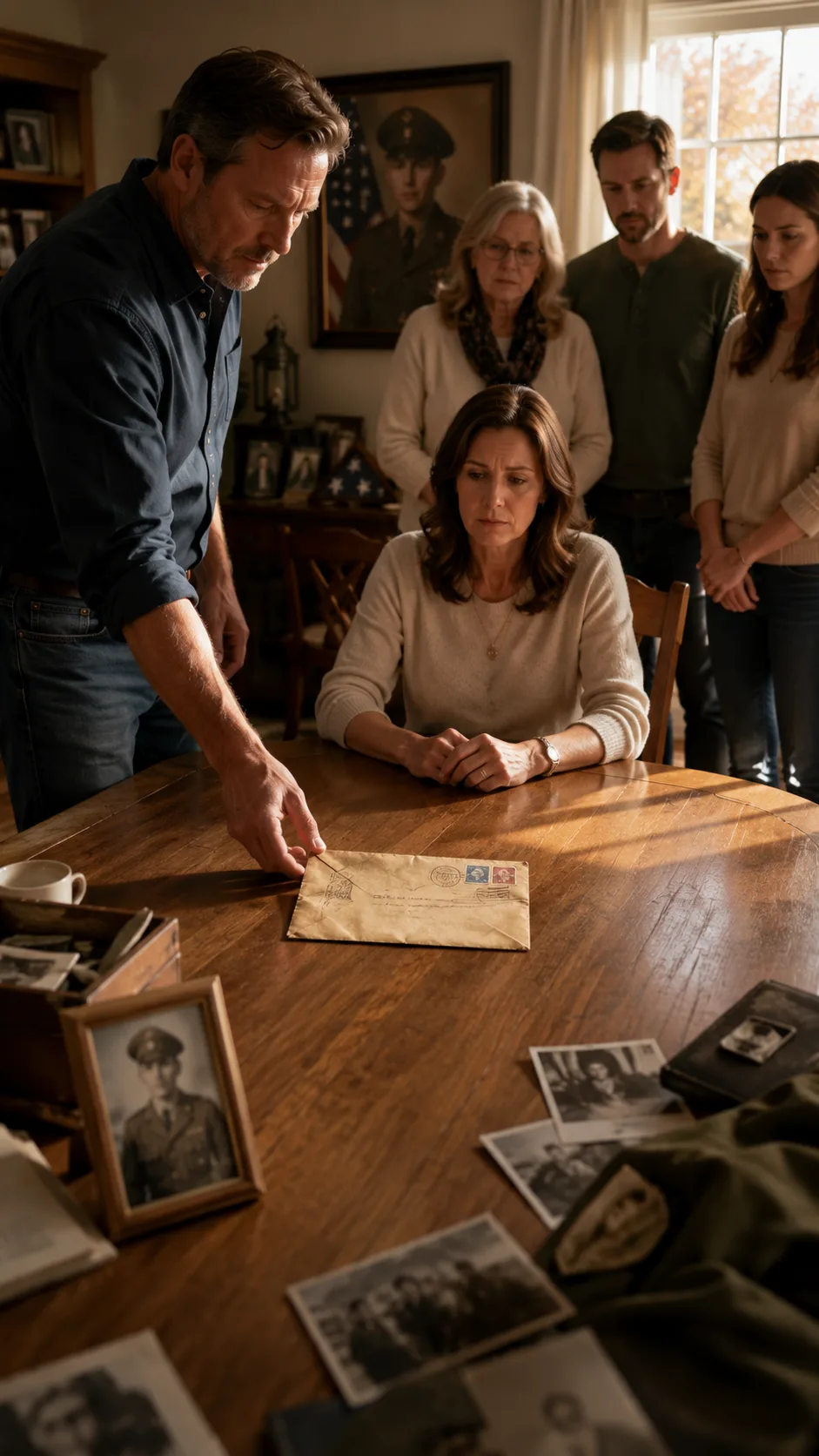
The cardboard box almost went into the donation pile.
Chapter 1
The cardboard box almost went into the donation pile.
That was the part I kept thinking about afterward.
One careless decision. One tired afternoon. One moment when my sister Susan nearly said, “Just throw it out.”
Instead, she dragged the box across the attic floor, leaving a trail through decades of dust, and set it beside an old lamp that hadn’t worked since the Clinton administration.
“Anything important in here?” she asked.
I shrugged.
Our father had been gone for three months.
At eighty-seven, he’d left behind a lifetime of ordinary things.
Old jackets.
Fishing gear.
Receipts from hardware stores that no longer existed.
Photographs nobody had labeled.
The attic was full of them.
We had spent two weekends sorting through his belongings, trying to decide what stayed and what went.
By then, grief had changed shape.
The casseroles had stopped arriving.
The sympathy cards had stopped appearing.
The church flowers were gone.
What remained was work.
Boxes.
Closets.
Drawers.
Evidence that a person had occupied space for nearly nine decades.
The box looked no different from the others.
No label.
No markings.
Just faded cardboard and brittle tape.
Susan cut it open.
Inside were military photographs, a folded map of Korea, several notebooks, and a bundle of letters tied with a blue ribbon.
Then she found the envelope.
“Michael.”
Her voice changed.
Not dramatically.
Just enough.
I looked up.
The envelope rested in her hands.
Yellowed paper.
Foreign stamps.
Korean writing.
Our father’s name.
Nothing else.
No return address.
No explanation.
No clue why it had been hidden among old military keepsakes for so many years.
Susan turned it over.
Still sealed.
That alone felt wrong.
Our father never left mail unopened.
Never.
He paid bills the day they arrived.
Returned calls within hours.
Organized tax records by year.
An unopened letter was completely out of character.
“Should
we?”
I looked at the envelope.
Then at her.
Then back again.
Neither of us answered immediately.
A dusty attic fan rattled somewhere overhead.
The sound seemed unusually loud.
Finally, Susan slipped a finger beneath the flap.
The paper crackled.
And sixty years of silence began to break apart.
Inside were two things.
A photograph.
And a letter.
The photograph fell out first.
A Korean woman stood beside a little girl.
The girl couldn’t have been older than six.
Dark hair.
Serious eyes.
One hand gripping the woman’s sleeve.
Neither face meant anything to us.
At least not yet.
Susan unfolded the letter.
She read the first line.
Then stopped.
Completely stopped.
“Michael.”
“What?”
She looked at me.
Then handed over the page.
I read the opening sentence.
Dear Robert,
Your daughter asks about you every day.
The attic became silent.
Not the normal kind.
The kind where your brain
refuses to move forward because it’s still trying to understand what just happened.
Your daughter.
Not our sister.
Not a child he sponsored.
Not a neighbor.
Not a friend.
Your daughter.
I read the sentence again.
The words stayed exactly the same.
Our father had a daughter in Korea.
A daughter nobody in Massachusetts knew existed.
A daughter he had never mentioned.
A daughter who had apparently spent years waiting for him.
Everything after that happened quickly.
Susan called our older brother David.
David arrived within an hour.
By evening the three of us were sitting around Susan’s kitchen table, reading copies of the letter beneath a yellow overhead light that suddenly made the room feel older.
The letter was dated 1956.
Three years after the Korean War.
The woman explained that the child was healthy.
Growing quickly.
Learning English.
Waiting for letters.
Waiting for news.
Waiting for Robert.
Waiting.
The word appeared repeatedly.
That bothered me.
Because waiting suggested expectation.
Expectation suggested history.
History suggested a relationship our father had hidden for nearly seventy years.
David pushed the letter away.
“No.”
“What?”
“No way.”
He stood and walked toward the window.
Outside, a neighbor was mowing a lawn.
Life continued.
Apparently unaware that ours had just changed.
“That’s not Dad,” David said.
Nobody answered.
Because we didn’t know anymore.
For most of our lives, Robert Carter had been easy to define.
Veteran.
Father.
Husband.
Church volunteer.
Machine shop supervisor.
Reliable.
Predictable.
Steady.
Now there was an entirely different version sitting inside a single envelope.
And neither version fit neatly beside the other.
The next week became an obsession.
Every box.
Every cabinet.
Every drawer.
We searched everything.
Not because we wanted to.
Because we couldn’t stop.
Secrets create momentum.
Especially family secrets.
The deeper we looked, the stranger things became.
We found photographs from military service.
Maps.
Travel documents.
Christmas cards.
Old receipts.
Then Susan discovered something hidden inside a military Bible.
A savings account book.
The account had been opened in 1958.
The beneficiary wasn’t our mother.
Wasn’t any of us.
It was the little girl’s name.
The same name from the Korean letter.
For over thirty years, our father had deposited money into that account.
Month after month.
Year after year.
Not once.
Not occasionally.
Consistently.
The room went quiet again.
Because accidental mistakes don’t last thirty years.
This wasn’t an affair forgotten in youth.
This was a commitment.
A deliberate one.
And nobody had known.
David sat heavily in a chair.
“I don’t understand.”
Neither did we.
But a larger question had begun forming.
If Dad had spent decades helping this girl, why had he hidden it?
And why keep only one letter?
Where were the others?
The answer arrived in pieces.
The first piece appeared when Susan found another document tucked inside a photo album.
A letter from a military chaplain.
Dated 1954.
Short.
Formal.
Easy to miss.
Yet one sentence stood out immediately.
Thank you for continuing to honor your promise.
Promise.
That word changed everything.
Not because it explained anything.
Because it complicated everything.
A secret daughter was one story.
A promise was another.
Suddenly there were possibilities we hadn’t considered.
Maybe the girl wasn’t actually his daughter.
Maybe the letter writer used the word differently.
Maybe there was context missing.
Maybe we’d misunderstood the entire situation.
The uncertainty grew larger every day.
Then I contacted a military historian.
At first, I only wanted information about Dad’s unit.
Nothing more.
I scanned documents.
Photographs.
Letters.
Maps.
The historian replied several days later.
His email was brief.
Please call me.
That was never a good sign.
When I called, he sounded careful.
Measured.
Like a man deciding how much truth to reveal at once.
“Your father served near Daegu?”
“Yes.”
“Interesting.”
“What is?”
A pause.
Then:
“I found something.”
My grip tightened around the phone.
The historian explained that many Korean civilians had worked alongside American forces during the war.
Interpreters.
Guides.
Drivers.
Messengers.
Some became extremely important.
Some saved lives.
Many disappeared into history.
Then he mentioned a name.
A Korean translator attached to Dad’s unit.
The translator died during an attack.
Before his death, he reportedly asked surviving soldiers to help his wife and daughter if possible.
Several men promised.
Only one followed through.
Robert Carter.
My father.
I sat silently.
The explanation fit.
And yet it didn’t.
Because it answered one question while creating another.
If the child wasn’t biologically his daughter, why did the letter call her his daughter?
The historian couldn’t answer.
Neither could anyone else.
At least not yet.
Weeks passed.
Then Susan made a decision.
She posted copies of the photograph online through a veterans’ organization.
Not publicly.
Carefully.
Respectfully.
A long shot.
Nothing happened.
For nearly a month.
Then one evening her phone rang.
The caller was in South Korea.
The woman spoke English.
Slowly.
Carefully.
Her name was Grace.
And she had been searching for Robert Carter’s family for nearly twenty years.
The first video call happened three days later.
I still remember seeing her face appear on the screen.
She was around seventy.
Silver streaks in dark hair.
Deep lines beside her eyes.
A calm expression.
For a moment nobody spoke.
Because despite being a stranger, she somehow looked familiar.
Not physically.
Not exactly.
Something else.
Something harder to define.
She smiled first.
“Hello.”
Susan smiled back.
“Hello.”
Grace glanced toward the photograph resting beside her computer.
The same photograph we had found in the attic.
The same one that started everything.
Then she said something none of us expected.
“I always hoped this day would come.”
The conversation lasted nearly four hours.
Grace told us about her childhood.
Her mother.
The war.
The years afterward.
She explained that her father—the translator—had died before she was old enough to remember him.
After the war, survival became difficult.
Many promises disappeared.
Most soldiers returned home.
Life moved on.
Letters stopped.
Money stopped.
Contact ended.
Except for one man.
Robert Carter.
Our father.
The only one who continued writing.
The only one who continued helping.
The only one who never disappeared.
Grace stood during the call and returned carrying a wooden box.
Inside were hundreds of letters.
Hundreds.
Birthday cards.
Christmas cards.
Graduation notes.
Advice.
Encouragement.
Photographs.
Stories about Massachusetts.
Stories about our father’s life.
Stories we recognized.
Stories she knew by heart.
He had written to her for decades.
More than he wrote to some relatives in America.
At one point Susan leaned closer.
“Why did your mother call you his daughter?”
Grace smiled.
Then looked down.
For several seconds she didn’t answer.
Finally she did.
“When I was little, I asked where fathers came from.”
Nobody moved.
“My mother told me some fathers give you life.”
Another pause.
“Others choose you.”
The room became quiet.
Again.
But differently this time.
Grace continued.
“She said Robert chose us.”
Nobody spoke.
Because there wasn’t much to say.
The story we had imagined—the scandal, the affair, the hidden family—began dissolving.
In its place emerged something far more complicated.
And somehow far more human.
Yet one surprise remained.
Grace reached into the wooden box.
Removed a photograph.
Held it toward the camera.
I stopped breathing for a second.
The photograph showed our father standing beside her as a teenager.
Not during the war.
Years later.
In Korea.
He had gone back.
He had visited.
He had crossed an ocean.
And never told anyone.
Not our mother.
Not his children.
Not his friends.
Nobody.
The realization landed heavily.
This wasn’t a forgotten obligation.
This was family.
Not through blood.
Through choice.
Several months later, Grace came to Massachusetts.
The meeting happened at Susan’s house.
The same kitchen where we first read the letter.
The same table.
The same yellow overhead light.
Only now there was one more chair.
Grace walked through the front door carrying a worn travel bag.
Nobody knew what to do first.
Shake hands.
Hug.
Speak.
Stand there.
We ended up doing all four.
Eventually.
Then Grace noticed the framed military portrait hanging above the fireplace.
Our father’s portrait.
She stopped moving.
Completely.
Slowly she approached it.
Raised one hand.
Touched the frame.
“He got old.”
Three words.
That was all.
But those three words carried seventy years.
The room fell silent.
Not because anyone told us to be quiet.
Because silence felt appropriate.
The afternoon disappeared into stories.
Stories she had heard.
Stories she hadn’t.
Stories we knew.
Stories we never imagined.
By evening it felt less like meeting a stranger and more like reconnecting with someone who had always existed just beyond the edge of our family photograph.
Then came the final revelation.
Grace handed me one last letter.
Unsent.
Written by our father during his final illness.
His handwriting trembled across the page.
I unfolded it carefully.
Read the first sentence.
And felt everything shift one final time.
I have four children, even if three of them don't know it yet.
I stopped.
Looked up.
Nobody spoke.
The kitchen clock ticked.
A chair creaked.
Outside, a dog barked somewhere down the street.
Normal sounds.
Ordinary sounds.
Yet the room felt entirely different.
Because the mystery was finally over.
Not with betrayal.
Not with scandal.
Not with a hidden second family.
With a promise kept longer than most people keep anything.
After Grace returned home, we stayed in touch.
Birthdays.
Holidays.
Photos.
Phone calls.
Life settled into a new shape.
David framed the original Korean photograph.
It now hangs beside Dad’s military portrait.
Visitors occasionally ask about it.
We tell them the story.
Or at least part of it.
The savings account was eventually closed.
The letters were preserved.
The attic box remains exactly where we found it.
Sometimes I still open it.
The smell of old paper rises immediately.
Dust.
Ink.
Time.
The blue ribbon is fading now.
The foreign stamps are curling at the edges.
Yet the story inside remains remarkably clear.
People still talk about Robert Carter the way they always did.
The reliable veteran.
The hardworking father.
The man who never missed a baseball game.
I listen.
Then I smile.
Because now I know the part they don’t.
The story he carried quietly for seventy years.
The daughter he chose.
And the promise he never broke.
Chapter complete
You have reached the end of this chapter.
Continue reading
A few more worlds to get lost in after this chapter.




