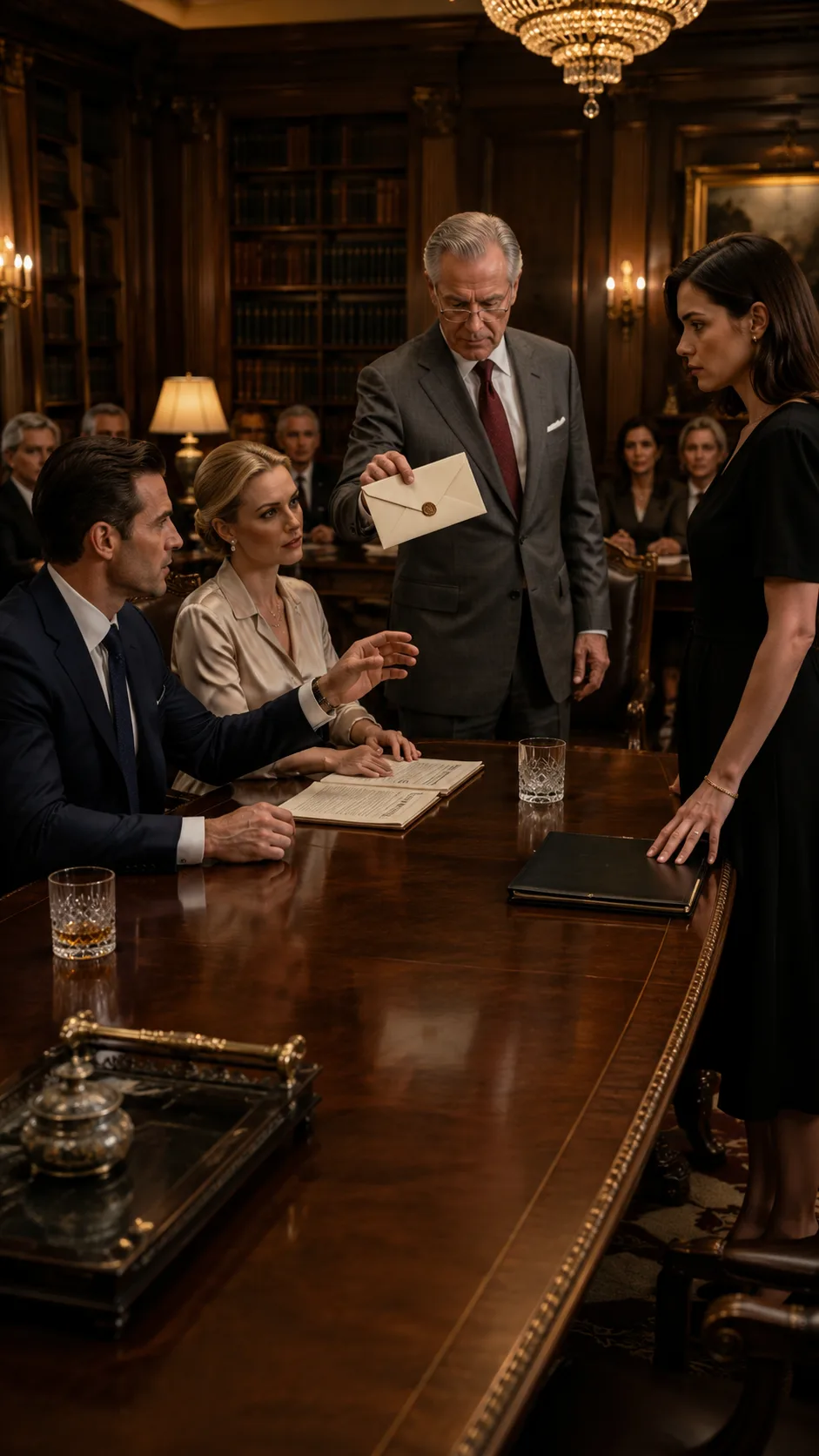
The chair at the end of the library table was gone.
Chapter 1
The chair at the end of the library table was gone.
I noticed it before anyone spoke.
There were twelve chairs around my father’s mahogany table, the same twelve chairs that had been there since I was ten years old and still short enough to swing my feet without touching the rug. My father used to tap the back of the last chair and say, “That one is Evelyn’s.”
Now there were eleven.
Daniel sat on the left side, in my father’s old place, though the funeral flowers had not even been cleared from the foyer yet. His dark suit looked expensive in the quiet way expensive things do when they want to be noticed without admitting it. One hand rested near a crystal glass filled with scotch. My father had hated scotch at legal meetings.
Clara sat beside him in champagne silk, her blonde hair pinned low at her neck, pearls bright against her throat. She had placed her phone
face down beside a silver pen, angled just enough so I could see the black screen catching the chandelier.
Recording, maybe.
Or waiting.
Mr. Whitman stood at the center of the table with a leather document case pressed under one arm. He had been my father’s lawyer for twenty-seven years. His hair had gone silver since I first met him. His suit was the same kind he always wore, gray and precise, with a burgundy tie and glasses that slipped down his nose whenever he read anything longer than a receipt.
He looked at the missing chair.
Then he looked at me.
Nobody moved to bring it back.
I stayed standing.
The black leather folder in my hand was warm from how tightly I had held it on the drive over. My mother’s folder. I had found it three days earlier in the bottom drawer of the cedar chest in
my father’s bedroom, under a stack of linen handkerchiefs he never used.
Daniel had told me not to go through “family things.”
He had said family like a locked door.
“Evelyn,” Clara said, smiling with only half her mouth, “you can stand if you want. This shouldn’t take long.”
I set the folder on the table at the far end.
Not hard.
Just enough.
Mr. Whitman opened his case.
The library smelled like lemon polish and old paper. Someone had left a cup of coffee on the sideboard. It had gone cold, with a brown ring forming at the rim. My father would have noticed. He noticed everything out of place, even when nobody else cared.
Daniel lifted his glass. The ice clicked once.
Mr. Whitman unfolded the will.
The room settled into the kind of silence money creates. Not peaceful. Managed.
My aunt Margaret sat near the fireplace, hands
folded over a black handbag. Two cousins took the chairs by the tall window. A family friend from the board, Mr. Vale, stood behind Daniel like he had already been told where the new power would sit.
I looked once toward the doorway.
No extra chair.
No mistake.
Mr. Whitman began reading.
My father’s name sounded strange in legal language. Arthur James Hart. Of sound mind. Hereby. Bequeath. Assign. Transfer.
Words that made a life smaller.
Daniel kept his eyes on the table, but I knew he was listening for numbers. He had always listened for numbers. Even as a child, he counted first and thanked second.
Clara listened for property.
I listened for my father.
The first pages went to Daniel. Voting control of Hartwell Holdings. Access to the executive trust. The right to appoint board members for a transitional term. Daniel’s mouth did not smile, but the corner of it lifted just enough.
He tapped the table twice.
My father used to tap twice when he wanted me to pay attention during chess.
Daniel tapped twice like he had won.
Clara received the lake house in Vermont, three investment accounts, and the charitable foundation seat she had wanted since the gala where she told the donors I was “more of a private family matter.”
Private.
That word had followed me for years.
I was private at dinners. Private in photographs. Private when people asked why I did not look like Daniel or Clara. Private when Clara’s friends came over and she told me to use the back stairs because “guests get confused.”
Mr. Whitman turned a page.
My name came near the bottom.
“To Evelyn Moore,” he read, “I leave all personal effects currently stored in the east bedroom, to be handled at the executor’s discretion.”
That was it.
No trust.
No shares.
No house.
No explanation.
Daniel gave a short laugh through his nose.
There it was.
Clara lowered her eyes to hide her smile, which only made it sharper.
My aunt Margaret adjusted the clasp on her handbag. One cousin looked at the carpet. Mr. Vale did not bother pretending.
Daniel leaned back in my father’s chair and tapped the will with two fingers.
“You heard him,” he said. “She gets nothing.”
The words landed on the polished wood and stayed there.
I did not answer.
Clara reached for the loose sheet beside her and slid it across the table. It stopped halfway, the blank signature line facing me.
“Sign this,” she said. “It confirms you accept the distribution and won’t contest anything.”
I looked at the page.
The paper was thick. Cream-colored. The same kind used for invitations and polite threats.
My printed name sat at the bottom.
Evelyn Moore.
Not Hart.
Daniel lifted his glass again. “Don’t drag this out. Dad was kind enough to keep you here.”
Keep you here.
The sideboard clock ticked behind me.
I remembered my father’s hand on my shoulder the night I was fourteen and Daniel told his friends I was “basically adopted charity.” My father had not shouted. He had only looked at Daniel and said, “Careful. You’re speaking about someone whose place here is older than yours.”
Daniel had laughed then too.
Not after.
Clara pushed the paper another inch.
“Your things are already packed,” she said. “The east bedroom boxes are in the hall.”
My fingers stayed on the leather folder.
Daniel noticed.
“What is that?” he asked.
I looked down at the folder. The edges were cracked, the corners softened by time. My mother’s initials were faintly pressed into the leather.
E.M.
Same as mine.
“Nothing you need,” Clara said before I could speak. “Evelyn likes keeping old papers. It makes her feel official.”
A few people smiled.
Not fully.
Enough to survive the room.
Mr. Whitman did not.
He looked at the folder, then at my hand, then at the document he had not yet read.
That was the first crack.
Small.
But real.
He closed the will.
Daniel’s eyes lifted. “We’re done?”
Mr. Whitman removed his glasses, cleaned one lens with a folded cloth, and put them back on.
“No,” he said.
Clara’s hand stopped on the silver pen.
Daniel sat forward. “No?”
“There is a second document.”
Mr. Vale shifted behind him. My aunt’s handbag clasp clicked open, then shut.
Daniel looked at me before he looked at the lawyer.
I did not move.
Mr. Whitman reached into his case and withdrew a sealed cream envelope. The wax seal had not been broken. It carried my father’s signet, but the handwriting across the front was not his.
I knew that handwriting.
My mother’s.
Daniel reached for it.
Mr. Whitman pulled it back by one inch.
The movement was small enough to be polite and clear enough to be a wall.
“This was delivered to me by Arthur Hart eleven months before his death,” Mr. Whitman said. “With instructions that it be opened only after the public reading of his will.”
“Public?” Daniel said.
Mr. Whitman looked around the library, at the relatives, the board friend, the cousins, Clara’s phone, the missing chair.
“Yes.”
Daniel’s jaw set.
Clara placed her hand over the recording phone, but she did not turn it off.
That was the mini twist I had not expected.
She wanted a record when she thought I would be humiliated.
Now she had one.
Mr. Whitman placed the envelope on the table.
Clara gave a small laugh. “Arthur loved theatrics near the end.”
“No,” I said.
It was the first word I had spoken.
Everyone turned.
I kept my hand on the folder. “He hated them.”
Daniel’s eyes narrowed. “You don’t get to correct us in his house.”
His house.
The phrase moved through the room like smoke.
Mr. Whitman looked at Daniel.
Then he looked at me.
“Miss Moore,” he said, “did your father ever discuss your mother’s estate with you?”
The room shifted again.
Daniel’s glass touched the table too hard. “Her mother had no estate.”
Clara turned toward him.
Too fast.
There.
A second crack.
Daniel had answered too quickly. He had not asked what estate. He had not laughed. He had denied.
Mr. Whitman heard it.
So did I.
My fingers pressed harder into the leather.
“No,” I said. “He only said not to sign anything unless you were in the room.”
Mr. Whitman nodded once.
Daniel stood halfway, then seemed to remember standing would make him look less in control. He sat back down, but his hand stayed on the table.
“You’re overstepping,” he said.
“To whom are you speaking?” Mr. Whitman asked.
Daniel blinked.
The room did not.
Clara picked up the pen and turned it between two fingers. “Can we finish this without making Evelyn more uncomfortable than she already is?”
“I’m comfortable,” I said.
It came out flat.
Clara’s smile tightened.
Daniel turned to me. “You’re standing because nobody put out a chair for you.”
“I know.”
He leaned back again, but it did not look like victory now. It looked like a man trying to return to a pose that had betrayed him.
“You have no claim here,” he said. “No blood. No shares. No name. You should be thanking us for letting this end quietly.”
The lawyer’s hand moved to the sealed envelope.
The wax cracked.
No one spoke.
The sound was small, but it reached every corner of the library.
Mr. Whitman opened the envelope and removed a folded legal record. It was older than the will. Thicker. A second page slipped out beneath it, attached by a brass fastener.
I saw my mother’s name before anyone else did.
Elena Moore.
My throat tightened, but my face stayed still.
I had only three clear memories of her. Her red scarf. Her singing off-key while cutting pears. Her hand pressing something small into my palm before a hospital visit I was too young to understand.
The signet ring.
I still had it.
Daniel stared at the paper.
Clara’s pen stopped turning.
Mr. Whitman placed the document flat on the table, but he did not push it toward anyone yet.
Daniel’s voice dropped. “That stays sealed.”
“It is open,” Mr. Whitman said.
“Then close it.”
“No.”
Aunt Margaret looked up.
The single word changed the room more than any shout could have.
Daniel’s eyes moved to the relatives, then to Mr. Vale, then to Clara’s phone beneath her palm. He knew people were watching him lose the shape of the evening.
He reached for the document.
Mr. Whitman covered it with one hand.
“Do not touch it.”
Daniel’s laugh came back, thinner now. “You work for this family.”
“I worked for Arthur Hart,” Mr. Whitman said.
Daniel pointed at me without looking away from the lawyer. “She is not this family.”
Mr. Whitman lifted his hand from the document and turned the first page toward Daniel.
“No,” he said. “She was never his daughter.”
The words did not sound cruel in his mouth.
They sounded like a key entering a lock.
Clara’s head snapped toward me.
A cousin made a small sound near the window.
Mr. Vale straightened.
Daniel sat very still.
For the first time since I entered the library, nobody looked at me like I was the one being exposed.
They looked at Daniel.
He swallowed once. “Then why is she here?”
I opened the black leather folder.
Inside, wrapped in a square of faded blue cloth, was my mother’s signet ring. Gold. Small. Worn smooth at the edges. My father had kept it in his safe for years, then returned it to me when I turned twenty-one.
He had said, “When the room gets loud, put this on the table.”
I had thought he meant courage.
I placed the ring beside the document.
Clara leaned in before she could stop herself.
Her eyes found the engraving.
E.M.
Mr. Whitman turned the second page.
“This is the original estate transfer of Elena Moore,” he said. “Recorded before her marriage to Arthur Hart.”
Daniel’s fingers curled against the table.
Clara whispered, “Marriage?”
Mr. Whitman did not look at her.
“Elena Moore married Arthur Hart eight months after this document was executed. At the time, she owned controlling interest in the east wing property, the lake parcels, and the founding shares of Hartwell Holdings.”
Mr. Vale took one step back from Daniel’s chair.
Not far.
Far enough.
Daniel saw it.
“You’re reading it wrong,” Daniel said.
Mr. Whitman pointed to the page. “No.”
Clara’s face had lost its careful softness. She reached for the document, then stopped when Mr. Whitman’s eyes moved to her hand.
“Arthur built Hartwell,” Daniel said.
“Arthur expanded Hartwell,” Mr. Whitman said. “With assets placed in trust by Elena Moore.”
The room absorbed that slowly.
The aunt by the fireplace closed her handbag.
One cousin lowered his glass.
Daniel looked at me then. Really looked. Not as a burden. Not as the girl in the wrong chair. As something he had miscounted.
“My father would have told me,” he said.
I kept my hand beside the ring.
“He tried,” Mr. Whitman said.
Daniel turned on him. “You don’t know that.”
Mr. Whitman removed another paper from the envelope.
A letter.
My father’s handwriting.
The lawyer did not read the whole thing. He did not need to. He placed the first page down where Daniel could see the date.
Six months before my father’s stroke.
Daniel stared at it.
Clara’s hand slid away from the phone.
Too late.
Mr. Whitman read one line.
“If my children ever use my will to erase Evelyn, open Elena’s record in front of them.”
The clock ticked.
Somewhere outside the library, someone moved a vase in the hall. Porcelain against wood. A normal sound in the wrong second.
Daniel’s lips parted.
Nothing came.
Mr. Whitman turned the final page of the estate transfer.
“Arthur Hart was never the owner of Elena Moore’s protected estate,” he said. “He was temporary executor until Evelyn Moore reached full legal control.”
Clara’s eyes moved to the lake house line in the will.
Daniel’s eyes moved to the company documents.
Mine stayed on the ring.
Mr. Whitman placed his finger on the final signature.
“Elena Moore’s estate passed to Evelyn Moore on her twenty-fifth birthday. Arthur’s will cannot distribute what he did not own.”
Daniel stood then.
The chair scraped hard against the rug.
“There is no way this is valid.”
Mr. Whitman looked up at him. “It was validated seven years ago.”
Clara’s voice was barely shaped. “Seven?”
I closed the leather folder with one hand.
Daniel looked at me again. “You knew.”
“No.”
He wanted anger from me. Something messy. Something he could use to make the room return to its old shape.
I gave him nothing.
“I knew there was a folder,” I said. “I knew there was a ring.”
Mr. Whitman slid a final document into the center of the table.
“This is the current ownership record for the house, the east wing property, and the controlling foundation assets.”
Daniel reached for it.
This time Mr. Vale moved.
He did not touch Daniel. He only stepped away from his shoulder and toward the side of the table where everyone could see him.
A board man shifting sides without a word.
Daniel saw that too.
The power left him in pieces.
First the chair.
Then the glass.
Then the room.
Mr. Whitman tapped the record once.
“Because this estate was never yours.”
Clara’s phone screen lit beneath her palm. The recording timer glowed.
One hour and twelve minutes.
She had recorded all of it.
A cousin saw.
Then Aunt Margaret.
Then Daniel.
Clara pulled her hand back like the phone had burned her.
Nobody laughed now.
Daniel’s hand dropped from the table edge.
“That is not—”
He stopped.
There was nowhere for the sentence to go.
Mr. Whitman gathered the will, but left my mother’s document in the center of the table.
That mattered.
The old will had been folded back into order. My mother’s record stayed open.
Daniel remained standing for several seconds. His chair sat behind him, crooked against the rug. My father would have fixed it with his foot before anyone noticed.
I noticed.
Clara did not move. Her pearls rose and fell at her throat. The pen she had offered me lay between us, useless now, pointing toward the empty signature line.
Mr. Vale cleared his throat.
No one answered.
The relatives began to understand the practical things before the emotional ones. That is how rich families survive themselves. First ownership. Then access. Then reputation. Then blame.
Aunt Margaret stood and smoothed her black skirt.
“Evelyn,” she said.
I looked at her.
She had not said my name all afternoon.
Her mouth prepared another word, maybe a careful one, maybe a useful one.
I picked up my mother’s ring before she found it.
Mr. Whitman turned to me. “There will be filings. Several. You do not need to sign anything tonight.”
“I know.”
Daniel’s face changed at that. Not much. Just enough.
He had expected the girl without a chair.
He had not prepared for the woman who knew when not to sign.
Clara reached for her phone at last and stopped the recording. The tap sounded louder than it should have.
“Evelyn,” she said, “none of us knew the full situation.”
The empty page still sat between us.
I turned it around and pushed it back with two fingers.
She watched it slide toward her.
The blank signature line faced her now.
I did not speak.
Mr. Whitman closed his document case. “The house staff has been instructed not to remove any belongings from the east bedroom.”
Daniel’s head lifted. “You instructed my staff?”
Mr. Whitman looked toward me.
“No,” he said. “Ms. Moore’s staff.”
The room held that line carefully.
Nobody wanted to be the first to react to it.
Daniel’s jaw worked once. Clara looked down. Mr. Vale checked his watch though there was nothing on it that could help him.
I stepped away from the far end of the table and walked to the missing chair against the wall. It had not been removed from the room. Only from the table.
That was almost worse.
Someone had carried it twenty feet away and placed it beneath the portrait of my father, as if the chair itself had been demoted.
I took it by the back.
Daniel watched me drag it across the rug.
The sound was low and rough and ordinary.
I placed it at the end of the table where it belonged.
Then I sat down.
Mr. Whitman’s mouth moved slightly. Not a smile. Not quite.
My father’s portrait hung over the fireplace, one hand resting on a chair that looked very much like mine.
For the first time that day, I looked at him without asking for an answer.
The legal filings took three months.
Daniel fought the first one. Then the second. Then he stopped when Clara’s recording was requested by the court-appointed auditor and her lawyer advised her that deleting it would be worse than handing it over.
Mr. Vale resigned from Daniel’s advisory committee within a week. The board used words like “fiduciary review” and “temporary leave.” Rich people have a language for collapse. It sounds clean from far away.
Clara moved out of the lake house before spring.
She left the pearl bracelet behind in the upstairs bathroom, coiled beside the sink like something shed. The housekeeper put it in a padded envelope and asked where to send it. I gave her Clara’s new address.
Daniel returned to the mansion once, six weeks after the reading, to collect boxes from my father’s office. He did not enter the library.
I saw him from the upstairs landing. His suit did not fit badly, but it looked less like armor now. He signed the inventory sheet without reading it, then placed the pen down with care.
He had learned that much.
Clara sent one message.
Not an apology.
A photograph.
It was from one of the old Christmas albums. I was twelve, seated at the edge of the library table, wearing a green velvet dress I hated. My father stood behind me with one hand on my chair. Daniel was turned away from the camera. Clara was looking at herself in a spoon.
On the back of the photo, my father had written one line.
Evelyn’s chair.
I kept the photo in the top drawer of the desk.
The mansion changed more slowly than people expected. I did not tear down portraits or replace curtains or remove the old books that smelled like dust and tobacco. I kept the library table. I kept the chandelier. I even kept Daniel’s scotch glass for a while, washed and placed upside down in the cabinet with the others.
Objects do not choose sides.
People do.
The east bedroom became mine again, but not the way it had been. I took down the pale wallpaper Clara had chosen when I was seventeen and replaced it with warm linen panels. I moved my mother’s cedar chest under the window.
On the first morning after the final transfer, I found the old sideboard clock had stopped at 6:12.
The repairman said it needed cleaning.
I told him to fix it.
No grand reason.
I just wanted the room to keep time honestly.
Mr. Whitman came by with the last documents on a Thursday afternoon. He placed them on the library table, then glanced toward the end chair.
“You moved it back,” he said.
“It was mine.”
“Yes,” he said. “It was.”
He did not stay long. Lawyers know when a room is no longer theirs to manage.
After he left, I sat alone at the table with the final ownership record, my mother’s signet ring, and the photograph Clara had sent. Outside, the gardeners were cutting back the hedges. The sound came through the glass in steady bursts.
I placed the ring on my finger.
It was loose.
My mother’s hand had been smaller than mine.
I looked at the chair at the end of the table. The wood was scratched along one leg from the day I dragged it back across the rug. The mark would not polish out completely.
I told the housekeeper to leave it.
That evening, I hosted the first dinner in the library since the will reading.
Not for relatives.
For the staff.
Mrs. Alvarez from the kitchen sat on Daniel’s old side of the table. Thomas, who had driven my father for nineteen years, took Clara’s chair after asking twice if I was sure. The gardener brought his wife. Mr. Whitman came late and placed a bottle of sparkling cider on the sideboard, nowhere near the legal papers.
There were twelve chairs again.
No one stood.
Before dinner, I touched the back of the end chair the way my father used to.
The room did not feel smaller without them.
It felt accurate.
I sat down.
The chair stayed.
Chapter complete
You have reached the end of this chapter.
Continue reading
A few more worlds to get lost in after this chapter.