THE KING TORE UP HIS DAUGHTER’S DREAM, BUT HER MOTHER’S HIDDEN DRESSES MADE THE PALACE BOW TO HER NAME
PART 1
The royal dining hall of Aurelia had never been so silent.
Chapter 1
PART 1
The royal dining hall of Aurelia had never been so silent.
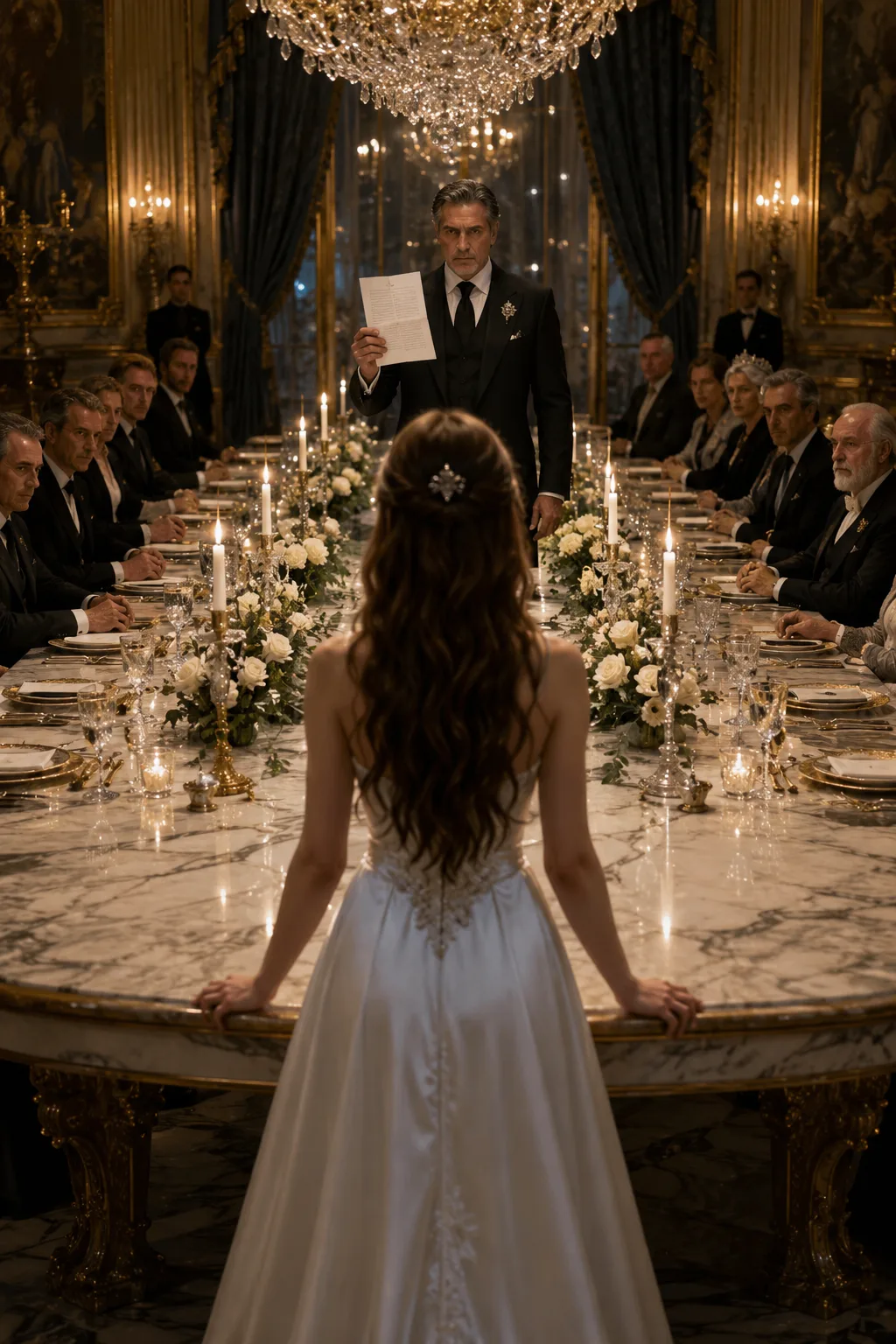
Crystal chandeliers burned above the long marble table. Ministers, physicians, and noble relatives sat frozen in their chairs while Princess Grace Bennett stood at the far end of the room, one hand pressed against the white satin dress she had secretly designed herself.
Across from her, King Thomas Bennett held the acceptance letter like it was something dirty.
École Lumière.
The fashion academy in Paris.
Not the Royal Medical Academy he had chosen for her.
Grace was twenty-one, old enough to rule a province, old enough to represent the crown abroad, old enough to smile beside her father at hospital openings and charity galas. But in Thomas’s eyes, she was still a child who needed to be corrected.
“You embarrassed me,” he said, his voice calm enough to scare everyone.
Grace lifted her chin. “No. I chose myself.”
Thomas’s jaw tightened.
Then he tore the letter in half.
A gasp
moved down the table.
He tore it again, and again, until the invitation Grace had waited months for became white scraps falling over the polished floor.
“I didn’t raise a princess to waste her life making dresses,” he said.
Grace stared at the pieces.
For a second, she looked like the little girl who had once waited outside her mother’s locked sewing room, hoping someone would finally tell her why Queen Evelyn’s name was forbidden.
Then Grace bent down.
One by one, she picked up every torn piece.
When she stood again, her fingers were shaking, but her voice was not.
“No,” she said. “You raised a daughter who finally stopped being afraid of you.”
And before the king could answer, Grace walked out of the hall with her broken dream in her hand.
PART 2
By midnight, the whole palace knew.
Servants whispered in the corridors. Guards lowered their
eyes when Grace passed. Somewhere behind the closed gold doors of the west wing, King Thomas was meeting with his advisers, probably deciding how to bury the scandal before morning.
Grace did not go to her bedroom.
She went east.
The east wing of Aurelia Palace had been closed since her mother died. Officially, it was under restoration. Unofficially, nobody went near it. The curtains stayed drawn. The brass handles were polished by servants who never dared open the doors. And every time Grace had asked about it as a child, her father gave the same answer.
“There is nothing for you there.”
But tonight, Grace knew that was a lie.
Lady Margaret Vale was waiting by the old corridor windows, wearing a dark green shawl over her nightgown. She had served Queen Evelyn for years, and though she now worked quietly in the royal archives, Grace had always felt
the woman knew more than she said.
“You should not be here,” Margaret whispered.
Grace held up the torn letter. “Then tell me where I should be.”
Margaret looked at the scraps in Grace’s hand. Her face softened.
“You have her hands,” she said.
Grace went still.
“My mother’s?”
Margaret nodded.
A dozen memories rushed through Grace at once. Her mother leaning over a sketchbook. Her mother’s fingers measuring silk. Her mother laughing as she pinned a ribbon against Grace’s shoulder. Then the funeral. Then silence. Then her father ordering every sketch, every gown, every unfinished piece of Evelyn Bennett’s life to disappear.
“What did he hide?” Grace asked.
Margaret hesitated.
Grace stepped closer. “What did my father hide from me?”
Margaret turned and unlocked the door behind her.
The room smelled of cedar, dust, and old perfume.
Grace walked in and stopped breathing.
It was not an empty wing.
It was a private fashion studio.
Moonlight spilled through the tall windows over dress forms draped in muslin. Shelves were stacked with silk, lace, velvet, pearls, buttons, ribbons, handwritten notes. Along the walls hung framed sketches—hundreds of them. Evening gowns. Royal uniforms redesigned for women. Mourning dresses that looked powerful instead of weak. Wedding gowns without veils. Coronation cloaks lined not with gold, but with white roses.
And on the central table was a large black portfolio embossed with one name.
Evelyn.
Grace moved toward it like she was walking toward a ghost.
Her fingers touched the cover.
“She was not just a queen,” Margaret said quietly. “She was one of the most gifted designers I ever knew.”
Grace opened the portfolio.
Inside were sketches signed in her mother’s hand.
Not childish sketches. Not hobbies. Collections. Notes. Measurements. Fabric experiments. Press clippings from before Evelyn married Thomas. Invitations from Paris, Milan, New York. Letters from editors who called her visionary.
Grace’s throat tightened. “He told me she gave all this up because she wanted to be queen.”
Margaret’s mouth pressed into a thin line. “No. He wanted her to give it up because he thought queens should not have dreams the public could judge.”
Grace turned another page and found a sketch of a gown so beautiful it made her chest hurt. White silk, silver embroidery, shoulders strong, waist soft, a cloak flowing behind it like moonlight. At the bottom, Evelyn had written: For Grace, when she learns that softness can still be power.
Grace covered her mouth.
Margaret reached into a drawer and pulled out a small velvet box. “There is something else.”
Inside was a letter, folded carefully, addressed in Evelyn’s handwriting.
To my daughter, when she is old enough to be told the truth.
Grace’s hands trembled as she opened it.
My darling Grace,
If you are reading this, then perhaps your father has done what frightened me most. Perhaps he has loved you so tightly that he has mistaken protection for possession.
I know Thomas. I know his fear. He believes the world is safer when everything is controlled. He believes pain can be prevented if dreams are trimmed before they grow wild.
But you, my love, were born wild in the most beautiful way.
If they ever tell you beauty is useless, remember this: beauty can become a crown no one can take from you.
Do not live small to make someone else feel safe.
Finish what I could not.
Grace read the last line again.
Finish what I could not.
Her tears fell onto the paper before she could stop them.
Behind her, a floorboard creaked.
Grace turned.
King Thomas stood in the doorway.
He was still dressed in the black dinner suit he had worn downstairs, but his face had changed. The anger was gone. In its place was something far worse: fear.
“Put that down,” he said.
Grace held the letter tighter. “You knew.”
Thomas stepped into the studio. His eyes moved over the sketches as if every wall had opened a wound.
“She was my wife,” he said. “I knew everything.”
“No,” Grace said. “You buried everything.”
His voice sharpened. “I preserved her dignity.”
“You erased her.”
Thomas flinched as if she had slapped him.
Margaret took one step back, but Grace did not move.
“You let me grow up thinking my own talent was something shameful,” Grace said. “You called it a waste. You made me feel like every drawing I made was a betrayal.”
Thomas’s face hardened again, the king returning because the man could not bear being seen. “Because I watched that dream consume her.”
Grace stared at him. “No. You watched her become someone you could not control.”
The room went silent.
For the first time in Grace’s life, her father looked old.
“You were a child,” he said, quieter now. “You don’t know what it was like. The critics, the papers, the nobles whispering that she cared more about fabric than duty. They were cruel to her.”
“And were you kind?”
Thomas said nothing.
Grace opened the portfolio wider and pushed it toward him. “She was invited to show in Paris, wasn’t she?”
His eyes dropped.
Margaret whispered, “Yes.”
Grace turned toward her. “What happened?”
Margaret looked at the king, then back at Grace. “The invitation arrived three months before your mother died. She wanted to go. She had already chosen the collection name.”
Grace swallowed. “What was it?”
Margaret’s eyes filled.
“Grace.”
The word broke something in the room.
Grace looked down at the sketches. Her mother had not designed a collection to escape her family. She had designed it for her daughter.
Thomas reached for the letter, but Grace pulled it back.
“You don’t get to take this from me too.”
His face tightened. “You are my only child. You are the future of this kingdom. I will not watch you throw yourself into a world that will tear you apart.”
Grace laughed once, but it came out broken. “You already did that.”
Thomas stepped closer. “Grace.”
“No.” She closed the portfolio. “You don’t get to say my name like you’re saving me.”
“You have responsibilities.”
“So did my mother,” Grace said. “And you used them as a cage.”
Thomas’s voice rose. “I loved her.”
Grace’s eyes burned. “Then why did you only keep the version of her that obeyed you?”
The question hit him harder than any accusation.
He looked around the room—the unfinished gowns, the sleeping dress forms, the letters from a life he had locked away because grief had made him selfish.
But Grace was done waiting for his answer.
She picked up the black portfolio.
Thomas moved slightly, as if to stop her, then froze when she looked at him.
“I am leaving at dawn,” she said.
“The palace will not fund this.”
“I didn’t ask it to.”
“You will have nothing.”
Grace held the torn letter in one hand and her mother’s portfolio in the other.
“Then I’ll start with nothing,” she said. “At least it will be mine.”
At dawn, Princess Grace Bennett walked out of Aurelia Palace with one suitcase, one portfolio, and no royal escort.
By noon, the official palace statement said she had chosen a period of private reflection.
By evening, every newspaper in Europe knew the truth.
The princess had left.
The king had torn up her dream.
And somewhere on a train to Paris, Grace opened her mother’s sketchbook and began drawing the first line of the life Thomas Bennett could no longer control.
To be continued, Part 3 now
Chapter complete
You have reached the end of this chapter.
Continue reading
A few more worlds to get lost in after this chapter.




