Ren kept his hands closed so the blood would not drip on the scripture.
Chapter 1
Ren kept his hands closed so the blood would not drip on the scripture.
The scrap was no larger than two fingers, torn from a prayer book that had been buried beneath the broken floor of Saint Orvan’s shrine. Most of the ink had faded. Damp had eaten through the edges. One sentence remained clear enough to read if he held it close to the single candle in the cellar.
Judgment does not sleep where truth is spoken.
He had copied those words six times before the soldiers broke the shrine door.
The first bootfall above him sent dust through the gaps in the ceiling boards. The second knocked loose a dead moth. Ren folded the scrap and slid it into the seam inside his sleeve. His candle guttered once, then steadied, thin and stubborn in the stale air.
A soldier shouted from the nave.
“Down here.”
Ren looked at the floor around him. Three cracked tablets. A clay bowl of lamp oil. A
bundle of other scraps tied with blue thread. The blue thread had belonged to Sister Mara, who used to bind the temple candles with it before the king’s men took her away.
He reached for the bundle.
Too late.
The trapdoor lifted. Torchlight cut into the cellar. A spear came first, then a helmet, then a young guard with red cheeks and a jaw still soft under his beard. Behind him stood Captain Veyl, one of the king’s shrine-breakers, with a white sun stamped on his breastplate.
Veyl looked at the prayer scraps.
Then he looked at Ren.
“Still feeding ghosts.”
Ren said nothing.
The young guard stepped down into the cellar. His boot crushed one of the tablets and left a print through the old carved scale. He seemed not to notice. He took the bundle from the floor and held it up like dirty cloth.
Veyl smiled with
only one side of his mouth.
“The king will like this one.”
Ren kept his eyes on the crushed tablet.
The guard grabbed his arm.
Ren moved before he meant to. He shoved the guard backward, not hard enough to hurt him, only enough to keep the bundle out of Veyl’s hand. The guard’s shoulder struck the ladder. Torchlight jerked across the walls. Someone above drew a sword.
Veyl did not move quickly. He never did when he had already won.
He came down one step at a time, ducked under the low beam, and took Ren by the throat with a gloved hand.
“You were told the old temples were closed.”
Ren’s fingers scraped the dirt floor. He found the broken tablet under his palm.
“The temple is closed,” Ren said. “Prayer is not.”
The young guard stared at him as if he had slapped the king in the
face.
Veyl tightened his grip.
Ren’s knees hit the dirt. The scrap inside his sleeve pressed against his wrist, warm from his skin. He kept his hand curled over it while the captain searched the room and gathered every page, every shard, every thread of the old faith into a leather satchel.
One piece remained hidden.
One sentence.
That was all he carried when they dragged him into daylight.
The city had learned to look away.
Vendors lowered shutters as the soldiers marched Ren through Saint Orvan’s Square. A woman selling figs swept the same three leaves into a pile until he passed. A child watched from behind a cart wheel until his mother pulled him back by the collar.
Above the square rose the king’s new banner: Morvain’s face painted in gold, crowned by a white sun. It hung over the entrance to what had once been the Judgment House. The old stone scale had been chiseled away from the arch. In its place, masons had fixed a bronze plaque that read: BY THE KING’S LIGHT, ALL THINGS ARE MADE TRUE.
The plaque was crooked.
Ren noticed that before the pain in his ribs, before the rope around his wrists, before the crowd pretending not to see him.
Small things told the truth when people could not.
At the palace gate, a priest in white stood beside the guards with a bowl of ash. He marked the soldiers’ brows with the sun sign, then hesitated when Ren came forward.
Veyl laughed.
“Mark him too. The king loves mercy.”
The priest dipped two fingers into the ash. His hand trembled enough that gray powder scattered across Ren’s cheek instead of forming a clean sun.
Ren looked at him.
The priest looked away.
Inside the palace, everything shone.
Polished floors. Golden doors. White silk hanging from balconies. Servants moving with their heads lowered so far they seemed to watch only their own feet. Every wall held Morvain’s image in some form: painted, carved, embroidered, pressed into metal.
In the outer hall, two boys no older than twelve practiced a morning hymn with a tutor.
The gods grew silent.
The king became flame.
The world was made clean
when we spoke his name.
One boy missed the last note. The tutor struck the back of his hand with a thin rod.
Again.
Ren turned his head as the soldiers pulled him past.
The boy did not cry out. He only tucked the hand against his side and sang again.
That was Morvain’s kingdom. Not quiet because it had peace. Quiet because every sound had learned the price of being wrong.
They threw Ren into a cell beneath the Hall of Ascension.
It was not a prison built for long keeping. It was a waiting place for people the king wanted the court to see before they disappeared. The walls smelled of wet stone and old iron. Someone had scratched names into the mortar near the floor. Most had been crossed out by later hands.
Ren found one name he knew.
Mara.
The letters were small, cut with care.
He sat beneath them and touched the seam in his sleeve. The scrap was still there.
For a while, that was enough.
The first night, no one came except a servant boy with water and a heel of bread. He placed both inside the bars and kept his eyes down.
Ren broke the bread in half.
“Take the other piece.”
The boy froze.
“You’ll be punished.”
“For bread?”
“For hearing you speak.”
Ren pushed the piece closer anyway.
The boy stared at it. His stomach made the decision for him. He took the bread and tucked it inside his tunic before anyone could see.
At the door, he stopped.
“They say you hid a god under the floor.”
Ren leaned back against the stone.
“No. Only pages.”
The boy’s fingers tightened around the empty cup.
“My mother used to make the sign of the scale when she thought no one watched.”
“Does she still?”
The boy did not answer.
Footsteps sounded beyond the corridor. He ran before the guard turned the corner.
Ren slept badly after that. The cell did not go dark. A narrow lamp burned in the corridor, and every time he opened his eyes, the scratched name above him seemed closer.
Mara.
She had found him at four years old behind the eastern granaries, with no shoes and a fever bad enough to make his skin shine. She had carried him to the temple herself. She had taught him letters by writing them in ash on black stone. She had slapped his fingers away from candle flames and told him that pain was not proof of wisdom.
When the first temple decree came, she buried the old books under the floor.
When the second came, she sent half the children out through the orchard gate.
When the third came, she put a broom in Ren’s hands and told him to sweep until soldiers stopped looking.
They took her anyway.
Ren had been eleven. He remembered her blue thread around the candle bundles. He remembered the way she walked between the soldiers without giving them the pleasure of dragging her.
He had not seen her again.
On the morning of the ceremony, Captain Veyl came with six guards and a white robe folded over one arm.
Not a robe. A costume.
It had been cut from cheap cloth and painted with black scales across the chest, mocking the old Judgment vestments. The paint had dried stiff. It smelled sour.
“You will wear this,” Veyl said.
Ren looked at it.
“No.”
Veyl handed it to the young guard from the shrine cellar.
The boy would not meet Ren’s eyes.
“You will wear it,” Veyl said again, “or they will carry you in wearing less.”
Ren took the robe.
There were moments when defiance only gave your enemy a better stage.
He changed with his back to them. Inside the sleeve of his torn tunic, the scrap waited against his wrist. He slid it free and pressed it under his tongue before the robe went over his head.
The ink tasted bitter.
Veyl noticed his jaw move.
“What was that?”
Ren looked at him.
“Prayer.”
The captain crossed the cell and struck him with the back of one hand. Ren hit the wall, caught himself with his shoulder, and stood before the guards could grab him.
The young guard shifted his weight.
Veyl saw it.
“Take his chains.”
Iron closed around Ren’s wrists. The rings were old, heavy, and too large for him, made for grown men who had once been marched through that same hall. Another chain ran from his wrists to a belt around his waist, then down to his ankles. The guards did not need all that iron.
Morvain did.
A king who called himself a god still liked visible proof that men could be bound.
They brought Ren up through a service passage behind the Hall of Ascension. He heard the crowd before he saw it: the scrape of armor, the low murmur of nobles, the rustle of silk, the metallic clink of soldiers adjusting grips on spear shafts.
Then the doors opened.
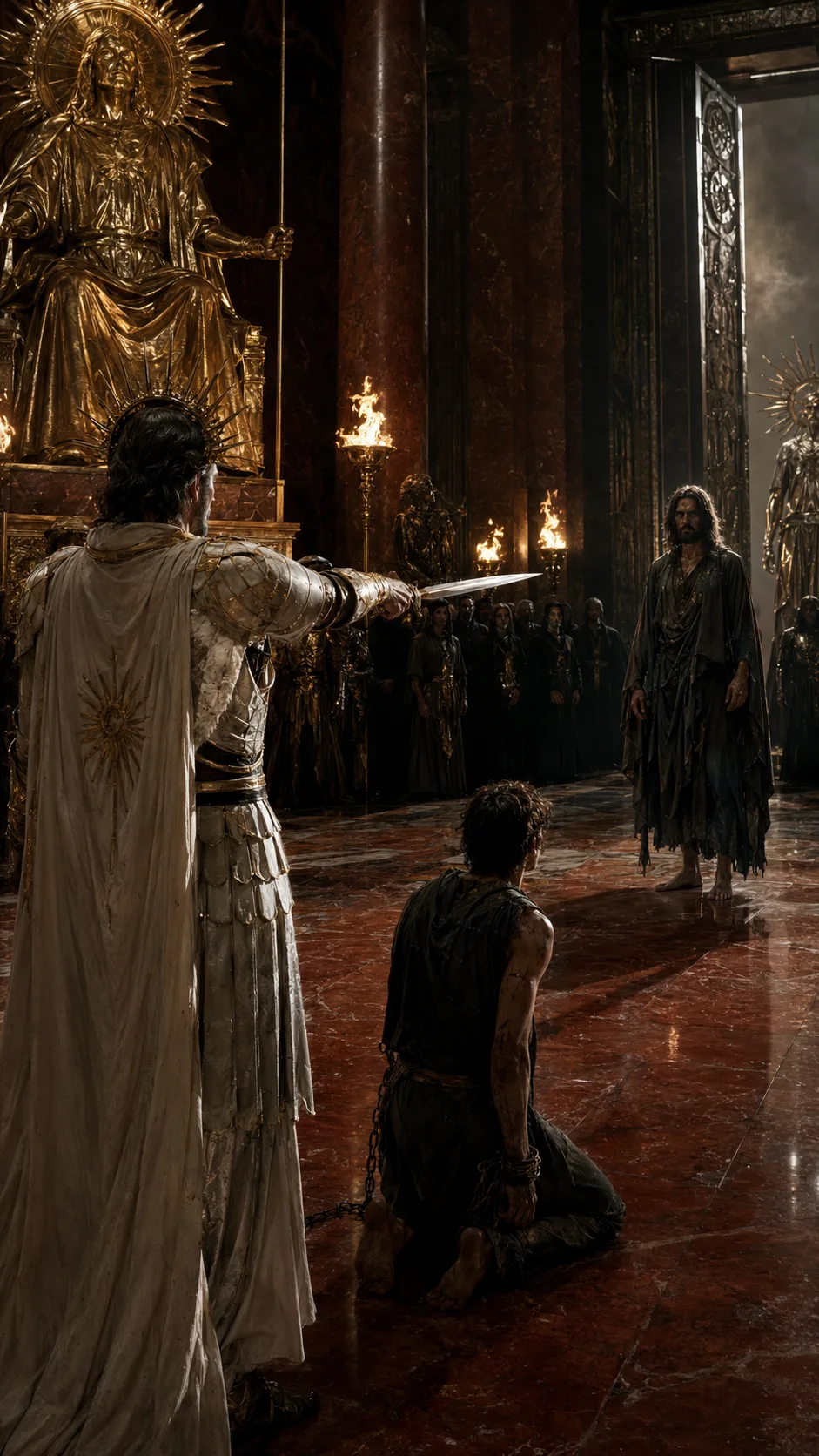
Red marble stretched before him, polished until the torchlight ran across it like trapped fire. Gold statues lined both walls, but black cloth covered each one from crown to base. Only the far end remained uncovered.
Morvain’s statue.
It towered behind the throne, twice the height of a man, one hand lifted in blessing and the other resting on a carved sun. Gold leaf covered every inch. The face was not the face of the older, living king. It was younger, smoother, made with the arrogance of a man ordering time itself to flatter him.
The sun disk behind its head caught the hall’s light and threw it back on everyone below.
Ren stopped at the threshold.
Veyl shoved him forward.
The chain between his ankles scraped the marble. Heads turned. The nobles looked first at the robe, then at the bruises, then away. Soldiers stood along the walls with their shields shining. Behind iron gates at the back, common citizens crowded shoulder to shoulder under guard.
He saw the servant boy there, half-hidden behind a pillar, carrying a tray of untouched cups.
The boy’s eyes found him.
Then the trumpets sounded.
King Morvain entered from a side arch in white armor.
He had silver in his hair and gold on every finger. His crown rose from his brow in sharp rays, each point tipped with a clear stone that caught the flame. He did not hurry. He let the hall watch him walk to the golden platform. He let the nobles lower themselves. He let the army strike spear butts against the floor three times.
Ren remained standing because the guards held him upright.
Morvain reached the throne but did not sit.
He turned toward the hall.
“Twenty years ago,” he said, “this kingdom was divided by superstition.”
His voice carried easily. The chamber had been built for judgment, and he used its old design for his new lie.
“Men bowed to absent powers. Priests kept records no king could read. Children were taught to fear names that gave them nothing. I ended that hunger. I ended that silence.”
The nobles clapped.
Not first. Not all at once. The applause spread like fire searching for dry grass.
Morvain lifted one hand, and it stopped.
“Today, the age of silent gods ends. Today, I declare what has always been true. I am not merely king. I am divine.”
The hall held its breath, then gave him what he wanted.
Hands struck hands. Armor rattled. The people behind the gates stood with their palms pressed together because soldiers watched them do it.
Ren kept the paper under his tongue until it softened.
Veyl dragged him forward to the center of the hall.
Morvain descended three golden steps.
Up close, he smelled of myrrh and polished metal.
“You were found hiding banned scripture beneath a ruined shrine,” the king said.
Ren’s mouth tasted of ink and old paper.
Morvain turned slightly so the hall could see his face.
“You were found praying to a dead god.”
Ren swallowed.
The scrap went down rough.
“No god is dead because a king is afraid of him.”
The applause died so quickly that the last two claps sounded like accidents.
A noblewoman in blue lowered her hands to her sides. One soldier near the wall looked at the covered statues instead of the king. The servant boy’s tray tilted, and one cup rolled against another with a small glass note.
Morvain’s face did not change at first.
That was worse.
He stepped closer, close enough that the rays of his crown cut the torchlight above Ren’s eyes.
“You think judgment is coming?”
Ren said nothing.
Morvain raised his hand.
The strike sent Ren to one knee. Heat flashed across his cheek. The chain at his waist jerked him sideways, but he caught himself before his forehead touched the floor.
The hall watched.
Ren lifted his head.
Morvain smiled again, but now it sat badly on his mouth.
He turned from Ren to the crowd.
“Let every person here witness the last breath of the old faith.”
He pointed to the massive bronze doors.
“Seal the hall.”
The guards moved at once. The doors groaned shut. Iron bars dropped across them from inside the frame. The sound rolled through the chamber and settled somewhere under the ribs of everyone listening.
No way out.
No way in.
Morvain drew a ceremonial blade from the guard beside him.
It was not long, but it shone cleanly. Its handle was set with white stones, and the pommel had been shaped into the sunburst of his reign. He held it high enough that the statue behind him seemed to lift its hand with him.
Ren stayed on one knee.
The young guard from the cellar stood six paces away. His jaw worked once, then stopped.
Morvain looked down at Ren.
“Where is your god now?”
The blade rose.
Ren did not close his eyes.
A sound came from the bronze doors.
One knock.
Small. Barely more than knuckles on metal.
The blade stayed where it was.
Every head turned.
The royal guards had cleared the corridor. Ren had heard the order given before they brought him in. No citizens. No servants. No soldiers beyond the sealed entrance. The ceremony was to belong entirely to Morvain.
The knock came again.
This time, something answered from the far end of the hall.
The golden statue cracked.
It began at the forehead, a thin dark line splitting the polished brow, running down over the carved nose, through the mouth, into the chest. Gold dust sifted from the wound and fell onto the throne platform.
No one moved.
Morvain lowered the blade a hand’s width.
“Open them,” he said.
The guards nearest the entrance did not move.
“Open them.”
Their hands stayed on their spears.
Then the bronze doors opened by themselves.
The iron bars lifted without hands. The hinges gave no sound. Smoke from the outer corridor rolled inward around bare feet.
A man stepped into the Hall of Ascension.
No crown. No armor. No jewels.
Only a dark robe, ash at the hem, and skin marked by dust as if he had walked through burned kingdoms to get there. His hair fell loose around a face that looked neither young nor old. His eyes were black, calm, and too deep for torchlight to touch.
The torches bent toward him.
Not flickered.
Bent.
Flames leaned from their bowls as if pulled by breath.
The man walked forward. Each step left a faint white mark on the red marble. The marks did not burn. They glowed, then faded, like memory pressed into stone.
A noble dropped his cup.
It did not break. It rolled in a slow circle and stopped at the edge of the platform.
Morvain pointed the blade at the stranger.
“Who enters my hall without permission?”
The stranger stopped.
The distance between them held the whole kingdom inside it: the king in white armor beneath his golden statue, the prisoner in chains on blood-red stone, the court waiting to see which fear would win.
The stranger looked at Morvain’s crown.
Then at the throne.
Then at the statue.
“Your hall?”
The red marble under Morvain’s feet split with a sharp crack.
He stepped back before he could stop himself.
The sound ran outward through the floor in thin black lines. Nobles lifted their robes away from the spreading cracks. Soldiers tightened their grips on spears. One of the covered statues along the wall began to smoke beneath its black cloth.
Then another.
Then all of them.
The cloths did not catch like ordinary fabric. They burned upward in clean lines of pale flame, leaving no ash. Underneath, the old kings emerged one by one from darkness: stone faces, stone crowns, stone hands resting on swords and law tablets.
Every face was turned toward the stranger.
Not the throne.
Not Morvain.
The High Commander fell to his knees first.
His armor struck the floor with a sound that made three soldiers near him flinch. He did not look at Morvain for permission. He only bowed his head until his forehead nearly touched the cracked marble.
A priest followed.
Then an old court scribe.
Then half the hall.
The people behind the iron gates did not kneel at once. They watched the nobles do it first, watched the army fail to stop them, watched the king stand alone with his blade pointed at someone who had not raised a weapon.
Then they sank down together.
Ren looked up from one knee.
The stranger turned his face toward him.
For the first time since the shrine cellar, Ren felt the scrap of scripture inside him not as paper, not as ink, but as a coal that had refused to go out.
The stranger’s gaze lowered to the iron rings around Ren’s wrists.
The locks opened.
No key. No hand. No command.
The first cuff fell to the marble. Then the second. The chain at his waist loosened and slid down in a heavy coil. The links around his ankles snapped open, one after another, and Ren rose because nothing held him down.
The young guard stared at the fallen chains.
His spear slipped from his fingers and hit the floor.
Morvain’s head turned toward the sound.
For one instant, his face belonged not to a god, not to a king, but to a man hearing a door close behind him.
Then he found his voice.
“He is a criminal!”
The word struck the hall and came back smaller than it had left him.
The stranger looked at Morvain.
“I know criminals,” he said. “They often build statues before they build graves.”
The giant statue behind the throne exploded into dust.
No fire. No falling chunks. No crushing stone.
One breath it stood above them, gilded and serene, commanding every eye in the chamber. The next, it came apart from within, gold skin turning to powder, carved hands dissolving, sun disk collapsing into a storm of bright dust that rolled across the platform and covered the steps at Morvain’s feet.
The king threw one arm over his face.
His crown shifted sideways.
No one fixed it.
The dust drifted through the torchlight and settled on his white armor until he looked less like the sun and more like a man standing under the ruins of his own face.
The stranger lifted one hand.
Above his palm appeared the old symbol of judgment: a black scale holding a white flame.
Ren had seen it in scratched tablets, hidden books, and the ash drawings Sister Mara made before dawn. None of those had weight. This did. The symbol hovered above the stranger’s hand with a silence so complete that even the torches seemed to hold still.
Morvain’s blade lowered.
The stranger walked past him toward the throne.
Morvain did not stop him.
The golden seat had been made to cover something older. Everyone could see it now because the statue dust had blown across the platform and stuck to the seams. The stranger placed his palm on the armrest.
Gold began to melt.
It ran down in quiet streams, pooling at the base, revealing black stone beneath. Not polished. Not decorated. The old judgment seat had no jewels, no sunbursts, no flattery carved into its back. It looked like something pulled from the root of the world.
The stranger did not sit.
He turned to the hall.
“You called him divine because you feared him.”
No one answered.
Then he looked at Ren.
“He kept praying because he feared only the truth.”
Ren stood beside the fallen chains.
His hands hung empty.
For years, he had imagined the return of judgment as thunder, as fire, as a blade in the sky. He had not imagined quiet. He had not imagined the loudest thing in the world would be a king breathing too fast in front of his own court.
Morvain looked around for someone to save him.
The nobles kept their eyes down.
The soldiers did not step forward.
Captain Veyl stood near the center aisle with his hand on his sword. The young guard from the shrine cellar turned and looked at him. Not in challenge. Not yet. Only enough.
Veyl removed his hand from the hilt.
Morvain saw it.
His knees bent.
He did not kneel like a worshipper. His body gave way in pieces: shoulders first, then hands, then crown tipping farther until one ray struck the marble with a tiny sound.
The whole hall heard it.
Ren picked up one broken chain link from the floor.
It was still warm.
The God of Judgment looked down at Morvain, but his face held no pleasure. He did not raise his hand again. He did not need to.
“Speak the names,” he said.
Morvain stared at him.
The white flame above the black scale burned brighter.
“Speak them.”
The king’s mouth opened.
At first, no sound came. Then one name slipped out. A priest who had vanished in the sixth year. Another. A judge removed from his bench in winter. Another. A girl from the western shrine who had refused to bow to the statue.
The scribe who had knelt earlier crawled toward a fallen writing board and reached for his pen.
Ink spilled across his sleeve.
He wrote anyway.
Name after name filled the hall.
Some made people gasp. Some made no sound at all because no one living in the room knew who they had been. Morvain spoke them with dust on his lips and gold on his armor, and each name seemed to strip another layer from the ceremony he had built.
Ren listened for Mara.
He did not breathe when the king’s mouth formed the first letter.
“Sister Mara of Saint Orvan.”
The pen scratched.
Ren’s fingers closed around the broken chain link until its edge bit into his palm.
No blood came. Not enough to matter.
The servant boy behind the gate covered his mouth with both hands.
The God lowered his hand, and the symbol faded.
The black judgment seat remained uncovered.
The golden throne was gone.
When the last name left Morvain’s mouth, the hall did not cheer. No one dared fill the space with noise. The people only looked at the king kneeling on cracked marble, then at Ren standing free, then at the old stone seat that had waited under gold for twenty years.
A guard at the bronze doors stepped aside.
Then another.
The gates that held the common people opened.
No order had been given.
People did not rush forward. They entered the hall in slow, careful steps, as if walking into a place they had known only in stories. Some touched the floor where the white footprints had faded. Some looked at the old king statues. An elderly woman knelt beside the dust of Morvain’s statue and pressed two fingers to her brow, not in the sun sign, but in the old shape of the scale.
The priest with ash on his sleeve came to Ren.
He held out both hands, palms up, the old gesture for confession.
Ren looked at the gray powder still staining the man’s fingers from the gate.
The priest swallowed.
“I marked you wrong.”
Ren did not answer at once.
The God of Judgment stood near the black seat, watching neither with approval nor rebuke.
Ren reached out and took the priest’s wrist. He turned the hand gently until the palm faced upward. With his thumb, he drew a line across it, then another beneath it.
A scale.
The priest bowed his head.
Across the hall, Morvain remained on his knees with guards around him. Not his guards anymore. Their shields faced outward, but not to protect him from the people. To keep him where he was.
Captain Veyl had removed his white sun badge and placed it on the floor.
No one picked it up.
By dusk, the black cloths had been carried out and burned in the courtyard. People stood along the palace steps and watched the smoke rise. No trumpet sounded. No proclamation came from a balcony. The old bell from the sealed temple tower rang once, then again, then continued until the whole capital seemed to measure itself by that sound.
Ren sat on the lowest step of the Hall of Ascension with his hands wrapped around a cup of water.
The servant boy sat beside him.
Neither spoke for a while.
At last, the boy reached inside his tunic and pulled out the half piece of bread Ren had given him the night before. It was flattened and stale now, broken at one corner.
“I kept it,” the boy said.
Ren looked at the bread.
Then at the open palace doors.
“You should eat it.”
The boy considered that, then split it in two again. He handed one half to Ren.
Small things told the truth when people could.
Ren took it.
Later, they found the hidden temple records beneath the Hall of Ascension itself. Morvain had not destroyed everything. Some records he had kept sealed under his throne because tyrants liked to own even the proof against them. Names. Orders. Confessions signed by frightened men. Lists of shrines burned and priests taken. At the bottom of one chest lay Sister Mara’s blue thread tied around a roll of pages.
Ren untied it with both hands.
The thread had faded, but it held.
Morvain was not executed in the hall he had stolen. The God of Judgment forbade spectacle. Instead, the former king was taken to the eastern tower where the windows faced the ruins of Saint Orvan’s shrine. Each morning, a scribe came to record another truth. Each evening, the bell rang for the names recovered that day.
The crown was melted down.
Not into another crown.
Into hinges for temple doors.
Ren did not become king. The court tried to make him one for three days. They brought robes, rings, and speeches written by men who had survived by changing ink faster than loyalties. Ren left them all on the black judgment seat and walked back to Saint Orvan’s with the servant boy, the young guard, and a crowd that followed at a distance.
The shrine door was still broken.
The cellar still smelled of damp paper.
Ren knelt where the old tablet had cracked under a soldier’s boot and set the blue thread beside it.
Then he lit one candle.
No banner.
No statue.
No face painted in gold.
Just one flame, small enough to protect with a hand.
Outside, someone began clearing stones from the doorway. Someone else brought water. The young guard removed the white sun from his breastplate and laid it facedown in the dirt.
Ren watched the candle until the wax softened around the wick.
Judgment had returned.
It did not need his name.
It needed his hands.
Chapter complete
You have reached the end of this chapter.
Continue reading
A few more worlds to get lost in after this chapter.