The boy hid the bread under his shirt before the baker turned around.
Chapter 1
The boy hid the bread under his shirt before the baker turned around.
It was not much bread. Half a heel, blackened at the edge, hard enough to scrape skin from the roof of his mouth. But Marrin had learned to take what could be swallowed and run before anyone asked where he had slept the night before.
The market of Ashkar was already loud before sunrise. Fishmongers slapped silver bodies onto wet boards. Women argued over onions. Stable boys pulled carts through mud while palace guards rode past without looking down.
Marrin kept his head low.
That was safer.
The city did not like boys without fathers. It liked them less when they had no papers, no trade mark, no family stall, no clan bracelet around one wrist. Marrin had none of those things. He had a torn gray shirt, a strip of leather tied around his left ankle, and a habit of disappearing before trouble learned his name.
But trouble had
sharp eyes that morning.
“Thief.”
The word cut through the market.
Marrin froze with one hand still pressed against his stomach. The bread under his shirt suddenly felt huge.
A baker with flour on his beard pointed at him from behind a table of round loaves. His face was red from the ovens, and his voice carried like a bell.
“That rat stole from me.”
Marrin ran.
Not toward the river. That was what they expected. He ran between spice stalls, under a hanging row of dried peppers, past a woman selling cracked cups. Someone grabbed at his sleeve and missed. Someone else kicked a basket into his path.
He jumped it.
Too late.
A palace guard stepped from between two horse carts and swung the wooden end of his spear across Marrin’s chest. The blow knocked him flat into the mud. The bread slipped from under his shirt and
rolled near a puddle.
The guard looked at it.
Then at him.
“All this noise for that?”
Marrin tried to stand. The guard put one boot on his wrist.
“Stay.”
The baker arrived panting, wiping his hands on his apron. He picked up the bread as if it were gold, then spat near Marrin’s face.
“I want payment.”
“I don’t have money,” Marrin said.
His voice sounded smaller than he wanted.
The baker turned toward the guard. “Then give him to the stones.”
People nearby stopped pretending not to listen.
The stones meant the punishment yard near the south wall. Three lashes if the judge was bored. Ten if the crowd was loud. A boy could survive that.
Usually.
The guard bent down and grabbed Marrin by the back of his shirt.
That was when the sleeve tore.
Rainwater from the night before had softened the cloth. The seam gave
way from shoulder to elbow, exposing the skin beneath.
A thin blue line shivered across Marrin’s arm.
Not a vein.
Not ink.
Light.
It appeared beneath the mud, then faded as quickly as a fish under dark water.
The guard’s hand loosened.
The baker stopped breathing through his mouth.
Marrin pulled his arm against his chest.
Too late.
Another guard saw it.
Then another.
By noon, the city had given him a new name.
Marked.
They dragged him to the lower cells beneath the palace before the sun reached the highest tower. Marrin had seen the palace only from outside, a black-stone mountain rising above Ashkar with golden roofs like blades against the sky. Up close, it smelled of wet iron, horse sweat, and old incense.
The cell they put him in had no window.
That suited him.
People did not look at him well in daylight.
He sat against the back wall, knees pulled close, and rubbed at the blue mark until the skin turned raw. Nothing came off. It never had.
The first time he remembered seeing the marks, he was six and washing himself in a rain barrel behind a tavern. Thin blue lines had appeared across his ribs when lightning flashed. He had thought he was sick. He had thought he would die.
He did not.
The marks came and went after that. Always during storms. Always when he was afraid. Sometimes when he heard animals cry from behind butcher stalls or when horses panicked in the street. The lines would wake beneath his skin like old writing trying to remember itself.
He hated them.
They made people step back.
A metal door opened somewhere down the corridor.
Boots approached.
Marrin lowered his head.
Two men entered the passage outside his cell. One wore palace armor. The other wore black velvet trimmed with silver thread. He was too clean for the cells. His hair was tied neatly at the back of his neck, and his gloves had tiny pearl buttons at the wrist.
Lord Varric.
Everyone in Ashkar knew his name. The king’s advisor. The man who decided which village paid extra grain and which prisoner never reached trial.
Varric stopped before the bars.
“So this is him.”
The guard beside him held a lantern higher.
Marrin turned his marked arm away.
Varric saw anyway.
His face did not change. That made it worse.
“How old are you?” Varric asked.
Marrin did not answer.
The guard struck the bars with his spear. “Speak.”
“Fifteen,” Marrin said.
“Parents?”
“No.”
“Village?”
“No.”
Varric tilted his head. “No village?”
Marrin stared at the floor.
The truth was simple. A woman named Ina had found him wrapped in a torn cloak near the old river shrine. She had raised him until fever took her when he was nine. After that, roofs changed. Faces changed. Hunger stayed.
He had no village because no village had kept him.
Varric crouched until his face lined up with the bars.
“Show me your arm.”
Marrin tucked it closer.
The guard reached for the door key.
Varric lifted one finger.
The guard stopped.
“You are frightened,” Varric said.
Marrin looked up.
Varric’s voice was gentle in the way a knife could be polished.
“That is wise. Boys who carry strange marks should fear powerful men.”
Marrin swallowed.
Varric stood and turned to the guard.
“The king will see him.”
The guard frowned. “For stealing bread?”
“No,” Varric said. “For lying about what he is.”
The throne room of Ashkar was larger than the market square.
Marrin’s bare feet made no sound on the polished black floor. Guards walked on either side of him with spear tips angled inward. At the far end of the hall, King Orlan sat beneath a canopy of red silk, his golden crown heavy on gray hair.
He looked exactly as the city coins showed him.
Older.
Harder.
A scar ran from one eyebrow into his beard. His robe was dark crimson, embroidered with gold beasts. Rings covered his fingers. One hand rested on the carved arm of the throne, and the other held a small cup he never drank from.
Varric stood beside him.
The court whispered when Marrin entered.
A barefoot orphan on royal stone.
A dirty boy under painted ceilings.
A rat brought before lions.
Marrin kept his eyes on the floor until a voice from the throne said, “Look at me.”
He did.
The king’s gaze moved over him without warmth. It stopped at the torn sleeve. Marrin felt the mark stir beneath his skin as though it recognized the room before he did.
King Orlan leaned forward.
“Where did you get that?”
Marrin looked at his arm.
“I was born with it.”
A few nobles laughed.
The king did not.
Varric stepped down from the platform and walked toward Marrin with slow, careful steps. He carried a small object wrapped in black cloth. He unfolded it in front of the court.
Inside lay a broken piece of metal.
A seal.
It was old and dark with age, but the symbol carved into it was still clear: three curved lines crossing through a circle, like lightning trapped inside a crown.
Marrin’s skin burned.
Blue light flickered across his wrist.
The whispers stopped.
King Orlan rose halfway from his throne.
“Enough,” he said.
Varric covered the seal again.
“Your Majesty, the mark responds.”
“I said enough.”
The king’s voice struck the hall flat.
Marrin looked between them. Varric’s eyes remained calm. The king’s fingers gripped the throne arm until his knuckles paled beneath the rings.
There was something here.
Something older than the bread.
Something they both knew.
Varric turned toward the court.
“A marked orphan was caught stealing in the royal market. Under old law, unnatural marks must be tested before the gods and before the crown.”
An old priest near the wall lowered his eyes.
The king sat back down. His jaw worked once.
“No trial?” a noblewoman asked.
Varric smiled at her. “The arena is a trial.”
Marrin’s mouth went dry.
The arena.
Even children in Ashkar knew what that meant. Condemned soldiers went there. Traitors. Murderers. Captured enemies from the border wars. Not boys who stole bread.
“I didn’t hurt anyone,” Marrin said.
His words barely crossed the hall.
Varric turned back to him. “Then perhaps the gods will spare you.”
The king looked away.
That was the first thing Marrin would remember later.
Not the guards.
Not the nobles.
The king looked away.
They kept him chained in a small room beneath the western arena wall until sunset. Rain tapped through cracks in the stone above. Outside, men shouted as they prepared the stands. Marrin heard iron gates being tested, chains dragged, animals snorting behind thick walls.
Once, something huge struck a door hard enough to shake dust from the ceiling.
Marrin sat very still.
A bowl of water waited near his feet. No food.
He drank with both hands because the bowl trembled too much in one.
Near the door, an old arena keeper watched him from a stool. He had one missing eye and a beard braided with gray string.
After a long while, the old man said, “You should have run toward the river.”
Marrin looked up. “I did.”
“No. You ran toward the palace road.”
“I didn’t know.”
The old man grunted. “Boys like you never know until the city teaches you.”
Marrin rubbed his wrist beneath the chain.
“What beasts?”
The old man did not answer at first.
Then he leaned back, looked at the ceiling, and said, “War buffalo from the northern ash plains. Royal breed. They do not stop once they charge.”
Marrin closed his hand.
The old man saw.
“Don’t make a fist. It wastes strength.”
“I don’t have any.”
“No.” The old man stood and picked up the bowl. “You have something else.”
Marrin stared at him.
The old man’s remaining eye shifted toward Marrin’s arm.
“I was a stable hand when the queen was alive,” he said.
The room changed around that word.
Queen.
People did not speak of Queen Elyra in the market. Not openly. Marrin had heard pieces: beautiful, kind, dangerous, dead. Fever, some said. Poison, said others after too much wine. Her infant son had died with her.
That was the official story.
The old man walked to the door and checked the corridor.
Then he turned back.
“She wore a pendant with a blue stone,” he said. “When storms came, it glowed through her dress.”
Marrin’s breath caught.
The old man tapped his own chest with two fingers.
“Same shape as your mark.”
Marrin stood too quickly. The chain pulled him back.
“Why are you telling me this?”
The old man looked older than he had a moment before.
“Because they will open the gates soon. And if what I think is true, you should not die without knowing they are afraid of you.”
A horn sounded outside.
The old man flinched.
The door opened.
Four guards entered.
Marrin tried not to fight. He failed. One guard caught him under the arms. Another pulled the chain from the wall. The iron ring around his wrist tore skin as they dragged him into the corridor.
The old man did not help.
He stood beside the door with the empty bowl in his hands.
But when Marrin passed him, the old man bent his head.
Not much.
Enough.
The arena waited under a broken sky.
Rain poured through the open circle above, silver in the torchlight. Thousands filled the stone seats, packed shoulder to shoulder beneath awnings and banners. Nobles wore jeweled hoods. Soldiers lined the lower wall. Priests stood near the royal platform with white cords around their wrists.
At the highest point, beneath a black canopy trimmed in gold, King Orlan sat on his throne.
Lord Varric stood at his right.
Marrin was pushed through the eastern gate.
The sound hit him first.
Not cheers.
Hunger.
People wanted to see something happen, and they did not care what shape it took as long as it was loud.
His bare feet touched the arena floor. Cold stone. Rainwater. Sand mixed with old rust-colored stains that the rain had not fully taken.
The guards removed the chains from his wrists.
One of them shoved him forward.
Marrin stumbled but did not fall.
That seemed to disappoint the lower seats.
Lord Varric stepped to the edge of the royal platform and lifted one hand. His voice carried through the arena by old stonework built to magnify commands.
“People of Ashkar, you have been brought here to witness judgment.”
The crowd quieted by degrees.
“This boy was caught stealing beneath the crown’s protection. Worse, he carries an unknown mark, one not registered by temple, house, guild, or bloodline.”
The priests shifted.
Marrin looked up at the king.
King Orlan’s face was unreadable from that distance. But his hand rested flat on the throne arm, too still.
Varric continued.
“By the old law, the beasts will decide whether he is cursed, false, or favored.”
A laugh broke from somewhere in the crowd.
Marrin looked at the western gate.
It was taller than a house.
Behind it, something breathed.
The captain of the arena walked to the center line and faced the throne.
“Your Majesty.”
King Orlan did not move.
For one strange second, Marrin thought the king might stop it.
Then Varric leaned close to the throne and said something no one else could hear.
The king’s face hardened.
He lifted two fingers.
The captain turned.
“Open the gate.”
The first chain dropped.
The sound cut across the arena like a blade.
The western gate began to rise.
Darkness waited behind it. Then armor moved inside the dark. A horn scraped against iron. A hoof struck stone.
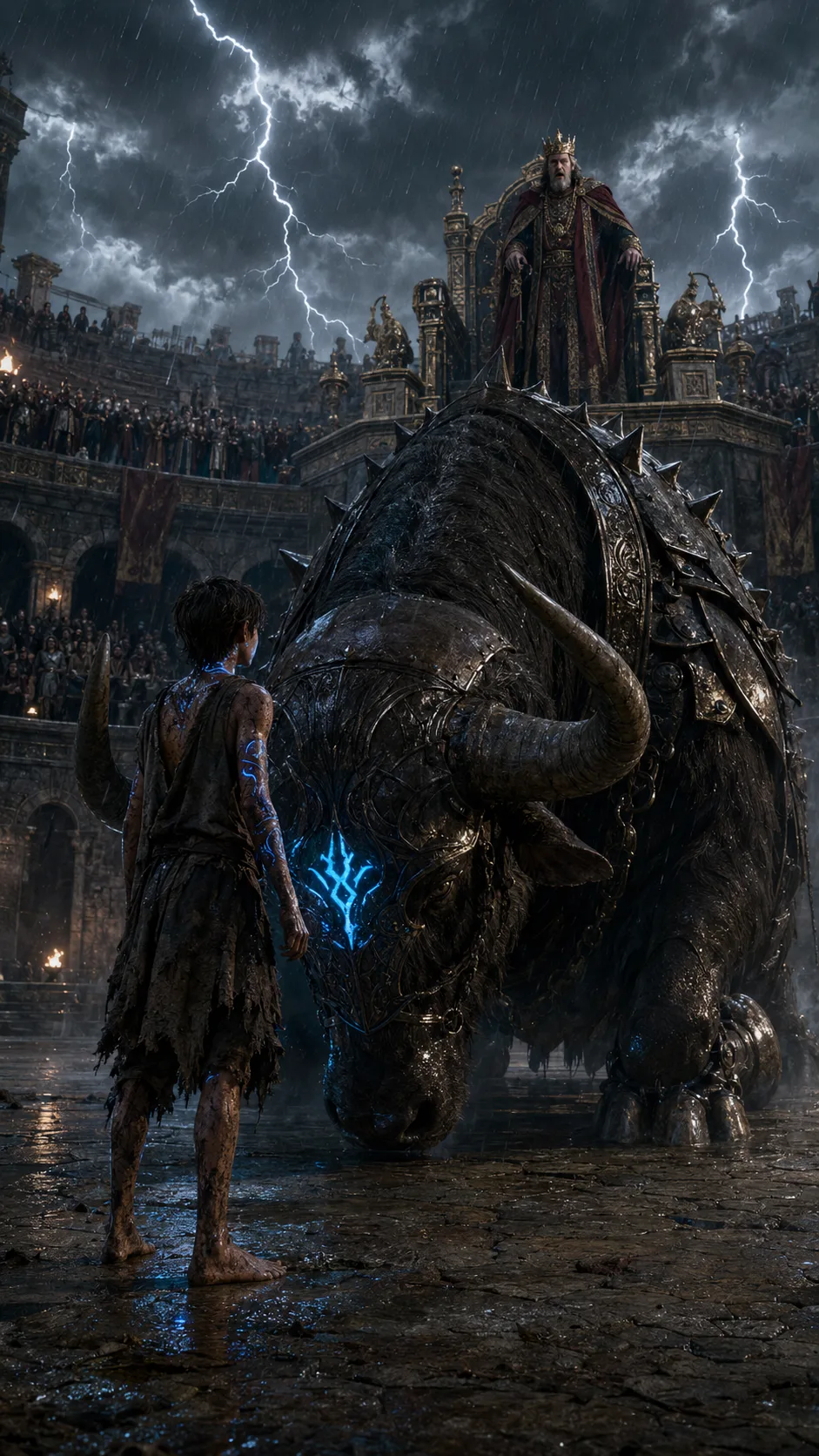
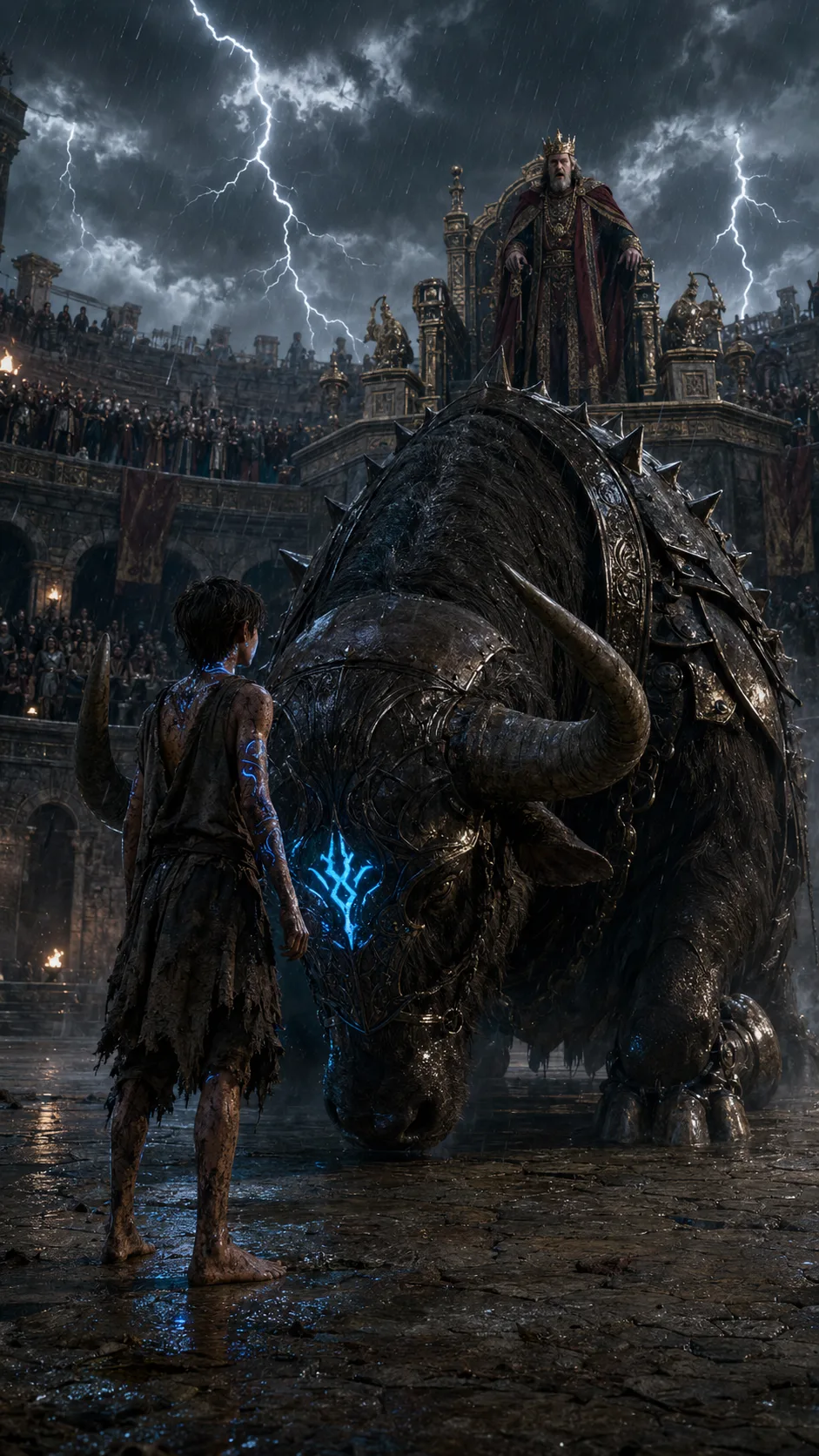
The first war buffalo stepped into the rain.
It was larger than any animal Marrin had ever seen. Its shoulders rose above the heads of the handlers standing behind the barrier. Black wet fur hung beneath plates of iron armor. Its horns curved forward, thick as tree limbs, sharpened at the tips and capped with steel. Spikes lined its shoulders. Chains swung from its neck.
Two more beasts followed.
The crowd pulled in one breath.
The lead buffalo turned its head.
Its eyes found Marrin.
Marrin’s stomach tightened so hard he nearly bent over.
Run.
Every part of his body said it.
Run now.
But there was nowhere to go. The walls were too high. The guards waited with crossbows. The beasts covered the gate. The crowd wanted movement, fear, blood, a boy scrambling across wet stone until the inevitable ended the game.
Marrin stood still because his legs would not obey.
The lead buffalo pawed the ground.
Stone cracked beneath its hoof.
Varric watched from above, hands folded behind his back.
The king looked down from the throne.
The captain struck his spear against the floor once.
The beasts charged.
The world became hooves.
Rain exploded from the stone with each impact. The lead buffalo lowered its armored skull and drove forward, the two behind it spreading wide to close the space. The ground shook through Marrin’s bare feet. The crowd rose with the motion, a thousand bodies leaning into one death.
Marrin heard the old arena keeper’s voice.
You have something else.
The mark beneath his skin burned.
He closed his eyes.
The charge grew louder.
Closer.
His hands stopped shaking.
For the first time in his life, Marrin did not try to push the blue light down. He let it move. It rose from his wrist to his elbow, from his ribs to his throat, lines opening beneath mud and rain like cracks in a sealed door.
The crowd noise thinned.
The pounding hooves remained.
Marrin opened his eyes.
The lead beast was almost on him.
Its horns filled the air in front of his chest. Its breath rolled over him, hot and white. Its armored head came with the weight of a falling wall.
Marrin opened his mouth.
The sound that came out was not a word he had learned.
It was deeper than his own voice. Older. It dragged through his bones before it crossed his tongue, a low call that spread across the arena and folded itself into the thunder above.
The lead buffalo slammed its hooves down.
Its body skidded.
Iron screamed against stone.
One horn stopped inches from Marrin’s chest.
The force of the stop blew rain against his face. The beast’s breath washed over him. Its eyes were so close he could see himself reflected there: small, wet, standing between death and silence.
Nobody moved.
Then blue light appeared beneath the beast’s armor.
At first, it was only a flicker through the cracks of the faceplate. Then it brightened, forming the same three curved lines that burned under Marrin’s skin.
The beast lowered its head.
Slow.
Heavy.
Deliberate.
Its front knees bent.
The arena floor trembled as the royal war beast bowed before the barefoot boy.
One gasp broke from the stands.
Then another.
The two beasts behind it stopped. Their heads swung toward Marrin. Their armor clattered as they shifted. For a breath, the whole kingdom waited for them to attack.
They did not.
The second beast lowered itself.
Then the third.
Three royal war buffalo knelt in the rain.
Before him.
Marrin stood with one hand lifted, not touching the first beast, not yet. Blue light ran along his fingers. The beast closed its eyes under the glow.
High above, the king stood from his throne.
His crown sat crooked on his head.
Lord Varric turned to him.
“Your Majesty,” he said.
The king did not answer.
His gaze was fixed on Marrin’s chest, where the mark now shone clear through the torn shirt.
Three curved lines through a circle.
Lightning inside a crown.
The old royal seal.
A priest dropped to his knees near the platform.
Then another.
A murmur moved through the arena.
“The queen’s mark.”
Someone said it too loudly.
The words spread faster than any horn call.
“The queen’s mark.”
“The lost prince.”
“No. The prince died.”
“Look at the beasts.”
Varric’s face sharpened.
“Silence,” he shouted.
No one obeyed.
Marrin finally touched the beast’s armored forehead. The metal was cold under his palm. The blue symbol there brightened, answering his skin.
A memory struck him without shape.
A woman’s hand.
A blue stone pendant.
A song hummed under rain.
Not enough to understand.
Enough to hurt.
The king took one step down from the throne platform.
“Marrin,” he said.
The boy looked up.
The arena quieted around the name because the king had spoken it like he had known it before today.
Marrin lowered his hand from the beast.
“My name,” the boy said, his voice carrying strangely well, “was given to me by a woman who found me beside a river.”
The king’s mouth moved once.
No sound came.
Varric stepped forward. “This is sorcery. The beasts have been tampered with. Seize him.”
The guards at the lower wall did not move.
They were looking at the kneeling beasts.
Varric turned red. “Seize him!”
A captain lifted his crossbow halfway, then lowered it again when the lead buffalo raised its head.
Not fully.
Just enough.
The message was plain.
Try.
Marrin looked at Lord Varric. For years, powerful men had looked through him, around him, over him. Varric looked directly at him now.
That was new.
The king descended three steps from the platform. Rain touched the edge of his robe as he left the shelter of the canopy.
“Show me your arm,” he said.
Marrin did not move.
“No.”
The word crossed the arena cleanly.
A boy denying a king.
The crowd held still.
King Orlan stopped.
Marrin’s hand lowered to his side.
“You saw it already,” he said. “You saw it in the hall. You saw it before the gate opened.”
Varric’s eyes narrowed.
The king’s shoulders sank by a fraction.
Marrin pointed toward the broken seal wrapped again in black cloth at Varric’s belt.
“You knew that mark.”
No one breathed loudly now.
The rain filled the spaces between words.
“You knew,” Marrin said again, “and you still opened the gate.”
The accusation did not need shouting.
It landed harder without it.
King Orlan looked older in the rain. The gold on his robe seemed dull away from the torches. His crown had slipped slightly to one side, and he did not fix it.
Varric moved closer to him.
“Your Majesty, do not answer a gutter child before the court.”
The lead beast stood.
Slowly.
Its massive head turned toward Varric.
The advisor stopped speaking.
Marrin’s fingers brushed the glowing mark on his own wrist.
The beast took one step.
Varric backed away.
A sound rose from the crowd. Not cheering. Not yet. Fear had changed direction, and everyone felt it move.
The old arena keeper appeared near the lower gate, half-hidden behind soldiers. His one eye met Marrin’s.
He nodded once.
Marrin turned back to the throne.
“Who was my mother?”
The question struck the king worse than any blade could have.
A priest near the royal platform covered his mouth. A noblewoman began crying without making a sound. Lord Varric looked toward the guards again, measuring exits.
King Orlan stood in the rain for a long time.
Then he reached to his throat and pulled something from beneath his robe.
A chain.
At the end of it hung half a blue stone pendant.
The other half was missing.
Marrin stared at it.
The mark under his skin pulsed.
The king held the pendant in his palm. Rain gathered in the lines of his hand.
“Elyra,” he said.
The name moved through the arena like wind through dead leaves.
Queen Elyra.
Marrin took one step forward. The beast did not stop him.
“She had a son,” the king said.
His voice was rough now. Not royal. Not polished. Just a man with too many eyes on him.
The crowd waited.
Varric said, “Your Majesty.”
The king kept looking at Marrin.
“She had a son,” he said again. “And I was told he died.”
Marrin’s jaw tightened.
“By whom?”
The king turned.
Lord Varric’s face emptied.
For the first time, the advisor looked almost plain.
A man in wet velvet standing too close to a lie.
“No,” Varric said.
The king’s hand closed around the pendant.
The lead war buffalo lowered its horns toward the advisor.
Varric stepped back until his heel met the first stair of the platform.
“No,” he said again, but it had less shape now.
The king looked at the black cloth at Varric’s belt.
“The seal.”
Varric did not move.
The captain of the guard finally crossed the platform and removed it from him.
Inside lay the broken royal seal.
The same symbol.
The old priest crawled forward on both knees, took one look, and pressed his forehead to the wet stone.
“Blood of Elyra,” he said.
The words broke the arena open.
Some nobles stood. Others knelt. Soldiers lowered their weapons. People who had come to watch a boy die now stared at him as if he had stepped out of a forbidden prayer.
Marrin did not feel taller.
He felt wet.
Cold.
Hungry.
His wrist hurt where the chain had torn it.
The bread he had stolen that morning was probably still in the mud.
The king approached him slowly, down the last steps, across the arena floor, stopping several paces away from the beast. The war buffalo watched him but did not attack.
King Orlan removed his crown.
Gasps rose from the royal platform.
He held it at his side.
“I did not know,” he said.
Marrin looked at him.
The words were too small for the arena.
Too small for fifteen years.
Too small for Ina’s fever, for winter alleys, for stones thrown at his back, for hands grabbing his shirt, for the gate rising.
“You didn’t look,” Marrin said.
The king flinched.
That was answer enough.
Varric tried to run when no one was watching him.
Someone was.
The old arena keeper moved first, catching the advisor’s cloak with both hands. Varric twisted free, but the wet velvet tangled around his knees. A guard seized him before he reached the stairs. The crowd erupted then, loud and ugly, the way crowds always sounded when they discovered which direction safety had taken.
Marrin turned away from it.
The lead beast lowered its head beside him again, not fully kneeling now, but close enough for Marrin to place one hand on the armor.
The blue mark dimmed under his palm.
Rain continued to fall.
The king stood a few steps away, crown in one hand, pendant in the other. He looked as if he wanted to kneel too but did not know whether he had the right.
Marrin did not tell him.
By nightfall, the arena was empty except for guards, priests, and the beasts.
No one knew what to call Marrin.
Prince.
Orphan.
Marked boy.
Blood of Elyra.
He sat on the lower step near the arena wall with a blanket around his shoulders. Someone had brought food on a silver tray: roasted meat, figs, white bread still warm from the palace ovens.
Marrin took the bread first.
He broke it in half.
Then he stopped.
The old arena keeper stood a few steps away, pretending not to watch.
Marrin held out the larger half.
The old man looked at it, then at him.
“That’s royal bread,” he said.
“It’s bread.”
The old man took it.
They ate without speaking.
Across the arena, the lead war buffalo rested near the western gate. Its armor had been removed from its face, revealing dark fur matted by rain and scars. The blue symbol was no longer visible, but Marrin knew it was there.
Some things did not need to shine to be real.
The king came near after the priests left.
He had changed out of his royal robe. Without the crown, without the gold, he looked less like the face on coins and more like a tired man trying to stand under a weight he should have carried years ago.
He stopped a respectful distance away.
Marrin noticed that.
“You will have rooms in the eastern tower,” the king said. “Servants. Tutors. Protection.”
Marrin chewed the bread slowly.
The king waited.
“I had a room once,” Marrin said.
The king looked at him.
“Behind a laundry house. It leaked when it rained.”
The king lowered his eyes.
Marrin looked at the beast near the gate.
“I don’t know how to be what you want.”
“I do not know what I want,” the king said.
That sounded true enough to be useless.
Marrin brushed crumbs from his palm.
“Then don’t start with wanting.”
The king looked up.
“Start with telling me where my mother is buried.”
For a while, only the rain answered.
Then the king nodded.
At dawn, they opened the small royal garden behind the northern chapel. It had been locked for fifteen years. Vines covered the gate. Moss had swallowed the stone path. The roses had grown wild and thorned, red blooms heavy with rain.
At the center stood a plain white marker.
No statue.
No crown.
Just a name.
Elyra.
Marrin stood before it in clothes that did not belong to him yet: a simple dark tunic, clean trousers, boots he had not laced properly. His hair was still too short, his hands still rough, his wrist still bandaged.
The king stood behind him.
No guards nearby.
No court.
No beasts.
Marrin reached into his pocket and pulled out the remaining half of the bread from the night before. He set it at the base of the stone because he had nothing else.
The gesture made no sense.
He did it anyway.
A breeze moved through the wet roses. For a second, beneath his collar, the blue mark warmed.
Not bright.
Just warm.
Marrin touched it with two fingers.
Behind him, the king said nothing.
That helped.
The city bells began ringing beyond the palace walls. News had already escaped into the streets. By noon, every market stall would carry a different version. By evening, songs would be wrong about him. By the next week, people who had spat at his feet would claim they had always known he was special.
Marrin did not care yet.
He looked at his mother’s name and thought of Ina, who had found him by the river and given him the first name anyone had ever used with kindness.
Then he thought of the arena.
Of hooves.
Of the horn stopped inches from his chest.
Of a king looking away.
Marrin turned from the grave and walked back through the wild roses, past the king, toward the palace doors.
The boots hurt.
He kept walking.
Chapter complete
You have reached the end of this chapter.
Continue reading
A few more worlds to get lost in after this chapter.




