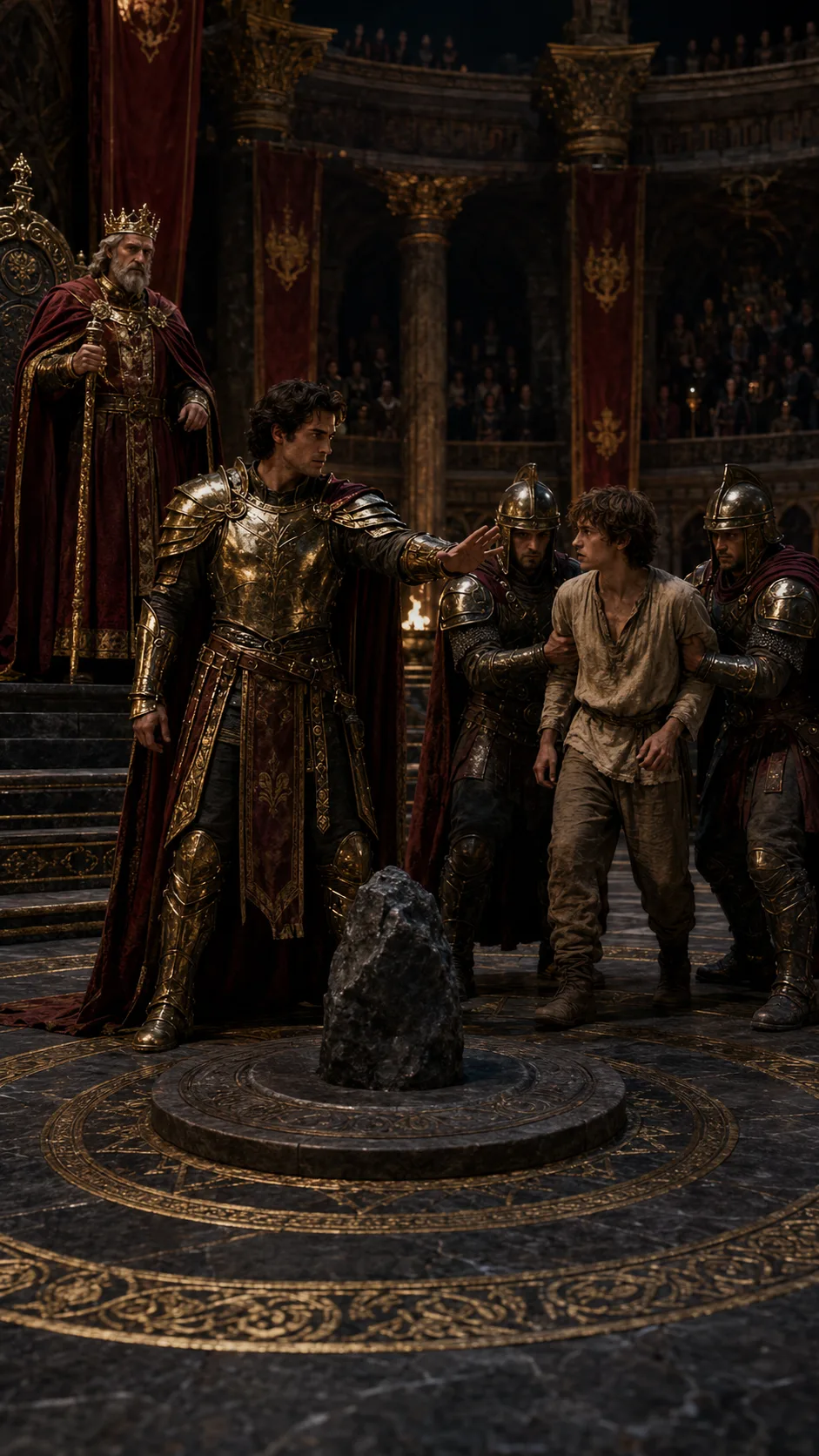
Rowan was still sweeping ash from the lower torch wells when the first horn sounded above the arena.
Chapter 1
Rowan was still sweeping ash from the lower torch wells when the first horn sounded above the arena.
The sound rolled through the stone corridors like a warning. Not the bright silver call used for weddings or summer games. This horn was deeper, older, dragged out from the throat of the palace itself, and every servant in the lower halls knew what it meant.
The Bloodstone had been opened.
Rowan stopped with the broom in his hands. The ash bucket beside his boot tilted slightly, spilling a thin black line across the floor.
“Move,” said Garran, the old gatekeeper, without looking up from the bronze latch he was polishing. “You hear royal horns, you become invisible.”
Rowan bent, righted the bucket, and pushed the ash back with the side of his broom.
He had practiced becoming invisible for most of his life.
At eighteen, he knew which walls cast the thickest shadows. He knew how to carry trays without letting the silver knock together. He knew which noble
houses tipped with copper, which tipped with insults, and which ones smiled while doing neither.
The palace records called him Rowan of No House.
No father named.
No mother named.
Found outside the east gate during the winter floods, wrapped in a brown cloak with a broken clasp and a scrap of cloth tied around his wrist.
That was all.
A scrap of cloth and a name someone had either given him or guessed.
The second horn sounded.
Above them, the arena stirred.
Dust fell from the ceiling cracks. Somewhere in the higher halls, soldiers shouted for the western gallery to be cleared. The nobility had been arriving since dawn, dripping in velvet, gold chain, polished boots, and perfume heavy enough to cover old stone.
Everyone wanted to witness Prince Caelan’s proof.
Everyone wanted to see the Bloodstone answer.
Garran finally glanced at Rowan, his one cloudy eye narrowing. “You
finish the third well?”
“Yes.”
“The fourth?”
“Almost.”
“Almost is how boys get noticed.”
Rowan gripped the broom tighter.
He was not a boy anymore, not really, but nobody at the palace had bothered updating the word. Kitchen boy. Gate boy. Ash boy. Stable boy, if the stable hands were short. The name changed with the task. The place did not.
Below.
Outside.
Useful only when unseen.
Rowan picked up the ash bucket and moved toward the fourth torch well near the service arch. The stone there was carved with symbols older than the current dynasty, thin lines curling into each other like roots under ice.
He had always noticed them.
Most servants stepped around them without looking. Soldiers called them dead marks. Priests called them sealed language. Rowan did not know what to call them. He only knew that sometimes, when the arena was empty and the sun slid
through the high eastern slit, the marks looked less carved than sleeping.
He crouched and brushed ash from one of the symbols with his thumb.
It was shaped like a crown split by a river.
The third horn sounded.
Garran cursed under his breath.
Rowan stood.
The service arch opened into the lower ring of the arena, where servants could bring water, oil, spare torches, and stretchers during tournaments. Today there would be no tournament. No games. No cheering for swordplay or horses.
Today was a rite.
King Aldric had waited years to perform it.
The old king had not been born kind, and age had not improved him. Rowan had seen Aldric only from a distance—on feast days, from behind pillars; during executions of tax decrees, from the end of a courtyard; once during winter distribution, when the king had passed a line of hungry children and looked over them like they were crates.
Prince Caelan was different.
He looked at people.
That was how he made them afraid.
Caelan was beautiful in the clean, polished way of a blade kept for display but still sharp enough to cut. Dark hair. Straight posture. Gold armor even when steel would do. A smile that appeared before a command and vanished before the consequence.
Rowan had crossed his path twice.
The first time, Rowan had been carrying wine and slipped on melted snow outside the council chamber. The tray fell. One cup shattered. The prince stopped.
Not to help.
To watch.
“Careful,” Caelan had said, while wine ran over Rowan’s sleeve. “Things without names are easy to replace.”
The second time was three days before the rite.
Rowan had been cleaning the lower stair when Caelan passed with two captains and a priest. The prince stopped near the old symbols carved along the wall.
“These stones still look dead,” Caelan said.
The priest bowed. “They wait for true royal blood, Highness.”
Caelan touched one gloved finger to the nearest carving.
Nothing happened.
He smiled anyway.
“Then they wait for me.”
The captains laughed because princes expected laughter.
The priest did not.
Rowan remembered that.
Now the arena above filled with footsteps.
He heard noblewomen settling into the upper tiers. He heard guards moving in groups. He heard the heavier strike of ceremonial boots crossing the royal platform.
Garran took the broom from Rowan’s hand.
“You’re done.”
“I haven’t finished the fourth.”
“You’re done because I say you’re done.” Garran grabbed the ash bucket and pushed it behind a pillar. “Stand back by the gate. Don’t breathe too loud.”
Rowan wiped his hands on his tunic. The fabric had been washed so many times it had lost any color it once had. Beige, brown, grey—depending on the dust.
He moved into the shadow beside the lower gate.
From there, he could see the arena.
The Bloodstone sat at the exact center.
It was not a jewel, not like children imagined when old women told stories in the kitchen. It was a raised slab of black stone, round and smooth, set into a wider circle of carved gold lines. At its edge stood the Crown Altar, sealed shut for three generations. A low black plinth with a narrow seam down the middle, as if the stone had lips.
Above it, the royal platform rose in steps.
King Aldric stood there in a crimson robe heavy with gold thread, one hand wrapped around a tall staff crowned with a lion’s head. His beard had gone silver, but his eyes had not softened. On his right stood Prince Caelan in ceremonial gold armor, bright enough to catch every torch.
Behind them waited High Priest Severin.
Severin was old in a way the king was not. Aldric looked preserved. Severin looked weathered. His ivory robes hung from narrow shoulders, and the ceremonial blade at his side looked more symbolic than useful. Rowan had delivered lamp oil to the temple wing often enough to know the priest’s habits. Severin spoke rarely. He listened to stone more than people.
The galleries quieted.
It happened in layers.
First the servants stopped moving. Then the guards stopped shifting their weight. Then the nobles lowered their fans and cups. Last came the silence of the king himself, which pressed down harder than all the rest.
Aldric lifted the staff.
The arena held its breath.
“Today,” the king said, his voice carrying without effort, “the old bond answers again.”
No one moved.
“For three generations, our house has ruled by blood, by conquest, and by divine witness. There are those beyond our walls who whisper that the old stones no longer know us.”
A small ripple passed through the nobles.
Aldric’s eyes moved across them.
“They will be answered.”
Caelan stepped down from the royal platform.
The light followed him.
Or maybe it only seemed that way because every polished surface on him threw gold back into the air. His cloak fell behind him in a crimson line. His hand rested near the sword at his hip. Not holding it. Not threatening.
Just reminding.
The High Priest descended after him, slower, carrying a shallow bronze bowl and a strip of white linen.
Rowan heard Garran exhale through his nose.
“Watch the priest,” the old gatekeeper said.
Rowan did.
Severin did not look at the prince.
He looked at the floor.
That should not have mattered.
It did.
Caelan reached the edge of the Bloodstone and turned toward the king. He smiled up at the platform, then turned to the galleries, giving them the exact face they had come to see.
The prince who could not be doubted.
The king’s only legitimate son.
The future of House Valeborn.
Aldric lowered the staff toward him.
“Let the arena judge your blood.”
Caelan stepped onto the center stone.
The sound of his armored boot hitting the Bloodstone was small.
Too small.
Rowan expected something to happen at once. A flare. A bell. A tremor. Some ancient proof loud enough to crush every whisper in the kingdom.
Nothing came.
The Bloodstone remained black.
The gold lines around it remained dull.
The Crown Altar stayed shut.
Caelan held his smile.
The arena waited politely at first. Then less politely. Somewhere in the second gallery, a noble’s bracelet clicked against the rail. A captain near the eastern gate shifted one boot back. Severin lowered his gaze to the center circle and did not lift it.
Caelan pressed his heel harder onto the stone.
Still nothing.
The smile thinned.
Aldric’s jaw moved once under his beard.
“Again,” the king said.
The High Priest dipped two fingers into the bronze bowl and touched the white linen to Caelan’s palm. No cut. No blood shown. Only the old symbolic contact. Cloth to skin. Skin to stone. The priest laid the linen on the Bloodstone at Caelan’s feet.
It should have been enough.
The linen sat there, pale and useless.
A murmur began on the western side.
It lasted less than a breath before Aldric looked up.
Silence returned.
Caelan lowered his chin toward the priest. “You performed it wrong.”
Severin did not answer.
The prince stepped closer. “Do it again.”
The old priest’s fingers tightened around the bronze bowl. The bowl trembled just enough for Rowan to see the light shake along its rim.
“The rite is complete,” Severin said.
Caelan’s face changed.
Not much.
A person looking from the upper gallery might not notice. Rowan saw it because servants survived by noticing small things. The prince’s left eyelid tightened. His mouth flattened. His hand slid down toward the hilt of his sword.
King Aldric struck the base of his staff against the platform.
The sound cracked through the arena.
“High Priest.”
Severin turned.
Aldric leaned forward, red robe pooling around his boots. “Speak carefully.”
Severin bowed his head. When he lifted it, he looked older.
“The stone does not answer him.”
The sentence landed with no echo.
That made it worse.
No echo meant the arena had taken it in.
Caelan stared at Severin.
The nobles stared at Caelan.
King Aldric stared at the Bloodstone.
Rowan stood behind the lower gate and forgot to breathe.
Garran’s hand closed around his wrist.
“Back,” the old man said.
Rowan took half a step.
Too late.
Aldric’s eyes moved.
They did not search the galleries. They did not stop on the priests or the captains. They swept downward, past the royal steps, past the lower ring, past the service arch.
Then they stopped on Rowan.
Not because Rowan mattered.
Because he did not.
A thing without a name could be used.
Aldric pointed the staff toward the lower gate.
“Bring that gate boy forward.”
Garran’s grip tightened so hard Rowan felt bone.
“No,” the old man said under his breath.
The guards heard the king, not Garran.
Two of them crossed the lower ring. Their armor was dark iron, their helmets shaped around the cheekbones. They did not run. Running would have made the order look urgent, and kings preferred cruelty to look like procedure.
Rowan stepped back until his shoulder hit stone.
“I did nothing,” he said.
One guard caught his upper arm.
The other caught his sleeve.
Garran moved in front of them before anyone expected him to.
“He’s only a servant.”
The first guard shoved him aside with a forearm.
Not hard enough to break anything.
Hard enough.
Garran struck the wall and stayed standing, one hand braced against the stone. His cloudy eye fixed on Rowan.
“Keep your feet under you,” he said.
That was all he had time for.
The guards dragged Rowan into the arena.
The light changed when he crossed from the service shadow to the open ring. Torches seemed brighter there. Faces sharpened. The nobles became rows of watching mouths and jewels and lifted hands.
Rowan felt every tear in his tunic.
Every smear of ash on his wrist.
Every place where the floor was cold beneath his bare feet.
Caelan turned.
The prince looked at him first with irritation, then recognition. The wine tray. The stairwell. The invisible boy who had not stayed invisible.
A corner of Caelan’s mouth lifted.
“Of course,” he said. “A witness from the dirt.”
The galleries gave a few nervous laughs.
Not many.
The Bloodstone was still dark.
Aldric descended three steps from the platform, staff in hand. He did not come all the way down. He did not need to. The whole arena bent toward him anyway.
“This court will see the difference,” he said. “Between royal blood and gutter shadow.”
Rowan’s throat went dry.
The guards pushed him closer to the center.
He tried to stop walking.
His feet slid over the carved outer circle.
Caelan moved fast.
Not with a sword. With his hand.
He stepped between Rowan and the Bloodstone and raised one palm, fingers spread, the gesture of a prince halting a servant before he stained a carpet.
“Keep him off the stone.”
The line cut through the arena cleaner than the horn.
Rowan stopped.
The guards stopped because Caelan had spoken.
For one second, everyone held their assigned place.
King above.
Prince at center.
Priest beside the dead stone.
Orphan at the edge.
Nobles watching.
Guards gripping.
The entire kingdom arranged like a painting made to prove the world had an order.
Then Rowan looked down.
At his feet, just beyond Caelan’s polished boot, one of the carved gold lines curved along the floor. The same crown split by a river that he had brushed ash from below.
Only here, it was larger.
Older.
The symbol seemed to be waiting.
Rowan lifted his eyes to Severin.
The High Priest was staring at him.
Not at his torn tunic.
Not at the guards.
At his face.
As if he had seen it somewhere before.
Caelan noticed.
His raised hand curled slightly.
“Back,” the prince said.
No one moved.
Aldric’s voice came from the platform. “Forward.”
The guards obeyed the king.
Caelan obeyed no one.
He stepped sideways, blocking Rowan’s path again, and for the first time that day the prince looked less like a statue and more like a man who had heard something behind a locked door.
Rowan stumbled.
One guard’s grip slipped from his sleeve.
His shoulder struck Caelan’s arm.
Caelan pushed him back.
Not a blow.
Not enough for the court to call it violence.
Enough to break Rowan’s balance.
Rowan’s bare foot landed on the Bloodstone.
The first line of gold appeared under his heel.
It did not flash.
It woke.
A thin, living seam of light opened beneath his skin and ran outward through the carved circle. Rowan jerked back, but the light followed the shape of the stone, not his body. It spread in disciplined lines, one symbol to the next, crown to river, river to flame, flame to open eye.
A sound rose from the arena floor.
Not music.
Not thunder.
A low, ancient hum, deep enough for Rowan to feel it in his teeth.
The guards released him.
Caelan’s hand dropped.
King Aldric went still on the steps.
The gold lines raced past the prince’s boots. For a heartbeat, they lit the underside of his armor, turning him from gold to something pale and borrowed. The light did not stop at him. It passed him.
It reached Severin.
The High Priest’s bronze bowl slipped from his hand.
It hit the floor once.
A clear sound.
Then silence.
Rowan looked down at the Bloodstone, breath stuck somewhere behind his ribs. The symbols were no longer sleeping. They circled him, climbing the raised edge of the center slab, linking one to another until the entire arena floor looked like a map of fire.
He did not know what to do with his hands.
He held them out, palms open, as if the stone might be asking for something he did not have.
“Why is it answering me?” he said.
His voice sounded too small for the arena.
That made the silence larger.
Behind Severin, the Crown Altar cracked.
It was not a violent sound. More like ice splitting under spring water. A narrow seam of gold appeared down the black plinth. Dust slid from the carved edges. The two halves parted just enough for light to spill through.
No one sat.
No one dared.
Caelan turned toward the altar.
Then toward Rowan.
Then toward his father.
The prince’s face had lost its ceremony.
“A trick,” he said.
The word came out clipped.
Aldric did not answer.
He was staring at the altar.
The seam opened wider.
Inside, resting on a black velvet hollow untouched by three generations of kings, lay the old crown.
Not the one Aldric wore.
This crown was darker. Older. The gold looked almost red under the torchlight, and at its center sat an empty setting where a stone should have been.
The Bloodstone beneath Rowan pulsed once.
The empty setting in the crown answered.
A noblewoman in the second gallery covered her mouth with two fingers.
One of the captains near the eastern gate lowered his spear.
Severin took one step away from Caelan.
That step changed the room.
It was small. Barely the width of a hand.
But everyone saw it.
The High Priest had been standing beside the prince as witness.
Now he stood between the prince and Rowan as if the old law had pulled him there.
Caelan saw it too.
“Severin,” he said.
The priest did not look at him.
Caelan’s voice hardened. “You serve the crown.”
Severin turned slowly.
His aged face was lined, pale, and lit from below by the gold rising from the stone.
“No,” he said. “I serve what crowns it.”
The words moved through the gallery like a blade drawn from velvet.
Aldric finally stepped down from the platform.
One step.
Then another.
His staff struck stone each time, but the sound no longer commanded the room. The hum beneath the arena swallowed it.
“Enough,” the king said.
The Bloodstone brightened under Rowan’s feet.
Aldric stopped.
That was the second crack.
Rowan saw it. So did Caelan. So did the nobles who had spent years learning the shape of power and the exact moment it began to slip.
The king lifted his staff higher. “This rite is corrupted.”
The gold lines climbed the base of the Crown Altar.
Severin bowed his head.
Not to the king.
To Rowan.
The arena did not gasp.
People did.
The first noble to kneel was Lord Maelor of the northern marches, a man with a scar across his chin and no reputation for softness. He lowered himself slowly, one knee touching the stone gallery floor.
Then the captain at the eastern gate knelt.
Then one of the temple singers.
Then three nobles at once.
A wave did not pass through the room. Waves are smooth. This was uneven, human, full of hesitation and fear. People looking left and right, calculating which truth would still be standing when the light faded.
Then kneeling anyway.
Caelan stepped backward until his heel caught the edge of the dead circle he had stood on moments before.
“No,” he said.
The crown inside the altar lifted.
No hands touched it.
It rose slowly, almost reluctantly, as if it had waited so long that motion itself had become sacred. The empty setting at its center faced Rowan. The Bloodstone pulsed again.
Rowan shook his head once.
He did not want it.
That was the worst part.
Aldric could have fought ambition.
Caelan could have crushed a claimant.
The court could have mocked a servant who reached too high.
But Rowan did not reach.
The crown moved toward him anyway.
Severin’s voice filled the arena, thin at first, then steadier.
“The arena has named its heir.”
The words did not cheer.
They judged.
Caelan’s hand flew to his sword.
Half the guards shifted.
Not toward Rowan.
Toward Caelan.
He noticed.
His fingers froze on the hilt.
The prince looked at the guards, then the kneeling nobles, then the priest, then finally at Rowan, who still stood barefoot on the glowing stone in a stained tunic with ash on one wrist.
For one stretched second, the whole kingdom balanced on Caelan’s hand.
If he drew the sword, the old law would meet steel.
If he let go, the room would know he had lost before he spoke.
His fingers opened.
The sword stayed sheathed.
That was the third crack.
King Aldric looked at his son’s hand.
Something moved across the old king’s face then. Not fear. Not grief. Something colder. Calculation finding no path.
The crown hovered before Rowan, low enough that its light touched his throat.
Rowan did not kneel.
He could not.
His knees had forgotten how.
Severin stepped closer, one careful foot at a time. He did not touch the crown. He did not touch Rowan. He only lowered himself with the difficulty of an old man whose bones knew the cost of public truth.
The High Priest knelt at Rowan’s feet.
The arena followed.
Not all at once.
Not cleanly.
But enough.
By the time the hum faded into the stone, half the royal court was on its knees, the other half halfway down, and the prince of House Valeborn stood alone in the center ring with his hand empty at his side.
Aldric’s staff lowered by an inch.
No one told him to.
His own arm did it.
Caelan looked up at his father.
“Say something,” he said.
The king’s mouth opened.
No sound came.
The Bloodstone had already spoken.
After the light settled, nobody knew where to place their eyes.
That was the first thing Rowan noticed.
Nobles who had spent their lives staring at kings now examined the floor. Guards checked their grip on spears that no longer told them who to defend. Temple attendants gathered fallen incense beads one by one, though none of them had spilled near the altar.
The crown hovered a breath from Rowan’s chest.
Then, slowly, it lowered—not onto his head, not yet, but into the waiting hands of High Priest Severin.
The old priest held it like it weighed more than metal.
“Not here,” Severin said.
His voice had lost the force of proclamation. Now it was only tired. “Not in a shouting arena.”
Aldric’s eyes snapped to him.
The king had found his voice again. Or part of it.
“You forget yourself.”
Severin stood with the crown in his hands.
“No,” he said. “I have remembered too late.”
That quiet answer did more damage than any accusation.
Caelan moved first.
He turned sharply and walked toward the royal stairs, cloak snapping behind him. No guard stopped him. No guard followed him either. That was new. He reached the first step, then paused as if expecting the old rhythm to return: captains falling in, nobles lowering heads, servants vanishing.
Nothing arranged itself around him.
He climbed alone.
Aldric did not look at Rowan when he left the platform.
He looked only at Severin and the crown.
Then he turned, red robe dragging over the stone, and walked through the royal arch with two guards behind him and an arena full of people watching the space where his authority had been.
Rowan stayed where he was.
The Bloodstone under his feet had gone dark again, but it no longer looked dead. It looked patient.
Garran came down from the lower gate after everyone else had begun moving. His left sleeve was dusty from where the guard had shoved him into the wall. He stopped at the edge of the circle and did not step onto it.
“Keep your feet under you,” he said again.
Rowan looked at him.
This time, the words meant something else.
They took Rowan to the temple wing, not the throne room.
Severin insisted.
Aldric objected.
The guards obeyed Severin.
That, more than the crown, told the palace what had changed.
By sunset, the whole capital knew a gate servant had lit the Bloodstone. By midnight, the story had already become something else in the taverns: the orphan prince, the false heir, the crown that flew, the king struck dumb by the gods.
None of those stories mentioned the ash bucket.
Rowan did.
He sat on a stone bench outside the inner sanctuary, still wearing the same torn tunic because nobody had decided what clothing belonged to him now. A tray of untouched food rested beside him. There was roasted duck on it, figs, bread brushed with oil, a silver cup of watered wine.
He picked at the bread.
It tasted too rich.
Across the chamber, Severin stood with three old women from the archive, all of them bent over a wooden box that had been sealed in wax. The crown sat on a black cloth beside them.
Garran slept in a chair near the door because Rowan had refused to enter the sanctuary unless the old gatekeeper came with him.
“He is not court,” one priest had said.
“Neither am I,” Rowan answered.
Nobody argued after that.
Near dawn, Severin brought him the scrap of cloth.
The same one found around Rowan’s wrist eighteen years earlier. Rowan had not seen it since he was ten. He thought the records room had lost it or thrown it away. But here it was, brown with age, the frayed edge embroidered with a thread so dark it was almost black.
Severin placed it on the bench.
“The symbol was hidden in the weave,” he said.
Rowan touched the cloth.
At first it looked like nothing. Then the old priest lifted a candle behind it, and the thread caught the light.
A crown split by a river.
Rowan’s fingers went still.
“Who left me at the gate?”
Severin did not answer quickly.
That was answer enough.
“The queen had a sister,” he said at last. “Princess Elianor. She vanished during the winter flood eighteen years ago. The court was told she died before reaching the border.”
Rowan looked down at the cloth.
“She had a child.”
“Yes.”
“Me.”
Severin folded his hands in front of him. The old man’s nails were stained with wax. One had cracked near the tip.
“The king ordered every record sealed. Those who knew were sent away. Some obeyed. Some hid what they could.”
Rowan thought of the gate.
The floods.
The cloak.
The broken clasp.
He thought of Garran polishing latches for eighteen years and never once letting him sleep outside the lower walls, no matter how many times the kitchen steward complained.
He looked toward the old gatekeeper asleep in the chair.
“Did he know?”
Severin followed his gaze.
“He suspected.”
“That is not the same.”
“No.”
Rowan picked up the scrap of cloth.
It fit in his palm like something too small to carry a life.
“What happens now?”
Severin looked older than he had in the arena.
“Now the kingdom decides whether it honors the law it pretended to worship.”
“And if it doesn’t?”
The old priest looked at the crown.
“Then the Bloodstone will not be the last thing to wake.”
Three days later, Rowan returned to the arena.
Not for a coronation.
Not yet.
Severin had refused to crown anyone while King Aldric still held the palace guard and Prince Caelan still commanded the western captains. The kingdom had become a room full of people lowering their voices whenever Rowan entered.
Some bowed.
Some stared.
Some pretended not to see him at all.
That part, at least, was familiar.
Rowan went back because he wanted the ash bucket.
It was still behind the lower pillar where Garran had pushed it. The broom leaned beside it. The fourth torch well remained half-cleaned, grey ash collected in one crescent along the carved edge.
No one had touched it.
The arena was empty except for Garran, who stood at the lower gate with a lamp in one hand.
“You should not be here alone,” the old man said.
“I’m not.”
Garran looked annoyed by that, which meant he was close to pleased.
Rowan picked up the broom.
The old gatekeeper sighed. “That is not what heirs do.”
Rowan brushed ash from the fourth torch well.
“What did they do for eighteen years?”
Garran said nothing.
The broom moved over stone, slow and steady. Dust lifted. The old symbol appeared beneath it, crown and river, cleaner than it had been that morning.
Rowan looked across the arena to the royal platform.
King Aldric’s seat stood empty.
Prince Caelan’s place stood empty beside it.
The Bloodstone sat dark at center.
Waiting.
A week later, Aldric abdicated in all but name.
The formal parchment said he had withdrawn from public judgment to preserve the dignity of the realm. Everyone knew better. He had not appeared in court since the rite. He remained in the eastern tower with his personal guard reduced to twelve men and his staff locked away in the temple vault.
Caelan left the capital before sunrise two days after that.
No exile was announced.
No farewell was given.
He rode west with four captains and enough gold to call it dignity instead of flight. At the outer gate, he passed Garran, who stood at his post as always.
The prince did not look at him.
Garran did not bow.
By winter, the court had stopped saying Prince Caelan’s name at meals.
By spring, they had started saying Rowan’s carefully.
Lord Rowan, at first.
Then Highborn Rowan, which made him laugh once and never again.
Then simply Rowan, when people realized the title mattered less to him than whether the lower kitchens received winter grain on time.
He was not crowned in the arena.
He chose the temple courtyard at dawn.
No gold armor.
No velvet platform.
No full galleries arranged to flatter power.
Only the temple bells, the captains who had sworn the old law, the servants who had known him before anyone else cared to, and enough citizens packed into the courtyard that the outer wall had to be opened.
Garran stood in the front.
Severin held the old crown.
When he lifted it, the missing stone at its center was still empty. Rowan had asked that it remain so.
“Why?” Severin had said.
Rowan looked at the crown then, at the hollow where something bright was expected to sit.
“So it remembers what it waited for.”
No one argued.
When the crown touched his head, no arena shook. No golden lines ran through the courtyard. No ancient voice spoke from the stones.
A baby cried somewhere near the back.
A woman laughed once, embarrassed, then covered her mouth.
A horse stamped.
Real sounds.
Rowan preferred them.
After the oath, he did not raise a sword. He did not promise conquest. He did not declare blood divine. He looked past the nobles, past the captains, toward the line of servants standing near the side gate because they had not known where else to stand.
Then he stepped down from the dais and walked to them first.
The court watched.
It learned.
Years later, people would still tell the story wrong.
They would say the arena chose a beggar.
They would say the crown flew across the air.
They would say the prince was struck by lightning from the Bloodstone, or that King Aldric fell to his knees, or that a dragon’s shadow crossed the arena roof.
None of that happened.
A king pointed at an orphan because he thought nothing could answer through him.
A prince raised his hand because he thought blood obeyed command.
An old stone woke because it had been waiting for the one person nobody had taught to lie about who he was.
That was enough.
On the first anniversary of the rite, Rowan returned alone to the lower ring before dawn. The arena gates were open now. Children from the city were allowed to see the old carvings on festival days. Servants no longer entered through the same narrow arch unless they wanted to.
The fourth torch well was clean.
Garran had kept it that way.
Rowan stood at the edge of the Bloodstone, wearing a simple dark coat with one small clasp at the throat. Not gold. Not red. Brown metal, repaired where it had once been broken.
He set the old ash broom beside the stone.
Then he placed the scrap of cloth next to it.
Crown and river facing upward.
The Bloodstone did not glow.
Rowan smiled at that.
Behind him, the sun climbed through the eastern slit and touched the arena floor, turning the carved lines gold for one quiet breath.
No crown moved.
No court watched.
No one knelt.
Rowan picked up the broom and finished the circle.
Chapter complete
You have reached the end of this chapter.
Continue reading
A few more worlds to get lost in after this chapter.