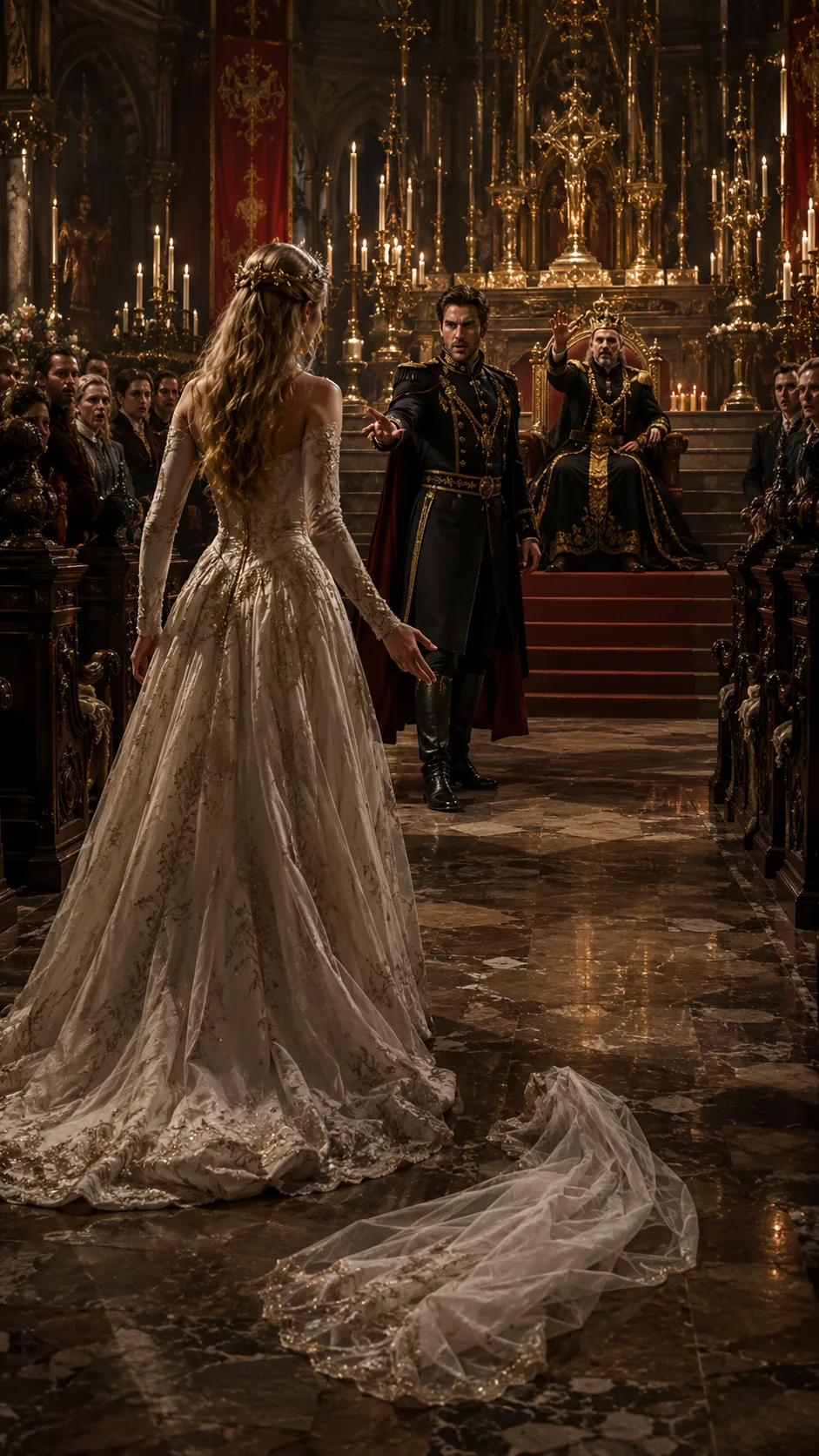
The veil pins bit into Elara’s scalp before she reached the cathedral doors.
Chapter 1
The veil pins bit into Elara’s scalp before she reached the cathedral doors.
A maid with trembling hands tried to fix the lace one last time, but Elara caught her wrist before the girl could push the final pearl comb deeper into her hair.
“Leave it,” Elara said.
The maid’s fingers went still.
On the other side of the carved oak doors, the royal choir had already begun. Low voices rose through the stone like smoke. Trumpets waited somewhere near the altar. Hundreds of candles burned in the nave, their wax dripping into gold holders shaped like lilies, though lilies had never been the flower of House Arvendale.
White roses filled the entrance hall instead.
Westmere roses.
Enemy roses.
Elara looked down at the embroidery along the front of her wedding dress. The thread shimmered faintly whenever she moved. Silver vines. White petals. Tiny golden crowns stitched into the hem. The seamstresses had spent three months making her look like a peace offering.
They had worked under guard.
So had she.
The maid lowered her eyes. “Princess, they are waiting.”
“They have waited long enough.”
Elara stepped toward the doors.
Two guards pulled them open from the inside.
The cathedral glowed like a treasure chest. Every surface reflected candlelight: polished marble, gilded saints, gold chalices, jeweled reliquaries, the high altar rebuilt after the siege. Crimson banners hung from the columns, but they were not her father’s banners. King Varric had replaced those within three days of taking the palace.
The old blue-and-silver stag was gone.
A black lion watched from every wall.
Elara entered alone.
No father to escort her. No brother to stand beside the altar. No mother in the front pew to adjust her veil with fingers that smelled of rosewater and ink.
Only nobles.
Nobles who had bowed to her father, then bowed lower to the man who buried him.
They rose as she walked past.
Silk rustled. Jewelry clicked. Someone coughed behind a gloved hand and stopped when Varric turned his head.
The cathedral aisle felt longer than it had during her coronation training. She remembered being eleven years old, walking that same strip of marble with a book balanced on her head while her father laughed from the altar steps.
“Again,” he had said.
She had complained that queens did not need to walk straight to rule well.
He had answered, “No. But people watch how you enter a room before they decide whether to believe you.”
Elara kept her chin level.
Every step mattered.
At the far end, Prince Kael of Westmere waited in a black ceremonial uniform trimmed with gold. His hair was dark and perfectly combed. His sword was polished. His gloves were white.
He looked like a bridegroom painted for a treaty.
Behind him,
King Varric sat on a temporary throne placed where no throne belonged, just above the altar steps. He had claimed he needed to be seen by both kingdoms. Everyone understood the truth. He wanted to sit higher than the priest, higher than the groom, higher than Elara.
His crown rested heavily on his head.
Her father’s crown.
He wore it without discomfort now. The first week, it had sat crooked. Elara had noticed. She noticed too much, according to the council.
The priest opened the book when she reached the last third of the aisle.
Kael extended his hand.
Elara stopped one step short of him.
The choir faded.
A small sound came from the noble seats to her left. A chair leg shifted against stone. One of her father’s old generals sat there in burgundy velvet, his face smooth as wax. General Merrow had once taught her how to read a battle map upside down. Now he wore Varric’s lion pin at his throat.
He did not meet her eyes.
Kael’s hand remained out.
“Princess,” he said.
Not Elara.
Never Elara.
The priest glanced toward the throne. His thumb pressed into the edge of the holy book hard enough to bend the page.
Varric leaned back, one ringed hand on the arm of the throne. The rings were too new. Freshly made. Heavy black stones set in gold claws.
“Proceed,” he said.
The priest’s throat moved. “Before crown, country, and the Most High, we gather to seal the union between—”
“No.”
The word did not echo.
It landed.
The priest stopped.
Kael’s hand lowered half an inch.
From the front pew, Lady Serane put her fan down slowly. Elara saw the movement from the corner of her eye. Serane had been her mother’s closest companion. After the coup, she had hosted the first victory dinner for Varric.
People survived in ugly ways.
Elara had learned that.
Varric’s smile did not vanish. It thinned.
“Continue,” he said.
The priest looked at Elara.
Elara looked past him to the altar candles. Seven on the left. Seven on the right. One tall center flame burning beneath the carved saint of mercy.
Mercy had a tired face.
“No,” Elara said again.
This time the word moved through the cathedral. No one repeated it, but every body in the room shifted around it.
Kael stepped closer. “You forget where you are.”
“I know where I am.”
“You stand before two kingdoms.”
“I stand before cowards.”
A hiss ran through the pews.
Varric’s hand closed on the throne arm.
Kael’s jaw tightened. “You will not shame yourself today.”
Elara turned her head and looked at the embroidery on her sleeve. Westmere flowers. Westmere crowns. Westmere silver. The gown had been sent across the border in a locked cedar chest, accompanied by six courtiers and twelve soldiers.
Kael had called it a gesture of honor.
Elara had worn it because Varric had locked every other dress away.
The priest tried to speak again. His voice cracked on the first syllable.
Varric rose from the throne.
The entire cathedral straightened with him.
“Kneel,” he said.
One word.
The same voice he had used in the council chamber when he ordered her father’s portrait removed.
The same voice he had used when he signed away the northern forts.
The same voice he had used when he told Elara that grief was unbecoming in a future queen.
Elara did not kneel.
Her hands lifted to the veil.
The pearl comb came loose first. Then the lace slipped from her hair. It was finer than spider silk and twice as expensive as the winter grain ration for the southern villages.
She held it for one breath.
Then she let it fall.
The veil landed on the marble between her and the altar.
A woman in the second row covered her mouth. Not from pity. From fear. Fear made people honest for a second before pride dressed them again.
Kael looked down at the veil.
“That was unwise.”
Elara said nothing.
He stepped over the lace and reached for her wrist.
His fingers never touched her.
Elara pulled back.
“Do not touch me.”
The room changed after that.
It was not loud. No one screamed. No bench overturned. The guards by the side doors did not rush forward.
But the nobles stopped pretending this was still a wedding.
Kael’s face hardened, the groom disappearing under the prince. “Finish the vow.”
“The vow was finished before I entered.”
“You will sign the treaty after the ceremony.”
“No.”
“You do not have the right to refuse.”
Elara looked at him then.
Not at his uniform. Not at the medals Westmere had given him for victories over her own border towns. At his face. The face of a man who had been told all his life that rooms would rearrange themselves to suit him.
“My father had the right,” she said.
Varric came down one step from the throne. His robes dragged behind him. “Your father is dead.”
The sentence struck the room like a bell.
Some nobles looked at their laps. Some looked at Varric. General Merrow closed his eyes.
Elara had heard those words many times.
From councilors. From guards. From servants who thought pity made them kind.
Her father is dead.
They used the truth as a lock.
Elara reached into the right side of the dress, where the seam pulled slightly against her hip. The seamstress had hidden the first stitch badly on purpose. A tiny flaw, almost invisible. Elara had touched that flaw every night for three weeks.
Inside the gown, under silk and wire, a strip of black leather ran from her ribs to her thigh. Not part of the dress.
Part of the armor.
Kael saw the movement and frowned.
“What are you hiding?”
Elara’s fingers closed around nothing yet.
Not time.
Not yet.
Varric’s eyes narrowed. He had not survived three courts by missing details. “Guards.”
The two soldiers by the side doors moved one pace inward.
Then stopped.
Only one pace.
Elara saw it.
So did Varric.
His head turned sharply toward them.
The taller guard lowered his eyes, but did not move again. The shorter one kept both hands on his spear and stared at the floor.
A small thing.
Small things opened gates.
Kael followed Varric’s glance, then turned back to Elara. He tried to make his voice smooth. “Do not make this uglier than it needs to be.”
A laugh came from somewhere near the back.
One breath. Cut off quickly.
Elara knew that laugh.
Captain Dain.
He had been fourteen when her father pulled him from the rubble after the eastern barracks fire. Twenty-eight now, if he had lived. Elara did not turn. She could not afford to confirm it.
Varric took another step down.
“I gave you mercy,” he said.
“You gave me a room with bars.”
“I gave you a crown.”
“You stole one.”
The cathedral drew in on itself.
Kael’s hand moved toward the sword at his hip.
Elara saw it. Varric saw it. Half the front row saw it.
The priest closed the holy book.
That was when Elara knew the last thread had snapped.
No blessing would save the ceremony now.
Varric lifted his chin. “Enough. You will kneel. You will speak the vow. You will sign. Then you will smile beside your husband while both kingdoms watch peace begin.”
Elara turned toward the altar candle.
Kael’s eyes flicked to her hand.
“Elara.”
He used her name for the first time that day.
Too late.
She reached for the center candle.
The flame leaned when she lifted it. Wax ran down the side and over her fingers. It was hot. She did not move her hand away.
Several nobles stood halfway, then sat again when no one else did.
Varric’s voice dropped. “Put that down.”
Elara looked at the hem of the dress. The enemy flowers curled around her ankles like vines.
“This dress was never mine.”
She lowered the candle to the silk.
The first thread caught quietly.
A small orange line opened along the white fabric.
A gasp broke from the right side of the nave. The priest backed into the altar table, rattling a silver cup. Kael stepped forward, then stopped because Elara still held the candle.
“Are you mad?” he said.
“No.”
The fire climbed just enough to blacken the embroidered flowers.
Elara dropped the candle onto the stone, seized the outer layer of the dress with both hands, and tore.
Silk split from hip to knee.
The sound was ugly. Fabric made to be admired did not like being used as armor.
She tore again.
Burning lace fell away in strips. A patch of flame licked toward her boot and died against black metal. Under the ruined silk, the first plate of armor flashed under candlelight.
Black steel.
Silver edges.
Her father’s stag carved over the breastplate.
The room did not gasp this time.
It stopped breathing.
Elara pulled the last burning panel free and threw it onto the aisle stones, where it curled and smoked beside the veil.
The wedding dress had hidden everything.
The breastplate. The bracers. The black riding trousers. The narrow silver belt that held more than decoration. The small rolled banner strapped flat along her spine.
Kael stared at the crest.
He had seen it on battlefields. On old treaties. On coins Varric had ordered melted.
Varric’s face changed by a fraction.
Only a fraction.
But enough.
He lifted his hand.
“Seize her!”
The guards by the side doors did not move.
One nobleman stood. Not to flee. To remove his velvet cloak. Underneath it, he wore a dark leather cuirass stamped with the old stag.
Then another.
Then another.
Cloaks slid from shoulders all along the cathedral. The sound moved like rain across pews. Velvet, silk, fur, all falling away to reveal mail, leather, hidden blades, archer straps, old campaign sashes.
General Merrow rose last.
His lion pin dropped from his collar and struck the floor.
Kael turned toward the pews.
His hand finally closed on his sword.
Captain Dain stepped out from the back row with two fingers raised.
Not a weapon.
A signal.
The side doors opened from the inside.
More soldiers stood beyond them, packed shoulder to shoulder in the outer hall, all wearing dark armor covered by pilgrim cloaks. No one charged. No one shouted. They simply stood there, present and impossible to ignore.
Elara reached behind her back.
The banner strap came loose.
Varric saw it and came down the final step from the throne. “Do not.”
Elara pulled the folded war flag free.
Kael took one step toward her.
Dain’s sword came halfway out of its sheath.
Kael stopped.
Elara snapped the banner open.
The old blue-and-silver stag unfurled in the smoke of the ruined wedding dress. Its edges were worn, patched in three places, but the crest still caught the candlelight like water.
Her father had carried that banner at the northern gate.
Her mother had wrapped it around Elara the night the palace fell.
It had not burned then.
It would not burn now.
Elara raised it with both hands.
The nobles who had stood in armor turned toward her.
Not toward the throne.
Toward her.
Kael’s face lost its shape of command. His mouth opened, closed, opened again.
“That is not—”
The words did not finish.
Varric remained on the altar steps. His hand hovered in the air without an order attached to it.
Elara stepped onto the first altar stair, not high enough to claim his place, high enough for the room to see her.
Her ruined silk smoked at her feet. The veil lay behind her like something shed by another woman.
She looked at the king.
Then at the prince.
Then at the nobles who had forgotten how to choose until someone else chose first.
“You wanted a bride,” she said.
The banner lifted higher.
“But you called an heir to war.”
No one moved for three seconds.
Three seconds was enough for a kingdom to change direction.
Then General Merrow knelt.
Not to Varric.
To Elara.
The sound of his knee hitting stone was not loud, but every person in the cathedral heard it.
Captain Dain followed.
The soldiers at the doors lowered their heads. More knees struck marble down the aisle, uneven and human, until the room that had risen for a forced wedding knelt for a different reason.
Kael looked around for someone still standing with him.
There were fewer than he needed.
His hand loosened on the sword.
Varric turned toward the guard nearest the throne. “Arrest them.”
The guard did not look at him.
Elara kept the banner raised until her arms began to ache. She welcomed the ache. It gave the moment weight.
At last, she lowered it enough to see the altar clearly.
The priest had retreated to the side, both hands around the holy book. His lips moved without sound.
Elara looked at him. “Open the western doors.”
The priest blinked.
“Open them.”
Dain moved first. He strode past the last row of pews and signaled to the soldiers outside. The great western doors were barred from within by Varric’s order. Two palace guards lifted the beam together. It fell with a heavy wooden thud.
Cold daylight entered the cathedral.
Not bright. Not clean. But real.
Beyond the doors, the palace square was packed.
People stood shoulder to shoulder under a grey sky: merchants, stable hands, laundresses, old veterans, children held above the crowd so they could see. Many carried pieces of blue cloth. Some carried nothing at all.
Elara had not known how many would come.
Dain had told her not to ask.
“If you know the number,” he had said three nights earlier through the laundry passage, “you’ll start measuring hope like grain.”
So she had not asked.
Now she saw them.
A kingdom waiting outside its own cathedral.
Varric saw them too.
His jaw shifted.
Kael stepped backward until his boot struck the altar step. He did not look like a prince then. He looked like a man counting exits.
Elara turned to the open doors and raised the banner again.
The crowd outside did not cheer at first.
They stared.
Then someone near the front lifted a cracked silver cup high into the air. An old soldier’s cup, dented and blackened at the rim. Others lifted cloth, tools, hands, whatever they had brought.
The sound started low.
Not applause.
Not celebration.
A chant.
“Arvendale.”
The name crossed the square slowly, as if people had to remember how to say it without fear.
“Arvendale.”
Inside the cathedral, Varric stepped down onto the aisle.
Dain moved to block him.
Varric looked at him with pure disbelief. “I gave you rank.”
Dain’s hand stayed on his sword. “Her father gave me a name.”
Varric’s face tightened.
Elara turned from the doors.
“Do not harm him,” she said.
Dain looked back.
Elara lowered the banner slightly. “He will stand trial in the hall where he crowned himself.”
Varric laughed once.
A short, empty sound.
“You think a banner makes you queen?”
“No.”
Elara looked at the smoking silk on the floor.
“The people outside do.”
Varric followed her gaze toward the doors. The chant had grown stronger now, but not wild. It beat against the cathedral walls with patience.
Kael recovered enough to speak. “Westmere will answer this insult.”
Elara faced him.
His sword still sat in its sheath. His hand hovered near the hilt, but the old soldiers in the pews watched every finger.
“Westmere already answered,” she said. “It sent you to marry a prisoner.”
His face hardened. “You were offered peace.”
“I was offered a collar.”
A noblewoman in the third row lowered her head. Elara did not know whether from shame or calculation. Sometimes they looked the same from far away.
Kael stepped back again.
Dain nodded to two soldiers by the altar. They moved toward him, not fast, not rough. Kael’s eyes darted to the sword on his hip.
Elara gave one small shake of her head.
The soldiers stopped at arm’s length.
Kael understood the mercy before he understood the insult.
He unbuckled the sword and placed it on the altar.
Metal touched stone.
That sound ended the wedding more completely than the fire had.
Varric stood alone on the aisle now, halfway between his stolen throne and the open doors.
His crown looked heavier in daylight.
The priest finally spoke.
“Your Highness.”
No one knew which ruler he meant until he turned toward Elara.
He bowed.
Not deeply. Not bravely. But enough.
Elara did not thank him.
Some bows came too late to deserve gratitude.
The next hour passed without ceremony.
Varric was escorted from the cathedral through the north passage under guard. He did not struggle. Men like Varric never imagined the room would continue existing after they left it, so his face held more confusion than fear.
Kael was taken to the guest wing, not the dungeon. Elara ordered his guards doubled and his correspondence sealed. She had no use for cruelty in a moment already sharp enough.
The nobles remained seated until told otherwise.
That pleased her more than it should have.
When the cathedral emptied, the floor looked like the aftermath of a strange storm. Velvet cloaks lay over pews. The lion pins had been dropped, crushed, kicked aside. The white veil still rested near the aisle center, grey now along one edge from smoke.
Elara stood beside it.
Dain approached, helmet under one arm.
“Your Highness.”
She looked at the veil.
“Do not call me that yet.”
“The square already is.”
“The square is cold and hungry.”
“Yes.”
“Then we begin there.”
Dain nodded once.
General Merrow waited near the altar steps. He had removed his cloak, his lion pin, and whatever expression he had worn for the last two years. Without them, he looked older.
“Elara,” he said.
Dain’s hand shifted toward his sword.
Elara stopped him with a glance.
Merrow held out a folded paper.
“What is that?”
“A list,” he said. “Names of the officers still loyal to Varric. Supply routes. Prison placements. Your father’s last dispatch.”
Elara did not take it immediately.
Merrow looked at the floor. “I should have given it to you sooner.”
“Yes.”
The word stood between them.
He kept the paper out.
Elara took it.
His hand shook once after she did.
She turned away before he could turn regret into a speech.
Outside, the square had not emptied. People waited in the cold, many of them silent now. Children sat on shoulders. A baker with flour still on his sleeve stood beside a stable boy holding a strip of blue cloth. An old woman clutched a candle stub in both hands like a relic.
Elara stepped onto the cathedral stairs.
The ruined dress dragged behind her in torn white strips. Armor showed beneath it. Smoke clung to the hem. Her hair had come loose, and the wind pulled it across her face.
No one seemed to mind.
She carried the banner down three steps.
Then she planted its pole between the stones.
The square lowered.
Not all at once. Not perfectly. Some people knelt. Some bowed. Some simply placed one hand over the heart because their knees were old or their pride still healing.
Elara looked across them.
“My father is dead,” she said.
The square held still.
“His kingdom is not.”
No roar followed.
Just breath.
A thousand people exhaling after holding too much for too long.
That was better than cheering.
By sunset, the palace bells rang for the first time since the coup. Not the wedding bells Varric had ordered. The old bells from the eastern tower, the ones with cracks in them, the ones her father had refused to replace because he said even broken things could still call people home.
Varric’s trial began three days later.
He demanded a crown on the table.
Elara denied it.
He demanded Westmere witnesses.
She allowed them.
He demanded to speak first.
She let the widows from the northern forts speak before him.
By the end of the week, the council that had bent around him for two years could no longer look directly at him. The official charge was treason against the crown. The unofficial charge was that everyone had heard enough.
He was sent to the island fortress at Greywatch, the same place where he had once imprisoned dissenting lords until their families became obedient.
Kael returned to Westmere without his sword.
He carried a treaty instead. Not the one he had come to force. This one named border reparations, prisoner returns, and the removal of Westmere soldiers from Arvendale soil.
He signed it because Elara placed her father’s last dispatch beside the parchment.
He read the date.
Then he signed.
The wedding dress was not repaired.
The seamstresses asked what should be done with the remaining silk. Some suggested preserving it in the royal archive. Others suggested burning it completely.
Elara ordered it cut into strips and sewn into bandages for the wounded in the southern camps.
The veil stayed with her.
Not because she wanted it.
Because she wanted to remember how soft a cage could look.
On the morning of her coronation, Elara stood again before the cathedral doors. No maid pushed pearl pins into her hair. No enemy flowers waited inside. No throne stood on the altar.
Dain held the old banner beside her.
General Merrow stood three steps behind, stripped of rank but not yet dismissed. He would spend the next ten years rebuilding the northern roads under the supervision of the families who had lost sons there.
That was Elara’s sentence.
Not mercy.
Work.
The doors opened.
This time, she entered without a veil.
The cracked bells rang above her.
She walked straight.
Chapter complete
You have reached the end of this chapter.
Continue reading
A few more worlds to get lost in after this chapter.