Amara was grinding feverroot into powder when the first stone hit her window.
Chapter 1
Amara was grinding feverroot into powder when the first stone hit her window.
It cracked the glass in the upper corner, not enough to break the whole pane, just enough to let the morning cold through in a thin line. The pestle stopped in her hand. The little boy on the cot beside the hearth opened his eyes, but he did not sit up. He had no strength for that yet.
“Don’t look,” Amara said.
Her voice stayed low.
The boy’s mother stood near the shelves, clutching a folded cloth to her chest. She had come before dawn, hood pulled low, carrying her son through the mud because the village physician had refused to touch him.
The fever had taken six children that week.
Amara had saved four.
That used to matter.
Another stone hit the wall outside. This one struck the shutter and fell into the herb bed below. Someone shouted from the lane.
“Witch.”
The boy’s mother did not breathe for
a full second.
Amara poured the powdered feverroot into a cup, added hot water, and stirred until the liquid darkened. Her hands had small burns across the knuckles from the previous night’s fire. A scratch ran down her wrist where a frightened goat had kicked while she was treating its infected leg.
She carried the cup to the cot.
“Small sips,” she said.
The boy’s mother moved toward her child, then stopped when another voice rose outside.
“By order of the Crown, open this door.”
That voice was not from the village.
Armor followed it.
Not one soldier. Several.
Amara set the cup down on the stool beside the cot and looked toward the old wooden door. It had been her mother’s door once, painted blue many years ago. Almost all of the paint had peeled away, but one streak remained near the latch. A tiny strip of sky.
She
had always meant to repaint it.
Never did.
The soldiers did not wait for permission.
The door slammed open so hard the iron hinge split the wood. Three royal guards entered first, cloaks wet from the road, boots black with mud. Behind them came a man in a red-trimmed robe with the king’s seal pinned at his shoulder.
A crown magistrate.
That was worse than soldiers.
The magistrate looked around the cottage without moving his head much. Shelves of dried herbs. Bowls. Linen bandages. A kettle over the hearth. The sick boy. The frightened mother. Amara standing beside a cup of medicine.
His eyes settled on her.
“Amara of the western woods.”
She wiped feverroot from her fingers onto her apron. “Yes.”
“You are accused of dark magic, unlawful healing, spreading sickness among loyal villages, conspiracy with forbidden spirits, and treason against the royal house.”
The boy’s mother made a
small sound.
Amara looked at the magistrate’s hands. Clean gloves. Soft leather. No mud beneath the nails.
“You came all this way for a healer?”
“For a witch.”
One of the soldiers stepped forward and grabbed her arm.
The boy on the cot started coughing. It came hard and wet, shaking his whole thin body. His mother rushed to him and lifted the cup, but her hand trembled so badly the medicine spilled onto the blanket.
Amara tried to turn.
The soldier tightened his grip.
“He needs the full cup,” she said. “Not half. The fever will climb again before noon.”
The magistrate looked at the boy, then at the shelves.
“Take the jars.”
Two guards began sweeping herbs, bottles, and folded notes into a sack. Glass cracked. Dried leaves scattered across the floor. A clay bowl rolled under the table and hit the wall with a dull tap.
Amara watched them take three years of work in less than a minute.
Then one guard reached for the small wooden box hidden behind the willow bark.
Amara moved before she could stop herself.
“Not that.”
The room paused.
The guard’s hand hovered over the box.
The magistrate noticed.
Of course he did.
He crossed the room and lifted it himself. It was plain, no larger than his palm, dark wood rubbed smooth from years of being touched. He opened it.
Inside lay a blackened pendant.
Old metal. A broken chain. A faded crest.
The magistrate’s face did not change, but his thumb moved over the mark at the center.
A crown wrapped in thorns.
He closed the box.
“This too.”
Amara’s throat tightened around the breath she did not let out.
“My mother gave me that.”
The magistrate slipped the box into his robe. “Your mother kept dangerous things.”
“She kept memories.”
“She kept evidence.”
That was the first time Amara understood this was not only about fear.
Fear was loud.
This was careful.
The soldiers tied her wrists outside her own cottage while villagers watched from the lane. Some stood behind fences. Some looked from windows. Old Mara from the mill, whose grandson Amara had treated after the river accident, pulled her curtain closed when their eyes almost met.
No one spoke for her.
Not one.
A little girl near the well held a copper charm against her chest. Amara had made it for her during the winter fever. The girl’s father saw it and pushed her hand down.
Amara was placed on a cart meant for grain sacks. The ropes bit into her wrists. The magistrate mounted his horse. The soldiers turned toward the capital road.
The sick boy’s cough followed her until the cottage disappeared behind the trees.
The palace had more candles than the village had windows.
Amara noticed that first.
They brought her through a servants’ gate after sunset, not through the front courtyard where nobles might ask questions. The corridors were high and cold, with carved stone arches and tapestries showing kings who all had the same hard eyes. Guards walked on both sides of her. The magistrate stayed ahead.
She kept looking for the wooden box.
He still had it.
At the end of a long passage, they stopped before a chamber with iron hinges across the door. Not a courtroom. Not yet.
A holding room.
The guard shoved her inside. She stumbled, caught herself on the wall, and stood straight before he could see her fall.
The door shut.
No window. One bench. One bucket. Straw on the floor that had already been used by someone else. A candle burned behind iron mesh near the ceiling, too high to reach.
Amara sat on the bench.
Her hands were still tied.
Her wrists had gone red beneath the rope.
She could hear movement beyond the door. Boots. Metal. Low voices. Once, laughter from somewhere far down the corridor, the kind that belonged to people eating warm food.
She thought of the sick boy.
Then the pendant.
Then her mother’s hands.
Not her birth mother. She knew that now, though no one had ever said it directly.
The woman who raised her had been named Elowen. A healer with sharp eyes, rough palms, and a habit of humming while cutting bandages. She had taught Amara how to boil needles, which mushrooms killed pain, which flowers killed people, and how to keep quiet when strangers asked about the past.
“When you are old enough,” Elowen used to say.
Amara had hated that answer.
Old enough never came.
Elowen died during the winter fever three years before the soldiers came. Amara buried her behind the cottage under the rowan tree. In the wooden box, she found the pendant, a scrap of blue silk, and one folded note written in a hand she did not know.
Protect her from the crown.
No name.
No explanation.
Just that.
Amara had worn the pendant beneath her clothes every day after.
Now the crown had it.
The door opened near midnight.
Amara stood.
A young man entered without a helmet.
That made the guards nervous.
His cloak was dark blue, fastened with a silver clasp shaped like a hawk. He was tall, with the kind of posture trained into children who were corrected before they were comforted. His face belonged to palace portraits, but not completely. There was something less polished around the eyes.
Prince Lucien.
Amara recognized him from coins.
The guards outside bowed. The door closed behind him.
He held a lantern in one hand and a small bundle in the other.
For a few seconds, neither of them spoke.
Then he looked at her wrists.
“They tied them too tight.”
“That is not the worst thing they’ve done today.”
He placed the lantern on the floor. “May I?”
She did not offer her hands. She did not pull them away either.
He stepped closer and cut the rope with a small knife. The blade was not jeweled. Not ceremonial. Practical.
The rope fell.
Amara rubbed one wrist with her thumb.
“You should not be here,” she said.
“No.”
He picked up the rope and set it on the bench instead of leaving it on the floor. A strange small courtesy.
“I read the charges.”
“Then you know I am very powerful. Be careful.”
His mouth almost moved into a smile.
Almost.
“You healed people in Westmere.”
“I tried.”
“You treated soldiers after the border raids.”
“Some.”
“You crossed three villages during the fever while physicians stayed behind locked doors.”
Amara looked at him. “You read more than the charges.”
“I asked questions.”
“That is dangerous in this palace?”
“Yes.”
The answer came too fast.
He opened the bundle and revealed bread, cheese, and a small flask. Amara looked at the food but did not reach for it.
“Eat,” Lucien said.
“Is this mercy?”
“It is bread.”
“That sounds like mercy with less courage.”
This time, his mouth did move. Only for a second.
Then the door shifted outside.
Both of them looked at it.
Lucien lowered his voice. “My father wants the trial tomorrow.”
“Tomorrow?”
“The council is already summoned.”
“That is not a trial.”
“No.”
He looked at the wall behind her, jaw tightening. The lantern light cut his face into gold and shadow.
“Why?” Amara asked.
He turned back.
“Why does a king care about a healer in the woods?”
Lucien did not answer right away.
She watched him make a choice and hate it.
“The western villages are failing,” he said. “Harvest rot. Fever. Wells gone sour. People are hungry. They need a reason.”
“And your father gave them me.”
His fingers closed around the knife handle.
“Yes.”
Amara took the bread then. Not because she wanted it. Because her hands needed something to do.
Lucien watched her break off a piece.
“There is something else,” she said.
He went still.
The prince had not survived palace life by missing changes in tone.
“The magistrate took a pendant from my cottage,” Amara said. “Old metal. Blackened. Crest of a crown wrapped in thorns.”
Lucien’s face lost color in a way the lantern could not hide.
“You’ve seen it.”
He did not speak.
“That crest means something.”
He reached for the wall behind him, only two fingers, barely touching the stone.
“Where did you get it?”
“My mother left it.”
“Your mother?”
“The woman who raised me.”
His eyes locked onto hers.
Not pity.
Calculation first.
Then something sharper.
“Do not mention that pendant tomorrow,” he said.
“Why?”
“Because if you do, they will not wait for a verdict.”
The door opened before she could ask more.
King Oren stood outside.
The guards dropped to one knee.
Lucien stepped back from Amara as if distance could erase the bread, the cut rope, the lowered voices.
The king entered alone.
He wore no crown now. Only a dark robe over a tunic embroidered with gold thread. Without armor, he looked older. Not weaker. Older in the way a locked chest looks old.
His eyes moved from Lucien to the lantern, then to Amara’s untied wrists.
“Leave us,” he said.
Lucien did not move.
The king looked at him.
One breath.
Lucien picked up the lantern.
As he passed Amara, his hand brushed the edge of the bench. He left the small knife beneath the straw.
The door shut behind him.
King Oren and Amara stood in the candlelit room.
He studied her face.
Not like a judge.
Like a man comparing a memory to a living thing.
“So,” he said. “The woods kept you alive.”
Amara’s skin prickled under her torn sleeves.
“You know me.”
“I know what you have pretended to be.”
“A healer?”
“A problem.”
That word landed colder than witch.
Problems were solved.
The king stepped closer. He did not rush. Men like him did not need to.
“The magistrate found an item in your possession.”
“My mother’s pendant.”
“Your mother had no right to keep it.”
“Then you know who she was.”
His face remained still.
Too still.
Amara felt the shape of a locked door inside her begin to split.
“Elowen told me nothing,” she said. “Only that the crown was dangerous.”
“Elowen was loyal once.”
“To whom?”
His eyes narrowed.
For the first time, the king looked directly angry. Not loud. Not red. Just a tightening around the mouth, the kind that made servants disappear.
“That question,” he said, “is why you are dangerous.”
Amara’s fingers found the knife beneath the straw. She did not pull it out. She only touched the handle.
The king saw the movement.
He smiled without warmth.
“You will not need that.”
“Because your trial will be fair?”
“Because by this time tomorrow, no one will care what you were.”
Were.
Not are.
He moved toward the door.
Amara spoke before he reached it.
“What was her name?”
The king stopped.
“The queen,” Amara said. “The one with the crest.”
His shoulders stayed square.
“Queen Seraphine died twenty-two years ago.”
“Childless?”
Silence.
The candle behind the mesh hissed once.
The king turned his head just enough for her to see his profile.
“Yes,” he said.
Then he left.
The trial lasted less than an hour.
They brought Amara into the Hall of Judgment with her wrists tied again. The room was not built for truth. It was built for people to feel small. Marble pillars rose into shadow. The floor shone black beneath rows of nobles in embroidered coats. Priests stood near the king’s chair. Scribes waited with ink already wet on their quills.
King Oren sat above them all.
Prince Lucien stood to his right.
The magistrate read the charges. Witnesses came forward, one after another.
A farmer said his field failed after Amara passed through it.
A woman said her cow died after Amara touched its head.
A merchant said he saw lights near her cottage.
An old soldier Amara had once stitched closed after a knife wound looked at the floor while saying she had “strange hands.”
Strange hands.
She almost laughed.
She did not.
The High Judge asked whether she denied using forbidden magic.
“I use herbs,” Amara said.
“And charms?”
“Copper keeps children from scratching fever sores when tied over bandages. They believe it helps. Sometimes belief keeps them still long enough for medicine to work.”
A noblewoman covered her mouth.
The judge glanced at the king before writing anything down.
Lucien stepped forward. “The crown has offered no proof of treason.”
The hall shifted.
A prince did not interrupt judgment.
King Oren’s fingers closed around the arm of his chair.
Lucien continued. “If healing is now a crime, half this court should be on trial for surviving last winter.”
A few nobles looked away.
The magistrate’s face hardened.
“She possessed a royal relic,” he said.
Amara’s eyes went to him.
The wooden box appeared in his hands.
Lucien went very still.
King Oren did not move at all.
The magistrate opened the box and lifted the pendant between two fingers.
A murmur passed through the hall.
Not everyone recognized the crest.
Enough did.
The oldest priest leaned forward.
The queen’s crest had been removed from banners after her death. Not destroyed. Not forgotten either. Memory lived in old people even when kings ordered silence.
The High Judge swallowed. “Where did you get this?”
Amara looked at King Oren.
He watched her from above.
A warning sat in his eyes.
Do not.
She thought of Elowen’s grave under the rowan tree.
She thought of the boy on the cot.
She thought of every villager who closed a shutter.
“My mother left it,” Amara said.
“Your mother was a woods healer,” the magistrate replied.
“The woman who raised me was.”
The hall turned sharper.
Lucien’s head turned toward her.
Amara did not look at him.
The king stood.
No one else moved.
“This court will not entertain village tricks,” he said.
His voice filled the marble chamber without effort.
“The accused has poisoned the weak with superstition, worn stolen symbols to manipulate royal mercy, and spread fear through already suffering lands. A kingdom cannot bleed forever because one girl knows how to make herself look innocent.”
The scribes wrote quickly.
The pendant still hung from the magistrate’s hand.
Amara looked at it until the crest blurred.
King Oren lifted his chin.
“Sentence will be carried out at dawn.”
Lucien turned toward him. “Father.”
The king did not look at him.
“At the public square,” he said. “By the King’s Sword.”
A sound ran through the hall.
The King’s Sword was not used for common criminals.
Only traitors to the bloodline.
Only enemies of the crown.
Only those whose deaths needed to become stories.
Amara stood between two guards while the room breathed around her.
The magistrate closed the box.
The king sat again.
Judgment was done.
That night, Lucien came again.
Not through the door.
A stone shifted behind the back wall of Amara’s holding room just after midnight. Dust fell first. Then a narrow panel opened inward, and the prince stepped through with a lantern covered in cloth.
Amara was already awake.
The palace did not let people sleep before dawn deaths. Too many footsteps. Too much metal.
Lucien froze when he saw her standing.
“There are passages?” she said.
“There are always passages.”
“Useful family habit.”
He removed the cloth from the lantern. His face looked worse than the night before. No blood. No wound. Something else.
He held out the wooden box.
Amara took one step, then stopped.
“You stole it.”
“I returned it.”
“That is not the same thing.”
“No.”
He opened the box.
The pendant lay inside.
Amara lifted it with both hands. The chain was broken, but the crest remained. Crown. Thorns. A tiny line along the back where something had once been engraved and worn smooth by touch.
Lucien watched her hold it.
“My mother had portraits of Queen Seraphine removed from the west wing before I was old enough to remember her face,” he said. “I found one in a locked room when I was twelve.”
Amara looked up.
“She had your eyes,” he said.
The words did not break loudly.
They entered quietly.
Worse.
Amara closed her fingers around the pendant.
“I do not know what I am.”
Lucien stepped closer. “I think he does.”
The palace above them creaked in the cold.
Lucien set the lantern on the floor. “There is a horse waiting beyond the lower kitchens. The south gate watch changes before dawn. I can get you out.”
Amara stared at him.
“You want me to run.”
“I want you alive.”
“And then what?”
“Then you go west. North. Anywhere.”
“My name stays witch. The villages keep burning. Your father says the sword killed a traitor who fled.”
His mouth tightened.
She knew he had already thought it.
“Amara—”
“No.”
The word came out small, but it stayed standing.
Lucien looked at the door, then back at her.
“You do not understand what will happen in that square.”
“I understand exactly.”
“The King’s Sword has never failed.”
“Has it ever been ordered to kill someone it was meant to protect?”
He had no answer.
She tied the broken chain around her wrist because it would not fit around her neck. The pendant rested against her pulse.
“Elowen hid me for twenty-two years,” she said. “She died with questions in her house because I was too afraid to ask them while she was alive. I will not spend the rest of my life running from the answer.”
Lucien’s hand flexed once at his side.
“You may not survive long enough to hear it.”
“Then make sure someone does.”
The words sat between them.
He understood.
She saw it in the way he stopped trying to save her body and started listening to what she was asking of him.
“What do you need?” he said.
She looked at the lantern flame.
“Stand where he can see you.”
Dawn came with bells.
The city poured into the execution square before the sun cleared the eastern roofs. Vendors did not call out. Bakers did not open shutters. Every street seemed to move toward the palace walls.
Amara rode in a prison cart with two guards and no cloak except the torn gray one from her cottage. Her hair had been combed by someone who did not care if the teeth of the comb cut skin. Her wrists were tied again. The pendant was hidden beneath the rope looped around her hands.
She had slept for maybe half an hour.
That was enough.
The square looked larger from the cart than it had from the road. Iron barriers had been placed in a wide ring. Soldiers stood shoulder to shoulder. Nobles occupied raised viewing platforms beneath awnings. Priests gathered near the front, robes white against the dark stone.
Common people filled every gap.
Some came to condemn.
Some came because fear pulls harder than bells.
Some came because they had heard the prince speak in court.
Amara saw the little girl from the well standing near the barrier with her father. The girl’s hand was closed around something hidden in her sleeve.
Copper, maybe.
A guard pulled Amara from the cart.
Her knees almost gave when her boots hit the stone, but she locked them before anyone could catch her.
The execution platform waited in the center.
Black cloth. Stone block. Iron ring. The King’s Sword resting on a stand like an altar offering.
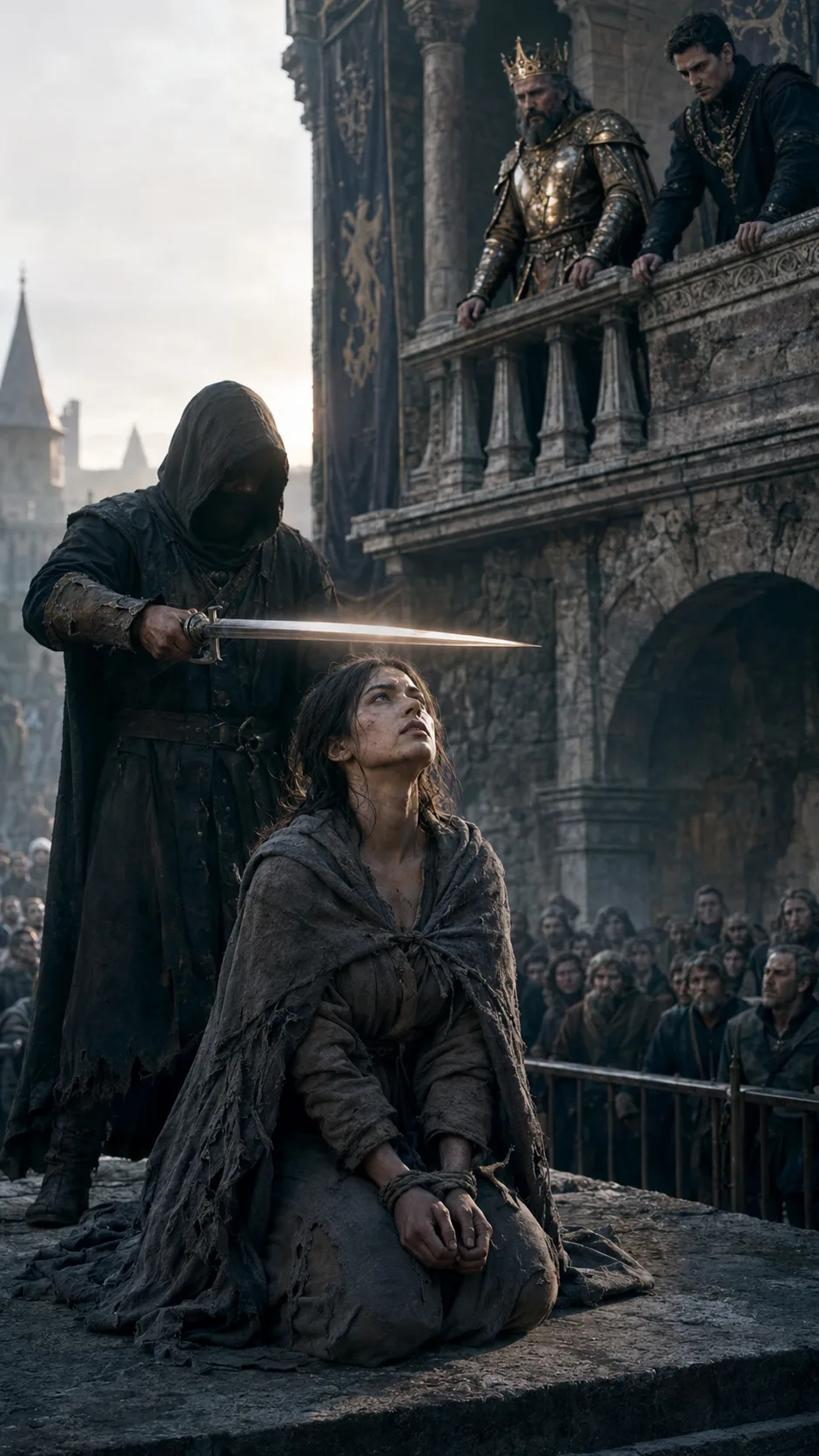
Above, King Oren stood on the royal balcony in gold armor.
He had dressed exactly as she expected.
No softness. No private doubt. No sign of the man who had come to her cell and said the woods kept you alive.
Prince Lucien stood beside him in dark blue.
Amara climbed the platform steps.
One.
Two.
Three.
The crowd noise folded over itself. Names. Curses. Prayers. Her own name became something passed from mouth to mouth until it no longer sounded like it belonged to her.
The executioner waited.
He was not the same man who had taken her from the cottage. Taller. Broader. Hood lower. His hands rested on the sword’s hilt but did not lift it yet.
The High Judge stepped forward.
He unrolled the parchment.
Amara looked at the crowd while he read. Faces blurred after the first few rows. She picked out details instead. A red scarf. A cracked tooth. Mud on a child’s hem. A man eating seeds from his palm until his wife slapped his hand down.
Life did not stop for death.
Even public death.
“Amara of the western woods,” the judge called, “accused of dark magic, treason against the crown, conspiracy with forbidden spirits, and the attempted destruction of the royal house—”
The words were the same as before.
Only the sky had changed.
Amara lifted her head.
The judge’s voice grew louder.
“By decree of His Majesty King Oren, the sentence is death.”
The crowd roared.
Prince Lucien stepped forward on the balcony. “Father, stop this.”
The roar cracked.
King Oren did not look at him.
“Stand down.”
“She saved my life.”
“She bewitched you.”
“She saved my life,” Lucien said again.
This time, people heard every word.
The executioner’s head turned slightly.
King Oren’s jaw tightened beneath his beard.
“Another word, and you will be removed.”
Lucien did not step back.
The king raised one hand.
Two palace guards moved toward the prince.
Amara watched Lucien look down at her.
He was where she had asked him to stand.
Good.
The executioner placed one hand on her shoulder and pushed her down.
Her knees met stone.
Pain sparked up her legs. She ignored it.
The pendant pressed beneath the rope at her wrist.
The executioner forced her head forward. Her hair slipped over one cheek. From there, she could see the edge of the platform, the first row of soldiers, the old priest near the front clutching prayer beads so tightly his fingers had gone white.
The King’s Sword lifted from its stand.
The crowd quieted.
A strange thing happened then.
The square did not become silent.
It became aware of every small sound.
A banner rope knocking against stone.
Someone’s breath catching.
A horse stamping behind the barrier.
The scrape of the executioner’s boot as he adjusted his stance.
The blade rose behind her.
Sunlight found it.
Not warm sunlight. Pale. Thin. Almost colorless. It ran along the sword’s edge and stopped at the tip.
Amara looked up.
Not at the king.
At Lucien.
His face had changed since the cell. Less prince now. More brother, though neither of them had earned the word yet.
Her mouth formed the words before she knew whether she would have strength to say them.
“Forgive me for hiding it.”
Lucien’s hands tightened around the railing.
King Oren saw his son’s face.
For one small second, the king’s mask shifted.
There.
That was the man who knew.
His raised hand dropped.
The sword descended.
The world narrowed to light and metal.
Then the blade stopped before it touched her.
Not against skin.
Not against bone.
Against something no one could see.
The sound came a heartbeat later.
A crack split through the square, bright and sharp, like ice breaking across a frozen lake.
The King’s Sword shattered.
White-gold light burst from the blade. The executioner staggered backward, arms thrown wide, the useless hilt still gripped in one hand. Fragments of silver metal scattered across the platform, but none struck Amara.
The crowd screamed.
Some ducked. Some fell. One soldier dropped his spear and scrambled away from the platform steps.
Amara stayed on her knees.
Her wrists burned.
Not from rope.
From light.
The broken sword pieces lifted from the stone one by one.
No hand touched them.
They rose around her, turning slowly, each fragment glowing at the edges. The rope around her wrists blackened, smoked, and fell away in ash.
The pendant slipped free.
It swung from her wrist, catching the same white-gold glow as the sword.
The old priest at the front saw it.
His knees hit the stone.
“No,” King Oren said from the balcony.
The word carried.
Not loud.
Enough.
Prince Lucien turned toward him. “What is happening?”
The king did not answer.
Amara placed one hand on the platform and pushed herself upright.
Her legs shook once.
Only once.
The sword fragments circled above her head now, not like weapons, not like broken metal, but like a crown the kingdom had been forced to remember.
The square held its breath.
Amara looked up at the balcony.
Her voice came out clear.
“The King’s Sword cannot spill royal blood.”
The words moved through the crowd faster than flame.
Royal blood.
Royal blood.
Royal blood.
Lucien stared down at her, then at the king.
The old priest bent lower, forehead nearly touching the stone.
The High Judge dropped the parchment. It rolled across the platform and stopped against Amara’s foot.
King Oren gripped the balcony rail so hard one of his rings cut into his glove.
Amara reached down with unsteady fingers and lifted the pendant.
The chain was broken.
The crest was not.
She held it high enough for the front rows to see.
A crown wrapped in thorns.
The queen’s crest.
A sound rose from the oldest people first. Not shouting. Not belief yet. Recognition. The noise of buried things being named by mouths that had been quiet too long.
Queen Seraphine.
Amara had heard the name only once from the king’s own lips.
Now the crowd whispered it without permission.
“I was not born in the western woods,” Amara said.
Her voice did not shake.
“I was hidden there.”
Lucien turned to his father.
His face had gone pale beneath the morning light.
“Is she my sister?”
King Oren said nothing.
He did not deny it.
He did not call for guards.
He did not order the sword fragments struck down or the crowd silenced.
His silence did what no confession could have done cleanly.
It gave the kingdom time to see him.
Amara stepped toward the edge of the platform. The glowing sword pieces moved with her. The executioner backed away until his heel slipped off the platform step.
“You called me a witch,” she said, “because you were afraid to call me heir.”
No one shouted for her death now.
The little girl near the barrier lifted her hand from her sleeve.
A copper charm hung from her fingers.
Her father did not stop her this time.
The first soldier knelt by accident.
At least, that was how it looked.
One knee struck stone. His head lowered before he seemed to know he had moved. The soldier beside him stared, then lowered his spear point to the ground.
The priests followed slowly.
Not all.
Enough.
Nobles on the viewing platforms shifted away from King Oren as if distance could protect them from having stood beneath his banner that morning.
Prince Lucien stepped back from the balcony rail.
The guards beside him did not touch him.
Below, Amara stood in prisoner rags, dirt on her face, ash on her wrists, the queen’s pendant in one hand and the broken King’s Sword circling above her like the old legends had chosen the worst possible day to become real again.
King Oren looked down at her.
For the first time since the cottage door broke open, Amara saw no plan in his face.
Only the cost.
After that, no one knew who was allowed to speak.
That saved them all from saying the wrong thing at once.
The square stayed frozen while the sword fragments slowly lowered. They did not fall. They arranged themselves at Amara’s feet in a half circle, points outward, guarding the platform steps.
The High Judge stood with his mouth open.
Lucien moved first.
He left the balcony.
A side door opened below, and he came down the narrow stairway with no escort, cloak moving behind him, boots striking stone one after another.
King Oren called his name once.
Lucien did not turn.
When he reached the platform, the soldiers stepped aside. Not because he ordered them to. Because the fragments of the sword glowed brighter when anyone came too close with a weapon.
Lucien climbed the steps empty-handed.
Amara watched him approach.
Neither of them knew what to call the other.
Not yet.
He stopped an arm’s length away.
His eyes moved to the ash around her wrists, then to the pendant, then to her face.
“I should have known,” he said.
“You knew enough.”
It was not forgiveness.
Not yet.
But it was not blame either.
He turned to the crowd.
The prince had spoken in courts and ceremonies before. This was different. His father stood above him. The woman beside him had just been condemned by royal decree. The sword of his ancestors lay broken at her feet.
He drew one breath.
“This execution is ended,” Lucien said.
A murmur rippled outward.
King Oren gripped the balcony rail again. “You do not have the authority.”
Lucien looked up.
“No,” he said. “But the sword did.”
A few people in the crowd made the sign of the first queen.
The king’s face hardened.
For one terrible second, Amara thought he would order the archers.
He looked toward the west wall where they stood.
The archers looked back.
Not one lifted a bow.
There are moments when power leaves a man before his crown does.
It does not announce itself.
It just stops being obeyed.
King Oren saw it.
So did everyone else.
The royal guard captain stepped onto the platform, removed his helmet, and bowed his head toward Amara.
“Your Highness,” he said.
The title crossed the square like a blade drawn from a sheath.
Amara did not move.
The pendant felt too heavy in her hand.
The crowd began to kneel in uneven waves. Front row first. Then the left side. Then the rooftops, awkwardly, people dropping low against tiles and chimneys. Not everyone. Some only stared. Some backed away. Some crossed themselves and muttered prayers to any god who might still be listening.
The old priest climbed the platform with help from two younger men. His hands shook as he reached Amara.
“I held you once,” he said.
The words barely left him.
Amara looked at him.
He touched two fingers to the pendant, then to his brow.
“You were wrapped in blue silk,” he said. “The queen would not let anyone else carry you.”
Amara’s fingers closed around the crest.
Blue silk.
In the wooden box.
A scrap without a story.
Now it had one.
Above them, King Oren turned and left the balcony.
No grand exit.
No final command.
His gold armor caught the light once before the shadows of the doorway swallowed him.
The crowd did not follow him with their eyes.
They watched Amara.
That was worse for him.
By sunset, the palace gates were barred from the inside.
By midnight, the council demanded an inquiry.
By morning, three old servants had given testimony about a child born in secret, a queen who vanished from public view, and a royal physician dismissed without pension. One retired guard confessed that he had escorted a healer named Elowen through the western gate twenty-two years ago with a sleeping infant in her arms and a purse of coin he had been ordered never to mention.
King Oren did not confess.
Men like him rarely did.
He sealed himself in the inner tower with six loyal guards and sent written orders no one carried out.
Lucien took control of the outer palace before the second dawn.
Not as king.
Not yet.
As the only royal heir the army would listen to without drawing steel inside the capital.
Amara was given chambers in the west wing.
Queen Seraphine’s wing.
The servants opened rooms that had been locked for two decades. Dust covered everything. Sheets lay over chairs and mirrors. The air smelled of old lavender and closed windows.
Amara walked through it alone.
Lucien had offered to come with her.
She said no.
She found the portrait in a narrow room behind velvet curtains.
Queen Seraphine stood painted beside a window, one hand resting on the curve of her pregnant belly. She was younger than Amara expected. Her hair was dark. Her mouth was serious. Her eyes—
Amara stepped closer.
There they were.
Not proof from a sword.
Not a priest’s memory.
A face.
Her face, sharpened by age and crown and paint.
On the table beneath the portrait sat a silver hairbrush, a cracked porcelain cup, and a dried flower pressed flat inside a book. None of it had been touched. Not by grief. Not by love. Only by dust.
Amara picked up the book.
A small paper fell from between the pages.
She unfolded it carefully.
Only three words.
For my daughter.
No name.
No explanation.
No grand royal blessing.
Just that.
Amara sat on the floor beneath the portrait and held the paper until the light faded from the windows.
The kingdom did not heal cleanly.
No song fixed the western villages. No crown restored the dead children. No public apology rebuilt trust by morning. People who had shouted witch looked away when Amara passed them in palace corridors. Some bowed too deeply. Some did not bow at all.
She preferred the second kind.
At least it was honest.
The boy from her cottage survived.
His mother came to the palace gate ten days after the execution with the empty medicine cup wrapped in cloth. She waited six hours before anyone told Amara.
When Amara reached the gate, the woman dropped to her knees.
Amara hated that.
She lifted her up with both hands.
The woman tried to speak, failed, then held out the cup.
A crack ran down one side from where it had fallen during the arrest.
Amara took it.
The boy stood behind his mother, thin but alive, a blanket around his shoulders. He looked at Amara’s gown, borrowed from the queen’s old wardrobe and pinned twice at the waist because it did not fit.
“You look different,” he said.
Amara looked down at the dark blue sleeves.
“Yes.”
“Are you still a healer?”
The guards near the gate went very quiet.
Amara looked at the cracked cup in her hand.
“Yes,” she said.
That answer became the first true thing anyone wrote about her.
Not witch.
Not heir.
Healer.
Three weeks later, King Oren was removed from the inner tower without a crown. He had not shaved. His armor was gone. His hands were bound in front of him with silk cord instead of rope because the council still had habits it had not earned the right to keep.
He crossed the same square where Amara had knelt.
No execution platform stood there now.
Lucien had ordered it dismantled plank by plank.
People gathered anyway.
They always did.
Amara watched from the palace steps, not the balcony. She refused the balcony.
Oren saw her.
For a moment, the old king stopped.
The guards waited.
His eyes moved over her plain cloak, the queen’s pendant at her throat, the scar on one wrist where the rope had burned. His face asked for many things. Pity. Recognition. A chance to speak first.
Amara gave him none.
He looked smaller without height beneath him.
Lucien stood beside her.
The council had named him regent until the bloodline question could be settled by ancient law, priestly record, and whatever politics nobles could drag from the ruins. Some wanted Lucien crowned. Some wanted Amara. Some wanted them married off to rival houses like pieces on a board.
Amara had laughed when she heard that one.
Once.
Not because it was funny.
Because otherwise she would have broken something.
Lucien looked at Oren being led away.
“He will live,” he said.
Amara nodded.
“Exile,” Lucien added. “Northern monastery. No letters. No court.”
“Good.”
“You wanted worse?”
She looked at the empty place where the platform had stood.
“No.”
The answer surprised him.
She could tell.
Amara touched the pendant.
“I wanted him to know the sword remembered me.”
Oren was placed in a covered carriage. The door shut. Wheels turned. The former king left through a crowd that did not kneel.
That was punishment enough for a man who had built his life on lowered heads.
Months passed before Amara returned to the western woods.
She went without a royal escort at first.
That lasted one hour.
Lucien sent twelve guards after her with strict orders to stay far enough back that she could pretend they were not there. She let them.
The cottage door still hung crooked from the day of the arrest. Someone had repaired the cracked window with oiled cloth. The herb shelves were mostly empty. The blue strip of paint remained near the latch.
Amara stood outside for a long time.
The rowan tree behind the cottage had grown new leaves.
Elowen’s grave sat beneath it, marked by a flat stone and a ring of small river rocks. Someone had placed fresh feverfew there.
Amara knelt and cleared weeds with her hands.
No gloves.
The earth was damp and cold.
“I found out,” she said.
The wind moved through the rowan leaves.
That was all.
She stayed in the cottage that night instead of returning to the palace. The guards camped badly in the lane and argued over how to cook rabbit. One burned his sleeve. Another sneezed every time he came near dried nettle.
Amara slept on the old cot beside the hearth.
Before dawn, she woke and saw the cracked cup on the shelf where she had placed it.
The boy’s cup.
She got up, wrapped herself in Elowen’s old shawl, and opened the door.
Mist lay low over the herb beds. The broken hinge creaked. Somewhere in the village, a rooster made a rough attempt at morning and failed twice before managing it.
Amara looked at the blue strip of paint by the latch.
After breakfast, she found the old brush in the shed.
By noon, the whole door was blue again.
Not royal blue.
Not queen’s blue.
Cottage blue.
The paint dried unevenly.
She liked it that way.
A rider came from the palace before sunset with letters from Lucien, the council, and three nobles who suddenly remembered loyalty to Queen Seraphine. Amara read Lucien’s letter first.
It was short.
The city is waiting.
She turned the page over.
Nothing else.
No command. No plea.
Just the truth.
The city was waiting.
The villages too.
The dead as well.
Amara folded the letter and placed it in the wooden box beside the scrap of blue silk, the queen’s note, and the pendant whenever she did not wear it.
Then she packed feverroot, clean bandages, willow bark, a needle case, and the cracked cup.
At dawn, she left the cottage.
The door was blue behind her.
The road ahead led to the palace, the square, the council chamber, and every mouth that would try to name her before she named herself.
Amara walked anyway.
The sword had refused.
Now she would too.
Chapter complete
You have reached the end of this chapter.
Continue reading
A few more worlds to get lost in after this chapter.




