Thomas learned to hide bread under his shirt before he learned to write his name.
Chapter 1
Thomas learned to hide bread under his shirt before he learned to write his name.
The baker on Ash Lane always burned the bottom loaves first. Not enough to throw away, not enough to sell to nobles, just enough that he stacked them near the back door where the rain could soften them and rats could find them by morning. Thomas waited there before sunrise with his shoulders tucked against the wall, listening for the scrape of the baker’s boots.
One loaf meant breakfast.
Half a loaf meant sharing.
Nothing meant he would spend the morning pretending his stomach was not making sounds loud enough for strangers to hear.
That morning, the baker opened the back door and looked straight at him.
Thomas froze with one hand already reaching.
The baker was a wide man with flour in his beard and one bad knee. He could have shouted. He could have thrown a pan. He could have called the city watch and watched them drag
Thomas through the mud like they did with boys who had no family names.
Instead, he tossed the smallest loaf toward the alley.
“Take it and vanish.”
Thomas caught it against his chest.
“Thank you.”
“Didn’t give it to you.”
The baker slammed the door.
Thomas stayed there for three more seconds, because gratitude needed somewhere to go and he had nowhere proper to put it.
Then he ran.
The city was waking beneath a gray sky. Horses stamped near the market gates. A woman in a green shawl argued with a fishmonger over scales. A monk swept water from the temple steps with the patience of a man who had never been hungry enough to steal.
Thomas tore the loaf in half as he walked.
He gave one piece to Mara before she asked.
Mara was nine, maybe ten. Nobody knew. She slept beneath the broken bridge with two
other children and a dog that belonged to none of them but followed whoever had food. Her left shoe had no lace. Her right shoe had no sole.
She took the bread and tucked it inside her sleeve.
“You heard?”
Thomas chewed slowly.
“Heard what?”
“King’s men came through Copper Row last night.”
That made him stop chewing.
Mara looked toward the palace hill, where the royal towers rose above the city like spears stabbed into the morning. “They searched the old houses.”
“For thieves?”
“For papers.”
Thomas swallowed.
The bread turned hard in his throat.
Mara noticed. She always noticed too much.
“You got papers?”
“No.”
A lie.
Small.
Necessary.
Inside Thomas’s shirt, beneath the patched cloth and the cord he used for a belt, a folded piece of parchment lay flat against his skin.
He had carried it for six days.
He had not known what it was
when he found it.
Not fully.
The old woman who died in the chapel cellar had pressed it into his hands with fingers as thin as twigs. Her name was Agnes. She had once served inside the palace laundry, back when Queen Elena still walked the gardens and wore blue ribbons at her wrist.
Agnes had hidden under the chapel for years.
Thomas had brought her water.
Sometimes soup.
Once, a pear.
On her last night, she grabbed his sleeve and pulled him close enough that he smelled candle smoke and sickness.
“Not the priest,” she said.
Thomas thought she wanted confession.
She shook her head.
“Not the priest. Not any man in red.”
Her eyes had gone glassy, but her grip stayed sharp.
Then she gave him the parchment.
And the diary.
The diary was worse.
It was heavier than paper should be.
Thomas had hidden it in the loose bricks beneath the bridge until he could think. He had not opened every page. Only enough to understand that dead queens still had voices if someone kept their words alive.
Now the king’s men were searching houses.
For papers.
Thomas looked again at the palace.
Mara tapped his wrist.
“You’re doing that thing.”
“What thing?”
“Looking like you’re about to walk into trouble and call it weather.”
Thomas pulled his sleeve down.
“I have to go.”
“No, you don’t.”
He did not answer.
That was how she knew he did.
By noon, Copper Row had emptied itself of noise.
The soldiers moved house by house, six at a time, cloaks dark with rain, helmets low, boots leaving black prints on doorsteps. They did not shout much. They did not need to. People opened doors before fists struck wood.
Thomas watched from the end of the alley near the old dye shop.
Captain Rourke led them.
Everyone knew his face. Square jaw. Scar through one eyebrow. The kind of man who never hurried because he trusted fear to clear the road for him.
He held a rolled order sealed with red wax.
Royal command.
Thomas kept one hand pressed under his shirt.
The parchment was no longer there.
He had moved it that morning.
The diary too.
Both were hidden beneath a cracked stone inside the abandoned bell tower behind Saint Orlan’s Chapel. He had chosen the place because nobody visited it except birds, and birds did not serve kings.
A soldier kicked open a door.
A woman cried out.
Not loud.
Cut short.
Thomas stepped forward without meaning to.
A hand grabbed his arm and yanked him back.
Old Petr, the cobbler, pulled him behind a stack of broken barrels.
“Don’t be stupid.”
Thomas twisted free.
“They’re searching her house.”
“They’re searching every house.”
“She has a baby.”
Petr’s face tightened.
“And if you run out there, the baby gets one more fool to watch.”
Thomas looked through the gap.
Captain Rourke stepped out of the house holding nothing.
He turned his head slowly.
His eyes found Thomas.
Not by chance.
Not a glance.
A finding.
Thomas backed away.
Petr whispered, “Go.”
Thomas ran.
The city turned narrow around him. Alleys split into alleys. Laundry slapped wet against lines overhead. Mud sucked at his bare feet. Behind him, someone shouted. Then another voice answered. Metal struck stone.
He cut through the spice market and knocked over a basket of dried peppers. Red pods scattered across the ground like little tongues of flame. The seller cursed, then went silent when royal guards burst after him.
Thomas ducked beneath a cart.
Rolled.
Came up running.
He reached Saint Orlan’s Chapel with his lungs burning and his vision sharp at the edges.
The chapel doors were closed.
The bell tower stood behind it, crooked and old, with ivy choking the lower stones.
Thomas shoved through the weeds and climbed through the gap in the wall.
Inside, dust floated in gray light. Rain tapped through holes in the roof. A dead bird lay near the steps, small bones wrapped in feathers.
He went to the third cracked stone.
Dropped to his knees.
Pulled it loose.
The diary was still there.
So was the parchment.
Thomas pushed both under his shirt.
Then he heard boots outside.
Not many.
Two.
Maybe three.
He turned.
Captain Rourke stepped through the broken wall.
Alone.
That was worse.
The captain looked at Thomas’s chest.
Then at his face.
“Give it to me.”
Thomas stood.
“No.”
Rourke sighed once, like Thomas had disappointed him by choosing the obvious road.
“You don’t know what you’re holding.”
“I know enough.”
“You know a dead woman wrote dangerous things.”
Thomas took one step back.
Rourke followed.
“No one will read them,” the captain said. “No one will hear them. They’ll call you a thief, then a liar, then something worse. By sundown, people will pretend they never saw your face.”
Thomas’s heel touched the first stair.
He could climb.
He could try.
Rourke noticed that too.
“Don’t.”
Thomas climbed.
The captain lunged.
Thomas took three steps before a hand closed around his ankle.
He kicked once.
Rourke did not let go.
They hit the stairs together. Pain flashed through Thomas’s shoulder. The diary slipped halfway out of his shirt.
Rourke saw the blue ribbon on the spine.
His face changed.
Only for a breath.
But Thomas saw it.
“You know it,” Thomas said.
Rourke grabbed the diary.
Thomas grabbed it too.
The old leather bent between them.
“Let go.”
“No.”
Rourke struck the step beside Thomas’s head with his fist, hard enough to make dust fall from the stone.
“Boy.”
Thomas stared at him.
Rourke lowered his voice.
“If you want to live, let go.”
Thomas thought of Agnes in the chapel cellar.
Not the priest.
Not any man in red.
He tightened his grip.
The captain’s jaw moved once.
Then he hit Thomas across the side of the head.
Not with a blade.
Not enough to end anything.
Enough to turn the tower sideways.
When Thomas woke, his wrists were tied.
His mouth tasted like iron and rainwater.
He was lying on the floor of a wagon, hands bound behind him, ankles tied with rope so tight his feet had gone numb. The diary was gone. The parchment was gone. For one terrible second, that was all he knew.
Then the wagon hit a rut.
Something pressed against his ribs.
Flat.
Hidden.
Thomas did not move.
The parchment.
Still beneath his shirt.
Rourke had taken the diary, but not the folded parchment. Maybe he had missed it. Maybe the old cloth had stuck to Thomas’s skin. Maybe dead queens had luck after all.
Thomas closed his eyes.
Not for prayer.
For counting.
One guard at the back of the wagon. One driver. Two horses. Wheels old. Rope rough but not new. Knot behind the left wrist.
He worked at it until his skin burned.
The guard noticed after ten minutes.
“Stop that.”
Thomas stopped.
For three breaths.
Then began again.
By late afternoon, the palace hill came into view. The wagon rolled through the eastern gate, beneath carved lions streaked black from rain. Servants moved quickly out of the way. Noblemen under covered walkways pretended not to look.
Thomas had never been inside the palace walls.
The stones were cleaner here.
Even the mud looked expensive.
They dragged him into a lower hall where torches burned in iron brackets and the air smelled of wet wool, oil, and old secrets. Captain Rourke waited near a table.
On it lay the diary.
Thomas looked at it before he could stop himself.
Rourke saw.
“You care for objects too much.”
Thomas said nothing.
A second man stood beside the table.
King Cedric.
No crown.
No court robes.
Only a dark tunic clasped at the throat, a silver ring on one hand, and eyes that made the room colder than the stone walls.
Thomas had seen him from far away at festivals and executions. Distance had made him look carved. Up close, he looked alive in the worst way.
The king opened the diary with two fingers.
“Do you read?”
Thomas did not answer.
Cedric turned a page.
“My wife had a fondness for dramatic sentences.”
Still nothing.
Cedric looked up.
“Who gave this to you?”
Thomas stared at the torch behind him.
Cedric closed the diary.
The sound was soft.
Rourke stepped forward.
The king lifted one hand.
Rourke stopped.
Cedric came around the table and stood close enough that Thomas could see rain still drying at the edge of his sleeve.
“You are young,” the king said. “That is the only reason you are still breathing.”
Thomas looked at him then.
Cedric smiled without warmth.
“There. Good. You understand me.”
Thomas’s hands curled inside the rope.
The king tilted his head.
“Tell me who else has seen it.”
“No one.”
The answer came too quickly.
Cedric’s smile disappeared.
“Loyalty is expensive. You cannot afford it.”
Thomas swallowed.
The king leaned closer.
“Dead women cannot protect you.”
Thomas thought of the parchment under his shirt.
He thought of the line written in ink so faded it looked almost brown.
The queen must die before she speaks.
He said, “Then why are you afraid of her?”
Rourke moved.
This time, the king did not stop him.
The captain shoved Thomas to his knees.
The floor struck hard.
Cedric watched him from above.
No anger.
Not yet.
Only calculation.
“Public execution,” the king said.
Rourke looked at him.
“For theft?”
“For treason.” Cedric turned toward the table. “And spreading lies about Queen Elena.”
Thomas raised his head.
The king picked up the diary.
His thumb rested on the blue ribbon.
“Burn this.”
Rourke hesitated.
A tiny thing.
Cedric saw it.
“So you recognize it too.”
Rourke took the diary.
“Yes, Your Majesty.”
“Then burn it yourself.”
The captain nodded.
Thomas watched the diary leave the room in Rourke’s hand.
He kept his breathing even.
Because if they searched him now, everything ended in that lower hall.
But Cedric had already turned away.
Men like him did not expect children to keep the most dangerous thing.
That was his mistake.
They threw Thomas into a holding cell beneath the courthouse, not the palace prison. The courthouse cells were for thieves, debtors, drunkards, and people scheduled to be made into lessons by morning.
The room had four walls, one bench, one bucket, and a barred window too narrow for a cat.
Thomas sat on the bench with his bound hands in his lap.
The rope had been cut from his ankles, but his wrists stayed tied.
He waited until the guard outside fell asleep.
Then he bent forward and used his teeth.
It took an hour to pull the parchment free.
He almost tore it twice.
When it slid out, damp and warm from his skin, he pressed it between his knees and opened it under the gray light from the barred window.
He had read it before.
Still, the words struck differently now.
The queen must die before she speaks.
Beneath it, another line.
The child must never be found.
Thomas stared at that sentence until the letters blurred.
The child.
Not a jewel.
Not a treaty.
Not a lover.
A child.
He turned the parchment over.
There was a mark on the back. Not writing. A seal pressed lightly into the paper, almost invisible unless held near flame.
He had no flame.
Only moonlight.
He angled it toward the window.
A crown.
A lily.
And beneath them, a small symbol like a broken circle.
Thomas had seen that symbol once.
On Agnes’s wrist.
Burned into the skin beneath her sleeve.
He pressed the parchment flat.
His hands shook now, so he trapped them between his knees until they stopped.
Near dawn, the guard opened the cell door.
Thomas folded the parchment and slid it into the torn lining near his waist.
The guard tossed in a piece of bread.
It landed near the bucket.
Thomas looked at it.
The guard smirked.
“Eat. Big morning.”
Thomas did not move.
The guard left.
After a while, a rat came from a crack near the wall and sniffed at the bread.
Thomas broke off a corner and pushed it closer.
The rat took it and vanished.
“Smart,” Thomas said.
His voice sounded strange in the cell.
The door opened again before sunrise.
Captain Rourke stood there.
No helmet this time.
He carried Thomas’s old shirt, now torn worse from being searched. He threw it at him.
“Put it on.”
Thomas did.
The parchment stayed hidden.
Rourke watched every movement.
“You still have time.”
Thomas pulled the shirt over his head.
“For what?”
“To say you lied.”
“I didn’t.”
“To say Agnes lied.”
Thomas stopped.
Rourke’s mouth tightened.
There it was.
He knew.
Thomas looked at him through the dim cell light.
“You knew her.”
The captain stepped inside and lowered his voice.
“Agnes served a dead queen and lost her mind in old age. That is what the court will say.”
“What do you say?”
Rourke said nothing.
Rain began again outside. It tapped against the tiny window in uneven bursts.
Thomas took one step closer.
“She trusted you?”
Rourke’s eyes moved to the floor.
Thomas had his answer.
“She gave you something too.”
The captain grabbed his collar and shoved him back against the wall.
“Listen to me. You think truth is a sword because you’ve never seen what kings do to hands that hold it.”
Thomas’s shoulder pressed into cold stone.
Rourke’s face was inches away.
“On that platform, you say nothing. You look small. You look afraid. You die quickly, and the city forgets by winter.”
Thomas’s breath caught once.
Rourke released him.
Then he reached into his coat.
Thomas stepped back.
The captain pulled out something wrapped in dark cloth.
He unfolded it.
The diary.
Burned at one corner.
Not destroyed.
Thomas stared.
Rourke looked older than he had yesterday.
“I was not in the room when she died,” the captain said. “That is what I tell myself.”
He pushed the diary into Thomas’s bound hands.
Thomas could not speak.
Rourke tied the cloth around it and shoved it under the torn shirt against Thomas’s ribs.
“Do not waste the first sentence.”
The cell door opened behind him.
Two guards entered.
Rourke turned before his face could betray anything else.
“Bring him.”
The execution square was already full.
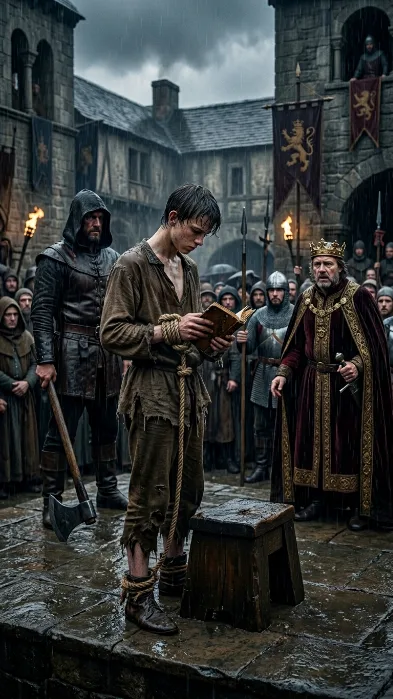
By the time they dragged Thomas up the wooden steps, rain had soaked the platform and turned the ropes dark. The crowd stretched from the courthouse steps to the market arch, faces half-hidden beneath hoods, caps, baskets, and raised hands shielding eyes from water.
Thomas saw Mara near the fountain.
She stood on a barrel, one hand gripping a drainpipe, her face pale under wet hair.
He almost looked away.
She shook her head once.
Not warning.
Not fear.
Stay standing.
So he did.
The executioner wore a black hood but no mask. Thomas could see his mouth. It was set in a straight line, as if this was work and work had rules.
A priest climbed the platform with a prayer book wrapped in oilcloth.
Captain Rourke stood below, helmet back on, face unreadable.
Above them all, King Cedric sat beneath the red canopy.
This time, he wore the crown.
Of course he did.
Gold on his head. Crimson at his shoulders. Rings on his fingers. The whole kingdom arranged beneath his feet like proof.
A herald stepped forward and unrolled a list.
“Thomas of no lawful house,” he shouted, “found guilty by royal decree of theft, treason, and spreading falsehoods concerning Her Late Majesty Queen Elena.”
A stir moved through the crowd at her name.
The herald swallowed and continued.
“For these crimes, His Majesty King Cedric orders sentence carried out before witnesses, so the realm may be cleansed of lies.”
Cleansed.
Thomas almost laughed.
Not because it was funny.
Because kings always found beautiful words for ugly rooms.
The priest opened his book.
The executioner guided Thomas toward the block.
Rourke did not look at him.
Thomas knelt.
The wood smelled of rain, sap, and something older that had been scrubbed too many times.
The priest began.
“May the gods receive—”
“No.”
Thomas’s voice cut through the prayer.
Not loud.
But close to the priest’s ear.
The priest stopped.
The executioner’s hand tightened around Thomas’s shoulder.
The crowd leaned forward.
King Cedric did not move.
Thomas stood.
The executioner grabbed him.
Thomas twisted just enough to face the crowd, the diary pressing against his ribs, the parchment hidden flat beneath the cloth.
“Queen Elena did not die of fever.”
The square changed shape.
No one moved much.
But every face sharpened.
The priest whispered, “Boy, don’t.”
Thomas pulled the folded parchment from inside his shirt.
A guard cursed.
Rourke’s hand went to his sword but stayed there.
Thomas held the parchment high.
Rain hit the wax. The royal seal flashed dark red.
“This was written the night she died.”
King Cedric stood.
At the sight of the seal, the first row fell silent. Then silence rolled backward, passing from person to person until even the merchants at the far edge stopped whispering.
Thomas unfolded the parchment.
His fingers were numb.
The paper nearly slipped.
He caught it.
“The queen must die before she speaks.”
The words landed harder than thunder.
A woman near the front covered her mouth.
A nobleman stepped backward into a guard and did not apologize.
The priest lowered his book.
The executioner lowered the axe.
King Cedric gripped the balcony rail.
“Seize that paper.”
The command rang clean.
The guards moved.
Thomas turned the parchment outward so the seal faced the crowd.
One guard reached the platform steps.
Then slowed.
People were watching his hand.
All of them.
The guard looked to Captain Rourke.
Rourke looked to the king.
Cedric’s face darkened.
“Now.”
Thomas lowered the parchment and pulled the diary free.
The blue ribbon came out first.
A small, faded strip.
Queen Elena’s color.
The effect was immediate.
Not noise.
Recognition.
The older women saw it. The palace servants in the crowd saw it. The priests saw it and began looking at one another in ways priests should not.
King Cedric stepped back from the rail.
For the first time since Thomas had seen him, the king moved like a man who had forgotten where the floor ended.
Thomas opened the diary.
The pages were swollen. One corner was blackened from fire. Rain spotted the ink.
The first page stuck.
He separated it with his thumb.
Do not waste the first sentence.
Thomas looked at the king.
Then at the crowd.
“Her name was Queen Elena.”
No one interrupted.
Thomas read.
“I fear my husband.”
A sound moved through the square.
Not a shout.
A thousand small breaths.
King Cedric descended from the balcony.
No herald announced him.
No trumpet called.
His crown sat heavy on his head, but the rain made his robes drag behind him as he crossed the stone path toward the platform.
Thomas kept reading.
“He watches every letter I send. He dismisses every servant who hears too much.”
The king reached the stairs.
“He smiles when the court is watching.”
Cedric drew his sword.
Steel rang across the square.
The executioner stepped back.
One step.
Enough.
Thomas turned the page.
“If I die, it will not be illness.”
“Enough,” Cedric said.
The word cracked against the rain.
Thomas looked up.
The king climbed onto the platform.
Now they stood facing each other with the execution block between them. A king with a sword. A boy with bound wrists and a half-burned diary.
Cedric pointed the blade toward him.
“Give me that book.”
Thomas held it tighter.
The rain hit the open pages.
Ink began to bleed at the edges.
The crowd saw the king’s hand.
It was not steady.
Captain Rourke stepped onto the platform behind him.
“Your Majesty.”
Cedric did not turn.
“Take it.”
Rourke did not move.
The king turned then.
Slowly.
Rourke’s face was hidden beneath the helmet, but his feet stayed planted.
That was all the crowd needed.
Another crack.
Cedric faced Thomas again.
“Boy.”
Thomas turned another page.
This one had been folded at the corner.
Marked.
Waiting.
His tied hands made the movement clumsy, but he managed it. The diary opened wider, its leather cover dark with rain.
He looked down.
The line was there.
Not long.
Not decorated.
Plain ink.
Plain truth.
Thomas read the first part.
“This page names the child Queen Elena hid from you.”
The square went silent in a way Thomas had never heard before.
Even the rain seemed to fall farther away.
Cedric’s sword lowered by half an inch.
Just half.
But thousands saw it.
Thomas looked at the next line.
His throat tightened once, then cleared.
Queen Elena’s handwriting crossed the page in thin, careful strokes.
The child lives.
He bears the mark beneath the left shoulder.
Trust only Agnes.
Trust Rourke if he still remembers mercy.
Thomas stopped.
Not because he chose to.
Because the world had narrowed to the page, the rain, and the king’s face.
Cedric saw something in his silence.
He stepped forward.
“Read it.”
The command came too quickly.
A mistake.
Thomas looked up.
The king’s eyes had changed.
No more performance.
No more throne-room voice.
Only fear with a crown on it.
Thomas reached with bound hands for the torn collar of his own shirt.
Cedric moved.
Rourke stepped between them.
The whole platform froze.
The captain drew his sword.
Not toward Thomas.
Toward the king.
Gasps struck the square like stones dropped into water.
Cedric stared at him.
“What are you doing?”
Rourke’s answer was quiet enough that only the front rows heard it.
“Remembering mercy.”
Thomas pulled the torn cloth aside from his left shoulder.
There, burned into the skin years ago and half-hidden by dirt and rain, was a broken circle beneath a crown and lily.
The same mark pressed into the back of the parchment.
The priest dropped his book.
It hit the platform and fell open in the rain.
Someone in the crowd said, “Royal blood.”
Another voice answered, “Elena’s child.”
Then another.
“Elena’s son.”
The words spread faster than any command.
Cedric raised his sword again, but now the movement looked wrong. Too late. Too exposed. A king cannot be feared properly once people have seen what frightens him.
Thomas lifted the diary higher.
“My mother wrote one more line.”
Cedric’s lips parted.
No sound came out.
Thomas read.
“If my son stands before the people, let them see what his father tried to erase.”
The square broke.
Not into chaos.
Into refusal.
One person knelt.
An old woman near the fountain.
Then a palace servant.
Then a soldier off duty.
Then three more.
The movement spread unevenly, awkwardly, humanly. People did not know the proper ceremony for a truth dragged back from the dead. So they made one with their knees in the mud.
Mara slid off the barrel and knelt with both hands at her sides.
Thomas saw her.
That nearly broke him.
Rourke kept his sword between Cedric and the boy.
The executioner removed his hood.
He set the axe flat on the platform.
No speech.
No grand gesture.
Just the blade laid down where everyone could see it.
Cedric looked across the square.
For once, no one looked away fast enough.
His mouth worked once.
Then again.
“Lies,” he said.
The word sounded small.
The priest bent slowly and picked up the wet prayer book. He looked at Thomas’s shoulder, then at the diary, then at the parchment.
He did not kneel.
But he closed the book.
That was enough.
Captain Rourke turned his head toward the nearest guards.
“Cut the rope.”
No one moved.
Rourke’s sword shifted.
“Cut it.”
A young guard climbed the platform steps, hands trembling. He took a knife from his belt and sawed through the rope around Thomas’s wrists.
The rope fell.
Thomas rubbed one wrist with the other hand, but he did not step away from the block.
Cedric stared at the cut rope like it had betrayed him too.
The captain said, “Your Majesty, lay down your sword.”
The rain kept falling.
No one breathed properly.
Cedric looked at the crowd again.
At the kneeling citizens.
At the servants.
At the guards who no longer knew where their loyalty was supposed to stand.
Then he looked at Thomas.
For a moment, Thomas saw the man behind the crown.
Not bigger.
Not stronger.
Just a man who had spent years burying one truth and had now watched a hungry boy dig it up with bound hands.
Cedric lowered the sword.
He did not drop it.
Men like him did not surrender cleanly.
Rourke stepped closer.
Two guards moved behind the king.
This time, they moved without looking for permission.
The crown remained on Cedric’s head as they took his sword.
That made it worse.
A powerless king still wearing gold.
Thomas closed the diary.
His fingers rested on the blue ribbon.
The square stayed silent for a long time after that.
No cheering.
No music.
No sudden sunlight.
Only rain, wet stone, and a crowd trying to understand that history had just changed without asking if they were ready.
By evening, Thomas sat in a small chamber inside the old council wing with a blanket around his shoulders and a bowl of soup cooling in front of him.
He had not touched it.
Mara sat across from him, swinging one foot because the chair was too tall. She had stolen two sugar plums from a tray and hidden one in her sleeve.
Thomas saw.
He said nothing.
Captain Rourke stood near the window, helmet under one arm, looking older than the walls.
The diary lay on the table between them.
So did the parchment.
A councilman had tried to take both.
Thomas had put one hand on the diary and looked at him until the man stepped back.
Now people came and went outside the door, speaking in low voices. Regents. Priests. Commanders. Men who had ignored hungry children yesterday and now whispered Thomas’s name as if it had always belonged in marble halls.
Prince Thomas.
Some said it already.
He hated how it sounded.
Too clean.
Too late.
Mara kicked the chair leg.
“So do you get a horse now?”
Thomas looked at her.
“What?”
“Princes get horses.”
“I don’t know.”
“You should ask for two.”
He almost smiled.
Almost.
Rourke turned from the window.
“The council will want to move you tonight. Somewhere guarded.”
Thomas touched the edge of the diary.
“Where is he?”
Rourke knew who he meant.
“Held in the west tower.”
“Will they put him on a platform?”
The captain did not answer quickly.
That was answer enough.
Thomas looked down at his wrists. The rope marks were dark against his skin.
“I don’t want his platform.”
Mara stopped swinging her foot.
Rourke’s face shifted, not much.
“No.”
Thomas opened the diary again.
Not to the marked page.
To the first.
Queen Elena’s handwriting began carefully, almost formally. Later pages slanted. Some lines pressed hard enough to scar the paper. Some entries had water stains that might have been rain, or wine, or something else.
Thomas did not know how a mother’s voice was supposed to sound.
He had pieces now.
Ink.
Fear.
Warning.
Love hidden in instructions.
It was not enough.
It was more than he had yesterday.
He tore a small corner from the stale bread beside the soup and placed it near the window ledge. A palace sparrow landed there after a minute, tilted its head, and took it.
Mara watched him.
“You still feed things that don’t belong to you.”
Thomas leaned back in the chair.
“Maybe they do.”
Outside, bells began to ring.
Not funeral bells.
Not festival bells.
Uncertain bells.
The city had not decided what it was yet.
Thomas closed the diary and tied the blue ribbon around it with careful fingers.
Then he finally picked up the spoon.
The soup had gone cold.
He ate it anyway.
Some boys inherit crowns.
Thomas inherited a voice.
Chapter complete
You have reached the end of this chapter.
Continue reading
A few more worlds to get lost in after this chapter.




