The guard took Princess Elara’s sword with both hands and would not meet her eyes.
Chapter 1
The guard took Princess Elara’s sword with both hands and would not meet her eyes.
The blade had belonged to her father before it belonged to her. Its leather grip still carried the darker mark where his thumb had rested during council sessions, battles, hunting rides, and the last winter he had been strong enough to climb the eastern tower without leaning on anyone. Elara had held it since she was sixteen. At twenty-six, she knew the weight of it better than she knew the weight of any crown.
King Malrec watched from the gatehouse balcony.
He was not king then, not by blood and not by right, but the court had already begun calling him Your Majesty because men with soldiers often received titles before laws caught up. He wore mourning black for Elara’s father, though the embroidery on his sleeves was too new, too gold, too eager.
“Remove the horse,” he said.
A stable boy led Stormglass away. The mare fought the reins
once, iron shoes scraping against the frozen ground, then went still when Elara raised two fingers.
No scene.
That was what Malrec wanted. He wanted a princess dragged from the palace like a failed servant, kicking and crying so the nobles could say she had never been fit for rule. Elara gave him a straight back and empty hands.
A line of court officials stood near the gate with scrolls tucked under their arms. They had signed what Malrec placed before them. Some of them had served her father for thirty years. One man, Lord Veyr, kept his chin so high his neck trembled.
Malrec descended the steps slowly, making the whole courtyard wait for him.
“You may keep the cloak,” he said.
Elara looked down at the gray travel cloak they had thrown over her shoulders. One of the clasps was missing. A tear ran near the hem, dark
with old mud.
“How generous,” she said.
A few soldiers shifted.
Malrec smiled with one corner of his mouth. “Generosity is a virtue of stable rulers.”
Behind him, Prince Corvin stood in polished armor, young enough to still enjoy the sound of metal on his own body. He was not Malrec’s blood heir in any proper line of Valoria, but Malrec had lifted him into court the day after the funeral and placed him at the high table before the priests could finish sealing the old king’s tomb.
Corvin had been watching Elara all morning as if waiting for her to break.
She did not.
Malrec moved closer, stopping just beyond the reach of a woman with no sword. “Beyond the northern border, your name has no power.”
“My name had power before you learned to dress like a king.”
His smile stayed.
His fingers did not.
They tightened around
the black leather glove in his hand until the leather creaked.
“You are banished from Valoria,” he said, loud enough for the courtyard. “No sword. No horse. No guard. No house colors. No royal seal. No claim.”
The scribe beside him read the decree in a cracked voice.
Elara listened to every word.
When the northern gate opened, the wind pushed snow across the stones and into the courtyard. No one stepped forward. Not Lord Veyr. Not the high priest. Not the captains who had once bowed to her father before battle.
Elara walked through the gate alone.
At the threshold, she turned once.
Malrec was still watching.
So was Corvin.
Elara lifted the torn cloak tighter around her shoulders, looked at the carved crest above the gate, and kept walking until the palace disappeared behind the falling snow.
The first night beyond the border, she slept under a broken wagon beside a road that had not seen royal patrols in years.
Her hands shook from cold, not fear. She pressed them under her arms and counted what Malrec had left her with. One cloak. One thin knife hidden in her boot because the guard who took her sword had missed it or chosen to miss it. Three copper coins sewn into the lining of her sleeve by her nurse years ago, back when Elara had laughed at the idea of ever needing secret money.
A fox watched her from the edge of the road.
She watched it back.
“Find something better,” she told it.
The fox left.
By the third day, she reached the village of Harrowmere, a place pressed into the foot of the mountains like it had been dropped there and forgotten. The people knew her face before they knew what to do with it. A baker’s wife opened her door, saw the cloak, the lack of guard, the torn hem, and lowered her eyes.
“Your Highness,” she said.
“Not here,” Elara answered. “Not today.”
The woman let her in.
No questions.
Inside the bakery, heat struck Elara’s skin so sharply she had to grip the table. Flour dust clung to everything. A child slept on a folded sack near the oven with one hand curled around a wooden spoon. On the wall hung an old iron horseshoe, black with soot.
The baker’s wife gave Elara bread, broth, and a place on the floor near the oven.
In the morning, three men stood outside the bakery pretending not to be soldiers.
Malrec had not waited long.
Elara left through the back with the baker’s old cloak over her dark hair and a loaf under her arm. She did not take the main road again.
The mountains rose beyond Harrowmere, black and white against the winter sky. Her father had told her stories about them. Not the soft court versions with songs and polished endings, but the old versions spoken by commanders after wine and priests when they forgot children were listening.
The first king had climbed those mountains before Valoria had a throne. He returned carrying a spear made not by smiths but by thunder trapped in iron. With it, he had broken a siege, crowned a kingdom, and sworn the weapon would answer only when the bloodline had been stripped of all worldly protection.
Elara had asked her father once where the spear had gone.
He had looked toward the north windows.
“Some weapons do not sleep in vaults,” he said. “They wait where cowards cannot reach them.”
At twelve, she had thought that sounded like a poem.
At twenty-six, with frost inside her boots, it sounded like directions.
The path into the mountains was not a path for princesses. It was barely a path for goats. Ice clung to the rocks. The wind cut between cliffs with a sound like metal drawn from a sheath. Twice, Elara slipped and caught herself with her bare palms. By sundown, her left knee had swollen against the fabric of her trousers.
She kept climbing.
On the fourth night, she found a shepherd’s shrine carved into a cliff wall. Small offerings had been left there: a cracked cup, a strip of red ribbon, three smooth stones stacked beneath a weathered carving of the first king.
Someone had placed a child’s wooden horse at the base.
Its painted eyes had faded.
Elara slept sitting against the shrine with the knife in her hand. Near midnight, she woke to hoofbeats.
Not horses.
Mountain goats, moving along the ledge above her. One dislodged a stone. It struck near her boot and rolled down into the dark.
Elara sat still until the sound vanished.
Then she noticed the carving.
Not the king’s face. The spear.
The carved spear pointed left, not up. She had seen that design in palace tapestries a hundred times and never noticed the angle. Left, toward a slit in the cliff half-hidden by hanging ice.
By morning, she had broken enough ice away to slide inside.
The tunnel was narrow at first. Then it opened into a chamber so large her breath returned to her from the walls. The ceiling vanished into darkness. Pale mineral veins ran through the stone like old lightning. At the center stood a ring of black pillars, and between them, buried halfway into the rock, was a spear.
Not shining.
Not singing.
Waiting.
Elara approached slowly.
The weapon was longer than she was tall, dark metal from tip to heel, wrapped in worn black leather at the grip. No gems. No gold. No royal vanity. At the base of the blade was a mark older than the palace crest: a crown split by a bolt of lightning.
She put one hand on the grip.
Nothing happened.
The cold of the metal went straight into her bones. Her fingers locked around it, not from choice. The chamber seemed to lean closer.
A voice did not speak.
A court would have made it speak. Priests would have written three verses about judgment and blood and destiny. The mountain offered no performance.
Only pressure.
Elara saw the courtyard again. Her sword taken. Her horse led away. Malrec’s glove twisting in his fist. Corvin’s half-smile. The nobles’ eyes lowered one by one, each silence added to the next until it became a wall.
She pulled.
The spear did not move.
Her injured knee buckled. She caught herself against the stone, teeth pressed together.
Again.
The second pull opened the cut across her palm. Blood darkened the leather grip. The spear stayed where it was.
Elara rested her forehead against the cold shaft.
“I have nothing,” she said.
The chamber took the words and returned them smaller.
She lifted her head.
“No sword. No horse. No guard. No seal.” Her voice scraped the stone. “He made sure of that.”
A thin sound came from somewhere above, like ice cracking on a lake.
Elara closed both hands around the spear.
“My father left me a kingdom,” she said. “I will not leave it to a thief.”
She pulled a third time.
The mountain answered.
Blue-white light snapped across the pillars. The floor shook beneath her boots. Dust rained from the unseen ceiling. The spear tore free with a sound that struck her chest more than her ears, and the chamber filled with the smell of rain on stone.
Elara fell back with the Thunder Spear in her hands.
For a long while, she stayed on one knee, breathing through her nose, the weapon crackling along the floor beside her. The cut on her palm closed around a line of light, not healed, not gone. Marked.
When she stood, the darkness stepped away from her.
Outside the mountain, the storm had no clouds.
Lightning crawled across a clear sky.
The first person to kneel was not a noble.
It was Captain Rorik, who had commanded her father’s border riders and vanished from court after refusing to toast Malrec. Elara found him three days later in a ruined watchtower with eleven soldiers, two mules, and a cook who could split firewood better than half the palace guard.
Rorik took one look at the spear and removed his helmet.
“Your Highness.”
Elara did not tell him not to call her that.
More came after him.
A courier whose brother had been hanged for keeping the old king’s seal. A priestess from the western abbey carrying records Malrec had ordered burned. Farmers with axes. Former palace guards wearing cloaks over armor they had hidden in cellars. A girl no older than seventeen who brought three raven cages and a map of the lower tunnels beneath the capital.
The army was not large.
Not yet.
But it moved like something that had been waiting to remember itself.
Meanwhile, Malrec prepared a succession ceremony.
He had delayed long enough to let rumors of Elara’s death settle into court manners. After six months, people stopped speaking of the banished princess in past tense by accident and began doing it by habit.
Her portrait outside the throne hall was taken down.
In its place, Malrec hung a tapestry showing Corvin receiving a sword from a figure meant to be the old king. Anyone who had known Elara’s father could see the lie in the painted hands. The old king’s left hand had never closed properly after the Battle of Westmere.
The tapestry showed both hands strong.
No one corrected it.
On the morning of the ceremony, the throne hall smelled of wax, metal polish, and orange peel scattered beneath the benches to hide the scent of too many people gathered indoors. Servants moved between nobles with wine and little trays of sugared almonds. One page dropped three almonds near the eastern aisle and kept glancing at them, unable to retrieve them without stepping in front of Lord Veyr.
The small things remained.
Malrec liked small things controlled.
He had ordered the banners lowered exactly one handspan above the floor. He had chosen which nobles sat closest to the throne. He had placed the high priest on the left side because the man’s limp made him less imposing there. He had even chosen the color of Corvin’s cloak, a deep red meant to echo the first king’s campaign mantle.
Corvin stood beside the throne steps, too still.
“You look like a statue,” Malrec said.
Corvin adjusted his sword belt. “That is what they came to see.”
“They came to see power pass cleanly.”
“It will.”
Malrec looked toward the bronze doors at the far end of the hall. They were shut, barred, and guarded by six men.
“She will not come,” Corvin said.
Malrec did not answer.
That was the first crack Corvin noticed.
His stepfather had spent six months saying Elara was dead with the easy rhythm of a man ordering wine. That morning, he had stopped saying it.
The high priest lifted the succession crown from a velvet cushion. It was not the true crown. That remained locked beneath the chapel in a chamber Malrec had not been able to open despite three locksmiths and one priest with shaking hands.
This crown was ceremonial.
Gold could be shaped quickly when a king was impatient.
The hall settled.
Goblets stopped moving. Sleeves brushed against velvet benches. At the far end, the six guards stood beside the bronze doors like iron hinges themselves.
Malrec raised his wine cup.
“To a new bloodline,” he said.
A few nobles repeated it.
Not all.
Lord Veyr did, too loudly.
Corvin stepped forward, chin lifted.
The high priest opened his book.
Then thunder struck the sky above a hall built under sunlight.
The chandeliers shivered. Candle flames bent sideways. Somewhere near the back, a servant dropped a tray. Sugared almonds scattered across the floor and rolled under the benches like tiny bones.
Malrec did not lower his cup.
For one breath, he held the room by refusing to react.
Then white lightning struck the courtyard outside.
The tall windows flashed. Horses screamed beyond the walls. Every guard at the bronze doors turned.
The doors shook.
Once.
Twice.
The third blow tore the bar from its brackets.
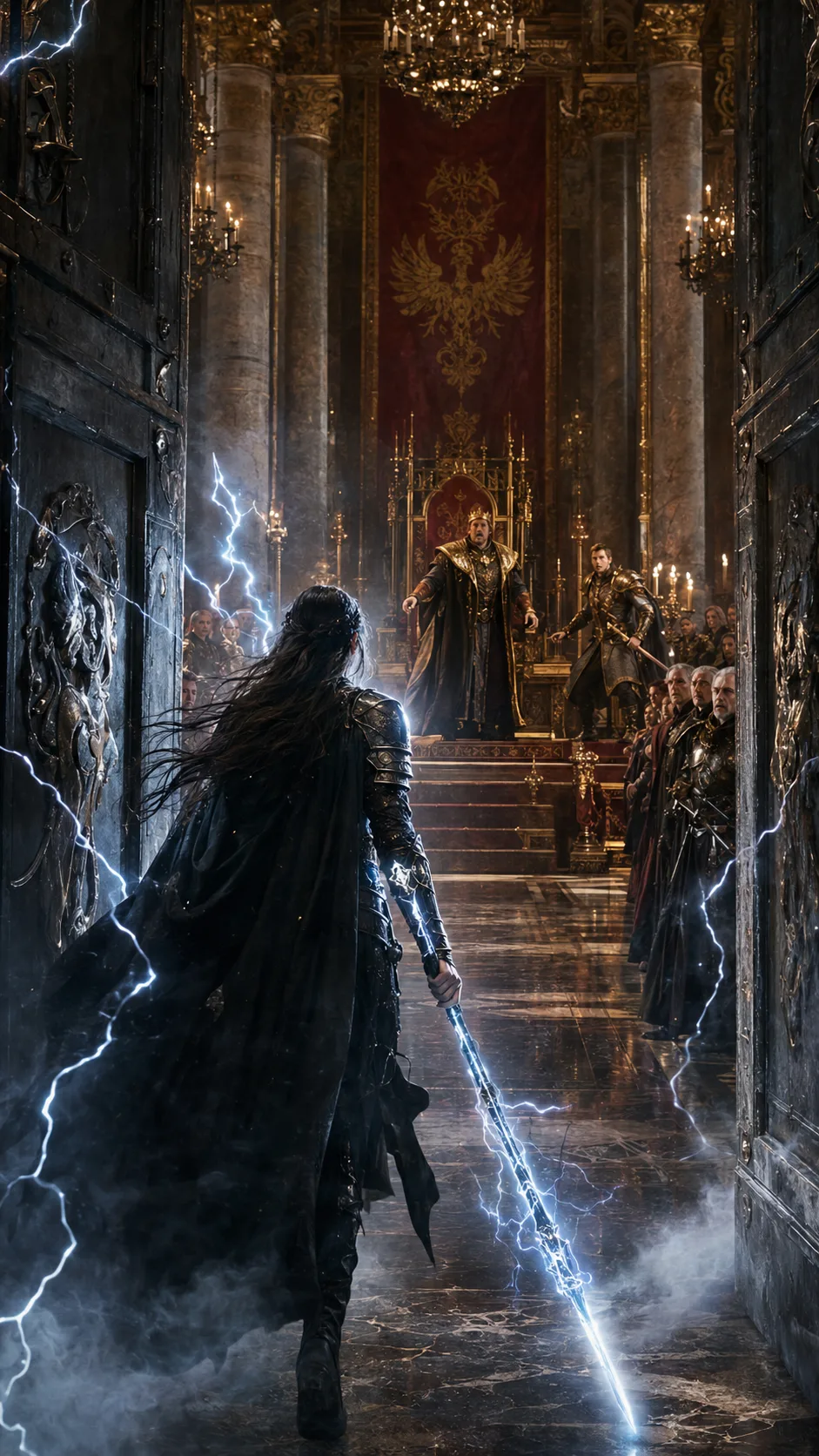
Bronze doors burst inward.
Smoke and white light rolled across the threshold. The nearest guards stumbled back, not struck, not harmed, but driven away by the force of the opening. Wind pushed through the hall, lifting banners, snuffing three candles near the priest’s book, throwing ash from a torch onto the polished floor.
Through the opening, Princess Elara walked in.
Not fast.
Not dressed like exile.
Her black battle cloak dragged smoke behind her. Dark silver armor covered her shoulders, arms, and chest, scarred in places where mountain stone or travel had touched it. Her hair moved in the charged air. In her right hand, angled toward the floor, she held the Thunder Spear.
The weapon lit the hall from below.
Blue-white veins of lightning ran along the shaft, across the blade, down to the floor where each step sent tiny sparks outward over black stone.
For the first time since taking the throne, Malrec’s hand opened without his permission.
The wine cup dropped.
It struck the steps and rolled, spilling red across gold trim.
“Impossible…”
The word left him small.
Corvin’s hand went to his sword. He pulled it halfway before the blade caught against the scabbard lip. He tugged once, too hard, and the sound scraped through the silence.
“Seize her.”
The guards nearest the aisle looked at Malrec.
Then at Elara.
Then at the spear.
Malrec’s face tightened. “Seize her.”
This time, they moved.
Two from the left. Three from the right. Shields lifted, spears angled, boots striking the stone in a rhythm meant to frighten crowds.
Elara stopped just inside the doors.
She lowered the Thunder Spear until the glowing tip touched the floor.
Every torch in the hall bent toward it.
“Ngài đày ta khỏi vương quốc mà không cho ta một thanh kiếm,” she said.
Her voice carried without strain.
The words moved through the court, struck each noble, and remained there. A few understood them as accusation. More understood them as record. The old king’s language. The language spoken in private royal vows, not in Malrec’s council decrees.
The first guard hesitated.
Corvin saw it.
“Bắt lấy ả!”
The guards charged.
Elara drove the butt of the Thunder Spear down once.
A ring of lightning burst across the floor.
It did not tear bodies. It did not spill blood. It struck shields, breastplates, spearheads, and the iron nails in the guards’ boots. Metal screamed. The front line flew back across the polished stone, sliding apart to the left and right, weapons spinning from their hands. One shield struck the base of a column and rang like a bell.
A banner behind the throne caught at the lower edge, fire licking a thin line of gold thread.
No one reached for it.
Elara walked forward.
The nobles on the aisle drew back. Not all at once. One bench first, then another, then Lord Veyr, whose hand lifted halfway as if to stop her before dropping against his side.
“Ngọn núi đã thấy điều đó…”
Elara’s injured palm tightened around the grip. A line of light under her skin flashed once.
“…và nó cho ta thứ tốt hơn.”
Malrec raised his left hand toward the balcony.
Archers stepped from between the columns. They had been hidden behind draped banners, ten on each side, bows already strung. The court looked up and saw what Malrec had prepared for a dead princess.
Elara did not look up.
Corvin did.
That was how the nobles knew he had not been told.
The archers drew.
“Loose,” Malrec said.
Arrows fell.
Elara turned the spear in a single circle.
Lightning rose around her in a bright, curving wall. The arrows entered it and burned black, their iron tips glowing red for half a breath before dropping as ash and twisted metal around her boots.
The court did not gasp.
That would have been easier.
Instead, the sound died completely.
A woman near the western benches lowered her goblet so slowly the base clicked against wood. The high priest closed his book without looking at Malrec. One of the palace guards at the aisle edge removed his hand from his sword and stepped back.
Elara reached the foot of the throne steps.
Corvin stood above her with his sword finally drawn.
The blade looked ordinary now.
He seemed to notice.
“Father,” he said.
Malrec did not look at him.
Elara climbed one step.
Corvin lifted his sword.
The Thunder Spear’s blade angled once, not toward his body, but toward the weapon in his hand. A thread of lightning snapped across the space. Corvin’s sword flew from his grip and clattered down the steps behind Elara.
He stared at his empty hand.
No one moved to return the sword.
Elara stepped past him.
Malrec backed against the throne.
The crown on his head sat slightly crooked from the wind. A small detail. A ruin in miniature.
“You have no court,” he said.
Elara looked to the benches.
So did everyone else.
Lord Veyr’s mouth opened, but nothing useful came from it. The priest held the ceremonial crown against his chest. The captain of the palace guard looked at the men scattered on the floor, then at the spear, then at Malrec.
Elara placed both hands around the Thunder Spear.
“Ngài đuổi ta đi như một đứa con gái tay trắng.”
The words struck harder than the lightning.
Malrec’s fingers dug into the carved arm of the throne.
She lifted the spear.
“Ta trở về với quyền lực của vị vua đầu tiên.”
She drove the Thunder Spear into the stone before the throne.
The crack began beneath the blade.
It ran forward like a white line under black glass, splitting the polished floor, climbing the first step, then the second, then the third. The throne platform groaned. Gold trim buckled. The ceremonial crown fell from the priest’s hands and rolled in a shining arc until it stopped at Elara’s boot.
The crack reached the base of the throne.
The stone split.
Not wide.
Enough.
Enough for everyone to see the throne was not untouchable.
Corvin dropped to one knee, not in loyalty, not by choice. His legs had failed him. His hand pressed against the step where his sword had fallen out of reach.
Malrec held to the throne arm until the split reached beneath his feet.
Then he let go.
Outside, hooves struck the courtyard stones.
One horse. Then five. Then too many to count inside the hall.
Armor sounded beyond the open doors.
Captain Rorik entered first, helmet under one arm, border riders behind him with the old blue-and-silver standard lifted high. Not painted. Not new. The original fabric, repaired by hand, its edges uneven from years hidden in a trunk or under floorboards.
The nobles turned toward it.
Some stood.
Some knelt.
One by one, the palace guards lowered their weapons.
Malrec looked at the standard, then at Elara, then at the split beneath his throne.
“You cannot rule with a weapon,” he said.
Elara pulled the Thunder Spear from the stone.
The crack remained.
“No,” she said. “But I can end a lie with one.”
The high priest stepped down from his place beside the throne. His limp made each step uneven. He passed Corvin without offering a hand. When he reached Elara, he bent and picked up the ceremonial crown from beside her boot.
For a breath, every person in the hall watched the old man hold gold that had been made too quickly.
Then he set it on the cracked step.
Not on her head.
Not in her hands.
On the broken stone.
“This crown has no oath in it,” he said.
Malrec’s mouth tightened. “You forget who elevated you.”
The priest looked up. “No. I remember who ordained me.”
Captain Rorik crossed the hall with six riders and stopped at the foot of the steps. He did not kneel yet. A commander kneeling too soon could make a room feel settled before it was safe.
“The northern gate is under loyal command,” he said. “The palace armory has surrendered. The chapel vault opened at dawn.”
At that, Malrec moved.
Only half a step, but enough.
Rorik’s riders shifted. No sword was raised. No one needed the motion completed.
Elara watched Malrec’s hand. It had moved toward a dagger hidden beneath his robe, thin and ceremonial, more insult than threat.
“Do not,” she said.
He stopped.
A small sound came from Corvin. Not speech. A breath pulled wrong. He looked younger on one knee.
Elara turned to him.
“You were handed a throne,” she said. “That is not the same as being chosen by one.”
Corvin’s fingers loosened on the stone.
Rorik gave one order with two fingers. Guards moved in, not dragging, not striking. They removed Corvin’s sword from the steps and took position beside him.
Malrec stared at the court.
He found Lord Veyr.
Lord Veyr lowered his eyes.
The same eyes he had lowered at the northern gate.
This time, everyone saw.
Elara climbed the remaining steps and stood before the split throne. The red banner behind it still burned along one lower edge, a thin flame crawling through gold thread. A servant finally rushed forward with a wet cloth and pressed it out, leaving a black scar across the embroidered crest.
The smell of smoke stayed.
The high priest turned toward the assembled nobles.
“The true crown,” he said, “will be brought from the chapel vault.”
“No,” Elara said.
The word stopped him.
She looked at the throne, at the crack running through the base, at the wine staining the steps, at the burned edge of the banner, at the men who had watched her banishment and now waited to see how much mercy looked like weakness.
“Not here.”
The priest held still.
Elara stepped down from the platform.
“The first oath will be sworn at the northern gate.”
A murmur passed through the hall.
That was where she had been stripped.
That was where they had watched.
That was where silence had first become treason.
Malrec understood before the others did. His face changed by a fraction. Not much. Enough for Elara.
Rorik turned toward the doors. “Clear the way.”
They took Malrec without chains.
Elara ordered it.
Chains made martyrs from thieves when crowds were hungry enough. He walked between two guards, crown still crooked, robes dragging through dust and spilled wine. Corvin followed under guard, unarmed, his armor making too much noise now.
The court filed behind them.
No ceremony had ever moved so quietly.
Outside, the courtyard was full of soldiers, servants, villagers, riders, and palace staff who had come out when the doors burst open and not gone back inside. The sky remained clear. Lightning flickered far above the towers without thunder.
At the northern gate, the old carving still held Malrec’s warning.
No one follows exile.
Snow no longer covered the letters. Someone had scraped them clean.
Elara stood beneath them with the Thunder Spear in her hand.
The true crown arrived in a plain iron box carried by two chapel guardians. It was smaller than the crown Malrec had made, darker, older, shaped for duty more than display. The high priest opened the box, and for the first time that day, his hands did not shake.
Elara looked at the crown.
Then past it.
The guard who had taken her sword six months earlier stood near the gatehouse steps. Older than she remembered. Or perhaps guilt had weight. He held her father’s sword across both palms, the blade cleaned, the leather grip repaired but not replaced.
He came forward and knelt.
“I kept it from the armory,” he said.
Elara took the sword.
The familiar weight settled into her left hand. The Thunder Spear remained in her right.
For a moment, the courtyard held both versions of her: the girl sent away without steel, and the woman who had returned with thunder.
She looked up at the carved words above the gate.
“Cut it down,” she said.
A mason stepped forward with hammer and chisel. No one had summoned him. He had come carrying the tools himself.
The first strike rang through the courtyard.
Malrec flinched.
The second strike broke the word exile.
Stone dust fell across the gate steps.
Elara did not watch every letter fall. She turned to the people gathered in the courtyard: soldiers with patched armor, servants still wearing kitchen aprons, nobles wrapped in fur, border riders, children sitting on barrels to see above the crowd.
She did not raise the crown.
She did not raise the spear.
She raised her father’s sword.
Only then did Captain Rorik kneel.
The movement spread outward. Soldiers first. Then servants. Then villagers. Then nobles, some too late, some too fast, all visible.
The high priest placed the old crown on Elara’s head beneath the scarred gate.
It did not shine much.
It fit.
Malrec was sent to the western tower under guard until a council of provinces could hear the charges. His decrees were sealed, reviewed, and one by one broken. Corvin was stripped of title and sent to the border abbey he had once mocked for feeding deserters. He did not argue when they took the armor from him.
Lord Veyr resigned before anyone asked.
No one stopped him.
Weeks later, the throne hall reopened.
The cracked platform remained. Elara ordered the masons to leave the split visible and build the new throne around it, not over it. The burned banner was taken down and folded, not destroyed. Lies, she said, should not be erased so cleanly that future kings could pretend no one had believed them.
The bronze doors were repaired last.
One hinge still groaned when opened.
Elara kept that, too.
On the first winter feast of her reign, she placed an empty chair beside her own. Not for the dead. Not for a husband. Not for a councilor.
For the person the court had failed when silence cost nothing.
At the end of the feast, after the candles burned low and the musicians packed away their instruments, Elara walked alone to the northern gate.
The new carving above it was simple.
The mason had asked what words she wanted.
She had given him five.
The snow began falling again, light against stone, gathering in the cut letters.
Elara stood beneath them until the torch beside the gate burned down.
No one banishes thunder.
Chapter complete
You have reached the end of this chapter.
Continue reading
A few more worlds to get lost in after this chapter.