The King Denied His Daughter Before the Nation Until Her Dead Mother’s Video Revealed the Signature He Couldn’t Erase
The first time Elena Hart saw her father’s face, it was not in a family photograph.
Chapter 1
The King Denied His Daughter Before the Nation Until Her Dead Mother’s Video Revealed the Signature He Couldn’t Erase
The first time Elena Hart saw her father’s face, it was not in a family photograph.
It was on a coin.
She was six years old, standing on a wooden chair in her mother’s tiny kitchen, trying to reach the tin box where Sofia Hart kept spare change for bread and bus fare. The coin slipped from her fingers and rolled across the cracked floor. Elena chased it under the table, picked it up, and froze.
A man’s profile was stamped into the silver.
A stern forehead. A straight nose. A jaw carved like stone. A crown above his head.
“Who is he?” Elena asked.
Her mother turned too quickly from the stove.
For a moment, Sofia’s face lost all color. Then she smiled the way adults smile when they are deciding how much truth a child can survive.
“That,” she said softly, “is King Adrian.”
Elena looked back down at the coin.
“Why is he everywhere?”
Sofia lowered the flame beneath the soup pot and
came to kneel beside her daughter. She took the coin from Elena’s hand, but she did not put it away. She held it between them like it was dangerous.
“Because he belongs to the country,” Sofia said.
Elena studied the man’s profile again.
“Does he belong to us?”
The question made Sofia close her eyes.
Only for one second.
But Elena remembered it for the rest of her life.
“No, my love,” Sofia whispered. “People like him are taught to belong to crowns before they belong to hearts.”
At six, Elena did not understand.
At twelve, she began to.
At nineteen, she stopped pretending she didn’t.
By then, she knew the story in fragments, because her mother never told it all at once. Sofia had once worked as a medical archivist inside the royal hospital. She had been young, brilliant, and trusted with files that could ruin ministers, generals, and
noble families. King Adrian, before he became king, had been a prince then—charming, lonely, restless, and already surrounded by people who treated his heart like a national asset.
He met Sofia during a charity inspection at the hospital.
He returned the next week without cameras.
Then the week after that.
Then every Thursday for almost a year.
“He laughed differently when he was not being watched,” Sofia once said, folding Elena’s school uniform at the kitchen table. “Like someone had opened a window inside him.”
“Did he love you?” Elena asked.
Sofia’s hands stopped moving.
“Yes,” she said after a long silence. “But not enough to be brave.”
That was the sentence Elena grew up inside.
Not enough to be brave.
King Adrian married Lady Victoria of House Maren when Elena was two months old. The wedding was broadcast across the world. Sofia watched it from a rented apartment above
a bakery, holding a baby with her father’s gray eyes and her mother’s dark hair.
By then, the palace had already sent lawyers.
They came with polite voices, black cars, and envelopes full of money.
They said the child must never be publicly connected to the royal family.
They said the king’s future depended on “stability.”
They said Sofia would be protected if she remained quiet.
Sofia refused the money.
But she kept the documents.
The birth certificate with Adrian’s full legal name.
The medical report confirming paternity.
The handwritten letter he had sent before his coronation, begging her for time.
And a video.
Elena did not know about the video until the year her mother died.
Sofia had been sick for eight months and had hidden it for five of them.
By the time Elena found out, her mother’s wrists had become too thin for her gold bracelet. Her voice had softened. Her steps became careful. But her eyes still burned with the same quiet fire that had carried them through poverty, gossip, and years of being erased.
One rainy night, Sofia called Elena into her bedroom.
There were three candles on the windowsill because the power had gone out again. Rain tapped against the glass. The city looked blurred and distant below them.
On Sofia’s lap rested a sealed blue folder.
“Elena,” she said, “there may come a day when he denies you.”
Elena sat on the edge of the bed.
“He already has,” she said.
Sofia shook her head.
“No. I mean before the world.”
Elena tried to laugh, but it came out bitter.
“He doesn’t even know I exist.”
Sofia looked at her daughter with such sadness that Elena felt the lie die between them.
“He knows.”
The room seemed to tilt.
Elena stared at her mother.
“What?”
Sofia’s fingers tightened around the folder.
“He has always known.”
Elena stood up.
For years, she had built a shield from one belief: that King Adrian had abandoned Sofia because the palace had hidden Elena from him. That he had never known the truth. That maybe, somewhere behind the golden gates, there was a man who would have chosen differently if someone had simply told him.
But Sofia’s face was the face of someone who had carried a truth until it bruised her.
“He signed the certificate himself,” Sofia said.
Elena’s throat tightened.
“He signed it?”
“Yes.”
“And then he left?”
Sofia looked away.
“He said he needed time.”
Elena laughed once. A sharp, broken sound.
“He had twenty-six years.”
“Elena—”
“No.” She stepped back from the bed. “No, don’t make him smaller for me. Don’t make it sound tragic. He had a daughter. He had a woman who loved him. He had proof. He had a name. And he chose a crown.”
Sofia did not argue.
That hurt more.
She only held out the folder.
“In this folder are copies of everything,” she said. “The originals are with someone I trust. If anything happens to me, and if the palace ever tries to destroy you, this will protect you.”
“I don’t want protection from him,” Elena said. “I want nothing from him.”
Sofia’s eyes filled.
“That is what I wanted too.”
Elena looked down at the blue folder.
“Then why keep it?”
Sofia touched the side of her daughter’s face.
“Because silence is not the same thing as peace.”
Three weeks later, Sofia died before sunrise.
The palace sent no flowers.
No official condolences.
No discreet representative.
No note.
Only two days after the funeral, a man Elena had never seen before arrived at her apartment. He wore a black coat, expensive shoes, and a smile with no warmth.
“Miss Hart,” he said, “my name is Marcus Vale. I represent the Office of Royal Communications.”
Elena did not invite him in.
He looked past her shoulder into the apartment, as if measuring how little power she had.
“We understand your mother recently passed,” he said. “Our condolences.”
Elena gripped the doorframe.
“What do you want?”
Marcus lowered his voice.
“The upcoming National Jubilee will attract international media attention. The palace has reason to believe certain… old rumors may resurface.”
Elena stared at him.
“My mother is dead.”
“Yes,” he said. “Which makes this a delicate moment.”
Something cold moved through Elena’s chest.
“You came here two days after her burial to warn me?”
“I came to offer clarity,” Marcus replied. “His Majesty has no personal connection to you. Any attempt to suggest otherwise would be treated as an attack against the Crown.”
Elena looked at his polished shoes standing on the worn hallway carpet.
An attack against the Crown.
That was what her existence had become.
Not a daughter.
Not a wound.
An attack.
Marcus reached into his coat and took out a white envelope.
“It would be best for everyone if you left the capital for a while.”
Elena did not take it.
He held it closer.
“There is enough here to begin somewhere else.”
Elena looked him in the eye.
“My mother refused your money.”
His smile tightened.
“Your mother made many emotional decisions.”
Elena opened the door wider.
“Get out.”
The smile vanished.
For one second, Marcus showed her the real face behind palace manners.
“You are not special, Miss Hart,” he said. “You are a mistake powerful men have been cleaning up for decades.”
Elena closed the door in his face.
Then she stood in the quiet apartment, shaking so hard she had to sit on the floor.
For two days, she did nothing.
She did not open the blue folder.
She did not answer calls from her best friend Nora.
She did not go to work at the historical library, where she catalogued old royal documents for tourists who believed kings were noble because history books were edited by winners.
On the third day, she made tea in her mother’s chipped cup and opened the folder.
Inside were copies of documents she had imagined but never seen.
Her own birth certificate.
Name: Elena Sofia Hart.
Mother: Sofia Maria Hart.
Father: Adrian Sebastian Laurent.
Occupation: Crown Prince of Valmere.
Signature: Adrian S. Laurent.
Elena touched the ink as if it might burn her.
Beneath it was a medical report from the royal hospital. DNA probability: 99.9987%.
Then a handwritten letter.
Sofia,
I know what they are asking of you. I know what my silence is doing. Please believe me when I say I have not forgotten either of you. I need time to secure the throne, then I will make this right.
A.
Elena read the letter three times.
Then she tore it in half.
Then she cried because tearing the copy did not tear him out of her blood.
At the bottom of the folder was a small silver flash drive taped to a note in her mother’s handwriting.
For the day he lies.
Elena did not play it.
Not at first.
She placed it in her desk drawer and tried to continue living.
But grief has a way of making silence unbearable.
In the weeks after Sofia’s death, King Adrian appeared everywhere. His face smiled from banners above the capital streets. His voice played in interviews about unity, duty, and the sacred bond between sovereign and people.
The National Jubilee approached like a storm dressed in gold.
Fifty years since the restoration of the monarchy.
Twenty-five years since Adrian’s coronation.
Three days of parades, speeches, state dinners, and international broadcasts.
The palace released a documentary called A Father to the Nation.
Elena saw the title on a billboard outside the library and stood beneath it until the rain soaked through her coat.
A father to the nation.
But not to her.
That night, she played the video.
Her mother appeared on the screen wearing the blue dress Elena remembered from childhood birthdays. She looked healthier than she had in her final months, but her eyes were tired.
For several seconds, Sofia only breathed.
Then she spoke.
“My name is Sofia Hart. If this video is being shown, it means I am no longer able to speak for myself, and the man who promised to protect my daughter has chosen to deny her.”
Elena covered her mouth.
Sofia looked directly into the camera.
“Adrian, I am not recording this to ruin you. You did that yourself when you decided a child could be hidden like a scandal. I loved you once. Maybe some part of me loved you until the day I died. But I will not let my daughter inherit your cowardice as if it were her shame.”
The video cut to Sofia holding up the birth certificate.
“You signed this.”
Then the medical report.
“You requested this.”
Then the letter.
“You wrote this.”
Her mother’s voice broke only once.
“Elena is not asking for a crown. She is not asking for your palace, your throne, or your forgiveness. But she deserves the truth. And if you stand before the world and say she is not yours, then explain why you signed her birth certificate.”
The video ended.
Elena sat in the dark long after the screen went black.
The next morning, she called Nora.
“I need a lawyer,” Elena said.
Nora did not ask why.
By noon, Elena was sitting in the office of Daniel Cross, a civil rights attorney with tired eyes and a reputation for making powerful people regret underestimating quiet clients.
He watched the video once.
Then he watched it again.
When it ended the second time, he removed his glasses.
“Miss Hart,” he said, “do you understand what will happen if this becomes public?”
“Yes.”
“Your life will change.”
“It already did.”
“The palace will attack your mother’s character. They will attack yours. They may say the documents are forged.”
“They’re not.”
“I believe you,” Daniel said. “But belief is not the same as protection.”
Elena leaned forward.
“What are my options?”
Daniel studied her for a long moment.
Then he smiled slightly.
“Legally? Many. Publicly? One.”
Elena waited.
“The Jubilee.”
She stared at him.
“You want me to go there?”
“I want you to understand that they are building the largest stage in the country to celebrate a lie. If they choose to keep lying, that stage can become evidence.”
Elena looked toward the window.
Outside, the city was already hanging flags.
“What if I can’t do it?” she asked.
Daniel’s voice softened.
“Then you don’t. No one gets to demand courage from someone who has already survived this much.”
Elena thought of her mother kneeling beside her on the kitchen floor, holding a coin like a secret.
People like him are taught to belong to crowns before they belong to hearts.
“I’m tired of surviving quietly,” Elena said.
The Jubilee took place on a bright morning in May.
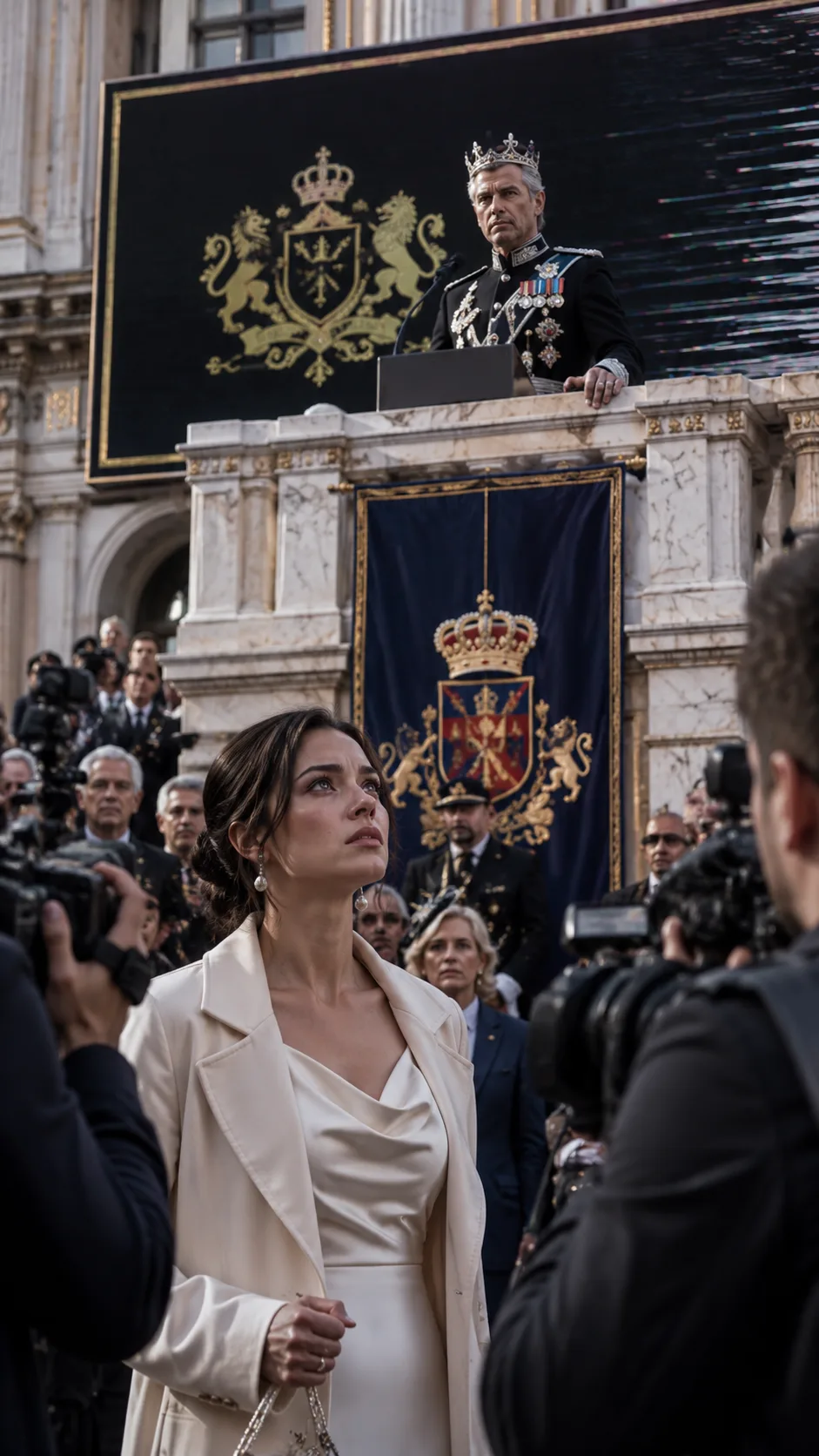
The palace courtyard had been transformed into a sea of marble, flags, cameras, and polished military uniforms. Thousands of invited guests filled the grand stands. Reporters stood behind velvet ropes. Drones hovered above the fountains. The giant screen behind the main balcony displayed the royal crest in gold and blue.
Elena arrived wearing her mother’s pearl earrings and a simple ivory satin dress beneath a pale coat.
She had no invitation.
Daniel walked beside her.
Nora followed with a small black case containing copies of every document and the flash drive.
At the first security gate, a guard stopped them.
“Invitation?”
Daniel handed him a sealed legal notice.
The guard frowned.
A supervisor came.
Then another.
Phones appeared. Voices lowered. Names were spoken into earpieces.
Elena stood still while cameras turned toward the disturbance.
She could feel the palace noticing her.
That was how it felt.
Not like a building.
Like a beast waking up.
Marcus Vale arrived within minutes, his face calm but his eyes furious.
“Miss Hart,” he said. “This is not the time.”
Elena looked at him.
“No. This is exactly the time.”
His gaze moved to Daniel.
“Mr. Cross, I assume.”
Daniel smiled politely.
“I’d say it’s a pleasure, but we both look too busy for lies.”
Marcus stepped closer to Elena.
“You need to leave.”
Elena’s fingers curled around the strap of her bag.
“Ask the king to speak to me privately.”
Marcus laughed under his breath.
“His Majesty does not respond to demands from strangers.”
The word struck exactly where he intended.
Strangers.
Elena lifted her chin.
“Then he can say that to my face.”
Marcus’s expression hardened.
“You have no idea what you are doing.”
“No,” Elena said. “For the first time, I do.”
The standoff might have ended there if one young reporter had not recognized Elena from the library’s public archive lectures.
“Miss Hart?” the reporter called. “Are you here to challenge the palace statement?”
Other reporters turned.
Cameras lifted.
Marcus moved too fast.
“Clear this area,” he snapped to security.
But the damage had already begun.
A murmur ran through the press line.
“Who is she?”
“What statement?”
“Is this connected to the old hospital rumors?”
Elena felt Daniel’s hand lightly touch her elbow.
“Your choice,” he said quietly.
The balcony doors above the courtyard opened.
The crowd erupted.
King Adrian stepped out in a dark ceremonial uniform, silver hair perfectly combed, crown gleaming beneath the morning light. Beside him stood Queen Victoria in pale blue, elegant as ice. Behind them were ministers, generals, and royal cousins arranged like pieces on a chessboard.
Elena looked up.
For twenty-six years, she had seen him on coins, stamps, screens, and portraits.
Never this close.
Never alive enough to disappoint her in person.
King Adrian began his speech with a voice trained to calm nations.
He spoke of duty.
History.
Sacrifice.
Unity.
Elena barely heard him.
She watched his hands.
The same hands that had signed her name into existence and then pretended she had never been born.
Then Marcus leaned toward a security officer and whispered something.
Two guards approached Elena.
Daniel immediately stepped forward.
“This woman has a legal right to remain in a public ceremonial area,” he said.
The nearest camera swung toward them.
Another followed.
The king paused.
Only for half a second.
But Elena saw it.
His eyes moved across the courtyard, found the disturbance, and landed on her face.
The world narrowed.
Elena knew the exact moment he recognized her.
Not because he looked shocked.
Because he looked afraid.
It disappeared quickly, buried beneath royal discipline.
But she had seen it.
For one breath, the king was not a king.
He was a man staring at the daughter he had abandoned.
The reporters began shouting questions.
“Your Majesty, who is the young woman at the gate?”
“Is she connected to Sofia Hart?”
“Did the palace suppress a birth record?”
Queen Victoria’s face turned rigid.
Marcus signaled desperately for the band to play louder.
But King Adrian raised one gloved hand.
The music stopped.
The courtyard fell into a silence so complete that Elena could hear the flags snapping in the wind.
Adrian looked down from the balcony.
Then, with the calm cruelty of a man choosing the crown again, he stepped toward the microphone.
“This country has endured many rumors,” he said. “Some are born from confusion. Others are created by those who seek attention through deception.”
Elena felt her body go cold.
Daniel whispered, “Elena.”
But she could not move.
The king’s eyes remained fixed on her.
“This young woman,” he said, “is not my daughter.”
A sound moved through the crowd.
Not a gasp.
Something worse.
A collective intake of breath from thousands of people witnessing someone being erased in real time.
Elena stood beneath the balcony, her mother’s pearls at her ears, her father’s denial echoing through speakers across the nation.
The giant screen behind him still showed the royal crest.
For a second, nothing happened.
Then the crest flickered.
Marcus turned sharply.
The screen went black.
The king looked over his shoulder.
A woman’s face appeared.
Sofia Hart.
Older than Elena remembered from childhood. Younger than the woman who had died. Beautiful, tired, and fierce.
The entire courtyard froze.
Elena stopped breathing.
On the balcony, King Adrian took one step back.
Sofia’s voice filled the palace courtyard.
“My name is Sofia Hart. If this video is being shown, it means the man who promised to protect my daughter has chosen to deny her.”
Queen Victoria turned toward Adrian with a look Elena could not read.
Marcus shouted at technicians below the stage.
“Cut it! Cut the feed!”
No one moved fast enough.
Or maybe someone inside the palace, someone tired of cleaning royal lies, had decided not to.
On screen, Sofia lifted the birth certificate.
“Adrian, you signed this.”
The camera zoomed in on the signature.
Adrian S. Laurent.
The crowd erupted.
Reporters shouted.
Guests stood.
The royal cousins looked at one another in panic.
Sofia lifted the medical report.
“You requested this.”
Then the letter.
“You wrote this.”
King Adrian’s face had gone pale.
Elena could see him gripping the balcony rail as if the stone itself might save him.
Sofia looked directly into the camera.
“Elena is not asking for a crown. She is not asking for your palace, your throne, or your forgiveness. But she deserves the truth.”
Her voice sharpened.
“And if you stand before the world and say she is not yours…”
The video paused for one devastating breath.
Sofia’s eyes seemed to look past death, past the screen, past the crown, straight into the man who had chosen fear over love.
“Then explain why you signed her birth certificate.”
The courtyard exploded.
Not with applause.
Not yet.
With chaos.
Reporters screamed questions. Ministers rushed toward the balcony doors. Queen Victoria stepped away from Adrian as if his disgrace were contagious. Marcus pushed through security, shouting orders no one obeyed. The royal band sat frozen with instruments in their laps.
And Elena stood still.
She had imagined this moment as victory.
But it did not feel like victory.
It felt like standing at the edge of a grave and finally hearing the dead speak.
The video ended.
The screen went black.
Every camera turned toward the king.
Adrian remained at the microphone.
For twenty-six years, he had known what to say.
That was the gift of kings. They were trained to turn disaster into ceremony, guilt into duty, cruelty into necessity.
But now his mouth opened and no words came out.
Elena walked forward.
The guards did not stop her.
Maybe because Daniel was beside her.
Maybe because the cameras were watching.
Maybe because, for once, the palace had run out of shadows.
She crossed the courtyard slowly, each step echoing against the marble. The crowd parted without being asked. She stopped beneath the balcony, close enough that she no longer had to look at him through screens or coins.
“Say it again,” Elena called.
Her voice was not loud.
But the microphone caught it.
The speakers carried it.
The nation heard.
King Adrian looked down at her.
Elena’s eyes burned, but she did not cry.
“Say I’m not your daughter again,” she said. “Now that my mother is not here for you to silence.”
Adrian swallowed.
Queen Victoria whispered something sharp behind him.
Marcus appeared at the balcony door, shaking his head violently.
The king looked at all of them.
Then he looked at Elena.
For one second, she saw the man her mother had loved.
Not the king.
Not the portrait.
Not the coward protected by marble and law.
Just a man old enough to understand that the cost of his silence had finally come due.
“I…” His voice cracked.
The crowd went silent again.
Adrian gripped the microphone.
“I knew,” he said.
The words struck harder than the denial.
Elena closed her eyes.
Somewhere behind her, Nora began to cry.
“I knew from the beginning,” Adrian continued. “I signed the certificate. I requested the test. I wrote the letter.”
A minister grabbed his arm.
“Your Majesty, stop.”
Adrian pulled free.
“No,” he said, and his voice gained force. “I have spent twenty-six years asking others to carry the weight of my cowardice.”
He looked down at Elena.
“I denied you because I was afraid.”
The crowd murmured.
Elena’s hands trembled at her sides.
“I told myself it was for the country,” Adrian said. “For stability. For the Crown. But the truth is simpler and worse. I chose myself.”
Queen Victoria’s face hardened into something like hatred.
Adrian removed his crown.
The movement silenced everyone.
He held it in both hands, looking at it as if seeing it clearly for the first time.
Then he placed it on the balcony rail.
“I cannot ask this nation to trust a man who abandoned his own child and called it duty.”
A wave of shock moved through the palace.
Elena stared at him.
She had wanted truth.
She had not expected surrender.
Adrian turned to the cameras.
“I will cooperate with Parliament, the courts, and the royal council. All records concerning Sofia Hart and Elena Hart will be released. No one in this palace is to threaten her again.”
Marcus looked as if he might faint.
Then Adrian looked back at Elena.
“I do not deserve to call myself your father,” he said. “But you are my daughter.”
The words came too late.
Far too late.
They did not heal the years.
They did not bring Sofia back.
They did not erase the apartment above the bakery, the cheap school shoes, the birthdays without cards, the nights Elena had watched her mother stare at royal broadcasts with grief hidden behind her eyes.
But truth, even late, has weight.
And for the first time in Elena’s life, the lie was not heavier.
She looked up at the king.
“No,” she said.
The entire courtyard seemed to hold its breath.
Adrian flinched.
Elena’s voice remained steady.
“You don’t get to become my father because the cameras forced you to tell the truth.”
Pain crossed his face.
She continued.
“My mother raised me. My mother protected me. My mother carried your silence until it killed something in her every day. I came here for her. Not for your name.”
Adrian bowed his head.
Elena turned to the crowd.
Cameras followed her.
She had not planned a speech. She had not written anything. But when she looked at the thousands of faces staring back at her, she understood something her mother had died trying to teach her.
The truth did not need to be perfect to be powerful.
“My name is Elena Hart,” she said. “I am Sofia Hart’s daughter. That is the name I am proud of.”
For a moment, there was only wind.
Then one person applauded.
An older woman near the front, wearing a navy hat and pearls.
Then another.
Then more.
The applause grew slowly, uncertain at first, then stronger, spreading through the courtyard like rain finally becoming a storm.
Elena did not smile.
She looked up at the blank screen where her mother’s face had been.
And for the first time since Sofia died, Elena felt less alone.
The days that followed broke the palace open.
Parliament demanded an inquiry.
The royal hospital released sealed records.
Three former palace aides testified that Sofia had been pressured, followed, and offered money for years. Marcus Vale resigned before he could be dismissed, then was summoned to testify anyway. Queen Victoria left the capital for her family estate and refused to comment publicly.
King Adrian temporarily stepped back from ceremonial duties.
The newspapers called it the Hart Scandal.
Elena hated the name.
Her mother had not been a scandal.
She had been a woman.
A mother.
A person who loved the wrong man and still refused to let his cowardice define her child.
Daniel asked Elena if she wanted to file a formal claim for royal recognition.
She thought about it for three nights.
Then she said no.
“I want the records corrected,” she told him. “I want my mother’s name cleared. I want the palace to admit what they did. But I don’t want a title.”
Daniel nodded.
“May I ask why?”
Elena looked at the framed photograph of Sofia on her desk.
“Because I spent my whole life thinking a crown was the thing he denied me,” she said. “But it wasn’t.”
“What was?”
“A father.”
In the end, the palace issued a public apology.
It was formal, careful, and not nearly enough.
But it named Sofia Hart.
It acknowledged Elena.
It admitted that representatives of the Crown had acted to suppress the truth.
The corrected birth record became public on a Friday morning.
Elena did not watch the announcement live.
She went instead to the cemetery.
The sky was clear. The grass was still damp from morning rain. She brought white roses because Sofia had always said red roses were too dramatic for real love.
Elena knelt beside her mother’s grave and placed the flowers carefully.
“It’s done,” she whispered.
The wind moved through the trees.
She took out the coin she had kept since childhood—the one with King Adrian’s face worn smooth by years of hiding in drawers and coat pockets.
For a long time, she held it in her palm.
Then she set it on the stone beside the roses.
“You were right,” she said softly. “Silence isn’t peace.”
Behind her, footsteps approached.
Elena turned.
King Adrian stood several yards away, without guards, without crown, wearing a dark coat that made him look older than he had on television. In his hands was a small bouquet of white roses.
He stopped at a respectful distance.
“I can leave,” he said.
Elena looked at him.
Part of her wanted to say yes.
Part of her wanted to punish him with the same absence he had given her.
But she thought of Sofia, who had loved him and still told the truth. Sofia, who had refused revenge but demanded dignity.
Elena stood.
“You can leave the flowers,” she said.
Adrian’s eyes glistened.
He walked to the grave and knelt slowly. For a moment, he did not speak. He placed the roses beside Elena’s.
“I’m sorry,” he whispered.
Elena did not know whether he meant it for Sofia or for her.
Maybe both.
Maybe neither enough.
He remained kneeling before the grave of the woman he had failed.
Elena watched him, and something inside her loosened—not forgiveness, not yet, but the end of waiting for an apology to make her whole.
She was already whole.
Her mother had made sure of that.
When Adrian rose, he looked at Elena.
“I would like to know you,” he said. “If you ever allow it.”
Elena looked at the man who had given her blood but not shelter, a name but not safety, truth only after exposure.
“I don’t know,” she said honestly.
He nodded.
“That is more than I deserve.”
“Yes,” Elena said. “It is.”
For the first time, he almost smiled.
Not because it was funny.
Because it was true.
Elena picked up her bag and turned toward the cemetery path.
After a few steps, she stopped.
Without looking back, she said, “My mother liked lemon tea. No sugar. She hated palace roses because they had no scent. And she laughed whenever it rained during royal parades.”
Behind her, Adrian said nothing.
But she heard him breathe in sharply.
Elena continued walking.
She did not know if she would ever call him father.
She did not know if blood could become family after twenty-six years of denial.
But she knew this:
The world knew her mother’s name.
The lie had cracked.
The daughter he tried to erase had stood before the palace and remained standing.
And somewhere beyond crowns, coins, cameras, and marble gates, Sofia Hart was no longer silent.
THE END.
Chapter complete
You have reached the end of this chapter.
Continue reading
A few more worlds to get lost in after this chapter.