My mother’s fingers closed around my wrist before the nurse could pull the sheet over her chest.
Chapter 1
My mother’s fingers closed around my wrist before the nurse could pull the sheet over her chest.
Not hard.
Not enough to hurt.
But enough to make the room stop moving.
The machines beside her bed still hummed. A plastic cup of untouched water sat on the tray. Someone had left a folded hospital blanket on the visitor chair, the blue one with the loose thread in the corner. My uncle had already stepped into the hallway to take a call, because death in our family was treated like a scheduling problem.
My mother’s lips moved.
I leaned closer.
Her hand opened.
Inside her palm was a handkerchief I had seen only once before, white linen with a faded blue flower stitched into one corner. It had been wrapped around something small and hard.
“Clara,” she said.
That was all.
One word.
I took the cloth.
Her eyes shifted toward the door, then back to me. She pressed my fingers closed over the bundle.
The nurse touched
my shoulder. My grandmother stood near the window with her purse held in both hands, straight-backed, dry-eyed, dressed in black before anyone had told her to be.
“She needs rest,” my grandmother said.
My mother made a sound. Not quite a laugh. Not quite breath.
I tucked the handkerchief into my coat pocket.
Her fingers slipped away.
The funeral was three days later, in the stone chapel where every woman in my family had been married and every man had been displayed in polished walnut after he died. The aisle smelled of lilies and cold wax. My grandmother sat in the front pew with her pearls resting at the base of her throat. My uncle Victor stood beside the coffin, shaking hands, nodding, accepting grief like rent.
“She was fragile for years,” I heard him tell someone.
Fragile.
My mother had raised me alone after my father left, worked two
jobs without once missing a school meeting, and fixed the kitchen sink herself with a butter knife and one wrench.
But in that chapel, she became fragile.
Unstable.
Difficult.
A woman who had imagined enemies.
I stood by the guest book and watched my relatives write their names with the same silver pen. They all looked at me after signing. Not at the coffin. Not at the flowers.
At my coat pocket.
After the burial, my uncle caught me in the hallway behind the chapel. The stained-glass windows threw red and blue patches across his suit.
“Your grandmother told me your mother gave you something.”
I kept my hand away from my pocket.
“She gave me a handkerchief.”
His jaw moved once.
“Give it to me.”
“No.”
He glanced toward the reception room where cousins and neighbors were eating finger sandwiches under a portrait of a saint. Then he stepped
closer.
“Some family matters should stay buried.”
There it was.
A clean sentence.
Too clean.
I walked past him before my voice could betray me. At home, I locked my apartment door, sat at the kitchen table, and unwrapped the cloth.
A tiny brass key fell into my palm.
Old. Scratched. Real.
Inside the handkerchief, written in my mother’s uneven handwriting, was one sentence:
When you are ready to know why they hated me, find the room behind the library.
I read it five times.
Then I folded the cloth exactly as she had folded it.
Outside my window, a neighbor’s dog barked twice and stopped.
The key stayed on the table until morning.
My grandmother called at 8:12 the next morning.
I knew because I was standing over the sink, watching coffee drip from the cracked filter basket, when my phone began buzzing across the counter.
Her name filled the screen.
I let it ring.
It stopped.
Then Victor called.
I answered.
“You left quickly yesterday,” he said.
“I went home.”
“You upset your grandmother.”
“She seemed fine.”
A pause.
“She is old, Clara.”
“She outlived everyone who ever disagreed with her.”
The line went quiet long enough for the coffee machine to spit hot water onto the counter.
“Do not make your mother’s illness your inheritance,” he said.
I looked at the key beside the sugar bowl.
Small thing.
Heavy room.
“What room is behind the library?”
Victor inhaled through his nose. I heard it.
“There is no room.”
“Then why do you want the key?”
He ended the call.
That was answer enough.
I called in sick to work and drove to the family mansion just after noon. The house stood at the end of Ashbourne Lane, behind iron gates and a row of clipped hedges shaped too neatly to be alive. My grandfather had built his money in shipping, then rebuilt his manners to match it. Every room in that house had rules. Which chairs were for guests. Which glasses were for holidays. Which topics died before dessert.
My mother had grown up there.
She had left with two suitcases and me.
The maid, Mrs. Bell, opened the door before I knocked. She was older than I remembered, smaller too, with gray hair pinned tight at the back of her head.
“Miss Clara.”
The way she said my name made me look up.
“Is my grandmother here?”
“In the sunroom.”
“Victor?”
“Not yet.”
Not yet.
She stepped aside.
The foyer smelled of beeswax and old roses. A porcelain umbrella stand waited near the staircase, though nobody in that family walked anywhere in the rain. I passed the mirror where, as a child, I used to check whether I looked enough like them to belong.
Still no.
My grandmother sat in the sunroom with a cup of tea cooling on the table beside her. The cup had a thin crack running from the rim down through the painted rose. She saw me notice it.
“Your mother broke that,” she said.
“She broke a cup?”
“She broke many things.”
I stood at the doorway.
Her eyes went to my coat pocket.
“Victor spoke to me,” she said.
“I’m sure he did.”
“She filled your head before she died.”
“She gave me a key.”
My grandmother’s hand moved to her pearls. Not to clutch them. To count them, one bead at a time.
“There are keys all over this house.”
“This one opens something behind the library.”
The bead-counting stopped.
Dust moved in the sunlight between us.
“She was sick,” my grandmother said.
“She was careful.”
“That is not the same thing.”
Mrs. Bell appeared in the hallway with a folded linen cloth in her hands. She froze when she heard the last word. My grandmother turned her head just slightly, and the maid lowered her eyes.
Too fast.
I saw it.
Mrs. Bell knew something.
The first crack had opened. I could hear it.
I left the sunroom without asking permission and walked toward the library. My grandmother did not call after me. That almost stopped me.
Almost.
The library doors were closed.
They had never been closed during the day.
I tried the handle.
Locked.
The key in my pocket warmed under my fingers, though I knew metal did not do that. The small brass key did not fit the library door. It was too old, too narrow.
Behind me, Mrs. Bell moved with a stack of folded towels she did not need to be carrying.
“Mrs. Bell.”
She stopped.
“Where is the library key?”
“I don’t keep that one.”
“Who does?”
Her eyes flicked upward.
The portrait hall.
Victor’s study was upstairs.
I took the back staircase, the servants’ staircase, the one my grandmother pretended did not exist when guests came. My shoes caught on the worn edge of a runner. Halfway up, I heard voices below.
Victor had arrived.
“She’s here?” he said.
“In the house,” my grandmother answered.
“You should have called me sooner.”
“She asked about the library.”
A chair scraped.
I kept climbing.
Victor’s study smelled of cigar smoke and leather polish. His desk was locked, but his sideboard was not. I found keys in a brass bowl: cellar, wine room, archive cabinet, west gate.
Library.
My hand closed around it.
Then I saw the envelope.
It lay under the bowl, cream paper, thick, with my mother’s name written across it in my grandmother’s handwriting.
Eleanor.
Not Mom.
Not my daughter.
Eleanor.
The envelope had been opened, then sealed again badly. I slid one finger under the flap.
Inside was a copy of a medical record from Saint Agnes Hospital, dated twenty-six years ago.
Mother: Eleanor Vale.
Delivery: Twin female infants.
Twin.
The word did not move.
I read the line again.
Twin female infants.
One page only. The second page had been removed. A torn edge clung to the staple.
My mouth went dry, but my hands kept working. I folded the paper, slipped it inside my coat, and took the library key.
Downstairs, Victor was standing at the foot of the staircase.
His coat was still on. His gloves were in one hand.
“Looking for something?”
I walked past him.
He caught my arm.
I looked at his hand on my sleeve.
He let go.
The library door opened with a heavy click. Inside, the curtains were drawn though the afternoon sun pressed white around their edges. The room smelled untouched. Not dusty. Watched.
Books lined every wall, floor to ceiling. My grandfather’s portrait hung above the fireplace, his eyes painted with that old-money boredom men mistake for power.
I moved to the third shelf from the left because my mother’s note had not said the room was in the library.
It said behind it.
I touched the shelves one at a time.
Victor stood by the door.
“You are embarrassing yourself.”
My grandmother appeared behind him.
“Clara,” she said, “leave this alone.”
I pulled down a row of old shipping ledgers. Nothing.
“You sound afraid,” I said.
Victor laughed once.
Wrong sound.
Mrs. Bell stood in the hallway, still holding the towels. Her knuckles were white around the linen.
My fingers found a groove behind a cracked copy of Paradise Lost.
A narrow brass plate.
A hidden lock.
The key from my mother slid in.
Perfect fit.
Victor crossed the room before I turned it.
“Do not.”
Two words.
Too late.
The wall shuddered.
A shelf shifted inward with a low wooden groan.
Mrs. Bell dropped the towels.
The hidden door opened into stale darkness.
I stepped through before Victor could reach me.
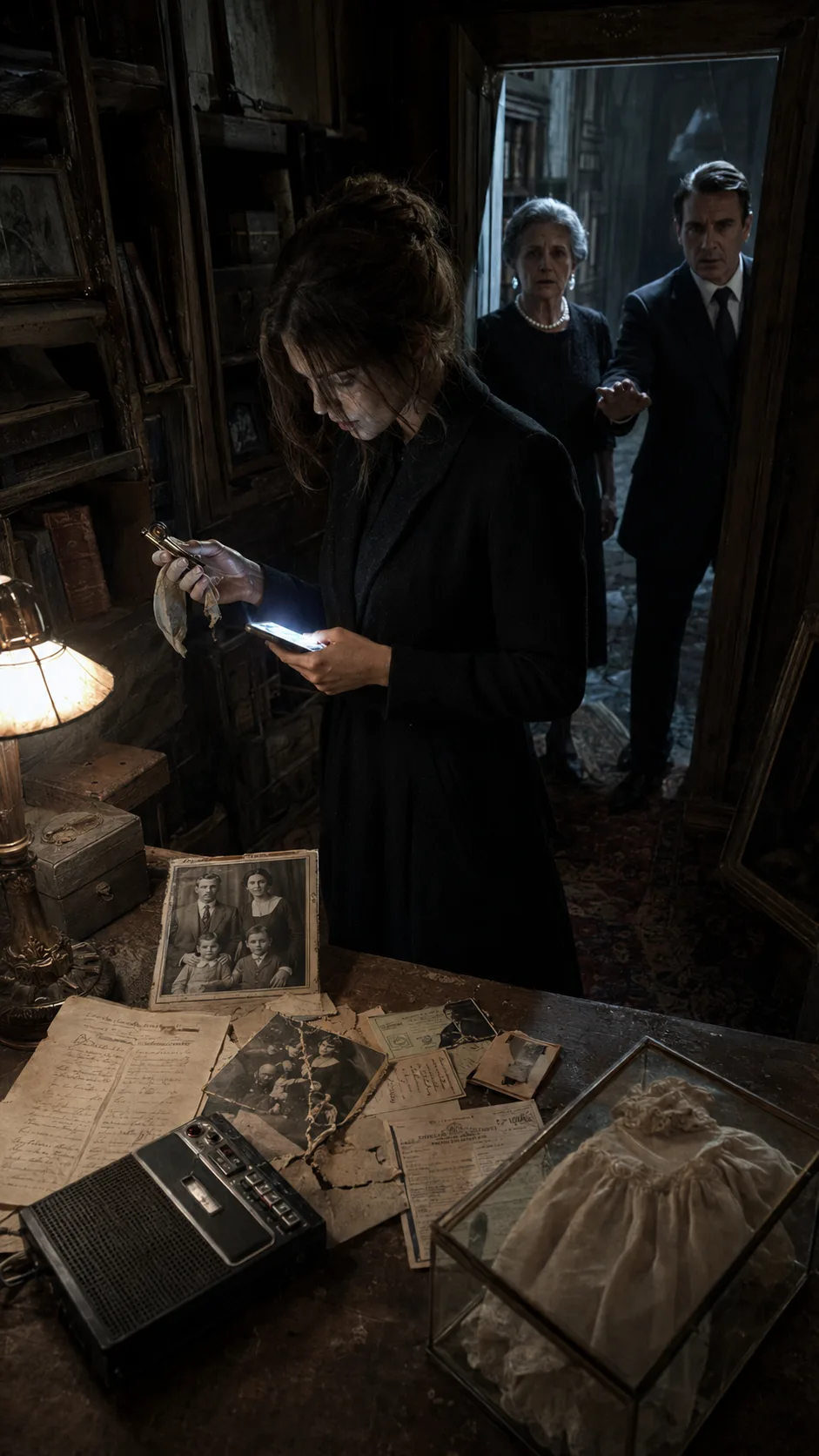
The air inside tasted old. Paper. Dust. Dried flowers. Something metallic from the lock. The narrow room beyond the shelf had no windows, only a slanted ceiling and one hanging bulb with a pull chain. I found the string and tugged.
Light flickered once.
Then stayed.
The room was not empty.
A desk stood against the far wall beneath shelves packed with boxes. The wood surface had been covered with papers, photographs, ribbon-tied bundles, and a glass case holding a child’s dress so small it could have fit over my forearm. A silver hairbrush lay beside it. One of its teeth was missing. A cup sat near the back of the desk with dried tea darkening the bottom.
Not a storage room.
A kept room.
My grandmother stopped at the threshold.
Victor stood beside her, his body blocking half the doorway.
Neither entered.
That told me more than any confession.
I moved toward the desk. The floorboards creaked under my weight. On the left side were wedding photographs, most of them torn through the middle. My mother in a white dress. My father beside her. My grandmother at the edge of the frame, one hand resting on my mother’s shoulder like a claim.
Under the photographs were letters.
Eleanor, stop asking.
Eleanor, you are making this worse.
Eleanor, the decision was final.
No signatures.
Of course.
I lifted a birth certificate.
My name.
Clara Anne Vale.
Another certificate had been folded underneath it, but the top half was missing. Only the lower section remained.
Female infant.
Time of birth: 3:42 a.m.
My certificate said 3:36 a.m.
Six minutes.
Six minutes between me and a life no one had spoken into the air.
Behind me, Victor moved.
“Put those down.”
I did not.
My grandmother said nothing.
I opened a small wooden box. Inside was a hospital bracelet, brittle with age. The printed name had faded, but two letters remained.
VA.
Vale.
I set it beside the certificates.
The objects gathered into a shape.
One I did not want to name.
Then I saw the photograph.
It was tucked beneath the glass case, its corner sticking out under the velvet base. I lifted the case just enough to slide the picture free.
My mother sat in a garden chair wearing a pale blue robe. She looked younger than I had ever seen her. Her hair hung loose over one shoulder. In each arm, she held a baby wrapped in white.
Two babies.
One had a round birthmark near the collarbone.
I put my fingers against my own coat, over the place where mine sat beneath the fabric.
Same place.
Same shape.
I turned the photograph over.
On the back, in my mother’s hand, were five words.
Clara was not the only child.
The bulb above me buzzed.
Victor stepped inside.
“Enough.”
He reached for the photograph.
I moved it behind my back.
My grandmother came only as far as the doorway. The light caught every line around her mouth.
“That child should never have existed.”
Her voice did not shake at first.
Then it did.
Victor lowered his hand.
The sentence sat between us, ugly and complete.
I looked at her.
“What child?”
She pressed her fingers to the pearls at her throat.
“You always looked like her,” she said.
Victor turned his head.
“Mother.”
But she kept looking at me, and for the first time in my life, she seemed less like the house and more like something trapped inside it.
“Your mother was warned,” she said. “She knew what your grandfather expected.”
“What did he expect?”
“A clean family.”
The bulb buzzed again.
I set the photograph on the desk.
Carefully.
One corner touched the hospital bracelet. Another touched my birth certificate. Proof beside proof beside proof.
Victor picked up his phone.
“Clara, you are going to leave now.”
“No.”
“You do not understand what you are holding.”
“I understand there were two of us.”
His thumb hovered over the screen.
“Give me the photograph.”
My grandmother’s gaze had shifted to the desk. Not the photo.
Something behind it.
I followed her eyes.
Under a stack of letters lay a tape recorder.
Black plastic. Square. Dust pressed into the speaker holes. A strip of masking tape had been placed across the top, browned at the edges.
FOR CLARA.
My mother’s handwriting.
My hand moved before Victor did.
He saw it.
“Don’t touch that.”
I picked it up.
The recorder was heavier than it looked. A cassette sat inside behind scratched plastic. My thumb found the play button.
Victor took one step forward.
I pressed it.
Static burst from the speaker.
My grandmother closed her eyes.
The static cracked, dipped, then steadied into a thin hiss. At first there was only breathing. Close to the microphone. Uneven. Then a chair scraping. A woman clearing her throat.
My mother.
Not the hospital version. Not the weak voice from the bed.
Younger.
Raw.
“If you are hearing this,” the voice said, “find your sister before they find you.”
Victor’s hand froze halfway toward the recorder.
My grandmother gripped the doorframe.
The room seemed to narrow around the speaker.
My mother breathed once on the tape.
“They told me she died before sunrise. They showed me nothing. No body. No certificate I was allowed to keep. Your grandfather said grief would pass faster if I stopped asking questions.”
A click sounded on the tape. Maybe a cup. Maybe her ring against the table.
“I found the nurse eight years later. Her name was Miriam Bell.”
Mrs. Bell.
In the hallway, a small sound came from behind my grandmother.
I looked past the doorway.
Mrs. Bell stood there with both hands pressed against her mouth.
Victor turned.
“Get out.”
She did not move.
My mother’s voice continued.
“She said one child left the hospital with me. One child left through the rear entrance with your grandmother’s driver.”
My grandmother’s knees bent slightly. She caught herself on the frame.
“Turn it off,” Victor said.
I held the recorder tighter.
“No.”
The tape hissed.
“They changed her name. I do not know where they took her. I spent every year looking. Every time I got close, your uncle found out first.”
Victor’s face emptied.
Not of anger.
Of calculation.
His phone remained in his hand. Screen lit. Thumb still hovering.
I reached with my free hand, picked up the brass key from the desk, and set it on top of the photograph.
The sound of metal touching paper was small.
It landed anyway.
Mrs. Bell stepped into the doorway behind my grandmother.
“I carried the second blanket,” she said.
Victor turned fully now.
“Be quiet.”
Mrs. Bell’s hands shook at her sides, but her feet stayed planted.
“She was alive.”
My grandmother made a thin sound.
Victor pointed at her.
“You signed the agreement.”
Mrs. Bell looked at him.
“I was twenty-two.”
“And paid.”
“I kept the bracelet.”
The room changed after that.
Not loudly.
No one shouted. No one ran.
But Victor lowered his phone. My grandmother stopped counting her pearls. Mrs. Bell took one more step forward, past the woman she had served for almost five decades.
I picked up my phone to record.
Victor saw the red recording dot.
“Clara.”
I turned the screen toward him.
He stepped back.
One step.
Enough.
The tape played on.
“If Clara is alive, she will find the key,” my mother said. “I left the second key where only my other daughter would know to look. If she found it, she knows enough to be in danger.”
My hand went cold around the phone.
Then it vibrated.
Once.
The screen changed.
Unknown Number.
A message appeared.
I have the same key.
No one breathed for a full second.
Then Victor moved toward me.
Mrs. Bell blocked him.
Not with strength.
With her body.
A small old woman in a gray dress standing between a man in a tailored suit and the niece he had spent years dismissing.
“Move,” he said.
She lifted her chin.
“No.”
My grandmother slid down against the doorframe until one knee touched the floor. One pearl earring had come loose and hung crooked against her neck.
The phone vibrated again.
A second message.
Do not trust Victor.
Victor lunged.
I stepped back, hit the edge of the desk, and grabbed the glass case with the child’s dress. It scraped across the wood and slammed against the birth certificates, the photograph, the bracelet, the key.
Everything came together in the center of the desk.
Proof under glass.
Proof on paper.
Proof in my mother’s voice.
Proof glowing in my hand.
Victor stopped inches from me.
My phone was still recording.
Mrs. Bell saw it.
So did he.
The tape clicked off.
The silence after it did not belong to my family anymore.
The bulb above the desk flickered, then steadied again.
Victor stood with one hand still lifted, fingers curled like he had grabbed something that was no longer there. Mrs. Bell remained between us. Her shoulders rose and fell beneath her gray uniform.
My grandmother sat on the floor at the doorway.
No one helped her up.
The room had changed without moving. The papers were scattered now. The glass case sat crooked on the desk, one corner hanging over the edge. The brass key lay on top of the photograph, half covering my mother’s younger face. My phone was still in my hand, still recording, still warm.
Victor looked at it.
Then at me.
“You don’t know what this will do.”
I put the phone into my coat pocket without stopping the recording.
“I know what was done.”
His mouth opened.
Closed.
Mrs. Bell bent slowly and picked up the fallen pearl earring from the floor. She held it out to my grandmother. My grandmother did not take it.
From the hallway came the sound of another phone ringing. Once. Twice. A house phone, old and shrill, somewhere near the foyer.
Nobody moved toward it.
I gathered the birth certificates, the photograph, the bracelet, and the letters. Not fast. Not gently either. The tape recorder went into my bag last.
Victor watched each item disappear.
When I reached for the child’s dress, Mrs. Bell touched my sleeve.
“Leave that,” she said.
I looked at the glass box.
The dress inside was pale, untouched, useless.
I left it.
At the door, my grandmother lifted her face.
“She will ruin you.”
I stepped around her.
Behind me, Victor picked up his phone again.
This time, his hand shook.
I did not go back to my apartment.
I drove to a twenty-four-hour copy shop two towns over, the kind with buzzing fluorescent lights and a vending machine that sold gum so old the wrappers had faded. The man behind the counter did not ask why a woman in a black funeral dress was scanning birth certificates at 2:17 in the morning.
He charged me eleven dollars.
I made six copies of everything.
One set went to a lawyer whose name my mother had written on the back of a grocery receipt hidden inside the tape recorder case. One went to a journalist who had spent years writing about closed adoptions and private hospitals. One went into a safety deposit box under my own name.
The original tape stayed with me.
At dawn, the unknown number texted again.
Train station. Platform 4. Noon. Bring the key.
I arrived early.
Of course I did.
The station smelled of burnt coffee and wet concrete. Commuters moved around me with paper cups and rolling bags. A little boy dropped a red mitten near the ticket machine, and his father scooped it up without slowing down.
I stood under the clock with my mother’s handkerchief wrapped around the brass key.
At 12:03, a woman stepped off the southbound train.
She was my height.
Same dark hair. Same line of the mouth. Same way of stopping before entering a room, as if measuring exits before furniture.
She wore a navy coat and carried no luggage.
For a moment, neither of us crossed the platform.
Then she opened her hand.
A brass key rested in her palm.
Mine looked older.
Hers looked used.
She came closer. Not quickly. The crowd moved between us and around us, annoyed by whatever private thing we were making them walk past.
“My name is Mara,” she said.
I nodded.
“Clara.”
She looked at my handkerchief.
“I know.”
We did not hug.
Not there.
Not with Victor still loose in the world and my grandmother’s money still capable of reaching places we could not see.
But we walked out of the station together.
One week later, Victor’s name appeared in the paper beside Saint Agnes Hospital and a private adoption broker that had closed before I was old enough to read. Mrs. Bell gave a statement. The lawyer filed for sealed records. My grandmother left the mansion in a black car with curtains over the windows and did not return.
The house was locked by court order.
For the first time in my life, Ashbourne Lane had no lights burning behind the hedges.
Mara and I went back only once, with the lawyer, to collect what belonged to my mother. The library smelled the same. Lemon polish. Old wood. A room trained to deny rot.
The hidden door stood open.
Inside, the glass case still held the small dress.
Mara stood beside me and touched the lid.
“Which one of us wore it?”
I looked at the yellowed sleeves.
“Maybe neither.”
She smiled without showing her teeth.
We left it there.
Before we walked out, I took my mother’s handkerchief from my pocket and wrapped both keys inside it. Mine and Mara’s. Side by side.
The cloth was too small to fold neatly around both.
I folded it anyway.
The keys touched.
Chapter complete
You have reached the end of this chapter.
Continue reading
A few more worlds to get lost in after this chapter.




