Mark threw my father’s service medals into a shoebox like they were loose bolts from the garage.
Chapter 1
Mark threw my father’s service medals into a shoebox like they were loose bolts from the garage.
“Keep the ribbons if you want them,” he said.
The lid scraped against the quilt.
I stood in the doorway of Dad’s bedroom with a trash bag in one hand and the other pressed against the doorframe, because the whole room still smelled like him: pine soap, old leather, and the coffee he drank too late at night. His slippers sat under the chair by the window, toes pointed toward the bed, as if he had only stepped into the hallway for a minute.
He hadn’t.
Not anymore.
My mother sat at the edge of the mattress, folding one of his flannel shirts across her lap. She smoothed the sleeves twice, then a third time, though the shirt was already flat. A safety pin clung to the cuff from some repair she had never finished.
Mark did not notice.
He never noticed small things unless they affected paperwork, money, or
his schedule.
“We need the pension documents, the house title, and the insurance file,” he said. “Everything else can wait.”
I looked at the shoebox.
“That’s not junk.”
Mark gave me the look he used in court, even though none of us were on trial. “Emily, Dad kept every receipt since 1984. We can’t turn grief into a museum.”
Mom’s fingers stopped on the shirt.
No one spoke.
The gray lockbox sat under Dad’s side of the bed. I had seen it there my entire life. When I was little, I thought it held a gun. When I was older, I thought it held war letters. After Dad came home from the Gulf War, he never told stories, never joined the parades, never corrected TV documentaries when they got some detail wrong.
He stayed quiet.
Always quiet.
Mark knelt and dragged the box out by its handle. The metal left
a pale line in the carpet dust. He found the key taped under the nightstand drawer, because Mark knew where practical men hid practical things.
The box opened with a stiff click.
Inside were envelopes, folded discharge papers, VA notices, a black-and-white photograph of men in desert uniforms, and a small prayer card from a funeral none of us recognized. Mark started sorting before Mom even leaned forward.
“Benefits. Medical. Trash. Unknown.”
I stepped into the room.
“Slow down.”
“I am slowing down.”
“You’re tossing his life into piles.”
Mark held up a faded gas station receipt. “This is from 1997.”
Mom reached for the photograph. She touched Dad’s face with one finger. He was younger there, thinner, with his arm around a man whose face had been scratched nearly white by age and handling. Someone had bent the corner of the photo hard enough to crease the stranger’s shoulder.
“Who is this?” I asked.
Mom shook her head.
“Your father never said.”
Mark took it from her and dropped it into the unknown pile.
Then a cream envelope slid from between two VA forms and landed near my shoe.
It had an Iowa return address.
Not Texas, where we lived.
Not Kentucky, where Dad was born.
Not Kuwait.
Iowa.
The paper inside was thinner than the others, the kind that had been folded and unfolded so many times the creases had gone soft. Across the top was a stamped notice about veteran’s benefits record verification.
Mark reached for it.
I picked it up first.
One line had been underlined in blue ink.
Dependent or family contact listed overseas.
Below it, in someone else’s handwriting, were six words that made my mother set Dad’s shirt down.
Verify blood relation before release.
Mark laughed once, short and flat.
“That’s clerical garbage.”
Mom held out her hand.
“Let me see.”
He took the paper from me before she could.
“It’s probably a unit contact,” he said. “Somebody misfiled something thirty years ago.”
“Then why does it say blood relation?” I asked.
Mark folded the notice once, then unfolded it. “Because government offices make mistakes.”
My mother’s face had gone still. She was not looking at Mark. She was looking at the gray lockbox.
“Your father got letters,” she said.
Mark turned.
“What letters?”
“Not many.” She pressed the flannel shirt into a square. “A few. Years ago.”
“From who?”
She didn’t answer right away.
The room felt smaller.
“Overseas,” she said.
Mark’s hand closed around the paper.
“Mom.”
She looked down at the shirt.
“He burned them in the grill.”
The words did not come with drama. They came like a bill placed on a counter.
Mark stepped back from the bed.
“That’s impossible.”
I picked up another envelope from the lockbox. The paper inside was blank except for a phone number written on the back in Dad’s blocky hand. The country code began with digits I did not recognize.
Mark saw me looking.
“Put that back.”
I didn’t.
He walked over and took the envelope from my hand. Not hard. Not gently either.
“We are not chasing ghosts,” he said.
Mom stood then, still holding Dad’s shirt against her waist.
“Don’t call it that.”
Mark turned toward her with the paper raised between two fingers. “Dad had no brother. Grandpa had one marriage. One family. We know our family.”
Mom’s mouth tightened.
“You knew the parts he gave you.”
A car passed outside, slow on the wet street. Its tires hissed against the curb. Inside the bedroom, Dad’s old alarm clock blinked 12:00 because Mark had unplugged the lamp and reset the outlet without noticing.
I took the Iowa notice back from him.
“We should call.”
“No,” Mark said.
One word.
Mom looked at me.
I folded the notice carefully and slid it into my coat pocket.
Mark watched the movement.
That was the first crack.
The next morning, he arrived at Mom’s house with coffee, a printed checklist, and his wife’s SUV idling in the driveway. He wore his gray blazer, the one he kept in the backseat for court appearances, and had shaved so cleanly his jaw looked scraped.
“We’ll go to Iowa,” he said.
Mom stood in the kitchen with Dad’s mug in her hand.
I looked at him over the table.
“Yesterday you said no.”
“Yesterday I didn’t know you were going to treat a misprint like a treasure map.”
“It was underlined.”
“By a clerk.”
“And Dad kept it.”
Mark put the checklist down. “Exactly. Dad kept everything.”
Mom’s coffee had gone cold. A pale ring sat on the table where she had set the mug down and picked it up and set it down again.
“Why are you coming?” I asked.
“To protect Mom.”
Mom’s eyes moved to him.
He added, “And Dad’s estate.”
There it was.
Not loud.
Not hidden.
Mark had always carried responsibility like a badge, but he also liked deciding where everyone else stood. When Dad got sick, Mark chose the hospice schedule. When Mom wanted to keep Dad’s truck, Mark said it was impractical. When I asked for time before sorting the room, he said time made simple things complicated.
Now he had a new simple thing.
Erase the overseas name.
He took the notice from the table and tucked it into his leather folder.
“I already called the Iowa office,” he said. “They found an archived file. We have an appointment at noon.”
Mom blinked.
“You called?”
“Someone had to.”
I watched him zip the folder shut.
“Did you tell them we were coming to verify a family record?”
He looked at me.
“I told them we were correcting an error.”
Mom set the mug down.
Too hard.
Coffee jumped over the rim and spread across the table. She did not wipe it up.
The drive took five hours. Mark drove. Mom sat in the front passenger seat with her purse on her knees. I sat in the back beside a cardboard box of Dad’s papers Mark had brought “for context.”
He talked for the first hour.
About probate.
About false claims.
About veterans’ benefits fraud.
About how families got “targeted” after a death because grief made people sloppy.
Mom stared out the window.
I opened the cardboard box and went through the folders again. Medical records. VA correspondence. An old appointment card. A benefits booklet with three pages dog-eared.
Then I found the mini twist tucked inside the booklet.
A photocopy.
Not from the VA.
A birth certificate.
The ink was faded, and half the page had been cut off in copying, but the father’s name was clear.
William Hayes.
Our grandfather.
The mother’s name was foreign to me, printed in block letters I had to sound out under my breath. The place of birth was overseas. The child’s first name had been smudged by the copier, but the last name remained.
Hayes.
I looked up.
Mark was still talking.
“If there were a real person involved, Dad would have told us. He didn’t hide things from family.”
Mom turned her head slightly.
The movement was small.
I slid the photocopy under Dad’s VA booklet and kept my hand on it for the rest of the ride.
The Iowa veterans’ records office sat in a low brick government building beside a county tax office and a closed sandwich shop. The lobby had beige walls, a plastic plant with dust on its leaves, and a vending machine that hummed too loudly in the corner.
Mark signed us in.
He wrote his name first.
Then Mom’s.
Then mine, smaller, like an afterthought.
A younger employee behind the glass window asked us to wait. He kept glancing at the gray box of documents under Mark’s arm. A woman in a dark green blazer appeared ten minutes later with a badge clipped to her pocket.
“Diane Walker,” she said. “Records supervisor.”
Mark shook her hand before Mom could stand.
“Mark Hayes. I’m the oldest son.”
Diane nodded to him, then to my mother.
“Mrs. Hayes.”
Mom stood.
Diane’s hand was warm when she took mine.
“You’re Emily?”
I nodded.
Her eyes stayed on my face for one extra second.
“You were listed on the request.”
Mark turned.
“I made the request.”
Diane looked down at the clipboard.
“The initial records inquiry came from an Emily Hayes six years ago.”
I felt Mark’s head turn toward me.
“I never filed one,” I said.
Diane checked the paper again.
“Not this Emily Hayes?”
She turned the clipboard.
The name was mine.
The address was Dad’s house.
The phone number was our old landline.
Six years ago, Dad was still alive.
Six years ago, I was living in Chicago.
Mark reached for the clipboard.
Diane did not hand it over.
“My father used my name,” I said.
The vending machine hummed behind us.
Mom’s purse strap slipped off her shoulder.
Mark’s voice lowered. “Why would he do that?”
Diane closed the clipboard.
“We can review the archived file in the records room.”
“Before we do,” Mark said, “I want to make clear that my family is here to correct a mistake.”
Diane looked at him.
“A record is not corrected because someone dislikes it.”
His mouth flattened.
“We’ll see.”
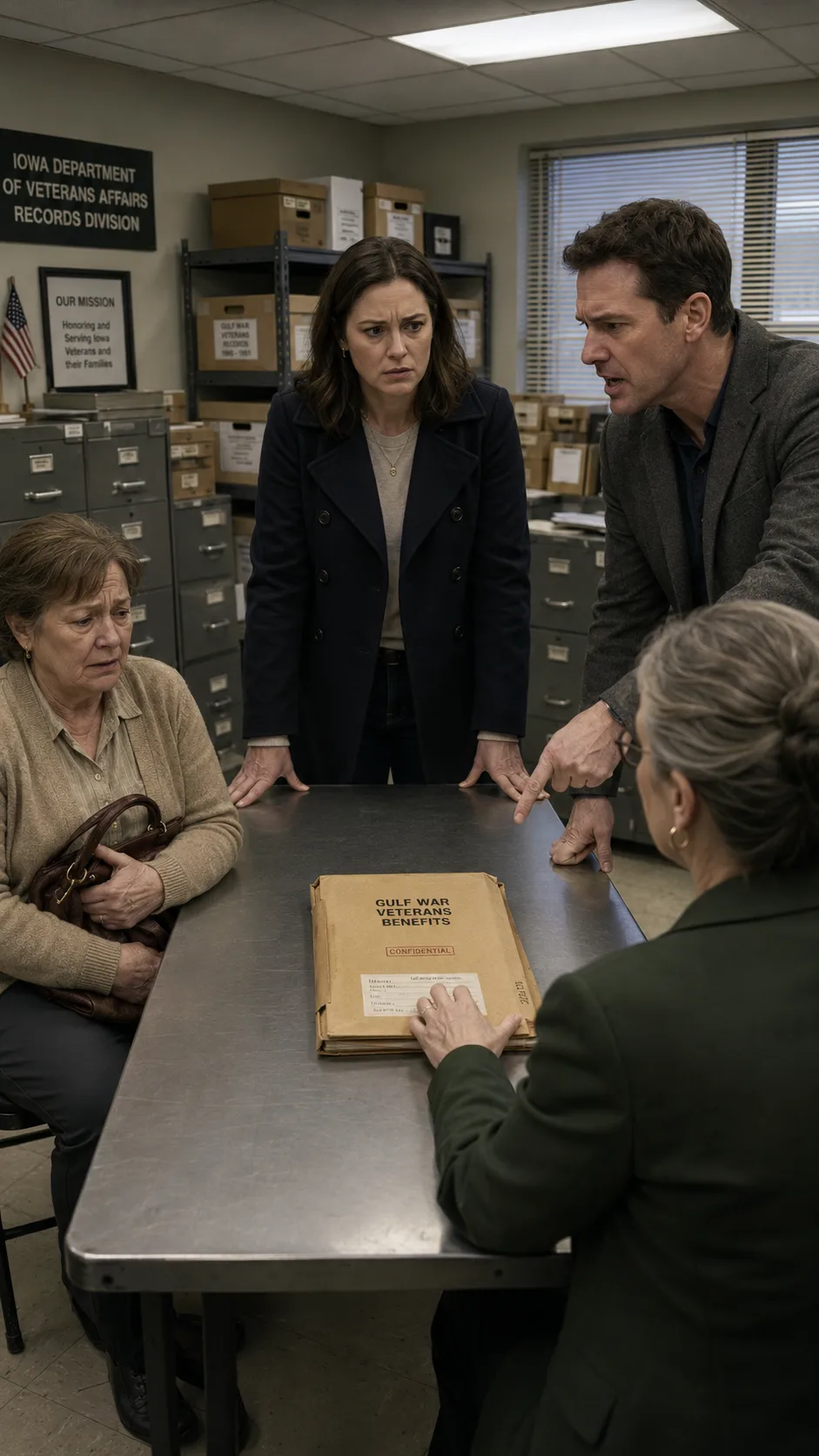
The records room was colder than the lobby. Metal filing cabinets lined the walls. Cardboard archive boxes sat on industrial shelves, their labels marked by war, year, and claim number. A framed mission statement hung crooked beside a small American flag. Someone had left a paper cup of coffee on a filing cabinet, the cream gathered in a pale skin across the top.
Diane led us to a steel table.
Mom sat first.
Mark stayed standing.
I placed Dad’s VA booklet and the hidden photocopy on my lap.
Diane left through a side door and returned with a sealed folder.
GULF WAR VETERANS BENEFITS.
Dad’s name sat under the title.
Thomas A. Hayes.
Mark tapped the folder with two fingers.
“That overseas name is a mistake. My father had no brother.”
Diane placed one hand on the folder lock.
“There are supporting records attached.”
Mark leaned forward, both palms on the table now.
“Open it, then. Prove this stranger belongs to our family.”
The lock clicked.
No one moved.
Diane opened the folder and removed the first page with both hands, as if age alone made it fragile. The paper had yellowed around the edges. A blue stamp cut across the corner. At the bottom, in black ink, was my father’s signature.
Thomas A. Hayes.
Not typed.
Not copied.
His hand.
Diane turned the document toward us.
Mark reached for it.
I got there first.
The paper trembled once against my fingers before I set it flat on the table.
Mom leaned closer.
Mark stood over my shoulder, breathing through his nose.
The form was standard at first. Name. Service number. Dates. Medical eligibility. Contact information. Then the page narrowed into a section I had never seen before.
Family contact outside the United States.
The name was printed carefully in block letters.
Samir William Hayes.
Address: Amman, Jordan.
Relationship: paternal half-brother.
Mom’s hand rose to her mouth, but she did not cover it. She only touched two fingers to her lips and held them there.
Mark shook his head.
“No.”
Diane remained standing.
Mark pointed at the form.
“That doesn’t prove blood. Somebody could have written anything.”
I turned the page slightly.
“Dad signed it.”
“That doesn’t prove blood,” he said again.
His voice had changed. Less sharp. More clipped.
Diane reached into the folder.
“There is a second supporting record.”
Mark’s hand hovered over the benefits form.
“Who requested that?”
“Your father.”
“When?”
Diane looked at the top of the second sheet.
“Originally, during post-service benefits review. Updated six years ago.”
Six years ago.
The old landline.
My name on the inquiry.
Dad sitting at the kitchen table after midnight, maybe, using my name because he could not use his own without answering questions.
Diane placed the second record beside the first.
It was thinner than the benefits form. A certified copy, folded twice, with a translation attached. The top line named a child born overseas to a woman I did not know.
Samir.
The father’s name sat halfway down the page.
William Arthur Hayes.
Our grandfather.
Mom gripped the edge of the table.
Mark stared at the record.
Diane put one finger beneath the line.
“This is not a clerical error. He was your father’s half-brother.”
The office changed without anyone moving much.
Mark’s shoulders dropped first. Only an inch. His right hand, still above the benefits form, curled and stopped. The young employee from the lobby had appeared in the doorway with another box and now stood frozen, the box pressed against his chest.
Mom pushed her chair back.
The legs scraped the floor.
“William,” she said.
Not Samir.
Not Thomas.
William.
My grandfather’s name landed on the table harder than any accusation.
Mark picked up the second record, then put it down as if the paper had heat in it.
“No,” he said.
Diane removed one more sheet from the folder but did not place it down yet.
Mark looked at her.
“What is that?”
“Correspondence log.”
“I want to see it.”
Diane looked at Mom.
“Mrs. Hayes is the surviving spouse.”
Mark’s head turned.
For the first time since Dad died, someone had placed Mom before him in an official room.
Mom’s hand was still on the table.
“Show us,” she said.
Diane laid the log beside the two records.
There were dates. Incoming letters. Outgoing notices. Verification attempts. One line showed a returned letter from Jordan. Another showed a phone call request that had not been completed. Then a note from six years ago.
Veteran requested confidential handling. Family unaware.
Family unaware.
Two plain words.
They did not explain Dad.
They only marked the edge of a room he had kept locked.
Mark stepped back from the table.
His heel hit the chair behind him. The chair tilted, then settled.
I looked at the photograph in my mind, the one from the gray box. Dad with his arm around the man in desert uniform whose face had been scratched pale. It had not been a stranger after all. Or maybe it had been a stranger then, and became blood later through paper, calls, and things Dad never said out loud.
“Did they meet?” I asked.
Diane looked through the log.
“There are travel reimbursement inquiries, but no confirmed visit in this file.”
Mom closed her eyes for one breath, then opened them.
“Thomas had a passport.”
Mark looked at her.
“What?”
“He told me it was expired.”
“Mom.”
She did not look at him.
“He kept it in the garage freezer.”
Mark stared.
I almost laughed, but nothing came out.
The freezer. Dad’s kingdom of deer meat, ice packs, and unlabeled coffee cans full of screws.
Diane made a copy of the benefits form, the supporting birth record, and the correspondence log. She slid the copies into a clean envelope and wrote Mom’s name on the front. Mark watched the pen move.
He did not reach for it.
Mom did.
Her fingers shook against the envelope seal, but she held it.
The younger employee left the doorway. Somewhere beyond the wall, a printer started and stopped. A phone rang twice and went unanswered.
Diane gathered the original documents and placed them back in the folder one by one.
The benefits form.
The birth record.
The log.
Dad’s signature vanished last when the folder closed.
Mark cleared his throat.
“We don’t know what this means.”
Mom turned toward him.
“We know what the paper says.”
“That’s not the same thing.”
“No,” she said. “But it is not nothing.”
He looked at me then, as if I had caused the ink to appear.
“You should have told me about that photocopy in the car.”
I pulled the VA booklet from my lap and placed the photocopy on the table.
“I found it while you were explaining fraud.”
His face tightened.
Mom looked at the photocopy, then at the official record Diane had copied into her envelope.
Same father.
Same last name.
Same hidden door.
Mark opened his mouth, then closed it.
Good.
On the drive home, he did not talk for the first hour.
Mom sat with the envelope on her lap. Her thumb traced the edge over and over until the paper bent slightly. I watched trees blur past the window and thought of Dad burning letters in the grill while smoke lifted over our backyard fence.
When we stopped for gas, Mark went inside and stayed too long.
Mom opened the envelope.
She removed the copy of the benefits form and held it under the dome light. Dad’s signature looked darker in the car than it had in the records room.
“I asked him once,” she said.
I turned toward her.
“About what?”
“Whether there was anyone from the war he missed.”
Outside, Mark stood at the counter with a bottle of water in one hand, staring at a rack of keychains shaped like states.
“What did he say?” I asked.
Mom folded the paper along the existing crease.
“He said, ‘Not from the war.’”
She put the form back.
Mark returned and got into the driver’s seat. He placed the water in the cupholder without opening it.
No one asked him to speak.
He didn’t.
Two days later, Mom told us to come to the house at noon.
Mark arrived with his wife, Andrea, though Mom had not invited her. Andrea wore black leggings, a cream coat, and the same careful expression she used at funerals and property closings. She kissed Mom’s cheek without touching her arms.
I came alone.
Mom had cleared the kitchen table.
Dad’s gray lockbox sat in the center.
Beside it was a freezer bag full of old papers, frosted at the edges though they had thawed. She must have gone into the garage freezer before sunrise, because the coffee can that usually held Dad’s screwdrivers was on the counter, open and empty.
“I found the passport,” Mom said.
Mark shut the back door behind him.
“And?”
Mom opened the passport to a stamped page.
Jordan.
Twice.
Mark sat down.
Not because anyone told him to.
Because his knees seemed to fold under the weight of the page.
Andrea looked between us. “Maybe he traveled for veterans’ work.”
Mom placed another item on the table.
A photograph.
The same one from Dad’s lockbox, but not scratched white this time. This was a second copy, hidden flat inside the passport sleeve. Dad stood outside a stone building beside a man with dark hair, a narrow face, and Dad’s exact left eyebrow, the one that rose higher than the other when he was trying not to smile.
On the back, Dad had written one line.
Samir and me, Amman, 2002.
Mom sat across from Mark.
“I don’t know why he hid it,” she said. “But he did not invent him.”
Mark stared at the photograph.
Andrea touched his shoulder.
He moved away from her hand, barely.
The old alarm clock from Dad’s bedroom sat on the counter now. Mom must have brought it down while cleaning. The time blinked 12:00 again, waiting for someone to set it.
Nobody did.
Over the next week, the house changed in small ways.
Mom stopped letting Mark take boxes without asking.
She called Dad’s old attorney herself.
She moved the gray lockbox from the bedroom to the kitchen cabinet where she kept recipes, batteries, and birthday candles. Not hidden. Not displayed. Kept.
Mark came by less.
When he did, he spoke carefully, as if every word might be filed somewhere.
I wrote to the address in Amman.
Not by email.
A letter.
My hand cramped halfway through because I had not written that much by hand in years. I told Samir that Thomas Hayes had died. I told him we had found the benefits form. I told him I was his niece, if he accepted the word. I did not ask why Dad had hidden him. I did not ask for anything.
I included a copy of the photograph.
Mom added one sentence at the bottom.
He kept your name.
Three weeks passed.
Then five.
Mark said the letter would come back undeliverable.
It didn’t.
The reply arrived on a Tuesday, thin and blue around the edges, with stamps that made the mail carrier pause on the porch. Mom opened it at the kitchen table while I stood beside her.
Samir’s handwriting was careful.
He wrote that he had known of Thomas since 1991, after a military chaplain helped trace a family connection neither man had expected. Their father, William, had left more than one life behind. Samir wrote that Thomas had tried to meet him, then pulled away, then tried again. He wrote that they had seen each other twice.
He wrote one line that made Mom lower the page.
Your father was ashamed of the silence before he was ashamed of the truth.
Mark read the letter later.
He stood at the same kitchen counter where Dad used to sort coupons with a pencil behind his ear. He read it once, then again. Andrea waited by the door with her arms crossed.
“Well?” she said.
Mark folded the letter along its crease.
“It’s real.”
No one answered.
He placed the letter on the table and pressed two fingers against the corner to flatten it.
“I was trying to protect the family.”
Mom looked at the gray lockbox in the cabinet, visible through the glass door.
“You were protecting the version you liked.”
Mark did not argue.
That was new.
Months later, Samir called.
It was early evening in Iowa, morning in Amman. Mom set the phone in the middle of the kitchen table and pressed speaker. The line crackled. For a few seconds we heard only distance.
Then a man’s voice said, “Paula?”
Mom held the table edge.
“Yes.”
He breathed once.
“My brother spoke of your garden.”
Mom looked toward the backyard, where Dad’s tomato cages still leaned against the fence, bent from last summer and never straightened.
“He hated weeding,” she said.
Samir laughed.
It sounded like Dad.
Not exactly.
Enough.
Mark stood near the sink, apart from us. He did not leave. He did not speak over anyone. When Samir asked about Thomas’s last days, Mom answered. When he asked if Thomas had suffered, I answered. When he asked whether Thomas still drank coffee too late, Mark looked down at his shoes.
“He did,” Mark said.
Two words.
Samir was quiet after that.
The family did not heal neatly. Families rarely do. Mark still tried to organize things that did not belong to him. Mom still folded Dad’s shirts too carefully before donating them. I still heard Dad’s silence in places where answers should have been.
But the story of him became wider.
Not cleaner.
Wider.
A year after the records office, Mom asked me to drive her back to Iowa. She wore the beige cardigan from that day, though she had sewn the loose cuff and replaced one missing button. In her purse was a copy of the benefits form, Samir’s first letter, and the photograph from Amman.
Mark came too.
He asked, not told.
That mattered.
Diane Walker remembered us. She brought us to the same steel table. The mission statement was still crooked. The vending machine still hummed. Someone had finally thrown out the old coffee cup.
Mom placed Samir’s letter on the table.
“For the file,” she said.
Diane read the first line, then looked up.
“We can add a family statement.”
Mom nodded.
Mark took a pen from his blazer pocket and set it beside her hand.
He did not touch the paper.
Mom wrote slowly. Her handwriting tilted more than it used to.
Thomas Hayes was survived by his wife, his children, and his brother, Samir William Hayes of Amman, Jordan.
She stopped there.
Diane waited.
Mom signed her name.
Then she slid the paper to Mark.
His hand hovered for a second.
He signed beneath her.
I signed last.
Diane placed the statement into the folder. The same folder. The one that had made Mark step back from the table, the one that had given Mom a name to a shadow she had lived beside for decades.
When the folder closed this time, it did not feel like a door shutting.
It felt like one left unlocked.
Outside, the afternoon light sat pale on the parking lot. Mark walked ahead, then stopped near the SUV. He turned back toward Mom.
“I’m sorry,” he said.
Mom adjusted her purse strap.
“For what?”
He looked at the building, then at me, then at the envelope in her hand.
“For deciding before I knew.”
Mom nodded once.
She did not rescue him from the silence.
We drove home with the radio off.
At Mom’s house, the old alarm clock sat on the kitchen shelf, no longer blinking. Someone had set the time. Not perfectly. It ran seven minutes slow.
Mom left it that way.
That night, I took Dad’s gray lockbox from the cabinet and placed Samir’s newest letter inside beside the medals Mark had once tossed into a shoebox. The ribbons lay flat now, blue and red and gold under the kitchen light.
I closed the lid.
No lock.
Chapter complete
You have reached the end of this chapter.
Continue reading
A few more worlds to get lost in after this chapter.




