Ethan refused to eat the sandwich again.
Chapter 1
Ethan refused to eat the sandwich again.
Claire had wrapped it that morning in wax paper and tucked it into the side pocket of his backpack, the way she did every school day, even though he had developed a habit of bringing lunch home untouched. Turkey, no tomato. Half a slice of cheddar. The crusts cut off because he claimed they tasted like cardboard.
At three fifteen, when she picked him up from school, he pulled the sandwich out and handed it to her with both hands.
“You forgot to eat.”
“I didn’t forget.”
Claire looked down at him while the line of parents moved around them. Children spilled down the steps in bright coats, bumping into knees, dragging scarves, shouting names over one another. Ethan stood still in the middle of all of it, his hair flattened on one side from his winter hat.
“Then why is it still wrapped?”
He shrugged.
There was a pencil
mark on his sleeve. He had a loose thread hanging from his scarf. Claire reached for it, then stopped herself because he hated when she fixed things in public.
“Were you not hungry?”
He looked past her toward the school gate. “A boy in my class said some people don’t have lunch.”
Claire held the sandwich between them.
“Did someone ask you for yours?”
“No.” Ethan looked at the sidewalk. “I just thought about it.”
The wind moved between the school buildings and lifted the edge of Claire’s coat. She put the sandwich into her handbag because she did not know what else to do with it. There were things Ethan said sometimes that were too large for eight years old. Not clever things. Not funny things. Heavy things, placed carefully in front of her like stones.
She took his hand.
“Come on. We’ll be late for your appointment.”
He
made a face but did not complain.
His appointment was not really an appointment anymore. It had started as one, after his teacher wrote that he sometimes stared at other children for too long when they cried. Then came the sleep questions, the food questions, the questions about whether he had ever asked about death. Claire answered what she could. She said he had always been sensitive. She said he noticed things.
She did not say that sometimes he stood in the hall at night and asked if she heard a baby crying.
That had stopped when he was five.
Mostly.
They walked west because the subway entrance was blocked by a crowd and because Ethan liked looking into the bakery windows. Manhattan in winter had a way of making everyone walk as if warmth were a destination. Shoulders hunched. Coffee cups lifted. Taxis nudging through crosswalks. The air smelled
like exhaust, roasted nuts, and wet wool.
Claire kept her grip loose but firm.
It was an old habit.
Eight years old, and she still counted his fingers when they crossed a street.
One, two, three, four, five.
A mother did strange math after loss.
She had never told Ethan that. She had never told anyone except Mark, and Mark had eventually stopped wanting to hear it. He said grief had a room, and Claire had turned it into a house. He said Ethan needed a mother who looked forward, not backward.
Then he moved to Boston with a woman who posted photos of spotless kitchens and golden retrievers.
Claire did not blame him out loud.
She had used up all her loudness years ago.
At the corner of Forty-Seventh, Ethan slowed in front of a toy store display. A train circled a miniature village under fake snow. He watched it pass a red station, disappear through a tunnel, and come back again.
“Can we look for a minute?”
“Only a minute.”
He pressed one gloved hand to the glass.
Claire checked the time on her phone. The therapist would understand if they were late. She always did. She had the sort of voice that made forgiveness sound expensive.
A message sat unopened on Claire’s screen from her mother.
Dinner Sunday? We need to talk.
Claire locked the phone.
No.
Not today.
Her mother had begun sentences like that since the divorce papers were filed. We need to talk about money. We need to talk about Ethan’s schooling. We need to talk about how long you intend to carry this.
Carry this.
As if Claire had chosen its weight.
She looked back at the toy train. Ethan had moved his finger along the glass, following its route. Round and round. Always returning.
Claire touched his shoulder.
“Time.”
He nodded and turned.
They had made it only half a block when his hand tightened around hers.
At first, she thought he had slipped. The sidewalk was wet near the curb where melted snow gathered in dark patches. She looked down at his boots.
Then Ethan stopped.
Hard.
Claire took one more step before his arm pulled against hers.
“What is it?”
He did not answer.
His eyes were fixed across the sidewalk.
Not on the street performer with the silver-painted face near the subway stairs. Not on the woman arguing into her phone. Not on the bakery door opening and closing with a bell.
Across from them, near the brick wall of a closed pharmacy, a child sat folded into himself.
Claire saw the shoes first.
Too thin for winter.
Then the knees.
Then the hair.
Her lungs did not stop. Her body did not do anything dramatic. The world did not offer her music, or warning, or mercy. It simply kept moving while the thing she had buried sat against a wall with dirt under his fingernails.
Ethan lifted one hand.
His glove shook.
“Mom… why does he look exactly like me?”
Claire’s fingers went numb around his.
She looked once.
Once was enough.
The boy had Ethan’s hair. Ethan’s cheekbones. Ethan’s mouth, though the lips were cracked and pale. His face was narrower, sharpened by hunger or cold or too many nights no one had counted. But the structure was there. The same small cleft at the chin. The same faint line in the left eyebrow.
Claire’s handbag slid lower on her wrist.
“No,” she said, but the word came out without shape.
Ethan turned his head slightly. “What?”
She had not meant to speak.
A man brushed past her shoulder and muttered something under his breath. Claire did not move. Ethan did. His small hand pulled free from hers, and by the time she caught air enough to reach for him, he had already stepped off the curbside edge of the sidewalk toward the brick wall.
“Ethan, stop.”
Her voice was too sharp. A woman walking a terrier looked over.
Ethan did not stop.
He crossed the space carefully, not running now, as if he understood that the child against the wall might break if approached too fast. Claire followed, but her legs had changed. They belonged to someone walking through water.
She saw the boy’s sleeve.
She saw the gray collar under his coat.
She saw a string tied around one wrist with a small metal key attached, the kind used for cheap luggage locks.
Not the other wrist.
Not yet.
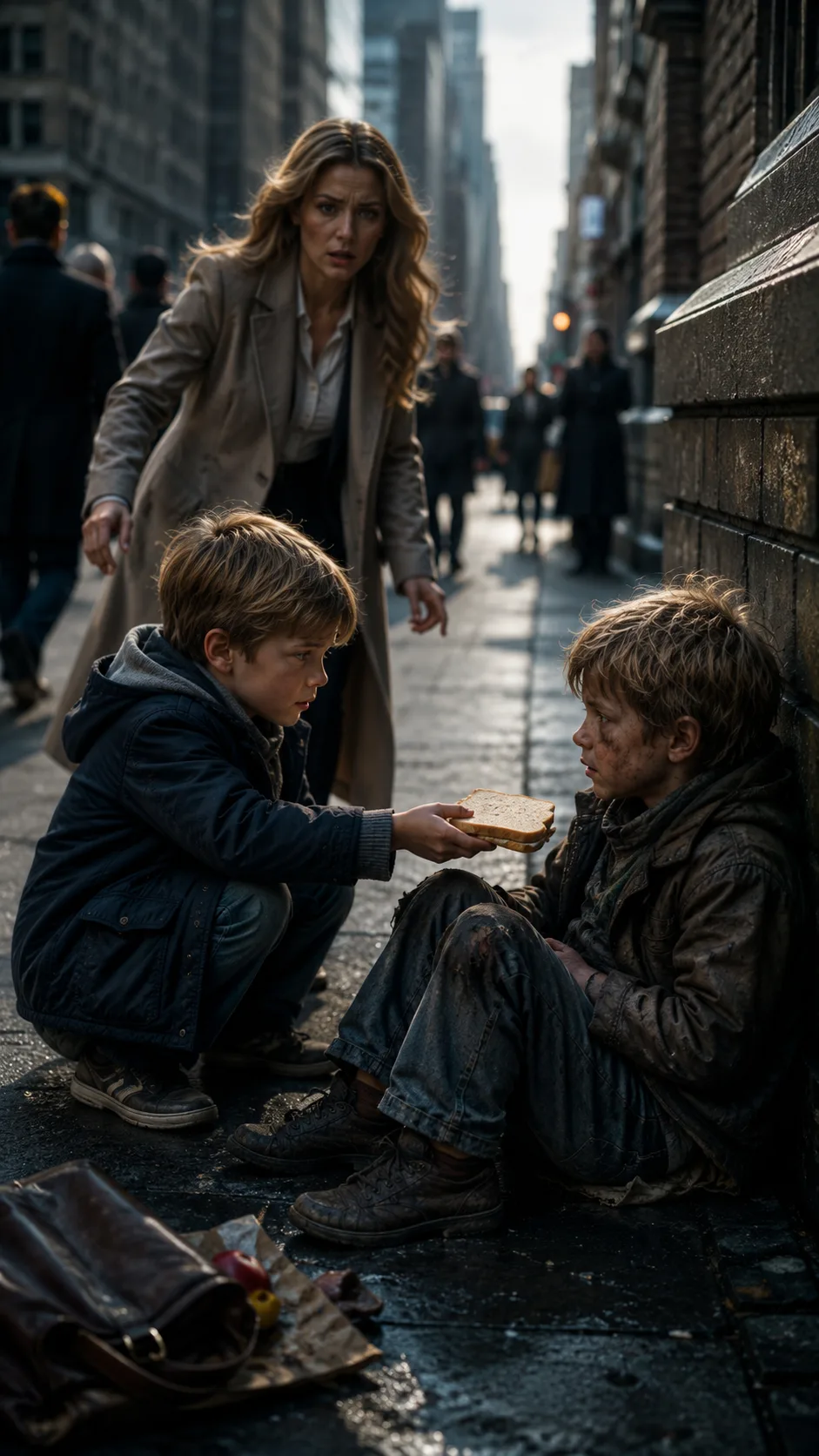
Ethan crouched in front of him.
“Hey,” he said.
The child did not move.
Claire stood three steps behind Ethan. She could smell damp brick and old paper. Someone nearby had spilled coffee; it ran in a thin brown line toward the gutter.
Ethan reached into his coat pocket.
Claire almost told him not to.
Not because of the sandwich. Because every instinct in her body screamed that if he touched this moment, it would touch back.
He pulled out the lunch he had refused to eat.
The wax paper had creased at the corners.
“Here… you can have mine.”
The boy’s eyelids moved.
For a second, Claire thought he would not wake. She had time to notice the people slowing around them, the shoes turning, the pause that passed from one stranger to another when public suffering became specific enough to watch.
Then the boy opened his eyes.
Blue-gray.
Claire’s knees weakened.
The boy looked at the sandwich first. His gaze stayed there longer than a child’s should. Food had its own gravity when you had been without it.
Then he looked at Ethan.
His expression did not change all at once. It shifted in small pieces. The eyes first, narrowing slightly. Then the mouth. Then his hand, which had been curled against his chest, loosened.
Ethan leaned forward.
“Hey… are you okay?”
The boy did not answer him.
His gaze moved past Ethan.
To Claire.
The sidewalk noise thinned, not because it grew quieter, but because Claire could no longer hold all of it. The taxis became streaks. The footsteps became dull. The bell over the bakery door rang once, and the sound seemed to come from another street.
The boy pushed one palm against the brick wall.
His body resisted him. He tried anyway.
“You came back…”
Ethan turned.
“Mom?”
Claire stepped backward. Her heel struck her handbag, which had fallen without her noticing. A lipstick rolled out and stopped near a cigarette butt.
“No,” she said.
This time the word had shape.
The boy flinched.
Not from fear.
From recognition.
Claire saw it and wished she had not.
Ethan stood halfway between crouching and rising. His face had gone pale under the cold. He looked at the boy, then at Claire, then back again. Children knew when adults were lying. They did not always know what the lie was, but they knew its temperature.
“Mom… what’s going on?”
Claire opened her mouth.
No sound came.
The boy shifted again, bracing his hand against the rough brick. His sleeve caught on a broken edge of mortar and slid back.
The bracelet appeared.
Yellowed plastic.
Faded black letters.
A hospital code almost rubbed away.
Claire did not need to read it.
She had seen one like it every night for three weeks after Ethan was born. She had worn Ethan’s around her wrist after the nurses cut it from him because she could not bear to throw it out. She had kept the other one, too, or what they told her was the other one. The tiny band from the son who had not lived long enough to wear it home.
Twin B.
That was what the hospital form had said.
Infant male.
No name assigned.
Deceased.
Claire dropped to her knees on the wet pavement.
The cold went through her coat at once.
Ethan stared at her.
The boy stared, too.
A circle had formed around them now. Not close enough to help. Close enough to remember.
Claire lifted one hand toward the bracelet, but stopped before touching it.
The boy pulled his arm back against his chest.
Good, Claire thought.
Some part of her still worked.
Good.
Do not trust me yet.
“They told me only one baby survived…”
The sentence did not end the moment.
It opened it.
Ethan’s mouth parted. “What?”
Claire looked at him, and for the first time in his life she had no smaller version of the truth to offer. No soft edge. No bedtime answer. No “I’ll explain when you’re older.”
He was older now because the world had made him older in front of a brick wall.
“I had twins,” Claire said.
The boy’s eyes stayed on her face.
Ethan took one step back from both of them.
“You said I was born early.”
“You were.”
“You said I was sick.”
“You were.”
“You didn’t say there was another baby.”
Claire looked down at the hospital bracelet.
“I buried an empty blanket.”
The words landed badly. She knew it as soon as she said them. Ethan’s shoulders tightened. The boy’s fingers curled around his sleeve.
A man in a dark coat spoke from the edge of the circle. “Someone should call somebody.”
A woman already had her phone out.
Claire turned toward her. “Please call an ambulance.”
The woman nodded, startled by the directness.
“I don’t need one,” the boy said.
His voice was thin but guarded now. He tried to push himself higher against the wall.
Ethan looked at him. “You’re freezing.”
“I said I don’t need one.”
Claire lowered her hand to the pavement, palm flat, because if she reached toward him again, he might run.
“What’s your name?”
The boy’s jaw tightened.
Ethan answered without meaning to. “I’m Ethan.”
The boy looked at him.
Something passed between them that Claire could not enter.
“Owen,” the boy said.
Claire closed her eyes once.
She had chosen that name.
Eight years ago, in a hospital room that smelled of antiseptic and plastic flowers, she had said the names aloud while Mark sat beside her holding a paper cup of coffee.
Ethan James.
Owen Michael.
Mark had said Owen sounded too old for a baby.
Claire had said he could grow into it.
She opened her eyes.
“Who gave you that name?”
Owen looked toward the street.
“No one.”
“That’s not true.”
“I gave it to myself.”
Ethan frowned. “How did you know it?”
Owen did not answer.
The ambulance arrived faster than Claire expected and slower than her body could bear. Two paramedics approached, careful and practiced. Owen resisted until Ethan placed the sandwich beside him on the cardboard and stepped back.
“He can still have it,” Ethan said to the paramedic.
The paramedic looked at Claire.
Claire nodded once, because it was the only decision she was allowed to make.
At the hospital, everything became forms.
Names.
Dates.
Addresses.
Insurance.
Relationship to patient.
Claire stood at the counter with wet knees and a coat that smelled like pavement while Ethan sat in a plastic chair under a television no one was watching. Owen was behind a curtain, arguing with a nurse about his shoes.
Claire gave her name.
Then Ethan’s.
Then she stopped.
“And the other child?” the woman behind the desk asked.
Claire looked at the pen in her hand.
“I don’t know yet.”
The woman’s expression changed, not with kindness exactly, but with caution. “Ma’am?”
Claire set the pen down.
“I need someone from social services. And hospital records. Now.”
The woman hesitated.
Claire leaned closer. Her voice did not rise.
“My son has a living twin wearing a neonatal bracelet from this hospital system. I was told that baby died eight years ago. I need someone who can explain why a child with my son’s face was sleeping on a sidewalk.”
The pen stopped moving behind the desk.
Ethan looked up.
He had heard enough.
He always heard enough.
A social worker named Dana arrived twenty minutes later with a badge clipped crookedly to her cardigan and a notebook already open. Claire expected softness. Dana gave none. That helped.
She asked what happened.
Claire told her.
Not all of it.
Enough.
She told her about the emergency delivery at St. Bartholomew’s. About the hemorrhage. About waking up after surgery with one baby in the NICU and one gone. About a doctor whose name she had spent years trying not to remember because his face came with too many white ceilings.
Dr. Arthur Venn.
Dana wrote the name down.
Ethan sat beside Claire now, knees touching but hands folded into himself.
“Where’s Dad?” he asked.
Claire looked at him.
“He’s in Boston.”
“He should know.”
“Yes.”
She took out her phone.
Her fingers would not unlock it twice. On the third try, the screen opened. Mark answered on the fourth ring, annoyed before he understood there was something to be annoyed about.
“Claire, I’m walking into a meeting.”
“I found Owen.”
Silence.
Real silence.
The kind that has edges.
Then Mark said, “What?”
“I found Owen.”
“Don’t do this.”
Claire stood. Ethan watched her. Dana watched, too, but pretended not to.
“He’s alive.”
Mark exhaled into the phone. “Where are you?”
“Mercy General.”
“Claire.”
“He was on a sidewalk.”
Another silence.
This one changed.
“I’m coming,” he said.
He hung up first.
Claire stared at the phone.
Dana’s pen moved again.
“You named him Owen?” Dana asked.
Claire looked toward the curtain. Behind it, the nurse said something about dehydration. Owen said something rude back.
“Yes.”
Dana nodded. “We’ll request the birth records.”
“They told me they were sealed.”
“They tell people that when they don’t want them asking twice.”
Claire sat down slowly.
Ethan’s shoulder pressed against her arm.
Not forgiveness.
Not comfort.
Contact.
She took it.
Mark arrived just after eight, still in his work coat, hair damp from the snow that had started after dark. He stopped when he saw Ethan. Then he looked toward the curtain where Owen slept, finally, under a gray hospital blanket.
Claire watched his face.
There it was.
Recognition.
Not surprise.
Her hand closed around the edge of the chair.
“You knew.”
Mark did not answer fast enough.
Ethan looked up at him.
“Dad?”
Mark’s eyes went to his son. “No. Not like that.”
Claire stood.
Dana stood with her.
Mark lowered his voice. “Claire, listen to me.”
“No.”
The word cut clean.
A nurse looked over from the station.
Mark rubbed both hands down his face. “My mother handled the arrangements.”
Claire felt the room tilt, but she did not move.
“Arrangements.”
“She said you couldn’t survive another loss. She said the second baby was too sick. She said there were papers. I was twenty-eight, Claire. I didn’t know what I was signing.”
“What did you sign?”
Mark looked toward Ethan.
Claire stepped closer.
“What did you sign?”
His mouth tightened.
“A private transfer.”
Dana’s pen stopped.
Claire heard the heart monitor behind the curtain, steady and small.
“Transfer to where?”
“I don’t know.”
“You signed away our son and didn’t know where?”
Mark flinched. “They told me he wouldn’t live long.”
“Who told you?”
“My mother. Venn. A woman from some foundation.”
Claire laughed once.
No humor.
Just air with a sharp edge.
Ethan stood up from the chair. “Dad, is he my brother?”
Mark looked at him and could not hide behind forms, or doctors, or his mother’s old money.
“Yes.”
The word changed Ethan’s face.
Claire saw childhood leave another inch.
Dana stepped between them slightly, not blocking, but marking the room. “Mr. Adler, I need you to remain available. There will be questions.”
Mark nodded.
Claire looked at the curtain.
Owen was awake.
His eyes were open.
He had heard.
Of course he had.
The next three days happened under fluorescent light.
Owen had no active guardian listed. No current school enrollment. No proper medical file after age four. He had been placed through a private charity that closed two years after his birth, moved between homes, then disappeared from the system when a foster parent stopped answering calls.
“Disappeared,” Claire repeated when Dana said it.
Dana did not soften the word.
“On paper.”
Claire stood at the foot of Owen’s hospital bed while he picked at the corner of a gelatin cup and refused to look at her.
Ethan came every day after school.
At first, he stood by the door.
Then by the chair.
Then close enough to place the sandwich from his lunch tray on Owen’s bedside table without asking.
Owen never said thank you.
Ethan never asked him to.
On the fourth day, Mark’s mother came.
Vivian Adler walked into the pediatric ward wearing camel wool, pearl earrings, and the expression of a woman who believed every room should make space for her. She did not see Claire first. She saw Mark, then Ethan, then the boy in the bed.
Her mouth opened.
Owen stared at her.
Claire had wondered, during those sleepless hours, whether Vivian would deny it. Whether she would perform grief or confusion or outrage. Instead, Vivian looked at Owen as if a locked drawer had opened by itself.
“You were supposed to be cared for,” she said.
Claire crossed the room before Mark could move.
“Not one more word to him.”
Vivian lifted her chin. “I did what had to be done.”
Ethan was beside the window. His hands hung at his sides.
“What had to be done?” Claire said.
Vivian looked at Ethan, then Owen. “You were dying. The hospital bills were already impossible. Mark was drowning. Claire was unstable.”
Claire nodded once.
There it was.
The old word.
Unstable.
A woman’s grief translated into permission.
“So you stole my child.”
“I saved this family.”
Owen pushed the gelatin cup away. It tipped, red liquid spreading across the tray.
Nobody moved to clean it.
Ethan spoke first.
“We were the family.”
Vivian looked at him as if she had forgotten children could answer.
Mark sat down.
That was his contribution.
He sat.
Claire looked at him and understood more from that than from every apology he had tried to form. He had let stronger people choose. He had called that helplessness. He had lived inside it because it asked less of him.
Dana arrived with hospital security two minutes later. Vivian objected to being escorted out. She used the words misunderstanding, legal, reputation, and private matter.
Owen watched until she disappeared through the double doors.
Then he looked at Claire.
“You really didn’t know?”
Claire moved closer, but not too close.
“No.”
He studied her face.
“You would’ve come?”
Claire looked at the bracelet still sealed in a plastic evidence bag beside his bed. The letters had been photographed, logged, matched. Proof had a strange ugliness when it arrived late.
“Yes.”
Owen turned toward the window.
“People say that.”
“I know.”
He did not look back.
Claire stayed anyway.
The investigation unfolded in pieces no one could put back cleanly. Dr. Venn had retired to Arizona. The foundation’s director had died the year before. Vivian had paid for silence through donations, favors, and a lawyer who used the phrase compassionate private placement in a letter that made Claire want to tear the paper in half.
She did not tear it.
She made copies.
Mark gave a statement. Then another. The second was closer to truth. He admitted he had signed documents while Claire was sedated, after being told one twin had no chance and the other needed a calm home. He admitted his mother arranged everything. He admitted he never asked to see the body.
Claire did not ask why.
She knew why.
Because if he had asked, someone might have answered.
Owen left the hospital after nine days.
Not with Claire.
Not at first.
Dana explained the process. Emergency placement. Kinship evaluation. Court review. Psychological assessment. Medical follow-up. Words lined up like gates.
Claire signed every paper they gave her.
She attended every meeting.
She brought Ethan to the ones he was allowed to attend and sat alone through the ones he was not.
Owen was placed in a temporary foster home in Queens with a retired nurse named Mrs. Alvarez, who took no nonsense from anyone and had three locks on her apartment door. Claire liked her immediately. Owen pretended not to.
The first time Claire visited, she brought no gifts.
Only the sandwich.
Turkey, no tomato. Half a slice of cheddar. Crusts cut off.
Owen opened the door, saw it, and frowned.
“I’m not a charity case.”
“I know.”
“Then why did you bring that?”
Claire held it out.
“Because he wanted you to have it.”
Owen looked past her. Ethan stood by the elevator, pretending to study the floor numbers.
“He came?”
“He asked to.”
Owen took the sandwich.
Not from Claire.
From Ethan, after Ethan walked over and placed it in his hand.
They sat in Mrs. Alvarez’s small kitchen under a humming light while she made tea nobody drank. Ethan talked about school. Owen said almost nothing. But he ate the sandwich slowly, in careful bites, as if testing whether it would be taken away.
Claire kept her hands around her paper cup.
A chair leg scraped every time Ethan shifted.
The sound should not have mattered.
It did.
Two months later, the court granted Claire temporary custody.
Owen arrived with one backpack, two shirts Mrs. Alvarez had bought him, and the hospital bracelet sealed inside an evidence envelope he refused to let anyone else carry.
Ethan had cleaned half his room without being asked.
Not all of it.
Half.
There were still books stacked wrong and a sock under the chair. Claire did not fix it. Owen stood in the doorway and looked at the two beds, the two lamps, the two folded blankets.
“I don’t have to sleep here if you don’t want,” Ethan said.
Owen looked at him.
“It’s your room.”
Ethan shrugged. “It can be both.”
Owen stepped inside.
Claire stood in the hall, one hand on the doorframe.
She did not cry.
She had learned that tears made some children nervous. Owen watched faces for weather. Ethan watched hands. So Claire kept her hands visible and her face quiet.
That night, after both boys were supposed to be asleep, she heard whispering.
Not much.
A question.
An answer.
Then silence.
Then Ethan’s voice.
“Do you like trains?”
A long pause.
“No.”
Another pause.
“Maybe.”
Claire sat on the hallway floor outside their room until her legs went numb.
Spring came slowly that year.
Vivian was charged in connection with falsified documents and unlawful private placement. Her lawyers called it complex. The newspapers called it a scandal. Mark called Claire every night for two weeks, then less after she stopped answering anything that was not about the boys.
He was granted supervised visitation.
He used the first visit to apologize.
Owen listened for four minutes, then asked to leave.
Ethan stayed seven.
Progress, the therapist said.
Claire disliked that word.
It made pain sound like a hallway.
On a Saturday in April, she took both boys past the toy store with the train display. The fake snow had been replaced with tiny tulips. The red station was still there. The train still disappeared into the tunnel and came back out.
Ethan stopped first.
Owen pretended he had not.
Claire kept walking three steps, then turned.
“You can look.”
Ethan pressed his hand to the glass.
Owen stood beside him with his hands in his jacket pockets.
The train circled once.
Twice.
On the third round, Owen leaned closer.
“That tunnel’s too small.”
Ethan nodded. “I know. It bugs me.”
Claire watched their reflections in the glass.
Two boys.
Same hair.
Same eyes.
One scarf tied badly.
One sleeve too short because he had grown faster than anyone expected.
Claire’s phone buzzed in her pocket. A message from Dana. Court date confirmed. Another gate. Another room. Another paper proving what blood, grief, and a plastic bracelet had already proven.
She did not open it yet.
Owen turned from the window and caught her looking.
“What?”
Claire shook her head.
“Nothing.”
He narrowed his eyes, not trusting the word.
Good.
He would ask.
He would not accept quiet as an answer.
Ethan reached into his backpack and pulled out a sandwich wrapped in wax paper.
Claire had not packed one that morning.
He held it toward Owen.
“I made it.”
Owen looked at the lumpy wrapping.
“It’s probably bad.”
“Probably.”
Owen took it anyway.
The train passed through the tunnel and came back into the light.
Claire counted their hands as they walked to the corner.
One, two, three, four, five.
Then the other.
One, two, three, four, five.
This time, both boys counted back.
Chapter complete
You have reached the end of this chapter.
Continue reading
A few more worlds to get lost in after this chapter.