Rachel found the safe because the wardrobe leg had left a crescent-shaped scratch in Margaret Whitmore’s polished floor.
Chapter 1
Rachel found the safe because the wardrobe leg had left a crescent-shaped scratch in Margaret Whitmore’s polished floor.
She had been moving it alone for almost twenty minutes, inch by inch, her shoulder pressed against the heavy oak frame, her palms sliding on old varnish and furniture oil. The room smelled of lavender sachets and dust trapped behind expensive things. Somewhere downstairs, the housekeeper was running water in the kitchen sink. The pipes knocked once inside the wall.
Margaret’s bedroom had never looked like a sick woman’s room.
Even with Margaret in the hospital, even with her silk robe still hanging from a hook beside the bathroom door, everything seemed arranged to make visitors feel smaller. The cream curtains fell straight. The silver brushes lined up on the vanity. The wedding portrait on the wall showed Margaret and Paul Whitmore standing beneath the rose arbor in the back garden, her chin lifted, his hand resting on her waist like he owned the air around her.
Rachel had not
wanted to touch anything.
Her husband, Daniel, had asked her to help because he had meetings all day and because Margaret had made a list. Not a request. A list. Which clothes to bring. Which jewelry box not to open. Which drawers contained winter scarves. Which cabinet had old medical forms.
At the bottom, in Margaret’s slanted handwriting, she had written:
Do not move the wardrobe.
So Rachel moved it.
Not because she was brave. Not at first. A scarf had slipped behind it, a pale blue one Margaret had specifically asked for, and the gap was too narrow for Rachel’s arm. She pushed the wardrobe two inches. Then four.
Then she saw the safe.
It was small, black, and built into the wall, hidden so neatly that anyone else might have mistaken it for a panel shadow. Dust gathered along the keypad. A dead spider rested in the corner
of the metal frame.
Rachel stood still.
Her phone lay on the bed beside Margaret’s folded cardigan. She looked at it once. Daniel would say to leave it. Daniel always said that when it came to his mother’s things.
“She likes privacy,” he would tell her.
Margaret liked obedience more.
Rachel brushed dust from the keypad with the sleeve of her sweater. She should have walked away. She knew that. The safe was not hers. The house was not hers. Even after five years of marriage, the Whitmore house still treated Rachel like a guest who had stayed too long.
She typed Daniel’s birthday.
The light turned green.
The click was small.
Too small.
Inside, there were no diamonds. No stacks of cash. No secret will. Just a few envelopes, a thin packet of old papers, and one photograph lying face down beneath a silver brooch shaped like a bird.
Rachel picked up the brooch first. It was cold.
Then the photo.
The baby in the picture had round cheeks, dark eyes, and a tiny mark near the left eyebrow.
Rachel touched her own eyebrow before she could stop herself.
She turned the photo over.
Do not let her find out.
The words were written in black ink, faded around the edges, but still sharp enough to cut through the quiet room.
Rachel sat down on the edge of Margaret’s bed. The mattress barely dipped. Across from her, Margaret’s wedding portrait watched from its gold frame, the younger Margaret smiling beneath the rose arbor with the same tight mouth Rachel had seen at every holiday dinner.
The baby photo shook once in Rachel’s fingers.
Then the housekeeper called from downstairs, “Mrs. Whitmore?”
Rachel slid the photo into the inside pocket of her coat.
She pushed the safe door closed. The click sounded louder this time.
The wardrobe scraped the floor again as she moved it back into place, covering the black square in the wall. The crescent mark remained in the polished wood, pale and fresh.
She stared at it for a second too long.
Then she picked up the blue scarf.
Daniel came home that night smelling like rain and office coffee.
He dropped his keys into the small ceramic bowl by the entryway and kissed Rachel on the side of the head without looking at her face. He had been doing that lately. Touching her kindly, quickly, as if kindness were something to finish before moving to the next task.
“Did you find Mom’s scarf?” he asked.
Rachel stood at the kitchen counter with the baby photo under her palm. The overhead light made the old paper look yellow and brittle. She had made dinner but not eaten it. The pasta had gone soft in the pot.
“I found this.”
Daniel loosened his tie. His fingers stopped halfway.
He looked at the photo.
Not at the writing on the back. Not yet. At the baby.
His mouth parted slightly. Then closed.
“Where did you get that?”
Rachel watched his hands.
He had always been careful with his hands. Smooth gestures. Gentle movements. Polished manners from a polished family. But now his fingers curled around the loosened tie like he had forgotten he was holding it.
“Your mother’s safe.”
He looked toward the hallway.
No one was there.
“She has a safe?”
“You didn’t know?”
Daniel took the photo from her. He held it by the edges, but not carefully. More like it had become hot.
“I’ve never seen this before.”
Rachel pointed to the mark near the baby’s eyebrow. “That looks like mine.”
“A lot of babies look alike.”
He said it too fast.
Rachel turned the photo over and showed him the words.
Daniel read them.
His thumb pressed into the corner of the photo. A crease appeared across the white border.
“Daniel.”
He handed it back.
“You shouldn’t have gone through her things.”
There it was.
Not Who is this?
Not Why would she have this?
Not Rachel, are you okay?
Just the rule she had broken.
Rachel set the photo on the counter between them. The refrigerator hummed. One burner on the stove clicked, clicked, clicked until she reached over and turned the knob fully off.
“That’s what you want to talk about?”
His shoulders dropped. “My mother is in the hospital.”
“She’s awake.”
“She’s recovering.”
“She hid a photo of a baby who looks like me.”
Daniel rubbed both hands over his face. When he lowered them, he looked tired in a way that did not soften him. It made him look older. More like his father.
“I don’t know what you want me to say.”
“The truth.”
“I don’t have one.”
He moved around her to pour a glass of water. His back blocked the sink. Rachel watched the way he filled the glass too full, water climbing near the rim, spilling over his fingers.
A thin stream ran across the counter.
He did not wipe it up.
The next morning, Rachel drove to St. Catherine’s Hospital with the photo in a sealed envelope.
Margaret’s room was private, of course. A vase of white lilies stood on the windowsill, filling the room with a clean funeral smell. Paul Whitmore sat in the corner reading financial news on a tablet, his glasses low on his nose. He did not stand when Rachel entered.
Margaret lay against raised pillows in a pale gray robe, her blond hair brushed smooth, pearl studs already back in her ears.
Even hospital lighting obeyed her somehow.
“Rachel,” Margaret said.
Not warm.
Not rude.
Just a name placed carefully on a table.
Rachel walked to the bed. “I found something yesterday.”
Paul looked up.
Margaret’s eyes moved to the envelope.
Rachel took out the photo.
Margaret’s hand shot forward and snatched it from her before Rachel had finished speaking.
The heart monitor beeped twice, then resumed its steady line.
Paul set the tablet down.
“Where did you find this?” Margaret asked.
“In your safe.”
A silence landed hard between the bed and the chair.
Margaret pressed the photo against her chest. Her knuckles had gone white around the edges.
“That was private.”
“Who is the baby?”
“A distant relative.”
“What was her name?”
Margaret’s gaze flicked to Paul.
Rachel caught it.
Paul removed his glasses and folded them with both hands. “This is not the time.”
“That’s what everyone keeps saying.”
Margaret’s mouth tightened. “She died years ago.”
“The baby?”
“The mother.”
Rachel looked at the photo still trapped beneath Margaret’s fingers. “Who was holding her?”
Margaret did not answer.
Rachel knew before she said it. Still, she said it anyway.
“It was you.”
The room changed after that. Not loudly. There was no dramatic gasp, no raised voice, no sudden movement. Paul simply stood and walked to the window. Margaret stared at the blanket over her knees. The lilies leaned toward the glass in their heavy vase.
Daniel came in ten minutes later.
He must have driven fast.
His hair was damp at the temples. He did not look at Rachel first. He looked at his mother.
That was when Rachel stopped hoping he knew nothing.
He closed the door behind him.
“Mom needs rest,” he said.
Rachel turned to him. “You called him.”
Margaret adjusted the blanket with small, precise tugs. “I called my son.”
Rachel laughed once. It did not sound like laughter.
Daniel took her elbow. Not hard. Not gentle.
“Come outside.”
She looked at his hand until he removed it.
No one spoke in the hallway for the first several seconds. A nurse pushed a cart past them, rubber wheels squeaking, small medicine cups rattling in a plastic tray.
Daniel kept his voice low.
“Whatever this is, don’t push her right now.”
“Whatever this is?”
“I mean it.”
“You saw the photo.”
“Yes.”
“You saw what was written on it.”
“Yes.”
“And you still want me to stop.”
Daniel looked down the hallway toward the nurses’ station. People always mattered to him when they could hear.
“She is my mother.”
“I’m your wife.”
He looked back at her.
Not enough.
Rachel drove home without him.
That afternoon, she went to the house again.
She had Margaret’s keys because she had never returned them. The housekeeper was gone. The driveway was empty except for the gardener’s leaf blower leaning against the hedge. Rachel parked on the street anyway.
The wardrobe was harder to move the second time. Her arms burned. Her shoulder caught against the edge of the frame, and a splinter sliced the inside of her wrist.
A tiny red line appeared.
She ignored it.
The safe opened with Daniel’s birthday.
This time she took everything out.
Envelopes first. Property tax receipts. A deed to a lake house Daniel had never mentioned. A newspaper clipping from twenty-nine years ago about a private adoption agency that had closed after allegations of forged paperwork.
Then medical bills.
Then a birth certificate folded twice.
Rachel opened it on Margaret’s vanity, smoothing the creases with the side of her hand.
Mother: Margaret Elise Whitmore.
Father: blank.
Child: blacked out with thick ink.
Date of birth: Rachel’s birthday.
The room made a sound around her. Not really. The pipes. The house. Some old board expanding under the carpet. But Rachel heard it as if the walls had shifted.
She sat in Margaret’s vanity chair.
The seat was too low. The mirror showed Rachel from the shoulders up, and behind her, the wardrobe stood slightly crooked. One door had drifted open. Inside, Margaret’s clothes hung in soft color order: ivory, navy, black, gray.
Rachel looked at herself in the mirror.
Then at the baby photo beside the birth certificate.
Then back at herself.
The same mark.
Small. Stubborn. Unchosen.
She took pictures of everything with her phone. Each document. Each envelope. The safe. The wardrobe. The birth certificate with the date clear and the name destroyed. She placed each item back exactly where she found it except for the photo.
That she kept.
When she came home, Daniel was waiting in the kitchen.
His sleeves were rolled to his elbows. A clean towel lay folded beside the sink, although nothing had been washed.
“You went back,” he said.
Rachel put her purse on the counter. “Yes.”
“What did you take?”
She stared at him.
He looked toward the purse.
Wrong move.
Rachel stepped between him and the counter.
“What do you know?”
Daniel’s jaw worked once.
“I know my mother has old family history that isn’t yours to dig through.”
“My birth date is in her safe.”
His face changed.
Only slightly.
Enough.
Rachel reached into her purse and pulled out her phone. She opened the photo of the birth certificate and turned the screen toward him.
Daniel did not step closer.
“What is that?” he asked.
A bad actor would have done better.
Rachel lowered the phone.
“Your mother had a birth certificate. Her name as the mother. My birth date. The child’s name blacked out.”
Daniel pressed his fingers against the bridge of his nose.
“She told me it was complicated.”
“When?”
He did not answer.
Rachel moved around the kitchen island. Daniel watched her as if she had become someone else.
“When did she tell you?”
He picked up the folded towel. Put it down. Picked it up again.
“Before the wedding.”
The lights above the island buzzed once.
Rachel looked at the man she had married.
The navy sweater he wore had a loose thread at the cuff. She had meant to fix it last week. She remembered placing the sewing kit on the stairs and then forgetting it there. Ordinary life had continued while a locked room sat inside her marriage.
“Before our wedding,” she said.
“She didn’t know exactly who you were.”
“Exactly?”
“She had doubts.”
“And you married me anyway.”
His eyes finally met hers.
“I loved you.”
The word arrived too late to be useful.
Rachel nodded once.
A small nod.
Daniel stepped toward her. “I didn’t know about the birth certificate.”
“But you knew there was something.”
“I knew Mom was afraid.”
“Of me?”
“Of what it could mean.”
Rachel almost asked what it meant. She almost let him hold the answer between them like a gift. But she saw his mother in that pause. His father. The whole Whitmore house. People who measured truth by how long it could be delayed.
She put her phone into her pocket.
“Sunday dinner is still happening?”
Daniel blinked. “What?”
“Your parents said everyone was coming. Your aunt. Your cousins. The family lawyer.”
“That was before all this.”
Rachel walked past him toward the stairs. “Good. Then it’s still on.”
Daniel caught up to her at the bottom step.
“Rachel, don’t do this publicly.”
She turned.
He stopped one step below her.
That had always been the shape of their marriage in his family’s house. Rachel above the basement truth. Daniel standing below it. Looking up. Asking her to come down quietly.
“Why?” she asked.
He swallowed.
She waited.
He gave the wrong answer.
“Because it will destroy them.”
Sunday dinner at the Whitmore house began with soup.
Margaret was home from the hospital by then, because Margaret had decided she was well enough to host. She wore a dark silk blouse and pearls, her hair pinned into a soft twist at the back of her head. The only sign of weakness was the way she kept one hand resting near her ribs when she thought no one was watching.
Paul sat at the head of the table.
Daniel sat beside Rachel.
He had tried three times in the car to make her promise not to “cause a scene.”
She had looked out the window at the wet road and said nothing.
The dining room glittered with polished control. Crystal glasses. Silver napkin rings. White roses low enough not to block anyone’s view. A roast chicken at Paul’s right hand. Red wine breathing in a decanter shaped like a swan.
Rachel noticed one chair was slightly crooked.
No one fixed it.
Aunt Lydia talked about a charity auction. Daniel’s cousin Mark described a new apartment downtown. The family lawyer, Mr. Harlan, sat near the far end of the table, eating carefully and watching everything without appearing to.
Margaret asked Rachel whether she wanted more soup.
Rachel said no.
Margaret smiled.
“Rachel has had such a difficult week,” she told the table. “I think she has been spending too much time alone in old rooms.”
Daniel’s hand tightened around his spoon.
Rachel folded her napkin once across her lap.
Paul carved the chicken.
“Old houses collect nonsense,” he said. “People should know what to leave undisturbed.”
Aunt Lydia looked between them. Mark stopped talking about apartment views.
Margaret lifted her wine glass but did not drink.
“Some women,” she said, “should learn not to dig through family things.”
The fork in Rachel’s hand touched the plate once.
She set it down.
The sound was small enough to be polite.
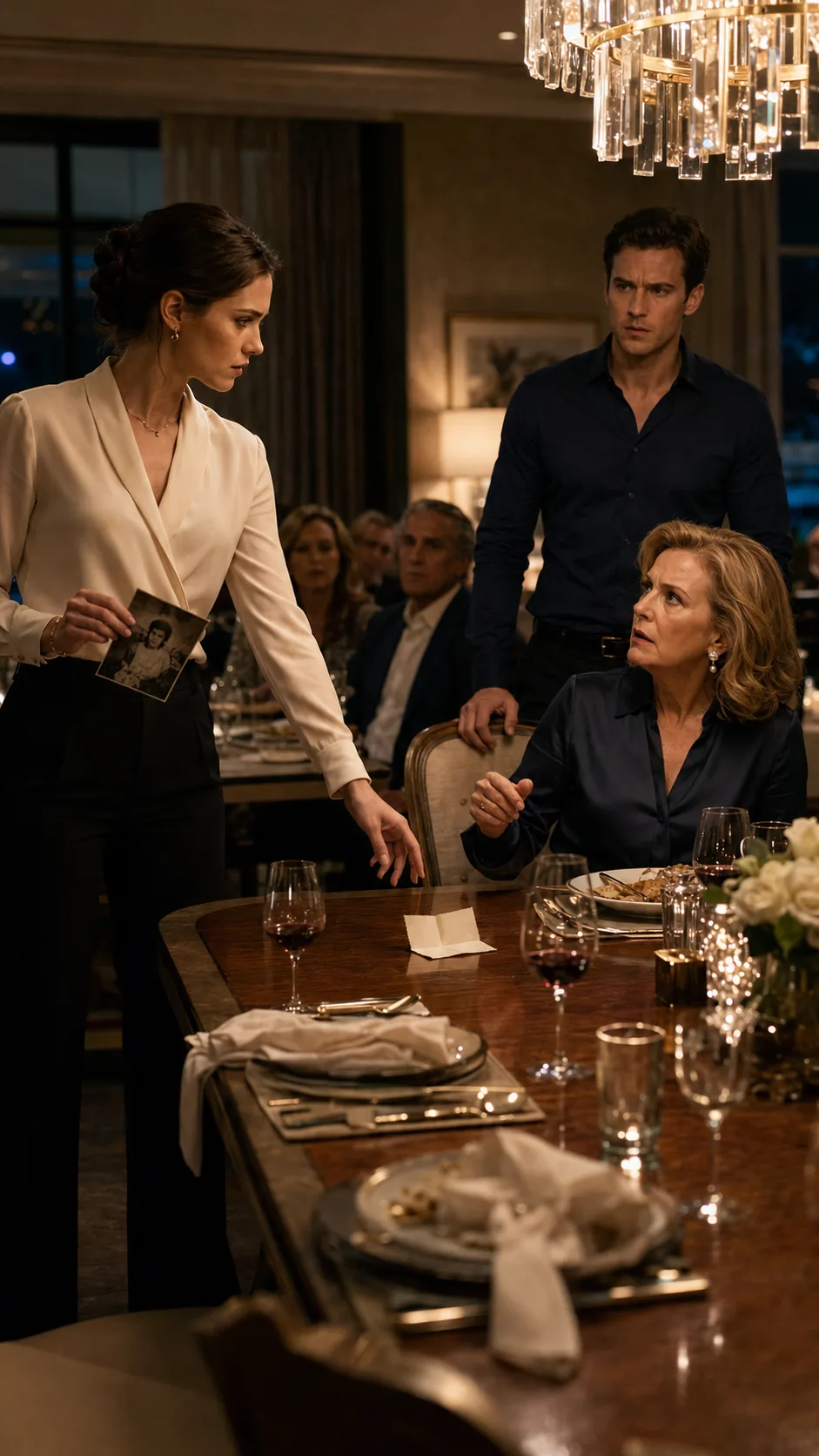
Then she reached into her purse.
Daniel’s knee shifted beside hers. Under the table, his shoe touched hers once, a warning disguised as an accident.
Rachel pulled out the baby photo.
She placed it in the center of the table, between the roast chicken and the white roses.
No one reached for it at first.
The baby’s dark eyes looked up at the chandelier.
Aunt Lydia leaned forward. Her pearl necklace swung slightly away from her throat.
“Who is that?” she asked.
Margaret’s face lost color in patches, starting near her mouth.
Paul’s knife stopped halfway through the chicken.
Daniel stared at the table.
“Enough,” Paul said.
Rachel looked at him. “I haven’t started.”
His hand came down flat on the table.
The glasses trembled. Red wine rippled in Aunt Lydia’s glass.
“You will not bring private family matters into my dining room.”
Rachel turned the photo over.
The writing faced upward now.
Do not let her find out.
Aunt Lydia read it. Then Mr. Harlan. Then Mark. One by one, their eyes moved from the words to Margaret.
Margaret’s fingers curled around her napkin until the linen twisted into a rope.
“That is not yours,” she said.
Rachel picked up the photo again.
“The baby has my birthmark.”
Margaret’s lips pressed shut.
“The birth certificate in your safe has your name on it.”
Paul stood.
The chair behind him scraped hard against the floor.
Daniel whispered, “Rachel.”
She did not look at him.
“The child’s name was blacked out,” Rachel continued. “But the date was mine.”
The lawyer set his fork down.
That mattered.
Paul noticed it too. His eyes cut to Harlan, and for the first time since Rachel had met him, Paul Whitmore looked at someone at his own table and did not get obedience back.
Margaret placed her palm on the table as if holding herself upright.
“You don’t understand what you found.”
“Then explain it.”
No one did.
The chandelier hummed faintly overhead. Somewhere in the kitchen, a timer beeped twice and went unanswered.
Rachel looked at the photo again.
That strip of brown tape on the back corner had bothered her since the first day. Old tape. Pressed flat. Too carefully placed for a torn photograph.
She slid her fingernail under one edge.
Margaret stood.
“Don’t.”
One word.
It moved through the room faster than a shout would have.
Rachel looked up at her.
Margaret’s chair had not moved back far enough, so she stood trapped between the table and the seat, one hand gripping the edge. Her pearl earring had twisted, showing the small gold clasp behind it.
Paul said, “Sit down, Margaret.”
Margaret did not sit.
Daniel reached toward Rachel’s wrist. “Please.”
Rachel moved the photo out of reach.
The tape lifted with a dry, faint crackle.
No one breathed loudly.
Rachel peeled it back slowly, not for drama, not to punish them, but because the photo was old and she did not want to tear the one piece of evidence everyone had spent decades hiding.
A tiny folded note slipped from behind the photo and landed beside her wine glass.
Paper on wood.
That was all.
And yet the room obeyed it.
Aunt Lydia pushed back from the table. Mark’s mouth opened but no sound came. Mr. Harlan leaned forward, his face stripped of professional distance.
Paul looked at the note the way a man looks at a locked door he knows has opened from the wrong side.
Rachel picked it up with two fingers.
The fold had been pressed so long that the paper resisted her. She opened it carefully.
The writing inside was smaller than the words on the photo. Sharper. Written by someone in a hurry or someone trying not to be seen.
She read it once.
Then again.
Margaret sat down.
Not gracefully. Her knees seemed to give first, and the chair caught her.
Rachel looked at Daniel.
He had gone pale.
Not confused.
Pale.
She turned the note toward him, though she did not yet show the rest of the table.
“Did you know about this?”
Daniel’s eyes moved across the words.
His hand dropped from the edge of the table.
Paul said, “Rachel, give me that.”
No one looked at him.
That was when the room left him.
Not loudly.
Not all at once.
Aunt Lydia’s gaze stayed on Rachel. Harlan’s body angled away from Paul and toward the note. Mark lowered his wine glass without drinking. Even the housekeeper standing near the kitchen doorway froze with the serving spoon in her hand.
Rachel held the note flat against the table.
Margaret’s eyes closed once.
Rachel read the words aloud.
“She must never marry into this family.”
Daniel’s chair scraped back.
Aunt Lydia covered her mouth.
Mr. Harlan took off his glasses and set them beside his plate.
Paul moved toward Rachel, but Harlan stood before he reached her.
“Paul,” the lawyer said.
Just the name.
It stopped him.
Rachel looked at her husband. “You knew there was a reason.”
Daniel’s throat moved. No answer came.
Rachel turned to Margaret.
“Who am I? And why were you afraid I would marry your son?”
The question stayed in the dining room like a knife set carefully on white linen.
Margaret’s fingers trembled against the table. She reached for her glass, missed it, and knocked the stem with her knuckle. Wine slid across the polished wood, dark and spreading, touching the edge of the baby photo.
Rachel picked the photo up before the stain reached it.
Margaret watched the movement.
Then she said, “Because I gave birth to you.”
No one spoke.
Not even Paul.
Rachel did not move for several seconds. She had expected lies. Denials. A family story arranged like furniture to block a door. But the words had come out bare, without decoration, and the table had no place for them.
Daniel pushed both hands into his hair and turned away.
Aunt Lydia said Margaret’s name once.
Margaret looked at the note in Rachel’s hand. “I was twenty-four. Paul’s family would have ruined me. The agency was supposed to handle everything quietly.”
Paul’s face hardened. “Margaret.”
She flinched at his voice.
Rachel saw it.
A small thing.
A lifelong thing.
Margaret continued, eyes fixed on the table now. “I signed papers. I was told you were placed with a family out of state. I was told there would be no contact.”
Rachel held the baby photo with both hands.
“My parents?”
“Chosen,” Margaret said. “Paid. Bound by agreement.”
The word paid moved across the table.
Mr. Harlan’s face tightened.
Paul looked at him. “Do not start.”
Harlan did not sit down.
Rachel said, “And Daniel?”
Margaret’s mouth opened.
Paul answered instead.
“We adopted Daniel three years later.”
Daniel turned sharply.
The room broke in a new direction.
“What?” Daniel said.
Paul’s eyes closed in irritation, as if the inconvenience were the problem.
Margaret covered her mouth with one hand.
Rachel looked from Daniel to Margaret, then back to the birthmark in the old photo, the blacked-out certificate, the note written to stop a marriage no one had the courage to explain.
Daniel gripped the back of his chair.
“I’m adopted?”
Paul’s jaw tightened. “This is exactly why these matters were kept private.”
Daniel laughed once.
It was a terrible sound.
Rachel had never heard it from him.
Aunt Lydia stood and stepped away from the table, one hand on the white rose arrangement as if she needed balance. Mark stared at his plate. The housekeeper disappeared into the kitchen, leaving the serving spoon on the sideboard.
Margaret looked at Rachel.
“You are not blood related to Daniel,” she said. “That is what I was trying to prevent people from twisting.”
Rachel let the sentence sit.
Then she placed the hidden note beside the baby photo.
“You didn’t write, ‘She must never find out who she is.’”
Margaret’s eyes lifted.
Rachel tapped the note once.
“You wrote, ‘She must never marry into this family.’ Not because of blood. Because of what this family did.”
Paul stepped forward again. “Careful.”
Rachel looked at him.
For years, he had occupied rooms like weather. Everyone adjusted around him. Chairs, conversations, holidays, even grief. But now the table was full of paper. Ink. Dates. A photograph. A hidden note.
Weather did not matter to evidence.
Mr. Harlan spoke before Paul could.
“Were adoption records falsified?”
Paul turned on him. “You worked for my father.”
“I asked a question.”
“You are paid to protect this family.”
Harlan picked up his glasses. Cleaned them with his napkin. Put them back on.
“I am paid to protect the estate from crimes that outlive dead men.”
That sentence changed the room again.
Rachel looked at Margaret.
“What happened to my real records?”
Margaret’s shoulders dropped.
Paul said nothing.
That was answer enough.
After dinner, no one ate dessert.
The apple tart remained untouched on the sideboard, powdered sugar melting into the glaze. Wine dried in a dark smear across the table where Margaret’s glass had tipped. The white roses leaned sideways, one stem broken near the base.
Rachel stood in Margaret’s bedroom with the safe open behind the wardrobe.
Mr. Harlan had insisted on witnessing it. Aunt Lydia came too, silent now, her pearl necklace removed and wrapped around her wrist. Daniel stood in the doorway but did not cross the threshold.
Margaret sat on the bed.
Paul had gone to his study and locked the door.
That suited him.
Rachel removed every document from the safe and placed each one on the bedspread. Birth certificate. Agency papers. Medical bills. A sealed envelope with her adoptive father’s signature. A bank transfer record from Paul’s father to the agency. Another from the Whitmore family trust to the couple who had raised her.
Her life arranged in folders.
No one touched the papers until Harlan photographed them.
Margaret watched Rachel pick up the blue scarf still folded on the chair from the first day.
“I did ask for that scarf,” Margaret said.
Rachel looked at it.
The fabric was soft. Pale. Expensive. Useless.
She placed it back on the chair.
Daniel remained in the doorway after everyone else went downstairs. The house was quiet except for Lydia on the phone in the hall and Harlan speaking in low tones near the front room.
“I didn’t know I was adopted,” Daniel said.
Rachel slid the baby photo into a folder.
“I believe you.”
He looked smaller under the bedroom light.
“I knew she was afraid before the wedding. She said there was an old scandal. She said you might be connected to it. She said she would handle it.”
Rachel closed the folder.
“And you let her.”
Daniel nodded once.
No defense came after it.
That was something.
Not enough.
He stepped closer. “What happens to us?”
Rachel looked at his hand. No ring had been removed yet. Neither of them had reached that scene. It waited somewhere ahead, patient and clean.
“I don’t know.”
He nodded again.
This time he did not touch her.
Three months later, Rachel signed the petition to unseal her adoption records in a county courthouse with flickering fluorescent lights and a vending machine that stole quarters.
Mr. Harlan filed an affidavit.
Aunt Lydia gave a statement.
Margaret gave two.
Paul gave none. His lawyers sent letters. Then fewer letters. Then a request that the family name be kept out of “unnecessary public filings.” The judge did not seem moved by the phrasing.
Rachel’s adoptive parents were already gone by then. Her mother had died when Rachel was twenty-two, her father two winters later. Their signatures appeared in the records more than once. Some were real. Some had been copied. Some pages were missing.
Rachel spent evenings at her kitchen table sorting the copies into stacks.
Daniel moved into an apartment downtown.
They did not divorce immediately. They did not pretend either. Their marriage became a hallway with doors neither of them opened quickly.
He visited once a week at first. Then every other week. He brought mail, old photographs, documents from his own adoption search. They sat across from each other at the kitchen table like two survivors of the same house fire, holding different burns.
Margaret wrote letters.
Rachel read the first one and put the rest in a box.
Paul had a minor stroke in November. The news came through Lydia, not Daniel. Rachel sent no flowers. She did not visit.
The Whitmore house went on the market in spring.
Before the sale, Rachel returned once.
She went alone.
The wardrobe was gone. The safe had been removed from the wall, leaving a square wound in the plaster. Dust outlined where the furniture had stood for years. The crescent scratch remained on the floor, pale against the polished wood.
Rachel stood over it for a while.
Then she walked to the rose garden.
The arbor from Margaret’s wedding portrait was still there, older now, its white paint cracked, one side sagging under vines. Rachel held the baby photo in her hand. Not the hidden note. Not the birth certificate. Just the photo.
A young Margaret holding a baby she had not been allowed to keep.
A child sold into silence.
A family protected by locked doors.
Rachel placed the photo in an envelope and slipped it into her coat.
She did not leave it behind.
At the front door, Daniel was waiting beside his car.
He had not called ahead. He did not ask to come in.
“I found my birth mother,” he said.
Rachel paused on the stone step.
“She lives in Oregon. She didn’t know where I went.”
Rachel nodded.
A moving truck passed slowly on the street, brakes squealing, empty metal ramp clattering in the back.
Daniel looked at the house. “I thought I’d feel better.”
Rachel followed his gaze.
The windows reflected both of them without keeping either.
“No,” she said.
He gave a small nod.
Then he handed her an envelope.
Inside was a copy of the first check Paul’s father had written to the agency. Rachel’s name was not on it. Neither was Daniel’s. Just a number, a date, and a phrase in the memo line.
Family matter.
Rachel folded it once and put it back.
“Thank you.”
Daniel looked at her hand, at the ring still there.
She saw him see it.
That afternoon, Rachel drove to the courthouse and filed one more document.
Not the adoption petition.
That was already moving.
This one was for her marriage.
The clerk stamped the papers without looking up. The sound was dull and final. Rachel watched the ink dry on the top page before sliding her copy into a folder.
Outside, the air smelled like rain on hot pavement.
She sat in her car for several minutes with both hands on the steering wheel. Then she removed her wedding ring and placed it in the cup holder beside a parking receipt and two old quarters.
Small things.
Too small.
Rachel started the car.
At home, the box of Margaret’s unread letters waited on the kitchen table. She moved it to the hall closet, behind winter coats and a broken umbrella she kept forgetting to throw away. Then she took out the baby photo, placed it in a plain wooden frame, and set it on the bookshelf.
Not hidden.
Not explained.
Just there.
The mark above the baby’s eyebrow caught the afternoon light.
Rachel touched her own.
Then she closed the safe door that no longer existed.
Chapter complete
You have reached the end of this chapter.
Continue reading
A few more worlds to get lost in after this chapter.




