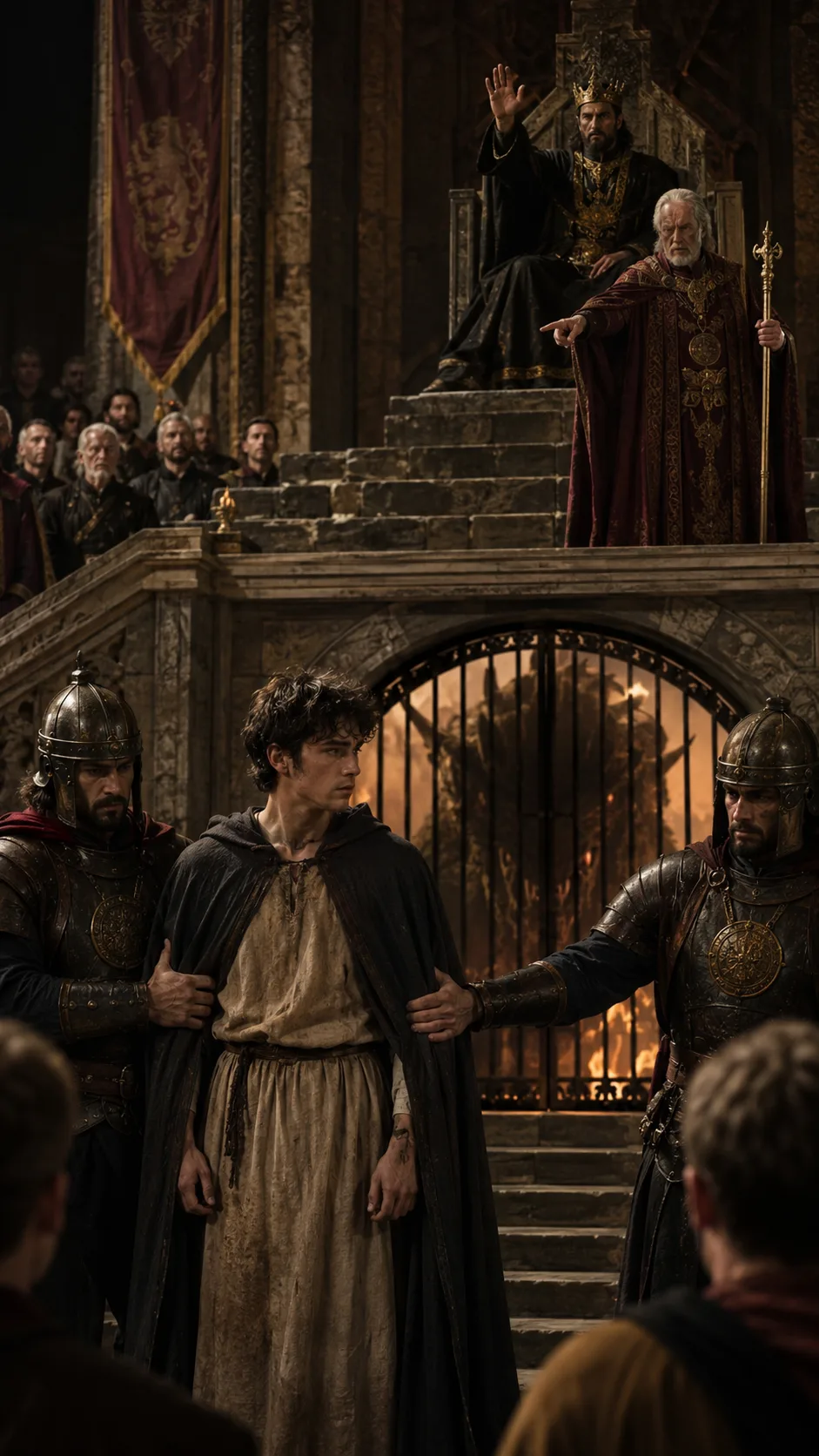
Rowan first noticed the missing cup because it was the only silver thing on the servant table.
Chapter 1
Rowan first noticed the missing cup because it was the only silver thing on the servant table.
It sat apart from the wooden bowls and chipped clay plates, polished so clean it caught the torchlight from the kitchen wall. No servant in the lower halls was allowed to touch silver. Not unless a steward placed it in their hands and counted their fingers afterward.
Rowan stopped beside the table with a basket of folded linen under one arm.
The cup had a black ribbon tied around its stem.
That meant royal use.
That meant trouble.
A scullery girl named Mara saw him looking and shook her head once.
“Don’t.”
Rowan looked away.
Too late.
Steward Calven came through the kitchen arch with two guards behind him and a red flush climbing up his neck. He was a narrow man who moved like every floor belonged to him, even when he was in rooms built for people he never noticed.
“There,” Calven said.
The guards turned toward Rowan.
Rowan shifted the linen basket higher against his ribs. “Sir?”
Calven crossed the kitchen without looking at anyone else. The cooks stopped chopping. The fire snapped in the hearth. Someone set a spoon down too carefully.
“Open your basket.”
Rowan lowered it.
Folded napkins. Fresh towels. Three table runners for the west balcony.
Nothing else.
Calven’s mouth tightened as if emptiness had personally offended him. He shoved his hand through the linen anyway. Cloth spilled over the table edge and fell onto the damp floor.
Mara bent to pick it up.
“Leave it,” Calven said.
She straightened.
One breath.
Then stillness.
The steward turned to the guards. “Search him.”
Rowan did not move as they checked his cloak, his sleeves, the worn belt around his waist. One guard avoided his eyes. The other was rougher, impatient from boredom rather than hatred.
No cup.
Calven’s gaze dropped to Rowan’s right wrist.
Rowan pulled the sleeve down without thinking.
It was a small movement.
Too small.
Calven saw it.
“What’s that?”
“Nothing.”
The guard took Rowan’s hand.
Rowan pulled back.
Not far.
Just enough.
The kitchen changed.
A pot hissed over the fire. Grease crackled. Nobody breathed like they had a right to it.
Calven stepped closer. “Hold him.”
The guard pulled Rowan’s sleeve up.
The mark on his wrist was faint, half-hidden beneath years of work and dust and old burns from kitchen steam. A broken crown. Three points, the middle one split. Rowan had been born with it. Mistress Elowen, who raised the lower-hall orphans, told him never to show it.
Not at the well.
Not in the stables.
Not if the palace caught fire and the only way to survive was to bare his arm to the gods.
Especially not then.
Calven stared at it.
For a moment, he
forgot to look disgusted.
Then he remembered who he was.
“Thief,” he said.
The word landed flat.
Mara’s face moved.
Only a little.
Rowan looked at her and gave the smallest shake of his head.
The silver cup was found ten minutes later in a flour barrel.
Not in Rowan’s basket.
Not in his room.
Not near him at all.
It did not matter.
By then Calven had already taken him upstairs.
The upper palace smelled different from the servant halls. Less smoke. More wax. Stone washed with rose water, carpets thick enough to swallow footsteps, golden plates carried past people who had never missed a meal in their lives.
Rowan had walked those corridors a thousand times carrying laundry, coal, wine, letters he was not supposed to read.
He had never walked them with guards on either side.
Nobles moved aside as he passed.
Not from respect.
From hygiene.
A woman in emerald silk pressed a handkerchief to her mouth. A young lord with too many rings smiled as if the day had finally become interesting. Someone whispered servant blood as though it were a stain that could spread.
Rowan kept his eyes on the floor.
That was how servants survived.
Count the seams between stones. Count the steps to each door. Count the breaths until the powerful got bored.
But King Aldren did not get bored.
The throne chamber opened at the end of the western gallery. Tall doors. Black iron. Two carved lions whose eyes had been replaced with dull red stones.
Rowan had polished those doors the previous winter.
He knew the crack in the left lion’s paw.
He knew the place where wax gathered near the threshold.
He had never crossed it.
The guards pushed the doors open.
The chamber was full.
Councilors. Priests. Noble houses in ranked colors. Officers in dark armor. High families gathered on the raised side tiers, murmuring over wine cups they had brought from breakfast.
A trial had been prepared before Rowan knew he was accused.
That was the first thing that told him this was not about a cup.
King Aldren sat high beneath the black canopy, his crown catching firelight in hard flashes. He was not old, not yet. His beard was trimmed sharp along the jaw, his posture straight, his hands resting on the throne arms as if they had been carved there with the chair.
Beside him stood High Priest Malrec.
Crimson robes. White hair. A staff topped with a gold disk etched with the old royal seal.
Rowan had seen him from a distance during holy feasts. Malrec never ate in public. He blessed the food and watched other people swallow.
That morning, his eyes fixed on Rowan’s wrist before they fixed on his face.
Calven bowed so low his chain of office swung forward. “Your Majesty. We found the thief.”
King Aldren did not look at the steward.
He looked at Rowan.
A long moment.
Then he said, “Bring him closer.”
The guards led Rowan to the center of the hall.
There was a circle inlaid into the floor there, old bronze lines worn dull by centuries of ceremony. The royal judgment circle. Servants cleaned around it, never across it.
Rowan was placed inside.
The nobles leaned in.
Someone behind him laughed under their breath.
Malrec tapped his staff once. The sound traveled farther than it should have.
“Name.”
Rowan swallowed. “Rowan.”
“House.”
“I have none.”
“Father.”
“I don’t know.”
“Mother.”
Rowan looked at the bronze line beneath his feet.
A hairline crack ran through it.
“I don’t know.”
A murmur moved through the chamber.
Malrec’s eyes did not leave him. “Convenient.”
Rowan said nothing.
King Aldren shifted one finger on the throne arm. The ruby in his ring caught the light. “The steward accuses you of stealing a royal cup.”
“The cup was not with me.”
“No,” Calven said quickly. “But he had hidden it.”
“In flour?”
A few nobles laughed.
Calven’s face tightened. “He had help.”
Mara stood at the servants’ arch near the back, half-hidden behind two footmen. Rowan saw her flinch.
He wished he had not spoken.
King Aldren’s gaze moved toward the servants’ arch, then back to Rowan. “Bold for a kitchen boy.”
“I work in linen, Your Majesty.”
The young lord with rings laughed again.
This time the king did not smile.
Malrec stepped down one stair from the throne platform. “Show your wrist.”
Rowan’s fingers closed.
There it was.
The real cup.
The real crime.
Not theft.
Skin.
Calven turned pale enough that Rowan understood. The steward had not discovered the cup missing. He had been sent to find the mark. The cup was only a leash.
“No,” Rowan said.
The word was small.
It still reached the king.
Aldren’s hand lifted from the throne arm.
The guards seized Rowan’s arms.
Mara moved at the back of the hall.
A footman caught her sleeve.
Malrec came closer. His staff clicked against stone. “A servant refuses the crown?”
“I refuse you touching me.”
The chamber went quiet in pieces.
First the servants.
Then the guards.
Then the nobles, once they understood the line had been crossed.
King Aldren stood.
Not quickly.
That would have given Rowan too much credit.
He rose as if gravity had asked permission.
“You stand in my hall,” the king said.
Rowan looked up.
He had not meant to.
But once he did, he did not lower his eyes.
Aldren’s face had no anger on it. That was worse. Anger belonged to men who had lost something. The king looked like a man deciding where to place a stain.
Malrec reached for Rowan’s sleeve.
The guard tightened his grip.
The fabric pulled back.
The mark showed.
A broken crown.
The chamber did not gasp.
People who lived near power knew better than to react before power told them how.
But one old man in the second tier set his cup down.
The sound was tiny.
It traveled.
King Aldren heard it.
His eyes moved toward the old man.
Lord Vael.
Everyone knew Lord Vael. He had served the dead queen before she died behind locked doors and official prayers. He had been removed from the council afterward, given a country estate, and invited back only when ceremony required witnesses too old to matter.
Lord Vael stared at Rowan’s wrist.
Not at the king.
At the mark.
His hand rested on the table before him, fingers spread, as if he needed the wood to remain standing.
Malrec turned and followed his gaze.
For the first time, the priest looked careful.
Not surprised.
Careful.
That was the second thing Rowan noticed.
The first had been the prepared trial.
The second was that Malrec had seen the mark before.
King Aldren descended two steps from the throne.
“Interesting,” he said.
The word was clean.
Too clean.
Malrec’s jaw moved once. “Marks can be forged.”
Rowan almost laughed.
Not because it was funny.
Because the mark had earned him nothing but warnings, long sleeves in summer, and Mistress Elowen’s hands shaking whenever palace inspectors came below stairs.
If it was forged, it was a very patient lie.
The king looked toward Calven. “Who else has seen this?”
Calven licked his lips. “Only the kitchen staff, Your Majesty. And the guards. And—”
“And half my court,” Aldren said.
Calven shut his mouth.
Mara stood very still near the back.
The king returned to Rowan. “Do you know what that symbol is?”
“No.”
The lie tasted old.
Malrec heard it.
So did the king.
Aldren smiled then, but only with the mouth. “The first kings were marked, they say. By the guardian beneath the eastern gate.”
A whisper moved through the room.
Eastern gate.
The bronze circle beneath Rowan’s feet seemed suddenly less decorative.
“The guardian has not judged blood in twenty years,” Malrec said.
“Twenty-one,” Lord Vael said.
Every face turned.
Lord Vael did not sit back down.
King Aldren’s smile faded by one degree. “You were not asked to speak.”
“No,” Vael said. “I was invited to witness.”
The old man’s voice was not loud. It did not need to be. Age had stripped it of everything except bone.
Aldren looked at him for a long second.
Then he laughed once.
“One servant. One kitchen accusation. One faded mark. And my court begins reaching for legends.”
Nobody joined him.
Not fast enough.
The king noticed.
He always noticed.
His gaze sharpened, passing over lords, priests, officers, servants at the walls. Rowan felt the room pull itself smaller. People tucked their opinions behind their teeth.
Aldren turned back to Malrec. “Then let us honor the old law.”
Malrec went still.
The king lifted his voice. “If the mark is false, the guardian will reject him.”
Reject.
Not kill.
Not here.
Not in front of witnesses.
The word was softer than the meaning behind it.
Rowan felt the guards’ hands loosen slightly. Not out of kindness. Out of fear of touching whatever he might be.
Malrec’s staff shifted in his grip. “Your Majesty, the old rite requires preparation.”
“The old rite requires a claimant.” Aldren looked down at Rowan. “He has brought us a mark. Let the realm see what it means.”
Rowan looked toward the servant arch.
Mara had both hands pressed together at her waist.
Behind her, Mistress Elowen stood in the shadow of the hallway.
Rowan had not seen her enter.
She was older now than she had seemed that morning, her gray braid pinned too loosely, flour on one sleeve, her face emptied of all the small commands that usually kept the lower halls alive.
Their eyes met.
She shook her head.
Once.
Not no.
Too late.
A memory opened in Rowan without asking.
A winter night. He was six. Fever in his bones. Elowen sitting beside his pallet with a candle stub between them, rubbing ash over the mark until it vanished beneath gray.
“Never show this,” she had said.
“Why?”
“Because some doors open only one way.”
He had asked what that meant.
She had not answered.
Now he knew.
The eastern gate was under the old arena, not the throne hall. They took him through corridors that sloped down behind the royal chapel, past carved walls showing kings with beasts at their feet, past lamps that burned blue instead of gold.
The court followed.
Not all of them. Only enough to make silence public.
King Aldren walked first with Malrec beside him. Lord Vael followed in the second group, leaning on no cane though he looked like he should have needed one. Calven walked near the back, sweating through his collar.
Rowan walked between guards.
No one held his arms now.
That should have felt better.
It did not.
The arena doors opened onto a circle of ancient stone beneath the palace, roofed by a dome blackened with old smoke. Balconies rose around the walls. Banners hung in dark red strips, faded to brown at the edges. At the far side stood the eastern gate.
Iron bars as thick as a man’s wrist.
A stone arch carved with the same broken crown.
Behind it, darkness.
Rowan had heard stories about the guardian in the way servants heard everything: through doors, through drunk guards, through kitchen gossip dressed as warning. It was a beast older than the current line, older than the church, older than the palace above it. Some said it had been born from mountain fire. Some said it had carried the first king out of a battlefield when all his brothers died.
Mistress Elowen said only one thing about it.
“Never lie near the gate.”
Rowan had been nine then, stealing honey with Mara from the winter stores.
He had thought she meant the steward.
The court arranged itself without being told. Nobles above. Priests at the right side. Officers at the left. Servants near the rear doors, low and silent.
Rowan stood at the center.
The guards stepped away.
Not far.
But away.
King Aldren took the raised stone seat built into the arena wall. It was not the black throne, but it still placed him higher than everyone else.
Malrec stood below him.
The priest’s face had changed. In the throne hall, he had been sharp. Here, under the gate carvings, he looked older and less certain.
Aldren saw it.
“Begin.”
Malrec lifted his staff.
The lower gate chains groaned.
Rowan’s hands stayed at his sides. His right sleeve hung loose now. There was no point hiding the mark. It seemed darker in this place, though maybe that was torchlight. Maybe fear made old things visible.
“Rowan of no house,” Malrec said.
No house.
The words should have stung.
They did not.
Not anymore.
“You stand before the eastern guardian under royal judgment. If your mark is false, the guardian will turn away from you. If your mark is true—”
His voice stopped.
Everyone heard the gap.
King Aldren’s fingers tightened on the stone armrest.
Malrec continued. “If your mark is true, the guardian will answer.”
Aldren leaned forward. “Open the gate.”
The chain master hesitated.
He was a broad man in leather, old scars on both hands. Rowan had once delivered clean towels to the gate rooms and seen him feeding meat through a side hatch with a prayer under his breath.
Now the man looked at Malrec.
The priest did not look back.
The chain master pulled the lever.
Iron moved.
Stone dust fell.
The sound filled the arena slowly, like thunder deciding whether to become weather.
Rowan did not step back.
He wanted to.
His body knew the old language of survival. Move away from teeth. Lower your head near authority. Keep your hands visible. Apologize before being accused. Make yourself useful before someone decides you are expensive to keep alive.
But his feet stayed inside the bronze circle.
The gate opened just enough for firelight to spill through from the chamber beyond.
Something moved.
A shape behind iron.
Too large.
Too quiet.
The guardian stepped into view.
It was not the monster from kitchen stories.
It was worse because it looked real.
Obsidian scales. A horned head marked with old scars. Amber eyes that reflected every torch in the arena. A heavy ceremonial collar around its neck, not a chain exactly, more like a relic someone had once mistaken for control.
It lowered its head.
Not to Rowan.
To the floor.
Scenting stone.
The nobles above leaned back as one body.
Calven made a small sound, then swallowed it.
King Aldren rose half an inch from his seat. “Let it judge him.”
Malrec stepped toward Rowan.
“Show the mark.”
Rowan turned his wrist outward.
A simple action.
Nothing more.
A servant showing skin to people who had never seen his face until that morning.
The guardian’s head lifted.
Its amber eyes fixed on the broken crown.
The arena lost its small sounds.
No fabric. No cups. No whispers.
The beast moved forward.
One step.
The stone under it shook.
Rowan did not breathe.
The guardian came close enough that warm air from its nostrils moved the hair at Rowan’s forehead. It smelled of iron, ash, and old rain trapped in deep caves.
A guard behind Rowan shifted his spear.
The guardian’s eye moved to him.
The guard froze.
Then the beast looked back at Rowan’s wrist.
It bent lower.
Malrec stared.
His staff slipped a little in his hand.
“That mark belongs to the first king,” Lord Vael said from the lower balcony.
The line broke something.
Not loudly.
But completely.
Every noble turned to him. Then to Rowan. Then to Aldren.
King Aldren stood.
“Lord Vael,” he said. “Take care.”
Vael rested both hands on the balcony rail. “I took care for twenty-one years.”
Malrec shut his eyes for half a second.
Rowan saw it.
So did Aldren.
The king’s voice dropped. “Priest.”
Malrec did not answer.
The guardian shifted.
Then the impossible became visible.
It lowered one enormous knee to the stone.
The sound was heavy and final.
The beast bowed its head before Rowan.
Not beside him.
Not near him.
Before him.
Rowan looked down at the crown of the creature’s horned head, close enough to touch if his hands had belonged to someone braver.
No one moved.
Even the torches seemed to burn without sound.
The guards nearest Rowan lowered their spears.
One first.
Then the other.
Not commanded.
That mattered.
Above them, a noblewoman covered her mouth. Her rings flashed. A councilor pushed back from the rail as if the stone had grown hot under his palms.
Malrec turned slowly toward the king.
His face had lost its ceremony.
“The guardian bows to the true heir.”
Aldren’s hand struck the stone armrest.
“Silence.”
The word cracked across the arena.
No one obeyed quickly enough.
That was when the room changed ownership.
Rowan felt it before he understood it. The space around him widened. The guards no longer stood as a wall keeping him in place. They stood as a line between him and the throne.
Lord Vael descended the balcony steps.
Aldren pointed at him. “Do not come down.”
Vael kept walking.
His old boots struck each step.
Once.
Twice.
The guardian did not move from its bow.
Malrec stood between the king and the bronze circle, staff lowered now, both hands wrapped around it.
Aldren looked at him as if seeing a servant where a priest had stood.
“You consecrated my crown,” the king said.
Malrec’s eyes lowered.
“I consecrated the crown,” he said. “Not the lie beneath it.”
The arena inhaled.
Aldren’s face changed then.
Only slightly.
His mouth remained firm. His eyes did not widen. But something beneath his skin moved, a small calculation that found no safe path.
Rowan’s sleeve hung open at his wrist.
The mark seemed darker now.
Vael reached the floor and stopped outside the bronze circle. He looked at Rowan for a long time.
Then he did something no one expected.
He bowed.
Not low like a courtier.
Not deep like a servant.
A soldier’s bow.
Controlled. Difficult. Earned.
“My queen wrapped you in a blue cloak,” he said. “The night they told us the cradle was empty.”
Rowan heard the words.
They did not settle.
Blue cloak.
Cradle.
Empty.
His mind reached for them and found only Mistress Elowen’s rough hands, ash over his wrist, a candle in winter, never show this.
Aldren came down from the stone seat.
Two officers moved with him.
The guardian lifted its head.
The officers stopped.
Aldren did not.
He stepped onto the arena floor with the confidence of a man who had watched people stop for him all his life.
“Enough,” he said.
The word was no longer clean.
It had edges.
“This is theater. A trained animal. An old man’s memory. A servant’s mark.”
Rowan looked at him.
Really looked.
The king was closer now. The gold on his robe was fraying near one cuff. There was a dark stain on his thumb, ink perhaps, or wine. A human detail. Small. Wrongly comforting.
Aldren pointed toward Rowan’s wrist. “You were planted.”
Rowan said the first thing that came to his mouth.
“By who?”
No title.
No Your Majesty.
The arena heard the absence.
Aldren did too.
His jaw tightened.
Rowan took one breath. “I scrubbed your floors yesterday.”
Someone in the servant section made a sound that was almost a laugh and almost pain.
Mara.
Aldren’s gaze cut toward her.
The guardian rose.
Not fully.
Just enough.
Aldren stopped looking at the servants.
Malrec stepped forward one pace. “The old law requires acknowledgment.”
“The old law serves the crown,” Aldren said.
“No,” Vael said. “The old law made the crown.”
Aldren turned on him. “You had twenty-one years to speak.”
Vael’s face did not move. “I had twenty-one years under watch.”
“Convenient.”
“Yes,” Vael said. “For you.”
The crowd stirred.
This time it did not stop when Aldren looked up.
That was new.
That was dangerous.
King Aldren knew dangerous rooms. He had made many. He had stood in halls where men confessed before the question was finished. He had smiled through funerals. He had signed decrees over breakfast and ordered entire houses erased from ledgers by noon.
But he had never stood in a room where his silence was not enough.
The guardian turned its body.
Slow.
Deliberate.
It placed itself between Rowan and the king.
No attack.
No snarl.
Only position.
A wall of scale and old authority.
Aldren’s hand lowered from his side.
Malrec lifted his staff again, but not toward Rowan.
Toward the throne seat.
“Under the eastern rite,” he said, and now his voice carried to every balcony, “the guardian has answered.”
Aldren stared at him.
Malrec’s fingers tightened around the staff until the knuckles paled.
“The mark is recognized.”
Aldren said nothing.
Lord Vael looked toward the nobles above. “Witnessed?”
The first answer came from the white-haired noble whose cup had touched stone in the throne hall.
“Witnessed.”
Then another.
“Witnessed.”
A woman in emerald.
“Witnessed.”
A guard.
Quietly.
“Witnessed.”
The word began to move.
Not like cheering.
Not like rebellion.
Like a ledger being corrected line by line.
Witnessed.
Witnessed.
Witnessed.
Aldren turned in place, looking for the first person he could punish.
He found too many.
That was the third thing Rowan noticed.
Power was not gone when people hated it.
Power was gone when people discovered they were not alone in hating it.
Aldren looked back at Rowan.
For one moment, the king’s face was empty of crown, throne, office, priest, law.
Just a man.
Then the mask returned.
“You think this makes you king?”
Rowan looked at the guardian’s lowered head beside him.
At Malrec’s shaking hands.
At Vael’s old soldier bow.
At Mara near the servant arch, one hand pressed to her mouth, eyes bright but dry.
He looked back at Aldren.
“No,” Rowan said.
The word carried badly at first.
Too soft.
So he said it again.
“No.”
The arena quieted.
Rowan lifted his marked wrist. His hand did not shake now. He did not know why.
“I think it means you knew.”
Aldren did not answer.
He did not need to.
His face did.
The whole room saw it.
The broken line at the corner of his mouth. The half breath he failed to hide. The way his eyes went to Malrec, not in confusion, but accusation.
The priest lowered his head.
That was the confession.
Aldren stepped back once.
Only once.
It was enough.
The guardian stood fully.
The nearest guards moved their spears across their chests, not pointed at the king, not yet, but no longer pointed away from him either.
Malrec spoke again.
“Seal the throne chamber.”
Aldren turned.
No one moved.
Then Captain Orthis, commander of the palace guard, stepped from the officer line. He was a square man with gray at his temples and a scar across one cheek. He had not spoken all morning.
He removed the black royal sash from his armor.
Folded it once.
Placed it on the stone floor.
Aldren watched him.
Orthis bowed to Rowan.
“Until the council convenes.”
The king laughed.
It came out wrong.
“Council?” he said. “You think a kitchen servant can sit before the high houses?”
Lord Vael answered. “No.”
Aldren smiled.
Vael finished. “The heir can.”
The smile died.
Mara stepped forward from the servants’ line.
A footman reached for her again.
This time she pulled her sleeve free.
Every eye turned. She nearly stopped. Rowan saw it in her shoulders. Then Mistress Elowen appeared beside her and placed one hand at her back.
Mara walked to the edge of the bronze circle and held out something wrapped in cloth.
Rowan knew that cloth.
Blue.
Faded almost gray.
His chest tightened in a way that had nothing to do with fear.
Elowen did not come closer. She stood where servants stood, just outside the places that could change history.
Mara unfolded the cloth.
A small clasp lay inside it.
Silver, not polished.
A lion with a split crown.
Vael covered his eyes with one hand.
Only for a second.
Elowen spoke from the rear of the arena. Her voice was rough from kitchen smoke and old orders.
“She told me to run.”
No one had to ask who.
The dead queen sat suddenly among them, not as portrait or prayer, but as a woman in a night corridor handing a baby to a servant while the palace turned against her.
Aldren’s hands closed.
Elowen looked at him. “You searched the nursery. Not the laundry carts.”
The arena held the sentence.
Then it gave it weight.
Aldren did not deny it.
He looked at the clasp in Mara’s hands.
Then at Rowan.
Then at the guardian.
His mouth opened.
No sound came.
For the first time that morning, King Aldren had no words prepared.
Captain Orthis gestured to two guards.
They did not seize the king.
They only stepped near him.
That was worse.
It made his captivity polite.
Aldren looked at the guards like he could make them remember themselves.
They did not.
Malrec lowered his staff and knelt.
The sound of his old knees meeting stone was soft.
Too soft for the size of what it meant.
One by one, the priests behind him followed.
Then the guards nearest the bronze circle.
Then Lord Vael.
The nobles did not all kneel.
Some were too proud.
Some were too afraid.
Some simply stood there, trapped between the man they had served and the truth they had watched bow.
Rowan wished suddenly, fiercely, that he were back in the linen room counting table runners.
He wished the silver cup had stayed missing.
He wished Mistress Elowen had lied better.
He wished the mark on his wrist were only a burn.
The guardian turned its head toward him.
Amber eyes.
Not gentle.
Not tame.
But waiting.
Rowan looked at the blue cloth in Mara’s hands.
“Come here,” he said.
Mara blinked.
He held out his hand.
She crossed the bronze line and placed the clasp in his palm.
No one stopped her.
The clasp was colder than he expected.
Old metal. Small lion. Split crown.
A baby could have worn it.
A servant could have hidden it for twenty-one years beneath flour sacks, laundry soap, loose stones, and fear.
Rowan closed his fingers around it.
His wrist mark pressed against the silver.
The guardian lowered its head again.
This time, Rowan touched it.
Not bravely.
Not like a king.
Like a person checking whether the world had become real.
The scales beneath his palm were warm.
The arena watched.
Rowan turned to Aldren.
He had imagined, in those first stunned seconds, that there would be a sentence big enough. Something clean. Something sharp. Something worthy of the way rooms changed in stories.
But standing there with kitchen dust still on his clothes and a royal clasp in his hand, he found only the truth.
“You knew my name before I did.”
Aldren’s face hardened.
Too late.
Captain Orthis spoke to the guards. “Escort Lord Aldren to the west chamber.”
Not King.
Lord.
The word cut cleaner than any blade.
Aldren heard it.
Everyone did.
He moved as if he might refuse.
The guardian took one step.
The stone answered under its weight.
Aldren went still.
Then he walked.
No chains. No shouting. No spectacle.
Just two guards beside him and every noble in the arena watching the back of the man who had entered as king.
At the archway, he stopped and looked once over his shoulder.
Not at Rowan.
At the throne seat above the arena.
Empty now.
The guards led him out.
Afterward, nobody seemed to know how to move.
The rite had no script for what came after truth.
Malrec remained kneeling until Rowan said, “Stand.”
The priest obeyed so quickly it made several nobles look away.
Rowan did not enjoy it.
That surprised him.
He had imagined, in smaller resentments, that powerful people lowering their heads would feel warm. It did not. It felt like finding rot under a polished table.
Lord Vael approached with care.
“Your Highness,” he said.
Rowan almost stepped back.
Mara’s fingers touched his sleeve.
A tiny pressure.
Stay.
Rowan looked at the old lord. “Don’t call me that yet.”
Vael studied him.
Then nodded. “Rowan.”
That helped.
The guardian shifted behind him, chains whispering against stone though no chain held it tightly enough anymore. The creature looked toward the open gate, then back at Rowan.
Malrec followed the movement. “It is waiting for your command.”
Rowan looked at him.
The priest lowered his eyes.
Rowan turned toward the gate chamber. Dark. Ancient. Built for keeping sacred things hidden until men needed them.
“Open the rest,” Rowan said.
The chain master looked to Malrec.
Then stopped himself.
He looked to Rowan.
Rowan nodded.
The man pulled the second lever.
The eastern gate opened fully for the first time in twenty-one years.
No one cheered.
No one dared.
The guardian walked out into the arena and stood in the bronze circle beside him.
Not behind him.
Beside him.
That was how the council found them an hour later: a servant in a stained tunic, a sacred beast at his side, a royal clasp in his hand, and a stolen king locked in the west chamber with no throne under him.
By sunset, the palace had split into whispers.
Some called Rowan the heir.
Some called him a danger.
Some called him a servant still, but quietly now, where spears and guardians could not hear.
Mistress Elowen was brought to the council chamber after dusk. She refused the chair offered to her because servants were trained too well by furniture. Rowan pulled it out himself and waited until she sat.
Only then did the others sit.
She told them the queen had known Aldren’s supporters were coming. How the nursery guard had been changed. How Lord Vael had sent a warning too late. How the queen had wrapped her son in the blue cloak and given him to the laundry mistress through a chapel door.
“His name?” Malrec asked.
Elowen looked at Rowan.
He braced for something golden.
Something carved into histories.
“Rowan,” she said. “She named him Rowan.”
The council wrote it down.
Not a palace name forced over a servant one.
His.
Aldren was not executed.
Rowan refused it before anyone could dress revenge as justice. The former king was stripped of crown, council, seal, and command, then confined to the northern monastery where bells rang before dawn and no one bowed to him except out of habit.
Malrec confessed before the council three days later.
Not everything.
Men like him never gave everything at once.
But enough.
Enough names. Enough sealed orders. Enough proof that the queen’s death had been turned into ceremony before her body was cold.
He lost his staff.
Lord Vael broke it himself across the council table.
The sound made half the room flinch.
Mara became head of the lower halls before the week ended. She claimed it was temporary, then reorganized the stores, dismissed three corrupt stewards, and banned Calven from every kitchen, pantry, linen room, and laundry court in the palace.
Calven lasted two days as a courtyard clerk before trying to order a stable boy to bow.
The boy laughed.
That story reached Rowan before dinner.
He kept the silver cup.
Not as evidence.
As a reminder.
It sat on the table beside the blue cloak clasp during the first open council Rowan attended. Nobles entered expecting velvet, crowns, perhaps a new robe cut to make him look born for the room.
He wore clean linen.
Dark cloak.
No crown.
The guardian waited outside the chamber doors because it did not fit inside without removing history from the hinges.
When the first noble addressed him as Your Majesty, Rowan looked at the empty chair at the head of the table.
Then at the long line of servants bringing ink, water, bread, and records for men who had never learned their names.
“Not yet,” he said.
The noble blinked. “Then how should we address you?”
Rowan touched the mark on his wrist once.
The skin there no longer felt like something to hide.
“By my name.”
The council wrote that down too, though no one had asked them to.
Months later, when the coronation finally came, the arena was opened again.
Not for judgment.
For witness.
The bronze circle had been polished. The banners were replaced. The eastern gate stood open, no bars between the guardian and the room. Sunlight reached the lower stones for the first time anyone remembered.
Rowan stood in the center in a dark cloak clasped with the old silver lion.
Mara stood with the lower hall staff in the front row.
Mistress Elowen sat beside Lord Vael.
She had argued.
She lost.
A crown was brought forward on a cushion of black velvet.
Rowan looked at it for a long time.
Then he looked toward the kitchen arch, visible far behind the crowd through the open doors.
For one strange second, he saw himself at fourteen carrying folded linen, at sixteen hiding his wrist in summer heat, at nineteen staring at a silver cup that had been placed to ruin him and accidentally opened a gate.
The guardian lowered its head.
The room followed.
This time, no one had to be told.
Rowan lifted the crown.
It was heavier than it looked.
He did not put it on right away.
He turned it once in his hands, studying the inner rim, the old scratches left by heads that had carried law, pride, fear, and hunger.
Then he set it on his own head.
Not because the beast had bowed.
Not because nobles had witnessed.
Not because blood had answered blood.
Because the next servant dragged into a room full of powerful people deserved someone on the throne who remembered the floor.
The arena stayed silent.
Rowan looked at them all.
Then at the open gate.
“Begin,” he said.
Chapter complete
You have reached the end of this chapter.
Continue reading
A few more worlds to get lost in after this chapter.