Kael was stealing turnips from a dead woman’s cart when the king’s banner slipped loose above the market gate.
Chapter 1
Kael was stealing turnips from a dead woman’s cart when the king’s banner slipped loose above the market gate.
Nobody reached for it.
The cloth had been nailed there three mornings before, black silk with a golden crown stitched so large it covered the old stone faces carved into the archway. Those faces had once belonged to the city’s founders, or saints, or kings before kings began calling themselves holy. Nobody knew anymore. Odran’s guards had ordered the vendors to cheer when the banner went up, and the vendors had cheered with empty baskets behind their stalls.
Now the left corner had come free.
The banner snapped in the dry wind and slapped against the gate like a hand against skin.
Kael stood beneath it with two small turnips hidden under his shirt and one in his palm. The cart beside him smelled of soil and old straw. The woman who owned it had died before sunrise, sitting on her stool with her chin on her chest, and her
son had dragged her body away before the tax officers saw the empty license hook above her stall.
The hook mattered.
The body did not.
A royal guard crossed the market square with a strip of dried meat between his teeth. People stepped aside before he reached them. Kael turned his face toward the baskets, but the guard’s boots stopped near the dead woman’s cart.
“You paid for those?”
Kael kept the turnip in his hand.
The guard looked at the banner, then at Kael’s shirt. One corner of his mouth moved. “Ash rat.”
Kael did not answer. He had learned early that answers fed men who already had enough.
Behind the guard, a child reached for a cabbage leaf on the ground. Her mother slapped her hand away before the guard saw. The sound was small. It carried.
The banner snapped again.
This time the loose corner dropped lower
and covered the carved faces completely.
Kael looked at the cloth. At the crown. At the row of hungry people forced to bow beneath it every morning before they were allowed to sell whatever they had left.
The guard grabbed his collar.
Kael moved before he decided to.
He threw the turnip at the guard’s face, jumped onto the dead woman’s cart, caught the loose edge of the banner, and pulled with all the weight hunger had left him. The nails screamed against stone. One tore free. Then another. The whole black cloth came down across his shoulders, heavy with dust and royal thread.
For a breath, the market saw the old carved faces again.
No one cheered.
That made it worse.
The guard struck him across the side of the head with a mailed hand. Kael hit the ground with the banner under him. Dust filled his mouth. The
two turnips rolled out of his shirt and stopped beside the guard’s boot.
“Why?” the guard said.
Kael pushed himself up on one elbow. Blood warmed his lip. He looked past the guard at the people standing under the gate, their eyes lowered, their hands tucked into sleeves, their stomachs empty beneath patched wool.
“Because it covered the faces of the starving.”
The guard stared at him for half a second.
Then he called for chains.
By dusk, the market gate had a new banner nailed above it. Twice the size. More gold.
Kael saw it from the back of a prison cart as soldiers took him up the hill toward the royal quarter. The city changed as the wheels climbed. Mud gave way to fitted stone. Laundry lines disappeared. Windows grew wider and cleaner. People at balconies watched the cart pass while servants carried silver trays behind them.
One woman lifted a cup and did not drink.
Kael sat between two prisoners who would not look at him. One had stolen lamp oil. One had refused the grain levy after his field burned. Their shackles were old, rough iron. Kael’s were new.
That meant someone important had decided quickly.
The palace rose above the city like a black tooth. Beyond it, higher still, the old temple crouched against the eclipse-dark sky. Its roof had been built around a circular opening so priests could read omens from the heavens, but the opening showed only a red-black moon sliding across the sun.
The horses slowed before the eastern prison gate.
A boy in fine armor waited there.
He was not much older than twenty, with pale gloves, polished boots, and a gold collar shaped like braided flame. Prince Malven had his father’s sharp chin and his mother’s dead eyes. At least that was what the ash district said, though few had seen the queen before she vanished from public festivals and portrait coins.
Malven stepped close to the cart and looked at Kael as if inspecting meat.
“This one?”
The guard holding the reins nodded. “Caught tearing down the king’s banner.”
Malven’s smile showed no teeth. “Brave.”
Kael spat blood onto the floorboards.
One of the guards laughed. Malven did not.
He took a folded strip of black cloth from the servant beside him and dropped it into Kael’s lap. It was a torn piece of the banner, the edge still marked with the gold thread of the crown.
“Keep it,” the prince said. “You should have something royal for your last night.”
The prisoner who had stolen lamp oil crossed himself with two trembling fingers.
Kael looked at the cloth.
A thread of gold stuck to his skin.
The prison beneath the eastern tower had no windows, only slits too high for air to pass through. They put Kael in a narrow cell with a stone bench and a bucket. The floor held the old smell of fear that had dried and been scrubbed and returned.
A guard shoved him inside.
“Sleep,” he said. “The god likes fresh offerings.”
The door shut.
Kael sat on the bench with the torn banner cloth beside him. He did not touch the food they slid under the door. It was better than anything he had eaten in a week, which meant it was not kindness.
Later, footsteps stopped outside the cell.
Not guard boots.
Sandals.
An old priest stood beyond the bars holding a clay lamp. His robe had once been red but had faded into the color of dried brick. His beard hung thin against his chest, and his hands were marked with ash in old ritual lines.
Kael watched him without moving.
The priest looked at the torn banner cloth on the bench. Then at Kael’s face.
“You should eat.”
“No.”
“You’ll need your strength.”
“For falling?”
The priest’s fingers tightened around the lamp handle.
A moth circled the flame, tapped the clay rim, and fell to the floor. Neither of them moved to crush it.
“What is your name?” the priest asked.
“Kael.”
“Who named you?”
Kael almost laughed, but his split lip pulled tight. “Whoever left me breathing.”
The priest closed his eyes for half a breath.
“You were found in the ash district?”
“Everybody knows that.”
“Who found you?”
“Old Mera. She kept laundry fires near the east wall. She’s dead.”
“What did she tell you?”
Kael leaned back against the stone. “That rich men ask questions when they already know answers.”
The priest looked down.
That was when Kael noticed the ring hanging on a cord under the old man’s robe. Not a fine ring. Not gold. Black iron, burned along one edge, shaped with a small open eye inside a broken crown.
The priest saw him looking and tucked it away.
Too late.
“Where did you get that?” Kael asked.
The old man stepped back from the bars. “Sleep if you can.”
“Where did you get it?”
The priest turned.
Kael stood so fast the chain at his ankle scraped sparks from the floor. “Answer me.”
The old priest did not look back.
“Some names should have stayed buried,” he said, and walked away with the lamp.
The dark came back.
Kael sat down slowly. The moth on the floor twitched once, then went still.
He did not sleep.
At dawn, the city bells did not ring. On execution days the palace used drums.
The first drum sounded from the temple hill while guards unlocked Kael’s cell. The second answered from the market gate. The third came from somewhere in the ash district, duller than the others, as if struck through cloth.
A servant entered with a basin.
Kael stared at it.
The servant was younger than the prince, maybe seventeen, with a shaved head and a scar at his jaw. He set the basin on the floor and kept his eyes down.
“Wash,” he said.
Kael looked at the water. Clean. Clear. Too much of it.
“No.”
“They’ll drag you dirty.”
“They were going to drag me anyway.”
The servant’s mouth pressed flat. He pushed a folded shirt through the bars, gray and thin. Prison cloth, but newer than Kael’s own.
The sleeve caught on a rough edge of iron. For a second, the fabric pulled open. Something small fell from inside it and tapped against the floor.
A bead.
Not wood. Not bone.
Black glass, cracked through the middle.
The servant went still.
Kael bent before the guard outside noticed and closed his fingers around it. It was warm.
The servant whispered without moving his lips. “Keep your shirt closed.”
Kael looked at him.
The guard struck the bars with his spear. “Move.”
The servant stepped back, face blank.
Kael changed into the prison shirt with his back to the guard. On the inside seam, near the chest, someone had stitched a mark with nearly invisible black thread.
An open eye.
Inside a crown.
His fingers stopped on it.
The guard yanked the cell door open. “Out.”
The corridors filled with the smell of torch oil and wet stone. Kael walked between four soldiers while the chain between his ankles scraped rhythm into the drums outside. At the upper passage, the old priest waited with two younger priests and the High Priest of Odran’s court.
The High Priest was a narrow man with a gold mask pushed up onto his forehead and a bone staff taller than himself. His eyes moved over Kael, not like a holy man, but like a merchant checking weight.
“This one is small,” he said.
Prince Malven’s voice came from the stair. “The pit does not measure height.”
Kael turned.
The prince descended in ceremonial black and gold, his hair oiled back from his temples. Behind him came King Odran.
The prison corridor seemed to shrink around him.
Odran was not a large man, but he wore largeness well. Black armor covered his chest and shoulders, chased with gold flame patterns. His crown was dark metal set with red stones, each one polished to catch torchlight like an eye. His beard had been trimmed into a point. His gloves were black.
He did not look at Kael first.
He looked at the old priest.
The old man lowered his head.
Odran’s gaze shifted at last. “This is the banner boy?”
The High Priest bowed. “Yes, Divine Majesty.”
Kael’s mouth moved before caution could catch it. “I thought the god was divine.”
A soldier drove a fist into his stomach.
Kael folded, but the chains kept him upright.
Odran stepped closer. His boots made no sound on the damp stone.
“The gods gave kings power,” he said. “Fools make trouble over wording.”
Kael forced air back into his lungs. “Hungry people make trouble over food.”
Prince Malven laughed once. Short. Bright.
Odran looked at his son, and Malven stopped.
The king reached out and gripped Kael’s jaw with gloved fingers. His thumb pressed against the split on Kael’s lip until warmth touched Kael’s chin.
“Your district has always produced loud children.”
Kael held his gaze.
Odran’s fingers tightened.
“For fifteen years,” the king said, “I have cleaned that ash from my kingdom.”
The old priest behind him made a sound too small to be a word.
Kael heard it anyway.
Fifteen years.
His own age.
The High Priest struck the floor with his staff. “The court waits.”
Odran released Kael’s face and turned toward the stair.
The servant from the cell stood among the torch bearers, eyes fixed on the floor. His hands shook around the pole.
Kael touched the black glass bead hidden in his palm.
The temple had been opened from the inside.
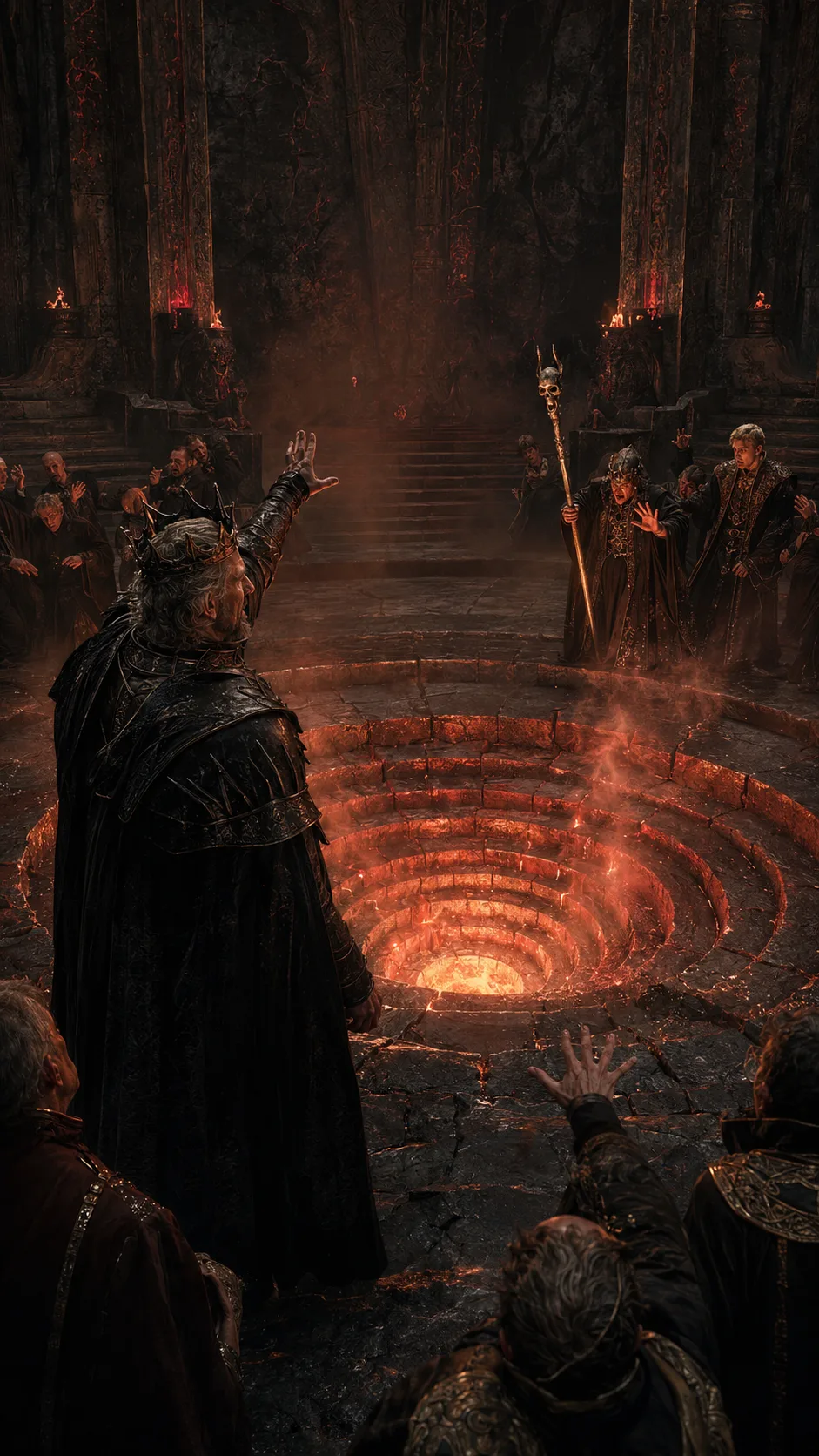
People said the God Pit lay beneath the oldest temple, but that was only half true. The temple had been built around it like a scar builds around iron. Nine rings of black stone circled the pit, each lower than the last, descending toward a center that held no visible bottom. Carvings covered the walls: crowns, eyes, flames, kneeling armies, kings standing with hands raised toward something below them.
The roof opening above showed the eclipse in full.
A dark sun.
A red edge.
The court had already gathered.
Nobles stood behind gold ropes, wrapped in velvet and worry. Soldiers lined the outer ring with spears angled upward. Priests held torches that burned red instead of orange. At the far side, near a carved altar, Prince Malven waited with one hand resting on his sword.
The ash district people had not been invited.
They watched through iron gates beyond the temple doors, pressed so tightly together that hands and faces appeared between the bars.
Kael saw the market woman’s daughter.
The child who had reached for the cabbage leaf.
She stood on a barrel outside the gate, both hands gripping iron. Her mother tried to pull her down. The child would not move.
The guards dragged Kael to the first ring.
The heat from the torches made sweat crawl down his back, but the pit itself breathed cold.
The High Priest lifted his staff.
“First Flame,” he called, “accept this rebel and prove the crown remains divine.”
The words rolled across the temple.
Kael looked into the pit.
Darkness.
Not empty darkness. Not the kind under beds or inside wells.
This darkness seemed to know where he stood.
Prince Malven crossed the ring toward him. His boots stopped inches from Kael’s bare toes.
“You wanted the gods to see the starving?” he said. “Good. Now one of them will see you die.”
Kael said nothing.
Malven leaned closer. “No speech?”
Kael looked past him at the iron gates. At the child on the barrel. At the torn banners hanging along the temple walls, each bearing Odran’s crown.
Then he looked at the king.
King Odran stood with one hand on the hilt of his ceremonial blade, chin lifted toward the nobles, not toward the pit. He had arranged himself for memory. For paintings. For songs paid for with tax grain.
The High Priest lowered his staff toward Kael.
The old priest stood behind him, face gray, both hands tucked into his sleeves. The black iron ring on the cord was no longer hidden. It rested against his robe.
Kael saw it.
So did Odran.
The king’s eyes moved to the old priest’s chest. The smallest crease appeared between his brows.
There.
The old priest reached for the ring, too late.
Odran did not speak, but a guard stepped behind the old man at once.
Kael’s fingers closed around the black glass bead.
The bead cracked in his palm.
A thin line of heat ran up his wrist.
He looked down. Nothing showed. No flame. No light.
The High Priest’s voice climbed.
“Let false blood fall.”
Two guards seized Kael by the arms.
The old priest took one step forward. “Majesty—”
Odran raised his hand.
The guard behind the old priest put a blade lightly against his back. Not deep. Enough.
The old man stopped.
Kael understood then that the old priest had known something. The ring. The shirt. The bead. The way Odran had said fifteen years. The way the prison servant had told him to keep his shirt closed.
All of it stood around him, unnamed.
The High Priest called again to the pit.
“First Flame, accept this rebel and prove the crown remains divine.”
The drums outside stopped.
Silence pressed down from the roof opening.
King Odran lifted his hand higher.
“Throw him.”
The guards shoved Kael forward.
His bare foot slid over the black stone rim. For one sharp second, he saw the temple tilt: torches, masks, nobles leaning forward, Malven smiling, the child at the gate with both hands over her mouth.
Then there was no floor.
Wind tore the breath from his chest.
The pit swallowed him whole.
He fell through dark so deep that the temple vanished before his body struck anything. His chains dragged at his wrists. His shoulder hit stone once, then nothing. He turned in the air. Up and down lost meaning. The black glass bead burned inside his fist.
No scream left him.
Something below breathed.
Kael’s fall slowed.
Not stopped.
Slowed.
Heat opened beneath him like a hand.
For the first time in his life, he smelled rain on ash.
The bead in his fist split apart.
Light poured through his fingers.
Far above, the court waited for a sound that never came.
Prince Malven turned from the pit toward the nobles, already smiling. His voice carried cleanly across the rings.
“There. The gods are fed.”
A few nobles laughed because princes taught people when to laugh.
The first red pulse rose from below.
It touched the lowest ring of black stone, then sank back.
The High Priest lowered his staff a little.
Another pulse came.
Brighter.
This time the stone answered. Hairline cracks opened around the inner ring and filled with red-gold light. A priest near the edge stepped back so quickly his heel caught his robe. Someone gasped. A soldier’s spear tip dipped.
King Odran remained still.
The third pulse struck like sunrise from underground.
Heat rolled up the shaft and pushed the first row of nobles backward. Red torches bent away from the pit. Dust shook loose from the carved walls. The gold ropes around the noble section swung without being touched.
Odran’s raised hand dropped to his side.
The old priest lifted his head.
From the pit came a voice.
Not thunder.
Older than thunder.
“Who threw my son into darkness?”
The temple froze.
A goblet slipped from a nobleman’s fingers and bounced once on stone. No one looked at it.
Prince Malven’s smile disappeared so completely his face seemed unfinished.
The High Priest raised his bone staff with both hands, but the staff shook.
“First Flame,” he began.
The pit answered with fire.
A column of golden-red flame surged upward, spiraling in clean rings, bright enough to carve every face in hard light. It did not touch the walls. It did not burn the ropes or the robes or the carved pillars. It rose with purpose.
Inside it, Kael came up from the dark.
His body hung in the center of the fire, head tilted, arms loose. The chains around his wrists glowed white. One link softened, then another. Iron fell away from him in molten drops that vanished before they struck the stone.
The crowd moved back as one body.
The child outside the gate climbed higher on the barrel.
Kael’s eyes opened.
He did not look powerful. He looked like a boy who had expected stone and found a hand instead.
The fire lowered him until he hovered above the innermost ring. His torn prison shirt lifted in the heat. The hidden stitching along the inside seam burned through the fabric, black thread turning gold, line by line.
A mark appeared on his chest.
An open eye inside a burning crown.
The old priest dropped to his knees first.
Not carefully.
His knees struck the stone hard enough for the sound to carry.
The High Priest turned toward him, mouth open, and the bone staff slid from his hand. It hit the floor and rolled once toward the pit.
“No mortal bears that mark,” he said.
King Odran took one step back.
His heel found the edge of the second ring. He looked down, corrected himself, then looked at Kael. The red stones in his crown flashed. His hand moved toward his sword and stopped halfway.
“Impossible.”
The fire behind Kael thickened.
It drew itself upward into shape: shoulders taller than pillars, hands broad enough to cover the altar, a crown of flame bending beneath the temple roof. Two burning eyes opened within the blaze and fixed on the king.
The First Flame had no mouth.
The temple heard it anyway.
“You stole the throne from my bloodline.”
The words did not echo. They landed.
A noblewoman covered her mouth with both hands. A soldier near the gate lowered his spear without permission. Prince Malven reached for his sword.
The blade screamed inside its sheath.
Heat ran through the metal until the hilt glowed red. Malven cried out and stumbled back, clutching his hand against his chest. His sword remained trapped at his side, useless and burning.
Kael looked at him, then at Odran.
The king straightened with effort. A king could survive famine, rumors, riots, dead wells. He could not survive a room watching him step away from a starving boy.
“This is blasphemy,” Odran said. His voice held for two words and cracked on the third. “The boy is a rebel.”
The First Flame leaned forward.
Flames swept over the black rings, circling Kael without touching him. One massive hand lowered to the stone beside him, palm open, guarding him from the king.
“You starved my people and called it tribute,” the god said. “You fed children to silence and called it law.”
The old priest bowed until his forehead touched the floor.
Kael’s feet settled onto the innermost ring.
The stone beneath him glowed, not red now, but gold.
He touched the mark on his chest with two fingers. It was warm. Not painful. Not strange, even though it should have been. The torn banner cloth Prince Malven had given him the night before had been tucked into his belt. He pulled it free and watched the stitched crown on it curl at the edges from the heat.
“My parents were dead before I knew their names,” Kael said.
The temple listened to a boy for the first time that night.
He looked at Odran.
“Did you know them?”
The king did not answer.
He did not have to.
The High Priest turned his face toward the court. His gold mask slipped from his forehead and hung crooked beside one ear.
“The last divine heir vanished during the Purge of Ashes fifteen years ago.”
The words traveled faster than flame.
Fifteen years.
Ash district.
Vanished heir.
The nobles looked at Kael, then at Odran, then at the old priest still kneeling on the stone. Memories they had buried for safety came up behind their eyes. Burned houses. Sealed records. Families renamed heretics after they were gone.
Odran lifted his chin. “Lies.”
The old priest reached beneath his robe and pulled the black iron ring from its cord. His hands shook as he held it up.
“I carried this from the nursery fire,” he said. “Your soldiers missed one child.”
Odran’s face changed by the width of a knife edge.
Small.
Enough.
The First Flame’s burning eyes narrowed.
“Choose,” the god said to the court. “Bow to stolen gold, or kneel before the blood you buried.”
No one moved first.
Then the soldier at the gate lowered his spear to the floor and knelt.
The sound of his armor striking stone made the nearest priest flinch. A second soldier followed. Then another. The old priest stayed down. Two younger priests dropped beside him. A nobleman tried to keep standing, looked at Odran, looked at the god’s hand beside Kael, and bent his knee.
Prince Malven backed away until he struck the altar steps.
His burned sword smoked at his side.
The High Priest took one slow breath, then removed the gold mask from his head and set it on the stone.
He knelt.
After that, the room broke in one direction.
Priests. Soldiers. Nobles.
One by one.
All around the God Pit, knees struck the ancient floor.
Outside the iron gates, the ash district people watched through the bars. The child on the barrel did not kneel. She stood taller.
King Odran remained upright.
Alone.
His crown tilted slightly to one side. Sweat ran along his temple and vanished into his beard. He looked at the kneeling court as if each bowed head had been stolen from him by hand.
Kael looked down into the pit.
The darkness no longer breathed like a mouth.
It breathed like a hearth.
He turned back to the king. The torn piece of banner hung from his fingers, half burned, the gold crown on it split by a line of ash.
“You sent me down there to prove your power,” Kael said.
Behind him, the First Flame rose higher until the roof opening filled with firelight.
“But your god knew my name.”
Odran’s hand finally found his sword.
He drew one inch of steel before every soldier in the first ring lifted their spears toward him.
Not toward Kael.
Toward him.
The king stopped.
His fingers stayed around the hilt for another breath, then opened. The blade slid back into its sheath with a soft, useless sound.
Nobody spoke.
The temple had become too large for words.
The First Flame’s hand lifted from the floor, leaving no burn mark where it had touched. Kael expected the stone to crack under the god’s weight, but the rings held. The ancient carvings along the walls glowed faintly, one after another: eyes, crowns, flames, children carried from burning halls.
The old priest rose only halfway, still on one knee.
“Kael,” he said.
The name sounded different in his mouth now.
Kael turned.
The priest held out the black iron ring. Its burned edge caught the light. Up close, the open eye inside the broken crown matched the mark on Kael’s chest.
“I was ordered to kill every witness,” the old priest said. “I hid one instead.”
Kael looked at the ring but did not take it at first.
Across the ring of stone, Odran stood surrounded by the soldiers who had served him that morning. Prince Malven held his burned hand against his chest and stared at his father as if waiting for an order that would fix the room.
No order came.
Kael took the ring.
It was heavier than it looked.
The gates at the temple doors opened from the outside. No one had commanded it. The iron simply groaned, and the ash district people spilled forward until soldiers crossed their spears to slow them. Not to threaten. To keep the crush from reaching the pit.
The little girl from the market slipped under one spear and ran to the first ring before her mother caught her sleeve.
She looked at Kael’s chest, then at his face.
“You came back,” she said.
Kael had no answer ready.
He held out one of the turnips he had stolen the day before. It had survived in his pocket, bruised and cracked but whole. He did not know why he still had it.
The girl took it with both hands.
Her mother pulled her close and lowered her head, not to the king, not to the nobles, but to Kael.
He stepped back.
The First Flame’s light dimmed enough for torchlight to return to the temple walls. The god’s shape loosened, but its eyes remained fixed on Odran.
“The stolen crown will not leave this hall,” it said.
Odran’s face hardened around the last piece of himself he could still control.
“You cannot crown a gutter child,” he said.
Kael looked at the nobles kneeling in their embroidered robes, at the soldiers with their spears turned, at the priests with ash on their foreheads, at the old man who had carried a burned ring for fifteen years, at the ash district pressed inside a temple that had never opened its doors to them.
Then he looked at the crown on Odran’s head.
“I don’t want yours,” Kael said.
He walked to the edge of the pit and dropped the torn banner cloth into the fire below.
It did not fall far.
The flame caught it, swallowed the stitched gold crown, and sent up a small ring of sparks that drifted toward the roof opening like fireflies.
Only then did Odran’s crown crack.
Not loudly.
A thin sound.
The red stones went dark one by one. The metal split above his brow and slid down the side of his face. He caught it with both hands, but the crown had already broken into two pieces.
No one reached to help him.
The old laws of Valcreth had no mercy for false blood crowned by murder. Odran knew them because he had used them. By sunrise, the palace scribes opened the sealed records of the Purge of Ashes. Names came out on brittle paper. Whole families returned to ink. The nursery fire was written in three different hands, each hand paid by the same royal seal.
Prince Malven was taken from the temple steps before noon. His burned hand was bandaged. His sword was left behind, fused into its sheath, a prince’s weapon made useless by a god that had not touched him.
Odran was not dragged through the streets.
Kael would not allow it.
The people wanted it. Some shouted for chains. Some for the pit. Some for the old punishments Odran had signed with a steady hand. Kael stood on the temple steps in a borrowed cloak too large for his shoulders and listened until the shouting wore itself thin.
Then he gave one order.
“Open the granaries.”
The captain of the palace guard looked at him.
Kael looked back.
The captain bowed and went.
That was the first command the kingdom obeyed from him.
Not a death.
Food.
For three days, carts rolled from the royal storehouses into the lower city. Flour first. Then dried beans. Salted fish. Barrels of clean water that had been kept for palace fountains while the wells below ran mud. People lined up with pots, aprons, baskets, torn sleeves, anything that could carry what should never have been withheld.
Kael did not sit on the throne.
He visited the ash district before he entered the palace. The old laundry fires were gone, but the stones remained black where Mera had kept them burning. Someone had placed wildflowers there in a cracked jar. The flowers leaned sideways from lack of water.
Kael poured half his cup into the jar.
The little girl from the market stood nearby eating the turnip raw, dirt and all. Her mother tried to make her stop. The girl chewed faster.
Kael almost smiled.
Almost.
The old priest came with him, walking slowly, the black iron ring now on Kael’s thumb because none of his other fingers were wide enough to hold it.
“Your mother’s name was Serane,” the priest said near the burned laundry stones. “Your father was Aven. They hid you under a coal cart when the soldiers came.”
Kael listened.
The names did not feel like parents yet.
They felt like doors.
“What did they want?” he asked.
“For you to live.”
The answer sat between them, plain and heavy.
At sunset, Kael returned to the temple. The God Pit no longer glowed, but warmth lingered around the black rings. The broken crown of Odran had been placed on the altar, split clean through the center. No one had touched it since.
Odran was kept in the eastern tower, in the same prison corridor where Kael had spent his last night as nobody. He was given water. Food. A window slit high enough to show only sky. His trial would be public. His records would be read aloud. Every name from the ash purge would be spoken before judgment.
Kael asked for that.
Names mattered now.
On the seventh day after the eclipse, the court gathered again in the temple. This time the iron gates stayed open. Ash district families stood beside nobles. Soldiers stood without ropes between them. Priests carried no red torches, only plain flame.
The High Priest’s gold mask was gone.
The old priest held the black iron ring in both hands and raised it before the God Pit.
Kael wore no crown. Just a clean gray tunic, a dark cloak, and the mark on his chest hidden beneath cloth. He had eaten twice that day and still looked too thin for the room.
The court waited for him to kneel at the rim and swear the old oath.
He did not.
He stepped to the edge of the pit and looked down.
The darkness waited.
Not hungry.
Awake.
Kael placed the black iron ring on the innermost stone.
“I will not feed anyone to prove I belong here,” he said.
The old priest closed his eyes.
A warm breath rose from below, gentle enough to move only the edge of Kael’s cloak. The ring glowed once, then cooled.
No voice came.
It did not need to.
Outside the temple, workers were already removing Odran’s banners from the market gates. They did it carefully at first, then faster when the first nail came loose. Under the black silk, the old carved faces appeared again, worn by weather, chipped at the mouths, still there.
Kael stood beneath them that evening with no guards close enough to touch him.
The market smelled of bread.
A vendor handed him one small loaf without bowing. Kael took it, broke it in half, and gave the larger piece to the child on the barrel.
She inspected it like treasure.
Then she looked up at the empty place where the banner had been.
“They can see us now,” she said.
Kael followed her gaze.
The stone faces watched the street.
So did he.
Chapter complete
You have reached the end of this chapter.
Continue reading
A few more worlds to get lost in after this chapter.