Arthur Hale knew the sound of porcelain before he knew who carried it.
Chapter 1
Arthur Hale knew the sound of porcelain before he knew who carried it.
The cup always arrived on a silver tray.
Not glass. Not ceramic. Porcelain. Thin enough that the spoon made a light, clean sound when it touched the rim. Three small taps, then one stir. Elena had never noticed she did it the same way every time.
Arthur noticed.
He noticed everything.
That was the worst part.
People believed blindness had turned the world dark for him, as if darkness meant emptiness. They lowered their voices near him. They spoke more freely when his head was turned away. They waved hands in front of his face to see if the rumors were true, then pretended to adjust their cuffs or necklaces when he tilted his chin.
They forgot his ears still worked.
They forgot memory had shape.
They forgot a man who had built a shipping empire out of lies, contracts, and frightened rivals could recognize a room by the weight
of silence inside it.
“Your tea, darling.”
Elena’s voice came from his right.
Arthur sat in the morning room with the sun falling over his knees. He wore the dark glasses because people expected them now. Without them, servants stared too long. Guests became awkward. Elena became careful.
The cup touched the small table beside his chair.
Three taps.
One stir.
The spoon rested against the saucer.
Arthur waited.
“Drink before it cools,” Elena said.
He reached for the cup with a steady hand. Not too steady. A blind man, even one who had memorized every inch of his house, should hesitate a little. His fingers found the handle. He lifted it.
The smell was wrong again.
Not enough for most people to notice. A bitter edge beneath bergamot. A dry sharpness that caught near the back of the throat before the tea even touched his mouth.
He took the
smallest sip.
Elena remained standing.
Arthur could feel her watching him.
People thought sight was only in the eyes. They never understood how attention had pressure. Elena’s attention pressed against his face every morning, every afternoon, every night when the tea came.
He set the cup down.
“Strong today,” he said.
“You asked for it strong.”
“No.”
A pause.
It lasted less than a second, but it was there.
“I must have misunderstood.” Elena picked up the spoon and stirred again, though there was no reason to stir. “You’ve been tired lately.”
Arthur turned his face toward the window.
Outside, gardeners trimmed the hedges into perfect walls. Somewhere near the fountain, a hose sputtered and clicked against stone. A delivery truck backed up near the east gate, its warning beep muffled by distance.
His mansion still breathed around him.
But not for him anymore.
Elena had changed the staff first.
She said it was for his comfort. Too many old employees, too much pity, too many people who remembered him before the accident. The cook left. His driver left. His valet, Marcus, vanished after thirty-one years of service with a severance package and a letter Arthur had never heard read aloud.
Then came the doctors.
Private specialists with smooth hands and expensive watches. Men who spoke to Elena before speaking to him. Men who said things like “degenerative response” and “neurological impairment” while Arthur sat in the chair and listened to them lie in careful voices.
He did have periods of blurred vision.
He had dizziness. Weakness. Hours when the room softened and faces lost their edges.
But he was not blind.
Not fully.
Not permanently.
Not the way Elena had announced.
The first time Arthur understood that his wife wanted the world to believe he could no longer see, he had almost corrected her.
Almost.
They had been at dinner with two board members, a senator, and a woman from the museum foundation. Elena sat beside him, warm fingers on his sleeve.
“Arthur’s vision is gone now,” she said.
The table fell quiet.
Arthur turned his head toward her.
Elena squeezed his arm.
Hard.
Not like a wife comforting her husband.
Like a warning.
So he said nothing.
After that, silence became his only weapon.
He let them believe he was broken.
He let Elena guide him through rooms he had walked through for twenty years. He let her answer questions. He let her take calls in the hall, thinking the door was thick enough.
It never was.
He learned what she said when she thought he could not see her.
He learned which papers she moved from his desk.
He learned that she kept a locked cabinet in the blue sitting room, behind the portrait of his grandfather.
He learned that his tea was always prepared by her hand.
And he learned, one late afternoon, that a child had been watching from beyond the hedge.
The girl first appeared near the service gate in April.
Arthur saw her by accident.
He had been standing at the upstairs window without his glasses, letting the blur pass. The dizziness had lifted early that day. The garden below looked soft, but not gone. A flash of yellow moved near the far hedge.
A child.
Thin shoulders. Dark hair. One shoe loose at the heel.
She slipped through a gap near the old stone wall and crouched behind the white roses. Not stealing flowers. Not digging through trash. Just watching the house.
Arthur stayed still.
The girl looked toward the morning room window, then toward the patio where Elena sat with a friend from the hospital board.
Elena laughed at something the woman said.
The child flinched.
Arthur remembered that.
After that, he saw her three more times.
Once near the fountain.
Once beside the kitchen steps.
Once at the edge of the west lawn, where she stood with both hands wrapped around the strap of a small cloth bag.
No servant mentioned her.
No guard chased her.
Either they did not see her, or someone had told them not to.
Arthur began dropping small signs.
A crust of bread left near the fountain. An apple placed on the lower stone ledge beneath the rose arch. A folded napkin with two sugar cubes tucked inside it.
The apple vanished.
The napkin vanished.
The child kept coming back.
On the fifth day, Arthur placed a silver spoon beside the apple.
Not one from the family set. A plain one from the breakfast tray.
The girl did not take it.
The next morning, the spoon was still there.
The apple was gone.
Smart child.
Arthur almost smiled.
That was before the charity garden reception.
Elena planned it for early June, when the roses were fat and white and the sunset hit the mansion windows like fire. She wanted photographers. Donors. Board members. A judge. Two doctors. His cousin Henry, who had been asking questions about the voting shares.
Arthur knew why she chose the garden.
Open air made secrets seem less likely.
Light made people trust what they saw.
Elena spent three days arranging the performance.
He heard her correcting the florist. Heard her tell the caterer that nothing should smell too strong because Arthur’s senses were “delicate now.” Heard her tell the photographer not to take images of Arthur without his glasses.
“He’s sensitive about it,” she said.
Arthur sat alone in the library while she spoke in the hall.
Sensitive.
That was one word for a man being erased one polite gesture at a time.
At four that afternoon, Elena came to his room with the navy suit.
“This one,” she said.
Arthur touched the sleeve. “The gray would be better.”
“The navy photographs better.”
“I thought I wasn’t being photographed.”
Another pause.
Elena crossed the room. Her heels made no sound on the rug, but the faint shift of perfume reached him before her hand did. She adjusted his collar though he had not put the shirt on yet.
“You know how these events work,” she said. “People need to see you. They need reassurance.”
“About my health?”
“About the family.”
“The company.”
“The family owns the company.”
“For now.”
Her fingers stopped at his collar.
Arthur kept his face empty.
Elena moved away.
“You’re tired,” she said.
That was how every conversation ended now.
You’re tired.
You’re confused.
You don’t remember.
You misunderstood.
Arthur let the words pass over him. He dressed. He put on the sunglasses. He took the cane Marcus had carved for him years ago as a joke after a skiing accident. Elena had turned it into a symbol. Guests loved symbols.
By six, the garden had filled.
Arthur sat on the stone bench at the center of the reception, exactly where Elena wanted him. Visible. Contained. Useful.
Guests approached in pairs.
“Arthur, you look wonderful.”
A lie.
“We’ve missed you at the club.”
A bigger lie.
“You’re so brave.”
That one almost made him laugh.
Elena stood beside him like a statue made of cream silk and discipline. She answered for him whenever she could. When he did speak, she placed a hand near his shoulder, not quite touching.
The photographer circled.
Arthur listened to the clicks.
Near the fountain, someone said, “Poor man.”
Another voice answered, “Poor Elena.”
Arthur turned his face toward the roses.
The girl was there.
He knew before he saw her clearly.
The yellow dress flickered behind the hedge, half hidden by white blooms. She was crouched low, one hand pressed to the ground. Her hair stuck to her cheek. She looked smaller than before.
Arthur’s fingers tightened around the cane.
Elena noticed.
“Too much sun?” she asked.
“No.”
“Would you like to go inside?”
“No.”
She leaned closer.
“Arthur.”
A warning again.
He turned his head toward the sound of glass and polite laughter.
The child stayed behind the roses.
Arthur wondered what she had seen.
He wondered how long she had been watching.
Then the waiter came with the tea.
The tray was different tonight.
Silver. Engraved. Family crest at the edges.
Arthur heard the cup before it reached him.
Three taps.
One stir.
Elena took the cup from the waiter.
“I’ll give it to him,” she said.
“Of course, Mrs. Hale.”
The waiter retreated.
The spoon touched porcelain.
Once.
Twice.
Arthur smelled the tea before she offered it.
Bergamot.
Honey.
And beneath it, that dry bitterness again.
His hand remained on the cane.
“Drink, darling.”
The word darling had become a locked door.
Arthur reached for the cup.
A sharp sound cut through the garden.
Not a scream at first. A breath. Broken. Child-sized.
Then the roses shook.
The girl burst from behind the hedge.
She ran straight across the lawn.
Her shoes slapped the stone path unevenly. One sole flapped with every other step. A waiter turned. A woman in pearls stepped back. Someone laughed once, thinking it was a mistake, some servant’s child gone wild.
The laugh died.
A guard near the terrace moved toward her.
“Stop.”
The girl did not stop.
Elena turned.
Her body changed before her face did. Shoulders stiff. Hand closing around the teacup. The spoon slid against the saucer with one bright sound.
Arthur stood halfway, then sat again.
Not yet.
The girl dodged the guard. She knocked into the side of a serving tray. Champagne spilled over a white tablecloth. A glass fell and shattered near the fountain.
Every conversation stopped.
The violin faltered.
Elena stepped in front of Arthur.
The girl slipped past her.
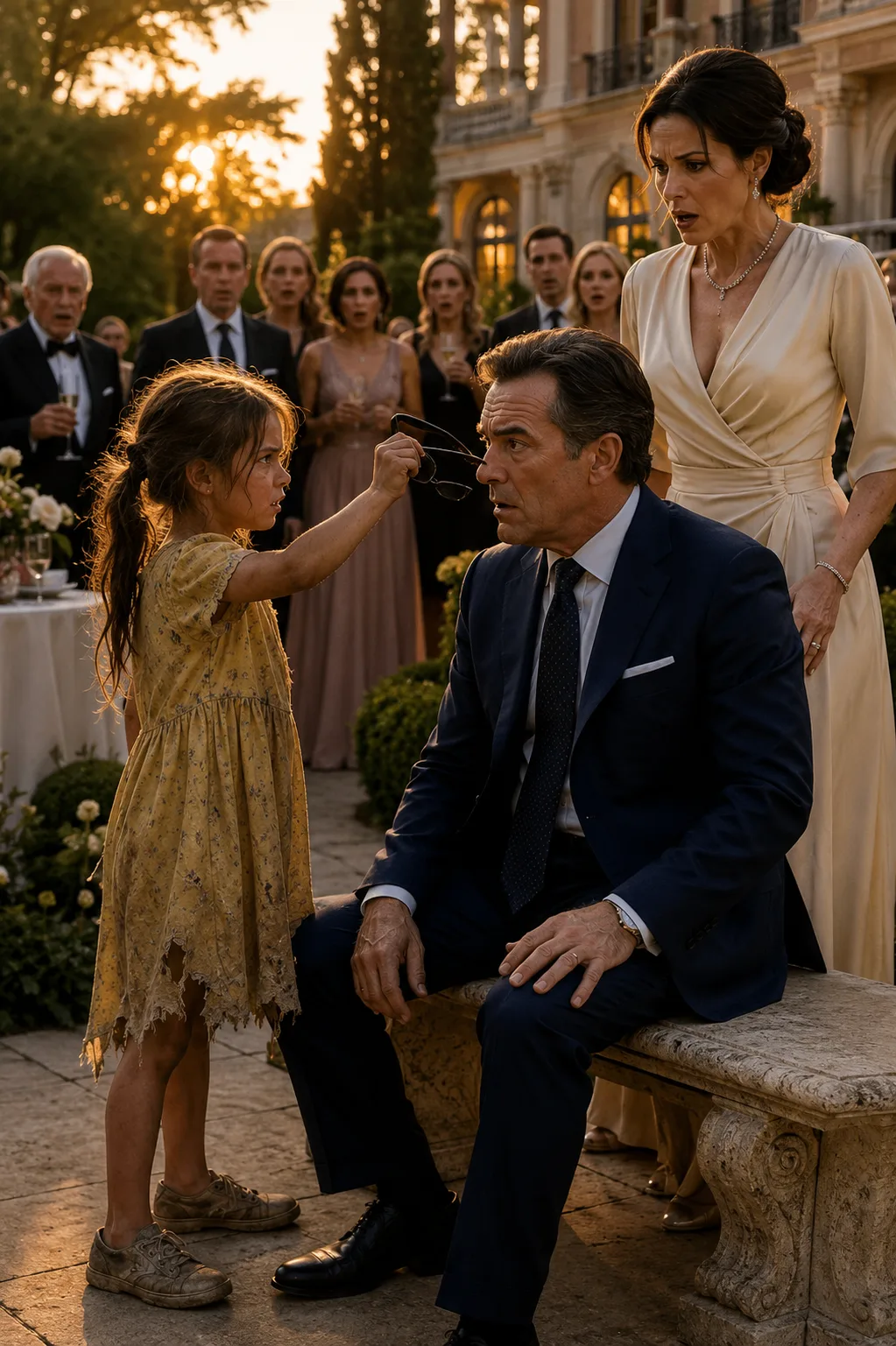
She was fast because fear had made her fast. She reached the stone bench with both hands raised, not like she wanted to fight, but like she had to break through glass no one else could see.
Arthur turned his face toward her.
For one second, he saw her clearly.
Dust on her cheek. Torn yellow sleeve. Eyes fixed not on him, but on the cup beside him.
Then her palm struck his forehead.
SMACK.
The sound cracked open the garden.
Arthur jerked back.
Not from pain.
From the force of the impossible becoming public.
The girl stood inches from him, breathing hard.
“You’re NOT blind!”
No one moved.
Arthur heard the sentence travel through the guests. Not repeated. Absorbed. It landed in mouths, throats, hands gripping glass stems.
Elena reached for the child.
“You filthy little—”
The girl grabbed Arthur’s sunglasses.
Her fingers caught the frame.
Arthur could have stopped her.
He did not.
She ripped them from his face.
The sunset hit his eyes.
For a moment, the garden blurred gold and white. Faces sharpened in pieces. Henry near the fountain with his mouth open. The photographer behind a cluster of guests. The doctor from the hospital board turning pale under his summer tan.
Elena stood beside him.
Arthur looked at her.
Not near her.
Not past her.
At her.
The first gasp came from a woman in pink.
Then another.
Then a low sound moved through the crowd, the ugly sound polite people make when their manners fail.
Elena’s lips parted.
Arthur saw the calculation start and fail behind her eyes.
The girl pointed at her.
“It’s your wife.”
Arthur remained seated.
“What are you saying?”
His voice came out low. Rougher than he intended. The garden seemed to lean toward the answer.
The girl reached into the pocket of her dress.
Elena moved.
Arthur lifted one hand.
“Stay where you are.”
Elena stopped.
The child pulled out a spoon.
Tiny. Silver. Tarnished along the bowl where small fingers had rubbed it again and again. The crest on the handle caught the light.
Arthur’s crest.
His family crest.
The same one engraved above the east gate. The same one stamped into the wax seals in his office. The same one on the spoon that belonged to the private tea service kept in Elena’s sitting room.
He knew that spoon.
A man could forget faces.
He would not forget silver he had eaten with since childhood.
“She puts it in your tea,” the girl said.
Arthur looked from the spoon to the cup.
The tea sat untouched on the small table beside him.
Elena’s fingers opened and closed once against her dress.
Henry stepped forward. “Arthur?”
No one else spoke.
The girl held the spoon out with both hands.
Arthur took it.
The metal was warm from her grip.
“What is your name?” he asked.
The child blinked at him as if no one had asked her that in a long time.
“Mara.”
Elena made a sound. Not a word. Just air.
Arthur turned his head toward her.
“You know this child?”
“No.”
Too fast.
Arthur stood.
The cane remained against the bench.
Without it, the guests saw his height. His balance. The lie Elena had polished for two years began to come apart in front of every donor, cousin, doctor, and servant she had invited.
Arthur held up the spoon.
“You said the private service was locked away.”
“It is.”
“This spoon was not stolen from the dining room.”
Elena’s gaze flicked toward the tea.
Arthur followed it.
There.
A crack.
Small, but enough.
Mara stepped closer to Arthur’s side. She did not hide behind him. She stood with the stubborn courage of someone who had spent too much of life being moved aside and had finally chosen a place.
“She told the man at the gate I was lying,” Mara said. “She said if I came back, they’d send me away.”
Elena turned on her. “You don’t belong here.”
The words came sharp.
Too sharp.
Every guest heard the real Elena for the first time.
Arthur’s hand closed around the spoon.
“Why were you here?” he asked Mara.
Mara looked at the cup again.
“My mother worked in the clinic. Before she got sick. She cleaned rooms at night.” Her voice shook, but each word landed. “She said a lady came there with little bottles. She said the bottles were not medicine for eyes.”
Elena laughed once.
It sounded wrong.
“A child repeating nonsense from a sick woman.”
Mara pulled something else from her pocket.
A folded paper.
Dirty at the edges. Creased many times. She held it out.
Arthur took it carefully.
He could not read all of it in the fading light. The letters swam, then sharpened. A clinic inventory sheet. No official stamp, but the handwriting was familiar from hundreds of household notes.
Elena’s handwriting.
Arthur lifted his eyes.
Elena had stopped breathing through her nose. Her chest barely moved. One earring trembled against her neck.
“What did you poison me with?” Arthur asked.
The question did not need volume.
It cut cleanly enough without it.
The garden gave Elena nothing to lean on.
No music.
No chatter.
No graceful exit.
She looked at the doctors first. Then Henry. Then the guests. Last of all, Arthur.
“You’re confused,” she said.
Arthur almost smiled.
There it was.
The old rope.
Confused.
Tired.
Unwell.
He stepped toward her.
“No.”
Elena swallowed.
Arthur held the spoon between them.
“For two years, I let you speak for me because I wanted to know how far you would go.”
The guests shifted.
Henry whispered something under his breath.
Elena’s face hardened. The softness fell away from it like a veil dropped onto the grass.
“You let me?” she said.
Arthur said nothing.
“You sat in that chair,” she continued. “You signed what I put in front of you. You let them all pity you.”
“I signed nothing that mattered.”
Elena’s eyes flickered.
Arthur reached into the inside pocket of his suit and pulled out a small recorder.
Not new. Not sleek. An old device Marcus had given him when Arthur first began forgetting names after the medication started. Elena had never checked the cane. Never checked his pockets. She had believed blindness made him harmless.
Arthur pressed a button.
Elena’s voice came from the tiny speaker.
Not loud, but clear enough.
“He won’t challenge it. By next quarter, the board will accept my authority. His condition makes it simple.”
Another voice followed. Male. One of the doctors.
“And if his vision returns?”
Elena answered.
“It won’t.”
The guests froze differently this time.
Before, they had witnessed scandal.
Now they heard conspiracy.
Elena reached for the recorder.
Arthur pulled it back.
“No.”
The doctor near the fountain turned and tried to leave.
Henry blocked his path.
“Stay,” Henry said.
Mara kept her eyes on the ground. Her hands were fists at her sides.
Arthur noticed mud on her shoes. One lace missing. A bruise-colored smudge near her wrist. He did not ask about it there, not in front of them. Some questions did not belong to crowds.
Elena lifted her chin.
“You recorded private conversations.”
“You drugged my tea.”
“You have no proof of that.”
Arthur looked at the cup.
Then at the spoon.
Then at the child.
“I have enough to start.”
A police siren sounded beyond the gate.
Elena’s composure cracked at last.
Not fully. Women like Elena did not collapse. They adjusted. They reached for the next room, the next lie, the next person who might still believe them.
But her hand shook when she touched the necklace at her throat.
The siren came closer.
Arthur glanced toward the terrace.
Marcus stood there.
Older now. Gray at the temples. Wearing a plain black suit instead of a valet’s jacket. Beside him were two uniformed officers and a woman from the district attorney’s office.
Elena stared.
“You,” she said.
Marcus looked at Arthur, not at her.
“You asked me to come back if the garden party happened.”
Arthur nodded once.
Mara looked between them.
She did not understand all of it. Not yet.
Arthur had not known about her paper. He had not known what she carried. He had planned to expose Elena with recordings, doctors, financial documents, and enough witnesses to keep her from burying the truth in private.
But Mara had done what no adult in the garden had dared to do.
She had broken the performance before it could finish.
An officer approached Elena.
“Mrs. Hale, we need to ask you some questions.”
Elena gave Arthur one last look.
Not love.
Not regret.
A look like a locked drawer being forced open.
“You think this saves you?” she said.
Arthur looked at the tea cooling beside the bench.
“No.”
That answer seemed to confuse her more than anger would have.
The officers led her away from the center of the garden. No handcuffs at first. Just one officer on each side, their presence enough to ruin every photograph she had planned.
The guests parted.
No one touched her.
No one defended her.
The woman in pearls who had called her devoted stared at the stone path.
The photographer lowered his camera.
Arthur sat back down on the bench.
His knees had begun to weaken. The world sharpened and blurred in pulses. Sunset cut through the trees in bright strips. The mansion windows burned gold behind the guests.
Mara stood near him, still holding the sunglasses.
She looked down at them as if they were some dead insect she had killed by accident.
Arthur held out his hand.
She placed them in his palm.
“You should have told someone sooner,” he said.
Mara’s mouth tightened.
“I tried.”
Two words.
Arthur accepted them.
Marcus came down the terrace steps and stopped beside the bench.
“Sir.”
Arthur looked up.
For the first time in two years, Marcus saw his eyes without dark glass between them.
Neither man spoke for a while.
Then Arthur turned to Mara.
“Where is your mother?”
Mara’s fingers twisted the torn edge of her dress.
“She died.”
The garden, which had already endured too much silence, found one more.
Arthur closed his hand around the sunglasses until the frame pressed into his palm.
Elena had not only aimed at him.
Her poison had spread farther. Into clinics. Into workers. Into people no one at the party had noticed until one of them ran across the lawn in a faded yellow dress and slapped the truth into daylight.
Arthur looked at Marcus.
“Find out where she’s staying.”
Mara stepped back.
“I’m not going anywhere with police.”
“No police,” Arthur said.
She watched him.
Arthur removed the crest spoon from his other hand and held it out to her.
“This belongs to you now.”
Mara frowned.
“It’s yours.”
“You brought it back to the right place.”
She did not take it.
Arthur set it gently on the stone bench between them.
The officers questioned guests for another hour. The party dissolved without anyone announcing it. Cars rolled down the long drive one by one. Champagne sat unfinished on white tables. The violinist packed his instrument with shaking hands.
By dark, the garden looked less like a magazine cover.
Flowers sagged in the heat. A broken glass still glittered near the fountain. Tea had gone cold in the cup Elena never got to finish serving.
Arthur remained outside after everyone left.
Marcus brought a blanket and placed it over his shoulders without asking.
Old habits.
Mara sat at the far end of the bench with a sandwich wrapped in a linen napkin. She ate like someone afraid the food might be taken away. Small bites. Fast hands. Eyes on the paths.
Arthur did not tell her to slow down.
The mansion lights came on one by one.
Inside, rooms Elena had controlled waited to be opened. Cabinets. Ledgers. Locked drawers. Names of doctors. Names of payments. Names of people who had looked away because the money was clean and the silence was convenient.
Arthur knew the work ahead would not be neat.
There would be courtrooms. Statements. Headlines. Doctors who denied everything. Board members who claimed ignorance. Guests who would retell the slap as if they had always suspected something was wrong.
No one ever admits they were fooled.
They only say they had doubts.
Mara finished half the sandwich and wrapped the rest carefully.
Arthur looked at the spoon on the bench.
The crest had caught a bit of moonlight.
“My father had that crest put on everything,” he said.
Mara said nothing.
“He thought a family name meant something.”
“Does it?”
Arthur watched the dark garden.
“It should.”
Mara reached for the spoon at last.
She picked it up and held it in her lap, not like treasure, not like proof, but like a small thing she had carried too far to drop now.
Arthur put the sunglasses beside him.
He would need them again tomorrow, maybe for the headaches, maybe for the cameras, maybe for the world that preferred men like him either powerful or pitied, never damaged in between.
But not tonight.
Tonight, the garden was dark.
And Arthur Hale kept his eyes open.
Chapter complete
You have reached the end of this chapter.
Continue reading
A few more worlds to get lost in after this chapter.




