The Ghost Walker Came Home
The first thing my father noticed was not my face.
Chapter 1
The Ghost Walker Came Home
The first thing my father noticed was not my face.
It was the badge on my chest.
He stood near the front of the memorial chapel in a black suit that looked more expensive than sincere, one hand tucked into his pocket, the other wrapped around a glass of water he hadn’t touched. Behind him, the room was filled with folded flags, polished shoes, quiet sobs, and the kind of silence that only comes when a family is pretending not to fall apart.
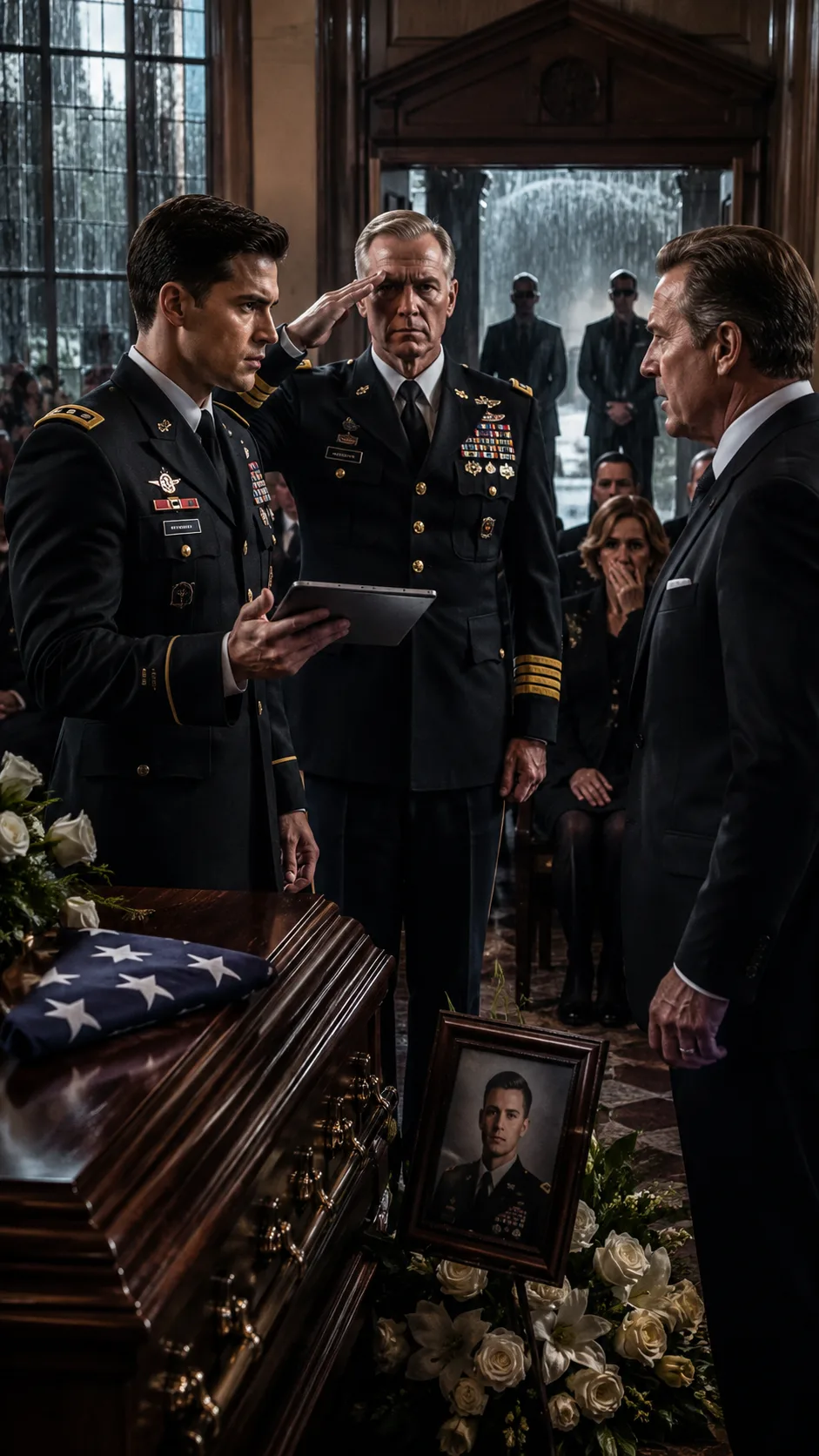
My brother’s photograph stood beside the casket.
Ryan Carter.
Twenty-nine years old.
A soldier.
A son.
A brother.
A man who had always known how to smile even when the whole world was cracking underneath him.
In the picture, he was wearing his dress blues, his shoulders straight, his eyes bright, his grin too alive for a room like this. A folded American flag rested in front of the frame. White lilies surrounded it like they were
trying to hide the fact that the man in the photo would never walk into this room again.
I stopped at the back of the chapel.
For a few seconds, I couldn’t move.
Not because of the uniforms.
Not because of the casket.
Because for the first time in ten years, I was home.
And Ryan wasn’t.
My mother sat in the front row, small and stiff in a dark navy dress. Her hands were clasped so tightly in her lap that her fingers had gone pale. My aunt sat beside her, whispering something into her ear, but my mother didn’t seem to hear. Her eyes never left Ryan’s photograph.
Then my father turned.
His gaze landed on me.
For one second, something flickered across his face. Recognition, maybe. Surprise. Maybe even fear.
Then his eyes dropped to my uniform.
And he laughed.
Not loudly at first. Just a sharp
breath through his nose, like he’d seen a bad joke wearing medals.
“You?” he said.
The people closest to him turned.
My father’s voice rose, just enough for the first few rows to hear.
“A soldier?”
He looked me up and down like I was a stranger who had wandered into the wrong funeral.
“Stop pretending.”
The words hit hard.
Not because they were new.
Because they sounded exactly like home.
I swallowed once.
I had heard worse from him.
At sixteen, when I missed a football tryout to stay with my sick mother, he called me weak.
At eighteen, when I left with a duffel bag and no plan except escape, he said I wouldn’t last a month.
At twenty-two, when I stopped calling, he told Ryan I was probably dead in a ditch somewhere.
And now, standing at my brother’s memorial in a real uniform with a real
badge and real blood behind every mark on my chest, he still looked at me like I was nothing.
But I hadn’t come for him.
I came to bury my brother.
So I walked forward.
Each step felt heavier than the last. Soldiers I didn’t recognize watched me pass. Some of them straightened. A few looked away, not because they didn’t know me, but because they did.
My father noticed that.
His mouth tightened.
He leaned toward me as I reached the front row.
“Don’t embarrass us,” he muttered.
I kept my eyes on Ryan’s photograph.
“I’m not here for you.”
He gave a quiet snort.
“You’re here to play dress-up.”
I didn’t answer.
There were some men you could fight.
There were some men you could reason with.
And then there was Frank Carter.
My father had built his whole life on control. His house, his business, his family, his reputation—everything had to bend toward the version of himself he wanted the world to believe. He was generous in public and cruel in private. He donated to veterans’ charities while mocking his own sons behind closed doors. He shook hands with pastors, judges, businessmen, and soldiers, then came home and told Ryan and me we were lucky he allowed us to carry his name.
Ryan had carried it better than either of us.
That was the worst part.
My brother had stayed.
Even when I left.
Even when Frank got meaner.
Even when Mom stopped speaking during dinner because silence was safer.
Ryan stayed because he believed families could be repaired.
I left because I knew some houses were built to trap people.
The pastor stepped up to the front.
The chapel settled.
A soft hymn played from hidden speakers. Rain tapped against the stained-glass windows. The American flag near the altar stood perfectly still.
The pastor began speaking about honor.
Duty.
Sacrifice.
Ryan’s service.
Ryan’s laughter.
Ryan’s loyalty.
My mother pressed a tissue to her mouth.
I stared at the casket and tried to breathe normally.
I had survived black valleys, burning convoys, storms of gunfire, rooms where one wrong shadow meant death. I had crawled through smoke with another man’s blood drying on my sleeve. I had walked into places my country would never admit existed.
But nothing had prepared me for seeing my little brother inside a box.
Then my father’s voice cut through the chapel.
“A hero?”
The pastor stopped.
The room froze.
Frank Carter stood near the aisle, his face twisted with something uglier than grief.
He looked at Ryan’s photo.
Then at the casket.
Then he scoffed.
“He was just a useless dead man.”
My mother made a sound I will never forget.
Half sob.
Half broken breath.
Every head in the chapel turned.
A few soldiers shifted in their seats. One older man in uniform lowered his eyes. Another clenched his jaw so tightly the muscle jumped beneath his skin.
My hands curled at my sides.
For a moment, I was no longer a soldier.
I was just a brother.
And I wanted to cross that aisle.
I wanted to grab my father by his perfect black collar and ask him how a man could stand beside his own son’s casket and still need to win.
But before I moved—
Boots.
Measured footsteps echoed from the second row.
Slow.
Heavy.
Certain.
A tall man in full dress uniform rose from his seat. Every soldier in the chapel seemed to recognize him at once. Backs straightened. Faces changed. The air shifted.
He walked toward the front with calm authority.
Three stars gleamed on his shoulder.
General Marcus Vance.
I hadn’t known he was coming.
The last time I had seen him, smoke had blackened half his face, and his son had been unconscious over my shoulder as I dragged him out of a burning valley under enemy fire.
He stopped directly in front of me.
Not my father.
Me.
The chapel became so silent that I could hear rain sliding down the glass.
General Vance raised his hand.
A formal salute.
Deep.
Sharp.
Absolute.
“Welcome home,” he said.
Then he spoke the name no one in my family had ever heard.
“Ghost Walker.”
The room changed.
Not loudly.
No gasps at first.
Just a ripple of recognition through the military men seated around us. A shift in posture. A glance. A breath held too long.
My father stared at the General like the language had changed without warning.
I returned the salute.
“General Vance,” I said. “You didn’t have to come.”
His eyes moved to Ryan’s casket, then back to me.
“For the man who pulled my son out of a burning valley in the middle of a blackout?” he said. “I would have crawled here on my hands and knees.”
My father blinked.
“What is this?” he said.
Nobody answered him.
So he looked at me.
For the first time since I walked in, he didn’t look amused.
He looked unsure.
“Ghost Walker?” he repeated. “What does that mean?”
General Vance turned toward him.
“It means your son is the lead tactical specialist for one of the most classified operational units in the United States military.”
Frank’s mouth opened.
Nothing came out.
The General stepped closer.
“It means he has no public records because he does not officially exist. It means men in this room are breathing because of him. It means the badge you mocked is not a toy.”
My father’s face began to lose color.
“He’s a dropout,” Frank said, but the words came out weak. “He left home. He disappeared. We thought he was driving trucks somewhere.”
“No,” I said.
My voice was quiet.
The chapel heard it anyway.
“You thought I was nothing because that made the story easier for you.”
Frank turned on me.
“You don’t get to talk to me like that.”
I took one step toward him.
The entire front row tensed.
“You called my brother useless,” I said.
His lips pressed together.
“You said that because you thought he couldn’t answer.”
I moved closer.
“You said that because you thought I was still the boy who took it.”
Frank’s jaw worked.
“Grief makes people say things.”
“No,” I said. “Grief didn’t say that.”
The chapel stayed silent.
“Cruelty did.”
My mother looked up then.
Her eyes found mine.
For ten years, I had wondered if she blamed me for leaving. If she thought I abandoned Ryan. If she knew I had sent money through accounts that never carried my name. If she knew I had checked on her from places where phones weren’t supposed to work.
Her hands trembled in her lap.
I turned from my father and looked at her fully.
“Mom,” I said. “There’s something you need to know.”
Frank stiffened.
A tiny movement.
Almost nothing.
But I saw it.
Ghosts see everything.
I reached inside my dress jacket and pulled out a slim encrypted tablet.
My father’s eyes locked onto it.
There.
That was fear.
Not grief.
Not anger.
Fear.
“What is that?” he asked.
I didn’t answer him.
I tapped the screen once.
A file opened.
Numbers.
Transfers.
Names.
Routes.
Dates.
A web Ryan had died trying to pull into the light.
My mother whispered, “What’s going on?”
I walked to her slowly and knelt beside her chair.
“Ryan knew,” I said.
Her brow tightened.
“Knew what?”
I looked back at Frank.
The father who taught us to fear slammed doors.
The husband who smiled in public and made my mother shrink in private.
The man who spent years calling other men weak while hiding behind money that wasn’t clean.
“Ryan knew about the business Dad was running behind your back.”
Frank lunged.
He didn’t get far.
A man from General Vance’s detail stepped between us so fast my father stumbled backward. The aide didn’t raise his voice. He didn’t even look strained. He simply placed one hand against Frank’s chest and stopped him like a door closing.
My mother stood.
“What business?”
Frank pointed at me.
“He’s lying.”
I turned the tablet toward her.
“Ryan joined the service because he wanted clearance. Not just to serve. He wanted access. He wanted to find where Dad’s investments were really coming from.”
My father shook his head.
“Don’t listen to him.”
I tapped again.
A second folder opened.
“He found shell accounts.”
Another tap.
“Offshore transfers.”
Another.
“Names connected to men my unit has been hunting for six months.”
The chapel broke into whispers.
My mother covered her mouth.
“No,” she said.
I wished I could tell her no.
I wished I could tell her Ryan’s death had been clean. That it was an accident. That a bad road, bad timing, and bad luck took him from us.
But lies had already buried too much in this family.
“Ryan didn’t die in an accident,” I said.
My mother’s knees almost gave out. My aunt caught her arm.
Frank shouted, “Enough!”
His voice cracked.
That crack told the room more than any document could.
I stood.
“He was targeted because he found out you were laundering money for the same network my unit was tracking.”
“That’s not true!”
“He was going to testify.”
“No!”
“He was coming home to take Mom away from you.”
The words landed harder than any accusation before them.
My father stopped moving.
His eyes shifted to my mother.
For one second, the mask slipped completely.
And she saw him.
Not the grieving father.
Not the respected businessman.
Not the husband with perfect manners in public.
She saw the man Ryan had died trying to expose.
Frank’s voice dropped.
“Evelyn,” he said. “You know me.”
My mother stared at him.
Her hands lowered slowly from her mouth.
“I thought I did.”
He took a step toward her.
General Vance’s aide moved again.
Frank stopped.
Then he looked at me.
The hate in his face was old.
But now it was cornered.
“You did this,” he said. “You hated me, so you built a story.”
“I don’t have to build anything,” I said.
I lifted the tablet higher.
“I intercepted the order.”
The chapel went completely still.
Frank’s face went slack.
“I was too late for Ryan,” I said. “But I’m just in time for you.”
At the back of the chapel, the heavy oak doors opened.
No one turned at first.
Then the footsteps came.
Not military boots this time.
Dress shoes.
Four men in dark suits walked inside.
Federal agents.
The lead agent moved straight down the aisle.
Frank looked around like a trapped animal.
“No,” he whispered.
The agent stopped in front of him.
“Frank Carter,” he said, “you’re under arrest for conspiracy, money laundering, and treasonous facilitation.”
The handcuffs clicked.
That sound filled the chapel.
Louder than the rain.
Louder than the whispers.
Louder than my father’s excuses.
Frank’s face twisted. The arrogance vanished so completely that he looked smaller than I remembered.
He turned to my mother first.
“Evelyn, tell them.”
She said nothing.
Then he turned to me.
And for the first time in my life, my father begged.
“Son,” he said. “Please.”
I looked at him.
The man who told me I was weak.
The man who called my brother useless beside his own casket.
The man who broke our home and called it discipline.
He took one step toward me, but the agents held him firm.
“I’m your father,” he said.
I adjusted the badge on my chest.
The same badge he had mocked.
The same badge Ryan had once asked me about during a call I wasn’t supposed to make.
“Does it ever get heavy?” Ryan had asked.
I told him yes.
He laughed and said, “Good. Means it matters.”
I looked my father dead in the eye.
“My father died a long time ago,” I said. “Today, I’m just the man burying a hero.”
No one spoke as the agents led him down the aisle.
The chapel doors opened again.
Rain flashed silver beyond them.
Frank looked back once.
Not at Ryan.
Not at my mother.
At me.
Maybe he expected regret.
Maybe he expected guilt.
But ghosts don’t haunt the innocent.
They haunt the ones who thought the truth would stay buried.
When the doors closed behind him, the chapel remained silent.
Then General Vance turned toward Ryan’s casket.
He stepped forward, placed one gloved hand over his heart, and bowed his head.
One by one, every soldier in the room stood.
Every uniform.
Every officer.
Every man who had known what Ryan gave and what Frank tried to stain.
They saluted my brother.
My mother broke then.
Not loudly.
Her shoulders folded, and my aunt held her as she wept into both hands.
I walked to her and knelt beside her chair.
For years, I had been trained not to break. Not in fire. Not in darkness. Not when the mission went wrong. Not when men screamed. Not when the only way out was through.
But when my mother reached for me, I stopped being Ghost Walker.
I was just her son.
She pulled my head into her lap the way she had when I was a boy.
Her fingers touched my hair.
“Why didn’t you come home?” she whispered.
I closed my eyes.
“Because I thought leaving was the only way to survive.”
Her hand shook against my temple.
“And Ryan?”
My throat tightened.
“Ryan stayed because he thought he could save everyone.”
The chapel blurred.
For the first time in ten years, I let myself breathe without listening for danger.
“He saved me,” she whispered.
I looked at Ryan’s photograph.
His smile was still there.
Too bright.
Too alive.
Too much like goodbye.
“No,” I said. “He saved all of us.”
Later, after the service ended, I stood alone beside the casket.
The chapel had mostly emptied. The rain had slowed. The flag near the altar still hadn’t moved.
I placed my hand on the polished wood.
For a long time, I said nothing.
There were too many things to apologize for.
Too many calls missed.
Too many birthdays swallowed by classified silence.
Too many years when I told myself Ryan was safer because I stayed away.
Finally, I leaned down.
“You were the better man,” I whispered.
The room gave no answer.
Only rain.
Only silence.
Only the weight of a brother’s name.
Behind me, General Vance stopped near the aisle.
“We’ll make sure the record honors him properly,” he said.
I nodded.
“Thank you, sir.”
He studied me for a moment.
“And you?”
I looked at my mother waiting near the chapel doors, wrapped in my aunt’s coat, staring at me like she was afraid I might vanish again.
“I’m going home,” I said.
The General gave a small nod.
“For how long?”
I looked once more at Ryan’s casket.
Then at the badge on my chest.
Then at the woman who had lost one son and found another in the same room.
“As long as she needs me.”
General Vance said nothing.
He only saluted Ryan one final time and walked out.
I stayed until the chapel staff began dimming the lights.
Before I left, I removed one medal from my uniform.
Not the highest one.
Not the most secret.
Just the one Ryan had once joked looked “too shiny for someone who hated attention.”
I placed it beside his photograph.
Then I touched two fingers to the frame.
“Rest easy, little brother.”
At the doors, my mother waited.
Her eyes were red.
Her face looked older than it had that morning.
But when I reached her, she took my hand.
Not tightly.
Not desperately.
Just enough to remind me that I was real.
Outside, the rain had stopped.
The sky was still gray, but somewhere behind the clouds, light was pushing through.
My mother looked at my uniform, then at the badge.
“Ghost Walker,” she said.
A faint, broken smile touched her mouth.
“Ryan would have loved that.”
I looked back at the chapel.
At the flag.
At the door where my father had been taken away.
At the place where my brother’s truth had finally been spoken aloud.
“He knew,” I said.
My mother looked up at me.
“He always knew.”
Then we walked down the chapel steps together.
For the first time in ten years, I didn’t disappear.
And for the first time in my life, home didn’t feel like a place I had to survive.
It felt like a promise I was finally strong enough to keep.
THE END.
Chapter complete
You have reached the end of this chapter.
Continue reading
A few more worlds to get lost in after this chapter.




