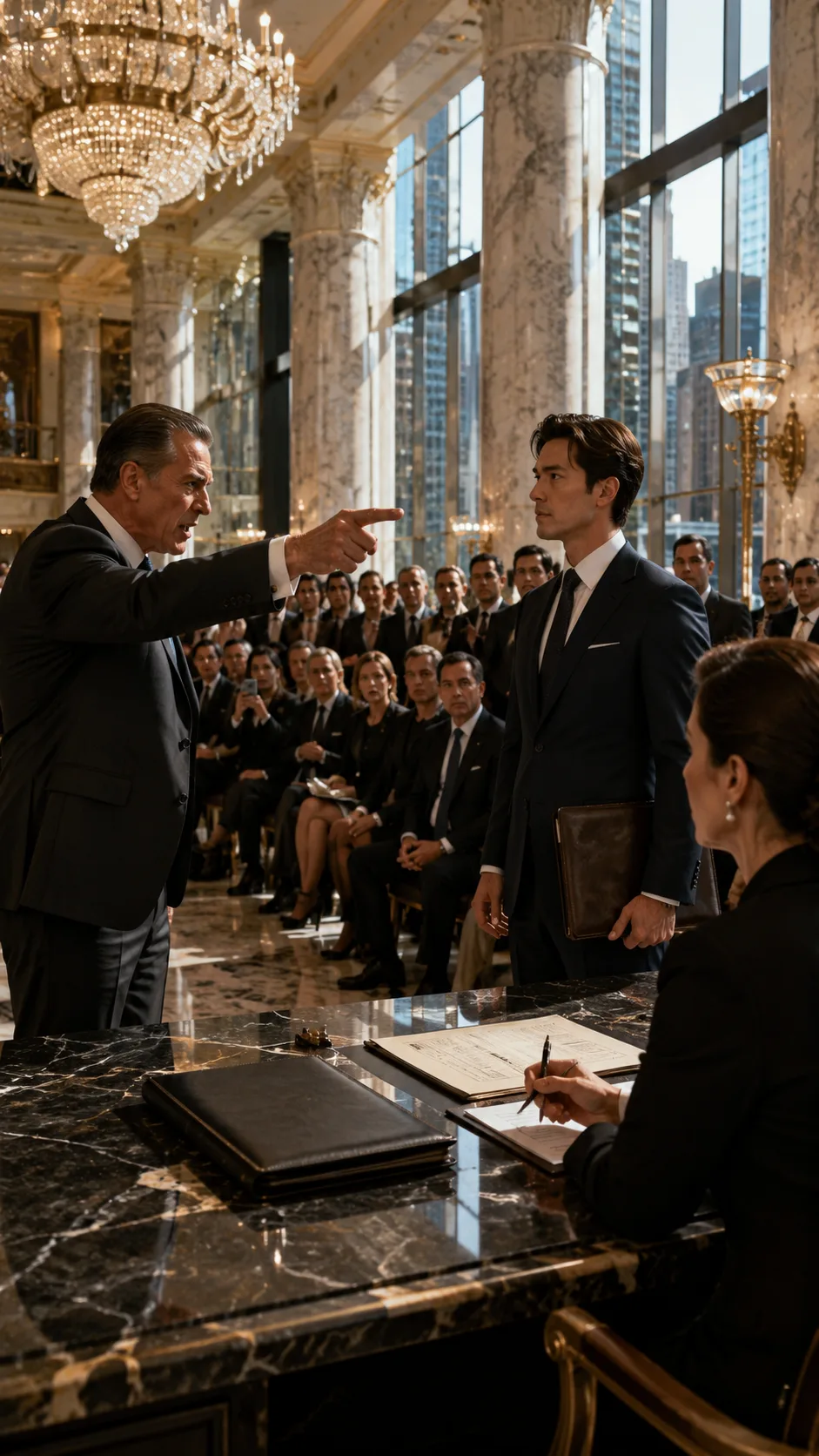
The first time Victor Lang pretended not to recognize me, he was standing beneath a crystal chandelier worth more than my annual salary.
Chapter 1
The first time Victor Lang pretended not to recognize me, he was standing beneath a crystal chandelier worth more than my annual salary.
He shook hands with investors.
Laughed at a joke someone else told.
Accepted compliments as if they belonged to him.
Then his eyes passed over me.
For half a second.
And kept going.
Like I was a stranger.
I stood near the concierge desk holding a worn leather portfolio that had belonged to my grandfather.
The corner was cracked.
The brass clasp no longer closed properly.
It looked out of place among tailored suits and polished marble.
That was fine.
I wasn't there to impress anyone.
I was there because my father had asked me to make a promise twenty-two years earlier.
And promises have a way of surviving longer than people.
The Grand Meridian Hotel dominated the center of downtown Chicago.
Thirty-four floors.
Four restaurants.
A rooftop ballroom.
Presidents had slept there.
Movie stars had celebrated there.
Entire careers had been built inside those walls.
The founder, Charles Whitmore,
liked to say the hotel wasn't a business.
It was a legacy.
People repeated those words after he died.
Most of them had no idea what he actually meant.
I knew.
Because my father had spent thirty-seven years working for him.
Not as an executive.
Not as a partner.
As head of maintenance.
The man who arrived before sunrise and left after midnight.
The man who knew every hidden pipe, every electrical panel, every locked room.
When guests looked up and admired the chandeliers, my father was the one who had spent nights hanging from scaffolding to repair them.
Nobody remembered men like him.
Except Charles Whitmore did.
That was the difference.
At least at first.
My father and Charles became friends in a way rich men and working men rarely do.
Not equals.
Not exactly.
But friends.
When I was a kid, Charles would stop me in the lobby
and hand me cookies from the kitchen.
He remembered birthdays.
Graduations.
Little things.
My father trusted him.
Completely.
Then everything changed.
Charles grew older.
The board grew larger.
And Victor Lang grew powerful.
By the time Victor became general manager, Charles was already slowing down.
He still owned the hotel.
But Victor controlled the day-to-day operations.
Employees feared him.
Investors admired him.
And gradually, Charles began disappearing from public view.
Victor never seemed concerned.
In fact, he seemed to thrive.
Three years before Charles died, my father came home carrying a sealed envelope.
I remember because he never carried paperwork home.
He placed it on the kitchen table.
Looked at it.
Then looked at me.
"If anything happens to me before Charles speaks publicly," he said, "you give this back to him."
I laughed.
"What is it?"
He shook his head.
"Not yet."
That answer irritated me.
But not enough
to argue.
A week later he repeated the instruction.
Then a month later.
Then again.
Always the same.
Protect the envelope.
Return it to Charles.
Nobody else.
Not lawyers.
Not management.
Not the board.
Only Charles.
I started treating it like a family joke.
Then my father had a stroke.
Everything changed after that.
He survived.
But barely.
The man who could repair entire electrical systems suddenly struggled to button a shirt.
Six months later he died.
The envelope remained.
Still sealed.
Still mysterious.
And Charles Whitmore never asked for it.
Not once.
Years passed.
I married.
Divorced.
Changed jobs.
Moved apartments twice.
The envelope sat inside a safe deposit box.
Sometimes I'd think about opening it.
I never did.
A promise is easier to keep when you don't know what's inside.
Then Charles Whitmore died.
And suddenly everyone wanted something.
Newspaper articles appeared.
Television interviews.
Speculation about ownership.
Inheritance.
Control.
The board announced a public ownership transition ceremony.
Victor Lang stood in front of cameras and promised stability.
Investors applauded.
Employees looked relieved.
I watched from my apartment.
And something felt wrong.
The next morning I visited the safe deposit box.
For the first time in twenty-two years, I opened the envelope.
Inside were two things.
A letter.
And a copy of a deed.
I read both three times.
Then a fourth.
Then a fifth.
By midnight I understood why my father had protected them.
And why someone desperately hoped they would never surface.
The deed showed a transfer of ownership.
Not complete ownership.
Not public ownership.
A controlling stake.
Enough to decide everything.
The transfer wasn't made to Victor.
Or the board.
Or Charles's relatives.
It was made to a trust.
A trust nobody seemed to know existed.
The letter explained why.
Twenty-seven years earlier, Charles Whitmore believed he was dying after emergency heart surgery.
He secretly created the trust.
Not for family.
For protection.
He feared people around him were positioning themselves to seize control after his death.
So he created a mechanism to prevent it.
Only four people knew.
Charles.
His attorney.
My father.
And one other person.
The attorney died years ago.
Charles never spoke publicly.
My father kept the documents.
That left only one remaining witness.
And I had no idea if that person was still alive.
For two weeks I searched.
Phone calls.
Old employee records.
Retirement databases.
Dead ends.
Then finally I found her.
Margaret Ellis.
Former corporate secretary.
Eighty-two years old.
Living in a small assisted-living community outside Rockford.
She remembered everything.
More importantly, she had copies.
Not originals.
Copies.
Enough to verify dates.
Enough to confirm signatures.
Enough to tell me something else.
Charles had signed two deeds.
Everyone knew about the first.
Nobody talked about the second.
The second changed everything.
"You need to be careful," she told me.
"Why?"
She stared out the window.
"Because Victor knows the first deed exists."
My stomach tightened.
"And the second?"
She didn't answer immediately.
Then she smiled without humor.
"He spent twenty years making sure nobody found it."
That was the moment the story stopped being about inheritance.
It became something else.
A cover-up.
A long one.
The hearing was scheduled for Friday.
Three days away.
I barely slept.
Every time my phone rang, I wondered who had learned what.
Every time a car slowed near my building, I looked outside.
Nothing happened.
That almost made it worse.
By Friday morning the city felt normal.
People bought coffee.
Traffic crawled.
Dogs barked.
Meanwhile an entire empire sat balanced on paperwork hidden for decades.
I arrived at the Grand Meridian ninety minutes early.
Victor was already there.
Talking.
Smiling.
Performing.
The lobby had been transformed.
Rows of chairs.
Media platforms.
Temporary tables.
Flowers.
Banners.
Everything designed to look inevitable.
I spotted Margaret seated near the back.
Then someone else.
Harold Simmons.
Former accountant.
Retired.
Then another.
And another.
Old employees.
People from the past.
People Victor probably wished had stayed forgotten.
The closer noon approached, the more nervous he seemed.
Most people missed it.
I didn't.
Victor touched his cufflinks repeatedly.
Checked his watch every few minutes.
Drank water.
Then drank more.
Tiny cracks.
Nothing obvious.
Enough.
The hearing began exactly at noon.
Judge Eleanor Hayes presided over the process.
Respected.
Methodical.
Impossible to intimidate.
Victor opened with prepared remarks.
He thanked everyone.
Celebrated Charles.
Praised continuity.
Promised prosperity.
The audience applauded.
Everything unfolded exactly as planned.
At first.
Then the judge requested final ownership documentation.
Victor presented the first deed.
The one everyone expected.
The one naming the transition structure already announced publicly.
The board relaxed.
Investors smiled.
Reporters prepared closing notes.
And then Judge Hayes asked a simple question.
"Are there any additional claims?"
Victor answered instantly.
"No."
Too fast.
I stood.
The room shifted.
Only slightly.
But it shifted.
Victor's face changed immediately.
He recognized the portfolio.
Not me.
The portfolio.
My father's.
And suddenly he knew.
Not everything.
Just enough.
"Sit down," he said.
I didn't.
The judge looked at me.
"Do you have something relevant to present?"
"Yes."
Victor stepped forward.
Too quickly.
"No, he doesn't."
Every camera turned.
Every head followed.
The room that had belonged entirely to Victor for an hour began slipping away.
Inches at a time.
He pointed directly at me.
"You have no claim here."
Silence.
Then another step.
"You were never part of this."
More silence.
Investors exchanged glances.
The reporters sensed blood in the water—not literal blood, but conflict.
The thing cameras love most.
I opened the portfolio.
Victor stopped moving.
I removed the letter first.
Then the deed.
Neither looked impressive.
Old paper rarely does.
The judge accepted both.
Read quietly.
Turned a page.
Then another.
Then stopped.
Her expression didn't change.
That somehow made it worse.
Victor attempted a smile.
Failed.
The judge requested archival records.
An assistant retrieved them.
The wait lasted less than three minutes.
It felt like thirty.
The entire lobby watched.
Nobody spoke.
The assistant returned carrying a thin storage box.
Dust clung to the edges.
Forgotten history.
The judge compared documents.
Checked signatures.
Dates.
Witness statements.
Then she requested a magnifier.
Victor sat down.
Then stood again.
Then sat.
The confidence was gone.
Now came calculation.
Desperation.
He knew.
Or at least suspected.
Margaret stood.
Harold stood.
Another former employee stood.
One by one.
Not speaking.
Just standing.
A silent confirmation.
The room noticed.
The room always notices.
Judge Hayes reached the final page.
The second deed.
The real one.
The document Charles Whitmore had never publicly disclosed.
Her pen hovered above the table.
Then stopped.
A tiny movement.
Enough to change everything.
Victor saw it.
I saw it.
Everyone saw it.
The judge lowered the pen.
Looked toward Victor.
Then toward me.
Then back at the deed.
And finally spoke.
"This deed supersedes the ownership structure currently before the court."
The room froze.
Completely.
Victor blinked.
Once.
Twice.
Nothing else moved.
Judge Hayes continued.
"The controlling interest was transferred twenty-seven years ago under a protected trust."
The reporters exploded into motion.
Pens.
Phones.
Cameras.
Questions.
Victor stepped forward.
"No."
One word.
Small.
Useless.
The judge ignored him.
"The trust remains valid."
Another pause.
Then the sentence.
The sentence that ended everything.
"The designated trustee is Daniel Carter."
Me.
The room turned.
Every face.
Every camera.
Every investor.
All at once.
Toward me.
Victor's hand dropped to his side.
The same hand that had pointed at me minutes earlier.
Nobody looked at him now.
Not a single person.
Power doesn't disappear gradually.
Sometimes it leaves a room all at once.
This was one of those times.
The trust granted operational control.
Voting authority.
Executive oversight.
The ability to appoint or remove management.
Victor understood immediately.
His face told the story.
Not panic.
Worse.
Recognition.
He had spent decades climbing toward a destination that vanished in one sentence.
Questions followed.
Lots of them.
Why had the trust remained hidden?
Why hadn't Charles announced it?
Why had nobody known?
Margaret answered some.
Harold answered others.
The truth emerged piece by piece.
Charles never intended the trust to remain secret forever.
He planned to reveal it publicly.
Then his health deteriorated.
Years passed.
Circumstances changed.
And people around him—including Victor—benefited from the silence.
Nobody could prove Victor had hidden documents.
Nobody needed to.
The second deed existed.
That was enough.
The hearing ended less than an hour later.
The lobby looked different afterward.
Same marble floors.
Same chandeliers.
Different gravity.
Reporters surrounded attorneys.
Investors held emergency meetings.
Board members whispered in corners.
Victor stood alone near the staircase beneath Charles Whitmore's portrait.
No audience.
No followers.
No applause.
Just a man and a painting.
For a moment I considered speaking to him.
I didn't.
There was nothing left to say.
Outside, rain had started.
A light spring rain.
The kind people barely notice.
Margaret approached before leaving.
"You kept the promise."
I looked down at the portfolio.
My father's portfolio.
The worn corner.
The broken clasp.
The thing Victor had recognized before he recognized me.
"I almost opened it years ago."
She laughed softly.
"But you didn't."
"No."
"That's why your father chose you."
Then she left.
Three months later the board voted unanimously to restructure management.
Victor retired.
Officially.
Quietly.
Without speeches.
Without ceremonies.
The newspapers moved on to other stories.
They always do.
The trust remained.
The hotel remained.
And for the first time in decades, the people who had actually built the place were invited back for recognition.
Maintenance workers.
Housekeepers.
Bellmen.
Accountants.
The invisible people.
The first event I hosted as trustee wasn't a gala.
It wasn't a fundraiser.
It wasn't an investor dinner.
It was an employee reunion.
Hundreds attended.
Old photographs covered the ballroom walls.
Near the entrance stood one framed picture of my father standing beside Charles Whitmore during a renovation project.
Most guests walked past it.
A few stopped.
Smiled.
Told stories.
That was enough.
Late that night, after everyone left, I stood alone in the lobby.
The same spot.
The same chandelier.
The same marble floor.
I could still picture Victor pointing.
Could still hear the certainty in his voice.
You were never part of this.
Funny thing.
My father had been part of it all along.
The city just didn't know it yet.
I looked up at Charles Whitmore's portrait.
Then at the hotel around me.
The lights glowed softly across polished stone.
A maintenance cart rolled quietly through the hallway.
And somewhere above me, someone was changing a lightbulb.
Exactly the way my father once did.
The building remembered.
That was enough.
Chapter complete
You have reached the end of this chapter.
Continue reading
A few more worlds to get lost in after this chapter.




