Daniel Vale arrived at the chapel twelve minutes late, and the first person to notice was the man in the coffin.
Chapter 1
Daniel Vale arrived at the chapel twelve minutes late, and the first person to notice was the man in the coffin.
Not really, of course. Thomas Vale could not notice anything anymore.
But his framed photograph stood beside the white lilies near the front, angled toward the aisle in a way that made Daniel feel watched from the second he stepped through the heavy wooden doors. The photo had been taken six years earlier at some church picnic Daniel had not attended. Thomas wore a charcoal sweater over a collared shirt, his gray hair neat, his smile small and uneven, like he had been caught between laughing and apologizing for it.
Daniel stopped just inside the entrance.
A woman in the last pew turned around. Then another. Black coats shifted. A cough died quickly. Someone’s purse clasp clicked shut.
He had told himself he would not make a scene.
He had flown in from Seattle that morning, changed in the airport bathroom, and taken a rideshare straight to Saint Matthew’s because
missing the funeral would have become its own statement. He knew his mother’s sister would notice. He knew Thomas’s church friends would whisper. He knew every person in that chapel already had an opinion about him.
The son who never came home.
The boy Thomas raised.
The man who still called him Thomas.
Daniel walked down the aisle with his black tie slightly crooked and his carry-on suitcase left somewhere near the entrance because he had not seen a place to set it down. His shoes sounded too loud against the stone floor.
His mother sat in the front pew.
Linda Vale did not turn around.
She held a folded tissue in both hands and stared at the coffin as if she could keep it closed by looking hard enough. Her shoulders were smaller than Daniel remembered. That bothered him, so he looked away.
A white-haired woman he recognized from
childhood touched his sleeve as he passed.
“Daniel.”
He nodded once.
No hug.
The first pew had space beside his mother. He did not take it. He sat behind her, close enough to be seen as family but not close enough to be useful. The pew was polished smooth beneath his hands. There was a small nick carved into the wood near his knee, shaped like half a moon.
He remembered doing that with a house key when he was nine.
Thomas had caught him.
Daniel had expected yelling. Instead Thomas had sat beside him and said, “If you’re going to damage church property, at least make it look like art.”
Daniel had laughed before he could stop himself.
He did not laugh now.
The pastor was speaking when Daniel came in. Something about steady hands, quiet service, a man who gave more than he took. The kind of sentence
that belonged to every funeral and nobody in particular.
Then the pastor said Thomas’s name, and Daniel’s jaw tightened.
Thomas Edwin Vale.
A good man.
A devoted husband.
A father in every way that mattered.
Daniel looked down at his hands.
There it was.
Every way that mattered.
People loved saying that when they wanted to erase the one way that did.
Thomas had married Linda when Daniel was six years old. Daniel’s real father, Michael Grant, had already been gone for eight months by then, though Linda never used the word abandoned. She said gone. Traveling. Sorting himself out. Needing time.
Thomas never corrected her.
He moved into the small yellow house on Burden Street with two suitcases, one toolbox, and a coffee mug that said WORLD’S OKAYEST ACCOUNTANT. He fixed the kitchen cabinet that had hung crooked since Daniel could remember. He learned which cereal Daniel liked. He drove him to school, soccer, dentist appointments, birthday parties, emergency rooms, music lessons, and later to the train station when Daniel left for college and said he would rather go alone.
Thomas never forced the word Dad.
That was part of the problem.
He waited for it like a man waiting at a bus stop in bad weather, pretending he did not mind how long it took.
Daniel never gave it to him.
The service moved on.
A choir of four sang from the corner, their voices thin but careful. Someone behind Daniel sniffed twice. The smell of lilies mixed with candle wax and old wood. A little boy in a black sweater kicked the pew in front of him once and was quickly stopped by his mother’s hand.
Daniel focused on small things.
The brass handles of the coffin.
The crease in the pastor’s robe.
His mother’s tissue tearing where her thumb pressed into it.
Anything except the photograph.
Near the end of the first hymn, Aunt Carol slid into the pew beside Daniel. She smelled like peppermint gum and rain. Her black hat had a small veil that she kept lifting away from her mouth.
“You came,” she said.
Daniel kept his eyes forward. “I said I would.”
“You didn’t answer your mother’s calls.”
“I was flying.”
“She called yesterday.”
The choir reached a higher note. Daniel watched the pastor lower his head.
Carol leaned closer. “She needed you.”
Daniel’s hand tightened around the edge of the pew. “She had him for thirty years.”
Carol looked at him.
The words had come out lower than he meant. Not loud. Still sharp enough.
Carol sat back. “Not today.”
Daniel almost said something worse.
He didn’t.
The pastor invited two people to speak.
First, a man named Warren from Thomas’s old office stood near the pulpit and told a story about Thomas staying late during tax season to help a junior employee who had made a mistake big enough to cost him his job. Thomas had taken blame for part of it, Warren said. He had always done that. Absorbed damage. Made it smaller before it reached someone else.
Daniel stared at the floor.
Then Mrs. Henley, the neighbor from Burden Street, stood with both hands on the microphone and spoke about the year Linda got sick. Daniel had been in college then. Thomas had cooked soup every Tuesday and brought trash bins back up every Thursday morning, not just for Linda but for half the block when snow came early.
“He never made people ask,” Mrs. Henley said.
Daniel looked up.
His mother’s head dipped.
Carol’s hand moved toward Linda’s shoulder and stopped before touching.
The pastor returned to the front and adjusted the microphone.
“Daniel,” he said.
Daniel’s name traveled through the chapel cleanly.
He had known this was coming. His mother had emailed him the order of service three days ago. He had not opened it until the plane. He had seen his name near the end and closed the message immediately.
Carol turned toward him. “You should.”
Daniel’s mouth went dry.
“I don’t have anything prepared.”
“Then don’t perform.”
That sounded like something Thomas would have said.
Daniel stood.
His knees felt unsteady for half a second, which annoyed him more than anything else. He buttoned his suit jacket, walked past his mother’s pew, and took the small microphone from the pastor’s hand.
The chapel looked different from the front.
Too many faces. Too many eyes ready to forgive him for grief he did not know how to show. The coffin stood to his right, close enough that he could smell the flowers on top of it.
He did not look at the photo.
He looked at the back wall.
“Thomas was a good man,” Daniel said.
The microphone made his voice sound flatter than it felt.
A few people nodded.
“He was patient. Reliable. He cared about my mother. He helped raise me.”
The word helped sounded small in the chapel.
Daniel heard it.
So did everyone else.
He could have stopped there. He should have handed the microphone back and sat down behind his mother like a decent person with a decent sense of timing.
But grief has a way of dragging old arguments into rooms where they do not belong.
Daniel looked toward the coffin then, not at the photo, but at the polished wood beneath the flowers.
“And I know people want this to be simple,” he said. “They want a clean story. They want me to stand here and say things I never said when he was alive.”
His mother’s head lifted.
Carol’s lips parted.
Daniel kept going.
“He was kind to me. I won’t deny that. He showed up. He did more than many men would have done.”
A cough sounded from the back pew.
Daniel swallowed.
“But he was not my father.”
No one moved.
The sentence did not echo. The chapel was too full of fabric and wood and bodies for that. It landed and stayed.
Daniel looked down at the microphone in his hand.
The worst part was that he believed it.
Or he had spent so long saying it that belief no longer mattered.
“My father was Michael Grant,” he said. “That doesn’t change because another man filled the space.”
His mother turned around.
Daniel did not meet her eyes.
“I respected Thomas,” he said. “I’m grateful for what he did. But I won’t rewrite the truth because he’s gone.”
He handed the microphone back.
The pastor took it with both hands.
Daniel walked to his seat, each step heavier than the last. The little boy in the black sweater stopped moving completely. An elderly woman in the second pew pressed her tissue to her mouth. Warren from the office looked at his shoes.
Linda had turned forward again.
Her shoulders did not shake.
That was worse.
Daniel sat behind her and unbuttoned his jacket.
Carol did not look at him.
The pastor cleared his throat. “Thank you, Daniel.”
The words sounded like mercy being forced through teeth.
He began the closing prayer.
People bowed their heads.
Daniel did not.
His eyes moved, despite himself, to the framed photo.
Thomas smiled from the frame like he had heard worse and forgiven it already.
Daniel looked away.
The prayer ended. The pastor invited everyone to remain seated while the immediate family had a final moment. The funeral director, Mr. Harris, stepped from the side of the room with the practiced calm of someone who knew how to guide people through the worst hour without touching anything too hard.
Daniel had met him once, three days earlier, over the phone.
Mr. Harris had a low voice and a habit of saying “your stepfather” with care, as if the word might cut someone if mishandled.
Now he stood beside the coffin with his hands folded.
The front pew began to shift. Linda did not stand. Carol reached for her, but Linda shook her head once.
Daniel stood because people expected him to.
He moved to the coffin, keeping distance between himself and the framed photo. The polished lid reflected a bent line of candlelight. White lilies lay across the top, too clean, too arranged.
His mother rose at last.
She placed her palm on the coffin. Not the fingertips. The full hand.
“Tom,” she said.
That was all.
Daniel looked at the floor.
Behind him, the mourners stayed silent, but not in the same way as before. Earlier, the room had been reverent. Now it was waiting.
Mr. Harris stepped closer.
“Mrs. Vale,” he said, “there’s one more item.”
Linda looked at him.
Daniel glanced up.
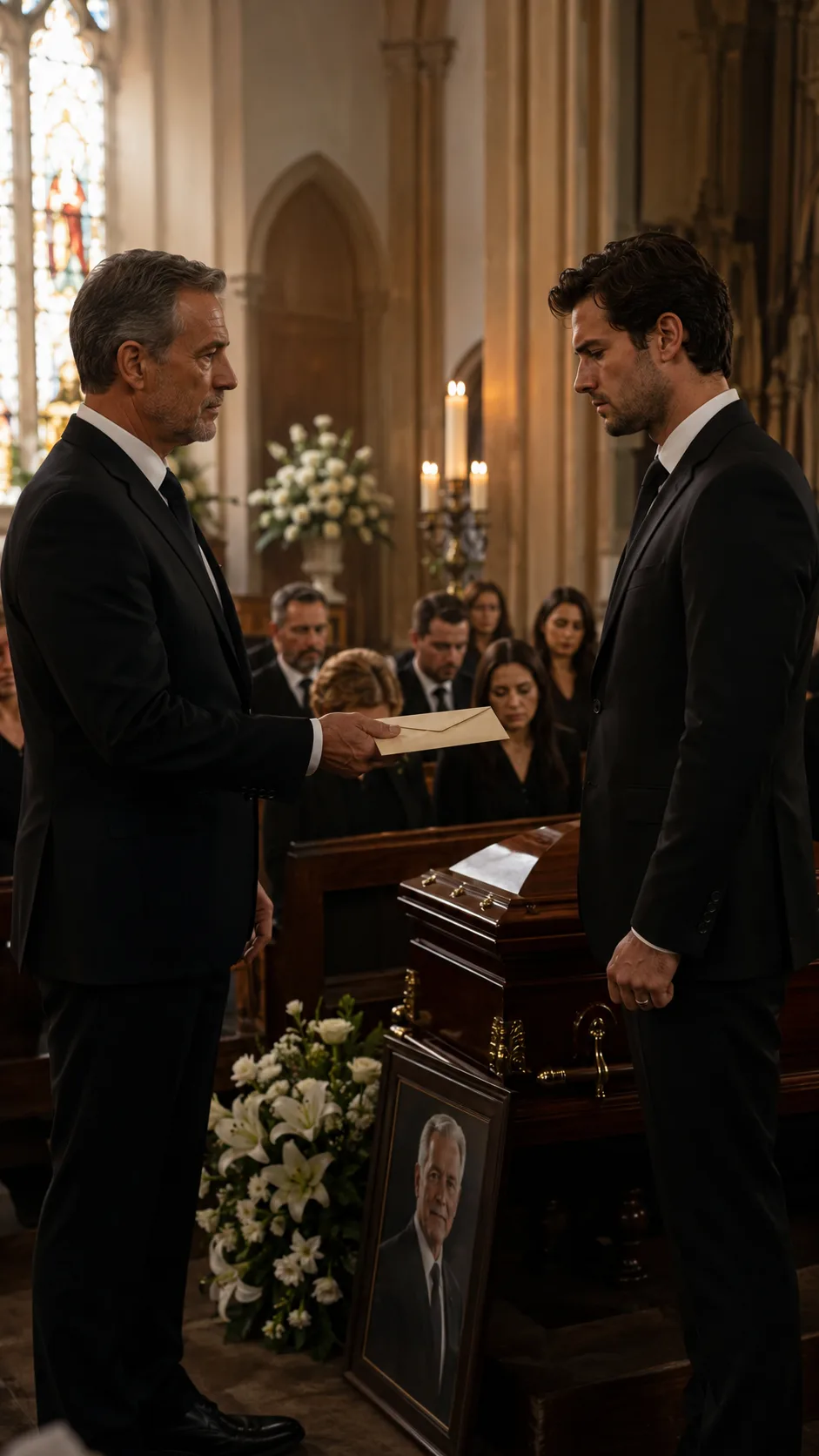
Mr. Harris reached inside his jacket and withdrew a cream envelope. It was sealed, unmarked except for Daniel’s name written across the front in Thomas’s careful block letters.
Daniel recognized the handwriting.
His stomach tightened.
Thomas had labeled everything like that. Christmas boxes. Fuse panels. Freezer bags. Receipts. Old jars of screws in the garage.
DANIEL.
All caps. Straight lines. No flourish.
Mr. Harris held the envelope out.
“Thomas asked me to give this to you after the service.”
Daniel did not move.
Linda’s hand stayed on the coffin.
Carol stood near the front pew, suddenly very still.
Daniel looked at the envelope and then at Mr. Harris. “You can mail it.”
“No,” Mr. Harris said.
It was the first hard word Daniel had heard from him.
A few people in the chapel lifted their heads.
Mr. Harris kept his arm extended. “He asked that you receive it here.”
Daniel gave a short breath through his nose. “That’s unnecessary.”
“He was specific.”
“I said mail it.”
Mr. Harris looked at the coffin.
Then back at Daniel.
“He asked me to give it to you while standing beside him.”
The chapel tightened around that sentence.
Daniel felt heat rise along the back of his neck.
“This is private.”
Mr. Harris did not lower the envelope. “Not all of it.”
Linda closed her eyes.
Daniel noticed.
A small movement. Fast. Almost nothing.
Enough.
“What does that mean?” Daniel asked.
His mother’s fingers curled slightly against the coffin.
Mr. Harris did not answer the question. He held the envelope closer.
“Open it here.”
Daniel stared at him.
The funeral director was not a large man, but he stood like a locked door. Calm. Polite. Impossible to move without making yourself look worse.
Daniel took the envelope.
Too fast.
The paper bent in his grip.
Someone in the second pew inhaled quietly. Daniel heard it and hated them for it. Hated the room. Hated the coffin. Hated Thomas for arranging one last public gesture, one final little test of loyalty dressed as closure.
He tore the envelope open.
Inside was a folded letter.
Something else slid out with it, thin and yellowed, nearly falling to the floor. Daniel caught it against his palm.
A receipt.
He frowned.
The top line showed the name of his university.
Bursar’s Office.
Paid in full.
His name beneath it.
Daniel’s thumb covered the date, then shifted.
August 14.
The year he left for college.
The year the yellow house on Burden Street was sold.
Daniel looked at his mother.
Linda had not opened her eyes.
Mr. Harris spoke.
“He sold the house for your tuition.”
Daniel’s hand stopped moving.
The chapel became sharp around him. Candle flame. Brass handle. White flower petal folded at the edge. The corner of the receipt pressing into his skin.
“That’s not true,” Daniel said.
It came out too quickly.
Mr. Harris held the empty envelope in both hands now. “He included the receipt.”
Daniel looked down again.
Paid in full.
He remembered that year. He remembered the fight.
He had been accepted to a private university he had no business attending, not with Linda’s hospital bills still sitting in a drawer and Thomas’s accounting office cutting staff. He remembered asking about loans. He remembered Thomas saying, “We’ll handle it.”
Daniel had assumed his mother had used savings.
He had assumed Thomas helped.
Helped.
The word returned like a loose nail underfoot.
Daniel unfolded the letter.
The first line was simple.
Daniel,
If you are reading this in the chapel, it means I guessed right. You came, but you stood far away.
His throat closed around air.
He read the line again.
You came, but you stood far away.
Mr. Harris waited.
So did everyone else.
Daniel lowered the letter slightly. “Why are you doing this?”
Mr. Harris’s face did not change. “Because he asked me to.”
“My mother should have given it to me.”
Linda opened her eyes then.
“I couldn’t,” she said.
Daniel turned toward her.
Her voice was not weak. That made him still.
“I promised him I wouldn’t stop it.”
“Stop what?”
She looked at the letter. “You reading the rest.”
Daniel’s pulse moved in his ears.
He looked down.
I know what you call me when people ask. Thomas. Sometimes stepfather. Sometimes “my mother’s husband.” I never corrected you because a name given under pressure is not a name. It is a debt.
Daniel’s fingers tightened on the page.
He could hear Thomas’s voice in the sentence. Not perfectly. Enough.
I wanted you to know one thing without your mother softening it for me. Your father did not pay for school. He did not call the office. He did not send a check late. He did not ask how much you needed.
Daniel shook his head once.
No one spoke.
Your mother kept waiting for him to become the man you needed. I stopped waiting before she did.
Daniel looked at Linda.
She pressed her tissue to her mouth.
The receipt shook now. More than before.
Mr. Harris said, “Your real father never came back.”
Daniel’s eyes moved to him.
The line was not cruel.
That made it worse.
“He called,” Daniel said.
Linda looked at the floor.
“He called me on birthdays.”
“Three times,” she said.
Daniel stared at her.
Linda’s hand remained on the coffin. “Three times in twenty-four years.”
Daniel’s mouth opened, then closed.
He remembered phone calls. A voice from a motel somewhere in Arizona. A laugh too loud. Promises about visiting in spring. Then summer. Then Christmas. He remembered holding the phone with both hands, pacing the kitchen, while Thomas pretended to fix something under the sink so Daniel could have privacy.
He remembered Thomas driving him for ice cream after one of those calls.
No reason. Just, “Get your coat.”
Daniel had thought Thomas was being nice.
Maybe he had been.
Maybe the word nice had always been too small.
He looked back at the letter.
I sold the house because it was the only thing I owned that was worth enough to buy you a door out. You were angry when we moved to the apartment. I let you be angry. It was easier than telling you the truth and watching you feel guilty for wanting a future.
The chapel blurred at the edges.
Daniel blinked hard.
No tears fell. His body did not give him that mercy.
A chair creaked somewhere behind him.
No one told him to keep reading. No one told him to stop.
He read.
I kept your old room door after we moved. Your mother laughed at me for it. It is in the storage unit, back wall, under the blue tarp. You carved a crooked moon into it with a house key when you were nine. You thought I did not notice. I noticed everything I was allowed to notice.
Daniel’s hand went cold.
The pew.
The nick near his knee.
Half a moon.
His mouth pressed into a line so tight it hurt.
Mr. Harris lowered his eyes.
Linda took her hand off the coffin and folded both hands in front of her like a woman waiting for a sentence.
Daniel read faster now, then slower, because each sentence seemed to arrive carrying furniture from a house he had locked himself out of.
I was not trying to replace anyone. That is a losing job. I was trying to be there when the replacing stopped mattering.
You did not owe me “Dad.”
I need you to understand that before the rest.
Daniel swallowed.
The paper made a small sound.
I wanted it. Of course I wanted it. I am not made of stone. There were nights when you called for your father in your sleep and I stood outside your door with a glass of water, waiting to see if you meant me. You never did. I went back downstairs.
Linda covered her face then.
Carol stepped toward her but stopped.
Daniel could not look away from the page.
I kept showing up because children should not have to audition for loyalty. Not even angry children. Especially not angry children.
His breath came unevenly once.
He steadied it.
Too late to break now, some ugly part of him said.
Too late to look human.
Then he reached the final paragraph.
There is a small box in my desk. Your mother knows which drawer. Inside is Michael’s last letter. I never gave it to you because he asked me for money before he asked about you. That was wrong. I know that now. The choice should have been yours. I am sorry for that.
Daniel’s eyes stopped.
Michael’s last letter.
His real father had written.
Thomas had kept it.
Anger rose so quickly Daniel almost welcomed it. It gave him somewhere to stand.
“You hid a letter from me?” he said.
Linda flinched.
Mr. Harris did not move.
Daniel looked at the coffin. “You hid it?”
His voice cracked on the last word, but not enough for the room to take it as grief.
Linda stepped toward him. “Daniel.”
He turned on her. “You knew?”
She nodded once.
The chapel watched without pretending not to.
Daniel gripped the letter. “All these years, you let me think—”
“Read the last page,” Mr. Harris said.
Daniel looked at him.
The funeral director’s mouth was set, but his eyes had changed. There was no pity there. Only duty.
Daniel almost threw the letter down.
He did not.
He turned the page.
Michael wrote once more when you were sixteen. I kept that too. In that one, he asked if you had a car yet. He said it might be easier if you could drive to meet him halfway. He did not ask if you wanted to. He did not ask if you were well.
Daniel’s anger hit something solid and split.
I should have told you. I thought I was protecting you from knowing that his love still came with a receipt attached. Maybe I was protecting myself from watching you choose him again.
The next line sat alone.
That was my cowardice, not yours.
Daniel’s fingers curled into the page.
Thomas had named it.
Not defended it.
Not polished it until it looked noble.
Named it.
Daniel read the last lines.
If you leave this chapel still calling me Thomas, I will not know. So do not say it for me.
Say whatever is true for you.
I chose you every day.
That was the only name I needed.
Daniel did not move.
The receipt trembled visibly now.
The old woman in the second pew lowered her tissue and looked straight at him. Warren from the office had both hands folded in front of his mouth. The pastor stood near the pulpit with his head bowed, not praying, not speaking.
Mr. Harris took one step back.
The room no longer belonged to Daniel’s sentence.
He had said Thomas was not his father.
The letter had answered without raising its voice.
Daniel turned toward the coffin.
For the first time since entering the chapel, he looked at the photograph properly.
Thomas’s smile stayed exactly as it had been.
Uneven. Patient. Almost apologetic.
Daniel stepped closer.
The distance was not far. It had never been far. Three feet of carpet. Thirty years of refusal.
His hand reached the coffin and stopped above the polished wood.
He could still choose not to touch it.
The thought passed through him like a final small cruelty.
Then he placed his palm flat on the lid.
The wood was cool.
He bent his head.
The microphone was no longer in his hand, but the chapel was so quiet he did not need one.
“Dad,” Daniel said.
The word came out rough.
His mother made a sound behind him. Not a sob. Smaller.
Daniel closed his eyes.
“I’m sorry I waited too long.”
No one moved for several seconds.
The candles kept burning.
Somewhere outside the chapel, a car passed on wet pavement. The sound came and went.
Daniel kept his hand on the coffin until his fingers stopped shaking. When he finally stepped back, the receipt was still in his other hand, bent at one corner. He smoothed it with his thumb, carefully, as if paper could bruise.
Linda stood beside him now.
Neither of them reached for the other.
Not yet.
“I should have told you,” she said.
Daniel looked at the coffin. “Yes.”
She nodded.
No excuse came after it.
That helped.
Mr. Harris approached with a small wooden box Daniel had not seen before. He offered it to Linda, but she shook her head and looked at Daniel.
“His desk,” she said. “He wanted you to open it when you were ready.”
Daniel took the box.
It was plain walnut, old enough to have scratches near the latch. Thomas had probably made it. Or repaired it. There was a difference, but with him it often became hard to tell.
Daniel did not open it there.
He tucked the folded letter and receipt inside, closed the lid, and held the box against his side.
The pastor resumed the service with fewer words than planned. Nobody seemed to mind. People came forward afterward in a slow line, not to comfort Daniel exactly, but to place something near him and step away.
A hand on his shoulder.
A nod.
A folded program.
Mrs. Henley stopped in front of him and said, “He kept your graduation photo on his desk.”
Daniel nodded.
“He told everyone you hated that picture,” she added.
“I did.”
“He knew.”
She touched his arm once and left.
Warren from the office told him Thomas had turned down a promotion the year Linda got sick because the new position required travel. A church deacon told him Thomas had paid quietly for three families’ groceries during a strike. A woman Daniel did not know said Thomas had once sat in the parking lot with her teenage son for two hours because the boy was too ashamed to go inside after failing an exam.
“He had a way of staying,” she said.
Daniel looked toward the coffin.
“Yes,” he said.
By the time the chapel emptied, the flowers seemed too bright against the dark wood. Linda sat in the front pew again, tired in a way Daniel could not fix. Carol had gone to bring the car around. Mr. Harris stood at the back, giving them space without leaving them alone.
Daniel sat beside his mother.
This time, he chose the front pew.
For a while, neither spoke.
The carved half moon in the pew behind him remained where it had been, small and stupid and permanent.
“I was angry for so long,” Daniel said.
Linda folded her tissue into a smaller square. “I know.”
“At him.”
“I know.”
“At you.”
She nodded. “I know that too.”
Daniel looked at the wooden box in his lap. “At the wrong person, maybe.”
Linda’s mouth tightened.
“Not all wrong,” she said.
He turned toward her.
She kept her eyes forward. “Tom wasn’t perfect. I wasn’t either. We made choices for you because we thought pain could be managed if we handed it to you in smaller pieces.”
Daniel looked down at the box.
“It doesn’t work like that,” he said.
“No.”
The chapel doors opened at the back. Cold air moved through for a second, carrying the smell of rain.
Daniel stood.
He walked to the framed photograph and crouched in front of it. The glass had caught a faint reflection of the stained-glass window, red and gold over Thomas’s shoulder.
Daniel adjusted the frame so it faced the chapel aisle more squarely.
A small thing.
Then he picked up one white lily that had slipped from the arrangement and placed it back among the others.
His mother watched him.
He did not look at her while he did it.
After the burial, Daniel went with Linda to the apartment Thomas had died in.
It was smaller than Daniel remembered, or maybe he had grown used to rooms built for people who did not save old cereal boxes for hardware storage. Thomas’s coat still hung by the door. His shoes were lined up on the mat, one lace tucked inside. The kitchen smelled faintly of coffee grounds and lemon dish soap.
On the counter sat a mug.
WORLD’S OKAYEST ACCOUNTANT.
Daniel touched the handle, then let it go.
Linda found the key to the desk in a ceramic bowl shaped like a duck. Thomas had bought it at a yard sale because, according to Linda, “no thief would respect it enough to check inside.”
Daniel almost smiled.
Almost.
The desk stood in the corner of the spare room. It was neat, of course. Pens in a cup. Receipts clipped by year. A small calendar still turned to the correct month. Thomas had crossed off appointments in blue ink right up until the week before the hospital.
Linda pointed to the bottom drawer.
Daniel opened it.
Inside was a small stack of envelopes tied with string.
Michael Grant’s name appeared on two of them.
Daniel did not touch them at first.
Beneath them was a photograph he had never seen.
He was nine, maybe ten, asleep on the couch with one sock half off and a book open on his chest. Thomas sat on the floor beside the couch, back against it, also asleep, one hand still resting near a glass of water.
The photo was blurry.
Unimportant.
Perfect.
Daniel picked it up.
Linda stood in the doorway and did not explain.
That was good.
He took the letters, the photograph, the receipt, and Thomas’s chapel letter back to his hotel that night. He did not open Michael’s letters until morning.
The first was worse than he expected because it was not cruel.
Cruel would have been easier.
Michael wrote like a man reaching into a room without entering it. He missed Daniel. He wanted to see him. He was sorry. He was short on money. He hoped Linda was not turning Daniel against him. He would come soon if things worked out.
Things had not worked out.
The second letter was shorter.
Thomas had been right.
There was a question about a car. A suggestion about meeting halfway. A line about how sons should understand fathers were only human.
Daniel read both letters once.
Then he folded them carefully and put them back in the envelopes.
He did not hate Michael after that.
Not cleanly.
But something in him stopped waiting.
Two weeks later, Daniel returned to Saint Matthew’s alone.
The chapel was empty except for a woman arranging hymnals near the back. The coffin was gone. The flowers were gone. The framed photograph now sat on a small memorial table with three candles and a guest book people were still signing.
Daniel walked to the front pew.
He found the half-moon nick.
Still there.
He sat in front of it this time, not behind.
In his coat pocket was a small brass nameplate he had ordered from a local shop. Nothing dramatic. No speech. No ceremony.
He waited until the woman with the hymnals left.
Then he took the nameplate out.
Thomas Edwin Vale
Father
Daniel placed it beneath the framed photograph.
It looked too small.
It looked exactly right.
He stood there for a while, hands in his coat pockets, listening to the old building breathe around him.
Before he left, he touched the edge of the frame.
Not the glass.
The frame.
“Dad,” he said.
This time, the word did not break.
It stayed.
Chapter complete
You have reached the end of this chapter.
Continue reading
A few more worlds to get lost in after this chapter.