THE FORMER STUDENT I SAVED CAME BACK YEARS LATER TO STEAL MY HUSBAND AND USED MY OWN LESSON AGAINST ME
PART 1
The first thing I noticed was not my husband’s hand on her waist.
Chapter 1
THE FORMER STUDENT I SAVED CAME BACK YEARS LATER TO STEAL MY HUSBAND AND USED MY OWN LESSON AGAINST ME
PART 1
The first thing I noticed was not my husband’s hand on her waist.
It was the pearl earrings.
Small, round, delicate. The same pair I had bought ten years earlier for a seventeen-year-old girl who cried in my classroom because she didn’t own anything nice enough to wear to her scholarship interview.
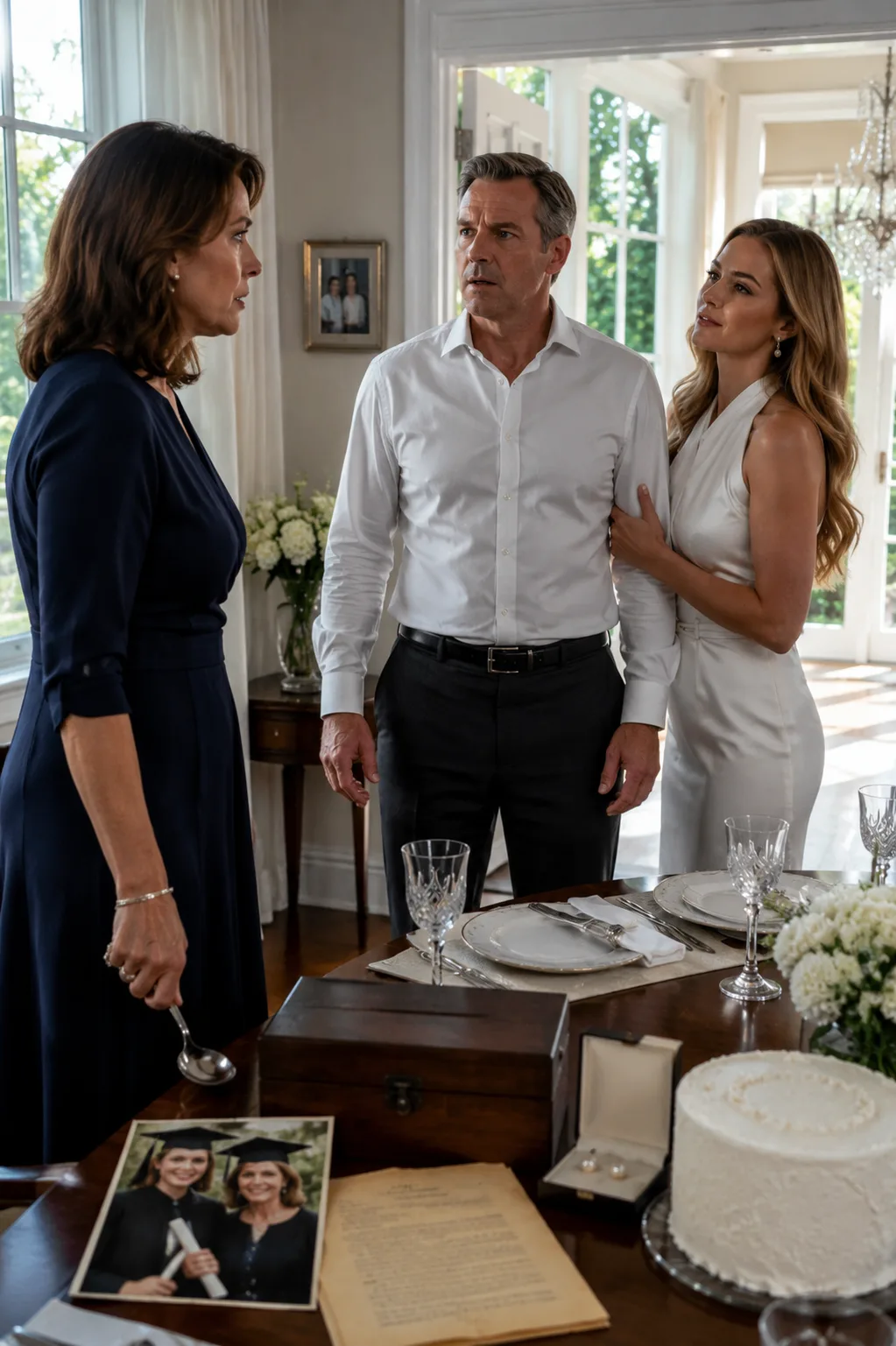
Ava Collins stood in my dining room at six o’clock on a Sunday evening, wearing those pearls like a trophy.
My husband, Mark, stood beside her.
His shirt was unbuttoned at the collar. His hair was still damp, like he had rushed here from somewhere he did not want me to know about. Ava’s hand was hooked around his arm, her red nails pressing lightly into the white fabric of his sleeve.
Behind me, the anniversary candles trembled on the table.
Twenty-two years of marriage.
Two plates untouched.
One cake still waiting to be cut.
I held the silver serving spoon so tightly my fingers hurt.
“Ava,” I said. “Why are
you holding my husband’s arm?”
She smiled.
Not shyly.
Not nervously.
Like a student who had finally found the answer key.
Then she stepped closer to my chair, touched the back of it, and said in a bright, cruel voice:
“You taught me to take opportunities, Mrs. Hayes. So I did.”
Mark whispered, “Eleanor, please—”
But Ava raised one hand to stop him.
That was the moment I realized she had not come to apologize.
She had come to perform.
And everyone in that room was about to learn what kind of woman my kindness had once protected.
PART 2
For three seconds, nobody moved.
The dining room was so quiet I could hear the candle flame flickering beside the anniversary cake. Mark’s mouth opened, closed, then opened again. He looked at me the way guilty people look at the door, like they are measuring the distance to escape.
But
Ava was not looking at him.
She was looking at me.
That hurt more.
Because once, that girl had looked at me like I was the only adult in the world who had not given up on her.
I still remembered the first time I found her crying in the girls’ restroom at Lincoln High. She was sixteen, wearing a hoodie two sizes too big, washing ketchup off the sleeve because someone had thrown food at her during lunch.
When I asked what happened, she said, “Nothing.”
Every broken child says nothing.
I had heard it a hundred times.
So I did not push. I handed her paper towels, stood beside her, and said, “You don’t have to talk today. But you do have to come back to class.”
She came back.
Then she stayed after school.
Then she started writing college essays on the old classroom computer because she
didn’t have internet at home.
I bought her notebooks. I packed extra sandwiches. I drove her to interviews when her mother disappeared for three days. I called the scholarship office five times in one week because one form was missing and Ava was too embarrassed to ask for help.
On graduation day, she hugged me so hard I could barely breathe.
“I’ll make you proud,” she sobbed.
I believed her.
I truly did.
Now she stood in my dining room, touching my chair as if it already belonged to her.
“Ava,” I said slowly, “take your hand off my chair.”
Her smile widened.
“Still giving orders like a teacher?”
“No,” I said. “Speaking like the woman whose home you entered with her husband.”
Mark flinched.
“Eleanor,” he said, softer this time, “this didn’t happen the way it looks.”
I turned to him.
“You walked into our anniversary dinner with my former student holding your arm. Which part would you like me to misunderstand?”
His face tightened.
Ava laughed under her breath.
It was a tiny sound, but it sliced through the room.
“Mark told me you’d do this,” she said. “Make everything about betrayal. About age. About loyalty.”
I stared at her.
“Mark talks to you about me?”
She tilted her head.
“He talks when someone listens.”
The spoon in my hand slipped and hit the edge of a plate.
Mark stepped forward. “Ava, stop.”
But she did not stop.
She pulled my chair out from the table and sat down in it.
In my chair.
At my anniversary dinner.
Across from the cake I had ordered that morning because I had still been foolish enough to believe my marriage was wounded, not already bleeding out.
Ava crossed one leg over the other and looked up at me.
“You were always so proud of saving girls like me,” she said. “But did you ever think maybe we didn’t want to spend our whole lives thanking you?”
My daughter, Lily, stood near the kitchen doorway with both hands over her mouth.
I had not heard her come in.
Mark saw her too, and the blood drained from his face.
“Lily,” he said. “Honey—”
“Don’t,” she whispered.
That one word broke something in him.
But I could not look at my daughter yet. If I did, I would fall apart.
So I looked at Ava.
And suddenly, beneath the makeup, the pearls, and the expensive white dress, I saw the girl she used to be.
The girl who had learned early that pity could open doors.
The girl who had learned tears could erase questions.
The girl I had protected from consequences because I mistook desperation for innocence.
I walked to the side cabinet.
Ava’s smile faltered.
Not much.
Just enough.
“Mrs. Hayes,” she said lightly, “what are you doing?”
I opened the bottom drawer.
Inside was a brown wooden keepsake box. Mark had teased me for years about keeping old letters from students. Thank-you cards. Graduation photos. Little notes written in pencil. Small memories that reminded me why teaching had mattered.
My fingers found the envelope immediately.
I had known exactly where it was for ten years.
When I turned back, Ava was standing.
The room shifted.
Mark looked from me to the box.
“What is that?” he asked.
I placed the box on the table.
Ava whispered, “Don’t.”
It was the first honest thing she had said all night.
I opened the lid.
Inside was a faded graduation photo of Ava and me. She was wearing a black cap and gown, clutching her diploma with both hands. I stood beside her, smiling with one arm around her shoulder.
Beside the photo was a yellowed letter.
Folded once.
Unfolded many times.
I picked it up.
Ava’s face went pale.
“Eleanor,” Mark said, “what is going on?”
I looked at him.
“Your girlfriend was my student before she was your midlife crisis.”
His jaw clenched.
Ava snapped, “Don’t call me that.”
I turned to her.
“You sat in my classroom and cried because you said the world never gave poor girls a chance. Do you remember that?”
Her lips pressed together.
“I was a child.”
“Yes,” I said. “And that is why I protected you.”
Mark frowned.
“Protected her from what?”
I placed the graduation photo on the table, then slid the yellowed letter beside it.
Ava stepped forward, her voice suddenly sharp.
“You have no right.”
That almost made me laugh.
“No right?” I said. “Ava, ten years ago, you rewrote part of your scholarship file using my recommendation letter. You changed the income information. You listed an address that wasn’t yours. And when the scholarship office called me, I realized the truth before they did.”
Mark stared at her.
Ava shook her head. “That’s not what happened.”
I raised my voice.
“For once in your life, do not perform for the room.”
She froze.
Lily began to cry quietly near the kitchen.
I still did not look at her.
I couldn’t.
I continued, “I could have reported it. I could have let them pull your scholarship. I could have let one lie follow you for the rest of your life.”
Ava’s eyes filled, but not with regret.
With rage.
“You didn’t because you needed to feel noble,” she hissed.
“No,” I said. “I didn’t because I believed one bad choice made by a scared girl should not destroy her future.”
Mark’s hand dropped from Ava’s arm.
She noticed.
And that was the first time fear truly crossed her face.
I held up the letter.
“This is what you wrote me the next week.”
Ava lunged toward the table. “Don’t read that.”
Mark caught her wrist. “Ava.”
She yanked free.
“Don’t touch me.”
I unfolded the letter.
My hands were shaking now, but my voice did not.
“You wrote, ‘Mrs. Hayes, I am sorry I lied. I was afraid no one would choose me if they saw the truth.’”
Ava’s breathing turned shallow.
“You wrote, ‘You gave me a second chance. I promise I will never use someone’s kindness against them again.’”
The room went still.
Mark looked at her like he had never seen her before.
Ava whispered, “I was seventeen.”
“And tonight,” I said, “you walked into my home, held my husband’s arm, sat in my chair, and used my own lesson to mock me.”
She looked at Mark.
“Say something.”
But Mark said nothing.
That silence was louder than any confession.
Ava’s face twisted.
“You think you’re better than me?” she snapped. “You think because you taught me, you own the story?”
I stepped closer to her.
“No, Ava. I don’t own your story.”
I placed the letter flat on the table between us.
“But I will no longer let you rewrite mine.”
Mark finally spoke, voice breaking.
“Eleanor, I didn’t know any of this.”
I looked at him.
“That may be the saddest thing you’ve said tonight.”
He flinched as if I had slapped him.
Ava laughed again, but this time it cracked halfway through.
“She kept this for ten years, Mark. Doesn’t that tell you who she is? She was waiting to use it.”
I turned to her.
“No. I was waiting to never need it.”
That shut her up.
For a moment, all I could hear was Lily crying softly into her sleeve.
Then Mark whispered, “Ava, did you lie to me too?”
Ava’s mouth opened.
No answer came.
And suddenly, I knew there was more.
The same instinct I had developed after twenty-five years of teaching pulled at me. The pause. The lowered eyes. The quick glance toward the exit.
Ava was not only afraid of the scholarship letter.
She was afraid of what else I might have.
So I reached back into the box and pulled out the second envelope.
Ava stopped breathing.
Mark saw it.
So did Lily.
I placed the second envelope on the table and said, “This one came last month.”
Ava’s voice dropped to a whisper.
“Mrs. Hayes…”
I looked at her.
“Now you remember how to call me that.”
To be continued, Part 3 now
Chapter complete
You have reached the end of this chapter.
Continue reading
A few more worlds to get lost in after this chapter.




