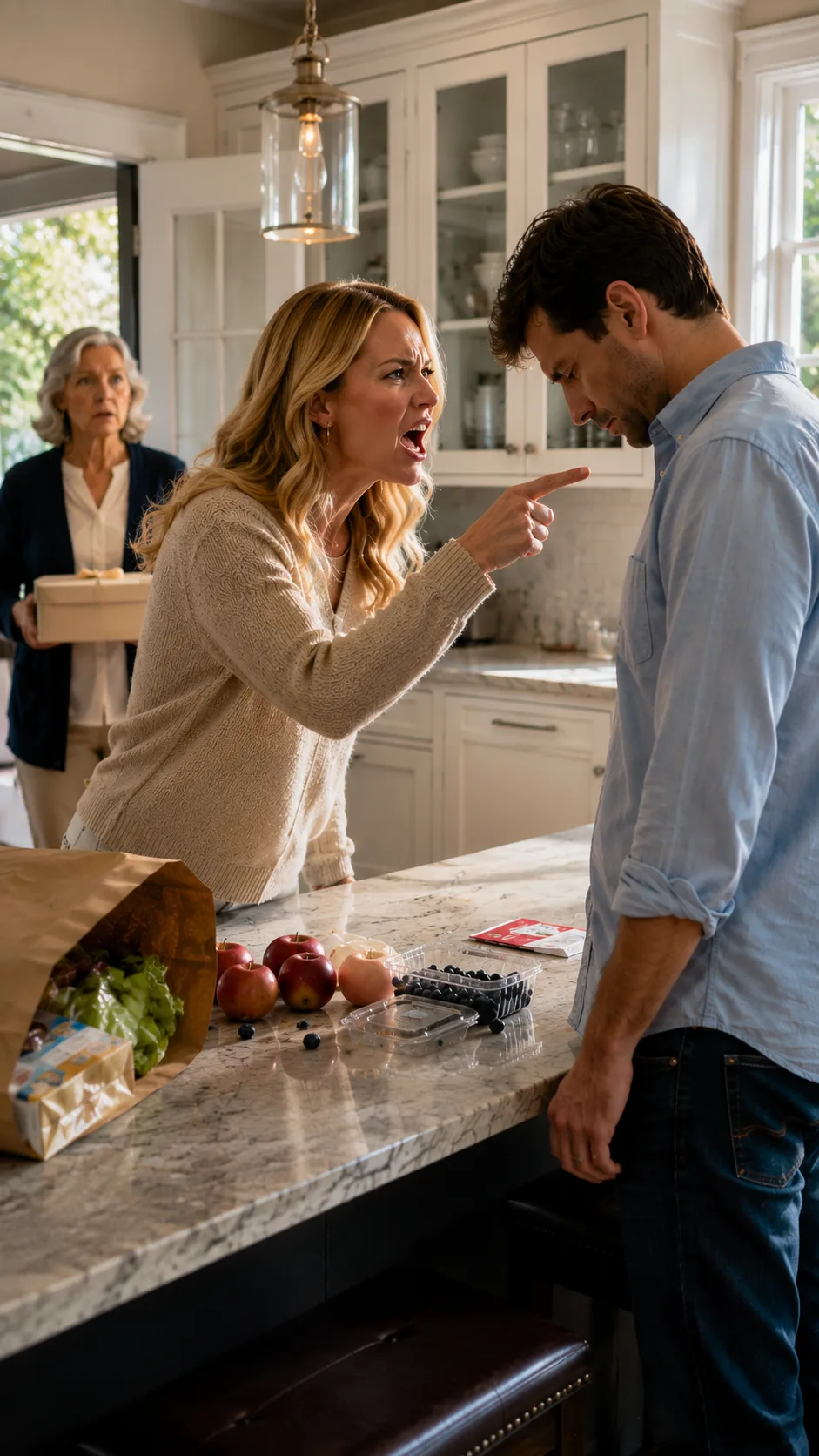
The first time I realized my son was afraid of his wife, he was standing barefoot in his own kitchen, apologizing for buying the wrong kind of blueberries.
Chapter 1
The first time I realized my son was afraid of his wife, he was standing barefoot in his own kitchen, apologizing for buying the wrong kind of blueberries.
I remember that detail because it was so small.
Not a car.
Not a job.
Not money.
Blueberries.
Vanessa had the little plastic container in one hand, holding it like evidence in a trial, while Ethan stood by the sink with his shoulders rounded forward and his eyes fixed on the floor.
“I said organic,” she snapped.
“They were out,” Ethan said quietly.
“Then you should’ve gone somewhere else.”
“I’m sorry.”
“You always do this.”
“I know.”
“You don’t listen.”
“I’m sorry.”
I stood in the hallway holding a lemon pound cake I had baked that morning, and for a moment I could not move.
My son was forty-two years old.
He had two children.
He owned a home in a beautiful neighborhood outside Columbus.
He had once been the kind of boy who would climb the tallest tree just because someone said he couldn’t.
And there he was, apologizing
like a child because his wife did not like the blueberries.
Vanessa saw me first.
Her face changed so fast it almost frightened me.
The tight mouth became a smile. The sharp eyes softened. The hand holding the blueberries lowered.
“Patricia,” she said brightly. “You should have called.”
“I did,” I said.
“Oh.” She laughed lightly. “I must have missed it.”
Ethan finally looked up.
“Mom.”
There was relief in his face. Then fear. Then guilt.
That combination became familiar to me over the next few years.
Relief when I arrived.
Fear when Vanessa noticed.
Guilt when he let me leave without saying what he really wanted to say.
I placed the cake on the counter and forced myself to smile.
“I thought I’d surprise the kids.”
Vanessa’s smile tightened.
“They’re doing homework.”
“It’s Saturday.”
“They’re behind.”
Ethan opened his mouth, then closed it.
I waited.
I wanted him to
say, “Vanessa, Mom drove forty minutes. Let the kids come down.”
He didn’t.
He just turned toward me and gave that little helpless smile I had come to hate.
“Maybe next time, Mom.”
Next time.
That was the phrase that slowly stole years from me.
Next time for dinner.
Next time for Christmas morning.
Next time for Emma’s recital.
Next time for Liam’s birthday.
Next time for a simple Sunday visit.
At first, I blamed busy family life. Marriage. Children. Work. I told myself not to be one of those mothers who interfered. I told myself Vanessa was just particular, maybe stressed, maybe overwhelmed.
But the truth kept revealing itself in small, ugly pieces.
Ethan stopped calling me unless he was in his car.
He stopped bringing the children over.
He stopped mentioning old friends.
He stopped laughing from his chest.
And every time I asked if everything was okay,
he gave me the same answer.
“Mom, don’t worry. I’m just trying to keep peace at home.”
Peace.
I learned that some people use that word when they really mean surrender.
I had raised Ethan alone after his father, Robert, died of a heart attack when Ethan was twelve. I worked as a receptionist during the day and cleaned medical offices at night. I missed sleep. I missed vacations. I missed chances at a life of my own.
But I never once regretted it.
Because Ethan was my world.
He was thoughtful, stubborn, funny, and brave. When he was sixteen, he worked all summer to buy me a new washing machine because ours kept flooding the basement. When he was twenty-three, he drove three hours in a snowstorm because I had the flu and he didn’t want me alone. When he met Vanessa, he still called me every Sunday night.
Then the calls became shorter.
Then less frequent.
Then supervised.
I knew because his voice changed whenever she walked into the room.
One evening, I called him while making soup.
“Hi, Mom,” he said warmly.
I smiled. “There’s my boy.”
He laughed.
Then, in the background, I heard Vanessa say, “Who is it?”
His voice dropped.
“My mom.”
There was a pause.
Then he said, “Can I call you back?”
He never did.
The first major break came on Thanksgiving.
I had invited them weeks in advance. Ethan said yes immediately. He sounded happy. He even asked if I was making the cornbread stuffing his father loved.
“I wouldn’t dare skip it,” I told him.
But the night before Thanksgiving, Vanessa texted me from Ethan’s phone.
We won’t make it tomorrow. Too much going on. Happy Thanksgiving.
I called.
No answer.
I called again.
Nothing.
On Thanksgiving morning, I set the table for one.
I told myself not to cry.
Then Diane Mercer, my neighbor and closest friend, knocked on my door with a pie in her hands.
“Don’t you dare eat alone,” she said.
I broke down before I could even invite her inside.
Diane had known me since Ethan was in middle school. She remembered the boy he used to be. She also remembered Robert.
After dinner, when I finally told her everything, she listened without interrupting.
When I finished, she said quietly, “Patricia, that doesn’t sound like marriage. That sounds like your son is disappearing.”
I stared at my plate.
“I know.”
“Then why haven’t you done something?”
“Because if I push too hard, I might lose him completely.”
Diane reached across the table and took my hand.
“Honey, I think you already are.”
That sentence stayed with me.
Still, I waited.
Mothers are good at waiting. We wait for children to come home, to grow up, to understand, to forgive us, to need us again.
But waiting can become its own kind of cowardice.
The next spring, I found out Vanessa had told people I moved to Florida.
It happened at a grocery store.
I ran into Mrs. Caldwell, whose granddaughter attended the same school as Emma.
“Patricia?” she said, genuinely shocked. “You’re still in Ohio?”
I frowned. “Of course I am.”
“Oh.” Her face flushed. “I’m sorry. Vanessa said you had moved away.”
My stomach tightened.
“When?”
“Last year, I think. She said it was hard on the children because you didn’t visit anymore.”
I gripped the shopping cart handle.
“I see.”
Mrs. Caldwell looked embarrassed and quickly changed the subject, but I barely heard her.
Moved away.
Didn’t visit anymore.
That night, I drove to Ethan’s house.
I didn’t call first.
The windows glowed with warm light. Through the front room curtain, I could see Emma sitting at the piano. Liam was on the floor with a book. Ethan was in the armchair, not reading, not watching television, just staring down at his hands.
I rang the bell.
Vanessa answered.
Her expression froze.
“Patricia.”
“May I come in?”
“It’s not a good time.”
“I’d like to see my grandchildren.”
“They’re busy.”
“I can see Emma through the window.”
Her eyes hardened.
“That’s inappropriate.”
“What is?”
“Showing up unannounced.”
“This is my son’s home.”
“This is our home.”
Behind her, Ethan appeared in the hallway.
“Mom?”
Vanessa turned slightly, not enough to let me in, just enough to remind him she was there.
I looked at my son.
“Did you tell people I moved to Florida?”
His face went blank.
“What?”
Vanessa laughed sharply.
“That’s ridiculous.”
“Mrs. Caldwell said you told the school parents I moved away.”
Ethan looked from me to Vanessa.
“Vanessa?”
She rolled her eyes.
“I may have said something like that because Patricia never comes to events.”
“I’m never invited,” I said.
Vanessa folded her arms.
“Maybe because you make everything about yourself.”
The words hit me, but I kept my voice steady.
“I drove here to see my family.”
“And I am telling you tonight isn’t good.”
Ethan stood there.
Silent.
Again.
I looked at him, waiting for something.
Anything.
He swallowed.
“Mom, maybe we can do lunch next week.”
I nodded slowly.
“Next time.”
His face tightened.
He knew what I meant.
I went home that night and opened the old metal box where I kept important papers. Birth certificates. Robert’s death certificate. Insurance documents. The deed history for the house Ethan lived in.
That house was the secret Vanessa loved to rewrite.
Years earlier, when Ethan and Vanessa were drowning in rent and childcare expenses, I used most of Robert’s life insurance and my savings to purchase the home. I put Ethan on the title because I trusted my son and wanted him to build a future. But Robert, careful even after death through the attorney who helped us plan, had insisted on protective language in the arrangement.
At the time, I thought it was unnecessary.
Now, reading through the documents under my kitchen light, I felt like my late husband was sitting beside me whispering, Pay attention, Pat.
There were conditions.
There were restrictions.
There was a clause tied to the grandchildren’s future interests.
I didn’t fully understand all of it, so I called a lawyer.
His name was Martin Hale. He was calm, gray-haired, and direct in the way people become when they have spent decades watching families destroy themselves over property.
After reviewing everything, he removed his glasses and said, “Mrs. Bennett, do you understand what you have here?”
“I understand I helped my son buy a home.”
“You did more than help. You preserved leverage.”
“I don’t want leverage. I want my son back.”
He studied me for a moment.
“Sometimes those are connected.”
I hated that he was right.
Still, I did nothing immediately.
Because a legal move, even a careful one, felt like war.
And despite everything, I didn’t want war with my son’s family.
Then came my birthday.
My sixty-eighth.
Ethan had promised to come.
He called me the week before.
“I’ll be there, Mom. The kids too.”
“Are you sure?”
“Yes.”
“Ethan.”
“I mean it.”
His voice lowered.
“I miss you.”
Those three words nearly broke me.
“I miss you too.”
I spent two days preparing.
I made roast chicken, mashed potatoes, green beans with almonds, and chocolate cake with the old frosting recipe Ethan loved. I bought Emma a bracelet with tiny silver stars. I bought Liam a set of sketch pencils because Ethan once told me he liked drawing.
At five o’clock, I lit candles.
At five thirty, I checked my phone.
At six, I called.
No answer.
At seven, the food had gone cold.
At eight, I blew out the candles myself.
At nine thirteen, I received a text.
Sorry. Vanessa isn’t feeling well. We’ll make it up to you.
I stared at the message.
Not “Happy birthday.”
Not “I love you.”
Not even a call.
Just an excuse.
Something inside me went very quiet.
The next morning, I drove to their house and parked across the street. I don’t know what I expected. Maybe darkness. Maybe proof that someone had been sick.
Instead, I saw Vanessa in workout clothes loading shopping bags into her SUV, laughing into her phone.
A few minutes later, Ethan came out carrying a box.
He looked tired.
Vanessa said something.
He lowered his head.
That was when my phone rang.
Unknown number.
I almost ignored it.
But something made me answer.
“Grandma?”
It was Emma.
Her voice was tiny.
“Emma? Sweetheart?”
“Are you mad at us?”
My throat closed.
“No. Never.”
“Mom said you didn’t want us at your birthday.”
I shut my eyes.
“What?”
“She said you wanted a quiet day because kids are too much.”
My hand trembled around the phone.
“Emma, I baked you a cake.”
There was silence.
Then she whispered, “You did?”
“Yes.”
“I made you a card.”
Tears spilled down my face.
“I never got it.”
Another silence.
Then, faintly, I heard Vanessa’s voice in the background.
“Emma, who are you talking to?”
The call ended.
That was the moment I stopped being afraid.
Not because I was angry, though I was.
Not because I wanted revenge, though part of me did.
I stopped being afraid because Vanessa was not just taking Ethan from me anymore.
She was taking me from my grandchildren.
And I had already lost enough in my life.
Two weeks later, Martin Hale and I stood on Ethan’s porch.
I wore my navy dress and the pearl earrings Robert gave me on our twentieth anniversary. I needed something of him with me.
Vanessa opened the door.
Her gaze moved from me to Martin’s briefcase.
“What is this?”
“A family conversation,” I said.
Her mouth curved.
“Then why did you bring a stranger?”
Martin handed her his card.
“I represent Mrs. Bennett.”
Vanessa laughed once, sharp and false.
“Represent her for what?”
Ethan appeared behind her.
His face went pale.
“Mom?”
“May we come in?”
Vanessa almost said no.
I saw it.
But pride stopped her. She wanted to appear unbothered.
“Fine.”
We sat in the living room.
It was a beautiful room. White walls. Gray sofa. Framed family photos arranged perfectly.
There was only one problem.
I was not in any of them.
Martin explained the structure of the house arrangement. He explained the trust provision. He explained that, because certain conditions had been triggered, the property would be sold within ninety days unless a restructuring agreement was reached that protected the grandchildren’s interests.
Vanessa listened with a frozen smile.
Then the smile cracked.
“You can’t sell our house.”
Martin kept his voice level.
“The house is subject to terms agreed upon years ago.”
“I don’t care what some paper says.”
“Vanessa,” Ethan whispered.
She whipped toward him.
“Don’t you start.”
He went silent.
There it was again.
The bowing of the head.
The disappearing.
Vanessa stood.
“This is disgusting, Patricia. Coming into our home to threaten us?”
“I’m not threatening anyone.”
“You’re jealous.”
That made me blink.
She stepped closer.
“You’ve always been jealous that Ethan chose me.”
I looked at my son.
He stared at the floor.
Vanessa continued, louder now.
“You couldn’t stand not being the most important woman in his life.”
Something in me hurt, but I did not break.
“I wanted him to be happy.”
“He is happy.”
I looked at Ethan.
“Are you?”
The room went still.
Ethan lifted his eyes.
Vanessa answered for him.
“Of course he is.”
I kept looking at my son.
“Ethan?”
His mouth opened.
For one second, I thought he might speak.
Then Liam walked into the room.
He was eleven now, tall for his age, with Ethan’s serious eyes.
“Dad?”
Vanessa turned sharply.
“Go upstairs.”
Liam didn’t move.
“Are we losing the house?”
“No,” Vanessa snapped.
Martin said gently, “This is an adult conversation.”
But Liam was not looking at Martin.
He was looking at the coffee table, where the folders sat.
Then he looked at me.
“Grandma, did you really not want us at your birthday?”
Vanessa’s face changed.
Ethan looked up fast.
“What?”
Liam swallowed.
“Mom said Grandma didn’t want us there.”
Ethan turned to Vanessa.
“You told them that?”
Vanessa’s jaw tightened.
“It was complicated.”
“No,” Liam said quietly. “It wasn’t.”
That small sentence shook the room more than Martin’s paperwork had.
Then Emma appeared at the stairs.
She held something against her chest.
A stack of envelopes tied with a pink hair ribbon.
“I found these in Mom’s closet,” she said.
Vanessa went white.
“Emma, put those back.”
Emma came down slowly.
Her hands were shaking.
“They’re from Grandma.”
Ethan stood.
“What are you talking about?”
Emma placed the envelopes on the coffee table.
Birthday cards.
Christmas cards.
Letters.
Photos.
Some addressed to Emma.
Some to Liam.
Some to Ethan.
All unopened.
I covered my mouth.
I had sent those.
For years.
Ethan picked one up.
His fingers trembled.
“This is from Mom?”
Vanessa stepped forward.
“I can explain.”
He picked up another.
“And this?”
“Ethan—”
“And this?”
His voice broke.
Emma started crying.
“I thought Grandma stopped loving us.”
The sound that came from my son then was not a word.
It was something torn out of him.
He looked at Vanessa with a face I had not seen in years.
Not defeated.
Awake.
“You told them my mother didn’t love them?”
Vanessa’s eyes filled with tears, but they were angry tears.
“You don’t understand what it was like.”
“What what was like?”
“Being second to her!”
The truth finally came out raw.
Ethan stared.
Vanessa pointed at me.
“She always had a place in your heart I couldn’t touch. Every Sunday call. Every memory. Every little story about your childhood. I was your wife, and I felt like I was competing with a ghost and a saint.”
“My father is dead,” Ethan said quietly.
“I know that!”
Vanessa pressed her hands to her face.
“I know. And I know that sounds awful. But you and your mother had this whole world before me, and I never felt like I belonged in it.”
For a moment, nobody spoke.
That was Vanessa’s first human moment.
Not innocent.
Not excused.
But human.
Then Ethan said, “So you erased her?”
Vanessa lowered her hands.
“I was trying to build my own family.”
“With lies?”
“With boundaries.”
Liam flinched.
Emma whispered, “You lied to us.”
Vanessa looked at her daughter, and for the first time I saw genuine fear.
Not fear of losing control.
Fear of being seen.
“Emma, honey—”
“No.” Emma stepped back. “You told me Grandma threw away my cards.”
Ethan’s head snapped toward Vanessa.
“What cards?”
Emma ran upstairs.
Vanessa reached after her but stopped when Ethan moved in front of the stairs.
He didn’t touch her.
He didn’t shout.
He simply stood there.
For the first time in ten years, he did not move aside.
Emma returned holding a shoebox.
She opened it on the coffee table.
Inside were handmade cards.
Drawings.
Letters from the children to me.
Never mailed.
I sank onto the sofa.
My knees could not hold me.
Liam picked up a drawing of me, him, Emma, and Ethan standing under a yellow sun.
At the bottom, in messy child handwriting, it said:
Grandma, please come back.
I began to cry.
Ethan sat beside me and stared at the cards like they were pieces of a life he had failed to protect.
Then he whispered, “How long?”
Vanessa didn’t answer.
“How long?” he repeated.
Her chin trembled.
“After Liam was born.”
Eleven years.
She had been building walls for eleven years.
Ethan stood again.
“I thought Mom was pulling away.”
Vanessa cried harder.
“I know.”
“I thought the kids didn’t ask about her.”
“I know.”
“I thought I was keeping peace.”
“I know.”
His voice rose.
“No, Vanessa. You don’t get to say ‘I know’ like that makes it smaller.”
She flinched.
He pointed to the cards.
“You stole years.”
That line broke something open.
Vanessa sat down slowly, as if her body had lost strength.
Martin quietly gathered his folders, but I raised a hand.
“Leave them.”
Everyone looked at me.
I wiped my face.
“I want them to understand.”
Ethan turned toward me.
“Mom, I’m so sorry.”
I wanted to comfort him. That was my instinct. It had always been my instinct.
But love told me to do something harder.
“Sorry isn’t enough this time.”
His face twisted.
“I know.”
“You let me stand outside your life and knock.”
His eyes filled.
“I know.”
“You let your children think I left them.”
He covered his mouth.
“I didn’t know.”
“But you didn’t ask.”
That landed.
He nodded slowly, tears falling now.
“You’re right.”
Vanessa whispered, “Patricia, please.”
I looked at her.
“You hurt me. But worse than that, you taught my grandchildren that love disappears without explanation.”
She sobbed once.
“I was afraid.”
“I know.”
“I felt like if I didn’t hold tight, everything would leave.”
“And because of that,” I said softly, “you made everyone want to.”
No one spoke for a long time.
The ninety days that followed were not dramatic in the way people imagine.
There were no screaming matches after that day.
No grand speeches.
Just consequences.
The house went on the market.
Ethan moved into a modest rental near the children’s school.
Vanessa stayed with her sister for a while.
The children began counseling.
So did Ethan.
To my surprise, Vanessa did too.
For months, I did not know what would happen to their marriage. Frankly, I stopped trying to predict it.
My concern was the children.
And Ethan.
He came to my house every Sunday at first. Sometimes alone. Sometimes with Emma and Liam.
The first time he arrived alone, he stood on my porch for nearly a minute before knocking.
When I opened the door, he looked like a boy again.
“I don’t know how to fix this,” he said.
I stepped aside.
“Then don’t pretend you do.”
He came in.
We sat at the kitchen table where he had done homework as a child.
For a long time, neither of us spoke.
Then he said, “I kept telling myself being a good husband meant absorbing everything.”
I nodded.
“That’s what your father did sometimes.”
His eyes lifted.
“He did?”
I smiled sadly.
“Your father was a wonderful man. But he avoided conflict until it grew teeth.”
Ethan looked down.
“I think I did that too.”
“You did.”
“I was scared if I challenged her, the family would fall apart.”
“And it did anyway.”
He laughed once through tears.
“Yeah.”
“Ethan, love without a voice becomes obedience.”
He closed his eyes.
“I don’t want my kids to learn that from me.”
“Then show them something different.”
That became his work.
Not saving his image.
Not blaming Vanessa for everything.
Not pretending he had been helpless.
His work was learning to stand up without becoming cruel.
Vanessa’s work was harder.
Because for the first time, she had to live without controlling the story.
Emma barely spoke to her for weeks.
Liam asked blunt questions that made adults uncomfortable.
“Why did you hide Grandma’s letters?”
“Did you want Dad to be lonely?”
“Were you mad at us too?”
Vanessa answered them badly at first.
Then better.
Then honestly.
One afternoon, months later, she came to my house.
I almost didn’t let her in.
She stood on the porch in a plain sweater, no perfect makeup, no polished smile.
“I’m not here to ask you to forgive me,” she said.
“Good.”
She nodded.
“I deserve that.”
I crossed my arms.
“What do you want?”
She held out a paper bag.
“Emma found more cards. These were in the garage. I thought you should have them.”
I took the bag but did not thank her.
Vanessa’s eyes filled.
“My mother left when I was nine.”
I stayed silent.
“She didn’t die. She didn’t explain. She just left. And my father acted like missing her was weakness. So I learned that if people love someone too much, that person can destroy them.”
Her voice cracked.
“When I saw how much Ethan loved you, I panicked. I thought one day you’d pull him away from me. So I pulled first.”
I looked at this woman who had cost me years with my family.
Part of me wanted to say something sharp enough to scar.
But I was tired of scars.
“Your pain explains your choices,” I said. “It does not excuse them.”
She nodded, crying.
“I know.”
“Do you?”
“I’m starting to.”
That was all she could offer.
It wasn’t enough.
But it was a beginning.
A year after the house was sold, Ethan opened his own small consulting firm.
Nothing grand.
Just four rooms above a bakery downtown.
He invited me to the opening.
When I arrived, Emma ran into my arms so hard I nearly dropped my purse. Liam showed me a framed sketch he had made for Ethan’s office. It was a drawing of an oak tree with deep roots and new leaves.
Ethan hung it behind his desk.
Vanessa came too.
She stood quietly near the door, not performing, not directing, not trying to own the room.
She and Ethan had not reconciled fully.
They were still separated.
Maybe one day they would rebuild something honest.
Maybe they wouldn’t.
But they were learning to parent without using the children as messengers or weapons.
That was enough for now.
During the opening, Ethan tapped a spoon against a glass.
Everyone turned.
He looked nervous, but he did not shrink.
“I’m not good at speeches,” he said.
A few people laughed.
He smiled.
“But I want to say something because I spent a lot of years not saying things that mattered.”
His eyes found mine.
“My mother gave up more than I understood so I could have a life. And when I became a husband and father, I confused silence with strength. I confused avoiding conflict with protecting my family.”
The room went quiet.
“I hurt people by disappearing inside my own life.”
His voice shook, but he kept going.
“I’m done disappearing.”
Emma wiped her eyes.
Liam looked proud.
Vanessa lowered her head, crying silently.
Ethan raised his glass.
“To second chances. And to the people who love us enough to tell the truth before it’s too late.”
Everyone drank.
I couldn’t.
I was crying too hard.
Later, after the guests left, Ethan handed me a small wooden box.
I recognized it immediately.
It was the same box from the living room that day.
My unopened letters had been inside it.
“I almost threw it away,” he said.
“I wouldn’t blame you.”
“I changed what it holds.”
I opened it.
Inside were new envelopes.
Dozens of them.
Emma’s drawings.
Liam’s notes.
Photos from Sundays at my house.
A birthday card from Ethan.
On top was a handwritten letter.
Mom,
I used to think you took the house away from me.
Now I understand you gave me a doorway out.
I’m sorry it took losing the walls to realize I had been living inside them.
Thank you for refusing to let me vanish.
Your son,
Ethan
I pressed the letter to my chest.
He whispered, “Were you afraid I’d hate you?”
I looked up at him.
“Every day.”
“Then why did you do it?”
I touched his cheek, just like I did when he was little and came home with scraped knees.
“Because I would rather have you hate me for one year than watch you lose yourself for the rest of your life.”
His face crumpled.
He pulled me into his arms.
For a long time, we just stood there.
Mother and son.
Not healed completely.
Not magically restored.
But present.
And sometimes present is the miracle.
The final twist came three months later.
Martin Hale called me into his office.
“There’s something you should know,” he said.
My stomach tightened.
“What now?”
He smiled.
“Nothing bad.”
He showed me the final accounting from the sale of the house. After the protected trust was funded for Emma and Liam, there was still a portion left under the terms Robert had created years ago.
I stared at the number.
“What is this?”
“Your husband structured it so that if the house was ever sold under these conditions, remaining funds would return to you.”
I sat back, stunned.
Robert.
Even after all those years, he had protected me too.
I went home that day and sat alone at the kitchen table with his photograph in front of me.
“You stubborn man,” I whispered.
Then I laughed through tears.
For years, I had thought the house was my final gift to Ethan.
But maybe Robert had known something I didn’t.
Maybe he knew mothers like me give until nothing is left.
Maybe he wanted to make sure that, one day, if I had to save our son, I would not be left empty-handed afterward.
I used part of that money to start college funds for Emma and Liam beyond the trust.
I used another part to repair my old house.
And for the first time since Robert died, I booked a trip for myself.
Not to run away.
Not to disappear.
Just to remember that I was still alive too.
The night before I left, Ethan came over with the kids.
We ate pizza on paper plates and laughed when Liam spilled soda on the floor. Emma showed me a bracelet she had made with beads spelling out GRANDMA. Ethan washed dishes without being asked.
As he stood at the sink, I watched his reflection in the dark window.
His shoulders were straight.
His face was peaceful.
Not perfect.
Not untouched by regret.
But his again.
Before leaving, he hugged me at the door.
“I love you, Mom.”
“I love you too.”
He paused.
“And I’m coming next Sunday.”
I smiled.
“You don’t have to promise that.”
“I know.”
He kissed my forehead.
“That’s why I want to.”
After they drove away, I stood on the porch under the quiet Ohio sky.
For the first time in years, I did not feel like I was waiting for next time.
I felt like next time had finally arrived.
And I understood something I wish I had known sooner.
A mother’s love is not always soft.
Sometimes it is a warm meal.
Sometimes it is a birthday cake.
Sometimes it is standing at the door with open arms.
And sometimes it is walking into your son’s living room with a lawyer beside you, ready to become the villain in his story for a little while, because you know the ending can still change.
I never wanted the house.
I never wanted the money.
I wanted my son to lift his head.
And on a bright spring afternoon, in a small office above a bakery, I watched him do exactly that.
That was when I knew I had not lost him.
Not really.
He had been buried under fear, guilt, silence, and someone else’s version of peace.
But he was still there.
My brave boy.
My stubborn boy.
My Ethan.
And finally, after ten long years, he came home to himself.
Chapter complete
You have reached the end of this chapter.
Continue reading
A few more worlds to get lost in after this chapter.




