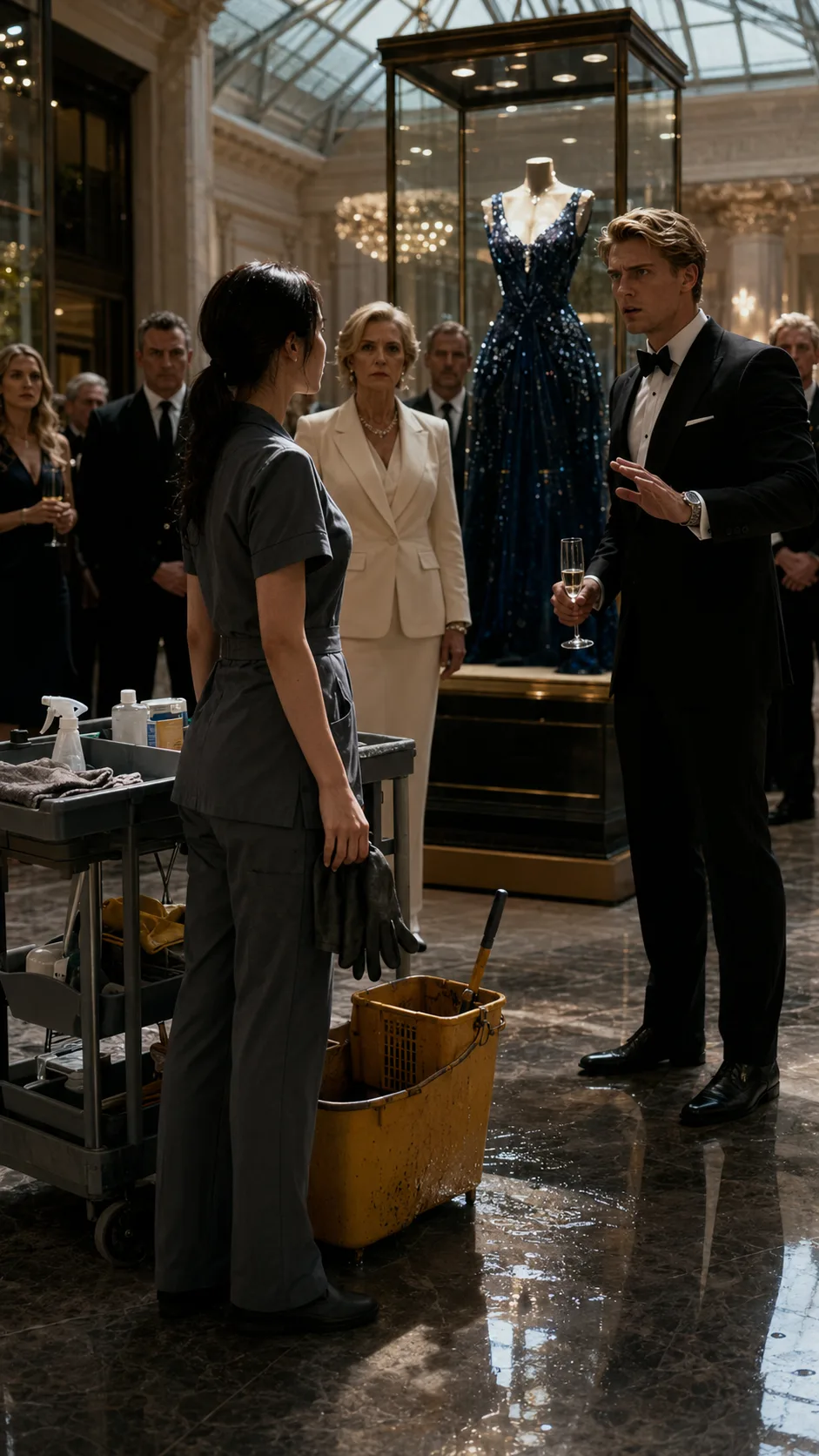
The first time Adrian Vale saw me again after seven years, I was kneeling on the marble floor of the Ashbourne Auction House with a mop in my hand.
Chapter 1
The first time Adrian Vale saw me again after seven years, I was kneeling on the marble floor of the Ashbourne Auction House with a mop in my hand.
He had arrived through the private entrance with a champagne glass already between his fingers, a black tuxedo fitted perfectly across his broad shoulders, and two laughing men walking behind him like shadows paid to admire him. His blond hair was styled back from his forehead. His shoes shone so sharply they caught the chandelier light. He looked every inch the man glossy magazines had spent the last decade calling visionary.
Then his gaze dropped.
It found me.
For a second, the whole room seemed to narrow around the space between us.
I was in a charcoal-gray cleaning uniform, sleeves rolled to my wrists, hair tied into a low knot at the back of my neck. My gloves were damp. A yellow caution sign stood beside the wet marble, and the cleaning cart behind me smelled faintly of lemon solution and metal.
Adrian stopped smiling.
His friends did not.
One
of them leaned closer, whispered something, and laughed into his drink.
Adrian recovered quickly. He always did. That was one of the first things people admired about him and one of the last things I learned to fear. Nothing stayed visible on his face unless he wanted it there.
His surprise melted into amusement.
“Well,” he said, loud enough for the guests nearby to turn, “this is unexpected.”
I lowered the mop into the bucket, wrung it once, and kept working.
Above us, sealed inside a tall glass display case, hung the midnight-blue Whitford gown.
It was impossible not to look at it.
The gown seemed almost alive beneath the auction lights. Dark blue silk, hand-beaded bodice, narrow waist, long sweeping skirt embroidered with tiny silver threads that looked like moonlight caught in rain. It had once belonged to Marion Whitford, one of the most photographed women in New York
society. Tonight, it was the centerpiece of a charity auction expected to raise millions.
To the guests, it was a piece of fashion history.
To Adrian, it was a trophy.
To me, it was evidence.
And for seven years, I had believed I would never see it again.
Adrian stepped closer, stopping just outside the wet patch on the floor. His eyes traveled slowly from my shoes to my uniform, then to the mop handle in my hand.
“Isabella Reed,” he said, as if introducing me to the room. “Or do you still use Vale?”
I looked up.
His expression sharpened with pleasure. He wanted me to flinch. He wanted the name to land like a slap.
“No,” I said. “I gave that back.”
A woman near the champagne table tilted her head, suddenly interested. The man beside her murmured, “That’s his ex-wife?”
Adrian heard it. Of course he did.
He smiled wider.
“She used to attend events like this as my guest,” he said. “Now she cleans the floors before them.”
A few people looked away, embarrassed by the cruelty but not enough to stop listening.
That was how rooms like this worked. Wealth did not erase hunger. It refined it. People in diamonds could still gather around humiliation like wolves, as long as no one called it by its name.
I stood slowly.
The mop handle rested between us like a thin wooden line.
“You should be careful,” I said.
His eyebrows lifted.
“Careful?”
“Wet floor.”
His friends laughed again, louder this time.
Adrian leaned in slightly, lowering his voice but not enough to hide it from the nearest guests.
“That dress is worth more than everything you’ve touched in years.”
I looked past him toward the glass case.
“No,” I said. “It’s worth exactly what someone is willing to lose over it.”
The smile left his face.
Not completely.
Just enough.
He followed my gaze to the gown, then back to me. Something old moved behind his eyes. Calculation. Suspicion. Fear trying to dress itself as annoyance.
“What is that supposed to mean?” he asked.
Before I could answer, the auction director stopped speaking at the front of the room.
The shift was subtle at first.
A security guard near the entrance straightened. Two assistants who had been moving trays of champagne paused. The string quartet softened, then faltered. Guests turned toward the central aisle as a woman in an ivory suit entered the hall with four private bodyguards behind her.
Eleanor Whitford.
Even people who did not recognize her face recognized her name.
Marion Whitford’s only daughter. Chairwoman of the Whitford Trust. Owner of more real estate, private shares, and museum board votes than most men in the room could ever charm their way toward. She was fifty-five, tall, elegant, silver-brown hair pulled into a smooth twist, her expression calm in a way that made everyone else seem nervous.
She did not look at Adrian first.
She came directly to me.
“Ms. Reed,” she said.
The room quieted.
I removed one glove.
“Mrs. Whitford.”
“The seam has been opened,” she said. “The storage chip is intact. My attorneys, the trustees, and federal investigators are upstairs.”
Every sound in the room seemed to disappear.
No glass clink.
No music.
No breath.
Adrian’s face changed so quickly most people missed it. But I did not. I had once lived with that face across breakfast tables, charity dinners, board presentations, and courtrooms. I knew the difference between his public arrogance and his private alarm.
He was afraid.
For the first time in seven years, Adrian Vale was afraid in a room full of witnesses.
He gave a short laugh.
“What is this supposed to be?”
Eleanor turned to him then.
“Mr. Vale,” she said, “you should come with us.”
His grip tightened around the champagne flute.
“I’m in the middle of a donor event.”
“No,” Eleanor said. “You are at the beginning of an investigation.”
The word traveled through the crowd like a cold draft.
Investigation.
People stepped backward.
It was almost beautiful how quickly powerful men became contagious when consequences appeared beside them.
Adrian looked at me.
“Isabella,” he said, voice dropping into the smooth tone he once used when he wanted me to soften. “Tell her whatever game you’re playing ends now.”
I placed the damp glove on the edge of the cleaning cart.
“No,” I said. “This is the first honest thing to happen tonight.”
His jaw tightened.
“You don’t know what you’re doing.”
“I know exactly what I’m doing.”
“You’re cleaning floors.”
“Yes,” I said. “That’s why no one watched me listen.”
Eleanor’s eyes moved briefly to me. Not pity. Not admiration. Recognition.
Adrian understood then.
The uniform was not my defeat.
It was the door he had left unlocked because he thought people like me no longer mattered.
Seven years earlier, I had been his wife.
More than that, I had been the invisible foundation beneath Vale Development.
Adrian was the face. I was the structure.
He could charm donors over dinner, but I built the projections that convinced them. He could stand before cameras and speak about urban renewal, but I knew which streets flooded in winter, which buildings had violations, which families would be displaced if numbers were manipulated. He shook hands with banks. I prepared the models. He gave speeches about legacy. I read every line before he signed.
In the beginning, I thought we were partners.
That was my first mistake.
My second was believing that love could exist with someone who measured affection in usefulness.
When Adrian and I married, he was not yet the man magazines adored. He was ambitious, handsome, impatient, and brilliant at making people believe his future was already guaranteed. I was twenty-four, disciplined, good with numbers, and desperate to prove that my mother’s sacrifices had built something more than survival.
My mother, Grace Reed, had spent thirty years altering gowns for women who never remembered her name. She worked in the back rooms of bridal salons and luxury boutiques, pinning silk against bodies that smelled of expensive perfume. She taught me how to read fabric, how to spot hidden seams, how to fix damage so quietly no one knew anything had been broken.
She also taught me that rich people often believed labor was the same as invisibility.
“Let them think that,” she used to say. “Invisible hands learn where everything is kept.”
When she died, she left me a small inheritance. Not much by Adrian’s standards, but enough to matter when he needed early capital. I put that money into Vale Development, and in return, I received protected equity in the company.
The agreement was clear.
My shares could not be transferred without independent legal review.
Adrian signed it with a smile.
“You’re very serious,” he said that day, kissing my forehead.
“I learned from watching men become careless,” I answered.
He laughed.
I thought he admired me.
He was only learning where to cut.
For five years, we built the company.
At least, I thought we did.
Then came Harbor Row.
Harbor Row was supposed to be Adrian’s masterpiece: a mixed-income development in Queens that would preserve affordable housing while bringing new businesses into the area. It had city attention, foundation grants, private investors, and a public story so polished it could blind anyone who looked too quickly.
But numbers do not care about charm.
The first irregularity was small.
A consulting fee appeared twice under two different vendor names. Then an environmental review invoice came from a company whose registered address was a mailbox in Delaware. Then a contractor payment was routed through an intermediary with no employees. Then a grant from the Whitford Foundation appeared in a reserve account where it did not belong.
I spent three nights in our home office reviewing ledgers after Adrian had gone to sleep.
By the fourth morning, I knew.
Money was being moved through shell companies and disguised as development expenses. Public funds, charitable grants, investor deposits, all braided together until accountability became almost impossible to trace.
Almost.
Adrian had always underestimated my patience.
When I confronted him, we were standing in our kitchen. Morning light came through the windows. His coffee sat untouched on the counter. I remember the smell of toast burning because neither of us moved to stop it.
I placed the folder in front of him.
“What is this?” he asked.
“Your signatures.”
He flipped through the papers too casually.
“You went through restricted files?”
“I went through company records. I own part of the company.”
He smiled faintly.
“That’s a dangerous tone.”
“That’s a dangerous spreadsheet.”
His eyes lifted.
For one second, I saw the man beneath the polish.
Cold. Alert. Offended not by wrongdoing, but by being seen.
“You don’t understand development finance,” he said.
“I understand fake vendors.”
“You’re tired.”
“I understand routed foundation funds.”
“You’ve been emotional lately.”
“I understand fraud.”
That was when he stopped pretending.
His hand flattened over the folder.
“Listen to me carefully,” he said. “You are my wife. You are not my enemy unless you choose to become one.”
“I already chose,” I said. “I chose the truth.”
I was pregnant then.
Nine weeks.
I had not told him. Some part of me had been waiting for the right moment, the soft moment, the one that proved we were still salvageable.
Instead, my hand moved instinctively toward my stomach.
Adrian noticed.
Of course he noticed.
His eyes dropped for the smallest fraction of a second, then returned to my face.
He said nothing about it.
That frightened me more than if he had.
Within two days, my access to Vale Development’s systems was suspended.
Within four, emails appeared from my account approving transfers I had never authorized.
Within a week, Adrian’s attorneys contacted me with language about emotional instability, financial misconduct, and the importance of a quiet separation.
Then the rumors began.
At first, they were whispers.
Isabella had been under stress.
Isabella had become erratic.
Isabella had misunderstood basic financial documents.
Isabella was jealous of Adrian’s success.
By the time the divorce papers arrived, the story was already waiting for me.
Poor Adrian.
Brilliant Adrian.
Betrayed by a fragile wife who could not handle pressure.
The pregnancy ended before I had the strength to speak of it.
I will not dress that pain in poetry. Some losses are too private to be made beautiful. I only remember sitting on the bathroom floor with my phone buzzing beside me as Adrian’s lawyer called again and again.
He never asked what had happened.
Later, in court, he used my medical leave as evidence that I had been unstable during the period when the suspicious transfers occurred.
He did not need to tell the judge everything.
Men like Adrian never did.
They simply placed the right implication in the right room and let other people complete the cruelty for them.
I lost the company.
I lost my reputation.
I lost friends who said they did not want to take sides while standing entirely on his.
I lost invitations, references, contacts, my apartment, and almost my name.
What I did not lose was the truth.
The night before he locked me out, I had copied files onto a small storage chip.
Transfer logs. Audio recordings. Draft agreements. Messages from Adrian to vendors. Copies of the original partnership agreement. Documents proving my equity transfer had been manipulated. Enough to wound him, perhaps even expose him.
I knew he would search my laptop.
I knew he would check my office.
I knew he would have people watch my accounts.
So I hid the chip somewhere he would never think I would dare touch.
Marion Whitford’s midnight-blue gown.
It had been delivered to our apartment for a private gala Adrian was hosting with the Whitford Foundation. The gown had been loaned as a showpiece, a symbol of trust between the foundation and his company. It hung in the guest room inside a climate-controlled garment case, guarded more carefully than most secrets.
Adrian believed I was too intimidated by wealth to go near it.
He forgot who had raised me.
My mother had taught me every kind of seam.
I waited until midnight, locked the guest room door, and opened the inner waist lining with a tiny blade. My hands shook, but the stitches held clean. I slipped the storage chip into the narrow space beneath the beadwork, then sewed the lining closed by hand.
The repair was almost invisible.
Almost.
I planned to retrieve it the next day and take it to an attorney outside Adrian’s network.
But by morning, the gown was gone.
Returned early, his assistant said.
No explanation.
No warning.
The chip vanished with it.
For seven years, I carried that failure like a stone inside my chest.
I worked where I could.
Bookkeeping for small businesses that paid late.
Night shifts for building management companies.
Temporary cleaning contracts.
Inventory work.
Anything that kept me housed, fed, and moving.
Some months were worse than others. Some nights, I walked past restaurants where Adrian used to bring investors and saw his face glowing on television screens above the bar.
Visionary developer.
Philanthropic leader.
Man of the year.
I learned not to stop.
Then, three months before the Ashbourne auction, I saw the announcement.
THE WHITFORD MIDNIGHT GOWN RETURNS TO AUCTION.
Donated by Adrian Vale.
Presented in partnership with the Vale Urban Futures Initiative.
Estimated value: 1.8 to 2.3 million dollars.
I stared at the photograph until my vision blurred.
The gown was the same.
The silver thread at the waist. The faint asymmetry near the inner fold. The tiny hidden unevenness no curator would notice, but my mother would have.
My stitch.
My evidence.
For one hour, I could not move.
Then I found Eleanor Whitford’s office number.
Her assistant tried to block me.
I called again.
Then I sent one email with no emotion in it at all.
Only numbers.
Grant routing dates.
Vendor names.
Shell entities.
The address of the Delaware mailbox.
A scanned copy of one old document Adrian had forgotten existed.
And one sentence:
Your mother’s gown may contain evidence of fraud committed through your foundation.
Eleanor called me herself the next morning.
Her voice was calm.
“Ms. Reed, do you understand the seriousness of what you’ve written?”
“Yes.”
“Do you have proof?”
“Inside the gown.”
“That is an extraordinary claim.”
“Yes.”
“If you are wrong, this conversation ends quietly.”
“And if I’m right?”
There was a pause.
Then she said, “Then nothing about it will be quiet.”
Two days later, I met her in a private office above a museum library. She listened for ninety minutes without interrupting. Not once did she soften her face into pity. I appreciated that. Pity makes the person giving it feel clean. I did not need clean. I needed useful.
When I finished, she asked, “Why come to me now?”
“Because the gown is visible again.”
“No,” she said. “Why not disappear? Why not take whatever life you have and leave this alone?”
I looked at the rain moving down the window behind her.
“Because he is still using the same story,” I said. “Only now more people are inside it.”
Eleanor looked at the file in front of her.
“My mother trusted very few men,” she said. “Adrian Vale was not one of them. My board overruled her.”
She closed the folder.
“I want you inside the auction house before the event.”
“As what?”
“As someone no one notices.”
That was how I became a cleaner.
Not because I had fallen.
Because I knew exactly how to disappear in plain sight.
For three weeks, I worked in Ashbourne Auction House under the name Bella Reed. I cleaned glass doors while donors discussed tax benefits. I emptied office bins while assistants debated seating charts. I mopped around crates, polished brass rails, and replaced hand towels in private bathrooms where men made calls they should have taken outside.
No one lowered their voice for me.
No one ever does around service staff.
I heard that Adrian had pushed to increase the gown’s valuation. I heard the auction director complain about donor pressure. I heard one assistant say that Mr. Vale had requested private access to the gown before the public viewing. I heard another say that the Whitford team had unexpectedly demanded independent textile inspection.
And one night, while cleaning the corridor outside the conservation room, I heard Eleanor’s attorney say, “The inner seam shows later handwork.”
I had to grip the cart until my fingers stopped shaking.
The chip was there.
The past had not forgiven me.
But it had waited.
On the night of the auction, the building was transformed into a theater of wealth. White flowers climbed the stair rails. Champagne moved through the crowd on silver trays. Cameras flashed near the entrance. The city’s richest people drifted between display cases, pretending they had gathered for charity rather than status.
I took the mop from storage at seven fifteen.
At seven twenty-eight, Adrian arrived.
At seven thirty-two, he saw me.
At seven thirty-four, Eleanor entered.
And at seven forty, Adrian Vale was escorted upstairs to the private conference suite where the life he had stolen from me began speaking in files.
The room upstairs was narrow, glass-walled, and cold. Below, through the floor-to-ceiling windows, the auction continued in confused silence. Guests whispered, phones lowered, champagne forgotten.
The storage chip sat inside a clear evidence bag at the center of a black conference table.
Adrian refused to sit.
I did not.
That alone seemed to offend him.
Eleanor sat at the head of the table. Beside her were two attorneys, a Whitford Trust compliance officer, and three investigators whose faces gave away nothing. One of them opened a secure laptop and connected a mirrored copy of the chip.
Folders appeared on the wall screen.
HARBOR ROW.
WHITFORD FOUNDATION.
VENDOR CHAIN.
BOARD AUDIO.
EQUITY TRANSFER.
CONTINGENCY.
Adrian laughed once.
“You expect me to believe she kept evidence inside a dress for seven years?”
Eleanor did not look amused.
“No,” she said. “I expect you to explain why evidence from seven years ago was found inside a gown you donated last month.”
His mouth tightened.
“My team handled the donation.”
“Convenient,” I said.
His eyes snapped toward me.
“You should not be in this room.”
“I should have been in many rooms,” I said. “You made sure I wasn’t.”
One of the investigators clicked open the first folder.
A spreadsheet filled the wall.
Rows of transfers. Dates. Accounts. Vendor codes.
Adrian folded his arms.
“Spreadsheets can be fabricated.”
The investigator opened an audio file.
Adrian’s younger voice filled the room.
“Route the Whitford reserve through Northline first. If Isabella asks, tell her the reconciliation is delayed. By the time anyone reviews final disbursement, it’ll be clean.”
No one moved.
The silence after the recording was worse than any shout.
Adrian’s face remained controlled, but his throat shifted.
“That proves nothing,” he said.
The second audio file played.
Another voice asked, “What about your wife? She has access to the internal ledger.”
Adrian answered, “Not for long.”
The air seemed to leave the room.
I stared at the screen, but the screen blurred.
I had known he betrayed me.
I had known he planned around me.
But hearing his voice from that time, calm and practical, discussing my removal like a line item in a budget, reopened something I had spent years sealing shut.
Eleanor glanced at me.
“Ms. Reed?”
I inhaled once.
“I’m fine.”
Adrian smiled faintly.
It was small, almost invisible.
He thought pain made me weaker.
He had never understood pain properly.
Pain had made me precise.
“Open the next folder,” I said.
The investigator opened VENDOR CHAIN.
Entity maps appeared on the screen. Shell companies. Repeated addresses. Consulting agreements. Payment cycles. The lines connected Adrian’s company to vendors controlled by men he played golf with, former classmates, one cousin, and a foundation consultant who had once testified that I appeared “confused” during a financial review.
Eleanor’s compliance officer went pale.
One attorney leaned forward.
“These accounts received restricted charitable funds.”
“Yes,” the investigator said.
“Then transferred them?”
“Within forty-eight hours in most cases.”
Adrian’s voice hardened.
“This is an interpretation of complex financing.”
“No,” I said. “It’s theft wearing a suit.”
His hand struck the table.
Not hard enough to hurt anyone.
Hard enough to remind the room what he wanted them to feel.
Control.
“Careful,” he said.
The investigator nearest the door shifted slightly. Not dramatic. Just enough.
Adrian noticed.
So did I.
For the first time, his anger had nowhere to go.
Eleanor’s attorney opened the folder marked EQUITY TRANSFER.
The first document appeared.
A partnership agreement.
My partnership agreement.
The original.
My mother’s inheritance listed as seed capital. My ownership stake. My protected equity rider requiring independent review before any transfer of shares.
I had not seen it in seven years.
My hands folded tightly in my lap.
Then the attorney opened the version Adrian had used during the divorce.
The rider was gone.
The date remained.
The signature page had been attached to a revised body.
The room understood before anyone spoke.
The attorney turned to Adrian.
“Mr. Vale, the transfer used to remove Ms. Reed’s ownership interest appears to have been executed with an altered agreement.”
“That’s absurd.”
“The original is on the chip.”
“Which she claims she hid in a dress.”
“Which your donation returned to Whitford custody.”
Adrian looked from the attorney to Eleanor.
“I will bury this in litigation.”
Eleanor’s expression did not change.
“No,” she said. “You will try.”
The final folder opened before he could answer.
CONTINGENCY.
I felt something inside me go still.
I had never seen that folder.
The investigator clicked it open.
Inside were notes.
Not financial notes.
Personal notes.
Strategy memos prepared before my confrontation in the kitchen. Drafts from Adrian’s lawyer. Messaging plans. Reputation language. Risk mitigation. Medical framing.
One document was titled:
SPOUSAL CREDIBILITY RESPONSE.
My name appeared underneath.
I read the first lines without meaning to.
Potential vulnerability: emotional volatility.
Potential leverage: pregnancy-related instability if disclosed.
Recommended position: concerned husband, reluctant but protective.
Secondary position: financial misconduct by spouse under stress.
The room tilted.
Not visibly.
Only inside me.
Pregnancy-related instability.
He had seen my hand move to my stomach in the kitchen.
He had known.
He had known, and before I ever had the chance to tell him about the baby, he had turned that fragile secret into a legal weapon.
For seven years, I had wondered whether Adrian understood what that time had cost me.
Now I knew.
He had understood enough to use it.
Eleanor’s voice came from far away.
“Stop the screen.”
“No,” I said.
My own voice surprised me.
It sounded steady.
“Keep going.”
Adrian looked uncomfortable now. Not ashamed. Men like him experience shame only when admiration disappears. But uncomfortable. Exposed.
The investigator opened another document.
A timeline.
My removal from the company had been planned weeks before I found the fraud. My accounts were scheduled to be frozen. My reputation was categorized as “manageable.” My mother’s inheritance was listed under “minor seed capital, can be absorbed.”
Minor.
My mother’s thirty years of bent shoulders, needle-pricked fingers, and unpaid overtime had been reduced to a minor line item in Adrian’s plan to erase me.
Something inside me settled.
Not broke.
Settled.
I stood.
Every person in the room looked at me.
Adrian’s eyes narrowed.
“What are you doing?”
“Finishing a conversation,” I said.
He gave a bitter laugh.
“With what authority?”
I stepped toward the screen, then turned back to him.
“The authority of the woman whose money started your company.”
His face tightened.
“The authority of the partner you defrauded.”
The attorney said nothing.
No one stopped me.
“The authority of the wife you framed because you thought grief would make me disappear.”
His lips parted.
For once, he did not have an immediate answer.
I walked closer, stopping at the far end of the table. There was still distance between us. Enough to make clear that I did not need to touch him, threaten him, or raise my voice.
“You told everyone I was unstable,” I said. “You told them I misunderstood the numbers. You told them I broke under pressure. You told them I was bitter because I could not survive beside your success.”
His expression hardened again, but the room had shifted beyond his reach.
“I survived something much harder than your success,” I said. “I survived your version of the truth.”
Adrian’s voice dropped.
“You think this makes you powerful?”
“No,” I said. “It makes you visible.”
That landed.
I saw it.
The smallest flinch.
Because visibility was the one thing Adrian had always controlled. He chose the lighting, the angle, the audience, the story. He decided which parts of himself became public and which bodies were buried beneath the floorboards of his reputation.
Now the room could see the rot.
An investigator stepped forward.
“Mr. Vale, you are under formal investigation for wire fraud, falsification of financial records, misuse of charitable assets, conspiracy, and obstruction.”
Adrian turned to Eleanor.
“You’re making a mistake. Your foundation is tied to this. If I go down, your name is dragged into it.”
Eleanor folded her hands.
“My mother taught me that a name protected by lies deserves to be dragged.”
For the first time that night, I almost smiled.
Adrian saw it.
His control cracked.
“This is because of her,” he snapped. “All of you are letting a bitter ex-wife manipulate you.”
The investigator looked at him.
“Mr. Vale, your voice is on the recordings.”
“Edited.”
“Your routing instructions match bank records.”
“Misinterpreted.”
“Your legal drafts predate the divorce filing.”
“My attorneys handled that.”
“Your donation returned the concealed evidence.”
His mouth closed.
There it was.
A wall with no door.
Adrian looked back at me, and the arrogance on his face gave way to something uglier.
“You planned this.”
“Yes.”
The word was clean.
No apology.
No tremble.
“Yes,” I repeated. “I planned it carefully. I listened quietly. I waited until the gown came back into reach. I worked beneath you, around you, beside you, and you never noticed because you still believe power only wears a suit.”
His eyes darkened.
“You think people will care about you?”
“No,” I said. “I think they’ll care about evidence.”
That was the thing men like Adrian never understood.
I did not need to become beloved.
I needed to become undeniable.
The investigators moved with quiet professionalism. They did not grab him. They did not make a scene. They simply closed the circle of the room around him with procedure.
One took his phone.
Another asked him to come voluntarily.
His attorney, reached by phone, advised silence.
Adrian did not like silence when it belonged to someone else.
At the door, he stopped.
“Isabella.”
I turned.
His voice softened.
Not with remorse.
With strategy.
“You can still stop this from becoming worse.”
I looked at him for a long moment.
For years, I had imagined what I would say if he ever stood before me afraid.
In my imagination, I shouted.
I named every wound.
I told him about the hospital. The empty apartment. The friends who vanished. The way I avoided mirrors for months because I no longer recognized the woman his lies had made of me. I told him how many nights I had counted money at kitchen tables, how many doors had closed, how many times I had almost believed the world preferred his lie because it was easier to admire him than repair me.
But standing there, I did not need a speech.
He already knew.
That was the worst part.
He had always known.
“No,” I said. “I can’t stop it from becoming worse.”
His eyes held mine.
“I can only stop protecting you from what you did.”
They led him out.
Downstairs, the auction hall had gone silent.
Guests parted as Adrian Vale crossed the marble floor where he had mocked me less than an hour earlier. His champagne glass was gone. His smile was gone. His audience remained.
That was enough.
He saw the mop bucket.
He saw the glass case.
He saw the gown.
For the first time, he understood the room correctly.
Not as a stage for his generosity.
As the place where his arrogance had returned to collect him.
When the elevator doors closed behind him, nobody clapped.
Real consequences rarely arrive with applause.
They arrive with paperwork, frozen accounts, resigned board members, unanswered calls, and people pretending they had always suspected something was wrong.
By midnight, the auction was canceled.
By morning, Adrian’s name was everywhere.
The same outlets that had called him visionary discovered new language.
Disgraced developer.
Federal inquiry.
Charity fund misuse.
Fraud allegations.
Questionable divorce documents.
Former wife cooperating with investigators.
My phone began to fill with messages from people who had abandoned me years earlier.
Isabella, I always wondered what really happened.
I’m so sorry, I didn’t know.
Please call me when you can.
You were so strong.
I deleted most of them.
Strength is not what people call you while they are watching you lose everything. It is what they call you afterward, when your survival becomes convenient for them to admire.
Eleanor found me later that morning in the empty auction hall.
The gown still hung in the glass case. Without the crowd, without the champagne, without Adrian’s name attached to it, it looked less like a treasure and more like a witness.
Eleanor stood beside me.
“My attorneys believe your equity claim is strong,” she said. “The altered agreement alone changes everything.”
I nodded.
“The trust will cooperate fully with investigators,” she continued. “We will also begin restitution procedures for Harbor Row.”
That made me look at her.
“The residents?”
“And the underpaid contractors. And the restricted funds.”
For the first time since the files opened, my throat tightened.
Not because of Adrian.
Because of everyone else.
That had always been the part lost in the public story. Fraud sounded clean when spoken by lawyers. But behind every stolen fund were people waiting for repairs, families promised stable rent, workers paid late, small vendors blamed for delays they did not cause.
Adrian had not only stolen money.
He had stolen time from people who had less of it to spare.
“What happens to the gown?” I asked.
“It becomes evidence for now.”
“And later?”
Eleanor looked through the glass.
“Perhaps a museum will want it.”
I almost laughed.
“A dress with a criminal history.”
“My dear,” Eleanor said, “most valuable objects have one.”
I glanced at her.
She was not smiling.
Weeks passed.
Then months.
Adrian’s world did not collapse all at once. That would have been too simple. It came apart in layers.
First, the Whitford Trust suspended all projects tied to Vale Development.
Then investors filed civil claims.
Then the city opened its own review of Harbor Row.
Then former employees began speaking.
A junior accountant admitted she had been instructed to backdate approvals. A contractor produced messages about inflated invoices. A former assistant turned over call logs. One of Adrian’s golf friends suddenly remembered that the consulting company in his wife’s name had not provided consulting at all.
Every man who had once benefited from Adrian’s silence began selling pieces of him to buy their own.
That was another thing powerful men misunderstood.
Loyalty purchased with fear expires when fear changes direction.
My equity case settled faster than anyone expected.
Adrian’s lawyers tried to argue confusion, procedural mistakes, clerical errors, marital conflict, anything but intent. But the original agreement, the altered divorce records, and the contingency memos made denial expensive.
The company I had helped build was no longer the empire he had promised himself.
But what remained owed me.
I received a financial settlement large enough to make old acquaintances suddenly sentimental. Reporters wanted interviews. Producers wanted exclusive rights. Former friends wanted lunch.
I declined almost everything.
Not because I was above the attention.
Because I had spent too many years being spoken about by people who preferred dramatic women to complicated ones.
The first thing I did with the money was repay every debt I had carried from the years after the divorce.
The second was buy my mother’s old sewing machine from the storage unit where I had kept it under a sheet.
The third was create the Reed Ledger Fund.
It started as a legal and forensic accounting support fund for spouses, employees, and small business partners trapped by financial abuse. People who had been locked out of systems. People whose signatures had been forged. People told they were confused because the truth was buried in numbers designed to intimidate them.
Eleanor joined the board.
So did two investigators after retiring from federal service.
Our first office was small. Three rooms. Bad coffee. Too many file boxes. A printer that jammed twice a week.
It was the most beautiful place I had ever worked.
One afternoon, almost a year after the auction, I returned to Ashbourne for a private meeting. The hall had been polished. New exhibitions filled the cases. No sign remained of the night Adrian had been escorted out.
Except I remembered exactly where the mop bucket had stood.
Eleanor found me looking at the marble.
“Does it feel strange?” she asked.
“Yes.”
“In a bad way?”
I thought about it.
“No.”
She handed me a folder.
“What’s this?”
“An offer.”
Inside was a proposal for me to lead a forensic review division attached to Whitford Holdings. Independent authority. Full access. A staff of my choosing. Cases involving charitable finance, development projects, donor funds, and internal misconduct.
At the bottom was a salary number that made me blink.
Eleanor watched me carefully.
“I am not offering this out of guilt.”
“I know.”
“I am offering it because you are very good at seeing what powerful people hide in plain sight.”
I closed the folder.
“My mother would have liked that sentence.”
“She taught you well.”
“She taught me seams.”
Eleanor looked toward the display cases.
“Apparently, that was enough.”
I accepted.
My office overlooked the same marble hall where Adrian had first seen me kneeling.
Sometimes, between meetings, I watched the cleaners move quietly through the building. They passed between billionaires, curators, donors, attorneys, and collectors. Most people barely glanced at them.
I always did.
Not out of pity.
Out of respect.
Invisible work holds up visible power.
Adrian learned that too late.
His trial took longer than headlines did. There were motions, delays, sealed filings, negotiations, and more statements than truth. I attended only when necessary. I did not need to watch every stage of his downfall to know it was real.
The last time I saw him in person, he was seated at a defense table in a dark suit that no longer looked like armor. His blond hair had gone duller. His face had sharpened. He did not look ruined in the dramatic way people expect.
He looked ordinary.
That was its own justice.
For years, he had seemed larger than life because rooms agreed to make him so. Without admiration, without wealth moving smoothly around him, without people rushing to interpret his cruelty as confidence, he was only a man who had lied badly enough to be caught.
During a recess, he turned and found me seated two rows behind the prosecution team.
For a moment, neither of us looked away.
I did not feel triumph.
I did not feel love.
I did not feel the old fear.
I felt the quiet distance between a wound and a scar.
He mouthed something.
Maybe my name.
Maybe an apology.
Maybe another attempt to remind me that we had once belonged to each other.
I turned away before I could find out.
Some doors do not need to be slammed.
They only need to remain closed.
Months later, the Whitford gown was placed in a special exhibition after the legal proceedings allowed its release. The museum titled the installation Threaded Evidence: Fashion, Power, and Hidden Records.
I almost refused to attend the opening.
Eleanor insisted.
“You don’t have to speak,” she said. “But you should see what became of it.”
So I went.
The gown stood behind glass again, but this time the label did not mention Adrian’s generosity. It mentioned Marion Whitford, the foundation inquiry, the concealed storage device, and the financial fraud case that followed.
It did not tell my whole story.
No label could.
But it told enough.
A young woman standing near the display whispered to her friend, “Can you imagine hiding evidence in a dress?”
Her friend said, “Can you imagine being desperate enough to have to?”
I stood behind them, anonymous in a black coat, and looked at the seam near the waist.
My stitch was still there.
Tiny.
Imperfect.
Human.
For years, I had thought that stitch was a failure because I lost the gown before I could use what I had hidden.
But maybe some truths need time to gather witnesses.
Maybe survival is not always a clean escape. Sometimes it is a thread pulled through darkness, knotted quietly, waiting for the right hands to find it.
When I left the museum, rain had begun to fall over Manhattan. The city lights blurred in the wet pavement. Cars moved slowly along the curb. Somewhere behind me, people were still staring at a dress worth millions.
But I was thinking of my mother.
Her bent head under workroom lights.
Her fingers guiding mine through fabric.
Her voice saying, Let them think invisible means powerless.
I smiled then.
Not because everything had been returned.
Some things never are.
But because Adrian Vale had seen me kneeling beneath a priceless gown and believed he was looking at the final proof of my defeat.
He had not understood the scene at all.
I was not beneath the dress.
I was beneath the lie.
And I was close enough to open the seam.
THE END.
Chapter complete
You have reached the end of this chapter.
Continue reading
A few more worlds to get lost in after this chapter.




