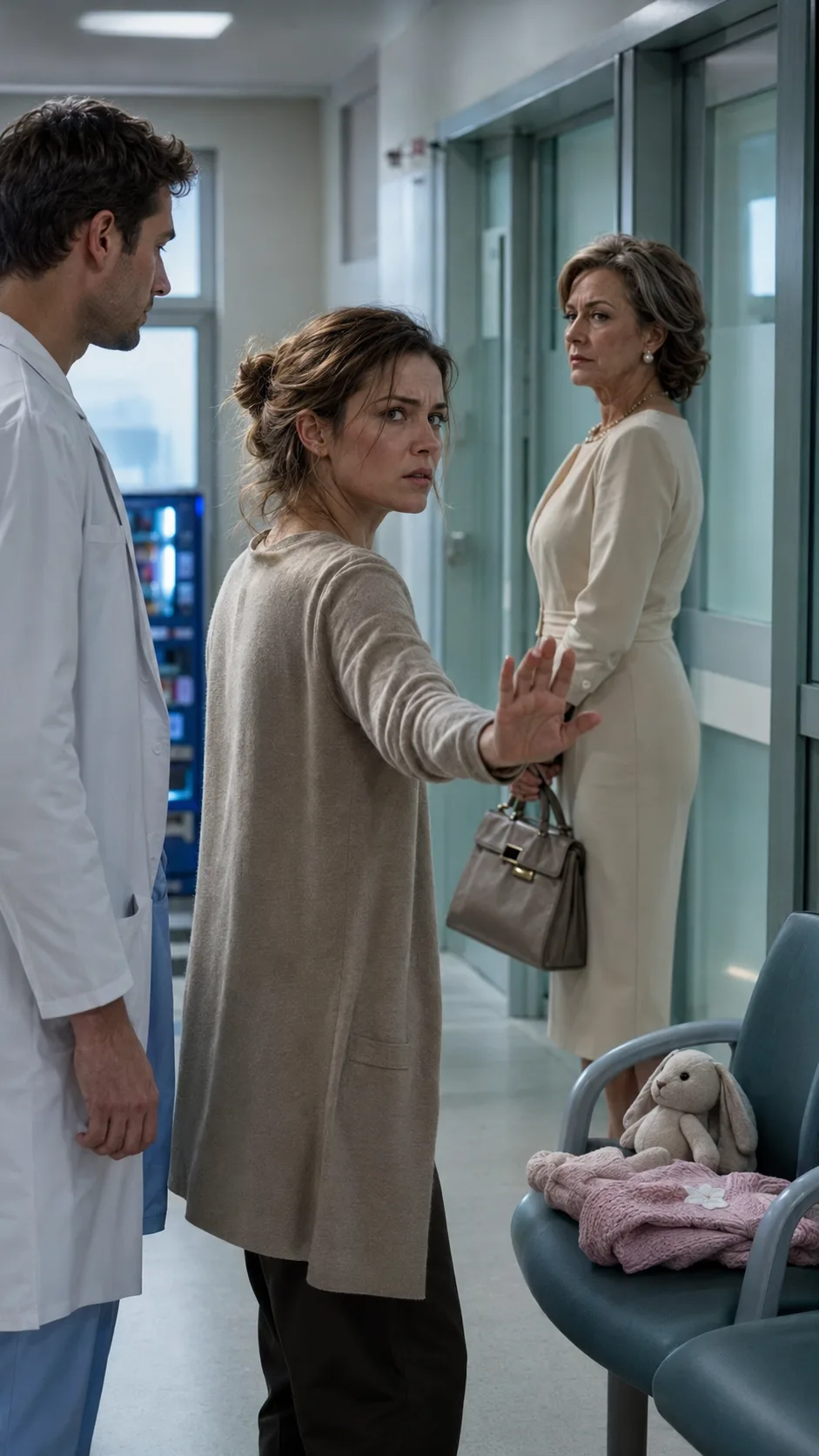
The first thing I remember about that night was the smell.
Chapter 1
The first thing I remember about that night was the smell.
Sharp hospital disinfectant. Burnt coffee from a vending machine. Rainwater drying on people’s coats as families moved through the corridor with hollow eyes and whispered prayers.
I had worked in hospitals long enough to recognize that smell. I had passed terrified parents in hallways before. I had watched doctors deliver careful sentences, nurses lower their voices, and families sit upright in plastic chairs because lying down felt too much like surrender.
But nothing prepares you for standing on the other side of it.
Nothing prepares you for being the mother outside the pediatric ICU doors.
My name is Emma. That night, my eight-year-old daughter Lily was behind those doors, unconscious, surrounded by monitors, tubes, and doctors speaking in quiet voices that made my heart beat harder with every word.
Head trauma.
Possible bleeding.
Close observation.
Neurological checks.
They said everything professionally. Gently. Carefully.
I understood every term because I was
a nurse. I knew what they meant. I knew what they were watching for. I knew how serious it was when a child was moved to the ICU instead of a regular room.
And because I understood, I was more afraid.
Lily was my whole world.
Five years earlier, my husband had died after a long illness, leaving behind a quiet house, unpaid bills, and a little girl who used to sleep with his old sweater pressed against her cheek. Since then, it had been just us.
I worked double shifts. I packed lunches before dawn. I braided Lily’s hair while half-awake. I learned to smile when I was exhausted because children notice everything, especially the things adults try to hide.
We were not rich. We did not take vacations. We did not have a perfect life.
But we had peace.
At least, we had pieces of peace.
Because every
weekend, my mother found a way to take it from us.
My mother, Barbara, had always believed family meant obedience. Not love. Not support. Not kindness. Obedience.
After my father died eight years ago, something in her became colder. She took control of the house, the accounts, the memories, even the way people were allowed to speak about him. She told me more than once that everything he left behind belonged to her because she was his wife, and that daughters who questioned their mothers were selfish, greedy, and ungrateful.
My younger sister Rachel learned to survive by pleasing her.
Or maybe she never needed to survive at all.
Rachel was the golden child. Her mistakes became misunderstandings. Her demands became needs. Her tantrums became stress. My exhaustion became attitude.
So when Rachel had twins three years ago, somehow I became part of her childcare plan without ever agreeing to
it.
Every Saturday, my mother expected Lily and me to come to her house. I cooked. I cleaned. I picked up groceries. I folded laundry that was not mine. Rachel arrived whenever she wanted, dropped her toddlers into the room, and disappeared into phone calls, naps, errands, or conversations about how busy and important her life was.
The part that still makes me sick is how easily they pulled Lily into it.
“She’s old enough to help,” my mother would say.
Lily was eight.
Helping, in my mother’s house, meant following two toddlers around while the adults talked in the kitchen. It meant stopping them from climbing furniture. It meant carrying toys, wiping spilled juice, keeping them entertained, and being scolded if one of them cried.
Whenever I objected, my mother’s face hardened.
“You’re raising her soft,” she told me once. “Children need responsibility.”
“She’s not their nanny,” I said.
My mother looked at Lily, not me, and sighed dramatically.
“Your mother doesn’t like helping family.”
Lily’s little shoulders always sank when she heard things like that.
That was my mother’s real gift. She did not just hurt you directly. She planted shame in the people you loved and waited for it to grow.
For years, I told myself I was keeping the peace. I told myself it was easier to give in for one more weekend, one more holiday, one more favor.
Then I met David.
David was a pediatric surgeon at the hospital where I worked. He was steady in a way that felt unfamiliar to me at first. He did not raise his voice. He did not punish silence. He listened before answering.
With Lily, he was even gentler.
He crouched when speaking to her so she never had to look up too far. He remembered the names of her stuffed animals. He asked about her science projects and let her explain every detail, even when the explanation lasted fifteen minutes and involved glitter glue, moon phases, and a cardboard volcano.
The first time Lily told him, shyly, that she wished he could be her dad someday, David did not laugh it off.
He looked at me, then back at her, and said, “That would be the greatest honor of my life.”
We were supposed to get married in three months.
A small garden ceremony. Nothing extravagant. Just family, a few close friends, and a beginning that felt clean.
When David learned how my mother and Rachel used Lily on weekends, his expression changed. Not dramatically. Not loudly. But enough that I knew he understood something I had been trying not to name.
“Emma,” he said one night after Lily fell asleep on the couch, “that is not normal.”
“I know it’s not ideal.”
“No,” he said gently. “It’s not just inconvenient. It’s wrong. She is a child. She should not be responsible for toddlers while adults sit around.”
I looked away because hearing it spoken plainly made it impossible to keep pretending.
David reached for my hand.
“When we’re married, this stops. Weekends belong to you and Lily. Not your mother. Not your sister.”
For the first time in years, I let myself imagine Saturday mornings without dread.
Pancakes. Cartoons. Laundry done slowly. Lily laughing without checking the room to see if someone was about to call her selfish.
My mother sensed the change before I even said anything.
“You’re abandoning me,” she shouted during one call.
“I’m not abandoning anyone. I’m setting boundaries.”
Rachel’s voice wailed in the background. “So what am I supposed to do with the twins? I have responsibilities!”
I almost laughed at that word.
Responsibilities.
The one thing nobody in that house seemed to think applied to them.
Around that time, Lily started begging not to go.
“Mom,” she whispered one Friday night while I packed her overnight bag, “do we have to go to Grandma’s tomorrow?”
I stopped folding her sweater.
“Why? Did something happen?”
She looked down and twisted her fingers together.
“I just don’t like it there.”
I sat beside her on the bed. “You can tell me anything.”
“I know,” she said quickly.
Too quickly.
But then her eyes filled with tears, and I convinced myself she was just tired. Tired of the noise, tired of the twins, tired of being corrected.
I told myself I would only go a few more times, just until the wedding. Then things would change.
I hate that sentence now.
Just a few more times.
Last Friday, Rachel was preparing for a promotion party. According to my mother, this party was “the most important event of Rachel’s career.” Fifty guests. Caterers. Decorations. A cake that apparently required more emotional attention than my child had ever received from them.
Naturally, I was expected to help.
I arrived at my mother’s house with Lily in the late afternoon. Rachel was already there, pacing with her phone pressed to her ear, while the twins ran through the living room shrieking. My mother was in the dining room arranging glassware as if she were hosting royalty instead of coworkers.
“I need you to pick up extra ribbons and table runners,” my mother said the moment I walked in.
“Hello to you too,” I replied.
She ignored that.
I looked at Lily. “Stay in the living room, okay? I’ll be right back.”
Lily’s eyes moved toward the staircase, then back to me.
“Can I come?”
“It’ll be quick,” my mother said before I could answer. “She can stay here. She’s not a baby.”
Something inside me hesitated.
I should have listened to it.
But the store was ten minutes away. I told Lily I loved her, kissed her forehead, and left.
At 7:03 p.m., my phone rang.
It was my mother.
Her voice was calm. Too calm.
“Lily fell down the stairs,” she said. “I called an ambulance.”
For a second, everything around me disappeared.
The store lights. The cashier. The basket in my hand.
All gone.
“What?” I whispered.
“She fell,” my mother repeated, as if I had failed to understand a minor inconvenience. “They’re taking her to the hospital.”
By the time David and I reached the emergency department, Lily was already being moved for scans. I remember running. I remember David speaking to doctors. I remember signing something with a hand that did not feel like mine.
Then the ICU.
Then the waiting.
My mother arrived not long after, with Rachel behind her.
“She was running,” my mother said. “Children run. I wasn’t watching every second.”
No tears.
No shaking hands.
No guilt.
Just that smooth, defensive tone she used whenever she wanted a subject closed.
I stared at her, unable to make my mouth work.
Rachel kept checking her phone.
“I have caterers coming tomorrow,” she muttered, like the universe had personally inconvenienced her.
David heard it. His jaw tightened, but he said nothing then.
I sat beside Lily’s bed for hours, holding her limp hand and whispering the same things again and again.
Mama’s here.
You’re safe.
Please wake up.
I’m sorry.
I’m so sorry.
Sometime after midnight, my phone began buzzing.
My mother.
For one impossible second, I thought maybe she had realized. Maybe the shock had finally reached her. Maybe she was calling to ask if Lily had opened her eyes.
I answered.
“Is she awake yet?” my mother asked.
“No.”
A short pause.
Then she said, “Tomorrow is Rachel’s promotion party. You’ll still handle the venue decorations, right?”
I pulled the phone away from my ear and stared at the screen.
I thought exhaustion had twisted the words.
“What?”
“The decorations,” she said, impatient now. “The venue needs to be ready by noon. Rachel cannot manage everything herself.”
I looked at my daughter, pale and still under a hospital blanket.
“Mom,” I said slowly, “Lily is unconscious in the ICU.”
“You’re not the doctor,” she replied. “Sitting there staring at her won’t change anything.”
Something cold moved through my chest.
Then Rachel came on the line, crying loudly.
“Emma, please. This is huge for me. Do you know how hard I’ve worked? People are coming. Important people. You can’t ruin this because you’re upset.”
“My child might have bleeding near her brain,” I said.
Rachel sniffed. “You always make things sound worse when you want attention.”
I could not breathe for a moment.
Then my mother’s voice returned, flat and final.
“If you don’t come tomorrow, Emma, we’re done.”
I looked at Lily’s tiny fingers wrapped loosely around mine.
And for the first time in my life, my mother’s threat did not frighten me.
It clarified everything.
“Then we’re done,” I said.
I hung up.
My colleague and closest friend, Nicole, had been sitting nearby with a cup of untouched coffee. She had heard enough. Her face was full of pain, but not surprise.
“Emma,” she said softly, “this is abuse. Not just what they’re doing to you. What they’ve done to Lily.”
The word landed heavily.
Abuse.
I wanted to reject it. I wanted to soften it. I wanted to call it family dysfunction, pressure, obligation, grief, anything else.
But Lily was in an ICU bed.
And my mother wanted centerpieces arranged.
David returned from speaking with the attending physician and found me shaking with the phone in my lap. When I told him what had been said, something in his face changed completely.
Not rage exactly.
Resolve.
He took the phone gently from my hands as messages kept appearing.
Mom:
Stop being dramatic.
Rachel:
You’re ruining my life.
Mom:
Your daughter fell. Accidents happen.
Rachel:
If you loved me, you would come.
Mom:
Don’t expect family after this.
David read them, then placed the phone face down.
“They forfeited the right to call themselves family,” he said.
I opened my contacts with trembling fingers.
Barbara.
Delete contact.
Rachel.
Delete contact.
My hands shook so badly I almost dropped the phone, but after it was done, I felt something I had not felt in years.
Fear, yes.
Grief, yes.
But underneath both, there was air.
The next morning, weak sunlight slipped through the blinds of Lily’s ICU room. I had not slept. David had dozed in a chair for maybe twenty minutes. Nicole had gone home only after making me promise to call her the second anything changed.
I was sitting beside Lily, watching her eyelids, when the door opened.
My mother walked in wearing a cream-colored dress and pearls.
Rachel followed in heels, carrying a garment bag over one arm.
For one second, I honestly thought I was hallucinating.
They looked ready for a party.
My daughter was in a hospital bed.
My mother glanced at Lily, then at me.
“Still sleeping?”
I stood slowly. “Get out.”
Rachel rolled her eyes. “Emma, don’t start. We came to check on her before heading to the venue.”
“You came dressed for your party.”
“It’s not a party,” Rachel snapped. “It’s a professional milestone.”
David rose from his chair.
My mother ignored him and stepped closer to the bed. “Enough of this nonsense. Lily will wake up, and then you’ll realize how badly you behaved.”
“You need to leave,” I said.
My mother’s mouth thinned. “You are jealous. You have always been jealous of Rachel.”
Rachel made a wounded sound. “My cake is probably ruined by now.”
That was when Lily moved.
Just a small twitch at first.
Then her eyelids fluttered.
Everything else vanished.
I rushed to her side. “Lily? Sweetheart? Mama’s here.”
Her eyes opened slowly, unfocused and frightened. Then they found me.
“Mama,” she whispered.
I started crying before I could stop myself. “I’m here. You’re safe. I’m right here.”
My mother leaned in with a soft, fake voice I knew too well.
“Grandma’s here too, darling.”
Lily’s body went rigid.
Her fingers clamped around mine.
Her eyes widened with pure fear.
I felt the change immediately.
“Lily?” I whispered.
She started crying.
“I’m scared of Grandma.”
The room froze.
My mother straightened. “She’s confused.”
David stepped closer.
Lily turned her face toward me, tears sliding down her cheeks. Her voice was weak, but every word cut through the room.
“Mama,” she whispered, “I didn’t fall.”
My heart stopped.
My mother’s expression flickered.
Just for a second.
But I saw it.
“Lily,” I said gently, though my whole body was shaking, “what happened?”
She swallowed and looked toward the door as if afraid someone might come back through it.
“The babies were crying,” she said. “Grandma told me to take them upstairs. I said I couldn’t. They were too heavy. I said I needed help.”
Rachel’s face went pale.
My mother snapped, “That is enough.”
David’s voice cut in. “Do not interrupt her.”
Lily gripped my hand harder.
“Grandma got mad,” she whispered. “She grabbed my arm. She pushed me.”
The silence after that was not empty.
It was full of everything I had refused to see.
Every flinch. Every quiet plea not to go. Every time Lily had gone still when my mother entered a room. Every time I told myself one more weekend would not matter.
My mother recovered first.
“She has a head injury,” she said sharply. “She doesn’t know what she’s saying. Emma, don’t be stupid.”
Rachel stepped forward, frantic now. “Lily, stop it. Tell your mom you tripped. We don’t have time for this.”
That sentence did something to me.
We don’t have time for this.
My daughter had just accused her grandmother of hurting her, and Rachel was worried about time.
David moved between them and the bed.
“As a physician in this hospital,” he said, his voice controlled and cold, “I am a mandatory reporter. A child has just disclosed suspected abuse. Security will be called. Social services will be notified. And if either of you speaks to her again before the proper authorities arrive, I will make sure everyone in this unit knows why.”
My mother’s eyes narrowed. “You think you can threaten me?”
“No,” David said. “I’m informing you.”
I pointed to the door.
“Leave.”
My mother stared at me as if seeing me clearly for the first time and hating what she saw.
“You’ll regret this,” she hissed. “When he leaves you, don’t come crawling back.”
Rachel grabbed her arm. “Mom, come on. The caterers—”
They left in a cloud of perfume, anger, and panic.
The party never mattered again.
Within the hour, I was speaking to a detective and a hospital social worker.
Because David had reported the disclosure immediately, everything moved quickly. The police requested footage from my mother’s doorbell camera. She had assumed it only recorded the porch. She did not realize the side window reflected part of the foyer.
The footage did not show the moment Lily was hurt.
But it showed enough.
It showed my mother standing over Lily after the fall.
Not rushing.
Not crying.
Not calling for help right away.
For three full minutes, she stood there, looking down, then checking her phone, smoothing her hair, and glancing toward the dining room as if calculating how much trouble this would cause.
Only after that did she pick up the landline.
Three minutes.
I watched the footage once and never again.
The police found more when they searched the house.
Texts between my mother and Rachel.
My mother:
She refused to take the twins upstairs. I lost my temper.
Rachel:
Just say she fell. I need the house clean. Don’t let the ambulance people make a scene.
My mother:
She’s breathing. I called.
Rachel:
Good. Keep it quiet.
There are moments when betrayal is so complete that grief cannot keep up.
I did not scream when the detective showed me the messages.
I simply felt something final close inside me.
Rachel’s promotion party was canceled.
Not postponed.
Canceled.
By the end of the week, her workplace knew she was being investigated for helping cover up what happened to a child. The same people she had been desperate to impress stopped answering her calls.
My mother was charged. Rachel faced charges too.
But the damage did not stop there.
During the legal process, another truth surfaced.
For years, my mother had used my father’s inheritance like a chain around my neck. She had claimed everything belonged to her. She had told me I had no right to question the house, the accounts, or any decision she made.
Then attorneys began reviewing documents.
A codicil to my father’s will had been added shortly before his death.
His signature was on it.
Except it was not his signature.
Experts confirmed what I think some part of me had always known: my mother had forged it.
The house, the money, the authority she had used to control me—it was built on fraud.
When I found out, I did not feel satisfaction.
I felt tired.
Tired of lies dressed as family. Tired of cruelty demanding respect. Tired of being told that survival meant silence.
Lily healed slowly.
Not just physically.
For weeks, she woke from bad dreams and called for me. She startled at loud footsteps. She asked whether Grandma knew where we lived, even though I had changed locks, blocked numbers, and made sure the school had strict pickup instructions.
David never rushed her.
He sat on the floor outside her room when she did not want anyone too close. He let her decide when to talk. He reminded her again and again that what happened was not her fault.
Three months later, on a clear afternoon, we got married in a small garden behind a friend’s house.
There were no grand decorations. No fifty important guests. No speeches about status or appearances.
Just sunlight, flowers, a few people who truly loved us, and Lily walking carefully down the aisle with a crown of daisies in her hair.
She looked beautiful.
More importantly, she looked safe.
When she reached the front, she did not scan the chairs for my mother or Rachel.
She looked at David.
And smiled.
During the vows, David turned to me first. His voice shook only once.
Then he looked at Lily.
He lowered himself to one knee so they were eye to eye.
From his pocket, he took a small silver locket.
“Lily,” he said, “I promise to listen when you speak. I promise that in our home, you never have to earn love by being useful. You get to be a child. You get to be safe. And I promise I will spend my life helping your mother protect that.”
Lily’s face crumpled.
Then she threw her arms around him so hard he almost lost his balance.
Everyone laughed and cried at the same time.
I used to believe being the stable one meant absorbing pain so the family would not break.
I was wrong.
Being stable means becoming solid ground for the people who depend on you.
It means refusing to hand your child back to people who call harm an accident and cruelty tradition.
It means understanding that some contacts are not deleted out of anger.
They are deleted because the life on the other side of that silence is finally yours.
As David, Lily, and I walked back down the aisle together, I realized my family had not ended in that ICU room.
The false version had.
The real one was just beginning.
THE END.
Chapter complete
You have reached the end of this chapter.
Continue reading
A few more worlds to get lost in after this chapter.




