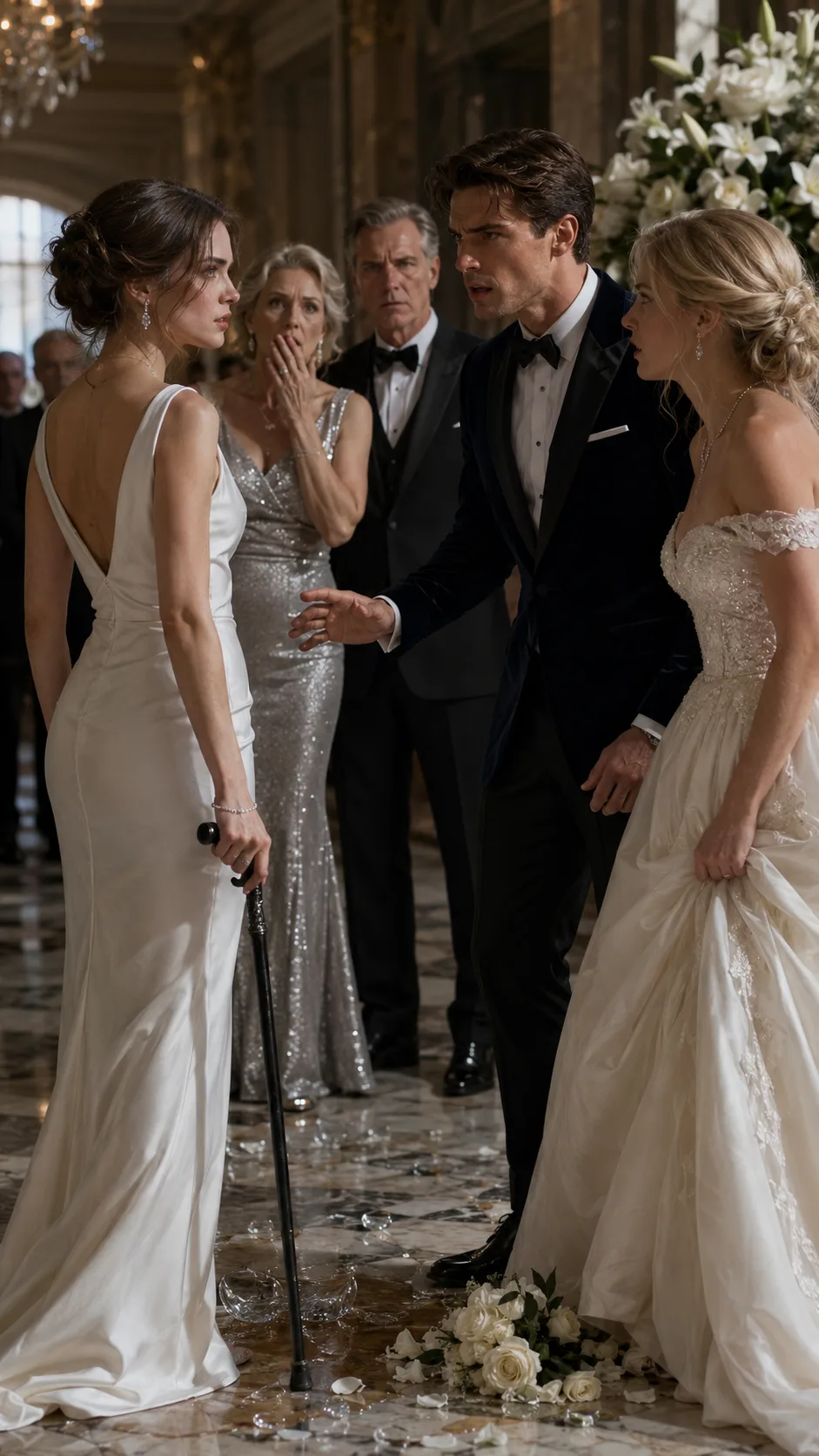
The first person to recognize me at my brother’s wedding was my brother himself.
Chapter 1
The first person to recognize me at my brother’s wedding was my brother himself.
And for one flawless second, Mason Harper looked as if the air had been stolen straight out of his lungs.
He stood in the grand foyer of the Crawford Hotel ballroom, posed beneath a canopy of white orchids and gold light, one arm resting around Avery Langford’s waist like she was another trophy he had already won. His tuxedo was velvet, deep navy, tailored so sharply it looked almost cruel. The photographer had just lifted his camera. Avery had tilted her head into that practiced bridal angle.
Then Mason saw me.
The smile collapsed from his face.
His fingers loosened from Avery’s waist.
His eyes widened, then emptied, as if his mind had reached for an explanation and found nothing but terror.
I stopped two steps in front of him.
Not hidden in a corner. Not trembling by the door. Not waiting for permission.
I stood directly in the path
of his perfect wedding and let him look.
“Congratulations, Mason,” I said.
My voice was soft, but it traveled.
That was the first thing that startled him. Not the dress. Not the money in the room. Not even the fact that I was alive and standing there after twelve years of silence.
It was my voice.
Calm. Steady. Unafraid.
His gaze moved over me like a man reading a sentence he already knew would destroy him. First my face. Then the white silk dress, cut clean and architectural, falling around me in a shape I had designed with my own hands. Then the small emblem stitched over my heart, almost invisible until the chandelier light caught its silver thread.
When it did, the color left his face.
Avery glanced between us, her polished smile beginning to crack. “Mason?” she asked quietly. “Who is she?”
He said nothing.
His lips parted,
but no sound came out.
Then my mother saw me.
Laura Harper had been crossing the foyer with two champagne flutes, her silver heels clicking against the marble, diamonds flashing on her wrists as if she had armored herself in wealth. She looked exactly as I remembered her: elegant, composed, expensive, and hollow in all the places that mattered.
For half a breath, she only stared.
Then both glasses slipped from her hands.
They shattered against the floor.
Crystal scattered across the marble like ice. Champagne splashed over her shoes and across the hem of her gown. The sound sliced through the quartet music, through the polite conversations, through the entire illusion of the Harper family’s perfect evening.
Every guest turned.
That was how I returned to Denver.
Not with shouting.
Not with tears.
Not with revenge written across my face.
I returned with silence, white silk, and my mother’s
celebration broken at her feet.
My father stepped out from behind her.
Richard Harper had aged, though not enough to make him humble. His hair was thinner, silver at the edges. His face carried the heaviness of expensive dinners, late-night scotch, and years spent believing no consequence would ever arrive at his door. But his eyes were still the same eyes that had watched me cry at seventeen and decided I was disposable.
Cold eyes.
Judging eyes.
Eyes that had once convinced me love was something I had to earn by disappearing.
But tonight, those eyes were not cold.
They were afraid.
He looked at me like a man seeing smoke rise from a foundation he had sworn was buried.
Twelve years earlier, Richard Harper had dragged my suitcase to the front hall during a Denver blizzard. Mason had stood on the stairs, laughing, spitting the words he knew would hurt most.
“You’re an ugly disabled idiot. Nobody wants you here.”
My mother had looked away.
My father had opened the door and pointed into the storm.
“You will not carry the Harper name again,” he had said. “Take what you have and go.”
What I had was one suitcase, eight hundred dollars, a damaged leg, and a name he thought he could tear off me like an old label.
I walked into that snow with nothing.
And twelve years later, I walked back into his world wearing a dress worth more than the mercy he never showed me.
Richard’s throat worked before his voice came out. “Elara?”
The room went still.
His eyes dropped to the emblem on my chest.
“What is that?” he asked, rough and low. “What did you put on your dress?”
I looked down, as if I needed reminding.
Silver thread. Two letters woven together: V and A.
“My signature,” I said. “Valerius-Aethel.”
The name moved through the room before I did.
Avery’s expression changed first. The Langfords knew that name. Everyone with real estate, investments, luxury holdings, or debt in Denver knew that name.
Valerius-Aethel was not just a design house. Not anymore.
It was architecture. Development. Fashion. Acquisitions. Silent ownership. Quiet control.
The kind of empire that did not beg to enter rooms because half the rooms already belonged to it.
Avery’s voice thinned. “Valerius-Aethel? The firm behind the Denver Spire?”
I met her eyes. “Yes.”
“The firm that bought out my father’s partners?”
“Yes.”
Her hands tightened around her bouquet.
I turned back to Mason. “And as of nine o’clock this morning, the firm that acquired the principal debt tied to Harper Holdings.”
A murmur rolled through the foyer.
Mason finally moved. It was not confidence. It was panic disguised as anger.
“You think this is funny?” he snapped. “You walk into my wedding dressed like a bride and start throwing around company names?”
“I didn’t come dressed like a bride,” I said. “I came dressed like the woman who owns the ground under your feet.”
His jaw clenched. “Security.”
No one moved.
I lifted one hand slightly. “That would be unwise.”
Mason’s eyes sharpened with hatred. “Get her out.”
“The Crawford Hotel sits on land purchased three years ago through a blind trust,” I said. “That trust belongs to me. So technically, Mason, you are the one standing where you have no right to stand.”
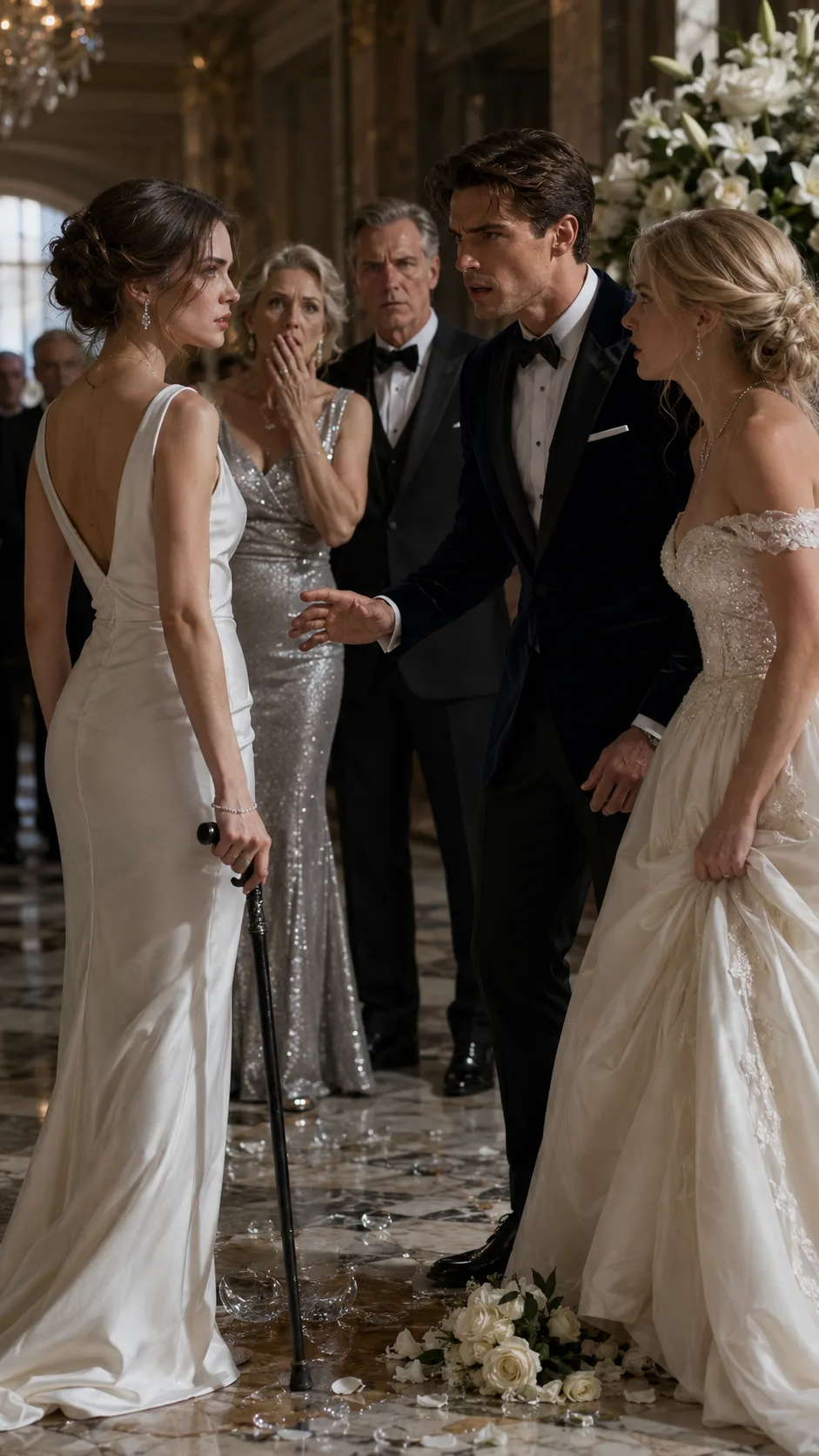
The photographer lowered his camera.
Somewhere behind me, someone whispered, “Oh my God.”
But I was not finished.
The money was only the door.
The secret was the blade.
I turned toward Avery.
She was beautiful in the careful, curated way women become when their whole family has taught them that marriage is a merger with flowers. Her gown was perfect. Her hair was perfect. Even her fear was trying to remain graceful.
I stepped closer, my cane tapping once against the marble.
Mason flinched at the sound.
I smiled faintly.
He used to mock that cane. He used to hide it. Once, he threw it into the snow and told me to crawl if I wanted it back.
Now every click sounded like a countdown.
“Avery,” I said, “I know why this wedding is happening.”
Her eyes flicked to Mason.
I kept my voice clear enough for the first two rows of guests to hear.
“I know about the Langford accounts. I know your father has been behind on property taxes for years. I know this marriage was not just romance. It was rescue.”
Avery’s face hardened.
The Langfords, gathered near the entrance to the ballroom, went silent in the way only guilty people do.
Mason stepped forward. “Shut your mouth.”
I did not look at him. “But there is something your groom forgot to tell you.”
Avery’s breathing became shallow.
I turned then, slowly, to my brother.
“Mason is not the heir he sold himself as.”
That sentence landed harder than the shattered crystal.
My father moved first. “Elara.”
There was warning in his voice.
There was begging too.
I had waited twelve years to hear both.
I continued.
“Grandmother Aethel’s original trust was never built around the Harper surname. It was built around direct bloodline and disinheritance protection. She wrote it that way because she knew exactly what kind of man her son was.”
Richard’s face went gray.
My mother pressed one hand to her mouth.
“When Richard threw me out and legally removed my claim to the Harper name, he thought he was cutting me off.” I looked at my father. “But he triggered the bypass clause.”
Mason stared at him. “What is she talking about?”
I let the silence answer first.
Then I said, “When I turned twenty-five, controlling interest moved to me. Eighty-five percent of the family voting shares. Quietly. Legally. Permanently.”
Avery’s bouquet slipped lower in her hands.
The guests began whispering again, louder this time.
Mason spun toward our father. “Dad?”
Richard did not answer.
That was answer enough.
The confidence Mason had worn all evening cracked straight down the center. He looked suddenly younger, smaller, less like a groom and more like the boy on the stairs who had laughed while I was pushed into the snow.
Only this time, no one was laughing with him.
My father took one careful step toward me, palms slightly open. “Elara, listen to me. We made mistakes. I admit that. But you’re here now. You’ve proven yourself. This family can still be repaired.”
I looked at him for a long moment.
Then I said, “You do not get to call something family after you used it as a weapon.”
His mouth tightened.
“You were difficult,” he said quietly. “You were angry. You needed discipline.”
“I was a disabled teenager grieving a home that never loved me properly.”
My mother made a broken sound.
I turned to her.
She stood in the middle of the spilled champagne, frozen, her perfect silver shoes stained and glittering with fragments of glass.
For years, I had imagined what I would say to her. I imagined shouting. I imagined demanding to know why she never came after me. Why she never called. Why she let a storm have me when she could have opened the door.
But standing there, I realized I no longer needed her answer.
Her silence had been the answer.
“The champagne suits the floor,” I said. “It belongs with everything else you let break.”
She lowered her eyes.
Avery looked at Mason then, really looked at him.
Not as a groom. Not as a Harper heir. Not as the man who had promised to save her family.
As a liability.
The transformation was instant.
Her shoulders straightened. Her expression cooled. Whatever affection had been there disappeared beneath calculation.
“You lied to me,” she said.
Mason reached for her. “Avery, don’t listen to her. She’s bitter. She’s always been—”
“Disabled?” I asked.
His mouth snapped shut.
“Ugly?” I continued. “Stupid? Useless? Which word were you reaching for this time?”
Avery pulled her hand away from him.
The bouquet fell.
White lilies scattered over the marble, mixing with champagne and broken glass.
“The wedding is over,” Avery said.
The room erupted.
Mason started shouting her name. Richard began speaking to someone about lawyers. Laura stood motionless, as if moving might make the scene real. Guests backed away from the family they had come to admire, suddenly afraid that proximity might stain them too.
I did not stay for the begging.
I did not stay for the threats.
I did not stay to watch Mason learn what it felt like to lose a future in front of everyone.
I turned and walked toward the entrance.
My cane clicked steadily beside me. Not weak. Not shameful. Precise.
Each sound marked the distance between who they had tried to make me and who I had become.
Outside, the Denver air was cold.
Not like that night twelve years ago. Not cruel. Not endless.
Just sharp enough to remind me I had survived winter before.
My driver opened the door of the black SUV waiting at the curb. Before I stepped inside, I looked back once at the Harper crest mounted across the street, glowing under the hotel lights as if it still meant something.
Tomorrow, my crew would remove it.
By next week, the building would carry a different name.
Mine.
I had not come back to carry the Harper name.
I had come back to bury it beneath the one I built myself.
THE END.
Chapter complete
You have reached the end of this chapter.
Continue reading
A few more worlds to get lost in after this chapter.




