The Fake Princess Stole Amelia’s Charity, But One Child Remembered the Name Isabella Tried to Erase Forever at the Gala
The first time I saw my name erased, it was not from a throne room document.
Chapter 1
The Fake Princess Stole Amelia’s Charity, But One Child Remembered the Name Isabella Tried to Erase Forever at the Gala
The first time I saw my name erased, it was not from a throne room document.
It was from a children’s hospital wall.
For three years, the royal charity had existed under one quiet file name on my private server: The Aurora Children’s Fund.
No crown logo.
No palace portrait.
No gold-stamped announcement.
Just a small, clean system of donor accounts, hospital invoices, school supply orders, transportation schedules, medical grants, and handwritten thank-you cards from children who had no idea that a princess had been reading every one of their names at midnight.
I had built it in silence because silence was the only space my stepmother had left me.
Queen Helena did not ban me from royal work. That would have looked cruel.
She did something smarter.
She let me work until the work mattered, then placed someone else in front of the cameras.
Her daughter, Isabella, smiled for the world.
I signed the forms.
Isabella waved from balconies.
I negotiated with hospitals.
Isabella
wore white satin to charity luncheons and said things like, “Children are the future of our kingdom,” while mispronouncing the name of the city where half the children lived.
I corrected her notes before she walked onstage.
I fixed the donor reports she never read.
I sent apology emails when she forgot meetings.
And every time the press called her “the heart of the palace,” Helena would look at me from across the room with that calm, perfect smile.
The kind of smile that said, You may be useful, Amelia, but you will never be seen.
That morning, I found out she had decided to take the last thing I had left.
The charity gala was scheduled for seven that evening in the west ballroom of Valmont Palace. It was supposed to be the official launch of the Aurora Children’s Fund. After years of private work, we finally had enough
donors, enough legal structure, and enough public partners to announce it properly.
I had written the speech myself.
Not for Isabella.
For me.
For the first time in three years, my name was printed on the program.
Founder: Princess Amelia of Valmont.
I stood in my office at 8:12 a.m., holding the gala program in both hands, staring at the proof like it might disappear if I blinked.
My office was not really an office. It was a narrow room behind the palace archive with one window, two filing cabinets, and a desk that had belonged to a retired secretary. The heating made a soft ticking sound in winter. The printer jammed if more than five pages went through at once.
But it was mine.
Every child’s file had passed through this room.
Every transfer had been checked from this desk.
Every desperate hospital letter had been opened under this
yellow lamp.
I touched my name on the program with my thumb.
For one second, I let myself believe it.
Then the door opened.
Isabella walked in without knocking.
She was wearing a pale blue silk robe, her blond hair pinned loosely like she had just stepped out of a beauty campaign. Two assistants followed her, one holding a garment bag, the other carrying a tray of coffee she would not drink.
She looked at the program in my hand.
Then she laughed.
Not loudly.
Worse.
Softly.
Like I had misunderstood something obvious.
“Oh, Amelia,” she said. “You actually saw the old version.”
My fingers tightened around the paper.
“What old version?”
Isabella tilted her head toward one of her assistants. The girl stepped forward and placed a new program on my desk.
I already knew before I picked it up.
The room went quiet inside my head.
On the front page, beneath the gold crest of Valmont, the founder line had changed.
Founder: Princess Isabella of Valmont.
My name was gone.
Not moved.
Not reduced.
Gone.
I read it once.
Then again.
My stomach dropped.
“This is a mistake,” I said.
Isabella smiled like she had already won. “No. This is branding.”
I looked up slowly.
She crossed to my desk and picked up one of the medical reports from Saint Carina’s Children’s Hospital. She barely glanced at it before setting it down again, as if the papers were props.
“Mother spoke with the council,” she said. “A children’s fund needs a public face. Someone warm. Someone beloved. Someone people want to donate to.”
I kept my voice steady. “Someone who built it?”
Her smile sharpened.
“Someone who can sell it.”
Behind her, the assistant with the coffee looked at the floor.
Isabella leaned closer and tapped one manicured finger on the new program.
“You did well with the paperwork. Really. But compassion needs presence. The kingdom needs to see a princess.”
“I am a princess.”
For half a second, something cold passed over her face.
Then it was gone.
“Technically,” she said.
The word landed harder than a slap.
Technically.
That was what Helena had turned my life into.
Technically, I was the late king’s daughter.
Technically, I had royal blood.
Technically, I was allowed to live in the palace.
But Isabella had the photographs, the gowns, the public introductions, the warm articles, the carefully arranged smiles beside foreign princes.
I had signatures at the bottom of documents no one read.
I looked down at the new program again.
“You can’t do this,” I said.
Isabella gave a small sigh, like I was making her late for something important.
“We already did.”
Then she picked up the speech from my desk.
My speech.
The one I had written after visiting the pediatric oncology wing in Eastmere. The one where I mentioned Daniel, who needed transport to dialysis. Nora, who wanted purple shoes for her first day of school. Lily, who had not spoken for a week after surgery until I brought her a stuffed rabbit from the palace nursery.
Isabella flipped through the pages.
“This line is good,” she said. “The part about children not needing pity, only protection.”
My throat tightened.
“Put it down.”
She looked amused.
“You should be proud. Your words are finally going to reach people.”
“Under your name.”
She lifted one shoulder. “Under the palace name.”
“No,” I said. “Under yours.”
The air changed.
Isabella’s smile faded just enough to show what lived beneath it.
“You still don’t understand your position here, do you?”
I said nothing.
She stepped around the desk, close enough that I could smell her perfume.
“People do not love you, Amelia. They respect your usefulness when they notice it. That is different.”
My chest went tight.
“You can take the program,” I said. “You can take the speech. You can stand under every chandelier in this palace and call yourself a saint. But you don’t know those children.”
Her eyes narrowed.
“You think anyone will ask?”
I did not answer.
Because that was the thing that scared me.
Maybe no one would.
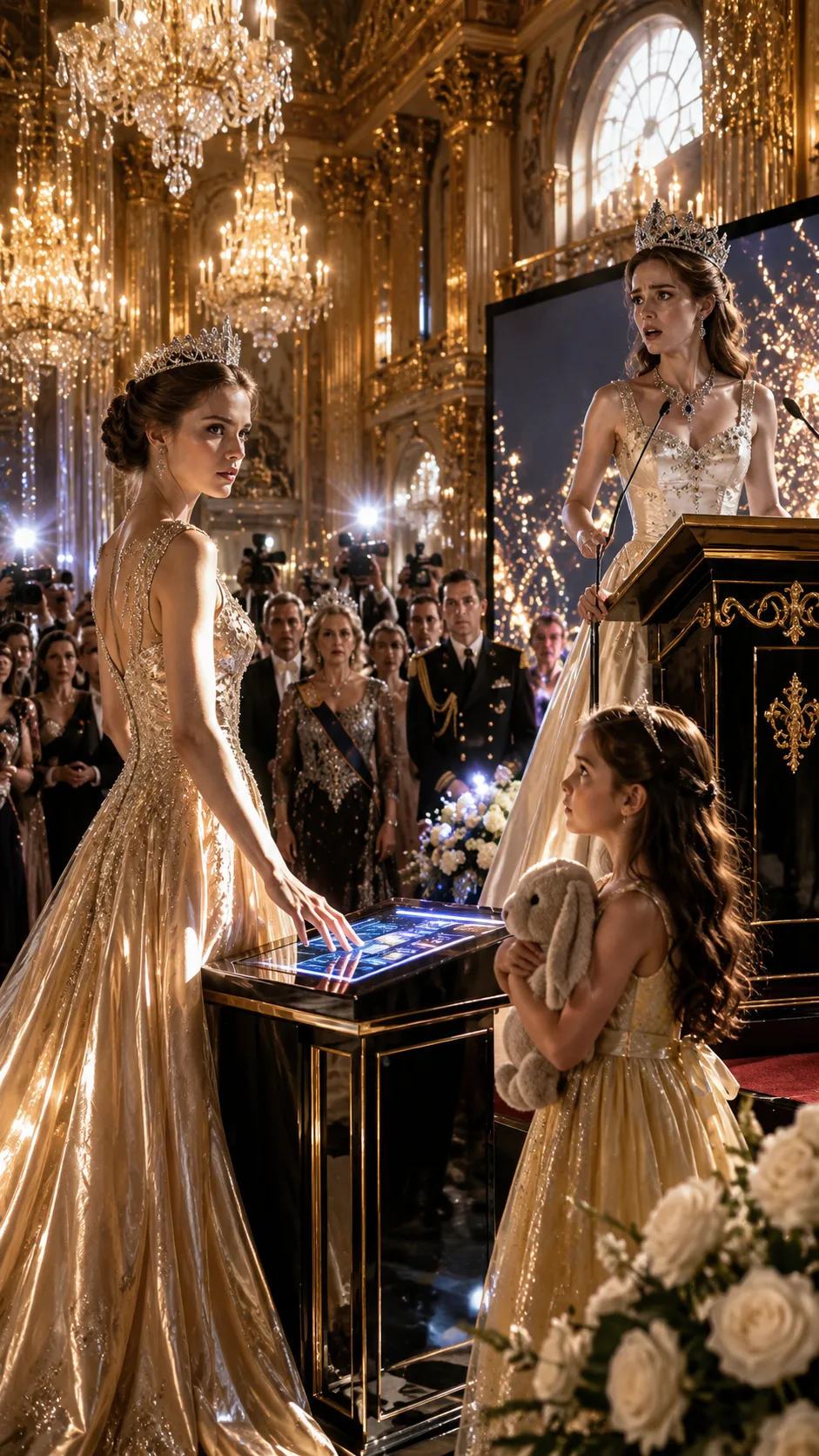
That evening, the west ballroom looked like something out of a royal dream.
Crystal chandeliers spilled warm light over white roses and gold-trimmed tables. Silk banners hung from the balconies. Reporters stood behind velvet ropes, cameras ready, lenses pointed toward the stage. The kingdom’s richest families floated through the room in diamonds and black tie, laughing softly over champagne.
Every detail had been arranged to look generous.
Beautiful.
Clean.
No one saw the panic behind the flowers.
I stood near the side of the stage in a champagne satin gown that Helena’s stylist had chosen for me at the last minute. It was elegant, but plain enough not to compete with Isabella’s white silk dress and sapphire necklace.
That was always the rule.
I could be beautiful, but not memorable.
I could be present, but not central.
I could stand close to the truth, but never in its light.
Prince Alexander arrived at 7:04 p.m.
I noticed because the room shifted.
People always noticed Alexander.
He was the heir to the neighboring kingdom of Alden, tall, dark-haired, and composed in a navy royal military uniform with gold embroidery at the shoulders. He did not smile easily. When he did, it meant something.
Our kingdoms had been discussing a formal alliance for months. Helena wanted Isabella beside him at every event. The press loved the idea. Two beautiful royals, two powerful families, one perfect diplomatic future.
Alexander had never seemed convinced.
He entered with two advisers and paused near the donor wall, reading the displayed history of the Aurora Children’s Fund.
I watched his eyes move over the text.
There was no mention of me.
Only Isabella.
A strange hollow feeling opened under my ribs.
I looked away before he could turn.
“Amelia.”
His voice came from behind me a few minutes later.
I turned.
Alexander stood close enough that I could see the slight crease between his brows.
“Are you all right?” he asked.
It was such a simple question.
No one in the palace asked me that unless they needed me to keep working.
I almost laughed.
“I’m fine.”
His gaze flicked toward the stage, where Isabella was greeting donors with both hands and a practiced tilt of her head.
“Is this program correct?”
My pulse moved once, hard.
“What do you mean?”
He held the printed booklet between two fingers.
“The fund’s founder.”
I kept my face still. “The palace made revisions.”
“That is not what I asked.”
Before I could answer, Helena appeared beside us.
She wore emerald silk and diamonds, her silver-blond hair swept into a perfect chignon. She looked every inch the queen. Calm. Untouchable. Kind enough for cameras. Dangerous enough for closed doors.
“Your Highness,” she said warmly to Alexander. “I hope the evening has impressed you.”
Alexander bowed his head slightly. “It has raised questions.”
Helena’s smile did not move.
“Successful charity often does.”
She turned to me.
“Amelia, Isabella needs the final donor figures before she speaks.”
I knew the command beneath the sentence.
Leave.
I lowered my eyes.
“Yes, Your Majesty.”
As I passed Alexander, he said quietly, “We are not finished.”
Helena heard him.
Of course she did.
Her smile thinned.
I walked backstage with the donor figures in my hand and a storm in my chest.
Isabella was standing behind the curtain, surrounded by stylists. One adjusted the fall of her sleeve. Another touched powder to her chin. She held my speech like a menu she had not ordered from.
When she saw me, she reached out lazily.
“Figures.”
I handed her the folder.
She opened it upside down.
I stared at her.
She noticed my look and smiled.
“Relax. I’ll read what matters.”
“What matters are the names,” I said.
“The donors?”
“The children.”
Her smile froze for a second.
Then she laughed softly.
“You really do make everything heavy.”
I stepped closer.
“Lily Harper. Daniel Cross. Nora Vale. Mateo Quinn. Sophie Alder. The Eastmere twins. You should know them.”
“Why?” Isabella asked. “Will they be voting?”
Something inside me went still.
She saw it and enjoyed it.
“Oh, don’t look so wounded,” she said. “You can keep writing letters to them after the gala. I’m not taking your little hobby away.”
Little hobby.
Three years of hospital nights.
Three years of donor calls.
Three years of watching children sleep through pain while their parents cried into vending machine coffee.
Little hobby.
I looked at the speech in her hand.
“That fund saved lives.”
“And tonight,” Isabella said, “it saves my public image.”
The curtain rustled behind us.
A stage manager whispered, “Two minutes.”
Isabella turned toward the mirror and checked her reflection.
Then she said the line that made my hands go cold.
“Compassion is not something one can pretend to have.”
She practiced it with a soft smile.
My line.
My words.
Written for the children.
Used by her like jewelry.
I stepped back.
Not because I was afraid.
Because if I stayed close to her, I might say something that Helena could twist.
The stage lights brightened.
The announcer walked to the podium.
“Ladies and gentlemen, honored guests, members of the press, and friends of the kingdom, please welcome Her Royal Highness Princess Isabella of Valmont, founder of the Aurora Children’s Fund.”
Applause rose like a wave.
Isabella walked out.
She knew how to move under light.
Chin raised. Shoulders relaxed. Smile gentle. Every step measured, every camera angle understood. The crowd loved her before she opened her mouth.
I stood in the shadow near the curtain, looking at the stage I had built for someone else.
Helena sat in the front row, hands folded, face serene.
Alexander stood near the donor wall, not sitting.
His eyes were not on Isabella.
They were on me.
Isabella reached the podium.
The applause faded.
She placed my speech down and looked out over the ballroom.
“Compassion,” she began, “is not something one can pretend to have.”
The room went soft with approval.
I felt the sentence leave me forever.
She continued.
“For three years, I have carried a dream in private. A dream that every child in Valmont, no matter their family name or income, would have access to medical care, education, and dignity.”
A woman near the front pressed a hand to her heart.
A reporter lifted his camera.
Isabella lowered her voice.
“I have visited hospitals at night. I have read every letter. I have learned their names.”
I closed my eyes.
For one second, the ballroom disappeared.
I saw Lily in a hospital bed with tubes taped to her small arm, refusing to look at anyone. I saw her mother asleep in a chair with a coat for a blanket. I saw the stuffed rabbit on the pillow, its palace tag cut off because Lily did not want charity. She wanted a friend.
I opened my eyes.
Isabella was still speaking.
“This fund is not about politics. It is about love.”
She paused for applause.
The applause came.
Then a small sound cut through the ballroom.
Not loud.
Not planned.
A child’s voice.
“That’s not true.”
The room shifted.
Isabella blinked.
Every camera turned.
A little girl stood near the center aisle in a pale yellow dress, one hand gripping the skirt, the other holding a worn gray stuffed rabbit.
Lily Harper.
She was nine now, thinner than most children her age, with dark curls pulled back by a ribbon. Her mother stood behind her, pale with panic, trying to pull her back.
But Lily did not move.
She looked straight at the stage.
“That’s not Princess Amelia,” she said.
The ballroom went silent.
My breath caught.
Isabella’s smile tightened.
“Sweetheart,” she said into the microphone, voice dripping warmth. “You must be confused.”
Lily shook her head.
“No.”
Her small voice trembled, but it did not break.
“You’re not the princess who came to the hospital.”
Every face in the room turned toward me.
I felt it like heat.
Helena’s expression did not change, but her fingers tightened on the armrest.
Isabella laughed lightly.
“Children remember kindness in many forms.”
Lily lifted the rabbit.
“She brought him.”
My throat closed.
I had forgotten the rabbit.
No, that was not true.
I had tried not to remember because it hurt too much.
Lily held it against her chest.
“She sat with me when my mother was sleeping. She read the scary forms to my doctor because Mom was crying. She said I didn’t have to be brave every minute.”
A camera flash went off.
Then another.
Isabella’s hand gripped the podium.
“What is your name, darling?” she asked.
The question sounded gentle.
But it was a trap.
A fake princess asking a sick child to prove herself in front of strangers.
Lily swallowed.
“My name is Lily Harper.”
Isabella smiled like she had regained control.
“Of course. Lily. We help so many children, sometimes—”
“Then what was my surgery for?” Lily asked.
The silence changed.
It became sharp.
Isabella did not answer.
Her eyes flicked once toward Helena.
The queen did not move.
Lily stepped forward one small step.
“What hospital was I in?”
Isabella’s mouth opened.
Nothing came out.
The reporters leaned forward.
Lily’s mother whispered, “Lily, come back.”
But Lily kept looking at the stage.
“What was the song Princess Amelia sang when I was scared?”
The word hit the room like a match dropped in oil.
Princess Amelia.
Not assistant.
Not adviser.
Not background figure.
Princess.
My name, spoken by the only person in the room who had no reason to flatter me.
Isabella’s face changed.
Just for one second.
But everyone saw it.
Fear.
Then anger.
Then calculation.
She reached for a laugh.
“Children can be influenced,” she said.
The room did not laugh with her.
That was when I stepped onto the stage.
Not quickly.
Not dramatically.
I just moved.
One foot after another, out of the shadow and into the light.
The cameras turned toward me.
Helena stood.
“Amelia,” she said, low enough that only the front rows heard. “Do not embarrass this family.”
I looked at her.
“You already did.”
A murmur moved through the ballroom.
Isabella turned from the podium, smiling too hard.
“This is not the time.”
“No,” I said. “It is exactly the time.”
I walked to the side table where the charity system was connected to the ballroom screens for the donation total. My hands were cold, but steady.
The stage technician looked at me, uncertain.
I met his eyes.
“Open the founder archive.”
He hesitated.
Helena’s voice cut across the room.
“Stop her.”
No one moved.
Not the guards.
Not the staff.
Not even the technician.
Alexander stepped forward from the donor wall.
“Let her speak.”
Three words.
That was all.
But the room obeyed him before it obeyed the queen.
The technician unlocked the system.
The screen behind the stage lit up.
I did not show private medical details. I would never use the children like that.
I opened the administrative archive.
Donor contracts.
Email chains.
Hospital approvals.
Supply invoices.
Emergency transfers.
Board notes.
Every document had the same signature.
Princess Amelia of Valmont.
My name appeared again.
And again.
And again.
Not once.
Hundreds of times.
The room went completely still.
I heard one woman gasp.
I clicked into the first founding document.
Created three years ago.
Signed by me.
I opened the donor negotiation file.
My messages.
My calendar invitations.
My recorded meetings with hospital directors.
My late-night approval notes.
I opened the master plan Isabella had presented as her own.
At the bottom of every page was my digital certification.
Isabella stared at the screen.
Her face had gone pale beneath the makeup.
I turned to her.
“You said compassion is not something one can pretend to have.”
My voice carried through the microphone she had left on.
“So tell them one name.”
No one breathed.
Isabella’s eyes flicked to the audience.
I stepped closer.
“One child,” I said. “Just one.”
Her lips parted.
The cameras zoomed in.
“Lily,” she said quickly.
I looked at Lily, then back at Isabella.
“You learned that name one minute ago.”
A low murmur spread through the ballroom.
I did not stop.
“What is Daniel Cross allergic to?”
Isabella’s jaw tightened.
“What city is Nora Vale from?”
No answer.
“What does Mateo Quinn draw on every thank-you card?”
Her eyes flashed.
“This is cruel.”
I almost smiled.
“No. Cruel is stealing suffering you never carried and calling it love.”
The room went silent again.
But this time, it was not shocked silence.
It was judgment.
I turned toward the audience.
“For three years, this fund was kept private to protect the children from palace politics. Every donor here can confirm the direct office line they used. Every hospital director can confirm who answered. Every parent who received emergency aid knows who called them at midnight.”
I looked at Lily.
Her small hand was still wrapped around the rabbit.
“And every child deserved better than becoming a costume for someone else’s ambition.”
Isabella’s face twisted.
“You ungrateful little shadow,” she snapped.
The microphone caught every word.
The ballroom froze.
Helena closed her eyes for half a second.
That was the moment everything changed.
Because Isabella had not just insulted me.
She had shown them the voice she used when the cameras were not supposed to hear.
Alexander moved toward the stage.
His expression was cold now.
Not disappointed.
Finished.
“Princess Isabella,” he said, “did you author any of the documents shown on that screen?”
Isabella lifted her chin.
“This is a family matter.”
“No,” Alexander said. “It is a donor matter. A public trust matter. And an alliance matter.”
Helena stepped forward.
“Prince Alexander, I caution you—”
He turned to her.
“Your Majesty, I caution you to choose your next words carefully.”
A ripple went through the room.
No one spoke to Queen Helena that way.
No one except another future king.
Alexander looked back at the screen.
“Princess Amelia,” he said, “are these files accessible for independent audit?”
“Yes.”
“Were donor funds ever transferred through Princess Isabella’s office?”
“No.”
“Did she attend any hospital board meeting related to the Aurora Children’s Fund?”
I looked at Isabella.
Her hands were shaking now.
“No.”
Isabella laughed once, brittle and ugly.
“You think this makes you beloved?” she said. “You think a few files and a sick child make you a queen?”
Lily flinched.
I saw it.
So did the room.
I stepped down from the stage and walked to the aisle.
The cameras followed me, but I was not looking at them.
I knelt in front of Lily, careful not to tower over her.
“You were very brave,” I said softly.
Her eyes filled with tears.
“I was scared she would take it.”
I knew what she meant.
Not the charity.
Not the speech.
The truth.
I touched the rabbit’s worn ear.
“She didn’t.”
Lily whispered, “Princess Amelia.”
My eyes burned.
The ballroom was silent around us.
For the first time in years, my title did not feel like a technicality.
It felt like something someone had placed back into my hands.
When I stood, Isabella was watching me with open hatred.
Helena had already begun whispering to a council member, trying to contain the damage.
But some damage could not be contained.
The donor chair, Lord Whitmore, rose from his seat.
He was seventy, stern, and had funded half the kingdom’s medical programs.
His voice carried without a microphone.
“Until the audit is complete, all donor funds are frozen under Princess Amelia’s direct oversight.”
Helena turned sharply.
“That is not your authority.”
Lord Whitmore looked at her.
“It is our money.”
Another donor stood.
Then another.
A hospital director rose from the second row.
“I confirm Princess Amelia handled every emergency grant submitted by Saint Carina’s.”
A woman near the aisle lifted her hand.
“She called me when my son needed surgery.”
Someone else said, “She paid for my daughter’s school transport.”
Then another voice.
And another.
The room that had applauded Isabella ten minutes earlier began speaking my name.
Not like a chant.
Like evidence.
Helena’s face hardened.
Isabella backed away from the podium.
For once, there was no soft exit prepared for her.
No assistant to cover the mistake.
No rewritten program.
No borrowed speech.
Only the screen behind her, filled with the truth.
Alexander stepped onto the stage and removed the gala program from the podium. He looked at the false founder line, then tore it cleanly in half.
The sound was small.
But in that room, it felt final.
He turned to the press.
“The Kingdom of Alden will recognize the Aurora Children’s Fund under its documented founder, Princess Amelia of Valmont. Any alliance discussions will proceed with the person who understands the work, not the person who stole the applause.”
The cameras exploded with flashes.
Isabella stared at him.
“You would humiliate me publicly?”
Alexander did not blink.
“You did that yourself.”
Helena moved toward me, her voice low and poisonous.
“You have no idea what you have done.”
I met her eyes.
For years, I had feared that voice.
The polished threat under velvet.
The calm cruelty behind royal manners.
But Lily stood behind me now.
So did the parents.
So did the documents.
So did every signature she had thought no one would ever read.
“I know exactly what I’ve done,” I said. “I stopped letting you donate my life to your daughter.”
Her mask slipped.
Only for a second.
But it was enough.
The queen looked old in that moment. Not weak. Never weak. But exposed.
The gala did not end in music.
It ended in emergency meetings.
Reporters were escorted out, but not before the footage had already left the ballroom. By midnight, every major outlet in Valmont had run the same clip: Isabella failing to name a single child, then calling me an ungrateful little shadow while the proof of my work glowed behind her.
By morning, the palace issued a statement.
It said administrative errors had led to confusion regarding the founder of the Aurora Children’s Fund.
No one believed it.
The donor council demanded a full audit.
The hospital directors signed a joint letter supporting me.
Parents began mailing cards to the palace, each addressed to the name Helena had tried to bury.
Princess Amelia.
Isabella locked herself in the east wing for two days.
Helena did not apologize.
She summoned me instead.
I entered the private council chamber on the third morning after the gala. The curtains were drawn. The long table was empty except for Helena at one end and Alexander near the window.
I had not expected him there.
Helena’s face was calm again.
That meant she had chosen a new strategy.
“Amelia,” she said, “this family has suffered enough public embarrassment.”
I stood across from her.
“No. The family caused public embarrassment. I corrected a lie.”
Her fingers tightened around a folder.
“You will release a statement saying Isabella’s role was misunderstood.”
“No.”
The answer came so easily that even I was surprised.
Helena stared at me.
Alexander did not move, but I felt his attention sharpen.
“You forget yourself,” Helena said.
“No,” I said. “I remembered myself.”
The words settled between us.
Helena’s mouth pressed into a thin line.
“You think one emotional child and a few documents make you powerful?”
“No,” I said. “But they make me honest.”
I placed my own folder on the table.
Inside were copies of every board approval, every donor clause, every legal restriction that protected the fund from palace interference.
“You cannot remove me from the Aurora Children’s Fund without donor consent, hospital council consent, and a public legal hearing.”
Helena opened the folder.
Her face changed before she could stop it.
I had learned from the best.
Not from her.
From surviving her.
“You prepared this,” she said.
“I built the fund expecting the palace might try to use it.”
Her eyes lifted to mine.
“You expected me.”
“Yes.”
For the first time in my life, the queen had no immediate answer.
Alexander stepped forward.
“The Alden council has also reviewed the documents,” he said. “Princess Amelia’s governance structure is clean. Isabella’s public claim creates diplomatic risk.”
Helena looked at him coldly.
“And you are here as what? A prince? A donor? Or Amelia’s defender?”
Alexander’s jaw tightened.
“As someone who knows the difference between service and performance.”
The room held its breath.
Helena leaned back.
“You are both very young.”
“No,” I said quietly. “I was young when you first made me invisible. I am not young anymore.”
Her gaze moved over my face, searching for the girl who used to lower her eyes.
She did not find her.
The weeks that followed were brutal.
Not violent.
Worse.
Polite.
The palace became a battlefield of careful statements, closed-door votes, strategic leaks, and public appearances where Helena smiled beside me like she had not tried to erase me. Isabella returned to society with softer makeup and sadder dresses, giving interviews about “miscommunication” and “pressure.”
But the public had seen too much.
They had seen her face when Lily asked the questions.
They had heard her voice when she thought she could still crush me.
Some lies survive because they are never challenged.
Hers had been challenged by a child with a stuffed rabbit.
A month after the gala, the Aurora Children’s Fund held its first official hospital visit under my name.
No chandeliers.
No velvet ropes.
No donor champagne.
Just a bright pediatric wing with paper stars taped to the windows and nurses who looked tired but kind.
Lily was there.
So were Daniel, Nora, Mateo, and twenty-seven other children whose names Isabella had never bothered to learn.
The press was allowed in for ten minutes, no more.
I made one short statement.
“This fund belongs to the children it serves. My name is only on the documents so responsibility has somewhere to land.”
Then I put the microphone down and went to sit on the floor with the children.
Mateo showed me a drawing.
It was a palace.
But not the real one.
This palace had no high walls.
Only windows.
“You forgot the guards,” I said.
He shook his head.
“No guards. People can come in.”
I smiled.
For the first time in a long time, it did not hurt.
Later, as the children ate cupcakes in the activity room, Alexander found me near the window.
“You handled Helena well,” he said.
I looked at him.
“I learned from her.”
“That sounds unfortunate.”
“It was useful.”
He smiled slightly.
Outside, soft daylight spilled over the hospital courtyard. Parents stood in small groups. Nurses moved between rooms. Somewhere down the hall, Lily laughed.
Alexander looked toward the sound.
“She changed everything,” he said.
“No,” I said. “She told the truth. There’s a difference.”
He turned back to me.
“And you?”
I watched the children through the glass.
“I think I’m done waiting for someone else to say my name.”
His expression softened.
“Good.”
That evening, when I returned to the palace, Isabella was waiting at the bottom of the staircase.
She wore black.
Not mourning black.
Strategy black.
Her arms were folded. Her face was pale and controlled.
“You must be enjoying this,” she said.
I stopped a few steps above her.
“Enjoying what?”
“Being loved.”
I looked at her for a long moment.
There had been a time when I hated her more than anyone.
But standing there, I saw something uglier than victory.
I saw a woman raised to believe applause was the same as worth.
That did not excuse her.
It only explained the emptiness behind her eyes.
“I don’t think you ever understood love,” I said.
Her mouth twisted.
“And you do?”
I thought of hospital hallways.
Midnight calls.
A child’s hand holding mine while a doctor explained another surgery.
Parents whispering thank you like they were afraid hope might leave if they spoke too loudly.
“Yes,” I said. “Love remembers names.”
Isabella looked away first.
That was enough.
I walked past her and up the stairs.
The palace felt different now.
Not kinder.
Not safe.
But changed.
The walls still held Helena’s portraits. The halls still carried old secrets. The council still whispered. The press still waited outside the gates for scandal.
But my office was no longer behind the archive.
Lord Whitmore had insisted the founder of the Aurora Children’s Fund needed a proper headquarters. The hospital council agreed. Alexander donated the first international wing under Alden’s name, but only after asking me three times if it would create political complications.
I told him it would.
He said, “Then we will make sure they are useful complications.”
I laughed for the first time in days.
Two months later, the palace hosted another event.
Smaller.
Quieter.
No false founder line.
No stolen speech.
No Isabella at the podium.
This time, when I walked onto the stage, the program said exactly what it was supposed to say.
Princess Amelia of Valmont, Founder of the Aurora Children’s Fund.
I looked out at the ballroom.
The same chandeliers.
The same gold columns.
The same cameras.
But I was not in the shadow anymore.
Lily sat in the front row with her rabbit on her lap. When she saw me, she lifted one hand and waved.
I smiled back.
Then I placed both hands on the podium.
For once, the speech was mine.
“My stepmother once told me that visibility is power,” I began.
The room went still.
“She was wrong.”
I looked at the children seated between donors and hospital staff.
“Responsibility is power. Memory is power. Truth is power. And sometimes, the smallest voice in the room is the one that saves the whole kingdom from believing a beautiful lie.”
Lily grinned.
Alexander stood near the side wall, arms behind his back, watching me with a quiet pride that did not ask for attention.
I looked down at the speech.
Then I closed it.
I did not need it.
Not anymore.
“For three years, this fund worked in silence,” I said. “Tonight, it works in daylight.”
The applause began slowly.
Then it grew.
Not the polite applause Isabella had stolen.
Not the kind given to a dress, a smile, or a royal title.
This was heavier.
Messier.
Real.
I let it wash over me, not because I needed it to know who I was, but because for once, it belonged to the truth.
Across the room, Helena watched from the back.
She did not clap.
I did not care.
Because the children did.
And when Lily stood on her chair and called out, “Princess Amelia!” the whole ballroom turned toward her.
Then, one by one, the children said it too.
Not as evidence this time.
Not as defense.
As recognition.
Princess Amelia.
Princess Amelia.
Princess Amelia.
The name filled the room Helena had tried to keep empty.
And I finally understood something.
A crown can be hidden.
A title can be stolen.
A speech can be copied.
But real compassion leaves witnesses.
And one day, when the liar stands under the brightest light in the palace, someone she forgot to fear will remember the truth.
THE END.
Chapter complete
You have reached the end of this chapter.
Continue reading
A few more worlds to get lost in after this chapter.