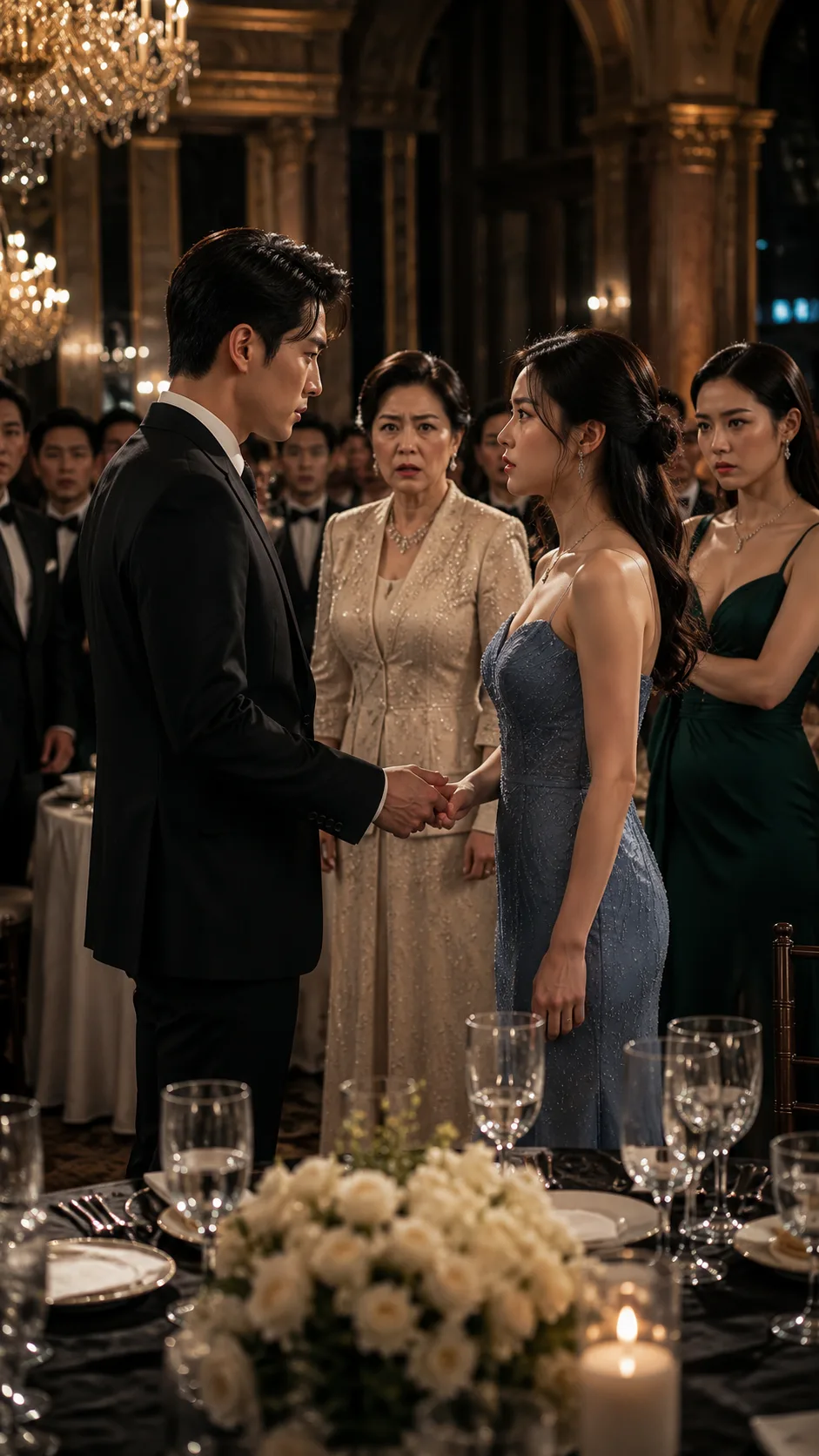
The Empty Chair at Her Sister’s Wedding
The empty chair beside Kora Bennett had a strange power.
Chapter 1
The empty chair beside Kora Bennett had a strange power.
It did not speak.
It did not move.
It did not accuse anyone.
Yet somehow, in the middle of the glittering wedding ballroom, beneath twenty crystal chandeliers and a ceiling painted with gold-trimmed clouds, that one empty chair managed to humiliate her more cruelly than any shouted insult could have done.
Every guest had noticed it.
Kora could feel their eyes, even when no one was directly looking at her.
Aunt Marlene saw it and quickly pretended to fix her pearl necklace. Two of her cousins whispered behind folded napkins. Her mother, Elaine, kept turning toward the chair with a tight, helpless expression, as if she could erase it by staring hard enough. Across the room, her younger sister, Serena, sat at the head table in a white lace gown, smiling for photographs while guilt flickered in her eyes every time she glanced toward Kora.
The chair had been meant
for Julian Cross.
Her fiancé.
Or former fiancé.
No one seemed sure what word to use anymore.
Six months ago, Julian had still been standing beside her in engagement photos, his hand resting proudly at her waist, his smile polished and effortless. He had been the kind of man people trusted too quickly: handsome, articulate, well-dressed, always remembering the right birthday, the right wine, the right compliment for the right person.
To Kora, he had once seemed like proof that calm love existed.
He had proposed during a winter trip to Vermont, outside a small inn lit by yellow windows. Snow had settled over his coat. His voice had trembled just enough to make her believe him. When he opened the ring box, she cried before she even saw the diamond.
“You are my future,” he had told her.
She had believed him.
That was the part that still embarrassed
her.
Not that he left.
Not even that he disappeared.
But that she had believed him so completely that when the truth came, she had no armor left.
Julian had not broken up with her in person. He had not even called. He had flown to Milan for what he called a “short consulting contract,” then sent a long message full of polished regret and meaningless phrases.
I need clarity.
We grew in different directions.
You deserve someone fully present.
I do not want to hurt you further.
Every sentence sounded kind.
Every sentence was a door closing.
Then his phone went silent.
Two weeks later, Kora learned through a mutual friend that Julian had been seen at a rooftop restaurant in Milan with the daughter of an investor whose company had recently signed his firm.
The humiliation should have ended there.
But Serena’s wedding had already been planned, and
Julian’s name had already been printed on the seating chart.
Kora had begged her sister to remove the chair.
Serena had cried and said she did not want Kora to sit alone.
“It will look worse if there is only one seat,” Serena whispered. “People will notice.”
“They already know,” Kora said.
“I just don’t want you to look abandoned.”
That word had hung between them.
Abandoned.
The wedding planner suggested filling the seat with a cousin. Elaine suggested changing the table arrangement entirely. Serena’s new mother-in-law, Patricia Vale, insisted it was too late to rearrange the family table without “creating confusion.”
So the chair remained.
Empty.
Elegant.
Merciless.
Kora sat beside it through the ceremony, through the cocktail hour, through the entrance of the bride and groom. She kept her back straight. She smiled whenever a camera passed. She laughed once when her uncle told a story she barely heard. She ate two bites of salmon and drank water because wine would have made the ache too visible.
She wore a midnight-blue satin dress Serena had chosen for the bridesmaids’ family table. Her dark hair was pinned low, a few soft waves framing her face. Her makeup was perfect because she had practiced it twice, not for beauty, but for defense.
Waterproof mascara.
Long-wear foundation.
Lipstick that would not betray trembling.
She had prepared for everything except the chair.
The chair made every breath feel public.
When Serena’s husband, Miles, stood to give his speech, Kora tried to relax. Miles was kind. He adored Serena. He would never hurt her deliberately.
His brother, however, was another matter.
Derek Vale took the microphone after Miles, already grinning as if the room belonged to him. He was broad-shouldered, loud, and dressed in a velvet tuxedo jacket that looked too theatrical for a wedding. Guests cheered because Derek was the type of man people encouraged before they understood how careless he could be.
“To Serena and Miles,” Derek began, lifting his champagne glass. “A perfect match. A real match. A love that shows up on time.”
Soft laughter moved through the room.
Kora’s fingers tightened beneath the table.
Derek smiled wider.
“And honestly, showing up matters. Marriage is about commitment. Presence. Not leaving someone sitting alone at the table wondering where their plus-one went.”
The laughter became uneasy.
Kora looked down at her plate.
Her mother went completely still.
Serena’s smile vanished.
Derek raised both hands as if the joke had slipped out by accident, though his eyes flashed with pleasure.
“Come on, don’t look at me like that. I’m just saying, when you find someone loyal, hold on tight.”
Kora heard a small sound beside her and realized it had come from her own throat.
Not a sob.
Not a laugh.
Something smaller and worse.
She pushed her chair back.
The legs scraped against the polished floor, louder than she intended. Several heads turned.
She stood.
Her heart beat so hard she felt it in her wrists.
She did not know where she was going. The restroom. The hallway. Outside into the cold evening air. Somewhere no one could watch her become the abandoned woman everyone already thought she was.
But before she took a single step, a man approached the empty chair.
He did not hurry.
He did not look embarrassed.
He moved with the quiet confidence of someone who did not need permission to belong anywhere, though nothing about him seemed arrogant. He wore a deep charcoal suit, sharply tailored but understated. He had dark hair combed back with one loose strand near his temple, and a face that looked calm in a way that made other people’s nervousness more obvious.
He stopped beside the chair and looked at Kora.
“May I sit here?” he asked.
His voice was low, clear, and steady enough to cut through the dying laughter.
Kora stared at him.
For a moment, she thought grief had made her imagine him.
“I’m sorry?” she said.
He touched the back of the empty chair, not pulling it out yet.
“May I sit here?”
The room had changed. The guests were still pretending not to listen, but every table close enough had gone quiet.
Kora looked at the chair.
Then at him.
“This is a private wedding.”
“I know.”
“Are you invited?”
“No.”
The honesty startled her.
Derek lowered the microphone slightly.
Someone at the next table whispered, “Who is that?”
Kora should have told him to leave. She should have called the wedding planner. She should have stepped away before this became another spectacle.
Instead, she said, “Why would you want to sit there?”
The stranger’s gaze flickered to the microphone in Derek’s hand, then returned to Kora.
“Because someone made that seat into a weapon,” he said. “And I dislike cowards who laugh from a stage.”
The room froze.
Derek’s smile disappeared.
Kora forgot how to breathe.
The stranger pulled out the chair and sat down beside her as if he had always been expected.
No applause.
No music.
Only a stunned silence spreading like spilled ink.
Derek forced a laugh. “Well, this is dramatic.”
The stranger looked toward him.
“Not as dramatic as humiliating a guest at a family wedding.”
Derek’s face darkened.
Miles stood at the head table. “Derek, give me the microphone.”
But Derek was not finished.
“And who exactly are you?” he demanded.
The stranger reached for the folded place card in front of the empty chair. Julian Cross. He looked at the name, then placed the card facedown on the table.
“No one who matters to your speech,” he said.
The microphone lowered.
Miles crossed the stage and took it from his brother without another word.
The quartet began playing again, too quickly, as if music could cover what had happened. Servers moved. Guests resumed breathing. Conversation returned in broken pieces.
Kora sat slowly.
Her knees felt weak.
The stranger did not look at her as if expecting gratitude. He simply unfolded the napkin that had belonged to Julian and placed it neatly beside his plate.
Kora watched his hands. Strong, clean, controlled. No wedding ring.
“This is absurd,” she whispered.
“Yes,” he said.
“You just sat down at a stranger’s wedding.”
“Yes.”
“To defend a woman you don’t know.”
This time, he turned toward her.
“I know what humiliation looks like when polite people pretend it is entertainment.”
The sentence reached somewhere inside her she had been trying to keep closed.
She looked away first.
“My name is Kora,” she said after a moment.
“I know.”
Her eyes narrowed.
He seemed to realize the answer sounded worse than intended.
“I heard it earlier,” he said. “The wedding coordinator asked a server to check on you.”
“So now I’m officially pitiful.”
“No,” he said. “You were noticed by someone paid to notice when guests are treated badly.”
That almost made her smile.
Almost.
“And you are?” she asked.
He hesitated just long enough for her to sense that his name mattered.
“Elias Lorne.”
Kora blinked.
The wedding was being held at the Lorne Meridian Hotel.
The menus bore the initials L.M.
The gold crest above the ballroom doors carried the same name.
She looked at him again, more carefully this time.
“You’re related to the hotel.”
“My family owns it.”
The water glass in Kora’s hand stopped halfway to her mouth.
“You own the hotel where my sister is getting married.”
“Technically, my father owns the hotel. I run it.”
“And you came downstairs to sit in a chair meant for my vanished fiancé?”
“When you say it that way, it sounds impulsive.”
“It was impulsive.”
“Yes.”
“Do you make a habit of interfering in weddings?”
“No.”
“Then why this one?”
Elias’s gaze moved briefly across the room, toward Serena’s table. Serena was watching them with wide eyes, one hand over her mouth while Miles spoke urgently to Derek near the stage.
Then Elias looked back at Kora.
“Because I was standing near the service corridor when that man made his joke,” he said. “And I saw your face before you stood up.”
Kora’s throat tightened.
She hated that.
She hated being seen at the exact moment she had failed to hide the wound.
“I was fine,” she said.
“No, you weren’t.”
The answer should have offended her.
It did not.
Because he did not say it with pity.
He said it like a fact too obvious to insult.
For several minutes, neither of them spoke. The dinner service continued. Wine was poured. A photographer passed, then hesitated when he saw Elias. The man’s eyes widened. Elias gave him one calm look, and the photographer moved on without lifting his camera.
Kora noticed.
“You really are important here.”
“I am useful here,” Elias corrected.
“That sounds rehearsed.”
“It is something my grandfather used to say. Importance is vanity. Usefulness is responsibility.”
“Was he a hotelier too?”
“He built the first Lorne Hotel with money he borrowed from three people who thought he would fail.”
“Did he?”
“Constantly,” Elias said. “Then less often.”
This time, Kora did smile.
It was small.
But it was real.
Elias saw it and did not point it out.
That made her like him more.
The rest of the evening unfolded differently after that. The empty chair no longer looked empty. The place card with Julian’s name remained facedown between them like a small defeated flag. People still watched, but the meaning had changed. Kora was no longer the woman abandoned beside an empty seat.
She was the woman a stranger had defended in front of everyone.
She was not sure that was better.
But it hurt less.
Serena came to the table as soon as she could escape the photographers.
Her eyes were wet.
“Kora,” she whispered. “I’m so sorry.”
Kora stood and hugged her.
The moment Serena touched her, the strength Kora had been performing all evening nearly cracked.
“It’s okay,” Kora lied.
“It is not okay,” Serena said. “Derek is awful. Miles is furious. I told them I want him removed from the reception.”
“You don’t have to ruin your wedding.”
“Kora, he ruined that part all by himself.”
Serena pulled back and looked at Elias.
“And thank you,” she said, voice trembling. “I don’t know who you are, but thank you.”
Elias stood.
“Elias Lorne.”
Serena’s face changed immediately.
“Oh.”
Then, because she was Serena, and because her emotions had always outrun her manners, she said, “You own the building?”
“My family does.”
“And you just… came to my sister’s table?”
“Yes.”
Serena looked from him to Kora.
Then she whispered, “That is the most romantic thing I’ve ever seen.”
Kora closed her eyes. “Serena.”
“I’m sorry. Wedding emotions.”
Elias’s mouth twitched.
Kora saw it.
For the first time all night, something inside her loosened.
By midnight, the ballroom had become softer. The sharp edges of the humiliation had dulled. Guests danced. Serena laughed again. Miles apologized to Kora three separate times, each more sincere than the last. Derek disappeared before the cake was cut.
When the reception ended, Kora stepped into the hotel lobby alone.
The lobby was enormous and quiet, with marble floors, dark velvet chairs, and tall windows reflecting the city lights. Outside, rain painted the street silver. Kora stood near the entrance, waiting for her mother to bring the car around, holding the small bouquet Serena had forced into her hands.
Elias appeared beside her without fanfare.
“Do you need a car?” he asked.
“My mother is coming.”
He nodded.
They watched the rain for a moment.
“Thank you,” Kora said.
“You already said that.”
“I know. I’m saying it again because I was too shocked the first time.”
“You don’t owe me anything.”
“That’s a rare sentence.”
He looked at her.
“Has no one said it to you before?”
She thought of Julian. Of all the invisible accounting that had lived beneath their relationship. His favors. His compromises. His sacrifices. His quiet resentment whenever her grief or fear became inconvenient.
“Not often,” she said.
Elias did not ask for details.
Kora appreciated that.
Her mother’s car pulled up outside. Elaine stepped out beneath an umbrella, then stopped when she saw Elias.
Mothers, Kora had learned, could identify danger faster than daughters could.
Elaine’s eyes traveled over Elias’s suit, his posture, his expensive calm.
“Mom,” Kora said carefully. “This is Elias Lorne.”
Elaine’s eyebrows lifted.
“The hotel?”
“Yes.”
Elias offered his hand. “Mrs. Bennett.”
Elaine shook it.
“You sat with my daughter.”
“I did.”
“Why?”
Kora nearly groaned. “Mom.”
But Elias answered without defensiveness.
“Because a man used her pain as entertainment.”
Elaine held his gaze for a long second.
Then her expression shifted. Not softened exactly, but changed.
“Good,” she said.
Kora stared at her mother.
Elaine opened the rear door of the car. “Kora, come on. Your sister will call you before breakfast and cry for an hour.”
Kora turned back to Elias.
The rain blurred the city behind him.
“I suppose this is where I say goodbye,” she said.
His gaze held hers.
“Only if you want it to be.”
Her pulse changed.
It was ridiculous.
It was too soon.
It was one sentence from a man she had met beside the worst chair in the world.
But after months of feeling like someone had walked out of her life and left only absence behind, Elias’s quiet presence felt dangerously solid.
“I don’t know what I want,” she admitted.
“That is allowed.”
Again, rare words.
Allowed.
Nothing about Julian had made uncertainty feel allowed. With Julian, uncertainty was weakness. Delay was failure. Pain had a deadline.
Kora stepped toward the car.
Then paused.
“I restore books,” she said.
Elias tilted his head slightly.
“That was not what I expected you to say.”
“I have a studio on Mercer Street. Bennett & Wren. If you ever have an old book falling apart, I can fix it.”
His expression changed, not into a smile, but into something warmer.
“I have several.”
“Then bring one.”
“I will.”
Kora got into the car before she could say anything foolish.
As they drove away, Elaine glanced at her through the rearview mirror.
“That man is trouble.”
Kora looked out at the rain.
“Yes,” she said.
But for the first time in months, trouble did not sound like abandonment.
It sounded like a door.
Three weeks later, Elias came to her studio carrying a leather-bound poetry book wrapped in brown paper.
Kora was standing at her worktable, sleeves rolled up, carefully repairing the spine of an old family Bible. Her business partner, Mae Wren, stood near the front desk arranging invoices and immediately dropped three of them when Elias entered.
Mae recovered with no dignity at all.
“Welcome,” she said brightly. Too brightly. “You must be extremely lost.”
Kora shot her a look.
Elias held up the parcel.
“I was told this was the place for damaged books.”
Mae looked at Kora, then at Elias, then back at Kora.
“Oh,” she said. “This is the chair man.”
Kora closed her eyes.
Elias’s mouth curved slightly.
“I’ve been called worse.”
Mae grinned. “Good. We’re informal here.”
Kora took the parcel and unwrapped it.
The book inside was old, beautiful, and badly worn. Deep green leather. Gold edging nearly rubbed away. The spine cracked from age and use.
Kora opened the first page and saw an inscription written in careful faded ink.
To Helena, who taught me that home can be a person.
She looked up.
“This is personal.”
“My grandmother’s,” Elias said. “My grandfather gave it to her before they were married.”
Kora touched the damaged spine gently.
“You trust me with this?”
“I wouldn’t have brought it otherwise.”
Mae suddenly found a reason to go into the storage room and shut the door behind her.
Kora pretended not to notice.
“This will take time,” she said.
“I expected that.”
“And it will be expensive.”
“I expected that too.”
“And I don’t give discounts to men who interrupt weddings.”
“Then I’m relieved. I would hate to benefit from scandal.”
This time, Kora laughed.
A real laugh.
It startled both of them.
Elias looked down for a second, as if giving the sound privacy.
That was the moment Kora knew he was dangerous.
Not because he was rich.
Not because he was handsome.
Not because he had defended her in a ballroom.
But because he noticed small things and did not try to own them.
He came back one week later to check on the book.
Then again the next week.
On the fourth visit, Mae blocked the doorway with a box of archival paper and said, “Mr. Lorne, either ask her to dinner or start paying rent.”
Kora nearly dropped a scalpel.
Elias, to his credit, looked directly at her.
“Dinner?” he asked.
Kora pretended to consider.
Mae made a strangled noise from behind the box.
“Yes,” Kora said.
They went to a small Italian restaurant where the owner greeted Elias with surprise because Elias had apparently once fixed a plumbing crisis in the building personally during a New Year’s Eve flood. Kora listened as the owner described him in rapid praise, and Elias looked increasingly uncomfortable.
“You hate being praised,” she said after they sat down.
“I dislike being praised for things people should do anyway.”
“That sounds noble.”
“It is mostly awkward.”
She liked him more than she wanted to.
Over dinner, he told her about the Lorne family. His grandfather, Victor, had built the first hotel from a bankrupt building and stubbornness. His father, Harrison, had expanded the company into luxury properties across three countries. His mother, Celia, had turned the family name into a brand sharpened by discipline and fear.
Kora told him about her father, who had died when she was nineteen. About how he taught English literature and repaired old paperbacks because he hated throwing away books. About how her love of restoration came from watching him glue cracked spines at the kitchen table.
She told him less about Julian.
But enough.
Elias listened without interrupting.
When she finished, he said, “He left badly.”
Kora smiled sadly. “That is a polite way to say it.”
“I’m trying not to insult a man you once loved.”
“You can insult him a little.”
“He was careless with something valuable.”
The simplicity of it hurt.
Kora looked down.
“I used to think being left meant I had failed to be worth staying for.”
Elias’s jaw tightened.
“No.”
“No?”
“No,” he repeated. “Leaving can be cowardice wearing a clean shirt.”
Kora stared at him.
Then she laughed softly, though her eyes burned.
“That may be the best thing anyone has ever said about my breakup.”
“It was not very poetic.”
“It was useful.”
He smiled then.
Fully.
And Kora felt herself step toward something she had not intended to enter.
For two months, Elias became part of her life in careful increments.
Coffee on Thursdays.
Dinner every other Saturday.
A walk through the old market district where Kora bought broken books and Elias carried them without being asked. Quiet phone calls after long workdays. Messages that did not demand immediate answers. Silence that did not punish.
He never tried to rush her.
That made her trust him.
Then, just as trust began to feel possible, the Lorne family reminded her that men like Elias did not belong only to themselves.
The invitation came on heavy cream paper.
Mrs. Celia Lorne requests the pleasure of Miss Kora Bennett’s company for tea.
Kora read it twice and felt her stomach tighten.
When she told Elias, his expression turned cold.
“You do not have to go.”
“Is that because she will be rude?”
“It is because she is precise.”
“That sounds worse.”
“It is.”
“Is she going to tell me I’m not good enough for you?”
Elias did not answer quickly enough.
Kora laughed once.
“There it is.”
“Kora—”
“No. It’s fine. I expected this part.”
“I have not asked you to face my family.”
“But your family has asked to face me.”
He looked pained.
“She should have come through me.”
“Would that have stopped her?”
“No.”
“Then I might as well hear it directly.”
Tea with Celia Lorne took place in a private salon on the top floor of the hotel. Not the ballroom. Not the public restaurant. Somewhere quieter, older, and more expensive, where every object seemed chosen to make visitors aware of their own hands.
Celia stood when Kora entered.
She was elegant in a pale gray dress, her silver-streaked dark hair swept back from a face that might have been warm if she had ever allowed softness to remain there. Her beauty had sharpness in it. Like glass.
“Kora,” she said. “Thank you for coming.”
“Mrs. Lorne.”
“Celia, please. We are not strangers.”
Kora nearly smiled.
They were absolutely strangers.
Tea was poured by a silent attendant who vanished behind paneled doors. For several minutes, Celia discussed the weather, Serena’s wedding, and Kora’s work restoring books. She had clearly researched her.
That frightened Kora more than open hostility would have.
Finally, Celia set down her cup.
“My son has been happier lately.”
Kora did not answer.
“I value that,” Celia continued. “Despite what you may think, I am not indifferent to his happiness.”
“I haven’t said what I think.”
“No,” Celia said. “You are well-mannered. That will help you today.”
Kora’s spine stiffened.
There it was.
The blade beneath the lace.
Celia folded her hands.
“Elias is not merely a man. He is the public face of a family institution. There are investors, properties, boards, partnerships, obligations older than whatever feeling may currently exist between you.”
“Currently,” Kora repeated.
Celia’s gaze sharpened.
“Do you object to the word?”
“I’m noticing it.”
“Then notice this too. My son has been expected for many years to form a partnership with Vesper Halliday. Her family owns the Aurum Group. Hotels, vineyards, art foundations, political connections. They understand our world.”
Kora felt the room tilt slightly.
“Expected to form a partnership,” she said. “You mean marry.”
“I mean align.”
“Did Elias agree?”
Celia paused.
Just half a second.
Enough.
Kora stood.
“Thank you for the tea.”
Celia’s face did not move, but the room cooled.
“Running from uncomfortable facts does not change them.”
Kora looked down at her.
“No. But staying to be politely diminished does not make me dignified.”
For the first time, Celia looked almost surprised.
Kora walked to the door.
Celia spoke behind her.
“You seem intelligent. So be intelligent. Do not become the woman a man chooses privately while his life rejects you publicly.”
The words struck with cruel accuracy.
Kora stopped.
For one breath, she was back beside the empty chair.
Back under the eyes.
Back being the woman no one chose loudly enough.
She turned.
“Your son will decide what kind of man he is,” she said. “But I will decide what kind of woman I refuse to become.”
Then she left.
Elias was waiting in the corridor.
Of course he was.
One look at Kora’s face and his changed.
“What did she say?”
“The truth,” Kora said.
His eyes hardened.
“Kora.”
“Were you expected to marry Vesper Halliday?”
He looked away.
That was enough.
Kora stepped back.
“I didn’t agree to it,” he said immediately.
“But you did not tell me.”
“I was ending it.”
“You were hiding it.”
“No. I was trying to keep it from hurting you.”
“That is what men say when they want credit for delaying damage.”
The words came out sharper than she intended.
Elias absorbed them.
“You are right,” he said.
That almost made it worse.
Kora wanted him to defend himself. To argue. To give her something solid to push against.
Instead, he looked devastated and honest.
“I should have told you,” he said. “I thought if I cut through it before it reached you, it would not matter.”
“It reached me in a private room with your mother explaining my place.”
His jaw clenched.
“She had no right.”
“She had confidence. That is sometimes more dangerous.”
“Kora, I am not marrying Vesper.”
“But your world expects you to.”
“My world does not get a vote.”
“It already voted. Your mother counted the ballots over tea.”
He reached for her hand.
She stepped back before he could touch her.
The movement hurt them both.
“I cannot do this,” she whispered.
His face went still.
“Do what?”
“Stand beside another empty chair. Wait for another man to decide whether I am worth being chosen in public.”
“You are.”
“Then why does it feel like I am the last person to know?”
She left him in the corridor.
This time, Elias did not follow.
The next twelve days were the longest Kora had known since Julian’s message.
Elias called twice. She did not answer. He sent one text.
You were right. I am fixing what I should have faced earlier.
She read it so many times the words lost shape.
Mae found her staring at the phone one afternoon and took it from her hand.
“You’re allowed to miss him and still be angry,” Mae said.
“I know.”
“You’re also allowed to answer.”
“I know that too.”
“But?”
Kora looked at the nearly restored poetry book on her table. Helena Lorne’s book. The green leather shone softly now, strengthened but not disguised. The cracks remained faintly visible because Kora believed restoration should not erase history.
“But I need to know he can stand without me asking him to,” she said.
Mae nodded.
“That’s fair.”
On the thirteenth day, an invitation arrived.
Not from Celia.
Not from Elias.
From the Lorne Meridian Foundation.
Annual Heritage Gala.
Kora nearly threw it away.
Then she saw the handwritten note tucked inside.
No pressure. No expectation. But if you come, you will not be hidden.
—E.
She sat with the note for a long time.
Then she bought a black dress.
The night of the gala, the Lorne Meridian Hotel looked transformed.
The lobby glowed with candlelight and polished brass. Reporters gathered near the entrance. Guests in designer gowns and tuxedos moved through the space with the smooth confidence of people accustomed to being welcomed everywhere. A photographer asked Kora her name. When she gave it, he blinked, checked his list, and stepped aside.
She was expected.
That alone made her nervous.
Inside the grand ballroom—the same ballroom where Serena’s wedding had taken place—the chandeliers blazed. But this time, there was no empty chair beside Kora. Her place card sat alone at a table near the front.
Kora Bennett.
No plus-one.
No apology.
No absence.
She sat down and placed her clutch in her lap.
Across the room, she saw Celia Lorne speaking with a tall young woman in emerald silk. Vesper Halliday. Beautiful, composed, born to rooms like this.
Celia noticed Kora.
Her expression did not change, but her eyes did.
A few minutes later, Elias entered.
The room reacted before Kora did. Conversation shifted. Heads turned. Cameras lifted. He wore a black tuxedo and looked more remote than she had ever seen him. Not cold. Armed.
His gaze found Kora immediately.
He did not smile.
Neither did she.
But something passed between them.
Recognition.
Pain.
Possibility.
Dinner began. Speeches followed. Kora listened to donors praise legacy and culture while her pulse beat too fast beneath her skin. Celia spoke briefly and beautifully about tradition. Harrison Lorne, Elias’s father, spoke about expansion and responsibility.
Then Elias took the stage.
He stood behind the podium, hands resting lightly on either side.
“Good evening,” he said.
His voice filled the ballroom without effort.
“Tonight, we celebrate heritage. That word is used often in this family. Heritage. Legacy. Duty. Continuity. They are good words when they remind us to protect what matters. They become dangerous when we use them to excuse cowardice.”
The room changed.
Celia’s head lifted.
Harrison’s smile faded.
Kora stopped breathing.
Elias continued.
“My grandfather built this company because three people believed in him when no one else did. Not because he was born into the right room. Not because he married the right name. Because he worked, failed, learned, and kept his word.”
A murmur moved through the tables.
Elias looked toward his mother.
“I have been told that my future should be arranged for stability. That affection is private, but alliances must be public. That a man in my position does not choose only for himself.”
Celia stood slowly.
“Elias,” she said, voice low but carrying.
He looked at her.
“No, Mother. You spoke privately. I will answer publicly.”
A collective inhale moved through the ballroom.
Kora’s hands trembled in her lap.
Elias stepped away from the podium.
“I will not marry Vesper Halliday.”
Gasps. Whispers. The flash of cameras.
Vesper closed her eyes briefly, more irritated than heartbroken. When she opened them, she looked at Celia with something like satisfaction, as if a tedious lie had finally ended.
Elias’s gaze found Kora again.
“And I will not allow the woman I love to be treated like a temporary embarrassment while my family decides whether she is useful enough to respect.”
The room vanished.
For Kora, there was only Elias.
Only his voice.
Only the fact that he had said it where everyone could hear.
Celia’s face had gone pale with fury.
Harrison stepped toward the stage. “This is not the place.”
Elias turned to him.
“This ballroom was the place where a woman was humiliated beside an empty chair because no one stopped it soon enough. I stopped it once by sitting down. Tonight, I stop it by standing up.”
Kora felt tears rise so fast she could not hide them.
Elias walked down from the stage.
Every camera followed.
Every guest watched.
He crossed the ballroom and stopped in front of her table.
For one terrible second, Kora saw the empty chair again. The place where Julian should have been. The place where shame had sat like a guest.
Then Elias offered his hand.
Not dramatically.
Not like ownership.
Like choice.
“Kora,” he said quietly, though the silent room heard every word. “I should have told you everything before my family tried to turn it into a weapon. I failed you there. I am sorry.”
The apology landed deeper than any declaration could have.
He did not ask her to rescue him from the scandal he had created.
He did not ask her to perform forgiveness.
He simply stood there.
Waiting.
Kora looked past him at Celia, whose anger was sharp enough to cut glass. She looked at Vesper, who gave her a small, unreadable nod. She looked at the guests, the reporters, the family empire that had decided she was too ordinary to matter.
Then she looked at Elias.
“You understand this does not fix everything,” she said.
“I know.”
“You understand I am not a symbol in your rebellion.”
“Yes.”
“You understand I will never again beg a man to choose me.”
His eyes softened.
“I am counting on it.”
That almost broke her.
Slowly, Kora placed her hand in his.
The ballroom erupted.
Not in applause at first. In noise. Shock. Questions. Cameras. Celia’s chair scraping back. Harrison speaking urgently to a board member. Vesper taking a calm sip of champagne as if she had waited years for someone else to make the mess visible.
Then, somewhere in the room, Mae began clapping.
Kora turned and saw her near the back, wearing a red dress and a triumphant expression.
Serena, beside her, stood and clapped too.
Then Miles.
Then Elaine.
The applause spread awkwardly, then sincerely, then loudly enough to drown out the whispers.
Elias did not look away from Kora.
She realized he was still waiting for her to decide whether to stay.
So she squeezed his hand.
Not because everything was healed.
Not because love erased humiliation.
But because this time, when the room watched, she was not alone beside an empty chair.
Celia left before dessert.
Harrison stayed, though his expression remained carved from stone.
Vesper approached Kora near the end of the evening while Elias was trapped in conversation with two board members and an elderly donor who seemed delighted by scandal.
“You are braver than I expected,” Vesper said.
Kora looked at her carefully.
“I’m not sure whether that is a compliment.”
“It is. From me.”
Vesper glanced toward Elias.
“For the record, I never wanted to marry him. Our mothers wanted efficiency. Marriage as a merger. I prefer mergers with exit clauses.”
Kora laughed despite herself.
Vesper smiled faintly.
“He is better than this family taught him to be. That is rare.”
“He still should have told me.”
“Yes,” Vesper said. “Make him suffer a little for that.”
“I plan to.”
“Good.”
Then Vesper walked away, leaving behind the light scent of expensive perfume and unexpected approval.
The weeks after the gala were not easy.
Public declarations made excellent headlines and complicated mornings.
There were articles. Speculation. Business analysts questioning Elias’s judgment. Society columns calling Kora “the mysterious book restorer.” Someone found photos from Serena’s wedding and published a blurry image of Elias sitting beside Kora beneath the chandeliers. The caption called it “the empty chair that started a dynasty scandal.”
Kora hated the word scandal.
Elias hated dynasty.
Mae printed the article and taped it to the studio refrigerator.
Kora removed it.
Mae taped up another copy.
Elias’s family did not collapse, though Celia behaved for several weeks as if it might. Harrison eventually requested a private dinner with Kora. She accepted only after Elias promised she could leave the moment anyone became “precise” with her.
Harrison was not warm, but he was honest.
“My son embarrassed the family,” he said over coffee.
Kora set down her cup.
“Your son told the truth.”
“That is often embarrassing.”
She studied him.
He looked tired more than cruel.
“Do you dislike me?” she asked.
Harrison considered.
“I do not know you.”
“That is more honest than most answers I’ve received from your family.”
His mouth twitched.
“I dislike surprises,” he said. “You were a surprise.”
“I didn’t plan to be.”
“No. That is probably why Elias trusts you.”
It was not acceptance.
But it was a beginning.
Celia took longer.
Much longer.
She did not apologize for tea. Not at first. She sent no invitations. Made no warm gestures. But three months after the gala, she arrived at Bennett & Wren holding a damaged cookbook that had belonged to her mother.
Mae saw her through the window and whispered, “The ice queen approaches.”
Kora gave her a warning look.
Celia entered the studio with the same controlled elegance as before. She placed the cookbook on the counter.
“I was told you repair family books,” she said.
Kora looked at the cracked cover, the stained pages, the loose binding.
“I do.”
Celia’s fingers rested briefly on the book.
“My mother wrote notes in the margins. I would prefer they remain.”
“Restoration should preserve history, not erase it.”
Celia looked up.
For once, the sharpness in her expression softened into something almost human.
“Yes,” she said. “I am beginning to understand that.”
It was not an apology.
But Kora heard the shape of one.
She accepted the book.
A year after Serena’s wedding, Kora returned to the Lorne Meridian ballroom.
This time, there was no wedding.
No gala.
No crowd.
Only the staff preparing for an afternoon charity luncheon, flowers arriving in buckets, linens being steamed, silverware placed with mathematical precision.
Elias had asked her to meet him there before lunch.
She found him standing near the table where she had once sat beside Julian’s empty chair.
The ballroom looked different in daylight. Less intimidating. More honest. Sunlight streamed through tall windows, revealing dust in the gold air and faint scratches on the polished floor from hundreds of celebrations.
Kora walked toward him.
“You brought me to the scene of the crime,” she said.
Elias turned.
“I brought you to the place where I first saw you.”
“That sounds better.”
“It is also true.”
On the table beside him sat Helena’s restored poetry book, Celia’s cookbook, and a small wrapped parcel.
Kora looked at the parcel.
“What is that?”
“A book that needs repair.”
She raised an eyebrow.
“You are using damaged books as emotional bait again?”
“Only because it worked the first time.”
She smiled and unwrapped it.
Inside was a blank book.
Hand-bound.
Deep blue leather.
Gold edges.
No title.
Kora opened it. The first page held one sentence written in Elias’s careful hand.
For the life we do not have to hide.
Her eyes blurred.
“Elias.”
“I know you may not be ready,” he said quickly. “This is not a demand. Not a performance. No audience. No family. No cameras. Just me, asking honestly.”
He reached into his pocket.
Kora’s breath caught.
He did not kneel immediately.
Instead, he held out a ring box, closed.
“I love you,” he said. “I loved you before I understood what courage would cost. I love you now with a better understanding of what honesty requires. I am not asking you to fill an empty chair. I am asking whether I can sit beside you for the rest of my life.”
Kora covered her mouth with one hand.
The empty chair was still there in her memory.
But it no longer hurt the same way.
It had become a beginning.
Not because Elias saved her.
She had never needed saving.
But because on the night everyone expected her to shrink, someone had sat beside her and made the room answer for its cruelty. Then, when his own world tried to make her small, he had stood.
Kora looked at the man in front of her.
Then at the blank book in her hands.
A life unwritten.
A history not erased.
A future not owed to anyone else.
“Yes,” she whispered.
Only then did Elias kneel.
Only then did he open the box.
The ring inside was not enormous. It was not designed to impress a ballroom. It was beautiful in a quieter way, with a deep blue sapphire at the center and small diamonds around it like captured light.
Kora laughed through tears.
“You remembered I hate showy rings.”
“I remembered everything I could.”
He slid the ring onto her finger.
No applause followed.
No cameras flashed.
No one shouted.
Somewhere in the ballroom, a server dropped a spoon and cursed softly under his breath. Elias laughed. Kora laughed too, wiping her eyes.
It was perfect.
Later, when Serena heard the news, she cried so loudly over the phone that Miles had to take it and congratulate them himself. Elaine said she knew from the start, which was a lie but a loving one. Mae demanded full credit for “forcing the dinner stage of the relationship.”
Celia sent flowers.
White roses.
No note.
Kora understood anyway.
At their wedding six months later, the seating chart was simple.
No symbolic empty spaces.
No cruel reminders.
No place cards for ghosts.
But at the family table, beside Kora’s chair, there was one extra seat left open until the ceremony began. Not for Julian. Not for absence. Not for shame.
For memory.
For the woman who had once sat alone and believed the empty chair meant she had not been chosen.
Just before the music started, Elias entered the reception hall, crossed the room, and sat in that chair.
Kora looked at him from the doorway in her wedding dress.
He looked back and smiled.
The chair was empty no longer.
And this time, everyone understood exactly what it meant.
THE END.
Chapter complete
You have reached the end of this chapter.
Continue reading
A few more worlds to get lost in after this chapter.




