land.
Duchess Marcelline wore emeralds and satisfaction.
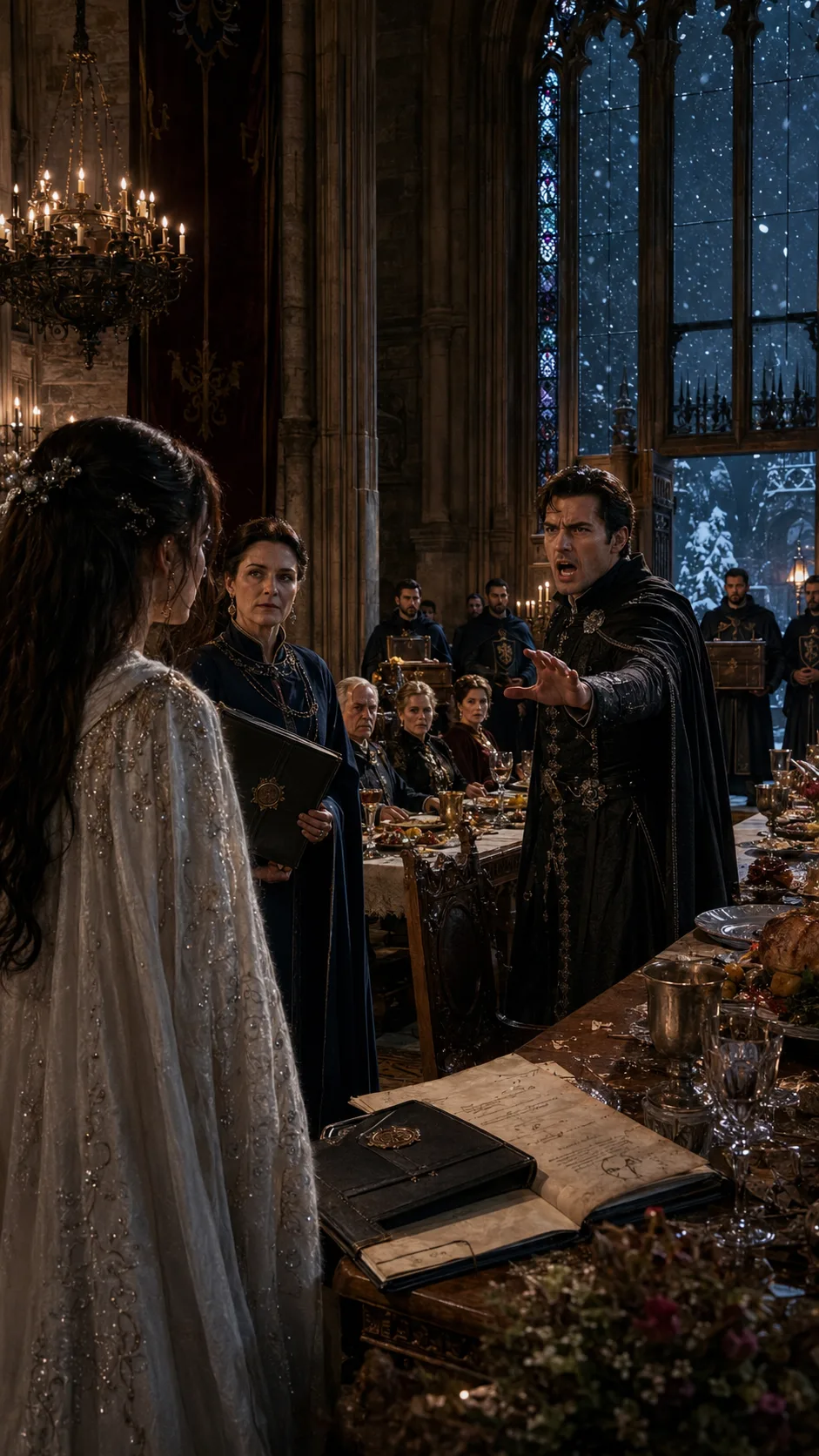
Ariella sat at Cassian’s right hand, dressed in a pale silver gown embroidered with tiny pearls. Her dark hair was pinned beneath a thin circlet of moonstones, the only crown she had kept from Valemont after her marriage. To the hall, she looked calm.
Inside, she could feel the floor disappearing beneath her.
Then the steward approached.
He carried a folded parchment on a black lacquer tray.
The music softened.
The conversations thinned.
Cassian leaned back in his chair.
“Give it to my wife.”
The steward hesitated for only half a second before placing the parchment before Ariella.
She looked down.
The seal on it belonged to Blackthorne Castle. The script beneath it was clean, official, and merciless.
A banquet expense totaling twelve thousand royal crowns.
Ariella stared at the amount, then at Cassian.
“What is this?”
His smile was small.
“The cost of tonight.”
A few nobles nearby lowered their cups.
Cassian lifted his wine as though making a toast.
“You will pay it.”
Ariella did not move.
The hall had become too quiet.
“Twelve thousand crowns,” she said softly. “For your banquet?”
“For your farewell,” Cassian corrected.
Something cold moved through the room.
Marcelline’s lips curved.
Cassian reached beneath his coat and withdrew a second document. This one bore the mark of the royal court: a separation decree prepared in advance.
He placed it beside the banquet debt.
“Pay the bill tonight,” he said, his voice carrying easily across the table, “sign the separation decree tomorrow, and be grateful we are letting you leave with your title.”
For a moment, Ariella heard nothing.
Not the fire.
Not the snow.
Not the sudden whispering.
Only the slow, steady beat of her own heart.
Lord Garrick laughed first.
Then a cousin.
Then two ladies at the far end of the table covered their smiles behind jeweled fingers.
Duchess Marcelline raised her glass.
“You were never truly one of us, Princess.”
The title should have protected Ariella.
Instead, it sounded like an insult.
Cassian watched her carefully. He wanted tears. He wanted a scene. He wanted her to beg, to tremble, to give him proof that she was every weak thing his family had always called her.
Ariella looked at the parchment again.
Twelve thousand crowns.
Eight years of humiliation had taught her many things. One of them was this: people who enjoyed cruelty were always disappointed by dignity.
So she did not cry.
She did not scream.
She removed the moonstone ring from her finger, the ring engraved with the private seal of Valemont, and pressed it into warm black wax beside the account.
The payment was authorized.
The laughter faded.
Not because they felt ashamed.
Because they had expected more entertainment.
Ariella rose.
Her chair whispered against the marble floor.
Cassian’s smile faltered.
“Nothing to say?”
Ariella looked at him for the first time all evening.
“No.”
Then she took her cloak from the back of her chair and walked out of the banquet hall.
No one stopped her.
Outside, the corridor was colder than death.
Snow blew through the open archways of the castle courtyard. Her slippers were not made for ice, but Ariella kept walking until the music behind her became only a memory. She crossed the stone bridge beyond the western gate and stood beneath a bare winter tree, looking out over the dark valley.
Her marriage was over.
She expected grief to crush her.
Instead, beneath the pain, she felt something almost like relief.
The door had opened.
Even if she had been pushed through it, it had opened.
Nearly an hour passed before a servant found her.
He came running across the bridge without a cloak, his face white with terror.
“Your Highness,” he gasped. “You must return to the hall.”
Ariella turned.
“Why?”
The servant swallowed.
“The Duke is asking for you.”
That almost made her laugh.
“The Duke dismissed me.”
“He is begging for you now.”
Ariella studied the boy’s face. He was shaking too badly for this to be another insult.
“What happened?”
The servant looked back toward the castle as if afraid the walls might hear.
“The Crown Treasury Inquisition has arrived.”
The words struck harder than the snow.
Ariella went still.
The Crown Treasury Inquisition did not attend banquets. They did not appear for etiquette disputes or noble gossip. They arrived when gold had vanished, seals had been forged, ledgers had been altered, or treason had begun wearing silk.
“Why would they come here?”
The servant’s voice lowered.
“They asked for you.”
When Ariella returned to the great hall, the entire castle had changed.
The musicians were gone.
The servants stood against the walls.
The nobles no longer whispered for amusement but from fear.
At the entrance, six royal officers in dark blue cloaks stood beneath the banners of Blackthorne, their steel badges marked with the golden scales of the Crown Treasury. Two of them examined ledgers taken from the steward’s office. Another questioned the head accountant. A fourth carried a locked evidence chest.
Cassian saw Ariella and crossed the hall quickly.
He looked nothing like the man who had humiliated her an hour earlier.
His face was pale.
His hair had fallen loose at his temple.
His voice, when he spoke, was almost broken.
“Ariella. Listen to me before you say anything.”
She looked at him.
The fear in his eyes told her more than any confession could have.
“What did you do?”
He flinched.
Before he could answer, a woman stepped between them.
She was tall, perhaps in her fifties, with silver-threaded hair pinned neatly beneath a dark hood. Her gown was simple, severe, and perfectly cut. A black leather portfolio rested beneath one arm, sealed with the treasury mark.
“Princess Ariella of Valemont?”
“Yes.”
The woman inclined her head.
“Lady Seraphine Vale, Senior Inquisitor of the Crown Treasury.”
Ariella felt the eyes of the hall on her back.
“Why are you here?”
Lady Seraphine opened the portfolio.
“We have been reviewing financial movements between Blackthorne holdings, eastern trade offices, and several royal construction funds.”
Cassian made a strangled sound.
Seraphine did not look at him.
“Your seal appears on forty-three authorizations.”
Ariella’s breath caught.
“My seal?”
“Yes.”
“I authorized no such transfers.”
The silence that followed was absolute.
Then Cassian closed his eyes.
Duchess Marcelline’s hand tightened around her wine glass until the stem looked ready to snap.
Lady Seraphine studied Ariella with calm precision.
“You were not aware of these documents?”
“No.”
Ariella turned slowly toward Cassian.
He looked away.
There it was.
The truth.
Not all of it, not yet, but enough.
For eight years, Cassian had called her weak, soft, ornamental. He had made her feel like a burden in his house, a decorative failure, a princess tolerated only because her name brought him prestige.
But her name had been useful enough to forge.
Her seal had been useful enough to steal.
Her reputation had been useful enough to hide behind.
Ariella stepped closer to him.
This time he stepped back.
“What did you put my seal on, Cassian?”
His mouth opened.
No answer came.
Lady Seraphine closed the portfolio with a sharp sound.
“Duke Blackthorne, by order of the Crown, your ledgers, vault records, correspondence, and trade contracts are hereby seized pending investigation.”
The hall erupted.
Marcelline stood so quickly her chair fell behind her.
“This is an outrage!”
Seraphine turned her calm gaze on the duchess.
“Then you will have the opportunity to explain it under oath.”
Garrick tried to slip away from the table.
Two officers blocked him before he reached the side passage.
Ariella watched it all unfold with a strange stillness.
Only an hour earlier, she had stood in this same hall as they laughed at her ruin.
Now every face that had smirked was pale.
Every voice that had mocked her was silent.
Cassian leaned toward her, desperation cracking through his pride.
“Ariella,” he whispered. “Please. You must tell them you knew about some of it.”
She stared at him.
For a moment, she wondered whether grief could turn into ice.
“You want me to confess to your crime?”
“Not confess,” he said quickly. “Just cooperate. Say there was confusion. Say you allowed me use of the seal for estate matters.”
“You forged my name.”
His voice dropped lower.
“If I fall, Blackthorne falls with me.”
Ariella looked past him at the long table, at the unpaid kindnesses, the years of insults, the mother who had smiled while her son destroyed a woman in public.
“No,” she said. “You are mistaken.”
Hope flashed in his eyes.
Then Ariella continued.
“Blackthorne fell the moment it decided honor was less useful than theft.”
His face collapsed.
Lady Seraphine turned to Ariella.
“Princess, we will need your full statement.”
Ariella removed the moonstone ring from the chain where she had placed it after leaving the hall. For a second, it rested in her palm, cold and bright.
Then she put it back on her finger.
“You shall have it.”
Over the next months, the kingdom learned what Blackthorne Castle had hidden behind its carved doors and noble banners.
The duchy had been losing money for years.
Cassian and his advisors had concealed debts through false trade contracts. Gold meant for road repairs, soldiers’ pensions, flood defenses, and rural schools had been shifted through shell estates and hidden accounts. When the losses grew too large, someone had begun using Ariella’s royal seal to approve transfers that appeared beyond suspicion.
That someone was Cassian.
The proof was everywhere once the Crown looked closely.
A forged signature.
A bribed clerk.
A duplicate seal.
A ledger burned badly but not completely.
Letters written in Cassian’s own hand.
The trial lasted forty-two days.
Ariella attended only when required. She did not need to watch every noble who had once laughed at her now pretend they had always suspected something was wrong.
Duchess Marcelline blamed servants.
Then accountants.
Then foreign bankers.
Then Ariella.
No one believed her.
Lord Garrick confessed first, trading testimony for a lighter sentence. Marcelline lost control of the duchy’s household. Cassian lost his title, his estates, and finally his freedom.
On the morning the court declared the separation decree valid, Ariella stood beneath the white arches of the royal palace and felt sunlight on her face for the first time in what seemed like years.
She was no longer Duchess Blackthorne.
She was Princess Ariella of Valemont again.
And this time, the name felt like her own.
Life did not become easy all at once.
Freedom rarely arrived without bruises.
There were nights when she woke expecting to hear Cassian’s quiet insults from across the room. There were banquets where laughter still made her shoulders tense. There were mirrors in which she struggled to recognize the woman looking back.
But slowly, piece by piece, Ariella returned to herself.
She reopened the rural schools funded by her mother’s foundation.
She restored bridges in villages Blackthorne had neglected.
She visited farms without a parade.
She listened when people spoke.
At first, nobles called it sentimental.
Then the roads improved.
The winter grain arrived on time.
Children who had once walked three miles through mud began learning in warm stone classrooms.
The word sentimental became harder to use when the results were visible.
Two years after the trial, Ariella attended a small council gathering near Lake Eldermere. It was not a grand event, only a meeting about flood defenses along the northern rivers. She arrived with ink on her fingers and a stack of maps under one arm.
In the corridor outside the council chamber, the maps slipped from her grasp and scattered across the floor.
A man nearby knelt at once to help.
“That,” he said, smiling as he gathered a map of the eastern marshlands, “is either an accident or a very dramatic way to begin negotiations.”
Ariella laughed before she could stop herself.
His name was Prince Nathaniel of Eldermere.
He was not the most powerful prince in the kingdom, nor the richest, nor the one poets praised most often. But he had steady hands, kind eyes, and the unusual habit of listening to answers after asking questions.
They spoke about floodgates for twenty minutes.
Then roads.
Then books.
Then everything except court politics.
Unlike Cassian, Nathaniel did not treat kindness as weakness. Unlike Cassian, he never mistook gentleness for surrender. When he looked at Ariella, he seemed to see not a title, not a scandal, not an alliance, but a person who had survived something and chosen not to become cruel.
Years later, they married beside Lake Eldermere at dawn.
There were no golden banners large enough to block the sky.
No banquet designed to impress enemies.
No laughter sharpened at someone else’s expense.
Only her parents, his sisters, village children throwing white petals, and a small circle of people who loved without performance.
Ariella wore no heavy crown.
Only the moonstone ring.
The same ring Cassian had tried to use as a weapon against her.
The same ring that had helped reveal his crime.
The same ring she had taken back.
On the evening after the wedding, as the sun melted across the lake, Ariella stood on the balcony of a quiet stone manor while Nathaniel prepared supper inside. He had insisted on cooking it himself, though the kitchen staff found this deeply alarming.
A messenger arrived with a sealed note.
No crest.
No title.
Only her name.
Inside were three words.
I am sorry.
Cassian’s handwriting had changed. It was smaller now. Less certain.
Ariella read the note once.
Then again.
For a long moment, she thought of the banquet hall, the snow, the laughter, the parchment pushed before her like a sentence.
She thought of the woman she had been that night, standing alone beneath a winter tree, believing her life had ended.
Then she looked through the open balcony doors at Nathaniel, who was arguing gently with a pot of soup.
Ariella smiled.
She folded the note and held it over the candle flame.
It blackened at the edges, curled inward, and became ash.
Not because she still hated Cassian.
Because she did not.
Hatred was a chain too, and she had no interest in wearing anything he had given her.
The twelve thousand crowns had once seemed like the price of humiliation.
But Ariella understood now.
It had bought her freedom.
And freedom, she had learned, was worth more than any crown.
THE END.




