The bread was too hard for a princess to tear with frozen fingers.
Chapter 1
The bread was too hard for a princess to tear with frozen fingers.
Ysolde tried anyway.
She sat on the lowest step of the chapel altar with the loaf pressed between her knees, her thumbs working at the linen knot until the skin beneath her nails burned. The chapel roof had split open above the west transept two winters ago, and now snow came through the broken ribs of it in thin white threads. It settled on the altar cloth. It gathered in the empty eyes of saints carved into the pillars. It melted in slow drops along the blackened stone where candles had once burned every morning.
No one had lit the chapel candles in four days.
No one had rung the bells.
No one had called her name.
The keep of Aldenmar had become a place of doors left ajar, bowls abandoned half-washed, cloaks still hanging from pegs as if the people who owned them had only stepped out to fetch
water. At first, servants whispered. Then they prayed. Then they stopped coming up from the lower halls at all.
Ysolde had counted footsteps until there were none.
Nine days earlier, Cook Marra had wrapped the loaf in linen and pressed it into Ysolde’s hands in the kitchen, where the hearth had already burned low and the last turnips sat like stones in a wooden bowl.
“Save it, child,” Marra had said.
Ysolde had been twenty-two, crowned at thirteen for ceremonies and trained since birth not to flinch when ambassadors stared too long at her birthmark, but Marra still called her child.
“Save it for the worst night.”
Ysolde had asked where Marra was going.
Marra had looked toward the service stairs.
Then she had tied the linen twice around the bread and said nothing.
That had been the last voice Ysolde heard for four days.
Now the worst night had
come, and the bread smelled faintly of caraway and ash. It smelled like the kitchen. It smelled like hands dusted with flour, like copper pots, like Marra humming under her breath when the court was too loud upstairs.
Ysolde had not cried.
Crying made thirst worse.
She pulled the knot loose and opened the linen.
The bread was dark and round, cracked along the top, heavy for its size. She set one palm on it and felt the cold through the crust.
A sound came from the nave.
Stone against stone.
Ysolde looked up.
At first she thought the chapel wall had shifted. The storm had been worrying the keep all week, and old buildings made their own noises when the cold got into them. Timber groaned. Ice cracked. Broken glass chimed in the wind.
Then the sound came again.
Lower.
Closer.
Ysolde reached for the small knife at her
belt.
It was a table knife, silver-handled, dull along one side where she had used it to pry open a pantry latch three nights ago. Court tutors had given her lessons in diplomacy, lineage, embroidery, and the names of every noble family that had ever married into Aldenmar.
No one had taught her how to fight a thing that breathed in the dark.
She rose from the altar step.
Her knees protested. Hunger made every movement slower than it should have been. The chapel floor dipped slightly toward the center, where generations of royal boots had worn the marble smooth. Ysolde stepped down carefully, the bread clutched under one arm, the knife held low in her other hand.
A shape moved beneath the broken rose window.
Large.
Too large.
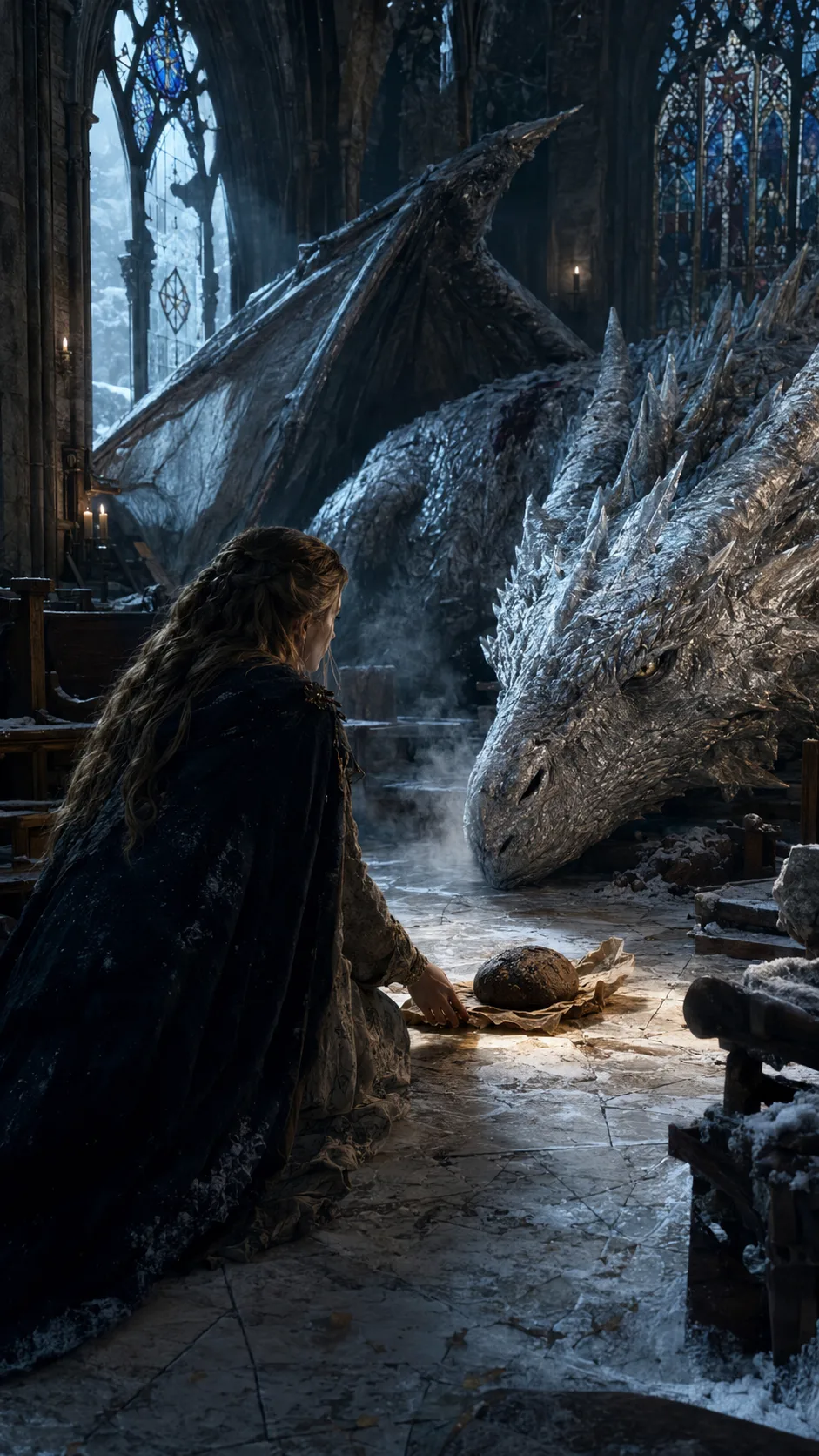
The moon found it in pieces. A ridge of silver-white scales. A folded wing. A horned skull resting against the base of a shattered pillar. Steam lifted from its body and vanished into the cold.
Ysolde stopped.
The stories had never described the silence of a winter wyvern.
They had described teeth. Claws. Children taken from shepherd huts. Horses ripped from their stalls during blizzards. Red banners carried up the mountain and never returned. Her father had spoken of them with wine in his hand and soldiers around him, making monsters sound simple because men with swords liked simple enemies.
Aldenmar had killed wyverns for two hundred years.
Aldenmar had built songs about it.
This one lay in her chapel with one wing twisted beneath a fallen beam and a sword wound along its ribs, its breath scraping out in clouds. It was the length of her father’s warhorse. Larger, maybe. Its tail disappeared behind broken pews. Its claws curved into the marble as if it had dragged itself inside inch by inch.
The knife in Ysolde’s hand looked foolish.
The wyvern’s eye was closed.
The other eye was hidden against the floor.
Ysolde should have run.
The doors were behind her. The north passage led to the queen’s gallery, then to the old nursery tower, then to the stair that ended above the frozen courtyard. If she ran now, perhaps it would not wake. If it woke, perhaps hunger would make it slower. If she reached the tower, she could bar herself in and wait for dawn.
For what came after dawn, she had no answer.
The wyvern exhaled.
The sound moved through the chapel, deep enough to stir snow from the altar cloth.
Ysolde tightened her grip on the bread.
The wound along its ribs steamed where the cold touched it. Not blood in the way human blood looked. Darker. Thicker. Something that seemed to turn the air around it white. The sword had gone in deep, under the scale line. Whoever had struck it had meant to kill it.
Perhaps they had.
Not yet.
Ysolde looked at the bread.
Then at the creature.
Her stomach cramped once, hard enough to make her bend slightly at the waist.
She took a step forward.
The wyvern did not move.
She took another.
A loose shard of stained glass snapped beneath her boot.
The creature’s claws flexed against the marble.
Ysolde stopped breathing.
The chapel returned to stillness.
She should have prayed then. The old kings would have. Her father would have called for a sword. Her mother would have told everyone to leave the room and then done whatever she had already decided to do.
Ysolde had always remembered that about Queen Maerwyn.
She never asked permission in rooms where men expected her to.
Ysolde lowered the knife.
“I’m not here to hurt you,” she said.
Her voice scraped coming out. Four days of silence had left it thin.
The wyvern did not open its eye.
Ysolde moved closer until she could see frost gathered along its lashes.
It looked dead from that distance.
Then its nostril flared.
White breath rolled over her boots.
The cold of it climbed her legs.
Ysolde knelt.
The movement made her cloak pool around her in a dark ring. The chapel stones pressed through the wool of her gown. She set the knife down beside her knee, far enough from her hand for the creature to see she was not raising it.
Then she unfolded the linen.
The bread sat between her palms.
The wyvern’s breath came again, rougher this time.
“You’re bleeding.”
The words left her before she chose them.
Too small.
Too ordinary.
The sort of thing one said to a child with a scraped hand, to a guard who had cut himself fastening a gate, to Marra when she nicked her thumb chopping onions and cursed in three languages.
Not to a winter wyvern.
The creature’s golden eye opened.
Ysolde’s fingers went still.
It was not yellow. Not exactly. It held gold the way old coins held fire after years in a locked chest. It opened slowly, with a clear, terrible intelligence, and fixed on her.
Not the knife.
Not the bread.
Her.
Ysolde set the loaf down on the marble between them.
The linen crinkled beneath it.
The wyvern watched.
She waited for teeth. For the sudden force of its head. For claws. For pain so quick she would not have time to think of the kitchen or Marra or the way her mother’s hands had smelled of lavender and ink.
Nothing happened.
The creature did not eat.
Ysolde pushed the loaf closer with two fingers.
The bread slid an inch across the stone.
The wyvern’s eye followed her hand.
Then the creature shifted its head.
Only a little.
The sound of scale on marble made her shoulders pull tight. Its jaw was long enough to close around her waist. Its spines caught the candlelight in narrow silver lines. Ice clung to the ridges above its brow.
It dragged one claw forward.
The talon scored the floor.
Ysolde did not reach for the knife.
The wyvern lowered its head until its eye was nearly level with hers.
No priest had stood that close to her since the spring after her mother died. No lord either. They all learned to address her from a careful distance once the rumors took shape.
The birthmark under her collarbone had started it.
Not large. Not ugly. A pale crescent at the edge of her left shoulder, hidden beneath gowns unless a seam slipped or a chambermaid talked. When she was a child, her mother would touch two fingers to it and hum under her breath. No one else was allowed to mention it.
After Queen Maerwyn’s death, everyone mentioned it without using words.
The court physician had stared too long.
The chaplain had stopped blessing her with his hand on her head.
Her father ordered higher collars.
Ysolde had learned to dress before mirrors without looking at herself.
The wyvern’s pupil narrowed.
Its breath washed across the bread.
Still it did not eat.
“You need food,” Ysolde said.
The creature’s throat moved.
Not like an animal growling.
Like something remembering a language.
The chapel candles trembled though there was no wind.
Ysolde’s fingers closed over the empty linen.
The wyvern spoke.
It spoke one word.
Her name.
Not Ysolde.
Not Highness.
Not the name embroidered inside her christening robe, recorded in the chapel book, sung by choirs when she turned sixteen and stood beside her father in the crown hall.
The other name.
The one that had never been written.
The one her mother had whispered into her ear on the night she was born, after the midwives were dismissed, after the shutters were closed, after the palace had been told the princess slept.
The name made of two old syllables Aldenmar no longer used.
The name that meant winter’s mercy in a language no tutor had been willing to teach her.
Ysolde’s hand slipped from the linen.
The bread remained between them, untouched.
The cold found the mark beneath her cloak.
It was not like the chapel cold. Not the sharp bite of winter. Not hunger chill. It spread from under her collarbone in a clean ring, as if someone had pressed a coin of ice against her skin.
Her lips parted.
“How do you know that na—”
She did not finish.
The wyvern’s eye changed.
Not in color. Not in shape. It was still gold, still too large, still set in a face built for mountain storms and old terror.
But the way it looked at her had altered.
The creature was no longer measuring distance. It was not waiting to strike. It was not asking if she would flee.
It looked at her the way her mother used to look at her when the candles had burned low and the court had finally left them alone. The way Queen Maerwyn had watched her from the edge of the bed, one hand on the blanket, mouth curved not quite into a smile because smiling too fully might wake the child.
Ysolde’s breath caught once.
The wyvern did not blink.
The chapel around them pulled away. The broken pews, the empty saints, the snow, the dead candles, the war stories painted into the walls. All of it grew thin.
Ysolde saw her mother’s chamber.
A basin of warm water.
The green velvet chair with one loose tassel.
A silver comb missing three teeth.
Queen Maerwyn bending over her, dark hair unbound, face pale from whatever illness the physicians had claimed would pass.
“Never let them name all of you,” her mother had said once.
Ysolde had been seven. Half-asleep. More interested in the ring on her mother’s finger than the words.
“What does that mean?”
Maerwyn had touched the crescent mark.
“It means a cage needs the right name to close.”
The memory struck with such force that Ysolde put one hand to the floor.
The marble was wet beneath her palm.
Snowmelt.
Not blood.
Just water.
Her table knife lay by her knee, useless and bright.
The wyvern’s gaze moved to it.
Ysolde looked down.
Then she pushed the knife farther away.
The creature’s eye returned to hers.
“You knew my mother,” Ysolde said.
The wyvern’s jaw opened slightly.
No roar came.
Only breath.
Then, with effort that seemed to move through its whole wounded body, it lifted one claw and placed it on the stone between them.
Not near the bread.
Near the linen.
Ysolde looked at the claw.
Something was caught beneath one dark talon.
A strip of fabric.
Old. Frozen stiff. Pale green silk, torn at the edge, threaded with silver in a pattern Ysolde knew before her mind could make sense of it.
Her mother’s color.
Not Aldenmar green. Not the royal banner shade. Softer. Deeper. The color Maerwyn had worn when she did not have to stand before the court.
Ysolde reached for it.
The wyvern did not move.
The silk cracked as she freed it from the talon.
A small object fell from the folded cloth and struck the marble with a tiny, hard sound.
A ring.
Ysolde stared.
It had no jewel. No royal crest. Just a narrow band of silver, plain except for a crescent mark cut into the inside.
Her mother had worn that ring on a chain beneath her gowns. Ysolde remembered the shape of it against the linen of her nightdress when Maerwyn held her close. The court had never seen it. Her father had never spoken of it. After the funeral, Ysolde had searched her mother’s boxes and found only empty velvet slots.
The ring rolled once and stopped against the bread.
Ysolde picked it up.
It fit the tip of her smallest finger.
Too large for her.
Too cold.
The wyvern closed its eye halfway.
A sound came from beyond the chapel doors.
Ysolde turned.
For a moment she thought it was the storm again. Then it came sharper. Boots on stone. Metal striking metal. Voices low in the passage beyond the nave.
People.
Alive.
Her first thought should have been relief.
Instead she closed her fingers around the ring.
The chapel doors shifted.
One of them groaned open.
Torchlight cut into the blue dark.
Three men entered in fur cloaks and chainmail, snow on their shoulders, swords at their belts. Not Aldenmar guards. Their armor bore the black stag of Veyr, the northern house that had ridden to war with her father in summer and withdrawn when the mountain passes closed.
Lord Veyr’s men.
The tallest saw the wyvern and raised his torch.
“Gods.”
The second man drew his sword.
The sound rang through the chapel.
The wyvern’s eye opened fully.
Ysolde rose too fast and nearly fell. Hunger caught her by the spine, but she steadied herself with one hand on a broken pew.
“Don’t,” she said.
The man with the sword looked at her for the first time.
Recognition crossed his face, then calculation.
“Princess.”
The way he said it had no bow in it.
The tallest stepped deeper into the chapel. His torch threw red light over the wyvern’s scales and the bread at Ysolde’s feet.
“We saw it come down near the west wall,” he said. “Thought it died outside.”
“It is wounded.”
“It is a wyvern.”
Ysolde moved in front of the creature’s head.
The motion was small.
The men noticed anyway.
The second soldier gave a short laugh through his nose.
“Your father paid good silver for a hide like that.”
“My father is dead.”
The words landed oddly in the chapel.
No one had told her. No messenger had come. No banner had changed. But she knew it as she said it. The keep had gone silent because Aldenmar had already broken somewhere beyond her walls.
The tallest soldier’s hand tightened on the torch.
Ysolde watched that hand.
Not his face.
“You should come with us,” he said. “Lord Veyr holds the outer road. He’ll want you alive.”
“Alive for what?”
The third man had been looking at the wyvern, not at her. Now he glanced toward the others.
The tallest did not answer.
He didn’t need to.
Ysolde had sat through council meetings since she was twelve. Men never said prisoner when hostage sounded too honest. They said protection. They said custody. They said rightful security until someone signed a treaty with shaking hands.
The wyvern’s breath stirred the edge of her cloak.
The soldier with the sword took one step toward it.
“Move aside.”
Ysolde did not.
The sword lifted.
Not high enough to strike her.
High enough for her to understand the choice being offered.
Behind her, the wyvern’s chest shifted.
The movement sent a tremor through the floor.
Ysolde felt it in her heels.
The soldier froze.
Good.
The wyvern was too weak to rise. Ysolde knew that. The men did not.
She slipped her mother’s ring onto her thumb. It stopped at the knuckle.
The silver warmed against her skin.
The birthmark beneath her cloak burned cold again.
The tallest soldier saw the ring.
His face lost color.
Just a little.
Enough.
“Where did you get that?” he said.
Ysolde looked at him.
The chapel had taught her something about silence in the last four days. Silence was not empty. It could be held. It could be placed between people like bread on stone.
She did not answer.
The soldier looked from the ring to the wyvern.
Then back to her.
“You don’t know what that is.”
Ysolde stepped over the loaf and placed herself closer to the creature’s head.
“Tell me.”
The soldier swallowed.
The torch snapped in his grip, throwing sparks onto the marble.
The second man looked at him. “Captain?”
“Shut your mouth.”
The wyvern made a sound then.
Low.
Not a roar. Not yet. Something under stone. Something that made all three men take one step back before pride could stop them.
Ysolde kept her hand closed around the ring.
“Tell me,” she said again.
The captain’s jaw worked once.
“That ring belonged to the queen before she belonged to Aldenmar.”
Before she belonged.
The words went into Ysolde slowly.
Her mother’s portrait hung in the council hall wearing a crown too heavy for her neck and a gown chosen by men who wanted queens to look like treaties. Every story at court began with the day Maerwyn arrived from the north to marry King Aric.
No story spoke of before.
No one spoke of the mountains except to name enemies.
The wyvern’s eye stayed on Ysolde.
The captain noticed.
His sword hand shifted.
“Kill it,” he said.
The second soldier moved.
Ysolde moved first.
She picked up the bread from the marble and threw it hard at the soldier’s face.
It was not heroic.
It was bread.
Stale, heavy, black rye, hard as winter stone.
It struck his cheek with a dull crack and made him stumble sideways into a broken pew.
The torch captain cursed.
The third man reached for Ysolde.
The wyvern’s head surged forward.
Not far.
Not fast.
But enough.
Its jaws opened beside Ysolde, and the sound that came out shook snow from the broken windows.
The men stopped being soldiers.
They became bodies trying not to fall over each other.
The torch hit the floor. Flame rolled briefly across old dust before dying in melted snow. The sword clattered. One man slipped near the altar step and caught himself with both hands. The captain backed toward the door without taking his eyes from the wyvern.
Ysolde stood between them and the creature with one hand raised, though she did not know whether she was restraining the wyvern or herself.
The roar faded into the rafters.
The chapel answered with falling snow.
The captain’s face had changed.
Not fear only.
Recognition.
He looked at Ysolde’s hand, at the ring, at the crescent mark that had become visible where her cloak had slipped from one shoulder.
His mouth opened.
No words came.
The wyvern spoke instead.
Not loudly.
The old secret name filled the chapel again.
The three soldiers heard it.
All three.
The captain stepped back as if the floor had cracked beneath him.
“No,” he said.
Ysolde turned halfway toward the creature.
The wyvern’s golden eye held hers.
And for the first time since her mother’s funeral, Ysolde understood that the court had not been afraid of the birthmark because it was strange.
They had been afraid because it was recognized.
The captain fled first.
The others followed.
Boots scraped, armor struck the doorway, and then the passage swallowed them. Their sounds faded fast. No one looked back.
Ysolde remained standing until her knees gave way.
She sank to the floor beside the bread’s torn linen.
Her body shook once.
Then again.
The wyvern lowered its head until its breath warmed the stone beside her.
Ysolde looked at the ring on her thumb.
“What am I?” she asked.
The creature watched her for a long while.
Then it moved its wounded wing.
Beneath the bent membrane, against the stone, something had been hidden.
A leather tube, cracked with age and sealed in silver wax.
Ysolde reached for it.
The wax bore no royal crest.
Only the crescent.
Her fingers hesitated.
The wyvern closed its eye.
Permission.
Ysolde broke the seal.
Inside was a parchment so thin it seemed made from winter itself. Her mother’s handwriting crossed it in narrow, careful lines.
Ysolde knew the first word before she read it.
Daughter.
The chapel blurred at the edges.
She blinked once and forced the letters steady.
The letter did not explain everything. Not at first. Her mother had never wasted ink on comfort when truth would do. It told Ysolde that Maerwyn had been born beyond the northern pass, in the valley where the last winter wyverns nested before Aldenmar called them beasts and made a kingdom out of their bones. It told her that the mark on Ysolde’s shoulder was not a curse, not sickness, not shame.
It was a bond.
Old magic. Older than crowns. Rare enough to be hunted. Strong enough to frighten kings.
Her mother had carried that bond. Her mother had hidden it inside marriage, inside silk, inside silence.
Aldenmar had wanted the queen.
It had not wanted what came with her.
Ysolde read until her hands shook too hard to hold the parchment.
The last lines were written darker, pressed deep.
If he turns them against you, go to the chapel.
If I cannot come, she will.
Trust the golden eye.
The wyvern breathed beside her.
Ysolde touched the parchment to her mouth, not as a kiss, not exactly.
More like holding a door closed for one more second.
Outside, the keep groaned under snow and old lies.
Inside, the last winter wyvern lay bleeding on royal marble with her mother’s secret under its wing.
Ysolde folded the letter and slid it beneath her cloak.
Then she crawled to the bread, picked it up from where it had fallen, and tore it at last.
The crust gave way unevenly.
She placed half before the wyvern.
The creature looked at it.
Then at her.
“Please,” Ysolde said.
This time, the wyvern ate.
Not like the stories said monsters ate. No snapping bones. No tearing. It drew the bread into its mouth with care, as if accepting a vow.
Ysolde ate the other half.
It was dry and hard and tasted of smoke.
It kept her alive.
By morning, Lord Veyr’s men had left the outer yard.
Not from mercy. Their tracks showed panic. One wagon had tipped near the gate, spilling sacks of grain into the snow. Two horses had broken loose and run south. The black stag banner lay trampled in the slush below the watchtower.
Ysolde found a cloak in the guardroom, a bow she did not know how to use, and three apples frozen solid in a barrel.
The wyvern could not fly.
Not yet.
It could walk by leaning heavily against the chapel wall, claws dragging lines through the marble until the old kings beneath the floor seemed marked through their names. Ysolde broke apart pews for splints, tore altar cloth for binding, and used melted snow to clean what wounds she could reach.
She did not know if she helped.
The wyvern allowed it.
That was something.
For three days, the chapel became a place of small labors. Ysolde brought grain from the tipped wagon. She carried water in a dented helmet. She slept in pieces, curled beneath her cloak near the altar steps, waking whenever the wyvern’s breathing changed.
On the fourth morning, the bells rang.
Not from the tower.
From the road.
Army bells.
Aldenmar’s surviving nobles arrived under white flags and red faces, with priests, clerks, two wagons of soldiers, and Lord Veyr himself sitting tall on a black horse at the center. They had come for the princess. They had come for the keep. They had come, Ysolde suspected, for the dead wyvern hide they expected to find cooling in the chapel.
Ysolde met them in the courtyard.
She wore her mother’s ring on a chain at her throat.
Her cloak covered the birthmark.
For now.
Lord Veyr dismounted without bowing.
“Your Highness,” he said. “Thank the gods you live.”
Ysolde looked past him to the soldiers behind.
Several would not meet her eyes.
The captain from the chapel stood near the rear with a bandage across one cheek.
Bread-shaped justice, Marra would have called it.
Ysolde almost smiled.
Almost.
“My father?” she asked.
Lord Veyr removed one glove finger by finger.
“Aldenmar mourns the king.”
No one in the courtyard breathed too loudly.
“And the council?”
“Scattered. Some dead. Some delayed by snow.”
Convenient snow.
“And you came to escort me.”
“To protect the line.”
There it was again.
Protection.
Ysolde stepped down from the courtyard stair.
Behind her, inside the open chapel doors, something shifted in the shadows.
The horses felt it first.
One stamped.
Another backed into a soldier.
Lord Veyr turned his head.
The wyvern emerged from the chapel like winter remembering it had teeth.
It moved slowly, favoring one side, wing bound in strips of torn altar cloth. Even wounded, even half-starved, even with one eye narrowed against daylight, it filled the doorway behind Ysolde and made every banner in the courtyard look like a child’s toy.
Swords came halfway out.
Then stopped.
Ysolde raised one hand.
The wyvern stopped with her.
Lord Veyr saw that.
So did everyone else.
The priest dropped his prayer book into the snow.
Ysolde reached up and unfastened her cloak clasp.
The wool slipped from her shoulder.
The crescent mark showed pale against her skin.
A murmur moved through the soldiers.
Lord Veyr did not move at all.
Ysolde took her mother’s ring from the chain and held it up.
“My mother left me a letter,” she said.
Lord Veyr’s eyes cut to the chapel captain.
Good.
Let them know someone had already failed.
“She left me more than that.”
The wyvern lowered its head behind her.
The courtyard changed shape without a sword leaving its sheath. Soldiers who had stood behind Lord Veyr angled away from him. A clerk took one step backward. One of the priests crossed himself and then seemed unsure whether he had chosen the right god for the gesture.
Ysolde looked at Lord Veyr.
“You came for a hostage.”
His face hardened.
“I came for my future queen.”
“No.”
The word was not loud.
It carried anyway.
Snow fell between them.
The wyvern’s golden eye opened fully.
Ysolde felt the old name beneath her tongue, the one her mother had hidden, the one the creature had returned to her. She did not speak it. Not for them.
A cage needed the right name to close.
She would not hand them the key.
Lord Veyr’s mouth thinned.
“You cannot rule with that thing at your back.”
Ysolde looked toward the broken chapel windows, the dead keep, the soldiers with hands trembling on sword hilts, the priest’s book half-buried in snow.
Then she looked at the wyvern.
“No,” she said. “I can leave.”
No one answered.
Perhaps they had not considered that a princess could choose the road over the throne. Men raised on maps forgot that borders were lines drawn by people who feared what lived beyond them.
Ysolde turned from Lord Veyr.
The wyvern moved aside enough for her to pass.
She went first to the tipped wagon and took a sack of grain. Then a waterskin. Then the bow, though she still did not know how to use it. No one stopped her. Not Lord Veyr. Not the soldiers. Not the priests who had once blessed her father’s banners before hunts into the northern mountains.
At the gate, she looked back once.
The keep of Aldenmar rose behind her, gray and broken and crowned in snow. It had been built to keep monsters out. It had kept other things in.
The wyvern lowered its body beside her.
Not a bow.
An offering of height.
Ysolde understood.
She climbed carefully onto the ridge behind its shoulders, where the scales were cold beneath her hands and the bound wing trembled with effort. It could not fly. Not yet. So they walked.
Through the gate.
Past the trampled black stag banner.
Onto the road where Veyr’s horses had fled.
No one followed.
By sunset, Aldenmar was a dark line behind them.
By the second night, Ysolde learned the wyvern’s name. Not through speech. Through dreams that came in gold and snow and the memory of her mother laughing before court life taught her to lower the sound.
The name was Saeryn.
It meant last witness.
Weeks later, when riders came north with proclamations declaring Princess Ysolde missing, cursed, stolen, dead, or unfit depending on which noble had paid for the ink, the mountain villages already knew better. They had seen a young woman in a dark cloak walking beside a wounded winter wyvern. They had seen her trade a silver hairpin for oats. They had seen her mend a child’s torn mitten outside a shrine and leave before anyone could kneel.
Spring came late beyond the pass.
When it came, Saeryn flew.
The first flight was not graceful. One wing dipped. Snow burst from the cliff edge. Ysolde nearly lost her grip and laughed so sharply the sound frightened three ravens from a pine tree.
She had forgotten she could make that sound.
Far below, the valley opened white and green under the morning sun. No banners. No court. No priests looking at her collar. No men explaining cages with polished words.
Only wind.
Only the golden eye turning back to make sure she was still there.
Years later, they would say the princess of Aldenmar vanished into the mountains and became a story used to frighten kings who hunted what they did not understand.
They would be wrong.
Ysolde did not vanish.
She returned when she chose.
And when she did, no one called her by the wrong name again.
Chapter complete
You have reached the end of this chapter.
Continue reading
A few more worlds to get lost in after this chapter.