Cael had stolen three crusts of bread before sunrise and still came home with only one.
The other two were taken from him in the alley behind the smokehouse, where royal guards liked to stand when the morning markets opened.
Chapter 1
The other two were taken from him in the alley behind the smokehouse, where royal guards liked to stand when the morning markets opened.
They never took enough to be called thieves. A bite from this basket. A coin from that hand. One apple from a child who knew better than to complain. Their armor shone even in the dirty light, and people moved around them the way water moved around rocks.
Cael kept his last crust under his tunic.
It was hard and dark at the edge, baked three days ago, wrapped in a torn strip of cloth that used to be part of his sleeve. He walked with one shoulder lowered so no one would see the shape of it against his ribs. His bare feet knew every broken stone between the market steps and the lower village. Left of the butcher’s drain. Right of the cracked fountain. Over the old cart rut where rainwater sat black and still.
His sister Nia waited behind the tannery wall.
She was eight, though hunger
had made her smaller. She sat with her knees tucked under her chin, watching the road with a seriousness that did not belong on a child’s face. A strip of blue ribbon, faded nearly white, tied back her hair. It had belonged to their mother. Nia never let it come loose.
Cael crouched in front of her and pulled the crust from beneath his tunic.
“Eat slow,” he said.
She took it with both hands, like it was a cup full of light.
“You?”
“I ate already.”
She looked at him.
He looked at the tannery door instead.
A mule brayed somewhere down the road. Smoke from the dye vats drifted low, carrying the sour smell that stuck to skin and cloth. The old woman who sold turnip ends coughed behind her stall. Nothing in the lower village moved quickly anymore. Hunger made people careful.
Nia broke the crust in
half.
Cael shook his head once.
She held it out anyway.
“Don’t start,” he said.
She did not lower her hand.
That was when the royal guard came around the corner.
His name was Torren. Everyone knew because he liked people to say it when they begged. He was broad through the shoulders, with a red cloak pinned crooked over one side of his armor and a toothpick rolling between his lips. Two younger guards followed behind him, laughing at something he had said before they turned into the alley.
Torren saw the bread first.
Then he saw Nia.
“Well,” he said, “tax paid late is tax doubled.”
Cael stood.
The movement was small.
It was enough.
Torren’s eyes slid from the bread to Cael’s face. “That yours?”
Cael said nothing.
Torren took one step closer. Nia’s fingers tightened around the crust until crumbs fell onto her skirt.
“Hand it
over.”
“It’s not yours,” Cael said.
The younger guards stopped laughing.
A chicken scratched near a broken barrel. Somewhere above them, a shutter closed.
Torren spat the toothpick onto the ground. “What did you say?”
Cael could have lowered his eyes. He had done it before. Everyone in the lower village had done it before. There were ways to survive men like Torren. Let them take the food. Let them take the coin. Let them hear their own boots on the stones and mistake that sound for law.
Nia held the bread against her chest.
Torren reached for it.
Cael hit him.
Not hard enough to win. Not clean enough to be clever. His fist struck the guard’s mouth, and pain flashed through his knuckles. Torren stumbled back one step, more from surprise than force. His lip split against his own tooth. A line of red appeared.
The alley stopped breathing.
Then Torren smiled.
By noon, Cael was in chains.
They dragged him through the lower village first. Not because the fortress was far, but because Prince Malrec liked examples to travel slowly. Cael’s wrists were bound in iron cuffs too large for him, so the edges cut whenever the guards jerked the chain. Nia tried to follow until the old turnip woman caught her around the waist and held her back.
Cael did not look behind him after that.
The road to Dravenguard rose in seven turns. Each turn took him farther from the smokehouses, the dye vats, the broken well, the thin gardens behind leaning cottages. Above the lower village, the fortress sat carved into the black mountain like it had grown there before people learned to build. Its towers were narrow and sharp. Its banners hung red and dark in the wind. At the highest point, the royal keep looked down over every roof, every road, every hand that reached for bread and found nothing.
At the gate, one guard shoved Cael hard enough that his knees hit stone.
“Stand,” the guard said.
Cael stood.
The courtyard was full of horses, iron carts, soldiers, and servants carrying silver trays. No one looked at him for long. A chained boy in torn brown cloth was not unusual enough to interrupt palace work. The only strange thing was the old man standing beneath the archway, watching.
He wore a general’s cloak, though it had been mended at the hem. His hair was white. His left hand shook against the carved head of a cane. When Cael passed him, the old man’s gaze dropped to the iron pendant hanging from the frayed cord around Cael’s neck.
Cael felt the look before he understood it.
The pendant was nothing. A flat piece of rusted iron, oval-shaped, darkened by years of skin and smoke. His father had worn it. That was all Cael knew. His mother once told him never to sell it, not even for food. She had said that while fever worked under her skin and Nia slept against her side.
“Keep it under your shirt,” she had told him.
“Why?”
Her hand closed over his.
“Because some things are safer when no one remembers them.”
That had been five winters ago.
Cael tucked the pendant back into his tunic as the guards pulled him past the old general.
The old man did not speak.
By evening, the fortress knew.
Not the truth. Only the version that moved fastest through polished halls. A village boy had struck a royal guard. A starving rat had raised his hand against the crown. Prince Malrec had heard the report while he was practicing sword forms in the western yard. He asked only one question.
“Did anyone see?”
The captain said yes.
Malrec smiled.
The court was summoned before the torches were fully lit.
They did not bring Cael to a cell. They brought him downward.
Past the kitchens, where he smelled roasted meat and nearly missed a step. Past the armory, where soldiers lifted spears from racks without looking at him. Past two iron doors, then three, then a spiral stair cut into the mountain itself. The air changed as they descended. It grew wet and metallic. The torchlight turned blue. The walls stopped showing chisel marks and began to look older than the fortress above them.
Cael counted the doors at first.
He stopped at seven.
At the bottom, the guards dragged him through a tunnel wide enough for a wagon and high enough for something much larger. Chains lay along both sides of the passage, thicker than his thigh. Some were broken. Some were fixed into the rock with iron pins as wide as bowls. Old scorch marks stained the ceiling.
One guard crossed himself with two fingers.
The other noticed and hit him in the shoulder.
“Don’t let the prince see you do that.”
“I don’t like this place.”
“No one asked.”
The tunnel opened.
The Dragon Pit waited below the royal fortress like a wound that had never closed.
It was round, deep, and ringed by balconies cut into black stone. Iron spikes lined the lower walls. Blue flames burned in braziers, though no wood sat beneath them. At the far end stood a gate large enough for a house, its bars carved with runes that pulsed faintly under soot. Above the pit, seats had been arranged along the viewing balcony. Nobles in dark silks and polished collars leaned forward with the hungry stillness of people who had never missed a meal.
King Varric sat at the center.
His throne had been dragged down from the upper hall or copied from it. Iron, black and sharp, with a back shaped like folded wings. His crown was black steel, each point curved like a claw. He rested one hand on the arm of the throne and watched Cael as if measuring wood for a fire.
Prince Malrec stood beside him.
He was nineteen, broad-shouldered from training, dressed in bright armor that had never been dented in war. His hair was tied back with silver thread. At his hip hung a sword with a jeweled hilt. He smiled when Cael was shoved into the center of the pit.
The chain between Cael’s wrists clattered on stone.
Somewhere in the dark behind the great gate, something breathed.
Slow.
Heavy.
Ancient.
Malrec stepped closer to the balcony rail.
“Look at him,” the prince said. His voice carried easily through the pit. “This is what the villages call courage. A starving rat with a stolen loaf and a dead man’s temper.”
The nobles laughed.
One ambassador covered his mouth with two fingers. A priest looked down and adjusted the rings on his hand. A lady in green silk tilted her head as if Cael were a stain on a floor tile.
Cael lifted his chin.
He did not answer.
Malrec’s smile thinned. He wanted sound. He wanted begging. He wanted Cael’s voice to crack in front of the court.
“You struck a royal soldier,” Malrec said. “Do you know what that means?”
Cael’s wrists burned where the cuffs had rubbed skin raw. He could feel grit under his feet. He could still see Nia holding the bread against her chest.
“It means he was hurting someone smaller than him.”
The laughter died.
A cup stopped halfway to a nobleman’s mouth.
Prince Malrec’s fingers curled around the balcony rail. For a few seconds, the only sound was water dripping somewhere below the stones.
King Varric leaned forward.
His eyes were pale gray, almost silver in the torchlight.
“Release the beast.”
The gate began to rise.
The sound rolled through the chamber and climbed the walls. Iron groaned against iron. Dust shook loose from the arch above the bars. The guards nearest the lower wall backed away before they seemed to know their feet had moved. Hot smoke poured from the darkness beyond the gate, thick and bitter.
Cael’s chains felt suddenly too heavy.
The breathing changed.
It became movement.
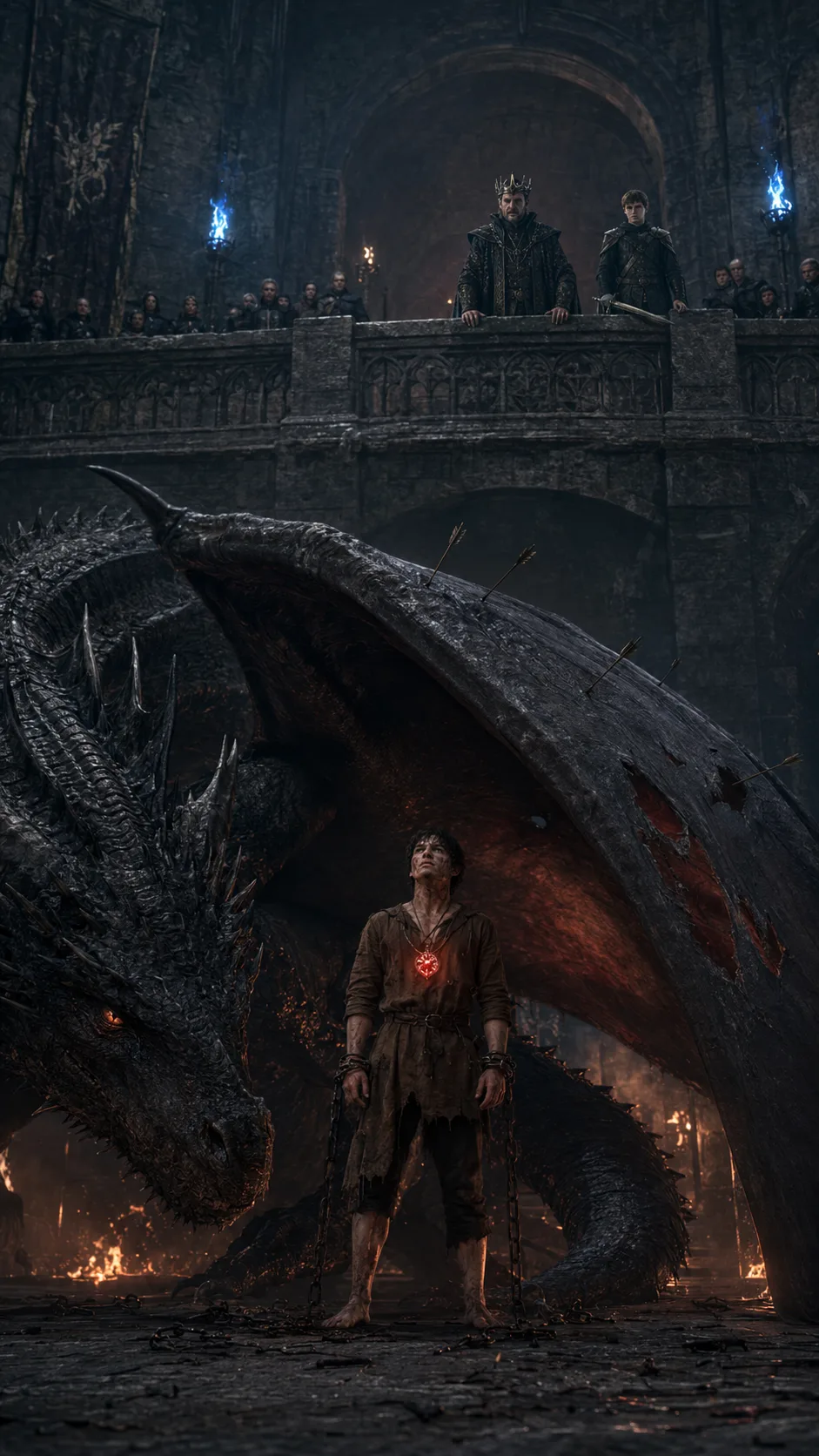
A claw emerged first, black and curved, scraping across stone. Then a head lowered beneath the rising gate. Horns, broken at the tips. Scales dulled by years without sun. A scar ran from one amber eye down along the jaw, pale against the black hide. Chains hung from its neck, each link marked with royal runes that glowed a sickly blue.
Orynd.
Even in the lower village, children knew that name.
The last war dragon of the old kings.
Mothers said it to make children come inside after dark. Priests used it in sermons about obedience. Soldiers painted its shape on shields to remind rebels what waited beneath Dravenguard. The crown’s story was simple: Orynd had burned villages, eaten traitors, and bowed only when King Varric chained it for the safety of the realm.
Cael saw the dragon’s eyes and knew the story was wrong.
No chained thing looked loyal.
Orynd stepped fully into the pit.
Every movement carried weight. Its wings dragged low, torn in places, the edges scarred from old restraints. Its ribs showed beneath scale and muscle. Smoke curled from its nostrils. One broken chain scraped behind it, leaving sparks where the rune-links struck stone.
Malrec’s smile returned.
“Now,” he said, “let us see if village courage survives dragon teeth.”
Cael stood alone.
The dragon lowered its head until its mouth was close enough that Cael could feel the heat of its breath. The smell of smoke and old blood filled his nose. Its teeth were long as daggers. Its eye, larger than Cael’s open hand, fixed on him.
Above, King Varric raised one hand.
“Feed.”
Orynd lunged.
Cael flinched.
He did not fall.
The dragon’s jaws stopped inches from his face.
The whole pit held still.
Orynd did not bite. It inhaled. Once. Twice. The sound pulled at Cael’s tunic, lifted the hair off his forehead, moved the pendant at his chest. The dragon’s amber eye shifted downward.
To the iron charm.
Cael looked down too.
At first, he thought the blue torchlight was playing across the rust. Then the pendant grew warm against his skin. Warm became hot. A red glow bled through the cracks in the iron, spreading like fire under ash.
The runes on Orynd’s chains flickered.
King Varric stood.
“No,” he said.
It was not loud.
It reached everyone.
The pendant split along a seam Cael had never noticed. Beneath the rust, a crest emerged in red light: a dragon coiled around a broken crown.
A sound came from the balcony.
Not from the king.
The old general with the shaking hand had risen from the second row. His cane had fallen beside his chair. He stared at Cael’s chest, lips parted, face gone colorless under the torchlight.
“That mark,” he said.
Varric turned his head slowly.
The general did not stop.
“That is not a village charm.”
“Sit down,” Varric said.
The general stepped forward instead. His legs looked weak, but he moved. One pace. Then another. The nobles near him leaned away, as if memory were contagious.
“It belonged to Commander Arlen,” the old man said. His voice broke on the name, then steadied. “The last protector of the true king.”
A murmur passed through the balcony.
Malrec looked from the general to the pendant, then to his father.
King Varric slammed his fist on the arm of the throne.
“Silence!”
Orynd roared.
The sound hit the stone and came back larger. Dust fell from the ceiling. One blue brazier guttered low, then flared high. Several nobles stumbled away from the rail. Below them, the chains around Orynd’s neck blazed bright blue, fighting to hold.
The dragon lowered its head.
Not toward the king.
Toward Cael.
Its massive skull touched the stone before the boy’s bare feet.
A bow.
Cael could not move.
The dragon’s breath warmed the floor around him. The pendant burned red against his chest. His chains hung from his wrists, suddenly ridiculous, small human iron in a chamber built for ancient things.
The old general dropped to one knee.
“It was said Arlen died protecting the queen’s infant son during the coup,” he said. “The child was never found.”
The first chain snapped.
The sound cracked through the pit like a branch under winter ice.
Then another.
The control runes flared, spat blue sparks, and burned away black. Orynd lifted its head from the floor. Chain after chain split from its neck and fell in heavy coils around its claws.
Prince Malrec drew his sword.
The blade rang too thin in that huge chamber.
“Kill them both!”
Archers stepped to the rail.
For the first time, Cael saw them clearly. A dozen. Then more behind them. Bows raised. Arrowheads aimed into the pit. Some hands were steady. Some were not.
Orynd moved before the first bowstring released.
The dragon stepped between Cael and the balcony, the floor shaking beneath its weight. One torn wing unfurled over him, scarred membrane stretching wide enough to cover a wagon road. Cael stood under the shadow of it, the red glow from his pendant painting the inside of the wing like banked fire.
The arrows flew.
They struck scale and wing with hard, fast sounds.
Orynd did not retreat.
Cael heard wood splinter. He heard one arrow skip off a horn and spin across the floor. He heard someone above drop a bow. Under the dragon’s wing, the air was hot, smoky, alive with the deep rumble in Orynd’s chest.
King Varric gripped the balcony rail.
His crown sat crooked now.
“You are nothing,” he said.
Cael looked at him.
Not at the crown.
At the man beneath it.
Then he looked at Orynd, at the broken chains around the dragon’s claws, at the old general kneeling above, at the nobles who had leaned over the pit to watch him die and now would not meet his eyes.
Cael stepped forward until the chain between his wrists pulled tight.
“If I am nothing,” he said, “why did your beast choose me over your crown?”
No one answered.
One of the younger guards near the lower wall lowered his spear.
It was a small thing.
Everyone saw it.
Malrec turned on him. “Raise it.”
The guard did not.
Another spear lowered. Then a third.
On the balcony, the old general pushed himself to his feet. He picked up his cane, but he did not lean on it. He faced the court with the slow care of a man laying a blade on a table.
“I served King Edric,” he said. “I saw Commander Arlen ride with the queen’s guard. I saw that crest on his breastplate. I saw the child wrapped in red cloth the night the palace burned.”
Varric’s face hardened.
“You saw nothing.”
“I saw enough.”
A noblewoman near the rear crossed herself. A priest removed his rings one by one and slipped them into his sleeve. The ambassador who had hidden his smile earlier stepped back from the rail until his shoulder touched the wall.
Malrec raised his sword toward the archers.
“Fire again.”
No one moved.
“Fire!”
Orynd’s head rose above the edge of its wing. Its amber eyes fixed on the prince. Smoke rolled from between its teeth.
Malrec took one step back.
His heel struck the base of the throne.
The sound was small.
Cael heard it anyway.
King Varric lifted his hand, palm outward, and the royal signet on his finger flashed blue. For a breath, the burned runes on Orynd’s broken chains sparked again. The dragon’s neck tightened. Its claws dug grooves into the stone.
Cael saw the pain move through the great body.
He did not think.
He reached up and closed both chained hands around the glowing pendant.
The red light flared through his fingers.
Orynd’s growl deepened.
The last blue runes died.
The signet on Varric’s hand cracked down the center.
A sharp line appeared in the black stone of the balcony rail beneath his grip.
The king looked at his ring.
Then at Cael.
The court saw him look.
That was the part he could not undo.
The false king had not feared the dragon when it entered the pit. He had not feared arrows, chains, soldiers, or starving villages. But he feared the pendant around a boy’s neck. He feared an old crest beneath rust. He feared a dragon that remembered what men had tried to bury.
Orynd lowered its head beside Cael again, but this time it did not bow.
It waited.
Cael turned toward the lower wall where the guards stood. The cuffs at his wrists felt heavier now, not because they held him, but because everyone could see them.
The young guard who had lowered his spear looked at the chains.
Then he looked up at King Varric.
No order came.
The guard crossed the floor.
Malrec shouted something from above. The words broke apart in the dragon’s growl.
The guard knelt in front of Cael and took a key from his belt. His hands shook so badly that the metal clicked twice against the lock before it turned.
The first cuff opened.
Then the second.
Cael’s wrists were red where the iron had bitten, but his hands were free.
The guard set the cuffs on the stone.
No one picked them up.
The old general bowed his head.
Not to the throne.
To the pit.
One by one, others followed. Not all. Not even most at first. But enough. A captain near the left stair. Two soldiers in the lower ring. A gray-haired noble who had spent the whole night laughing behind his cup and now could not lift his eyes. Then more.
King Varric remained standing.
His cracked signet hung loose on his finger.
Malrec’s sword trembled in his hand.
Cael looked up at them once. He did not smile. He did not raise a fist. He did not need to.
Orynd turned toward the great gate.
The gate that had opened to release a monster.
The dragon struck it with one shoulder.
Iron bent.
A second strike tore the left hinge from the stone. Dust and sparks burst through the tunnel. The blue flames along the wall snapped low, as if bowing with the rest of them.
Cael walked beside the dragon through the broken gate.
No one stopped him.
The tunnel beyond smelled of smoke, wet rock, and old fear. Behind him, the Dragon Pit did not erupt into battle. Not yet. It emptied slowly, like a cup tipped by a careful hand. Soldiers stepped away from posts they had held for years. Servants vanished into side passages. Nobles gathered their silks and their secrets and hurried toward the upper stairs without waiting for permission.
The old general met Cael at the first turn of the tunnel.
Up close, he looked smaller than he had on the balcony. His eyes were wet, though no tear fell. He held Cael’s pendant between two fingers, not touching it, only hovering near the glow.
“Your father’s name was Arlen,” he said.
Cael’s throat worked once.
The general nodded, as if he had heard the question Cael could not ask.
“He was the queen’s shield commander. He carried you out when Varric took the throne.”
“My mother?”
The general looked down at the stone.
Cael did not ask again.
Some answers were already standing in the space between words.
Orynd shifted behind him. The tunnel was too narrow for the dragon’s full body, but it folded itself carefully, wings tight, head lowered so its horns scraped the ceiling only once. At that sound, three soldiers at the far end dropped their weapons and backed into the wall.
Cael looked at them.
They were not Torren. They were not Malrec. They were men who had held spears because someone above them said hold. That did not make them clean. It did not make them brave.
It made them useful.
“Open the village gate,” Cael said.
No one moved at first.
His voice was not loud. It was not practiced. It did not sound like a prince from a song.
Orynd’s amber eye opened wider.
The soldiers ran.
By dawn, Dravenguard had two crowns and no king who could wear either safely.
Varric locked himself in the upper throne room with Malrec and fifty loyal guards. The court split before breakfast. Some fled through the eastern road with chests of silver tied to their horses. Some claimed they had always doubted the king. Some sent letters sealed in wax, then sent new letters an hour later saying the opposite.
The old general’s name was Soren.
He brought Cael to a chamber near the broken west tower, where the windows looked down toward the lower village. The room smelled of dust and old cedar. A basin of clean water sat on a table beside folded clothes, bread, cheese, and a cup of watered wine.
Cael stood in front of the food for a long time.
Then he picked up the bread.
He broke it in half.
Soren watched but said nothing.
Cael wrapped one half in cloth and tucked it into his tunic.
“For your sister,” Soren said.
Cael looked at him.
Soren lowered his eyes.
The clothes did not fit well. The boots were worse. Cael left them beside the bed and walked barefoot across the cold floor. A healer came to wash his wrists. Cael let her. When she reached for the pendant, Orynd growled from outside the broken tower wall, low enough to shake dust from the window frame.
The healer folded her hands in her lap.
“I won’t touch it.”
Cael nodded.
Below, the lower village gates opened for the first time without a tax bell.
People did not rush in. They gathered outside, suspicious of mercy that came from stone walls. Cael saw Nia near the front, blue ribbon in her hair, one hand gripping the old turnip woman’s sleeve.
He ran.
Down three flights, across the courtyard, past soldiers who stepped aside before they knew who had given the order. He reached the open gate with the wrapped bread still under his tunic.
Nia saw him and froze.
Then she ran too.
She hit him hard enough that he stumbled back against the gatepost. Her arms locked around his waist. He held her with one hand and pressed the bread into her palm with the other.
“Eat slow,” he said.
She looked at the bread.
Then at the dragon standing behind him.
Orynd had followed only as far as the courtyard, its head lowered, smoke curling gently from its nostrils. Villagers fell back at the sight of it. A child dropped a wooden cup. No one screamed.
Nia stepped out from behind Cael.
The blue ribbon had come loose on one side.
“Is it yours?” she asked.
Cael looked at Orynd.
The dragon watched him with the patience of mountains.
“No,” Cael said. “I think I’m his.”
Three days later, King Varric tried to flee through the old aqueduct beneath the northern wall.
He did not get far.
The soldiers who found him did not drag him through the village. Cael would not allow it. There had been enough streets turned into stages. Varric was held in the same lower fortress where he had kept men who questioned him, though Soren ordered the chains removed from the wall before the cell door closed.
Malrec was taken at the river road with twelve riders and two chests of gold. His sword was returned without the jewels. No one admitted taking them.
A council formed because kingdoms did not stand on bloodlines alone, no matter what priests liked to say. Soren sat in the first chair. Two village elders sat beside him, including the turnip woman, who arrived with flour on her sleeve and corrected a noble’s grammar before sitting down. Captains came. Priests came. Farmers came. Cael came only when they asked him to listen.
They asked him to take the crown before the week ended.
He said no.
Not because he did not understand what the pendant meant. He understood enough. He had seen men kneel to it. He had seen Varric’s face when it glowed. He had felt Orynd’s chains break when his hands closed around it.
That was why he said no.
“A crown can wait,” he told them.
Soren studied him from across the table.
“For what?”
Cael looked out through the council window.
Below, villagers carried sacks of grain from the royal storehouses into the square. No guards counted the loaves. Nia sat on the fountain edge with three other children, splitting bread into pieces that did not need to be hidden.
“For people to eat first.”
No one argued after that.
By the first frost, the Dragon Pit had changed.
The spikes were removed from the lower walls. The blue braziers were broken apart and thrown into the river. The great gate remained bent where Orynd had struck it, and Cael ordered it left that way. Not as a warning to prisoners. Not as a monument to fear.
As a reminder.
Orynd slept there by choice now, curled in the open pit beneath shafts of daylight cut through the stone ceiling. Children were not allowed near without a guard, though Nia ignored that rule twice and was caught both times sitting on the lowest step, telling the dragon about market gossip. Orynd listened with one eye open.
Cael visited at dusk.
He still wore the pendant, though it no longer burned red unless Orynd came close. His wrists had healed, leaving pale lines where the cuffs had been. The first time Soren brought him a cloak embroidered with the old royal crest, Cael folded it over one arm and set it aside.
“Not yet,” he said.
Soren did not press.
Winter came thin and hard, but fewer people died than the year before. Grain moved south. Taxes stopped at the lower village. Torren, the guard with the split lip, was assigned to shovel ash from the old execution furnaces until his palms blistered. Nia asked if that was enough punishment.
Cael watched Torren carry a bucket across the courtyard, head down, red cloak gone.
“No,” he said. “But it is a start.”
On the day the first snow fell, Soren brought Cael to the highest balcony of Dravenguard. Not the Dragon Pit balcony. The outer one, where the whole valley opened below. Roofs, fields, smoke, road, river. All of it gray and white under the sky.
A black crown sat on a cloth between them.
Varric’s crown had been melted down. This one was old bronze, found in the sealed chapel behind the queen’s tower. It had no claws. Only a simple band, worn thin along one edge where another head had carried it long ago.
Cael looked at it.
Then at the village.
Nia stood far below in the courtyard, blue ribbon bright against the snow. She waved both arms when she saw him.
Orynd lifted his head from the broken wall beside the tower, snow melting against his black scales.
Soren waited.
Cael picked up the crown.
It was lighter than he expected.
He did not put it on.
He carried it down to the courtyard, past soldiers, servants, nobles, and villagers who turned as he passed. At the open gate, he stopped beside Nia and broke the morning loaf in half. He gave her the larger piece.
Then he set the crown on the stone step between them and looked at the people gathered there.
No throne.
No pit.
No chains.
Only the open gate behind him.
Chapter complete
You have reached the end of this chapter.
Continue reading
A few more worlds to get lost in after this chapter.




