Rowan counted six stale crusts under the baker’s table before the royal guard’s shadow fell across his hand.
Chapter 1
Rowan counted six stale crusts under the baker’s table before the royal guard’s shadow fell across his hand.
He had already hidden three inside his tunic. One for Mara, who had not spoken since her fever. One for the twins who slept under the broken cart near the east wall. One for himself, though he knew he would give it away before night if someone smaller looked at him too long.
The fourth crust was hard enough to crack a tooth. He reached for it anyway.
A boot came down beside his fingers.
The table shook. Flour dust drifted from the edge and settled over Rowan’s wrist like pale ash.
“Thief.”
The guard did not shout. He did not need to. The royal kitchen went quiet around them, except for the soft hiss of fat in a pan and the slap of dough on stone. Servants turned away first. Then the cooks. Then the boy who had let Rowan slip through the side door every third morning for
two months.
Rowan pulled his hand back.
The guard bent, caught him by the back of his tunic, and lifted him off the floor. The stolen crusts dropped one by one from under the cloth.
Three small sounds.
Hard bread on stone.
The head cook shut her eyes. Only for a second. Then she opened them and picked up her knife again.
Rowan did not kick. He had learned early that kicking made men laugh before they hit. He let his feet hang and kept his hands close to his ribs, where the cracked wooden pendant rested against his chest.
The guard noticed it.
“What’s that?”
Rowan’s fingers closed over the pendant.
“Mine.”
The guard smiled with one side of his mouth. He smelled of wine and cold iron.
“Nothing in this castle is yours.”
He dragged Rowan through the kitchens, past baskets of apples polished for the prince’s table
and silver trays stacked with meat the lower village would never smell. A maid with red hands from washing pots stopped in the passage. Her eyes went to the bread on the floor, then to Rowan’s bare feet.
She did not move.
No one did.
Outside the kitchen corridor, the palace changed. The low ceilings became arches. The stone became black-veined marble. The torches burned cleaner here. Even the air seemed trained not to carry the smell of hunger.
Rowan’s shoulder struck the wall when the guard turned too fast.
He bit the inside of his cheek.
No sound.
At the end of the passage, two men in silver armor waited beneath a carved dragon crest. One held a scroll tied in black ribbon. The other held nothing at all, which made him worse.
The guard shoved Rowan to his knees.
“Caught in the royal kitchen.”
The man with the
scroll looked down. He had narrow eyes and a face that had practiced patience until it became cruelty.
“Name.”
“Rowan.”
“House.”
Rowan looked at the floor.
A crack ran through the marble near his left knee. Someone had filled it with gold long ago.
“No house.”
The man wrote something.
“No father?”
“No.”
“No mother?”
Rowan’s hand moved to the pendant again.
The man saw.
His pen stopped.
For the first time, he looked at Rowan’s chest instead of Rowan’s face.
“Where did you get that?”
Rowan said nothing.
The guard struck him across the back of the head, not hard enough to break anything, hard enough to make his ears ring.
“Answer.”
Rowan’s fingers tightened.
“I had it when they found me.”
“Who found you?”
“Old Bren. By the river.”
The man with the scroll exchanged a glance with the one who held nothing.
It was small.
Too small for most people.
Rowan saw it.
He always noticed the tiny things. The lid placed crooked on a jar. The coin hidden beneath a sleeve. The way a person’s hand moved before a lie. Hunger taught him to watch what adults thought did not matter.
The man rolled the scroll closed.
“Take him to the lower holding room.”
The guard frowned.
“For bread?”
The man’s eyes shifted once toward the dragon crest above them.
“For judgment.”
The holding room had no window. It had a bucket in the corner, a stone bench, and one iron ring bolted into the wall. Someone had carved marks into the floor with a nail or a bone. Lines crossing lines. Names half-finished. A little crown scratched near the drain.
Rowan sat beneath the ring and rubbed flour dust from his wrist.
His hand shook.
He pressed it flat against his knee until it stopped.
Hours passed by footsteps.
Heavy boots first. Light sandals later. A priest’s slow pace near midnight. Two servants carrying laundry before dawn. No one opened the door.
When it finally moved, it was not the guard from the kitchen.
Prince Damar stood in the doorway with four soldiers behind him.
He was dressed in silver training armor, polished bright enough to catch the torchlight and throw it back. His blond hair had been tied at the neck. His gloves were clean.
He looked disappointed when he saw Rowan.
“This is him?”
The scroll man bowed behind him.
“Yes, Your Highness.”
Damar stepped inside and glanced at the bucket, the bench, the wall ring. His nose moved slightly.
“He looks smaller than I expected.”
No one answered.
Damar crouched in front of Rowan. The metal plates of his armor clicked softly.
“You stole from my father.”
Rowan looked at the prince’s boots. The leather had no mud on it.
“I stole bread.”
Damar smiled.
“Royal bread.”
“For hungry children.”
The prince’s smile stayed, but his eyes did not.
“There are always hungry children.”
Rowan lifted his head then.
“There doesn’t have to be.”
One soldier shifted his weight. The scroll man drew a breath through his nose.
Damar stood.
The room seemed too low for him now. He reached toward Rowan’s chest and caught the wooden pendant between two fingers.
It was old, dark, cracked down one side. A child’s thing. Nothing worth stealing.
Yet Damar held it longer than he should have.
“This is ugly.”
Rowan tried to pull back.
Damar did not let go.
“Who gave it to you?”
“No one.”
“Liar.”
Rowan looked at the prince’s hand on the pendant.
The prince looked at Rowan’s face.
Then the pendant gave a faint pulse of heat.
Damar released it at once.
Only Rowan felt it against his skin. Only Damar had been touching it. The soldiers did not see. The scroll man did.
His eyes lowered to the pendant and stayed there.
Damar flexed his fingers inside the glove.
“What are the punishments for theft from the royal kitchen?”
The scroll man answered without looking up.
“Public whipping. Labor brand. Loss of hand for repeated offense.”
Damar tilted his head.
“Boring.”
The word landed harder than a slap.
The prince turned toward the soldiers.
“My father needs the court entertained tonight. The border lords are restless. The grain riots made them nervous.”
The scroll man stiffened.
“Your Highness.”
Damar raised one finger.
“Do not advise me.”
The room went flat.
Damar looked back at Rowan.
“The dragon has not eaten in five days.”
Rowan’s fingers curled around the pendant.
The prince saw the movement and smiled again.
“There it is.”
Rowan did not ask what.
“Take him below after sunset,” Damar said. “Let the court watch. Let the city hear by morning that even a child pays for touching what belongs to the crown.”
The scroll man bowed.
Damar walked out first. His soldiers followed.
The door stayed open a moment too long. In the passage beyond, Rowan saw a servant boy standing with a bundle of cloth in his arms. He was younger than Rowan. Nine, maybe. One of the kitchen children.
His eyes went to Rowan.
Then to the floor.
The door shut.
The old woman came after dusk.
Rowan knew she was old by the way she breathed before she spoke. The door opened, and she entered with a bowl of water, a strip of cloth, and a heel of bread hidden inside her sleeve.
She wore a laundress’s gray wrap. Her hair had been braided tight, but white strands had slipped free near her ears.
She set the bowl down.
“Eat fast.”
Rowan stared at the bread.
She pushed it closer.
“Fast.”
He took it and broke it in half.
The woman watched him.
“Still sharing?”
Rowan paused.
“You know me?”
“I knew the man who found you.”
“Old Bren?”
She nodded once.
“He brought you to the river chapel wrapped in a red cloak.”
Rowan looked at her hands. They were cracked from soap, but the right thumb bore an old burn scar shaped like a crescent.
“I never had a cloak.”
“You did once.”
The bread had gone soft in his mouth. He swallowed slowly.
“Where is it?”
“Burned. That same night.”
“Why?”
The woman dipped the cloth into the water. She wrung it out. Her fingers worked without hurry.
“Because soldiers came looking for a child.”
Rowan did not move.
The pendant rested hot against his chest.
The woman reached toward him, then stopped before touching the wood.
“Bren told me to never speak of it. He said silence was safer than truth. He died two winters later with a knife under his pillow and the door barred from inside.”
Rowan’s throat moved.
The woman cleaned the dried blood near his lip.
“What child?”
Her hand stopped.
“Not here.”
“The prince is feeding me to the dragon.”
“I know.”
“Then say it.”
The woman looked toward the door. A thin line of light showed beneath it. Shadows passed once, then twice.
She leaned close enough for Rowan to smell lye and smoke on her sleeve.
“The last queen had a son before Damar was born. The court said the infant died during the river fever. Some of us saw the little coffin. Some of us also saw the queen’s maid carry a bundle through the rain before dawn.”
Rowan’s palm flattened on the floor.
“The queen had dark hair?”
“Yes.”
“Did she have this?”
He lifted the pendant.
The woman’s mouth tightened. Not with surprise. With recognition.
“Her father carved it before she married the king. Not for jewelry. For oathkeeping.”
The door latch moved outside.
The woman sat back at once and wiped Rowan’s cheek with the cloth.
A guard opened the door.
“Time.”
The woman lowered her head.
Rowan tried to hand back half the bread.
She closed his fingers around it.
“Keep it.”
The guard dragged him up.
At the door, Rowan looked back.
The woman had turned away, but her shoulders had gone square. On the floor beside the bowl, her wet cloth dripped one red dot into the water, then another.
The stairs to the sacrifice hall went down longer than any stairs Rowan had known.
The air changed first. Cold. Then damp. Then something old beneath both, like metal left in the mouth too long.
Two guards held his arms. A third walked behind with a spear. The scroll man walked ahead, carrying a lantern with blue glass.
Rowan counted steps until he lost the number at one hundred.
At the bottom, the passage opened into a hall so large that the torchlight failed before it reached the ceiling.
Black pillars rose on both sides, carved with runes that twisted like vines. Blue flames burned in iron bowls along the walls. Above, balconies ringed the chamber, already crowded with nobles wrapped in fur and velvet. Some held cups. One man had brought sugared almonds in a silver dish.
At the far end stood the gate.
Behind it, something breathed.
The sound filled the floor.
The guards stopped.
Rowan did not.
They shoved him forward into the open.
His bare feet touched stone slick with old water. The chains on his wrists clinked with each step. Someone laughed from the left balcony, then stopped when no one joined.
King Aldric sat on a throne built for the night, raised on black steps, flanked by banners stitched with the gold dragon of the royal house. He wore a crown heavy with rubies. His beard had been combed and oiled. One hand rested on the arm of the throne. The other held a cup he had not lifted.
Prince Damar stood below him.
He looked brighter here. Silver armor. White cloak. A thin smile.
The king’s eyes moved over Rowan once.
No name.
No question.
No weight.
Damar descended three steps.
“Look at him,” he called to the hall. “This is what the lower streets send us now. Rats with fingers.”
A few nobles laughed.
The old priest near the altar did not. He stood with both hands pressed around a bone staff, his face drawn tight beneath the hood.
Damar reached Rowan and walked around him once.
“He stole bread from the royal kitchen. Not scraps from a gutter. Not crumbs from a tavern floor. Royal bread.”
Rowan looked toward the gate.
The breathing behind it stopped for a beat.
Damar leaned close.
“Are you ready to beg?”
Rowan’s lips were dry. His tongue touched the split place at the corner of his mouth.
“No.”
The prince’s fingers snapped around Rowan’s jaw and forced his face toward the balconies.
“Say it louder.”
Rowan looked at the nobles, the priests, the guards, the king.
“I took the bread because children in the village were hungry.”
Silence moved across the hall like a blade being drawn.
A woman in green lowered her cup.
The king’s fingers tightened on the throne.
Damar released Rowan and stepped back with a laugh that arrived late.
“Good. Let them hear how noble hunger sounds when it learns consequences.”
He turned toward the gate.
“Release the dragon.”
The chains began to move.
Metal dragged over stone behind the iron bars. The first pull was slow. The second shook dust from the carvings above the gate. Blue flames bent sideways though no wind crossed the hall.
A guard near Rowan stepped back.
Then another.
The gate rose.
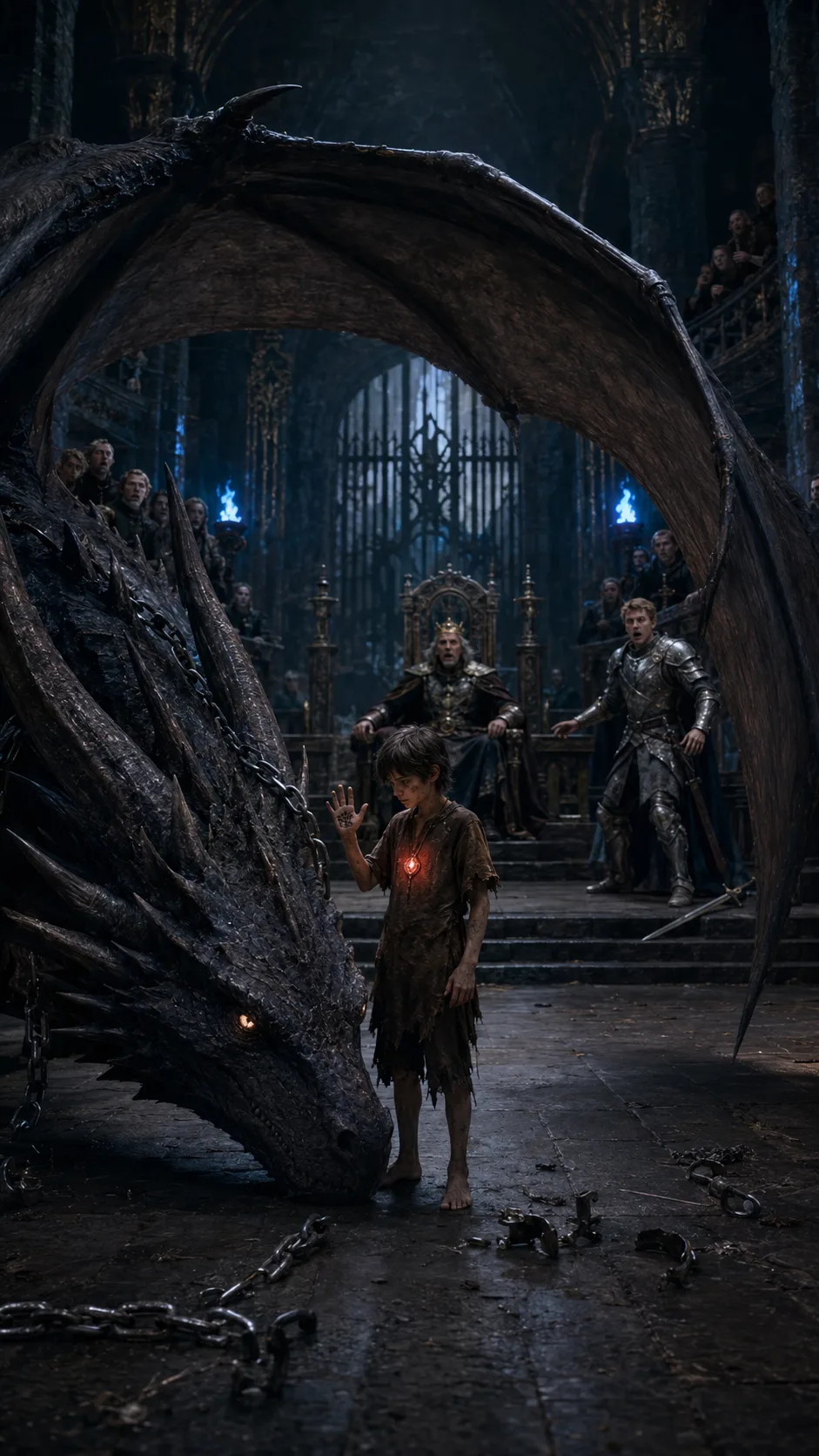
The dragon came out of darkness in pieces.
A horn first, black and ridged. Then one amber eye. Then the massive head, scarred along the jaw, each scale edged like cut stone. Silver chains bound its neck and chest, thick as young trees, covered in runes that burned white against the dark.
The nobles leaned back now.
No one laughed.
The dragon’s claws struck the stone floor.
Once.
Twice.
The hall answered each step.
Rowan stood where they had left him.
Small.
Still.
The dragon’s gaze found him.
The king lifted his hand.
“Eat it.”
The command crossed the hall cleanly.
The dragon lowered its head.
Heat rolled over Rowan’s face. Smoke curled around his knees. The creature’s teeth were longer than his forearm, yellowed near the root, wet with steam. Its eye filled the world to Rowan’s left, amber and ancient, turning with the faintest click beneath the lid.
Rowan closed his eyes.
His hands stayed at his sides.
The pendant grew warm.
Not warm like fever. Warm like a coal wrapped in cloth. Warm like bread stolen before dawn and shared under a broken cart.
The dragon breathed in.
The sound changed.
It was no longer a predator taking scent of meat. It was deeper. Slower. A memory pulled through stone.
Rowan opened his eyes.
The dragon was looking at his chest.
The wooden pendant glowed once.
Red light spread through the crack in the wood.
The silver runes on the dragon’s nearest chain flickered.
One went dark.
Then another.
A murmur rose from the balcony, but it died under the dragon’s next breath.
The creature lowered its head closer, not to Rowan’s throat, but to the pendant. Its nostrils flared. Its amber eye shifted from the wood to Rowan’s face.
The rage had gone.
Something else stood there.
The old priest took one step forward.
His staff struck the stone.
Damar turned on him.
“Stay back.”
The priest did not move again, but his fingers slipped from the staff and pressed against his own mouth.
The pendant burned brighter.
Rowan lifted one hand without deciding to.
The shackle around his wrist cracked.
A single split appeared along the iron.
Damar saw it.
His smile broke.
“No.”
The dragon bent its forelegs.
The hall changed before anyone spoke.
A guard at the left wall lowered his spear until the point touched stone. A noble boy on the balcony dropped his silver dish, and sugared almonds scattered across the steps like pale teeth. The king rose halfway from the throne, one hand still gripping the armrest, his crown tilting forward.
The dragon lowered its massive head all the way down.
Its brow touched the floor in front of Rowan’s feet.
The last black dragon bowed.
No one breathed loudly enough to hear.
Rowan looked down at the creature that had been ordered to kill him. Its chains hung slack now. One of the silver links near its neck snapped open and fell, ringing against the stone.
Damar stepped backward.
“Impossible.”
The word did not carry far.
The old priest dropped to his knees.
“Black dragons bow only to the blood of the first king.”
King Aldric’s cup fell from his hand.
Wine spread down the black steps.
“Silence.”
The priest kept his head lowered.
The second shackle on Rowan’s wrist split apart.
Iron fell from him.
Rowan looked at his palm.
A dark mark had risen beneath the skin: a dragon coiled around a crown.
The balcony erupted into movement, but not noise. People stood. Hands gripped railings. Faces turned from Rowan to the king, then back again. One guard removed his helmet without knowing he had done it.
Damar drew his sword.
The scrape rang too loud.
He lunged down the last steps toward Rowan.
The dragon moved faster than its size should have allowed.
One wing swept forward and came down between the prince and the boy, a wall of black leather and bone. The dragon’s growl rolled through the stone under Rowan’s feet. Damar’s sword shook in his grip.
Then the dragon roared.
The sword flew from Damar’s hand and struck the floor near the broken chains.
Damar fell backward onto the steps.
The king did not go to him.
Rowan stood under the dragon’s wing with his marked palm still open. The pendant’s glow faded from red to ember, but the mark remained.
He looked at King Aldric.
The king’s face had gone white beneath the beard. His hand moved toward his crown, then stopped before touching it.
Rowan’s voice came out smaller than the hall, but the hall gave it back.
“If I am nobody,” he said, “why does your dragon kneel to me?”
No one answered.
The dragon’s wing stayed between Rowan and the throne.
A chain link rolled slowly across the floor until it touched Damar’s boot.
The prince kicked it away.
No one looked at him.
The old priest rose from his knees, not fully, only enough to turn toward the balconies.
“Bring the river records.”
The scroll man near the wall shook his head once.
The priest looked at him.
“Bring them.”
The scroll man did not move.
The dragon did.
Only a shift of its head. Only one amber eye turning toward the man with the scroll case at his belt.
That was enough.
The scroll man walked to the altar with both hands visible. From inside his robe, he pulled a narrow leather packet sealed in black wax. His fingers slipped on the knot twice before he opened it.
The priest took the papers.
The hall waited while he read.
The king sat down again, but it was not sitting. It was falling into the shape of authority.
Damar pushed himself up on one elbow.
“Father.”
The king’s eyes did not leave the papers.
The priest unfolded the final sheet. Old ink. Water stains. A red smear at the corner that had never fully faded.
His voice carried without effort.
“On the ninth night of winter flood, by order of Queen Elianor, the male child bearing the river pendant was removed from the nursery and placed under the protection of Bren of the Lower Crossing.”
The laundress stood in the shadow near the servant entrance.
Rowan saw her then. Gray wrap. White hair. One hand pressed against the wall.
The priest continued.
“The royal infant was declared dead by fever at dawn.”
Damar got to his feet.
“That is a forged record.”
The old priest looked at him.
“It bears the queen’s blood seal.”
A sound came from the upper balcony. Not a gasp. Not a cry. A small, broken intake of air from people who had spent years practicing quiet.
The king stood.
“Enough.”
The dragon raised its head.
The king stopped.
For the first time that night, his crown looked heavy in a way gold had no right to be.
A guard captain stepped away from the throne platform. He was a broad man with gray at his temples and a scar across one brow. He crossed the floor, stopped before Rowan, and removed his sword.
He laid it flat on the stone.
Then he knelt.
One by one, the guards nearest the walls lowered their weapons.
Not all.
Enough.
The nobles watched the math change in front of them.
Prince Damar stared at the captain.
“Get up.”
The captain did not.
Damar turned to the king.
“Make him get up.”
The king looked at the dragon, then at Rowan, then at the papers in the priest’s hand.
His fingers opened and closed around nothing.
The blue torches burned without sound.
Rowan lowered his marked hand.
He did not step onto the throne platform. He did not reach for the crown. He bent instead and picked up the half crust of bread the old woman had given him. It had fallen from his tunic during the march down, trampled once, dust along one edge.
He broke it.
The sound was small.
He placed one half on the stone in front of the dragon.
The dragon touched it with the edge of its breath.
The other half Rowan held in his fist.
The old laundress covered her mouth.
King Aldric’s crown slipped slightly to one side.
No servant ran to fix it.
The hall emptied in pieces after that.
The nobles left first, not with dignity, but with the careful speed of people who did not want to be last beside a collapsing throne. Some bowed to the king out of habit. More did not. The guards remained where they had lowered their weapons until the priest told them to stand.
Damar was taken from the steps by two men who had once opened doors for him.
He tried to pull his arm free.
No one struck him. No one needed to. His own sword still lay on the floor behind him.
King Aldric stayed on the platform after the banners were removed. Without the gold dragon cloth behind him, the throne looked temporary again. Wood, nails, black paint. A chair made taller by fear.
The priest read the river records twice more before dawn.
The dragon did not return behind the gate.
It lay across the center of the hall with its head near Rowan and its wing folded around him, not touching, close enough to stop anyone from reaching him too quickly. Rowan sat on the stone because no one had brought him a chair.
The captain offered his cloak.
Rowan took it, then placed it around the old laundress’s shoulders instead.
Her hands closed on the cloth.
“You should wear it,” she said.
Rowan looked at his bare feet.
“I’m used to cold.”
She did not answer that.
Above them, servants pulled down the prince’s white banners. One knot refused to loosen. A boy climbed the railing and cut it with a kitchen knife.
The cloth fell hard.
By sunrise, the city knew before the bells were rung.
News traveled through laundry doors, stable gates, kitchen passages, and the mouths of guards who had stood close enough to see the mark on Rowan’s palm. The lower village heard first. Then the markets. Then the houses with iron balconies and painted doors.
No one agreed on the exact words.
Some said the dragon had spoken.
It had not.
Some said Rowan had commanded fire.
He had not.
Some said King Aldric had begged.
He had not. Not where people could hear.
What remained true was enough.
The king who fed children to fear had lost the creature that made fear obey him.
The council convened three days later in the upper throne room, though everyone present knew the real decision had already happened underground. Aldric surrendered the crown under witness of the priesthood, the guard, and twelve houses that had once praised him loudest.
His hands shook only when the crown left his head.
Damar was sent north before noon, stripped of title, with six guards and no silver armor. His horse threw a shoe at the outer gate. He had to wait in the mud while a blacksmith replaced it.
People watched from windows.
No one offered him bread.
Rowan did not sit on the throne that day.
He stood before it with washed hair, borrowed clothes, and the cracked wooden pendant still around his neck. The mark on his palm had faded to a dark outline, but when the dragon shifted below the palace, every candle in the room bent toward the floor.
The priest held out the crown.
Rowan looked at it.
Then he looked at the doors leading toward the city.
“Open the granaries first.”
A councillor blinked.
“Before the ceremony?”
Rowan turned the half crust over in his hand. He had kept it through the night, through the records, through the shouting, through the men who wanted him dressed and seated and named before breakfast.
“Yes.”
The captain bowed.
Orders moved faster when people were afraid of disappointing a dragon.
By dusk, carts rolled through the lower gates loaded with grain, dried beans, apples gone soft but still good, and loaves baked from flour that had been locked away for winter feasts. The twins from the broken cart ate until one fell asleep with bread in his hand. Mara spoke for the first time in four days and asked for water.
Rowan stood near the granary doors and watched.
No one called him Your Majesty there.
Not yet.
One small boy from the kitchen came forward with both hands behind his back.
He opened them.
Three crusts lay in his palms.
“I saved them,” the boy said.
Rowan took one.
He broke it in half and gave it back.
The dragon slept beneath the palace with its chains broken around it.
The crown waited upstairs.
Rowan ate standing by the open granary door, crumbs on his fingers, the river pendant warm against his chest.
The bread was not stolen.
Chapter complete
You have reached the end of this chapter.
Continue reading
A few more worlds to get lost in after this chapter.




