The Door She Opened Twice
The storm did not arrive like weather.
Chapter 1
The storm did not arrive like weather.
It arrived like a warning.
Long before the snow began to fall, the wind came first, dragging its frozen breath across the empty fields and slamming itself against the old cottage at the edge of the forest. Every loose board trembled. Every window rattled. The chimney groaned as if the house itself was tired of surviving.
Inside the last home in the village, Agnes Petrova sat alone beside her iron stove, wrapped in a faded gray shawl that had once belonged to her husband.
The fire was weak.
The room was silent.
And Agnes had learned to live with silence.
Silence after laughter faded.
Silence after neighbors stopped visiting.
Silence after Mikhail, the only man who had ever made the cottage feel warm, was buried beneath the frozen earth behind the village church.
For years, Agnes told herself that loneliness was simply what remained after a long life.
But that
night, the silence felt different.
It felt like something was waiting outside.
She leaned forward and placed the last thin pieces of wood into the stove. The flames caught slowly, barely strong enough to push back the cold. Her hands trembled, but not only from age.
Outside, the road had disappeared completely beneath snow.
No one came this far anymore.
Not at night.
Not in winter.
Not since the village forgot there was still an old woman living at the edge of the forest.
Then—
Three knocks sounded at the door.
Agnes froze.
The kettle stopped rattling.
Even the fire seemed to quiet.
She stared at the door.
No one should have been there.
The nearest house was almost half a mile away. The village road was buried. The storm was too dangerous for any traveler.
She told herself it was the wind.
Then the knocks came again.
Three times.
Slow.
Measured.
Intentional.
Agnes’s heart began to pound.
Opening the door could mean inviting danger inside.
But refusing to open it could mean leaving someone to die in the snow.
She stood slowly, her knees stiff, her fingers tightening around the edge of her shawl. Step by step, she crossed the room. The floorboards creaked beneath her slippers.
At the door, she paused.
Her hand hovered over the latch.
For one long moment, fear whispered louder than mercy.
Then Agnes opened the door.
The storm burst into the cottage like a living thing.
Snow swept across the floor. Wind tore at her shawl. Cold struck her face so sharply that she stumbled back.
And in the doorway stood four men.
They were not villagers.
They were not lost farmers.
They were not harmless travelers.
They were tall, broad-shouldered, dressed in black coats dusted with snow. Their faces were hard, carved
by years of danger and silence. Tattoos marked their hands and necks before disappearing beneath their collars.
One of them carried a large black travel bag.
He held it close.
Too close.
The tallest man looked down at Agnes. His eyes were dark, calm, and unreadable.
“Evening,” he said. “The road is gone. We need shelter.”
Agnes studied them carefully.
Everything inside her told her to close the door.
“I live alone,” she said. “There is little space.”
“We do not need space,” another man replied quietly. “Only the night.”
Behind them, the storm screamed across the fields.
Agnes looked past their shoulders into the white darkness.
There was nowhere else for them to go.
So she stepped aside.
“Come in.”
The moment the men crossed the threshold, the cottage changed.
The storm remained outside.
But something heavier entered with them.
The men removed their boots without being asked. Snow melted onto the wooden floor. One of them moved toward the stove and placed more wood inside with surprising care. Another noticed the gap beneath the window and pressed a folded cloth into it to stop the wind.
They did not behave like drunk men.
They did not behave like thieves.
They behaved like men who noticed everything.
That frightened Agnes more.
She took her last loaf of bread from the cupboard and placed it on the table. Then she cut it into five equal pieces.
The men watched in silence.
“You don’t have to do that,” the tallest one said.
Agnes did not look at him.
“A guest who crosses my door does not sit hungry.”
No one answered.
She poured hot water into cups. There was no tea left, but no one complained. They accepted the plain hot water like it was something precious.
One of the men lowered his head.
“Thank you.”
The words sounded strange coming from him.
Agnes nodded once and sat near the stove, pretending not to watch them.
But she watched everything.
The way they sat with their backs to the wall.
The way their eyes moved toward the window at every sound.
The way no one fully relaxed.
Then the man with the black bag opened it.
Only for a second.
But one second was enough.
Inside, Agnes saw cloth-wrapped objects. Heavy things. Hard things. Things carried with purpose.
And beneath them—
Money.
A lot of money.
Bundles of cash stacked tightly together.
Agnes’s breath caught.
The man closed the bag immediately, but it was too late.
She had seen.
And he knew she had seen.
For a moment, their eyes met.
Agnes looked away first.
Her mind raced.
These were not ordinary travelers.
Whatever they carried did not belong in a quiet cottage at the edge of a forgotten village.
The night became endless.
Agnes did not sleep.
She lay fully dressed on her narrow bed, staring at the cracked ceiling while the storm beat against the roof. Every sound from the main room made her heart jump.
A chair shifting.
A quiet cough.
The creak of a floorboard.
Once, footsteps stopped outside her bedroom door.
Agnes held her breath.
Her fingers tightened around the small silver cross on her chest.
But the footsteps moved away.
No one entered.
No one threatened her.
No one stole from her.
No one even raised their voice.
Still, she did not sleep.
By morning, the storm had passed.
The world outside was buried in white, silent and shining beneath pale sunlight.
Agnes opened her bedroom door carefully.
The men were already awake.
The fire was burning stronger than it had in weeks.
Fresh wood had been stacked neatly by the wall.
The water bucket was full.
The broken hinge on her cupboard had been fixed.
Agnes stood still.
The tallest man zipped the black bag closed.
“We will go now,” he said.
She studied his face again.
In the morning light, he looked less like a stranger and more like someone carrying a memory too heavy to speak.
“Who are you?” Agnes asked.
The room fell silent.
The man held her gaze for a moment.
Then he said softly, “Someone who remembers.”
Before Agnes could answer, he placed his hand over his heart and nodded.
Then the four men left.
The door closed behind them.
For several minutes, Agnes stood alone in the center of the room.
The silence returned.
But now it felt different.
Not empty.
Unfinished.
Then she noticed something on the table.
A bundle of cash.
Thick.
Heavy.
Impossible.
Agnes approached it slowly, as if it might vanish if she moved too quickly.
Beneath the money was a folded note.
Her fingers trembled as she opened it.
For the winters ahead.
For the roof.
For what you gave once… and again.
Agnes frowned.
What you gave once?
The words made no sense.
Not yet.
Then voices rose outside.
Loud voices.
Urgent voices.
Too many at once.
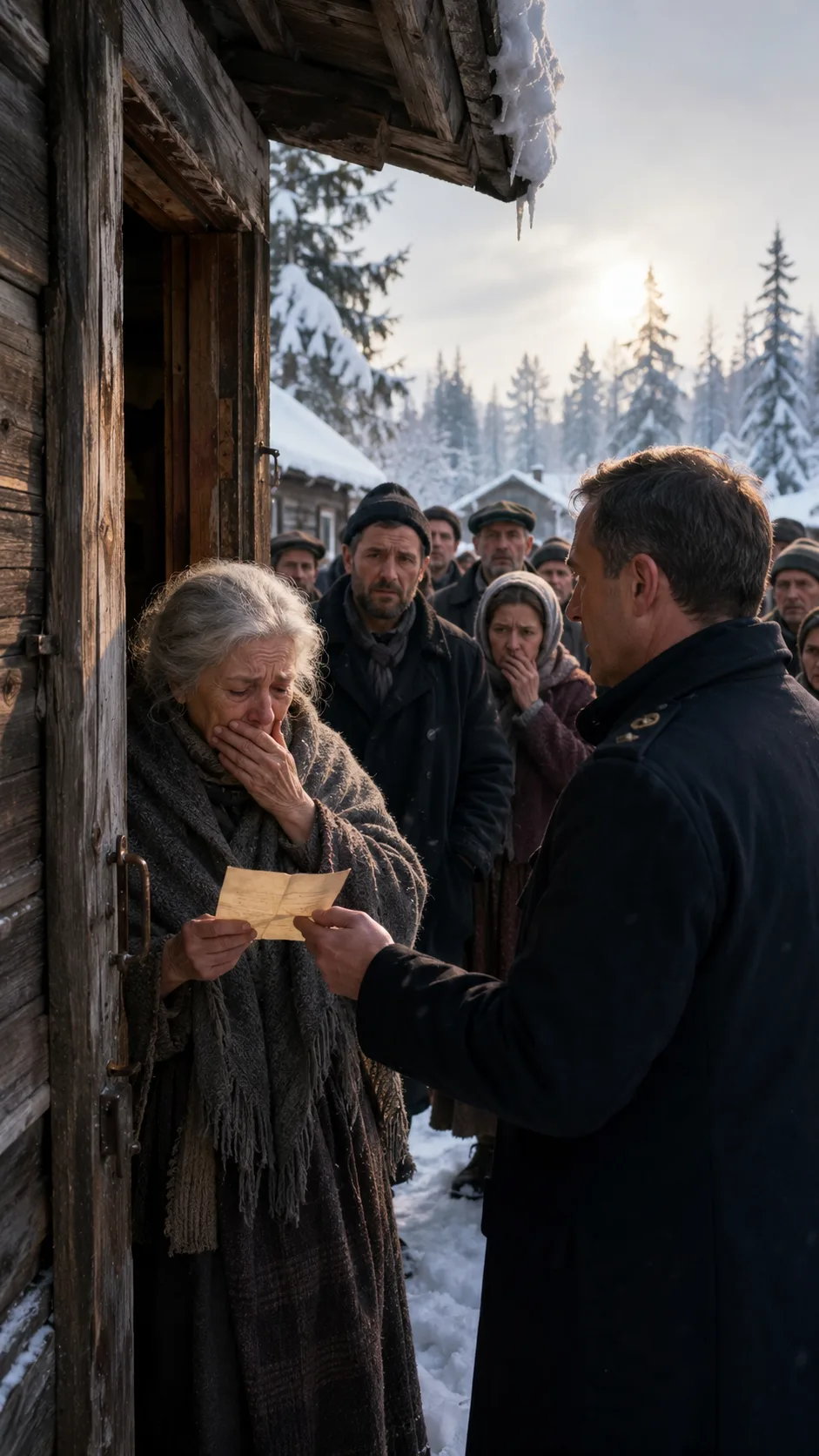
Agnes hurried to the door and opened it.
The village was gathering in front of her cottage.
Men and women stood in the snow, their faces pale with fear and curiosity.
“They came here!” someone shouted.
“The four men!”
“Agnes, did you see them?”
“Are they still inside?”
Agnes gripped the doorframe.
“Yes,” she said. “They stayed here.”
Shock moved through the crowd like a gust of wind.
“You let them in?” a woman gasped.
“They’re dangerous!” another cried.
Before Agnes could respond, engines rumbled from the road.
Several black vehicles rolled into the village, cutting through the snow. Men in dark coats stepped out. Not villagers. Not police from the local station.
Officials.
Serious men with badges, folders, and faces that carried the weight of things ordinary people were never meant to know.
One of them approached Agnes.
“Mrs. Petrova?”
Agnes nodded.
“Did four men come to your house last night?”
“Yes.”
The villagers began whispering.
The official looked at her carefully.
Then he said something that silenced everyone.
“They were not running from us.”
Agnes blinked.
“They were running from something far worse.”
The village went still.
The official explained slowly.
There had been an attack far beyond the valley. A transport had been ambushed. Men had been hunted through the mountains because they carried evidence powerful people wanted buried forever.
The four men were not innocent in the way children are innocent.
They had lived hard lives.
They had made choices Agnes did not need to know.
But last night, they had been trying to survive long enough to reveal a truth that could destroy people who had hidden behind wealth and power for years.
“They asked us to find you,” the official said.
Agnes’s heart tightened.
“Me?”
“One of them said you helped him before.”
A strange coldness moved through her chest.
Before?
The official reached into his folder and handed her another note.
Agnes unfolded it slowly.
The handwriting was strong, controlled, but the words shook something deep inside her.
You did not ask who I was.
You did not ask what I had done.
You saw someone who needed help, and you opened the door.
Agnes stopped breathing.
Last night, I stood there again.
Not as a boy.
Not as someone innocent.
But you still opened it.
Her eyes filled with tears.
I spent my life trying to become someone worthy of that moment.
I do not know if I succeeded.
The page blurred in her hands.
But I know this—
You saved me twice.
The paper trembled.
And suddenly, Agnes remembered.
A winter long ago.
A boy standing outside her door.
Thin.
Starving.
Blue from cold.
The village had turned him away because he looked like trouble. Because no one knew his family. Because people were always afraid of what they did not understand.
But Agnes had opened her door.
She had given him soup.
A blanket.
A place near the fire.
One night.
Only one.
In the morning, he was gone.
For years, she had thought of him only as a sad memory.
A boy she hoped had lived.
Now she understood.
He had.
And he had never forgotten.
Agnes pressed the note to her chest.
Around her, the villagers stood in stunned silence.
No one spoke.
Because every person there had ignored her for years.
They had passed her cottage without stopping.
They had watched smoke disappear from her chimney and never asked if she had enough wood.
They had seen her walking alone to the market and never offered help.
Yet the person they had judged—the stranger, the hunted man, the boy they would have left in the snow—had spent decades remembering the only woman who showed him mercy.
But the official was not finished.
“There is something else,” he said.
Agnes looked up.
The villagers leaned closer.
“The men did not come to this village by accident.”
Agnes’s fingers tightened around the note.
“What do you mean?”
“They chose this house.”
A ripple of confusion passed through the crowd.
The official opened his folder.
Inside were documents.
Records.
Old photographs.
One photograph showed Agnes many years younger, standing outside this same cottage beside a boy in oversized winter clothes.
Agnes covered her mouth.
“That boy,” the official said, “built something after he left here.”
“What kind of thing?” someone whispered.
“A network,” the official replied. “Not of crime. Not in the way people imagine. A network of survival. People who had been abandoned, hidden, forgotten. People who owed their lives to one moment of kindness.”
Agnes shook her head slowly.
“I don’t understand.”
“He made sure you were never completely alone.”
The words struck her harder than the storm.
The official continued gently.
“The firewood that appeared by your wall during the worst winters.”
Agnes went still.
“The medicine left on your doorstep when you were sick.”
Her eyes widened.
“The repairs made to your roof while you were away at the market.”
A sob caught in her throat.
“The money quietly paid to keep this land from being taken after your husband died.”
The villagers stared at her cottage.
At the repaired roof.
At the stacked wood.
At the old woman they had believed was simply stubborn enough to survive alone.
Agnes looked around slowly.
All these years, she had believed the world had forgotten her.
She had believed every winter she survived was a miracle.
But it had not been a miracle.
It had been memory.
A boy’s memory.
A debt of kindness carried through decades.
The official’s voice softened.
“It was never charity, Mrs. Petrova. It was gratitude.”
Agnes stepped back against the doorway.
Her knees weakened.
For years, she had sat beside that stove believing silence meant abandonment.
But now she understood.
Silence had not meant she was unloved.
It meant someone had been protecting her quietly, without ever asking to be seen.
The village stood frozen in shame.
The woman who had lived alone at the edge of the forest had not been weak.
She had not been forgotten.
She had been the center of a promise.
A promise made by a starving boy who once knocked on her door and found mercy instead of fear.
Agnes looked down at the note again.
Then she looked at the road where the four men had disappeared into the white morning.
No one knew if she would ever see them again.
No one knew what truth they carried, or what powerful people would fall because of it.
But Agnes knew one thing.
The world was not changed only by grand sacrifices, loud heroes, or people with power.
Sometimes, the world changed because an old woman opened a door.
Once to a hungry boy.
And years later, to the man he had become.
That morning, the village finally understood what Agnes had known all her life.
Kindness was never small.
It only looked small at first.
And sometimes, long after everyone else had forgotten it, kindness returned through the storm, knocked three times, and changed everything.
THE END.
Chapter complete
You have reached the end of this chapter.
Continue reading
A few more worlds to get lost in after this chapter.




