Daniel was rinsing blood from a cracked porcelain bowl when the doorbell rang.
Chapter 1
Daniel was rinsing blood from a cracked porcelain bowl when the doorbell rang.
Not his blood.
Max had cut his paw that morning on the broken slate near the back steps, and the old dog had stood there without complaint, one gray foot lifted, watching Daniel wrap gauze around it like he had done a hundred times before. The bowl sat in the sink now, pink water circling the drain, while Daniel dried his hands on a dish towel that smelled faintly of lemon soap and old smoke from the fireplace.
The bell rang again.
Max lifted his head.
One sound.
Not a bark. Not yet.
Daniel looked toward the front hall. His mother had been upstairs since lunch, arranging lilies beside his father’s portrait, even though his father had been dead three years and the lilies always made her sneeze. It was the anniversary. People did strange things on anniversaries. They lit candles. They set extra plates. They answered doors they should
have left closed.
Daniel walked through the hall, past the grandfather clock that had stopped at 2:16 years ago and refused every repairman after that. His father used to wind it every Sunday. Nobody touched it now.
The bell rang a third time.
Max followed Daniel halfway, then stopped near the rug.
That was the first wrong thing.
Max always reached the door first.
Daniel opened it.
A man stood on the porch with rain on his shoulders and a leather duffel bag in one hand. He had dark hair cut neatly, a trimmed beard, and a navy coat too expensive for a man who looked like he had traveled by bus. He stared at Daniel for one beat too long, then smiled like someone remembering how to use a face.
“Danny?”
Nobody called him that anymore.
Daniel’s fingers tightened on the doorknob.
The man dropped the bag.
Behind Daniel,
his mother came down the stairs with one hand on the banister. She was wearing the pearl earrings she only wore on death days and weddings. Her eyes moved from Daniel to the man on the porch.
The pearls shook.
“Matthew,” she said.
The man stepped forward, and she crossed the hall like the years between them had been nothing but a hallway she could run through. She grabbed his face. Touched his cheekbones. Pressed her forehead against his chest.
The man held her carefully.
Too carefully.
Daniel watched his hands. Clean nails. No tremor. No old burn scar near the thumb where Matthew had grabbed a hot pan at sixteen. Maybe scars faded. Maybe memories did, too.
The house filled within an hour.
Aunt Grace came first, then Uncle Peter, then neighbors who had once organized search parties and now arrived carrying casseroles like guilt in ceramic dishes. Someone
opened wine. Someone called the local paper. Someone said God had a strange calendar.
Matthew sat in the living room under the portrait of their father and told the story in pieces.
An accident.
A hospital.
No papers.
Memory loss.
Years in another city under the care of a couple who had found him wandering near a truck stop.
Every sentence was ugly enough to sound true.
Daniel said little. He brought coffee. He changed Max’s bandage. He watched.
Matthew laughed at the right memories. He lowered his head when their father’s name came up. He touched his mother’s hand whenever her breathing grew thin.
Then Max entered the living room.
The old dog came slowly, stiff in the hips, one bandaged paw tapping against the floorboards. The room softened at the sight of him.
“Max,” Aunt Grace said. “Look who came home.”
Matthew turned.
Daniel stopped beside the coffee table with an empty cup in his hand.
Max looked at Matthew.
No wagging tail.
No raised ears.
The dog’s lips pulled back from his teeth, and a low growl rolled through the room.
The coffee cup clicked against the saucer.
Matthew’s smile stayed in place, but his left hand moved behind his knee.
Max stepped in front of Daniel.
The room went quiet.
Then Daniel’s mother laughed once, sharp and small.
“He’s old,” she said. “Poor thing barely knows the mailman anymore.”
Matthew crouched and reached out his hand.
Max snapped.
Not enough to bite.
Enough.
Daniel set the cup down. The spoon inside it rattled for longer than it should have.
Matthew stood.
The smile changed at the edges.
By morning, the house had decided Daniel was the problem.
His mother said it over eggs she did not eat.
“You’re watching him like a stranger.”
Daniel cut Max’s pill in half with the edge of a butter knife. The pill crumbled. A small white piece rolled under the sugar bowl.
“He is a stranger,” Daniel said.
His mother’s fork stopped.
Across the table, Matthew lowered the newspaper enough to show his eyes.
“I don’t blame him,” Matthew said. “Fifteen years is a long time.”
The words were kind.
His fingers were not.
He folded the newspaper with the neatness of someone ending a meeting. The headline on the front page mentioned his return. Their family name sat in bold ink beneath a photo taken on the porch the night before. In the photo, Matthew had his arm around their mother. Daniel stood behind them, half cut from the frame.
Matthew slid the paper toward Daniel.
“You probably had to become the man of the house.”
Daniel looked at the headline. Then at the hand pushing it.
“That was Dad.”
Matthew’s smile thinned.
Aunt Grace arrived with cinnamon rolls and a list of people who wanted to visit. She kissed Matthew’s cheek twice. She patted Daniel’s shoulder once.
By ten, the front rooms were full again. Family friends came through the door, touched Matthew’s arm, asked him if he remembered them, then forgave him before he answered wrong. Memory loss made every mistake holy. It gave him shelter.
Daniel stood near the window with Max leaning against his shin.
Matthew moved through the crowd like a man testing keys in old locks.
He knew the lake trip.
He knew the blue truck.
He knew the name of the nurse who had brought soup after Daniel broke his collarbone.
But he called the orchard “the grove.”
Matthew never called it that.
Small thing.
It stayed.
At noon, Uncle Peter clapped Matthew on the back and said, “Do you remember that scar on the oak tree? Your father nearly skinned you both alive over it.”
Matthew laughed.
“Of course.”
Daniel looked at him.
“Which scar?”
Matthew lifted his glass. “The big one.”
There were three.
The smallest one mattered.
Daniel had made it with a pocketknife the day their father died. Matthew had carved over it, covering Daniel’s shaky D with an M, then told him, “Now they’ll blame me.”
Nobody else knew.
Daniel waited for Matthew to add it.
He didn’t.
Max sneezed under the table.
Aunt Grace wiped icing from her finger with a napkin and said, “Poor boy. Trauma takes strange things.”
“Convenient things,” Daniel said.
His mother turned.
“Enough.”
Two syllables.
A door closing.
Matthew set down his glass. “No, let him ask.”
Daniel looked at him. “What did you call Max when he stole socks?”
Matthew glanced at the dog.
The pause lasted half a second too long.
“Thief,” he said.
A few people laughed.
Daniel did not.
Matthew had called him Bishop. Because Max would sit on stolen socks like a churchman guarding secrets.
Daniel looked down.
Max’s eyes stayed on Matthew’s wrist, where the white cuff disappeared beneath the jacket sleeve.
That evening, Daniel went to the garage.
The air inside smelled of dust, motor oil, and cardboard left too many winters in damp corners. He opened the metal cabinet where his father had kept old tools and useless screws sorted into baby-food jars. The labels were still in his father’s handwriting.
HINGES.
NAILS.
KEYS, MAYBE.
Daniel found the music box on the second shelf, wrapped in a towel.
It was small, walnut, with a brass latch and a dial of four letters. His father had bought it after Matthew vanished, then locked inside it every newspaper clipping from the search. Daniel had tried to open it for years. Matthew had known the password.
Or the real Matthew had.
Footsteps crossed the garage threshold.
Daniel closed the cabinet halfway.
Matthew stood in the open doorway, coat off, sleeves rolled down, one hand in his pocket.
“Mom said you might be out here.”
Daniel held up the music box.
“Open it.”
Matthew looked at it without moving.
“That old thing.”
“Open it.”
A car passed outside the garage. Headlights slid along the wall, over rakes and fishing rods and the bicycle Matthew had outgrown before he disappeared.
Matthew took the box.
His thumb brushed the dial.
“Daniel, I was hit by a truck, not given a perfect inventory of childhood objects.”
Daniel said nothing.
Matthew tried four letters.
Wrong.
The latch held.
He tried another.
Wrong.
Daniel watched his jaw move.
“Dad changed it,” Matthew said.
“He didn’t.”
Matthew handed the box back.
“Maybe you did.”
There.
Not fear.
Calculation.
Daniel put the box on the workbench. The brass latch caught a stripe of light.
Matthew stepped closer.
“You want me to be fake because it means you didn’t spend fifteen years living in my shadow.”
Daniel looked at him.
“You were gone.”
“And still first.”
The garage seemed to shrink around that sentence.
Matthew’s face changed before he corrected it. He looked toward the shelves, then back at Daniel, as if measuring how much damage one word had done.
Daniel picked up the box.
Max barked once from the yard.
Matthew’s eyes flicked toward the sound.
A thin strip of something dark showed beneath his left cuff when his sleeve rode up.
Not much.
A curve of ink.
Daniel saw it.
Matthew saw Daniel see it.
The sleeve came down.
Fast.
“Careful with that dog,” Matthew said.
Daniel did not answer.
At dinner, his mother announced that the estate attorney would come the next evening.
Not to discuss.
To prepare.
Daniel stood by the sink after she said it, washing the same plate three times while his mother spoke from the doorway.
“He’s my son.”
“So am I.”
She looked smaller under the kitchen light. The pearls were gone. Without them, her ears looked bare and fragile.
“You grew up here,” she said. “You had your father. You had this house. He had nothing.”
Daniel set the plate in the rack.
“You don’t know what he had.”
His mother pressed her lips together, then opened the drawer beside the stove. She took out the linen napkins used for formal dinners.
The good ones.
Daniel looked at them.
“He shouldn’t sign anything yet.”
She smoothed a napkin over her arm.
“He won’t be alone. The attorney will be here. Your aunt and uncle. It will be proper.”
“Proper doesn’t make him Matthew.”
Her hand froze over the drawer handle.
“Do not make me choose between my sons.”
Daniel looked past her.
Max stood in the hallway, staring at the stairs.
At the top, Matthew watched them both.
He had heard enough.
The next day moved like a trap being polished.
The dining room was cleaned before noon. The long table shone. The silver candleholders came out of the cabinet. The estate papers arrived in a blue folder with the attorney’s seal on the corner. Daniel’s mother wore a cream blouse and touched her hair every time the doorbell rang.
Matthew came downstairs in a dark suit Daniel had never seen before.
It fit too well.
The attorney, Mr. Vale, was a narrow man with silver glasses and a briefcase he never let out of reach. He offered Daniel a nod, then opened the folder at the head of the table.
Matthew sat beside their mother.
Daniel sat across from him.
Max lay under Daniel’s chair, bandaged paw stretched forward, eyes open.
The first page slid across the table.
Estate control transfer.
Primary heir recognition.
Emergency family restoration clause.
Daniel read enough.
His mother held the pen.
Matthew touched her wrist.
“Only if you’re sure,” he said.
A performance.
Daniel placed both hands flat on the table.
The room waited for him to spoil the miracle.
He let them wait.
Then he pushed his chair back.
Not much.
Just enough for Max to stand.
The pen touched the paper.
Daniel spoke before ink could mark the line.
“Before he signs, answer one thing.”
His mother closed her eyes for the length of a breath. Aunt Grace’s hand tightened around her water glass. Uncle Peter leaned back, already irritated. Mr. Vale looked over the top of his silver glasses but did not interrupt.
Matthew kept his fingers on the pen.
Daniel looked only at him.
“On the day Dad died, what did you hide under the floor of your bedroom?”
The room changed by inches.
The attorney’s pen stopped moving above his notes. Daniel’s mother turned her head. Aunt Grace’s glass lowered to the table without a sound.
Matthew’s hand remained on the transfer document.
For the first time since his return, he did not smile.
“What?”
Daniel did not repeat it.
Max rose fully beneath the table, his old shoulders pressing against Daniel’s knee.
Matthew laughed once and leaned back.
“That’s what this is? A children’s game?”
Daniel pointed at the paper.
“You want the estate. Answer.”
His mother whispered, “Daniel.”
He heard her.
He did not look at her.
Matthew stood, and the chair legs scraped across the rug. The sound cut through the room hard enough that Aunt Grace flinched.
“You’re jealous,” Matthew said.
Daniel sat still.
“You couldn’t stand that I came home.”
The word home came out polished and wrong.
Matthew looked around the table, gathering witnesses the way some men gather weapons.
“All of you see it, don’t you? He had years here. Years with Mom. Years with Dad’s business. And now he wants me gone again because he can’t bear to step aside.”
Uncle Peter shifted in his chair.
Mr. Vale closed the folder halfway.
Daniel’s mother placed one hand over her mouth. Her other hand stayed near the pen.
Matthew pressed both palms on the table.
“Say it,” he said. “Say you don’t believe your own brother survived.”
Max growled.
The sound came low from under the table.
Matthew’s eyes dropped.
Daniel felt the dog’s body tense against his leg.
“Max,” Daniel said.
Not a command.
A warning to the room.
Matthew straightened. “That dog is half blind and half dead.”
Max moved before anyone else did.
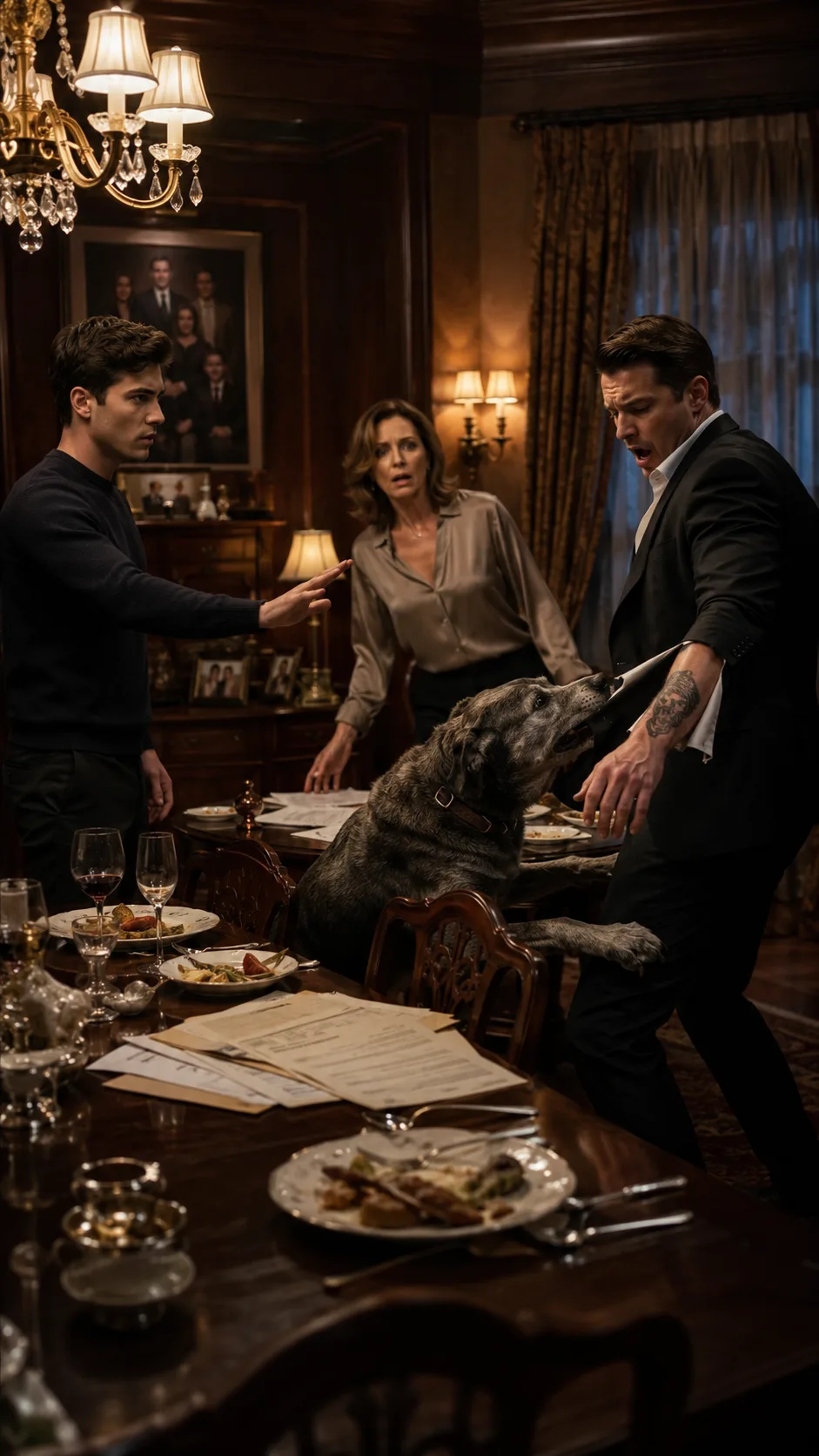
The old dog shot from beneath the chair with a force Daniel had not seen in years. His bandaged paw slipped on the rug, caught, then drove forward. The table shook as Daniel grabbed the edge. Aunt Grace cried out and pulled her hands back from her plate.
Max hit Matthew’s side.
Matthew twisted away, but Max’s teeth caught the sleeve of his dark suit.
Fabric tore.
A long, ugly rip opened from cuff to forearm.
Matthew shoved at the dog’s shoulder. Max held on for one more second, enough to pull the white shirt beneath out of place.
Then the sleeve split fully.
The tattoo showed.
Black ink curved around Matthew’s wrist, half hidden under the torn cuff. A hooked symbol. Three lines through a circle. Daniel had seen it on a printed page two years earlier, in a folder passed to his father by a private investigator who never came back for the second meeting.
The mark of the men who sold names.
Not fake passports.
Lives.
The attorney stood.
Daniel’s mother took one step backward from the table, away from the pen, away from Matthew.
Matthew clamped his right hand over the tattoo.
Too late.
Mr. Vale saw it.
Uncle Peter saw it.
Daniel saw his mother see it, and that was the part that made the room go still.
Matthew’s mouth opened.
No sound came out.
Max backed toward Daniel, teeth bared, torn cloth hanging from his jaw.
Daniel stood.
He did not reach for Matthew.
He did not shout.
He turned from the table and walked toward the hallway.
“Daniel,” his mother said.
He stopped at the edge of the dining room carpet.
The old runner stretched down the hall toward the staircase. It had been there since Daniel was small, faded red and blue, with one corner near the baseboard that never lay flat. Their father had cursed that corner every week. Matthew had hidden marbles under it. Daniel had hidden report cards.
And under the boards beyond it, Matthew had hidden one thing Daniel had never touched.
Daniel crouched and pulled the runner back.
Dust lifted.
The attorney followed halfway into the hall. Aunt Grace stayed in her chair, one hand on her throat. Matthew did not move from the table.
Daniel pressed his thumb against the loose board near the wall.
It rose.
A narrow dark gap opened beneath.
Inside lay a metal box.
Small.
Dented.
Wrapped in wax paper turned yellow at the folds.
Daniel lifted it out and carried it back to the dining room.
Matthew watched the box in Daniel’s hands.
The color had left his face unevenly, first around his mouth, then beneath his eyes.
Daniel placed the box in the center of the table, on top of the unsigned estate papers.
The sound was soft.
It landed like a verdict.
Mr. Vale opened his briefcase and removed his phone.
Matthew noticed.
His hand jerked toward his jacket pocket, then stopped when Max growled again.
Daniel opened the box.
Inside sat a photograph, a brass key, and one envelope with his father’s handwriting across the front.
FOR DANIEL, IF THE WRONG SON RETURNS.
His mother reached for the chair behind her and missed it the first time.
Daniel opened the envelope.
The paper inside had been folded twice. The handwriting slanted harder than his father’s usual script, as if written quickly, maybe at night, maybe by a man who already knew he was running out of safe days.
Daniel read aloud.
“If Matthew ever returns and Max does not recognize him, check the truth.”
Nobody interrupted.
The chandelier hummed above them.
Daniel continued.
“The boy who left this house knew things no record can hold. The scar under the oak. The music box word. The name only he used for Max. If a man comes here wearing Matthew’s face but not carrying Matthew’s memory, do not give him the house. Do not give him the accounts. Do not let your mother sign anything before you open this box.”
His mother sat down hard.
The chair legs struck the floor.
Daniel looked at the second page.
There were names. Dates. A private investigator’s number. A report about criminal groups targeting families with missing heirs and valuable estates. One line had been underlined three times.
They study grief before they study signatures.
Daniel set the letter down.
Matthew stared at it.
Then he looked at Max.
The old dog stood beside Daniel now, one torn strip of dark fabric at his feet, chest moving hard, eyes fixed on the man at the head of the table.
Matthew’s lips barely moved.
“I should have killed it first.”
The sentence did not travel loudly.
It did not need to.
Aunt Grace’s hand flew away from her glass as if the glass had burned her. Uncle Peter rose halfway, then stopped. Mr. Vale pressed a button on his phone and held it at his side. Daniel’s mother stared at Matthew with both hands flat on the table, fingers spread across the linen like she needed the wood to keep her upright.
Matthew heard his own words after the room did.
His eyes shifted.
First to the attorney.
Then to Daniel.
Then to the open doorway.
Daniel stepped into that doorway before Matthew moved.
Not fast.
Not dramatic.
Just enough.
Max came with him.
Matthew’s shoulders lowered by a fraction.
The room no longer belonged to him.
Mr. Vale spoke into his phone.
“Yes. Police. Possible fraud and threat. Address is Whitmore House.”
Matthew took one step back.
The torn sleeve hung from his arm.
The tattoo stayed visible.
Daniel’s mother pushed the estate folder away from her until it slid off the edge of the table and fell open on the floor.
The pen rolled after it.
Max placed one paw on the fallen papers.
No one picked them up.
The dining room kept its shape, but nothing in it looked arranged anymore.
One chair lay sideways near the wall. Wine had spilled across the white runner and reached the edge in a dark, branching line. The roast had gone cold. A piece of torn sleeve sat beside Daniel’s plate.
Matthew stood near the fireplace with Uncle Peter between him and the hall. Mr. Vale remained by the window, phone in hand, speaking in short answers. Aunt Grace had moved to Daniel’s mother’s side but did not touch her.
Daniel’s mother looked at the fallen folder.
Not at Matthew.
Not at Daniel.
At the folder.
Max lowered himself beside Daniel’s chair, breathing through his mouth, his bandaged paw leaving a faint print on the rug. Daniel knelt and checked the gauze. It had loosened. The cut had opened again.
He took the clean napkin from his place setting and wrapped it around the paw.
His father would have scolded him for using good linen on a dog.
Daniel tied the knot anyway.
Outside, tires rolled over gravel.
The police did not use sirens.
Two officers came through the front door with wet coats and careful eyes. Mr. Vale met them in the hall. Words passed low. Fraud. Threat. Impersonation. Evidence.
Matthew said nothing at first.
Then he said, “You don’t understand.”
Nobody asked him to explain.
One officer took his arm. Matthew tried to pull his sleeve down over the tattoo, but the fabric had torn too high. The mark stayed bare beneath the chandelier.
Daniel’s mother finally looked up.
Matthew turned toward her.
“Mom.”
She flinched before the word ended.
The officer led him away.
At the threshold, Matthew looked back once, not at the woman he had nearly robbed, not at the family he had studied, not at the papers still spread across the floor.
At Max.
The dog lifted his head.
Only that.
The front door opened. Rain air moved through the hall and touched the candles until their flames leaned sideways.
Then the door closed.
Daniel gathered the letter, the photograph, and the brass key from the table. He placed them back into the metal box, except for the first page.
That one he gave to his mother.
She held it with both hands.
The ink did not shake.
Max rested his chin on Daniel’s shoe.
The old clock in the hall stayed stopped at 2:16.
By the following week, the newspapers stopped calling the man Matthew.
They used his legal name once the police released it. Daniel read it at the kitchen table while Max slept under the window in a square of pale morning light.
Evan Cross.
Thirty-four.
Prior charges in two states.
Linked to at least three estate fraud investigations.
No confirmed connection to Daniel’s missing brother.
No confirmed death, either.
That last line stayed on the page longer than the others.
Daniel folded the paper and placed it beside the coffee mug. His mother came in wearing a blue cardigan she had owned since before his father died. No pearls. No makeup. She opened the cabinet, took down two bowls, and stood there as if she had forgotten what bowls were for.
Daniel reached past her and took the dog food from the pantry.
Max lifted his head.
One ear first.
Then the other.
“Don’t milk it,” Daniel said.
Max thumped his tail once.
His mother watched the dog.
“I told everyone he was old.”
Daniel poured food into the bowl.
“He is.”
Max stood slowly, joints stiff, then limped toward breakfast with the dignity of a retired judge.
Daniel’s mother set one bowl back in the cabinet.
“I signed nothing.”
“No.”
“But I would have.”
Daniel did not answer.
She turned toward the sink and ran water over her hands though there was nothing on them. The faucet sputtered first, then steadied.
“Your father knew,” she said.
Daniel picked up the empty pill bottle from the counter and shook it. One left.
“He suspected.”
She dried her hands on a towel.
“I hated him for hiding things.”
Daniel looked toward the hallway, where the metal box now sat on the small table beneath the stopped clock. The brass key lay beside it. Mr. Vale had taken copies of everything. The police had taken the torn sleeve. The estate folder had gone into a locked drawer until the court finished its work.
The house felt larger without visitors.
Not safer.
Larger.
Aunt Grace called every day. Uncle Peter had replaced the torn carpet strip in the hall without asking. Neighbors left food on the porch and did not ring the bell. The local paper asked for an interview. Daniel deleted the message.
Evan Cross remained in custody while investigators connected him to other families with money, missing children, and old grief. Mr. Vale said the case would take months.
The estate stayed with Daniel’s mother.
For now.
She changed the locks anyway.
Three days after the arrest, Daniel went to the orchard with Max.
The old oak stood near the back fence, bigger than it looked from the house, its trunk split by age and weather. Daniel found the scars beneath a spread of moss.
The large one everyone remembered.
The second one Matthew had made during a fight over a pocketknife.
The smallest one, almost swallowed by bark.
D covered by M.
Daniel brushed dirt from it with his thumb.
Max sniffed the roots, then sat heavily beside him.
The wind moved through the branches.
Daniel took the brass key from his pocket. He had carried it for days without knowing why. It did not open the metal box. It did not fit the music box. It belonged to something else his father had left unexplained.
Maybe another drawer.
Maybe another room.
Maybe another truth.
Daniel closed his hand around it and looked toward the house.
His mother stood at the kitchen window, small behind the glass. She raised one hand.
Daniel raised his back.
Max leaned against his leg.
For the first time in fifteen years, Daniel did not try to imagine Matthew walking home.
He looked at the scar instead.
Then he turned the key in his palm and started back.
Max followed.
No growl.
No warning.
Just footsteps in wet grass.
The house waited.
Chapter complete
You have reached the end of this chapter.
Continue reading
A few more worlds to get lost in after this chapter.




