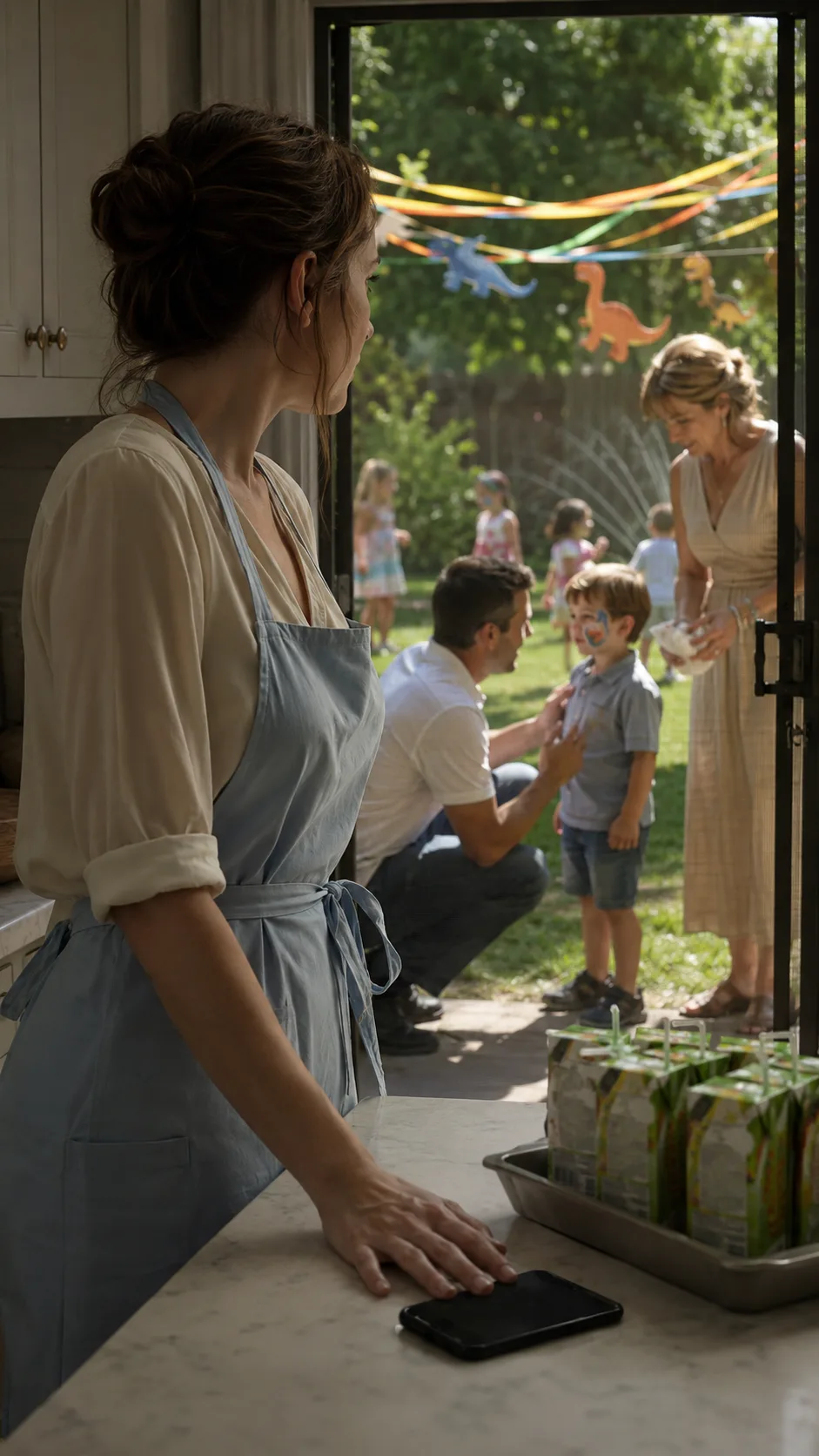
Hannah stuck the tiny dinosaur candles into the cake with the careful focus of someone defusing a bomb.
Chapter 1
Hannah stuck the tiny dinosaur candles into the cake with the careful focus of someone defusing a bomb.
Four candles. One green. One orange. Two blue.
Noah had chosen them himself from the party store, standing on tiptoe in the aisle with one sticky hand wrapped around Caleb’s finger and the other pointing at anything with teeth. He wanted dinosaurs on the plates, dinosaurs on the balloons, dinosaurs on the napkins, and one inflatable tyrannosaurus that stood by the patio door with its head tilted like it had overheard family gossip.
“Not too close together,” Caleb said from behind her.
Hannah did not turn around.
“They’re candles,” she said. “They’ll survive.”
Caleb leaned against the kitchen island with his coffee mug in hand, smiling into the rim like she had made a joke for him. He was already dressed for the party in a white linen shirt and beige pants, the version of himself other parents liked immediately. Easy smile. Sleeves rolled once. Hair neat without trying too
hard.
People trusted Caleb after five minutes.
Hannah had trusted him after three dates.
That was not the part that bothered her.
The part that bothered her was how much of her life had been arranged around other people’s certainty. Caleb’s certainty that Noah would love preschool. Diane’s certainty that Hannah needed help. Her mother-in-law’s certainty that a child’s birthday party should have “at least one proper cake, not just cupcakes.” Even Noah had certainty, loud and pure, about dinosaurs and sprinkler time and whether socks were enemies.
Hannah had learned to move between all of them.
Quietly.
Efficiently.
She wiped a bit of blue frosting from the cake board with the corner of a paper towel.
Caleb’s phone buzzed on the island.
He looked at it, then turned the screen down.
Too fast.
Hannah saw the movement only because she was watching the reflection in the microwave door.
A
small thing.
It joined the others.
For months, the small things had been gathering like dust in corners no one wanted to clean.
A message that disappeared when she entered the room. A receipt from a hotel bar on a night Caleb said he had worked late. Diane calling Caleb directly instead of calling Hannah. Diane knowing Noah’s preschool schedule before Hannah told her. Caleb and Diane exchanging a look across Thanksgiving dinner when Hannah mentioned family medical history.
That one stayed.
Not because it was dramatic. It was not. Caleb had simply gone still with his fork halfway to his mouth. Diane had reached for her wineglass and missed it by half an inch.
Then Diane had laughed.
“My goodness, you’re becoming your grandmother,” she said. “Always digging through everyone’s business.”
Everyone had smiled.
Hannah had smiled too.
She was good at that.
Noah ran into the kitchen wearing
a paper dinosaur crown tilted over one eye. His hair stuck up in the back. He had marker on his wrist and one sock missing.
“Mommy, can I do the sprinkles?”
“No,” Hannah said.
“Please?”
“No.”
“I’m four.”
“Not until two o’clock.”
He held up four fingers anyway.
Caleb laughed and scooped him up.
“Birthday boy gets special privileges.”
“No,” Hannah said again.
Caleb kissed Noah’s cheek. “Your mom is a very strict woman.”
Noah giggled.
Diane appeared in the doorway with a stack of folded towels in her arms.
“I found these in the laundry room,” she said. “You’ll need them when the children start running through the sprinkler.”
Hannah looked at the towels.
She had already placed towels in a basket by the back door.
Diane followed her eyes.
“Oh, I know,” Diane said. “But those are the good ones. These can get dirty.”
She set them down on the bench without asking.
There it was again.
The soft invasion.
Diane never barged. She arranged. She replaced. She corrected without leaving fingerprints.
Caleb carried Noah outside. Diane moved toward the cake.
“I can help with that.”
“I’ve got it.”
“It’s just candles.”
“I said I’ve got it.”
Diane’s hand stopped above the cake.
For two seconds, mother and daughter stood across the kitchen island, separated by blue frosting, a plastic dinosaur, and years of swallowed replies.
Then Diane smiled.
“Of course.”
She stepped back.
Hannah finished the candles and placed the cake in the refrigerator.
Her phone sat on the counter beside the juice boxes.
No notification yet.
Six weeks earlier, she had ordered the DNA test from a lab two states away because she did not want the charge showing up near their town. She told Caleb it was a genetic health screening before they tried for a second child.
He had said, “Smart.”
Nothing else.
That was the word that made her complete the order.
Smart.
Not why. Not what kind. Not do we need to talk about this.
Just smart.
Diane had been easier. Too easy. Hannah had mentioned building a family health profile and needing a sample from her side. Diane had taken the swab in the bathroom during Sunday dinner and handed it back in a sealed tube.
“Anything for Noah,” she said.
Hannah had waited for one question.
None came.
So the kit went out. Six weeks passed. Life kept wearing its ordinary clothes.
Laundry.
Preschool drop-off.
Grocery lists.
Caleb’s late meetings.
Diane’s visits.
Noah’s small warm hand in hers every morning.
Now the party had arrived before the truth did, and Hannah had spent the day walking around with a phone in her apron pocket like it could burn through fabric.
By noon, the backyard was full.
Children shrieked through the sprinkler. Parents stood in polite clusters near the patio table. Caleb manned the cooler and handed beers to fathers he barely knew. Diane floated from group to group, offering napkins, correcting the placement of gifts, wiping Noah’s face every time he got close enough.
Hannah carried out the fruit tray.
A woman from preschool named Marissa lifted her sunglasses.
“This looks amazing,” she said. “You did all this?”
Before Hannah could answer, Diane touched her shoulder.
“She’s always been a perfectionist.”
The word landed lightly.
Hannah set the fruit tray down.
Marissa smiled. “Well, lucky Noah.”
“Yes,” Diane said. “Lucky little boy.”
She looked toward Noah when she said it.
Caleb was helping him refill a water blaster. They had the same mouth when they concentrated. The same crease between their brows. People had told Hannah that for years.
He looks just like his daddy.
Hannah had believed it.
Then Caleb’s mother, Ruth, had said something strange at Easter.
They were sitting on the porch after lunch, watching Noah collect plastic eggs from the grass. Diane had come early and stayed late, as usual. Caleb had gone inside for more coffee.
Ruth had watched Diane adjust Noah’s collar and said, almost to herself, “She holds him like she’s afraid someone will count his bones.”
Hannah had turned.
“What does that mean?”
Ruth blinked. “Nothing.”
But her hand tightened around her teacup.
That night, Hannah searched old family photos.
Caleb as a baby. Caleb at four. Caleb at twelve. Diane in her twenties. Diane holding Hannah. Diane at a beach in 1991 beside a man Hannah did not recognize, one arm around his waist, her face turned away from the camera.
On the back of the photo, in Diane’s handwriting, were two initials.
C.R.
Hannah had asked her mother about it the next day.
Diane said, “College nonsense.”
Then she took the photo.
She never gave it back.
A child screamed near the sprinkler.
Hannah turned too fast.
Noah had slipped on the wet grass. Caleb reached him first, lifting him under the arms.
“I’m okay!” Noah shouted, more offended than hurt.
The parents laughed.
Diane pressed a hand to her chest.
Hannah watched Caleb kiss Noah’s wet hair.
He loved their son.
That was the hardest part to hold.
Caleb loved Noah. He packed lunches with terrible drawings on napkins. He knew which dinosaur had three horns and which one had a long neck. He slept on the floor beside Noah’s bed during the week of nightmares after a thunderstorm.
Love was not proof of innocence.
That sentence had come to Hannah at three in the morning and refused to leave.
The lab notification came at 1:07 p.m.
Hannah was in the kitchen, refilling juice boxes, when her phone buzzed.
Once.
She knew.
Noah’s party kept going outside. A dinosaur balloon scraped against the screen door in the breeze. Someone’s toddler banged a plastic cup against the patio table. Caleb called, “Who wants cake in ten minutes?”
Hannah pulled the phone from her apron pocket.
The notification sat on the screen.
Results ready.
No thunder. No broken glass. No music stopping.
Just two words.
She looked through the screen door.
Diane stood beside Noah, wiping his cheek with her thumb. Caleb crouched in front of him, laughing. Noah’s face was covered in blue frosting from a cupcake Diane had told him he could have “just a little early.”
Hannah opened the lab portal.
Her password failed once because her thumb hit the wrong number.
She entered it again.
The first file loaded.
Noah Calloway-Mercer compared to Caleb Mercer.
She stopped breathing through her nose and read the result.
99.97% probability.
Biological father and child.
Hannah read it twice.
Then a third time.
Caleb was Noah’s father.
For one strange second, the kitchen seemed too bright. The white cabinets. The clean sink. The row of juice boxes with tiny straws pointed upward. The cake knife resting on a paper towel with blue frosting along its edge.
She placed the phone on the counter.
Her hand stayed on top of it.
So that was not it.
The months of suspicion did not vanish. They shifted.
A puzzle piece had been placed correctly, and the picture underneath had become worse.
“Hannah?”
Diane’s voice came from the doorway.
Hannah turned the phone face-down.
Her mother stood half inside, half outside, holding an empty paper plate.
“Do you need help?”
“No.”
Diane looked at the counter. Her eyes passed over the phone, the juice boxes, Hannah’s hand.
Only once.
“I thought I’d rinse this.”
“It’s paper.”
Diane looked down at the plate. “Right.”
She did not leave.
Hannah picked up the cake knife.
Outside, Caleb began gathering children around the picnic table. “Cake time, monsters.”
The children roared.
Noah roared loudest.
Diane set the paper plate in the trash and moved toward the sink anyway. She turned on the faucet. Water ran over nothing.
“You should come out,” Diane said.
“I will.”
“People are waiting.”
Hannah looked at her mother.
Diane’s pearl bracelet slid down her wrist as she adjusted the faucet handle. That bracelet had been in Hannah’s childhood forever. Diane wore it to school recitals, doctor appointments, funerals, first communions, grocery stores. Hannah used to spin the pearls around her mother’s wrist when she was small.
A memory came without asking.
Hannah at seven, feverish on the couch. Diane on the phone in the kitchen, voice low.
No, you can’t come here.
Then a pause.
She looks too much like me already.
Hannah had not understood.
Children forget sentences until life teaches them where to put them.
The second file waited under the first.
Hannah lifted the phone.
Diane turned off the faucet.
Noah’s name appeared again.
Noah Calloway-Mercer compared to Diane Calloway.
Hannah’s thumb hovered.
Diane said, “Honey.”
Hannah opened the file.
The page loaded line by line.
Genetic relationship probability: 99.99%.
Biological grandparent and grandchild.
For half a second, it looked normal.
Of course Diane was Noah’s grandmother.
Of course.
Then Hannah saw the detailed relationship table.
Expected relationship through maternal line: inconsistent.
Shared DNA pattern: consistent with paternal-line grandparent.
Hannah did not move.
The words stayed where they were.
Paternal-line grandparent.
She read them again, this time slowly, the way a person reads a street sign after missing the turn.
Diane was not just Noah’s grandmother through Hannah.
The lab had found a pattern that pointed to Diane as a biological grandparent through Caleb’s side.
Hannah looked up.
Diane stood near the sink.
Her face had gone blank in a way Hannah had never seen before. Not guilty. Not afraid. Blank. Like a curtain had dropped behind her eyes.
Outside, everyone began singing.
Happy birthday to you.
Caleb held Noah in front of the cake. Noah’s wet hair stuck to his forehead. Blue frosting marked one cheek. Four candles burned unevenly in the breeze.
Diane took one step toward Hannah.
“Give me the phone.”
Hannah put it behind her back.
The singing continued.
Happy birthday dear Noah.
Diane’s hand gripped the edge of the counter.
“Hannah.”
It was not a request.
Hannah slipped the phone into her apron pocket.
Noah blew out the candles. Everyone clapped.
The sound hit the kitchen like rain on metal.
Hannah picked up the tray of juice boxes.
Diane blocked the doorway.
For a moment, they stood close enough for Hannah to smell her mother’s perfume. Powder. Gardenia. Something expensive and old.
“Not today,” Diane said.
Hannah looked past her to the backyard.
Noah was reaching for cake with both hands. Caleb was laughing. Ruth, Caleb’s mother, stood near the fence with her arms folded, watching the kitchen door instead of the party.
She knew.
Maybe not all of it.
Enough.
Hannah shifted the tray to one hip.
“Move.”
Diane did not.
“There are children outside.”
“Yes,” Hannah said. “Mine.”
Diane stepped aside.
Hannah walked into the sunlight with a smile on her face.
She handed out juice boxes. She cut cake. She wiped Noah’s chin. She thanked parents for coming. She tied wet towels around shivering children and found one missing sandal under the hydrangeas.
Her phone stayed heavy in her apron pocket.
Every time Diane came near her, Hannah moved away.
Every time Caleb looked at her, Hannah looked back until he glanced somewhere else.
The party ended in pieces.
First the toddlers with early naps. Then the preschool parents with polite excuses. Then the cousins. Then the neighbor who stayed too long and took three extra cupcakes wrapped in napkins.
By four-thirty, the backyard looked like a small storm had passed through.
Crushed cups in the grass. One deflated balloon caught in the fence. Blue frosting on the patio table. Wet towels piled by the door.
Noah fell asleep on the living room rug with one hand inside a gift bag, his dinosaur crown bent under his cheek.
Hannah stood over him for a moment.
Then she covered him with the yellow blanket from the couch.
Caleb came in carrying trash bags.
“Great party,” he said.
Hannah looked at him.
He stopped smiling.
“What?”
Diane stood behind him in the hallway, purse over one shoulder.
Ruth remained seated in the armchair by the window. She had not left with the others. Her cane rested against her knee. She looked older than she had that morning.
Hannah took her phone from her apron pocket.
Caleb’s eyes dropped to it.
Diane said, “Hannah, don’t.”
That was all it took.
Caleb turned toward Diane.
Ruth closed her eyes.
Hannah opened the lab results and placed the phone on the coffee table.
“Read it.”
Caleb did not move.
Diane moved first.
Hannah picked up the phone before her mother could reach it.
“No.”
Diane’s lips pressed together.
Caleb looked between them. “What is this?”
“Read it.”
He took the phone.
His face changed at the first result.
He looked up. “This says Noah is mine.”
“Yes.”
“So what are we doing?”
“Scroll.”
His thumb moved.
Ruth made a small sound from the chair.
Caleb read the second report.
The room became very quiet.
Outside, the sprinkler still clicked every few seconds because no one had turned it off.
Caleb looked at Diane.
“What does this mean?”
Diane did not answer.
He looked at Hannah.
“Hannah.”
“I asked the lab to compare Noah to my mother. The result says she fits as his biological grandparent on the paternal side.”
Caleb stared at the screen.
The words did not find him at once. Hannah watched them arrive.
His hand lowered.
“No.”
Diane said, “The test is wrong.”
Ruth opened her eyes.
“No, Diane.”
Two words.
They cracked the room wider than any scream could have.
Caleb turned to his mother.
Ruth’s face had folded in on itself. She looked at her son, then at Diane, then at the sleeping child on the rug.
“I told you this would come back,” Ruth said.
Caleb shook his head once. “Mom?”
Diane’s purse slid from her shoulder to the floor.
Hannah noticed it because the sound was ordinary. Leather against wood. A metal zipper tapping once.
Ruth gripped the arms of the chair.
“You were three days old when your father brought you home,” she said.
Caleb did not blink.
Hannah looked at Diane.
Diane’s face had color now. Too much of it.
Ruth kept going.
“He said your birth mother couldn’t keep you. He said it was private. He said if I wanted to be your mother, I had to stop asking.”
Caleb’s mouth opened, but no sound came.
Diane whispered, “Ruth.”
Ruth looked at her.
“I raised him. You don’t get to use my silence anymore.”
Noah shifted on the rug. Everyone froze until he settled again.
Hannah crouched and adjusted the blanket over his shoulder. Her hands were careful. They had to be.
Caleb sat down on the edge of the sofa like his legs had stopped following orders.
“You’re saying Diane is my mother.”
No one answered quickly enough.
That was the answer.
He looked at Diane.
All the easy parts of him were gone now. The charming father. The host with a cooler full of drinks. The husband who could make neighbors laugh. What remained was a man with a phone in his hand and no place to put his childhood.
Diane lifted her chin.
“I was sixteen.”
Ruth made a noise through her teeth.
Diane looked at Hannah then, not Caleb. That was what Hannah would remember later.
Not the confession.
That look.
Like even now, the story still belonged to Diane.
“My parents sent me away for five months,” Diane said. “I had the baby. His father’s family arranged the adoption through people they knew. I came home. I finished school. I met your father two years later.”
Hannah said nothing.
Caleb stared at her. “You knew who I was.”
Diane’s mouth moved.
No answer came.
“You knew when Hannah brought me home.”
Diane looked down.
Caleb stood up.
“You let me marry your daughter.”
“I didn’t know how to stop it.”
Hannah laughed once.
Not loud.
Not because anything was funny.
Diane flinched.
Hannah stood. “You didn’t know how to stop it?”
Diane reached for her. “I thought if I kept quiet—”
“Don’t.”
Diane’s hand dropped.
Caleb walked to the window. His reflection looked back at them from the glass, pale and split by the frame.
Ruth wiped her mouth with two fingers.
“I wanted to tell you when you got engaged,” she said. “Frank wouldn’t let me.”
“Dad knew?” Caleb asked.
Ruth nodded.
Hannah looked toward the hallway where Diane’s purse lay open on the floor. A lipstick had rolled out beside it. Pale pink. The same shade Diane always wore.
So many ordinary objects survived terrible rooms.
Caleb turned from the window.
“Hannah.”
She looked at him.
“I didn’t know.”
She believed him.
That did not fix anything.
“I know,” she said.
He looked at Noah.
Their son slept with blue frosting still dried near his ear. One bare foot stuck out from under the blanket. His hand rested inside the gift bag, fingers curled around the tail of a plastic stegosaurus.
Caleb covered his mouth.
Diane took one step toward him.
He stepped back.
“No.”
The word stopped her better than a locked door.
Hannah picked up the lab results from the coffee table after Caleb printed them from his phone. The printer in the corner made harsh, mechanical sounds, pushing out page after page while the living room stayed still.
When it finished, Hannah gathered the papers and placed them in a folder.
Diane watched.
“What are you going to do with those?”
Hannah did not answer.
Ruth pushed herself up from the chair.
“I’ll go,” she said.
Caleb crossed the room at once. “Mom.”
Ruth touched his cheek.
“You were mine every day I fed you,” she said. “That part is not changing.”
His face bent.
She pulled him down and held him, one hand against the back of his head like he was small again.
Diane looked away.
Hannah saw that too.
Later, she would wonder if Diane had looked away because she felt guilt or because she could not stand watching another woman claim what she had surrendered.
Maybe both.
Maybe neither.
Diane left without saying goodbye to Noah.
She picked up her purse, placed the lipstick back inside, and paused at the front door.
“Hannah.”
Hannah stood by the staircase.
Diane’s eyes moved over her face, searching for the daughter who used to accept half-truths if they were wrapped gently enough.
That daughter was not in the room.
“You don’t understand what it was like,” Diane said.
Hannah nodded once.
“No. I don’t.”
Diane waited.
Hannah opened the door.
Her mother walked out.
The screen door clicked shut behind her.
For a long time, no one moved.
The house smelled like sugar, wet towels, and extinguished birthday candles.
Caleb slept in the guest room that night.
Not because Hannah asked him to. He carried a pillow down the hallway, stopped at their bedroom door, and looked inside like the room belonged to someone else.
“I don’t know where to stand,” he said.
Hannah was folding Noah’s party shirt over the laundry basket. Blue frosting had hardened near the collar.
“Neither do I.”
He nodded.
At midnight, Hannah went downstairs for water.
Caleb was sitting at the kitchen table with the printed results spread in front of him. He had written three names on a napkin.
Diane.
Ruth.
Frank.
Under them, he had drawn lines and crossed them out.
The dinosaur cake sat in the refrigerator with one large piece missing from the tail.
Hannah filled a glass from the tap.
Caleb looked up.
“Does this make Noah—”
“Don’t.”
He stopped.
Hannah set the glass down.
“He is Noah.”
Caleb nodded. His eyes moved to the ceiling, toward their son’s room.
“Right.”
The next week, Caleb called a lawyer. Then a therapist. Then the lab. Then his father, who denied everything for nine minutes before Ruth took the phone and told him to stop.
Diane called Hannah seventeen times.
Hannah did not answer.
On the eighteenth call, Diane left a voicemail.
“I made one mistake when I was a child.”
Hannah deleted it before the message ended.
Not because the past was simple.
Because Noah was four.
Because Caleb had spent two nights on the bathroom floor with a towel pressed to his mouth so his son would not hear him break.
Because Ruth had come over with a cardboard box of Caleb’s baby pictures and sat at the kitchen table labeling each one with dates, places, small memories, proof of a life she had built with her own two hands.
Because Diane’s mistake had not stayed in the past. It had attended birthday parties. It had corrected Hannah’s parenting. It had handed Noah napkins with a grandmother’s smile while burying the truth under manners.
Two months later, Hannah found the bent green birthday candle in the junk drawer.
Noah had been searching for stickers and dumped half the drawer onto the floor. Batteries, rubber bands, takeout menus, a broken tape measure, the candle.
“Can we use it when I’m five?” he asked.
Hannah crouched beside him.
The candle was chipped at the base. A little frosting still clung to the wax.
“Maybe,” she said.
Noah studied her face with Caleb’s eyes.
“Was my party good?”
Hannah looked toward the backyard.
The grass had recovered. The streamers were gone. The inflatable dinosaur had a slow leak and now lived folded in the garage.
“Yes,” she said. “Your party was good.”
He smiled and ran back to his blocks.
Hannah held the candle for another second before placing it in the drawer.
Then she closed it.
Gently.
Chapter complete
You have reached the end of this chapter.
Continue reading
A few more worlds to get lost in after this chapter.




