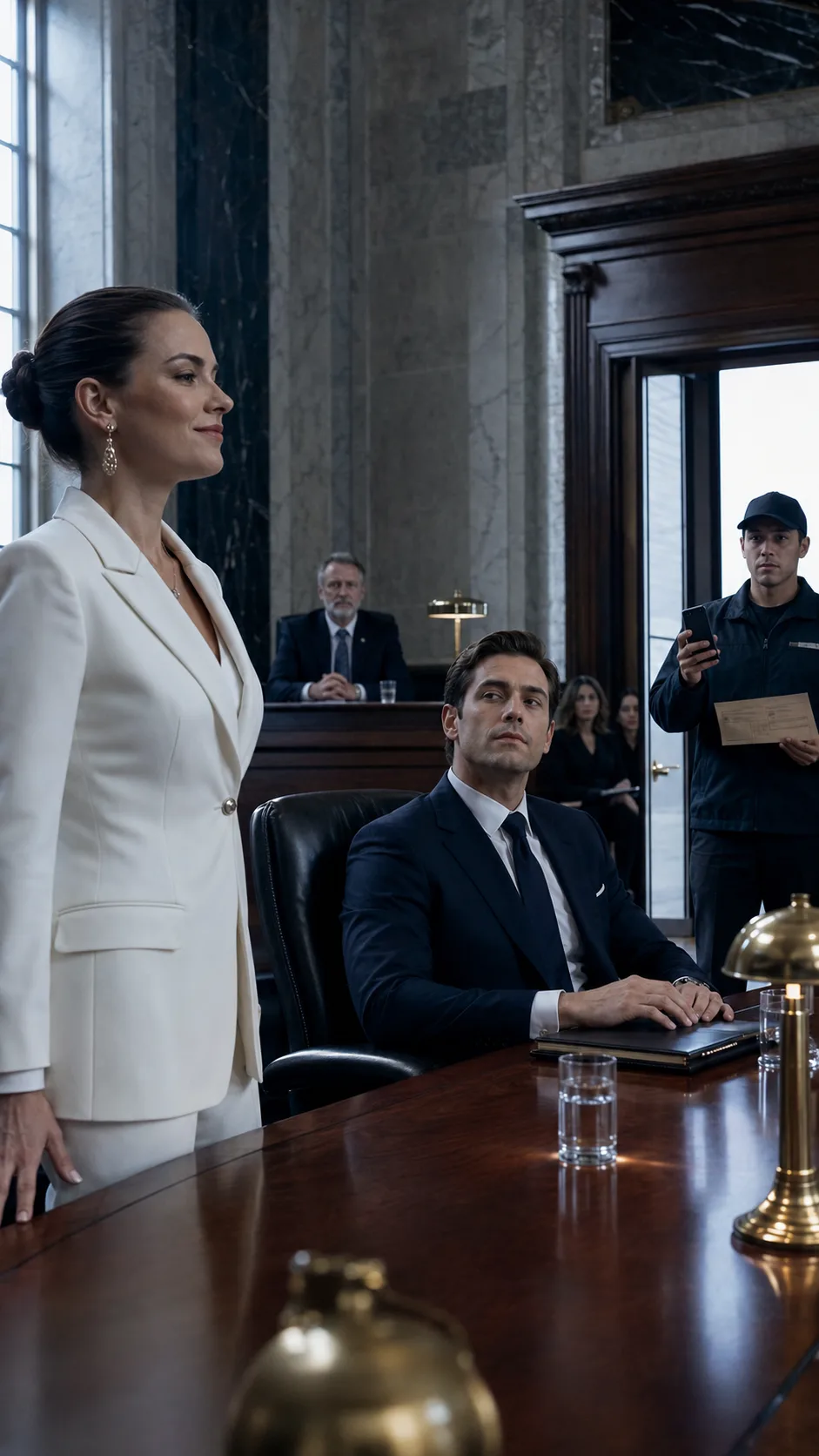
Adrian Cole placed his black portfolio on the hearing table at 8:17 in the morning and noticed the water glass had already been moved to the wrong side.
Chapter 1
Adrian Cole placed his black portfolio on the hearing table at 8:17 in the morning and noticed the water glass had already been moved to the wrong side.
That was how he knew Victoria Hale had arrived before him.
She liked small victories. A glass shifted three inches. A chair angled away from someone she wanted to diminish. A file placed closer to her side than the center. Tiny adjustments no one else would mention, because mentioning them made you look petty.
Adrian did not move the glass back.
He sat in the leather chair, buttoned his jacket, and rested both hands on the closed portfolio.
The chamber had been designed to make people speak carefully. Marble walls. Tall windows. Cold morning light. Brass desk lamps on dark wood. A raised bench at the far end where the presiding reviewer would sit beneath a framed city seal. It was not a public courtroom, not exactly, but it had the same effect on people.
Voices lowered here.
Postures corrected themselves.
Even powerful people looked smaller under that ceiling.
Victoria
did not.
She stood near the left end of the table in a white tailored suit, one hand resting lightly on the polished wood, her dark hair pinned into a clean bun. Her earrings caught every strip of light that came through the windows.
She smiled when Adrian entered.
Not wide.
Just enough.
“You came alone,” she said.
Adrian set his phone face down beside the portfolio. “So did you.”
Victoria’s eyes moved once toward the two assistants seated behind her. Then toward the older man with silver-rimmed glasses arranging papers at the clerk’s desk. Then toward the silent observers along the back wall.
She did not need to say it.
She had filled the room without calling them allies.
“They’re here to observe,” she said.
“Of course.”
Victoria looked at the water glass on his side of the table.
Adrian left it where it was.
That annoyed her. Not
enough to show. Enough for her index finger to tap once against the wood.
The sound was small.
He heard it anyway.
This hearing had started six months earlier with a sentence Adrian had not meant to keep.
He had been standing in the archive room of Hale Meridian, the foundation Victoria directed with the calm certainty of someone born into institutions with her name on the wall. Adrian had worked there for four years, first as a strategy consultant, then as deputy director of special projects, though Victoria never used the title in front of donors.
To donors, he was “Adrian from operations.”
To board members, he was “helping with the transition.”
To staff, when Victoria forgot to lower her voice, he was “temporary.”
He had learned not to correct her in public.
Not because he lacked pride.
Because every correction became a weapon in her hand. Victoria had
a talent for making accuracy look like insecurity.
The problem began with a message.
Not a long one. Not emotional. Not even angry.
A timestamped text sent from Adrian’s phone to himself at 11:42 p.m. on a Thursday, the night before Victoria announced the new global initiative as her own idea.
The message contained three things: the original project name, the name of the donor who had requested Adrian personally, and one line Victoria had spoken in the archive room when she thought no one else would ever repeat it.
Send it to yourself before morning. If she changes the record, you’ll need proof she knew.
He had typed it with his thumb while Victoria stood ten feet away, speaking to someone on the phone by the archive shelves.
Then he had scheduled it to be delivered six months later through a secure courier service, with instructions that the device containing the verified message copy be brought directly to the hearing chamber if the internal review reached final session.
It had felt excessive then.
Almost theatrical.
Adrian hated theatrical.
But the woman who gave him that advice had not been theatrical. She had been precise.
Mara Whitcomb, the former compliance officer, had looked at him over the top of a cardboard box of files and said, “People like Victoria don’t deny what happened. They rearrange the room until everyone remembers it differently.”
Two weeks after that, Mara resigned.
Three weeks later, the initiative launched under Victoria’s name.
Four months later, Adrian was accused of falsifying authorship records.
Victoria never accused him directly. That would have been crude. She let the accusation move through official channels like perfume through a lobby.
By the time Adrian understood how completely the story had been rewritten, the board packet already described him as having “later attached himself to development-stage materials.”
Attached himself.
He had stared at that phrase for a full minute.
Then he printed the packet, placed it in his black portfolio, and waited.
Now, in the chamber, Victoria turned toward him with the same expression she used in donor photographs.
“Before the reviewer comes in,” she said, “I’ll give you one last chance to make this easy.”
Adrian looked at the brass lamp between them. It had a fingerprint on the base.
Not his.
“Easy for whom?”
Her smile did not move. “For your future.”
One of her assistants shifted in the second row. A young woman with a tablet. Nervous hands. New to the foundation, probably. She looked at Adrian and then quickly down.
Victoria noticed.
Her voice stayed smooth.
“Don’t mistake procedure for suspense,” she said. “The record is clear.”
Adrian opened the portfolio one inch, then closed it again.
Victoria’s gaze dropped to it.
There.
A tiny crack.
She wanted to know what he had brought. That was the first real thing she had shown all morning.
The chamber door opened, and Presiding Reviewer Nathaniel Greer entered with no announcement. Everyone stood except Adrian, who was already halfway up before Greer waved a hand.
“Sit. We’ll be brief.”
Victoria sat only after Greer did.
Adrian sat after Victoria.
Another small thing.
The clerk read the session number, the parties present, the matter under review. Greer adjusted his glasses and looked over the summary sheet.
Victoria’s attorney, Daniel Price, placed a blue folder on the table with its corners aligned perfectly. Daniel had the careful face of a man paid to speak softly while doing damage.
“Reviewer Greer,” Daniel said, “the foundation has cooperated fully. The record shows that Ms. Hale originated, developed, and secured support for the Meridian Access Initiative. Mr. Cole’s later claims have no independent basis.”
No independent basis.
Adrian looked at the moved water glass.
Victoria’s finger rested beside her pen.
Greer turned to Adrian. “Mr. Cole.”
Adrian did not reach for the portfolio yet. “The record you have is incomplete.”
Daniel’s pen paused.
Victoria’s smile grew faintly brighter.
That was her favorite version of him. Isolated. Making a statement that sounded weak because the proof had not yet appeared.
“Incomplete how?” Greer asked.
Victoria answered before Adrian could.
“Because Adrian believes memory should outweigh documentation.”
Greer’s eyes moved to her.
Victoria dipped her chin, polished and apologetic. “Forgive me. But that is the pattern we’ve seen.”
Adrian watched the young assistant in the second row press her tablet tighter against her lap.
Victoria continued.
“He was involved in operational support. No one disputes that. But involvement is not authorship. Being near important work does not make the work yours.”
There it was.
The sentence she had come to say in front of everyone.
Adrian let it sit.
Daniel slid one sheet from the blue folder toward Greer. “You’ll see here the internal development timeline. Ms. Hale’s name appears from the beginning. Mr. Cole’s appears only after public funding interest increased.”
The clerk carried the paper to Greer.
Adrian knew that page.
He had seen it three months ago.
The metadata had been scrubbed. The revision history exported clean. Victoria’s team had been thorough.
Almost.
Greer read, then set the page down.
“Mr. Cole, do you have material evidence contradicting this timeline?”
Victoria looked at him then.
Fully.
Her eyes said: This is where you look small.
Adrian opened the black portfolio.
The hinge made a soft leather creak.
Inside were printed emails, meeting notes, donor acknowledgments, copies of calendar invitations. Enough to raise questions. Not enough to end the room.
He removed one page and slid it forward.
Daniel glanced at it and gave the smallest exhale through his nose.
Victoria did not look down.
She knew which page he would choose. She had prepared for it.
“That memo is unsigned,” Daniel said.
Adrian took out another.
“Draft language,” Daniel said.
Another.
“Operational notes.”
Another.
“After-the-fact reconstruction.”
Greer did not interrupt. He let the rhythm expose itself.
Victoria’s hand relaxed near her pen.
She thought the room had returned to her.
“Adrian,” she said, using his first name for the first time that morning, “you were good at supporting the vision. That mattered. It truly did. But this obsession with ownership—”
“I never asked to own it.”
She stopped.
Only for a breath.
Adrian looked at her. “I asked not to be erased from it.”
The young assistant in the second row looked up again.
Daniel’s pen resumed moving.
Victoria leaned back. Her smile returned, cooler now.
“Strong wording,” she said. “Still no proof.”
Greer folded his hands. “Ms. Hale, let Mr. Cole finish.”
Victoria inclined her head. “Of course.”
But she had already won that beat.
Everyone had heard the word proof.
Everyone had seen Adrian place papers that Daniel swept aside with labels. Unsigned. Draft. Operational. Reconstruction.
A row of small dismissals.
A room can be trained quickly.
By the time Adrian placed the fifth page down, even the clerk’s face had taken on that neutral distance people use when they think they are watching a man lose with dignity.
Adrian returned the pages to the portfolio.
Victoria stood.
Daniel touched her sleeve, barely.
She ignored it.
That was the second crack.
Victoria never stood before the closing moment unless she wanted to make the room feel her height.
“Reviewer Greer,” she said, “I respect this process. I’ve respected it from the beginning. But at some point, we have to call this what it is.”
Adrian kept both hands flat on the portfolio.
Victoria turned slightly, including the observers now.
“A disappointed former employee trying to attach himself to work he could not lead.”
The assistant with the tablet went still.
Greer’s expression did not change.
Daniel closed his eyes for half a second.
Too late.
Victoria had crossed from defense into performance.
And performance always needed an audience.
She looked down at Adrian.
“You should have accepted this quietly.”
The chamber held the sentence.
Adrian looked at the clock above the door.
8:59.
He had not moved the water glass.
He had not touched his phone.
He had not checked the door.
Victoria noticed the clock only because he did.
Her eyes flicked toward it.
Then back to him.
For the first time that morning, the smile on her face had to work.
Greer looked at Adrian. “Mr. Cole. Final response.”
Adrian did not open the portfolio again.
He said, “Not yet.”
Daniel’s head lifted.
Victoria laughed once under her breath.
It was not loud. It was worse because it was controlled.
“Not yet?” she said. “You had six months.”
Adrian’s phone remained face down on the table.
The clerk glanced toward it, then away.
Greer’s mouth tightened. “Mr. Cole, if you’re waiting for additional material, it should have been submitted before—”
A knock sounded at the chamber door.
Not dramatic.
Three clean taps.
Everyone turned except Adrian.
Victoria did turn.
Slowly.
The clerk walked to the door and opened it.
A courier stood outside in a navy jacket and dark cap, holding a small device case in one hand and a delivery slip in the other. He checked the room number, then the name on the slip.
“Secure delivery for Reviewer Greer.”
Daniel stood halfway. “This is not part of the submitted packet.”
The courier did not look at him.
Greer raised one hand. “Bring it forward.”
Victoria’s smile stayed on her face.
The courier entered.
His shoes made two clean sounds on the marble floor.
The young assistant in the second row lowered her tablet.
Adrian watched Victoria now.
Not the courier.
Not the device case.
Victoria’s fingers had stopped touching the table.
The courier placed the case on the clerk’s desk and handed over the slip. The clerk checked the code, broke the small security tag, and opened the case.
Inside was a phone.
Not Adrian’s current phone.
His old one.
The one Victoria had asked IT to wipe during the device transition after his access was “restructured.”
Victoria’s face did not change enough for most people.
Adrian saw it.
A tiny tightening near the mouth.
The clerk lifted the phone.
The screen was already powered on, locked to a verification page.
The courier read from the delivery slip.
“This was scheduled before the hearing.”
Daniel turned to Victoria.
She did not turn back.
Greer leaned forward. “Scheduled by whom?”
The clerk read the sender field.
“Adrian Cole.”
Victoria gave a small laugh. “He sent himself a phone?”
Adrian lifted his chin. “Read the message first.”
No one moved for one second.
Then Greer nodded to the clerk.
The clerk tapped the verification prompt.
The screen changed.
A timestamp appeared.
11:42 p.m.
Six months earlier.
Below it was the message Adrian had sent himself, preserved through the courier service’s verification chain, mirrored to the old device before the wipe request, scheduled for delivery only if the final review session occurred.
The clerk read silently at first.
His eyes moved once toward Victoria.
Then he carried the phone to Greer.
Victoria reached forward.
Only halfway.
Her hand stopped before it crossed the center line of the table.
That mattered.
The center line had belonged to her all morning.
Now she would not touch it.
Greer lowered his glasses and read the screen.
Daniel’s pen rolled once across the table and stopped against the base of the brass lamp.
No one picked it up.
Adrian opened the black portfolio again and removed one final sheet.
Not a memo.
Not an email.
A printed copy of the same timestamped message, with the courier verification number at the bottom.
He slid it to the exact center of the table.
This time Daniel did not label it.
Victoria’s lips parted slightly.
Greer looked up from the phone.
“Ms. Hale.”
Victoria’s smile returned too late. “Reviewer Greer, I would caution against treating a self-directed message as—”
Greer tapped the screen once. “The message quotes you.”
The room changed shape around that sentence.
The observers in the back leaned forward without meaning to. The assistant with the tablet lowered it into her lap. Daniel stopped reaching for his pen.
Victoria did not sit.
Greer read aloud.
Not all of it.
Only the line that mattered.
“‘Send it to yourself before morning. If she changes the record, you’ll need proof she knew.’”
The young assistant put one hand over her mouth, then dropped it quickly.
Victoria looked at Adrian.
For the first time that morning, she looked at him without performance.
The line was not the whole proof.
It was the key that made every other page in the portfolio turn.
Greer looked at the printed verification sheet. “Who else had access to the archive room that night?”
Adrian said, “Mara Whitcomb.”
Victoria’s head turned sharply.
There.
The third crack.
Daniel whispered her name under his breath. Not as a question. As a warning.
Greer looked to the clerk. “Is Ms. Whitcomb present?”
The clerk checked the attendance sheet.
Before he could answer, the chamber door opened again.
Mara Whitcomb stepped in carrying no folder, no dramatic evidence, no expression built for effect. She wore a gray coat, her silver hair tucked behind one ear, and held a paper coffee cup with the lid slightly dented.
One of the observers recognized her and sat straighter.
Victoria’s face drained of its carefully arranged warmth.
Mara walked to the witness chair and set the coffee cup on the floor beside it.
A useless detail.
Adrian noticed it anyway.
The lid had a brown stain where coffee had escaped.
Greer looked at her. “Ms. Whitcomb. You were asked to remain available outside?”
Mara nodded once. “I was.”
Victoria finally spoke.
“Mara.”
The name came out almost friendly.
Mara did not look at her.
Greer asked, “Did you hear Ms. Hale speak the words quoted in this message?”
Mara folded her hands.
“Yes.”
Daniel stood fully now. “Reviewer Greer, this is highly irregular.”
Greer did not look at him. “Sit down, Mr. Price.”
Daniel sat.
The words made no sound after that.
Mara looked at the phone in the clerk’s hand. “She said it after asking Adrian to remove his name from the donor draft. He refused. She told him he was naive if he thought records stayed honest by themselves.”
Victoria’s jaw tightened.
Mara continued.
“I told him to make a private timestamp. He did. I watched him send it.”
Adrian kept his hands on the portfolio.
Victoria looked around the room.
That was the moment she lost it.
Not when the phone appeared.
Not when Greer read the message.
When she looked for the room and found no one waiting to be led.
The assistant in the second row stared at her tablet as if it had become too heavy. Daniel looked at the table. Greer looked at the phone. Mara looked at the reviewer.
And Adrian looked at the water glass.
Still on the wrong side.
Greer placed the phone flat on the table, screen up.
“The review will enter this verified message and Ms. Whitcomb’s statement into the record.”
Victoria’s hand dropped from the table edge.
Greer turned to Adrian. “Mr. Cole, submit the remaining materials.”
Adrian slid the portfolio forward.
The clerk took it.
Victoria did not move.
Daniel leaned close to her and said something too low for the room to hear.
She stepped back half a step.
White suit. Brass light. Marble wall.
For most of the morning, she had looked carved into the room.
Now she looked placed there by mistake.
Greer reviewed the first page from Adrian’s portfolio again.
Then the second.
Then the third.
The same documents Daniel had dismissed minutes earlier.
Only now they had a spine.
The unsigned memo had a night attached to it. The draft language had a witness. The operational notes had context. The donor acknowledgment had a reason for being rewritten.
Paper had not changed.
The room had.
Victoria sat down at last.
Not gracefully.
The chair made a short scrape against the floor.
Everyone heard it.
Greer did not announce a grand verdict. He did not raise his voice. He did not give Adrian the kind of moment people imagine when they wait months to be believed.
He simply said, “The foundation’s submitted timeline is no longer reliable.”
Daniel looked down.
Victoria’s eyes fixed on the phone.
Greer continued. “Pending full review, authorship attribution on the Meridian Access Initiative will be suspended. Ms. Hale’s administrative control over related materials will be paused. Mr. Cole’s claim will remain active.”
Paused.
Suspended.
Active.
Quiet words.
Heavy ones.
Victoria’s lips moved once before sound came.
“That’s not—”
She stopped.
No one helped her finish.
Greer looked at her over his glasses. “Not what?”
Victoria’s mouth closed.
The clerk collected the blue folder from Daniel’s side of the table.
Daniel released it immediately.
That was when Adrian finally moved the water glass.
He picked it up from the wrong side, placed it in front of himself, and took one drink.
His hand did not shake.
After the hearing, no one rushed out.
The room had to remember how to move.
The observers gathered their coats in silence. The young assistant stood with her tablet pressed against her chest, then turned toward Adrian as if she wanted to say something. She did not.
Mara picked up her dented coffee cup.
Adrian met her near the doorway.
“You came,” he said.
“You scheduled the message,” she said.
A fair answer.
He nodded.
Across the room, Victoria remained seated while Daniel spoke to her in short, urgent bursts. She did not seem to hear him. Her eyes stayed on the place where the phone had been before the clerk sealed it into an evidence sleeve.
Adrian almost looked away.
Then she raised her head.
For one second, their eyes met.
There was no apology there.
No collapse.
Only calculation interrupted.
That was useful to know.
Mara touched Adrian’s sleeve lightly. “Don’t stand here too long.”
He picked up the black portfolio, now much thinner, and followed her into the hallway.
Outside the chamber, the civic building sounded normal. Shoes on stone. Elevator doors opening. Someone laughing too loudly near the security desk. A man arguing with a vending machine that had taken his dollar.
Adrian stood under the hallway light and breathed once through his nose.
Mara removed the lid from her coffee, checked inside, and frowned.
“Cold,” she said.
Adrian almost smiled.
Almost.
Two weeks later, Hale Meridian issued a revised public statement that did not mention Victoria’s smile, the courier, the phone, or the sentence Greer had read aloud.
Statements rarely include the parts that matter.
It said an internal review had identified inconsistencies in prior attribution materials. It said Adrian Cole would be recognized as originator and principal architect of the Meridian Access Initiative. It said Victoria Hale would take a temporary leave from program oversight during restructuring.
Temporary.
A word designed to sound soft.
By then, three donors had already requested direct meetings with Adrian.
One sent a note handwritten on cream paper.
I should have asked you sooner.
He did not frame it.
He put it in the bottom drawer of his desk.
Mara returned to the foundation on a limited advisory basis, which meant she appeared twice a week, corrected everyone’s language, and refused the good coffee because she said good coffee made people careless.
The young assistant from the hearing chamber transferred to Adrian’s team.
Her name was Eliza.
On her first day, she placed a tablet on his desk and said, “I should have said something earlier.”
Adrian looked at the moved water glass beside his keyboard.
People kept moving his glass now. Not as an insult. Out of nerves. Out of habit. Out of not knowing where things belonged around him yet.
“You’re saying something now,” he said.
Eliza nodded.
That was enough.
Three months later, Adrian returned to the same hearing chamber for a donor ethics panel. Not as the accused party. Not as an observer. As a speaker.
The brass lamps were still there. The marble still made voices smaller. The raised bench still looked too formal for human mistakes.
Before the panel began, he placed his black portfolio on the table and sat down.
The water glass had been set on the wrong side again.
This time, he moved it.
Not with anger.
Not for anyone else to notice.
He put it where it belonged and opened the portfolio.
At the top was a printed copy of the message he had once sent to himself at 11:42 p.m.
He no longer needed it.
But he kept it anyway.
Some records are not for proving.
Some are for remembering where the table used to stand.
Adrian turned the page.
Chapter complete
You have reached the end of this chapter.
Continue reading
A few more worlds to get lost in after this chapter.