The Detonator Did Not Blink
Arya Bennett noticed the bruise in the elevator mirror before Marcus did.
Chapter 1
Arya Bennett noticed the bruise in the elevator mirror before Marcus did.
That was the mistake.
Her hand moved too quickly toward her jaw, just a small lift of her fingers to check whether the concealer had cracked beneath the warm light. Marcus saw the motion in the mirrored wall. He did not turn his head. He did not need to. His reflection smiled as he adjusted the cuff of his navy tuxedo.
The elevator climbed toward the forty-second floor.
Numbers glowed above the doors. Thirty-six. Thirty-seven. Thirty-eight.
Arya lowered her hand.
Marcus watched her reflection for another second, then reached across the narrow space between them and touched her wrist. His thumb rested over the place where his fingers had dug in earlier that evening, in the back seat of the car, when she had asked if they could leave the gala early.
Not tonight, he had said.
Not after what I paid for that dress.
Now his thumb pressed once.
Not hard enough to make her wince. Not enough for a mark someone could see. Marcus was careful in public places. That was one of the first things Arya had learned about him, long before she learned the shape of his temper, long before she learned how a man could speak gently and still make a room feel locked.
“You look lovely,” he said.
The elevator doors opened before she could answer.
Sound poured in first: violin music, low laughter, champagne glasses, the soft collective hum of wealthy people pretending the world existed to serve them. The Harrington Gala filled the top floor of the hotel with gold light and white orchids. Marble columns divided the ballroom. The city glowed beyond the glass walls, clean and glittering from this height, as if pain lived only down below where the streets were wet and the traffic lights blinked red.
Marcus stepped
out first.
Arya followed.
A photographer lifted a camera near the entrance. Marcus’s hand slid to Arya’s back.
Smile.
He did not say it.
He did not have to.
Arya smiled.
The flash went off.
Marcus laughed at something the host said. His hand stayed at her back. His fingers were flat and warm through the silk of her dress. Anyone watching would have seen a handsome man guiding his girlfriend into a beautiful room. They would have seen his perfect posture, his easy charm, the way he bent his head to hear the host better. They would not have seen Arya’s shoulders held half an inch too high.
They never did.
That was what Marcus understood about rooms like this.
Money made people polite. Politeness made people blind.
For the first hour, Arya did what she had learned to do. She laughed when Marcus laughed. She nodded at names
she had heard too many times. She let women with diamonds at their throats compliment her dress, then watched their eyes slide to Marcus for approval, as if he had chosen her the way he had chosen his cufflinks.
He had.
The dress was midnight blue, fitted but not revealing, expensive enough that no one would pity her. Marcus had sent it to her apartment that afternoon with a note.
Wear this. Don’t embarrass me.
The note was still folded inside the lining of her clutch.
She had not thrown it away.
She did not know why.
Near the bar, a banker with red cheeks leaned too close to Marcus and whispered something that made both men laugh. Marcus placed one hand in his pocket, the other around his glass, and for a few minutes Arya could breathe without being directly watched.
She stepped toward the windows.
The city below looked almost peaceful. She held her champagne flute with both hands but did not drink. Bubbles rose and died in the glass. Her reflection floated in the window, pale and neat and unfamiliar.
Eight months ago, Marcus Vale had made her feel chosen.
He had waited outside the law office where she worked as a junior assistant, leaning against a black car with coffee in one hand and her forgotten scarf in the other. He had remembered her order after one meeting. He had sent flowers without making them too large. He had said she was careful in a way he admired.
Careful.
She should have heard the warning in that.
The first time he frightened her, he apologized before she could fully understand what had happened. The second time, he brought earrings. The third time, he said she made him become someone he hated. By the fifth, Arya had stopped numbering them.
She only counted quiet days.
At the gala, the quartet changed songs. The violin rose higher.
Arya looked toward the bar.
Marcus was watching her.
He smiled.
Not the public smile.
The other one.
A small tap of his finger against the side of his glass.
Come here.
Arya’s feet stayed still.
The banker kept talking. Marcus did not look at him anymore. His eyes remained on Arya, calm and patient and certain. He tapped the glass again.
Once.
Twice.
A waiter passed between them carrying silver spoons of caviar. Arya moved aside without meaning to. The waiter nodded. The room kept breathing. No one saw the tiny command crossing the ballroom.
No one saw the refusal either.
Marcus set his glass on the bar.
He excused himself from the banker.
Then he began walking toward her.
Arya’s throat closed.
There were hundreds of people in the room. Senators. executives. donors. wives with trained smiles. security near the doors. cameras at the entrance. Staff moving constantly with trays and napkins and refilled glasses.
None of them mattered.
Marcus could walk through all of them, take her elbow, smile down at her, and say she needed air. People would make space. They would admire the concern in his voice. They would call him attentive. They would let him lead her out.
Then the elevator.
Then the car.
Then whatever came after she made him look ignored.
Her hand tightened around the champagne flute.
The stem creaked.
She set it down on the nearest table. Too fast. The base slid on a ring of condensation, tilted, then settled without falling.
A foolish detail.
Later, she would remember it.
The glass did not fall.
Marcus was halfway across the room.
Arya looked left. A cluster of women near the flowers. Right. A senator blocking the path to the staircase. Behind her, glass and a view too high to escape through.
Then she saw the man by the marble column.
He stood apart from the room without appearing alone. Two men lingered a few feet behind him, not close enough to crowd him, not far enough to be separate. The man wore black with no visible flash of color. His hair was dark, brushed back, touched with silver at the temples. His shoulders filled the jacket without strain. He did not hold a drink. He did not perform interest.
People moved around him differently.
Not fear exactly.
Recognition.
Arya knew his name before she knew why.
Damiano Ricci.
Marcus had mentioned him once, months ago, in the same tone he used for storms and prosecutors and men whose phone calls he took in another room. Arya had heard rumors too. Everyone in the city had. Damiano owned restaurants, hotels, shipping companies, charities with saintly names, security firms with no public faces. Some called him a businessman. Some called him a criminal. Some called him worse things and lowered their voices first.
Marcus was still coming.
Arya moved.
Not gracefully. Not strategically. She crossed the ballroom with her pulse knocking against her ribs, slipped past a waiter, nearly brushed the sleeve of a woman in emerald silk, and reached Damiano Ricci before courage had time to become thought.
He turned as she came close.
His eyes dropped to her hands when she grabbed his lapels.
Then Arya kissed him.
The room did not go silent immediately.
It lost sound in layers.
A laugh died near the orchids. A waiter paused with his tray tilted. The violin missed half a note. Someone inhaled too sharply by the staircase.
Arya pulled back.
Damiano Ricci looked at her mouth, then at her eyes.
He did not touch her.
He did not smile.
“Three seconds,” he said. “Explain.”
His voice was low enough that only she heard him.
Arya could barely speak. Marcus was behind her. The skin between her shoulder blades knew it.
“The man behind me hurts me,” she said. “He was coming for me. If he thinks I’m with you, he’ll stop. Just tonight. Please.”
Damiano’s face did not change.
That should have frightened her more.
Instead, the stillness gave her one full breath.
His gaze moved past her.
Arya watched his eyes find Marcus.
Something in the air shifted.
Damiano placed one hand near the small of Arya’s back. Not pressing. Not gripping. Just there, a visible answer to the room.
“Stand beside me,” he said. “Breathe.”
Arya turned enough to see Marcus stop.
Twenty feet away.
For eight months, Marcus Vale had owned every room Arya entered. He had owned the ride home, the expression she wore, the friends she called less often, the apologies she gave before knowing what she had done. He had owned the pause before she spoke.
But in that ballroom, facing Damiano Ricci, Marcus hesitated.
It lasted less than a second.
Arya saw it.
Damiano did too.
The quartet found its rhythm again. Conversations restarted with rough edges. People pretended not to stare while staring through the corners of their eyes. A woman near the bar whispered Damiano’s name into another woman’s ear.
Marcus smiled.
He was good at that.
Damiano did not.
For the next hour, Arya stayed beside him while the gala rearranged itself around the scandal it was too polite to name. Damiano introduced her to no one. He did not ask her to explain more. He did not demand gratitude. He did not look down at her like she had become his entertainment.
When Marcus tried to approach, one of Damiano’s men stepped into the path before anyone could call it interference.
When a donor asked whether Arya and Damiano knew each other well, Damiano said, “Well enough,” and let silence do the rest.
When a waiter offered champagne, Arya reached automatically, and Damiano took the glass first. He placed it untouched on the nearest table.
“You do not have to drink because people are watching,” he said.
Arya stared at the glass.
Her hand was shaking.
She tucked it behind her clutch.
Damiano noticed.
Of course he did.
At midnight, he walked her toward a private elevator. Marcus stood near the opposite side of the ballroom, a glass in his hand, his mouth curved in something no longer passing as a smile. His eyes stayed on Arya until the elevator doors closed.
Inside, Damiano kept space between them.
That space mattered.
Arya pressed her back against the elevator wall and let her head tilt down for one second. Her knees wanted to fold. She locked them.
Damiano looked at the number panel.
“Is there somewhere safe you can go tonight?”
She almost laughed.
Safe had become a decorative word.
“No.”
His gaze moved to her.
“Family?”
“My mother is dead. My father is dead.” She swallowed. “No one close.”
“Friends?”
She thought of Maya, who had stopped calling after Marcus answered Arya’s phone one night and told her Arya was sleeping. She thought of the old life she had let shrink because explaining became harder than disappearing.
“No.”
The elevator descended.
Damiano took a black card from his inner jacket pocket and held it between two fingers.
“There is an address on this card. A room. A lock from the inside. No one there will ask for your story. In the morning, you decide what comes next.”
Arya did not take the card.
“What is the price?”
The question made his eyes sharpen.
“None.”
“Men like you don’t do things for nothing.”
“No,” he said. “But sometimes the debt belongs to the man being stopped.”
Arya looked at him.
“Marcus?”
Damiano’s mouth moved, almost not a smile.
“Marcus Vale has owed debts longer than he has owned suits.”
The elevator doors opened into a private garage.
A black car waited.
The driver stood beside it with both hands visible. Young, dark-haired, nervous around Damiano. He opened the rear door and looked at Arya only once before looking away.
Inside, the car smelled of leather and cedar.
The same scent would come back to her later, years later, when she could no longer remember every word of that night but still remembered how the seat felt beneath her palms.
Damiano sat across from her.
Not beside her.
He placed the card on the seat between them.
“Why are you doing this?” Arya asked.
He looked at her jaw again, at the bruise she had worked so hard to hide.
“Because you asked.”
“That’s not enough.”
“It should be.”
She looked away first.
The car pulled out of the garage and into the wet city.
For a while, neither of them spoke.
Then Arya said, “He’ll call.”
“Yes.”
“He’ll threaten me.”
“Yes.”
“He’ll come.”
Damiano’s gaze rested on the city beyond the window.
“Then he will learn the difference between wanting a thing and reaching it.”
The safe room did not look like a prison.
That made Arya distrust it more.
It was hidden behind a paneled wall on the second floor of an old brownstone at the end of a private street where no taxi passed and no one parked by accident. The suite had white sheets, a narrow desk, a bathroom stocked with unopened toothbrushes and soap, shelves with nothing personal on them, and a closet filled with new clothes in her size.
No windows.
Arya stood at the threshold and noticed that first.
Rosa, the housekeeper, noticed her noticing.
The old woman had silver hair pinned at the back of her neck and wore a black dress so severe it looked like armor. She carried tea on a tray. Her eyes were small and sharp.
“No windows means no one sees in,” Rosa said.
Arya touched the inside lock.
“And no one sees out.”
Rosa placed the tray on the desk. “Both can save a life.”
“I didn’t ask to be locked away.”
“Good. Then do not lock yourself away. The door opens from inside.”
Arya turned the lock once.
Opened it.
Turned it again.
Rosa watched without comment.
“There is food. Clothes. Bathroom. If you need a doctor, say so. If you need sleep, take it. If you need to break something, use the blue vase. It is ugly.”
Arya looked at the vase near the shelf.
It was ugly.
A laugh almost came.
Almost.
When Rosa left, Arya sat on the bed without taking off her shoes. Her phone sat in her lap.
It began ringing at 2:13 a.m.
Marcus.
She watched the screen until it stopped.
Then it started again.
And again.
By dawn, sixteen missed calls.
By noon, messages.
Baby, you’re confused.
Come home and we’ll talk.
Do you know how this looks?
By evening, the softness had peeled away.
You made me look stupid.
You have no idea what you started.
You think an old man with a reputation can keep you?
Arya played the last one twice because fear did not trust hearing.
Then she turned the phone off.
Three minutes later, she turned it on again.
Rosa brought soup at six.
Arya had not touched the tea from morning.
“No appetite?” Rosa asked.
“No.”
“Eat.”
“I said no.”
Rosa set the bowl beside the tea. “I heard you. Eat anyway.”
Arya stared at her.
Rosa stared back.
The house beyond the room remained quiet. Not silent. Quiet. She could hear footsteps sometimes, a door below, a man speaking briefly in Italian, the low hum of security systems. The brownstone felt old and guarded, like a throat holding back words.
“How long have you worked for him?” Arya asked.
“For Damiano?”
Arya nodded.
“Since he was smaller than your suitcase.”
“He doesn’t seem like he was ever small.”
Rosa’s mouth twitched. “Boys become men. Some become walls. It is not the same thing.”
“What happened to him?”
Rosa picked up the untouched tea and replaced it with fresh.
“That story is not mine.”
“Everyone here says things like that.”
“Because everyone here is alive enough to know which stories cost blood.”
Arya looked down at the soup.
“Is he dangerous?”
“Yes.”
The answer came too quickly.
Arya’s fingers tightened around the blanket.
Rosa added, “So is a locked door when the fire is outside.”
Then she left.
On the fourth morning, Marcus sent a message that changed the house.
Arya had slept badly, waking every hour with the feeling that someone was standing beside the bed. When her phone rang, she let it. When the voicemail appeared, she listened with the device on the desk and her hands flat on her knees.
Marcus’s voice had gone soft.
Too soft.
“I know where you are,” he said. “And when I come, I’m not coming alone.”
The door opened before Arya could decide whether to call for help.
Damiano stepped in.
No jacket. Black shirt, sleeves rolled to his forearms. Without the gala polish, he looked rougher. Older. More human and less safe.
His eyes moved from her face to the phone.
“He called again.”
It was not a question.
Arya nodded.
“He says he knows where I am.”
Damiano held out his hand.
“May I?”
The courtesy hurt in a place she did not have a name for.
She gave him the phone.
He listened once. Then again. Then placed it screen down on the desk.
“He does not know where you are.”
“How can you be sure?”
“Because if Marcus Vale knew where you were, he would already be dead.”
The words arrived softly.
That made them worse.
Arya stood.
“Do you hear yourself?”
“Yes.”
“Is that supposed to comfort me?”
“No. It is supposed to inform you.”
He crossed to the closet, took out a gray cardigan, and laid it over the chair instead of handing it to her.
“He wants you afraid enough to run. Running makes you visible. If you answer, he gets a voice inside this room. I recommend you do neither.”
“You recommend?”
“Yes.”
“You don’t command?”
Damiano looked at her then.
“No.”
Marcus would have smiled at that challenge. He would have let her regret it slowly.
Damiano simply waited.
Arya sat back down.
“What is he involved in?”
“Money.”
“That’s not an answer.”
“It is the clean part of one.”
“Then give me the dirty part.”
Damiano looked at the phone.
“Marcus moves funds for men who prefer not to know how their profits are washed. Politicians. judges. old families. foreign buyers with new names. He is useful because he is charming, greedy, and careless in ways that flatter worse men.”
Arya wrapped her arms around herself.
“He was careful with me.”
“No,” Damiano said. “He was practiced.”
That landed too cleanly.
She turned away.
For four days, Damiano had given her space. He had not asked how many times Marcus had hurt her. He had not demanded the details people often wanted because horror fascinated them when it belonged to someone else. He had sent a doctor who spoke gently, a lawyer who slid documents across the table without forcing eye contact, and Rosa, who brought soup like a weapon.
It was kindness.
It was also strategy.
Everything about Damiano Ricci had edges.
Arya looked back at him.
“Am I a person to you?”
He did not answer quickly.
That mattered.
“Yes.”
“Or leverage?”
This time the silence lasted longer.
“You are a person,” he said. “You may also be leverage. I will not insult you by pretending danger forgets your name because I prefer it to.”
Arya laughed once. It came out wrong.
“That’s a terrible answer.”
“It is the honest one.”
“I don’t know what to do with honest anymore.”
His expression changed.
Only a little.
“You survive it first,” he said. “Understanding comes later.”
A knock sounded.
Damiano’s body shifted by one degree.
Arya saw it because fear had trained her to read men before they moved.
Rosa entered without waiting. She looked at Arya first, then at Damiano.
“A package was left at the east gate.”
Damiano’s eyes sharpened.
“From?”
“No courier. No plate. No one saw the face.”
Damiano turned to leave.
Arya reached for his wrist before she knew she was moving.
He stopped.
Her fingers rested against warm skin and hard tendon.
“Don’t.”
His gaze dropped to her hand.
She released him immediately.
“I’m sorry.”
“Do not apologize for warning a man away from danger.”
“Then why go?”
“Because someone left it where a guard could open it.”
He left with Rosa.
Arya stood alone in the room, listening to the house.
It was quiet for too long.
When Damiano returned, he carried a black box.
Rosa stood behind him with one hand pressed to the cross at her throat.
Arya knew before the box opened.
Not what.
Only that something inside it belonged to a life she had tried to leave.
Damiano placed it on the desk and lifted the lid.
A silver bracelet lay inside on black velvet.
A pale sapphire winked beneath the lamplight.
Arya’s stomach turned.
Marcus had given it to her on their second month together. He had fastened it around her wrist in a restaurant, kissed her hand, and laughed when the waiter called them beautiful together. Later, when she tried to remove it before sleeping, he had caught her arm.
Gifts stay on.
She had left it on his bathroom counter the night she ran.
Damiano did not touch the bracelet.
Beneath it lay a photograph.
Arya saw the white sheets first.
Then the gray cardigan.
Then herself.
Asleep.
In the safe room.
Taken from above.
Her hair spilled across the pillow. One hand tucked beneath her cheek. The date printed in the corner was last night.
Rosa crossed herself.
Arya backed away from the desk until her shoulders hit the wall.
“He was here.”
“No,” Damiano said.
She shook her head. “That is me. In this room.”
“Marcus was not here.”
“Then who took it?”
Damiano turned the photograph over.
On the back, written in black ink, were four words.
Not yours to keep.
Arya pressed one hand to her mouth.
For the first time since she had met him, something uncontrolled moved behind Damiano’s eyes.
It vanished almost immediately.
That made it more frightening.
He looked at Rosa.
“Lock down the house. No one leaves. No one calls out. Luca in my office. Bring everyone with access to this floor.”
Rosa left.
Arya stared at him.
“You said this room was safe.”
“It was supposed to be.”
“Supposed to be doesn’t matter.”
“No,” he said. “It does not.”
Men appeared in corridors that had seemed empty. Locks were changed. Cameras checked. Phones collected in black cases. The house did not become loud. It became sharper. Footsteps had purpose. Doors closed differently.
Arya refused to stay in the safe room after that.
Damiano did not argue.
They moved her to the east library, a long room with dark shelves, leather chairs, and curtains pulled against the gray morning. Rain tapped at the windows. A crooked brass lamp on the side table flickered once every few minutes. No one fixed it.
Arya noticed that.
The stupid lamp.
The black box sat on the table.
The silver bracelet gleamed inside.
Luca entered with a tablet in one hand. He was younger than Damiano, lean, pale-eyed, with a scar through one eyebrow and the restless energy of a man who slept with one ear awake.
“Camera looped for nine minutes at 2:13,” Luca said. “No forced entry. No heat signature in the corridor. Whoever did it had internal access.”
Damiano stood near the window.
“Names.”
“Six. You. Me. Enzo. Matteo. Rinaldi. Rosa.”
Rosa’s name changed the room.
Arya saw it in Damiano’s jaw.
“Bring them here,” he said.
One by one, they entered.
Rosa first, stiff and pale but not afraid. Enzo, broad and red-faced, his hands curled at his sides. Matteo, too young, sweating through his collar. Rinaldi, elegant in a charcoal suit, hair silver at the temples, lawyer’s smile in place before anyone accused him of anything.
Arya stood beside the fireplace.
A wall at her back.
Damiano lifted the photograph.
No one spoke.
Rosa made a sound like prayer. Enzo swore. Matteo looked away.
Rinaldi smiled.
It was barely there.
Luca moved before the others noticed. He crossed behind Rinaldi and pulled a small pistol from inside the man’s jacket.
The room broke open.
Enzo shouted. Matteo stumbled into a chair. Rosa’s hand flew to her mouth. Arya gripped the mantel until her fingers hurt.
Damiano did not raise his voice.
“Who paid you?”
Rinaldi looked at the photograph, then at Arya.
“Not Marcus Vale.”
Damiano stepped closer.
“Then who?”
Rinaldi’s smile widened.
“Your wife.”
The library died.
Damiano said nothing.
Then, very softly, “My wife is dead.”
Rinaldi tilted his head.
“No. She is not.”
The gunshot came from the hallway.
One of Damiano’s men dropped outside the library doors.
Then the lights went out.
Someone grabbed Arya from behind.
A hand clamped over her mouth. An arm locked around her waist. His breath hit her ear.
“Run, sweetheart. The dead woman wants you alive.”
Arya bit down.
Hard.
The man swore. His grip loosened. She drove her elbow back the way a guard had shown her that morning. It caught ribs. She twisted free and lunged toward the only voice cutting through the dark.
“Arya!”
Damiano’s hand found hers.
He pulled her behind him as another shot cracked. Glass shattered. Books tumbled from shelves. The emergency lights flickered red, then black, then red again. Luca fought two masked men near the table. Enzo was on one knee, bleeding from the shoulder. Rosa crouched behind a chair, gripping a rosary like a blade.
Damiano shoved a section of shelving inward.
A hidden passage opened.
“Move.”
They descended a narrow staircase that smelled of dust, old stone, and gun oil. Arya stumbled halfway down. Damiano caught her elbow, steadied her, released her.
“Your wife,” she said. “You told me she was dead.”
“She was.”
“That is not an answer.”
“No.”
At the bottom, a black car waited in an underground garage. Luca appeared moments later, blood on his cheek, gun in hand.
“Rinaldi escaped,” Luca said. “Three attackers dead. Two taken. They had Vale’s men with them, but Vale wasn’t directing it.”
Damiano opened the car door for Arya.
“Where is Marcus?”
“Missing.”
Arya stopped.
Marcus did not go missing.
Marcus staged exits. Controlled narratives. Left messages designed to hurt.
Missing meant someone had taken that control from him.
Luca handed Damiano a phone.
“There’s a video.”
Damiano looked at the screen.
His face changed.
Not much.
Enough.
A woman appeared in a white room, dressed in red silk. Her black hair was cut sharply at her jaw. She had the kind of beauty that looked preserved by money and sharpened by resentment. She leaned toward the camera as if greeting guests at a dinner table.
“Hello, husband.”
Arya looked at Damiano.
The phone creaked in his hand.
Luca looked down.
The woman smiled.
“I hear you found a stray girl with sad eyes and a talent for ruining old plans. How unlike you, Damiano. You used to know better than to pick up broken things.”
Damiano did not move.
Elena Ricci.
The dead wife.
The ghost Marcus had used as a weapon.
Alive on a screen.
Elena’s eyes shifted toward the camera.
“Hello, Arya Bennett.”
Arya stepped back before she could stop herself.
Elena’s smile deepened.
“You do not know what you saw, do you? Eight months in Marcus Vale’s bed, and you never asked why he kept you alive when others vanished.”
The garage seemed to shrink.
Damiano’s jaw tightened.
Elena lifted one hand, showing a diamond ring that caught the white light.
“Because your father hid something inside your name before he died. Marcus was never your nightmare, darling. He was your leash.”
The video ended.
No one spoke.
Arya heard the low hum of the garage lights.
“My father fixed machines,” she said.
The words came out thin.
No one answered.
“He worked nights. He came home with grease on his shirt. He made pancakes with too much butter.”
Luca looked away.
Damiano saw it.
“Luca.”
Luca exhaled.
“Thomas Bennett kept quiet books for your father.”
Damiano turned slowly.
“My father?”
“Yes. Before the old Ricci trial. Hidden payments. protection routes. names connected to judges and bankers. Bennett disappeared before the warehouse fire. Everyone thought the records died with him.”
Arya shook her head.
“No.”
Luca looked at her. “He may have lied to protect you.”
“That doesn’t make him less dead.”
“No.”
The garage air felt cold against her skin.
Damiano shut the car door halfway, then stopped.
“Where?” Luca asked.
Damiano looked at Arya.
“To Father Matteo.”
The safest place Damiano Ricci trusted was not a vault, a mansion, or one of his guarded hotels.
It was a stone chapel squeezed between a laundromat and a bakery that had closed years ago. The sign over the bakery had two missing letters. Rain dripped from the awning into a dented bucket.
Father Matteo opened the side door with a shotgun in one hand and a rosary in the other.
“A little dramatic,” Damiano said.
The priest looked at Arya.
“So is bringing a bleeding empire to my doorstep before breakfast.”
Inside, the chapel smelled of wax, dust, and wet wool. Cracked stained glass colored the aisle in broken patches. Father Matteo led them behind the altar and down through a trapdoor Arya would never have noticed.
Beneath the chapel was a narrow room lined with filing cabinets and humming servers. A crucifix hung above a monitor. Someone had placed a coffee mug beneath it that read WORLD’S OKAYEST PRIEST.
Arya stared at it.
Father Matteo followed her gaze.
“It was a gift from a nun with poor judgment.”
Luca made a sound that might have been a laugh.
Damiano did not.
The priest set a metal box on the table.
“Thomas Bennett left this with me ten years ago. Instructions were clear. If his daughter came asking with a Ricci, I was to open it.”
Arya touched the lid.
Her fingers would not close.
Damiano stood beside her, close enough that she felt the heat of him, not close enough to trap her.
“You do not have to do it now.”
“Yes,” Arya said.
Her voice sounded unfamiliar.
“Yes, I do.”
Inside lay three things: a leather notebook, a flash drive, and a folded letter.
Her name was written on the front.
Not Arya Bennett.
My little star.
The room blurred.
She unfolded the paper.
Her father’s handwriting leaned slightly to the right. He had always pressed too hard with pens, leaving grooves on the pages beneath. She remembered that suddenly, with painful clarity. Tax forms. grocery lists. notes on the refrigerator. Buy milk. Fix sink. Love you.
Arya, if you are reading this, I failed to keep the wolves from your door.
She pressed her knuckles to her mouth.
I tried to give you an ordinary life. I tried to become smaller than my sins. Some men build prisons from paper, and I helped them do it.
The ledger is not money. It is names. Judges, officers, bankers, ministers, men who smiled in daylight and sold lives after dark. Old Ricci wanted it buried. Elena wanted it sold. I stole it before they could use it.
Damiano’s face went still.
Arya kept reading.
I hid the key where no one would search. Not in a vault. Not in a bank. In the thing your mother loved most. Her song. Your name is the password, but not the one on your birth certificate. The real one. The one she sang when you were small.
Arya lowered the paper.
“I don’t remember.”
Father Matteo’s face softened.
“Memory hides when the house burns.”
“I don’t need poetry.”
“No. You need the song.”
They plugged the flash drive into an isolated computer. A black screen appeared with one white prompt.
PASSWORD.
Arya typed ARYA_BENNETT.
Denied.
THOMAS_BENNETT.
Denied.
She tried her mother’s name.
Denied.
Her hands began to shake.
Damiano stepped closer.
“Stop.”
“No.”
“Arya.”
“I said no.”
She turned on him so sharply the chair scraped behind her.
“Everyone keeps saying stop. Wait. Hide. Don’t run. Don’t answer. Don’t force it. I have been handled and watched and hunted, and now my dead father is telling me my childhood is a lock. So I am going to force it.”
The room went quiet.
Damiano looked at her.
Then he nodded once.
“Good.”
The answer steadied her more than comfort would have.
Her phone rang.
Unknown number.
Everyone froze.
Damiano reached for it.
Arya pulled it back.
“No. It’s for me.”
She answered.
Marcus’s voice came through stripped of charm.
“Arya.”
Her body remembered him before her mind could reject it. Her fingers tightened around the phone.
“Elena has me,” he said.
She said nothing.
“She’s going to kill me.”
Arya looked at the password screen.
“And?”
A pause.
A breath.
“I can help you.”
“You hurt me.”
“I was ordered to watch you.”
“You hurt me.”
The silence on the line changed.
Then Marcus said, “Yes.”
It did not repair anything.
It did not undo a single night.
But the word stood there, ugly and useful.
“Elena wants the ledger,” he said. “She thinks you remember the password. Something your mother called you. Stella something. Stella mia.”
Arya’s breath stopped.
Not because of Marcus.
Because the song came back.
Rain against windows. Her mother’s hand moving through her hair. Lavender soap. A voice in the dark.
Dormi, stellina mia, finché passa la tempesta.
Sleep, my little star, until the storm passes.
Arya turned to the keyboard.
STELLINA_MIA.
The screen flashed.
ACCESS GRANTED.
Files opened.
Names. Dates. transfers. photographs. testimonies. Politicians with clean speeches. judges with sealed accounts. police commanders who posed beside children at charity events and took money from men who sold them.
One file sat apart.
ELENA_RICCI_CONFESSION.
Damiano stared at the name.
Arya clicked play.
Elena appeared younger, standing in a room lined with dark wood. Her hair was longer then. Her mouth was twisted with fury. Beside her stood an older man Arya recognized from portraits in Damiano’s brownstone.
Damiano’s father.
Elena’s voice filled the bunker.
“You think Damiano will forgive you when he learns you ordered the hit on his brother?”
Damiano stepped back.
Arya turned.
“Brother?”
Luca closed his eyes.
Damiano’s voice barely carried.
“My brother died in a car accident.”
On screen, Elena laughed.
“No, he didn’t. And when I disappear, you will tell Damiano I died too, because grief makes men obedient.”
The video ended.
For several seconds, even the servers seemed too loud.
Damiano stared at the blank screen.
The feared man. The wall. The larger thing blocking Marcus’s door.
For one second, he looked like a boy standing at the edge of a grave that had just opened.
Arya reached for him.
This time, he let her take his hand.
Elena sent her invitation at midnight.
Not by phone.
Not by courier.
Through Marcus.
He was found tied to a chair in the center of Damiano’s empty nightclub, beaten enough to shake but alive enough to deliver a message. Around his neck hung a diamond necklace Arya had seen in old photographs of Elena Ricci. A white card was pinned to his jacket.
Bring the girl. Bring the ledger. Come alone. Or I burn every name in your city and crown myself with the ashes.
Arya stood behind the one-way glass of the private office and looked down at Marcus.
He looked smaller tied to the chair.
Not harmless.
Never harmless.
But reduced.
His hair was damp with sweat. His navy suit was torn at the shoulder. He kept looking toward the dark corners of the club as if Elena might step out of one.
Damiano stood beside Arya.
“You are not going.”
Arya did not look away from Marcus.
“She won’t stop.”
“I said no.”
That voice made men obey.
Arya turned to him.
“You don’t get to say no to my life.”
The room felt the old Damiano rise. Authority. violence. the habit of command. Men like him were built from rooms bending around them. He looked at Arya, and for one dangerous second, she saw the instinct in him.
Lock the door.
Move the woman.
End the threat.
Then his hand closed.
Opened.
“You’re right,” he said.
Luca looked at him like the ceiling had collapsed.
Damiano ignored him.
“I want to put every wall I own between you and the world,” he said. “That is my instinct. It is not always my right.”
Arya swallowed.
“At the gala, you told Marcus I was yours.”
“I spoke in a language he understood.”
“And now?”
Damiano came closer, stopping before closeness became pressure.
“Now I say this. You are not mine to own. I am yours to call when the dark comes.”
The words entered her quietly.
They did not ask for anything.
That made them heavier.
Marcus screamed downstairs.
Everyone turned toward the glass.
The club’s main screen flickered on.
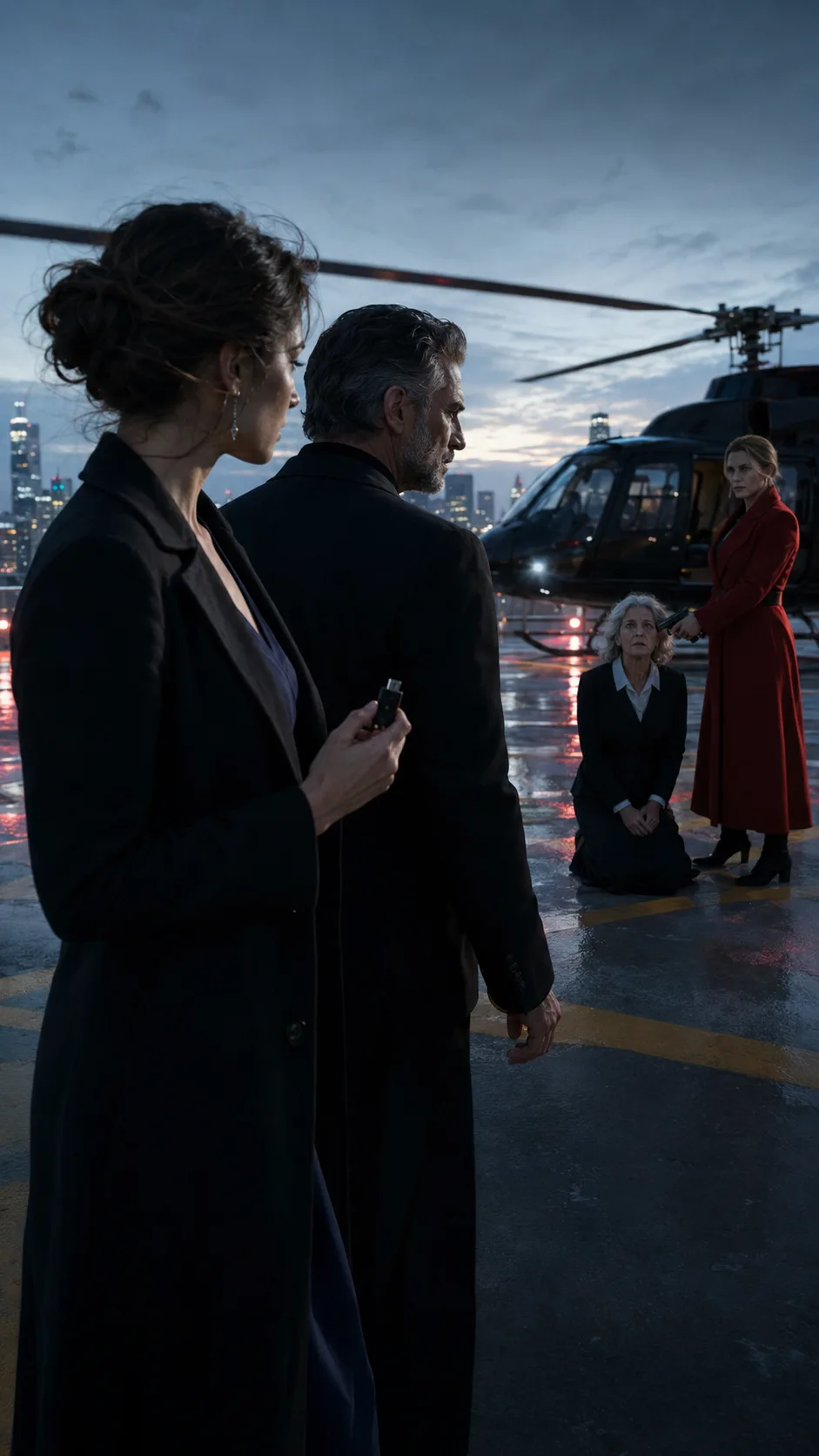
Elena stood on a rooftop helipad in a red coat, wind whipping the fabric against her legs. Behind her, a helicopter waited with blades barely moving. Men loaded crates into it.
Beside Elena, Rosa knelt on wet concrete.
A gun rested close to the old woman’s head.
Damiano’s face emptied.
Elena smiled into the camera.
“You always did love your ghosts, Damiano. Your dead wife. Your dead brother. Loyal little Rosa. How many beloved things must I threaten before you remember who taught you grief?”
Damiano moved.
Luca blocked the door.
“It’s a trap.”
Damiano’s voice dropped.
“Move.”
Arya caught his sleeve.
“Wait.”
Every man in the room looked at her.
Her heart hammered. Her palms were cold. But the fear had changed shape.
Elena wanted Damiano angry.
She wanted him alone.
She wanted the ledger still valuable because it was still hidden.
Arya looked down at Marcus.
Then back at the screen.
“Elena doesn’t want the truth destroyed,” she said. “She wants it owned.”
Damiano turned his head.
“So we don’t trade it,” Arya said. “We release it.”
Luca stared. “That exposes half the city.”
“Good,” Arya said. “Then half the city can panic.”
Father Matteo crossed himself in the corner.
“I like her.”
They moved fast after that.
The real ledger went to three journalists, two federal servers, and one international archive Father Matteo accessed through what he described as a confession with excellent Wi-Fi. Luca built a corrupted copy that looked real and carried a tracker. Enzo loaded weapons. Damiano checked every route to the helipad twice.
Arya changed into a dark coat over the midnight-blue dress Rosa had pressed for her.
Rosa was not there to fuss over the collar.
That made Arya’s hands pause.
Damiano saw.
“We will get her back.”
Arya looked at him.
“Don’t promise what you can’t choose.”
He accepted that with a nod.
“I will do everything I can.”
“That one I’ll take.”
He almost smiled.
Almost.
Before they left, Damiano said, “Stay behind me.”
“No.”
“Arya.”
“I stand beside you.”
He looked at her for a long moment.
Then nodded.
“Beside me.”
They reached the rooftop just before dawn.
The city below was blue and silver, still caught between night and morning. Wind cut across the helipad and pushed Arya’s coat against her legs. Red safety lights blinked on wet concrete. The helicopter blades turned behind Elena, slow at first, then faster, each rotation chopping the cold air into pieces.
Elena stood near the open helicopter door.
The red coat made her look unreal against the gray skyline.
Rosa knelt beside her with her hands folded in her lap. Her silver hair whipped across her face. She did not look at Damiano. She looked at Arya.
Once.
Then down.
The gun in Elena’s hand rested near Rosa’s head.
Damiano stopped ten yards away.
Arya stopped beside him.
Elena’s eyes went to the flash drive in Arya’s hand.
“Well,” Elena said. “The little star rises.”
Arya lifted the drive.
“Let Rosa go.”
Elena smiled. “Girls who survive one monster often mistake survival for authority.”
Damiano shifted half a step.
Elena pressed the gun closer.
“No,” Arya said.
The word came out clear.
Elena looked amused.
“No?”
Arya’s fingers tightened around the drive.
“You don’t want the ledger public. You want it controlled. You want to sell silence forever.”
The smile thinned.
“You learned a few words and think you understand a war.”
“I understand shame,” Arya said. “I understand what people do when they think it will keep someone quiet. You are not different. You are just richer.”
Luca moved somewhere behind them. Arya did not turn.
Elena’s gaze slid to Damiano.
“You always did choose women who thought they understood wars.”
Damiano’s voice cut through the rotor noise.
“I chose one woman. She died. The person standing there is only what crawled out.”
Elena’s face cracked.
Only for half a second.
But Rosa had spent a lifetime in Damiano’s house. She knew how to move when half a second opened.
She drove her elbow into Elena’s ribs and dropped.
The gun fired.
Arya shouted, but the wind swallowed the sound.
Damiano lunged. Luca appeared from the service ladder and fired once. One of Elena’s guards fell backward against the helicopter skid, weapon clattering across concrete. Enzo dragged Rosa away by the shoulders while she cursed at him in Italian for grabbing too hard.
Elena ran.
Her red coat flashed near the helicopter door. She turned with one hand inside her pocket.
The detonator was small and black.
Damiano stopped.
Everyone stopped.
Elena smiled.
Then she pressed it.
Nothing happened.
The helicopter blades kept turning.
The city kept breathing.
Elena looked down at the device.
Pressed again.
Still nothing.
The rooftop access door opened.
Father Matteo stepped out holding a fistful of disconnected wires.
“Forgive me,” he said. “I meddled.”
Elena’s smile vanished.
Arya saw it leave her face.
Power without performance.
Fear without costume.
Sirens rose from the streets below.
Elena turned toward the helicopter.
Damiano caught her wrist.
For one second, husband and wife stood locked in the wind. Twenty years of lies stretched between their hands. Elena stared at him with hatred so clean it almost looked like love turned inside out.
“This is not over,” she said.
Arya stepped forward.
Her knees shook.
She let them.
“Yes,” she said. “It is.”
Federal agents stormed the rooftop from three entrances. Voices shouted. Weapons rose. Luca pulled Damiano back before anyone could decide he belonged on the wrong side of a gun. Enzo lifted Rosa to her feet, and she slapped his hand away.
“I can walk.”
“You were kneeling with a gun at your head.”
“And now I am not.”
Father Matteo dropped the wires at his feet like dead snakes.
Elena did not scream when they restrained her.
She watched Arya.
That should have made Arya look away.
It didn’t.
By noon, the ledger had reached too many hands to bury.
By evening, the first judge resigned.
By midnight, the first banker tried to flee through a private terminal and was arrested before his passport cleared the scanner.
The city learned how much rot could hide under marble.
Names filled the news. Officers. ministers. men with charities named after dead wives. bankers who smiled beside children at galas while moving money for people who sold fear by the pound. Every day brought another resignation, another indictment, another door opened by someone who had thought locks were permanent.
Marcus Vale testified behind bulletproof glass.
Not because he had found goodness.
Fear had simply changed owners.
He gave names. Dates. accounts. He admitted he had been ordered to watch Arya, admitted he had kept her close because Elena believed Thomas Bennett’s daughter might one day lead them to the ledger.
When asked whether he had hurt her, he looked down.
“Yes.”
One word.
Still not enough.
Arya testified two weeks later.
That was harder than the rooftop.
The courtroom was packed. Reporters waited outside with cameras. Inside, Marcus sat in a gray suit at the defense table, his charm stripped thin by fluorescent light. He looked smaller than he had in the gala ballroom. More ordinary. That almost made him worse.
Damiano sat in the front row.
He did not smile for her. Did not nod dramatically. Did not perform protection for the room.
When Arya looked at him, he placed two fingers over his heart.
I am here.
Arya gripped the edge of the witness stand.
Then she spoke.
She told them about the car. The wrist. The bracelet. The messages. The way Marcus made leaving feel more dangerous than staying. She told them about the gala, the kiss, the safe room, the photograph taken while she slept.
Marcus’s attorney stood with a folder in one hand.
“Miss Bennett, you entered the relationship willingly, correct?”
Arya looked at Marcus.
Once, that question would have folded her inward.
Now she answered.
“I entered believing him. I stayed because leaving became dangerous. Those are not the same thing.”
The courtroom went quiet enough for the wall clock to sound too loud.
Elena wore white when she testified.
Of course she did.
She denied everything with grace. She spoke of grief, instability, confused loyalties. She called Damiano a violent man obsessed with ghosts. She called Arya a damaged girl seeking a new story. She described Marcus as weak. Rinaldi as dishonest. Rosa as confused by age.
Then the prosecutor played Thomas Bennett’s video.
Elena’s younger voice filled the courtroom.
Grief makes men obedient.
Damiano closed his eyes.
Arya watched his hand curl once, then open.
Elena did not scream when the verdict came.
That was almost worse.
She only turned her head toward Arya as the guards moved in.
“You still don’t know the best secret.”
The guards pulled her away.
Arya stood frozen.
Damiano came to her side.
“Do not let her live in your head.”
“What secret?”
“A lie, probably.”
But Luca’s face had gone pale.
Arya saw it.
So did Damiano.
The next morning, Luca drove them to a cemetery outside the city where cypress trees leaned over old stones and the grass held last night’s rain. Rosa came too, silent in the back seat, rosary wrapped around her fingers. Father Matteo followed in a second car because, according to him, secrets involving graves required supervision.
They stopped before a stone.
NICOLO RICCI
Beloved Son and Brother
Damiano stared at the name.
“What are we doing here?”
Luca swallowed.
“Elena wasn’t lying about everything.”
Authorities arrived before noon.
The coffin was opened under a gray sky.
Empty.
No bones. No clothes. No proof of death.
Only dust and a small silver saint medal lying in the corner.
Damiano did not speak.
Rosa sat down on a nearby bench as if her legs had been cut.
Arya stood beside Damiano, close enough that his sleeve brushed hers when the wind moved.
Finally, he said one thing.
“Find him.”
It took twelve days.
They found Nicolo Ricci in a seaside village two hundred miles south, living under the name Nico Bell, repairing boats near a harbor that smelled of salt, diesel, and fish. He walked with a limp. His hair had gone sun-brown at the edges. His hands were scarred from work. He had no memory of the first twenty-two years of his life.
Damiano saw him across the harbor road and stopped.
The man by the boats turned.
Same eyes.
Same jaw.
Older than the brother in the photographs, weathered and wary, but alive.
Damiano stepped off the curb.
“Nico.”
The man frowned.
Then his eyes dropped to the silver saint medal hanging from Damiano’s neck.
His own hand rose to his throat, where no medal hung.
“I had one like that,” he said.
Damiano crossed the distance and stopped before him like he had reached something sacred and did not know whether he was allowed to touch it.
Nico looked at him for another second.
His face changed.
Not memory.
Not fully.
Enough.
Damiano bent forward, not falling, not kneeling, but folding as if twenty years had finally found a door out of his body. Nico caught him with both arms.
Two brothers held each other beside the sea while gulls screamed overhead.
Arya turned away and wiped her face with the heel of her hand.
Rosa cried without hiding it.
Luca stared at the boats.
Father Matteo pretended to inspect a rope.
One year after the Harrington Gala, Arya returned to the forty-second floor.
The ballroom looked almost the same. Chandeliers. Marble. white orchids. Champagne. Glass walls holding the city at a distance. The quartet played near the staircase, not the same musicians but the same kind of song, soft enough for secrets to move under it.
Arya stood by the windows because she chose the view.
Not because she needed a corner.
Her dress was midnight blue again. Different cut. Simpler. Hers. Around her wrist there was no silver bracelet from Marcus. No chain disguised as a gift.
Only a thin gold band engraved with two words.
Stellina mia.
Nico had made it from melted gold found in Thomas Bennett’s old lockbox. Rosa had cried when Arya put it on. Father Matteo declared it acceptable craftsmanship, which everyone understood as praise.
Damiano stood near the marble column where she had first found him.
Black suit. Silver at the temples. Still terrifying to anyone with sense.
But when he looked at Arya, his face opened in a way the room did not deserve to see.
“You came back,” he said.
“I wanted to know if it still scared me.”
“And?”
Arya looked around.
The bar. The staircase. The place where Marcus had crossed the room. The table where her champagne glass had tilted and not fallen.
“No,” she said. “It doesn’t.”
Across the ballroom, a television above the bar showed a news segment about Marcus Vale’s sentencing. Twenty-eight years. No early release for half. Elena received longer. Rinaldi traded testimony for a smaller cage. Matteo left the city. Enzo stayed. Luca complained about everyone. Rosa ruled the brownstone with soup and judgment.
The city still had shadows.
But now light knew where to look.
Nico entered with Luca, leaning on a polished cane and laughing at something Rosa had said. He remembered pieces now. A childhood song. A hand pulling him from a car. Elena’s voice. Damiano’s medal. Enough to begin. Not enough to erase. But enough.
Damiano watched his brother for a long moment.
Arya watched Damiano.
He had begun dismantling pieces of his father’s empire quietly and without ceremony. Shell companies dissolved. old debts forgiven. dangerous partnerships ended in ways Luca described as “mostly legal.” Damiano did not become harmless. Harmless would have been another costume.
He became free in increments.
A senator crossed the room toward him with a smile prepared.
Damiano looked at the man once.
The senator changed direction.
Arya laughed.
Damiano looked at her. “What?”
“You enjoy terrifying powerful men.”
“I enjoy efficiency.”
The quartet began a waltz.
Damiano offered his hand.
Arya looked at it.
A year ago, his hand near her back had meant survival.
Now his open palm meant choice.
She placed her hand in his.
They moved slowly at first. People watched, of course. People always watched Damiano Ricci. Arya no longer felt like prey beneath chandeliers. The room did not shrink around her. The music did not hide anything. Her reflection in the glass looked like a woman standing where she meant to stand.
Halfway through the dance, Damiano stopped.
“I have something to ask you.”
Arya narrowed her eyes. “That sounds dangerous.”
“It is.”
“Ask.”
He lowered himself to one knee.
The entire ballroom quieted.
Arya forgot how to breathe.
But Damiano did not take out a ring.
He held up a small brass key.
Ordinary. Scratched at one edge. Warm from his palm.
Arya stared at it.
“What is that?”
“The house by the sea,” he said. “Nico found it. Rosa hates the plumbing. Luca says it is impossible to secure. Father Matteo wants a chapel in the garden, which he will not get.”
Arya laughed, and the sound broke.
Damiano looked up at her.
“I am not asking you to belong to me. I am asking where you want the morning to find us. If the answer is there, I will go. If the answer is somewhere else, I will follow. If the answer is not me, I will still make sure you are safe enough to choose it.”
The room blurred at the edges.
This was not a mafia king claiming a prize.
Not a frightened woman disappearing into his shadow.
It was a dangerous man kneeling with an ordinary key, offering not ownership, not rescue, not a locked room.
A door.
Arya took the key.
“Yes,” she said.
Damiano closed his eyes for one second.
Then Arya smiled.
“But I want the bedroom facing the water.”
His mouth curved.
“Done.”
“No guards inside the house.”
“Outside.”
“Far outside.”
A pause.
“Reasonably far.”
“Damiano.”
He sighed.
“Far.”
The ballroom erupted around them. Rosa wiped her eyes. Luca stared at the ceiling as if applause were personally inconvenient. Nico clapped with both hands above his head like a fool and grinned so widely Arya nearly cried harder.
Fireworks burst beyond the glass.
Gold. Blue. Silver.
For one second, Arya flinched.
Damiano felt it.
He did not tighten his hold.
He waited.
Arya breathed in.
Once.
Twice.
Then she turned toward the window and watched the sky bloom.
“I’m all right,” she said.
Damiano kissed her forehead.
“I know.”
Later, they left before midnight in a car that smelled like leather and cedar. The same scent as the first night. But Arya did not sit curled against the door. She sat beside Damiano with the brass key in her palm and the city falling away behind them.
At a red light, he looked at her.
“What are you thinking?”
Arya watched streetlights slide across the windshield.
“Marcus was wrong.”
Damiano’s face darkened at the name, but he only asked, “About what?”
She closed her fingers around the key.
“He thought hurting me made me smaller.”
The light turned green.
Ahead, the last line of city lights thinned toward black water and morning.
“It led me to the door.”
Damiano opened his hand across the seat.
Arya took it.
The car moved forward.
The sea waited. THE END.
Chapter complete
You have reached the end of this chapter.
Continue reading
A few more worlds to get lost in after this chapter.




