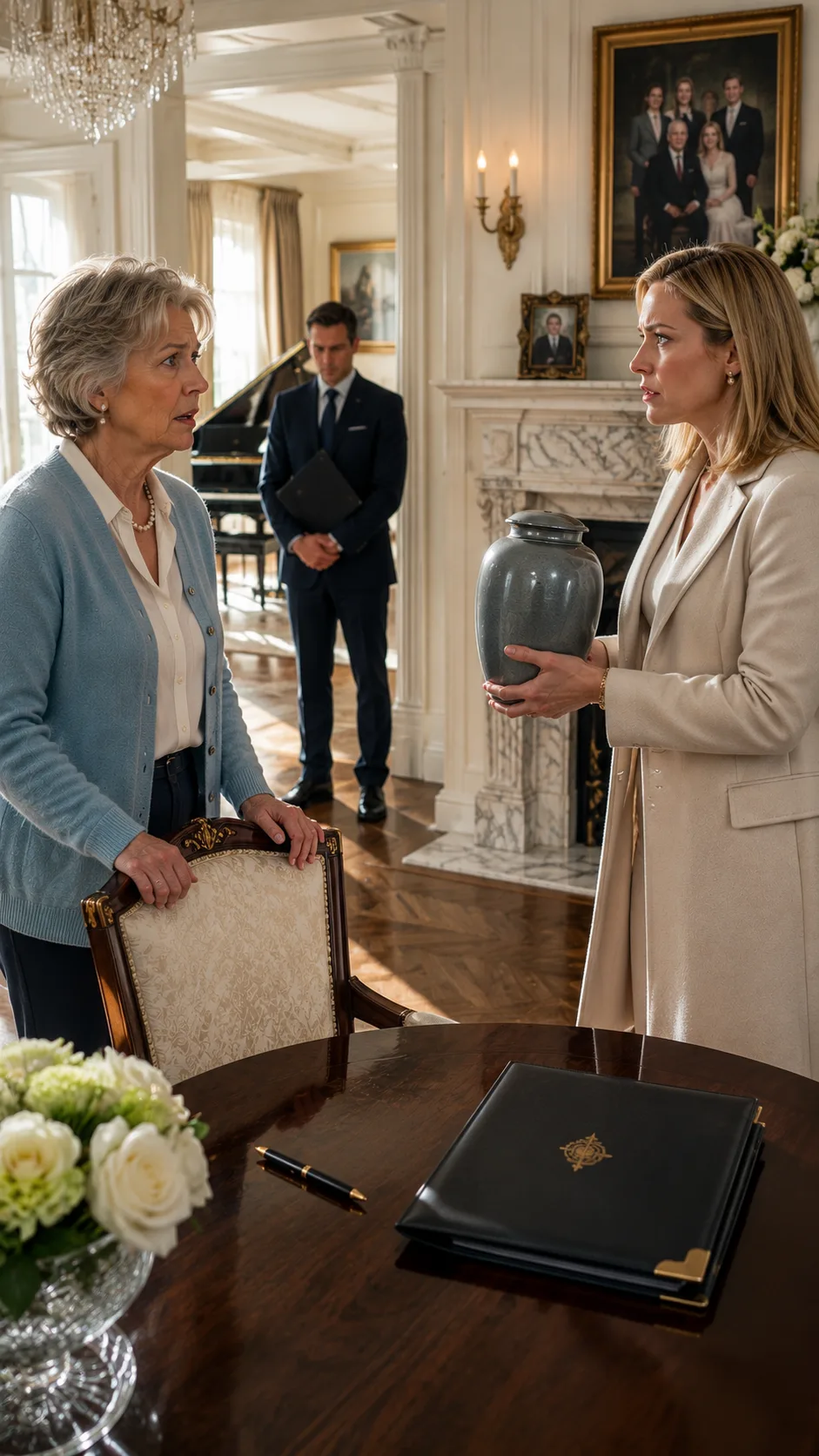
THE DAUGHTER WHO USED HER FATHER’S ASHES TO BREAK HER MOTHER AND UNCOVERED HIS FINAL WARNING
PART 3
Claire didn’t leave right away.
Chapter 2
THE DAUGHTER WHO USED HER FATHER’S ASHES TO BREAK HER MOTHER AND UNCOVERED HIS FINAL WARNING
PART 3
Claire didn’t leave right away.
She sat at my dining table with her head bowed, staring at the place where the urn had been. The papers she had brought were scattered in front of her now, no longer powerful. Just paper. Just ink. Just the evidence of a moment she could never take back.
Nathan stood by the mantel, one hand resting near his father’s urn but not touching it. Martin packed the estate folder slowly, giving our family the dignity of silence.
I wished William were there.
Then I looked at his photograph and realized he was.
His eyes smiled from the silver frame. The same eyes that had watched Claire take her first steps. The same eyes that had watched me put on lipstick for our fortieth anniversary and said, “Still the prettiest girl in Ohio.”
Claire lifted her face.
Her mascara had run. Her perfect cream coat was wrinkled at the sleeves
where she had gripped herself too tightly.
“Did he really think I would do this?” she asked.
Nobody answered at first.
The question was too small for the damage.
Finally, Martin said, “Your father hoped you wouldn’t.”
Claire flinched.
Nathan looked away.
I sat across from her.
“Claire, why didn’t you tell me about the debt?”
She wiped her cheek with the back of her hand.
“Because I knew how you’d look at me.”
“How?”
“Like this.”
I shook my head.
“No. This is how I look at someone who hurt me.”
Her chin trembled.
“I didn’t mean to hurt you.”
I glanced at the mantel.
“You moved your father’s ashes from their resting place and put them beside a pen.”
She closed her eyes.
“I know.”
“No,” I said softly. “You don’t get to know it quickly. You have to sit with it.”
Her eyes opened, wounded and angry.
“I said I know.”
“And I’m saying that isn’t enough.”
Nathan whispered, “Mom.”
I raised one hand.
Not to silence him harshly.
To ask him to let me be the woman William believed I could be.
For forty-two years, I had been the soft place in this family. The one who forgave first. The one who called back after cruel words. The one who smoothed arguments at Thanksgiving, sent birthday checks, pretended not to notice who visited and who only came when they needed something.
William used to say, “Ellie, kindness is holy, but don’t confuse it with surrender.”
I had confused it many times.
Not today.
Claire looked at Martin.
“There has to be something we can do.”
Martin’s face remained kind.
“The clause was clear.”
“But I didn’t make her sign.”
His eyebrows lifted.
The room stilled.
Claire heard herself.
Her mouth opened slightly.
I saw the exact
moment she realized what she sounded like.
Not sorry that she had done it.
Sorry that she had not succeeded.
She began crying harder.
“Oh God.”
Nathan turned toward her.
“Claire.”
She pushed back from the table.
“No. Don’t. Don’t comfort me. I heard it too.”
She stood, then nearly sat back down as if her legs couldn’t hold her.
“I heard myself.”
For the first time, I saw something break open that wasn’t performance, pride, or panic.
“I came in here thinking if I just made it emotional enough, you would give in,” she said. “I told myself Dad would understand. I told myself you were being selfish. I told myself a lot of things.”
Her eyes moved to the urn.
“But I knew. The second I touched it, I knew.”
I swallowed hard.
The truth hurts differently when it finally stops wearing excuses.
Martin cleared his throat gently.
“Eleanor, there is one more provision. It is not about Claire’s inheritance.”
I looked up.
He took out a smaller envelope.
“This is for you alone. But William asked that if both children were present, you may choose to read it aloud.”
My hands were tired from trembling.
Still, I reached for it.
The envelope had no dramatic message. Just my name.
My Ellie.
I opened it.
The letter smelled faintly of cedar, as if he had kept it in his desk drawer.
Ellie,
You stayed when I was proud.
You stayed when I was sick.
You stayed when the children grew up and thought our sacrifices were furniture they could move around.
If they forget what this house cost us, I want you to remember.
The house is not a prize.
It is not a cage.
It is not a burden.
It is the place where you became yourself.
If one day you want to sell it, sell it.
If one day you want to burn every curtain and move to Florida, do that too.
If you want to sit in my chair and yell at the television until you are ninety-six, I hope the neighbors hear you.
But let it be your choice.
Not grief.
Not guilt.
Not our children.
Yours.
I had to stop.
The words blurred.
Nathan was crying quietly now. He didn’t hide it.
Claire pressed her knuckles against her mouth.
I looked around the room.
The old blue sofa William hated but never let me replace because he said it “knew our shape.”
The mantel with the nick in the wood from the year Nathan threw a toy truck too hard.
The dining table where Claire had once spilled grape juice and sobbed because she thought her father would be mad, only for William to pour his own coffee beside it and say, “There. Now it has company.”
How had we gotten from that to this?
I folded the letter.
Then I looked at my daughter.
“I am not selling the house.”
Claire nodded quickly, crying.
“I understand.”
“No,” I said. “I need you to hear the rest.”
She looked up.
“I am also not paying your debt.”
The words hung there.
Nathan’s face shifted, but he said nothing.
Claire looked like I had struck her.
“Mom—”
“I will help you make calls. I will sit with you while you talk to creditors. I will help you find a smaller apartment. I will help you sell the clothes, the car, whatever illusion you bought trying to look unbreakable.”
Her tears fell faster.
“But I will not let your emergency become my erasure.”
She covered her face.
“I don’t know how to fix this.”
“Then start with the only thing that does not cost money.”
She looked at me.
“The truth.”
The room was quiet for a long moment.
Then Claire turned to Nathan.
“I told Aunt Linda Mom was confused.”
Nathan’s jaw tightened.
“I know.”
“I told people you were influencing her because you wanted the house later.”
He looked down.
“I figured.”
“I was jealous of you.”
That made him look up.
She laughed through tears, bitter and ugly.
“You never seemed to need anything. Dad trusted you. Mom relaxed when you came over. You could sit in silence and still belong. I always felt like I had to arrive with news, success, gifts, something.”
Nathan’s voice broke.
“Claire, I wasn’t trusted because I was better. I just showed up.”
She nodded like that hurt worse than an accusation.
Then she looked at me.
“I’m sorry,” she said.
I waited.
She took a shaky breath.
“I’m sorry I moved Dad’s urn.”
Another breath.
“I’m sorry I used your love for him against you.”
Another.
“I’m sorry I made your grief about my money.”
That one reached me.
Not enough to erase the wound.
Enough to let me breathe around it.
I nodded once.
“Thank you.”
Her face crumpled again, maybe because she expected forgiveness to rush in like a warm blanket. But forgiveness is not the same as repair. Forgiveness can begin in a second. Repair takes time, humility, and changed behavior when nobody is watching.
Martin left soon after.
Nathan walked him out.
Claire remained standing in the dining room, suddenly looking out of place in the house where she had grown up.
“Should I go?” she asked.
I looked at the mantel.
“Yes.”
She absorbed it like a sentence.
Then she nodded.
At the door, she stopped.
“Can I come back?”
I answered honestly.
“Not for a while.”
Her hand tightened around her purse strap.
“But someday?”
I thought of William’s letter. Do not hate her for being afraid. But do not rescue her from the consequences of becoming cruel.
“Someday,” I said, “if you come as my daughter. Not as someone looking for something to take.”
Claire began to cry again, silently this time.
Then she left.
The door closed.
Nathan came back into the room.
For a while, neither of us spoke.
Then he said, “Dad knew everything.”
I smiled through tears.
“Your father knew where I hid Christmas presents, when the car needed oil, and when someone was lying at dinner.”
Nathan laughed softly, then wiped his face.
“I should have checked on you more.”
“You came.”
“Not enough.”
I reached for his hand.
“Then come more.”
He nodded.
That evening, after Nathan left, I stood alone in the living room as the sun lowered behind the maple trees.
I lifted William’s urn carefully.
It was heavier than I remembered.
Or maybe I was just feeling the weight of everything it had almost become.
I placed it back on the mantel, centered between our wedding photograph and the small brass clock he bought at a yard sale in 1987 because he swore it had “character.”
Then I took the real estate papers Claire had left behind.
For a moment, I considered throwing them into the fireplace.
Instead, I put them in a drawer.
Not because I would sign them.
Because someday, I wanted to remember the day I almost disappeared to keep everyone else comfortable.
Weeks passed.
Claire moved out of her large townhouse and into a small apartment across town. She sold her car. She sent me one message after her first meeting with a financial counselor.
I told the truth today. It was awful. I’m still here.
I stared at the message for a long time before replying.
That is a beginning.
She did not ask for money.
That mattered.
Nathan started coming every Sunday with groceries I did not need and stories I pretended not to enjoy as much as I did.
Sometimes we sat in William’s old chair and talked to him like he had just stepped into the kitchen for coffee.
Three months later, a letter arrived from the William Carter Memorial Fund.
The first scholarship had been awarded to a nineteen-year-old woman named Maya whose parents had cut her off when she chose nursing school over the life they wanted for her.
Inside the envelope was a copy of Maya’s thank-you note.
I do not know who Mr. Carter was, but his gift made me feel less alone.
I sat down hard at the dining table.
The same table.
The same place.
But now, instead of papers trying to take my home, there was a letter proving William’s love had moved beyond it.
That night, Claire called.
Her voice was quiet.
“Mom, Nathan told me about the scholarship.”
I closed my eyes.
“Yes.”
She was silent.
Then she said, “Dad still helped someone.”
“He did.”
“Even with what I lost.”
I looked toward the mantel.
“No, Claire. With what you released.”
She cried then.
Not loudly.
Not dramatically.
Just enough for me to know she understood the difference.
“I miss him,” she whispered.
“So do I.”
“I miss who I was when he still believed in me.”
I looked at William’s photograph.
“He never stopped believing you could come back.”
Her breath shook.
“Do you believe that?”
I did not answer quickly.
The old me would have rushed to comfort her.
The woman William protected waited until the truth was ready.
“I believe you can become someone who never uses love as leverage again.”
Claire whispered, “I want to.”
“Then start there.”
A year after William died, we gathered in the living room on his birthday.
Not a party.
Just dinner.
Claire brought grocery-store flowers and placed them on the mantel without touching the urn. Then she stepped back and looked at me for permission.
I nodded.
She smiled through tears.
Nathan brought William’s favorite lemon pie, slightly burned at the edges. We ate it anyway.
After dinner, Claire stood by the fireplace.
“I wrote something,” she said.
Her hands shook as she unfolded a small note.
She read it aloud to her father.
Not to impress us.
Not to earn anything.
Just to tell the truth.
“Dad, I used your memory because I forgot what you taught me. I thought being desperate made me innocent. It didn’t. I’m sorry I hurt Mom. I’m sorry I made your ashes part of my fear. I’m trying to become the daughter you raised, not the woman grief exposed.”
When she finished, the room was silent.
I walked to the mantel and touched William’s photograph.
Then I turned to Claire.
“Thank you.”
She nodded, tears running down her face.
I did not say everything was fixed.
It wasn’t.
But the house felt different.
Not healed.
Healing.
Later that night, after both children had gone home, I sat in William’s chair with his final letter in my lap.
The house creaked around me the way old houses do, as if settling deeper into their own memories.
I looked at the urn on the mantel.
“You protected me one last time,” I whispered.
Then I smiled.
“No. That’s not true.”
The room was warm. The clock ticked. The photograph caught the lamplight.
“You taught me how to protect myself.”
For the first time since the funeral, I did not feel like a widow guarding ashes.
I felt like a woman still standing inside a life that belonged to her.
And on the mantel, beneath William’s photograph, I placed a new note in my own handwriting.
For the day I forget my own worth.
Then I turned off the light and left the room without looking back.
THE END.
Chapter complete
You have reached the end of this chapter.
Continue reading
A few more worlds to get lost in after this chapter.




