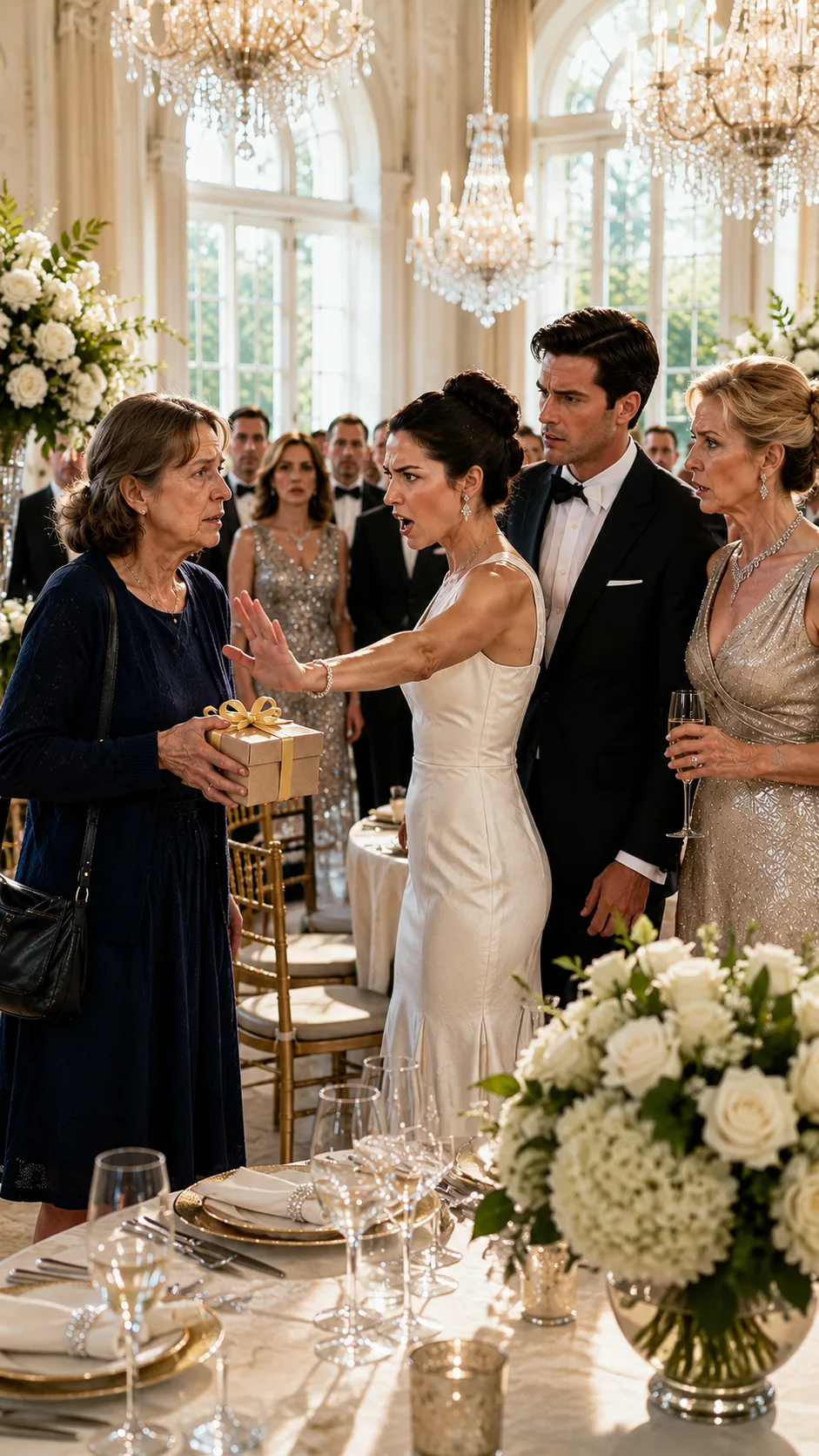
THE DAUGHTER WHO CALLED HER POOR MOTHER THE HELP AT HER ENGAGEMENT PARTY AND LEARNED WHO SAVED THE NIGHT
PART 3
I did not leave the ballroom right away.
Chapter 2
THE DAUGHTER WHO CALLED HER POOR MOTHER THE HELP AT HER ENGAGEMENT PARTY AND LEARNED WHO SAVED THE NIGHT
PART 3
I did not leave the ballroom right away.
That was what everyone expected, I think. A dramatic exit. A mother running out in tears. A daughter chasing after her. A room full of rich people whispering into champagne glasses.
But I had spent too many years working around people who looked through me to give them that kind of show.
So I picked up the cake box, held it carefully against my chest, and turned to Mr. Callahan.
“Cancel the extra champagne,” I said. “There’s already enough here.”
He nodded. “Of course, Mrs. Ellis.”
Lily flinched as if I had slapped her.
Maybe because it was the first time all night I had made a decision without asking whether it would upset her.
Evan stepped toward me. “Mrs. Ellis, I’m sorry.”
I shook my head. “You don’t owe me that.”
“I think someone does,” Diane said.
Everyone looked at Lily.
My daughter stood beneath a chandelier that made
her diamond earrings sparkle. She looked expensive. Beautiful. Terrified.
“Mom,” she whispered, “can we talk outside?”
I almost said yes.
A mother’s heart is a dangerous thing. It remembers every fever, every first step, every bedtime story. It will beg you to forgive before the wound even finishes bleeding.
But then I looked at the guests.
I looked at the flowers I had paid for.
I looked at the man Lily had promised to marry without telling him the truth of who she was.
And I said, “No. We can talk here.”
Lily’s lips parted.
Evan lowered his gaze, not to avoid the truth, but to give her room to face it.
Diane stood quietly beside me. Not in front of me. Beside me.
That mattered.
Lily took a breath. “I’m sorry.”
The words came too fast.
I waited.
She looked around the ballroom, then back at me. “I’m sorry
I said that. I panicked. I didn’t want people judging us.”
“Us?” I asked.
Her eyes flickered.
I nodded slowly. “No, Lily. You didn’t want people judging you.”
The silence after that was heavier than shouting.
She pressed both hands to her stomach. “You don’t understand what it feels like to walk into rooms like this and know everyone can tell you don’t belong.”
A sad laugh escaped me before I could stop it.
“I cleaned rooms like this,” I said. “I served food in rooms like this. I know exactly what it feels like when people decide where you belong before you open your mouth.”
Her face tightened.
“But I never taught you to be ashamed,” I continued. “I taught you to stand straight.”
Tears began to shine in her eyes.
Diane spoke then, calmly. “Lily, when I met your mother years ago, she was wearing a cafeteria apron.
I remember thinking she had more grace than half the donors upstairs.”
Lily looked crushed by that.
Evan turned to her. “Why did you tell me your mother didn’t come to your graduation?”
Lily’s head snapped up.
My breath caught.
She had told him that?
Evan’s voice trembled now. “You said she was too busy working.”
I felt the room tilt slightly.
I remembered that day with painful clarity. I had worked overnight, changed in a gas station bathroom, and arrived with wet hair because I did not have time to dry it. I sat in the back row so Lily would not see how tired I was. When they called her name, I clapped until my palms hurt.
Lily covered her mouth.
“Mom,” she whispered.
I stared at her. “You told him I wasn’t there?”
She could not answer.
That was answer enough.
A murmur moved through the guests.
Evan looked at me, his eyes glassy. “She said you never supported her dreams.”
I felt something inside me finally break cleanly.
Not loudly.
Cleanly.
Like a thread pulled so tight it simply snapped.
“I sold my wedding ring to pay for her first semester books,” I said.
Lily made a small sound.
“I worked Thanksgiving morning so she could fly to a college interview. I took buses across town to bring her a winter coat because she said the dorm heater was broken. I missed sleep. I missed meals. I missed years of my own life.”
My voice lowered.
“But I did not miss her graduation.”
Evan turned away for a second, pressing his fingers to his mouth.
Diane’s eyes were wet.
Lily looked smaller now, as if every expensive thing on her body had become too heavy to wear.
“I didn’t know how to explain you,” she said.
That sentence hurt worse than the first one.
I nodded. “Then let me make it easy.”
I stepped toward the center table and placed the cake box down. Slowly, I untied the yellow ribbon.
Inside was the lemon cake I had made before sunrise. The frosting was not perfect. One corner had smudged during the bus ride. It looked homemade because it was.
“When you were little,” I said, “you asked for this cake every time you had a bad day. You said it made the world feel kind again.”
Lily was crying openly now.
I closed the box.
“Tonight, I think I’ll take it home.”
She stepped forward. “Please don’t.”
I looked at her hand reaching for mine, and for the first time, I did not automatically take it.
“I love you,” I said. “But I will not stand in a room I paid for and pretend I am invisible so you can feel important.”
Evan removed his hand from Lily’s back.
It was a small movement.
But everyone saw it.
Lily turned to him, panicked. “Evan, please. This isn’t who I am.”
He looked at her for a long time.
“I think this is exactly who you became,” he said. “And I don’t know if you want to change, or if you only regret being seen.”
She sobbed once, hard.
The ring on her finger flashed under the chandelier.
He did not ask for it back. He did not make a scene. He simply stepped away, and somehow that was worse.
Diane touched my arm. “Margaret, would you allow me to have a slice of that cake with you somewhere quieter?”
I looked at her, surprised.
She smiled gently. “I have trusted expensive food all my life. Tonight, I’d rather trust the woman who sat with me in a hospital hallway.”
Lily broke.
“Mom,” she cried, “I’m sorry. I’m so sorry.”
This time, the words sounded different.
Not polished.
Not useful.
Just raw.
I wanted to hold her. God help me, I did. But love without consequence had helped build this moment. Every time I rescued her from discomfort, I taught her someone else could carry the weight.
So I said, “Then start by telling the truth.”
She wiped her face with shaking fingers.
Then she turned to Evan, to Diane, to the guests, and finally to me.
“My mother was at my graduation,” she said, her voice breaking. “She was at every important day. I lied because I thought poor sounded like shame. But the shame was mine.”
No one applauded.
Thank God.
This was not a performance anymore.
It was only a daughter standing in the wreckage of the image she had built, finally seeing the woman buried beneath it.
I left the ballroom with Diane beside me and my lemon cake in my arms. Evan stayed behind, not close to Lily, not far either. Maybe there was still a future for them. Maybe there wasn’t. That was no longer mine to fix.
Three weeks passed before Lily came to my apartment.
I saw her through the peephole standing in the hallway wearing jeans, a plain sweater, and no makeup. Her hair was pulled back like it used to be when she studied at my kitchen table.
In her hands were two things: a small envelope and a pair of sensible black shoes.
When I opened the door, she did not rush in.
“I’m not here to be forgiven today,” she said. “I’m here to start paying you back.”
I looked at the envelope.
“It’s the first part,” she said quickly. “For the party. And I called the clinic. Your surgery consultation is back on the calendar.”
My throat tightened.
She lifted the shoes slightly. “And these are not enough. I know that. But I remembered yours hurt your feet.”
For a moment, I saw both versions of her.
The woman who denied me under a chandelier.
And the little girl who once cried because my hands were cracked from winter soap.
I stepped aside.
Lily stared at the open doorway as if she did not deserve it.
Maybe she didn’t.
But healing does not begin with deserving. It begins with truth.
She walked into my small kitchen and stopped when she saw the lemon cake on the counter.
I had made another one that morning.
Not because I knew she was coming.
Because some part of me hoped she would.
Lily covered her mouth, and her chin shook.
“I don’t deserve a slice,” she whispered.
I took down two plates.
“No,” I said. “But you can earn the next one.”
She laughed through tears, then cried harder.
We sat at my old kitchen table, the same table where I had filled out her school forms, braided her hair, and counted quarters for bus fare. She told me the truth about her debt. About the pressure she felt. About the lies that had gotten easier each time she told them.
I listened.
I did not excuse her.
I did not rescue her.
But when she reached across the table, I let her hold my hand.
Outside, the city moved on. Somewhere, chandeliers were glowing over people pretending to be better than where they came from.
But in my kitchen, my daughter took one bite of lemon cake and began to cry like a child who had finally found her way home.
THE END.
Chapter complete
You have reached the end of this chapter.
Continue reading
A few more worlds to get lost in after this chapter.




