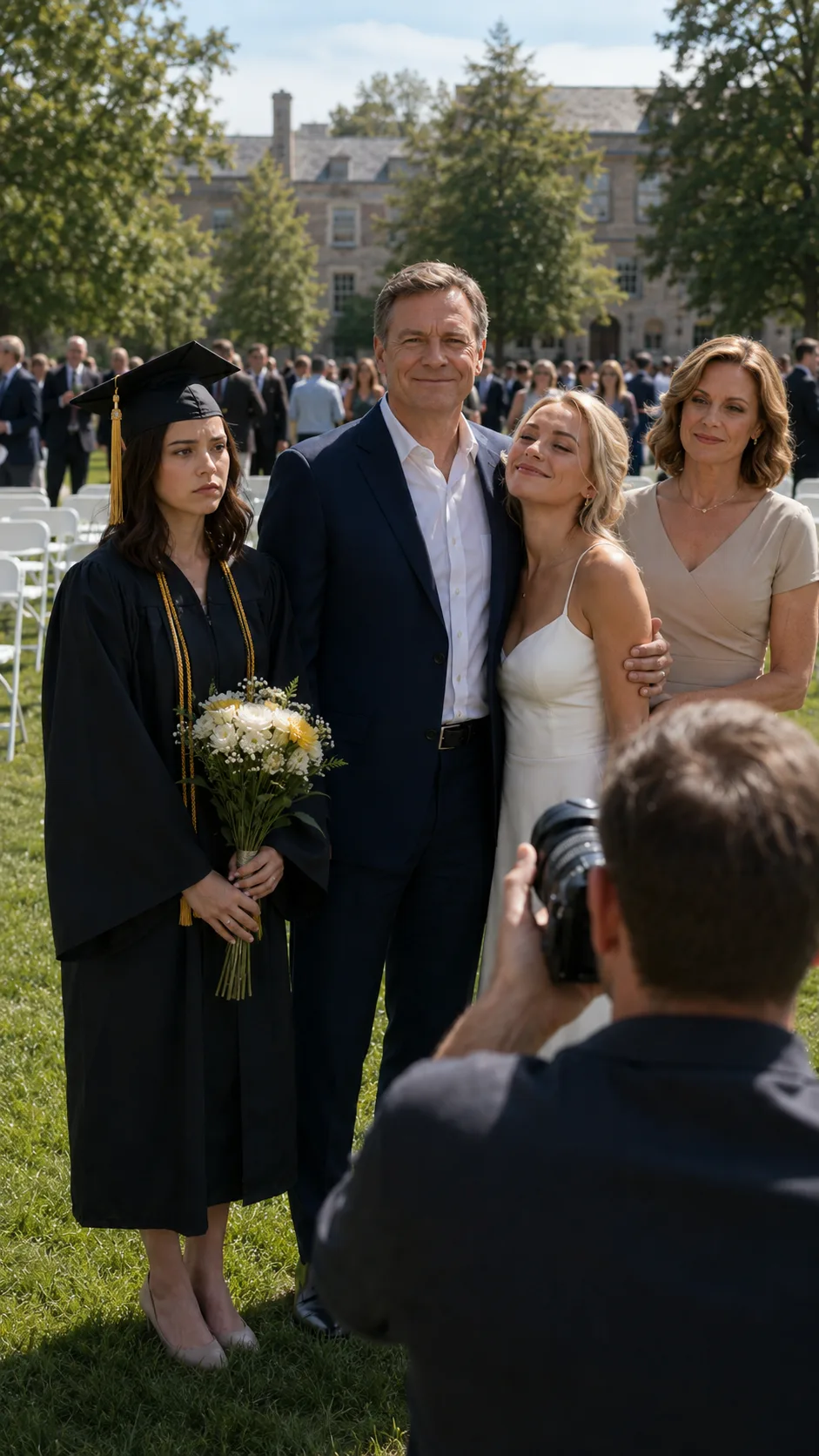
THE DAUGHTER HE PUSHED OUT OF THE GRADUATION PHOTO WAS THE ONLY REASON HIS NEW FAMILY COULD SMILE
PART 3
“I didn’t know it was this much.”
That sentence hung between us like smoke.
Chapter 2
THE DAUGHTER HE PUSHED OUT OF THE GRADUATION PHOTO WAS THE ONLY REASON HIS NEW FAMILY COULD SMILE
PART 3
“I didn’t know it was this much.”
That sentence hung between us like smoke.
For a second, I just stared at him.
My father stood there in his navy suit, the same suit he had worn to my mother’s funeral, though it fit tighter now and looked less certain on him. His hands shook around the statements. His face had collapsed into something older than fifty-three.
But I could not comfort him.
Not anymore.
“That’s what you’re sorry about?” I asked.
He blinked. “Lena, no. That’s not what I meant.”
“It is exactly what you meant.”
He took one step closer. “I was overwhelmed. After your mother died, I didn’t know how to raise you alone. Then Marissa came in, and Cassie—”
“Needed everything I had?”
His mouth opened, then closed.
I nodded slowly. “That’s what I thought.”
He looked past me, toward the courtyard where our relatives were gathering in tight circles, whispering. Marissa stood near a stone pillar, one hand gripping Cassie’s
wrist. Cassie was crying openly now, but she kept glancing at the papers in Dad’s hand like she was watching her life burn.
“You don’t understand what it was like,” Dad said quietly. “Marissa made me feel like if I didn’t help Cassie, I was failing as a father.”
I felt something inside me snap, but not loudly.
It was quieter than that.
Cleaner.
“You were failing as a father,” I said. “Just not to her.”
His eyes filled.
“Lena…”
“No. You don’t get to say my name like that today.”
He looked down.
“For two years,” I said, “you told me I had enough. Enough love. Enough memories. Enough advantages. Enough strength. Every time Cassie wanted something, you made my mother’s death sound like a privilege.”
Dad’s face twisted.
“I never meant—”
“You said Mom would want me to be kind,” I interrupted. “But you never asked what Mom
wanted for me.”
That finally silenced him.
Because we both knew.
Mom had written it down.
Not just in the trust.
In letters.
Mr. Hale had given them to me after I turned twenty-two. Three cream-colored envelopes in my mother’s handwriting. One for my first apartment. One for my graduation. One for the day I felt alone.
I had opened the graduation letter that morning before the ceremony.
My sweet Lena,
If you are reading this, you made it. I wish I were there to fix your collar, embarrass you with too many pictures, and tell every stranger within five feet that my daughter is brilliant.
Do not shrink to make anyone comfortable.
Do not confuse sacrifice with love.
And never let anyone spend your future to buy their peace.
I had cried for exactly five minutes.
Then I put on my cap and gown.
Now, standing in front of
my father, I understood that Mom had known something I hadn’t.
Love could become theft if the wrong person used it as a reason.
A sharp voice cut across the lawn.
“This is ridiculous.”
Marissa was walking toward us now, Cassie behind her, wiping under her eyes without ruining her mascara. My aunt Rebecca followed, and behind her came Grandma Moore, moving slowly but with a face I had never seen on her before.
Marissa stopped beside Dad.
“This has gone far enough,” she said. “Lena, you made your point. You embarrassed everyone. Now you need to calm down and stop punishing Cassie for adult decisions.”
I looked at Dad.
He said nothing.
Even now.
Even after everything.
Marissa still spoke first, and he still let her.
I turned to her. “Cassie is twenty-two. Same as me.”
Cassie’s mouth trembled. “I didn’t ask for all of this.”
I pulled another paper from my folder.
“No, you just sent your mom a spreadsheet.”
Cassie froze.
Marissa’s eyes flashed. “What spreadsheet?”
That was new.
Interesting.
I handed the page to Grandma Moore, not Dad.
Grandma read it once, then looked up with disgust.
“What is this?” Dad asked.
I answered without looking away from Cassie.
“Cassie made a list of everything she wanted covered before my access changed. Summer tuition. Apartment renewal. Car upgrade. Sorority dues. A trip to Miami. She labeled it ‘before graduation deadline.’”
Dad turned slowly toward Cassie.
For the first time that day, Cassie looked genuinely scared.
“Cassie,” he said. “Is that real?”
She pressed her lips together.
Marissa grabbed the paper from Grandma. Her face drained as she read it.
That was twist number one for her.
She had thought Cassie was only receiving.
She had not known Cassie was planning.
“I was stressed,” Cassie whispered.
Dad’s voice broke. “You knew?”
Cassie looked at him, tears spilling now. “Mom said Lena wouldn’t need it like I did.”
Marissa snapped, “Do not put this on me.”
Cassie whipped toward her. “You told me he owed us!”
The courtyard went silent again.
Dad staggered back half a step.
I watched the words hit him.
Not because Cassie had taken the money.
Because Cassie had said us.
Not family.
Not Lena.
Us.
Marissa’s face sharpened. “I said he owed us stability after dragging us into a house full of grief.”
Grandma Moore gasped. “Dragging you?”
Marissa turned on her. “Yes. Do you know what it was like living under Elaine’s shadow? Her photos everywhere. Her daughter acting like the house was a museum. David couldn’t even buy Cassie a coat without Lena looking wounded.”
I almost laughed.
A coat.
She meant my mother’s camel coat, the one Cassie wore to Thanksgiving after Marissa told me, “It looks better on someone with confidence.”
Dad stared at Marissa like he was seeing her face from a different angle.
“You said Lena offered that coat,” he murmured.
Marissa’s mouth closed.
Aunt Rebecca stepped forward. “David, she didn’t offer the room either. I was there. Lena cried in the kitchen after you told her to pack.”
Dad looked at me.
“You cried?”
I hated that question more than all the others.
Because it proved how absent he had been.
“Yes,” I said. “Quietly. So you wouldn’t call me dramatic.”
His hands dropped to his sides.
Cassie suddenly spoke, voice small. “So what happens to me now?”
Everyone looked at her.
There it was.
Not “I’m sorry.”
Not “Lena, I hurt you.”
Just fear of the bill finally coming due.
I took the final envelope from my bag. Not a legal notice. Not a threat. Just a letter from Mr. Hale confirming that the fund was now under my control and that all recurring withdrawals not approved by me had been canceled.
I handed it to Cassie.
She read the first lines and began shaking her head.
“No. Lena, please. My apartment—”
“Canceled after this month.”
“My classes—”
“You can apply for financial aid.”
“My car—”
“My car,” I corrected.
She looked at Dad. “Do something.”
Dad did not move.
Maybe he couldn’t.
Maybe he finally understood that every time he had “done something” for her, he had done it with my mother’s hands.
Marissa grabbed Dad’s arm. “David, you cannot let her do this.”
He looked at Marissa’s hand on his sleeve.
Then he gently removed it.
It was the smallest movement.
But it was the first time I had ever seen him choose silence against her instead of me.
Still, it came too late to save anything.
“Lena,” Dad said, turning back to me, “what can I do?”
I thought of the little girl I had been, sitting between Mom and Dad at school plays. I thought of Mom squeezing my hand whenever Dad cheered too loudly. I thought of the first birthday after she died, when Dad forgot cake but cried in the garage until midnight.
I had loved him through all of it.
That was the tragedy.
Not that he had become cruel overnight.
But that he had slowly taught me to survive him.
“You can stop calling it helping,” I said. “You can tell the truth.”
His face tightened.
“To who?”
I looked toward the family.
“To everyone.”
Marissa said, “Absolutely not.”
Dad closed his eyes.
For a moment, I thought he would fold again.
Then he turned.
Our relatives stood in a loose circle beneath the bright afternoon sun. The photographer had lowered his camera. Students passed around us, pretending not to stare.
Dad lifted the papers.
“My daughter is telling the truth,” he said.
Marissa made a strangled sound.
Dad’s voice shook, but he kept going.
“I used money Elaine left for Lena. I told myself I was helping my new family. I told myself Lena was strong enough to understand. But I was wrong.”
His eyes found mine.
“I didn’t protect my daughter’s future. I spent it trying to look like a good man.”
Nobody spoke.
Grandma Moore covered her mouth.
Aunt Rebecca wiped her eyes.
Cassie stared at the grass.
Marissa looked furious, but beneath the fury was fear, because the story she had built around herself had just lost its narrator.
Dad walked toward me and held out the papers.
Not like an offering this time.
Like he was returning something heavy.
“I’m sorry,” he said.
The apology landed softly.
Too softly to fix the damage.
But not so softly that I could pretend it meant nothing.
I took the papers.
“Thank you for finally saying it.”
His face broke a little. “Can we start over?”
I looked at him for a long time.
Behind him, Cassie was sitting on the edge of the fountain, crying into her hands. Marissa stood over her, whispering harshly, probably already rewriting the story. Grandma Moore watched me like she wanted to run over and hold me, but knew I needed to stand alone.
“No,” I said.
Dad’s breath caught.
“We can’t start over. Mom is gone. The money was spent. The room was taken. The car was taken. The graduation photo was taken before I even got to smile.”
His eyes shone.
“But,” I said, “you can start telling the truth from here.”
It was not forgiveness.
Not yet.
Maybe not ever.
But it was the only door I could leave unlocked without betraying myself.
Three weeks later, I moved into a small apartment twelve minutes from the hospital where Mom had worked. The furniture was secondhand. The kitchen table had a scratch down the middle. The window faced a brick wall.
But every key on that ring belonged to me.
The Honda came back with Cassie’s perfume still in the seats and glitter in the cup holder. I had it cleaned, changed the registration, and hung Mom’s tiny blue tassel from the mirror again.
Cassie emailed me once.
It was not an apology.
It was three paragraphs about how hard her life had become and one sentence near the end that said, “I guess I didn’t think about what it felt like for you.”
I did not answer.
Marissa left Dad two months later after Grandma Moore refused to let her attend Sunday dinner and Dad stopped paying Cassie’s bills. I heard it from Aunt Rebecca, who said it carefully, like she was afraid I would break.
I didn’t.
I had already broken in quieter rooms.
Dad called every Sunday.
At first, I let it ring.
Then I answered once a month.
Then, one evening in October, he asked if he could bring me a box from the attic.
I almost said no.
But something in his voice sounded smaller now. Not performative. Not wounded to make me feel guilty.
Just tired.
He arrived at my apartment holding a cardboard box taped at the corners.
“I found these behind the Christmas bins,” he said.
Inside were Mom’s photo albums.
Not the ones Marissa had moved into storage.
The old ones.
My first steps. Mom in scrubs. Dad holding me at a county fair. Mom laughing in the passenger seat of the blue Honda when it was still hers.
At the bottom was a photo I had never seen.
Mom, Dad, and me at my kindergarten graduation.
I was in the center.
Dad had one hand on my shoulder.
Mom had written on the back: Our girl gets the middle. Always.
I stared at those words until they blurred.
Dad saw them too.
He sat at my scratched kitchen table, covered his face with both hands, and cried without asking me to comfort him.
That was the first honest thing he had done in years.
I put the photo in a frame.
Not because everything was healed.
Because something had been returned.
The following spring, my college mailed the official graduation portraits.
There was one photo from the courtyard.
The photographer had taken it at the exact second after I spoke.
Cassie stood in the center, pale and frozen.
Marissa’s mouth was half open.
Dad held the first statement in his hand, eyes wide with the beginning of understanding.
And I stood just outside the frame, my cap tilted slightly, my face calm, my mother’s necklace catching the sun.
I ordered a copy.
Then I placed it behind the kindergarten photo.
Not hidden.
Just second.
Because that was the truth of my life.
My father pushed me out of one frame.
But my mother had already given me the strength to build another.
And this time, nobody else stood in the center of it but me.
THE END
Chapter complete
You have reached the end of this chapter.
Continue reading
A few more worlds to get lost in after this chapter.




