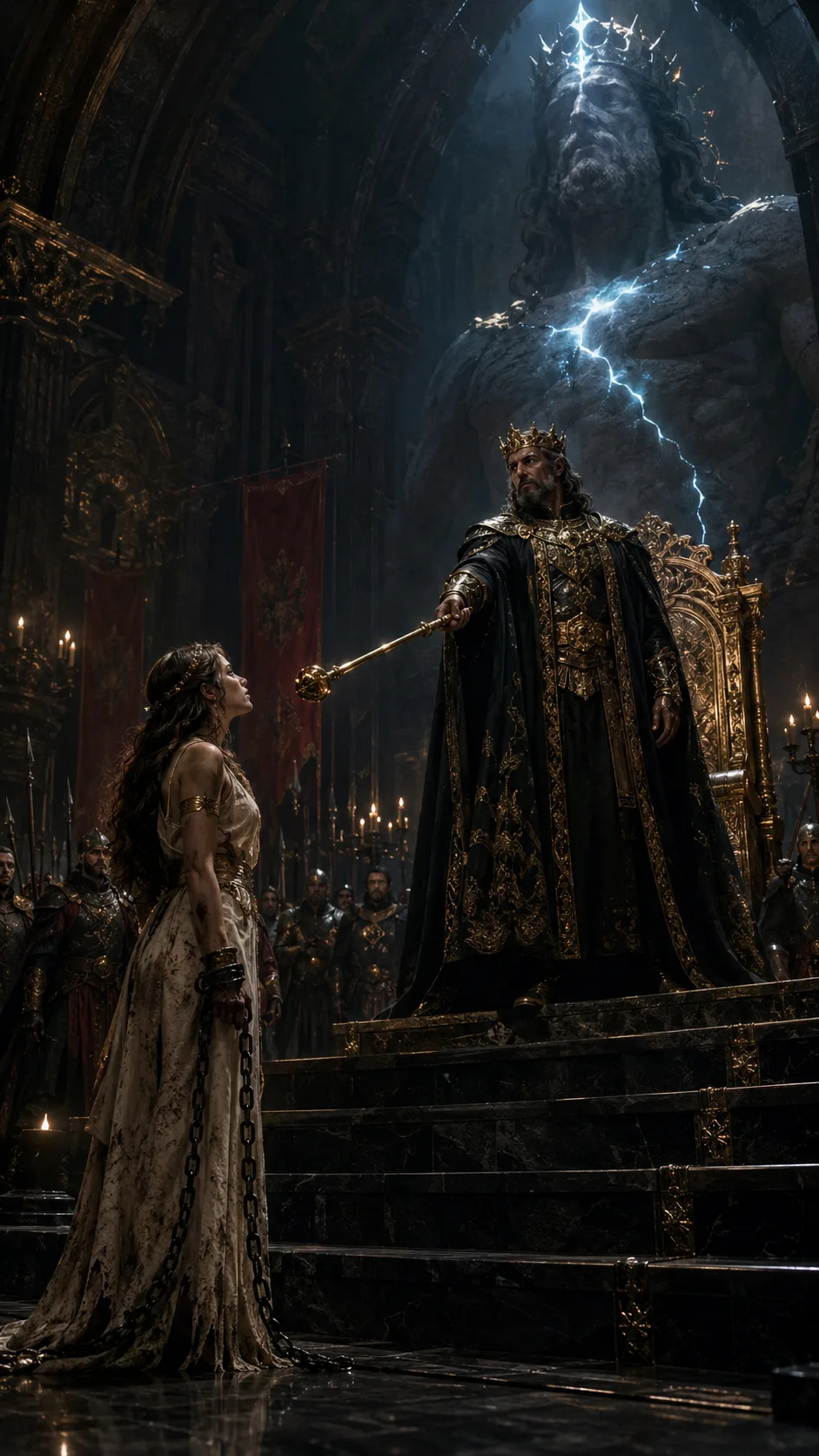
The chain cut into Elara’s wrist before the first horn finished sounding.
Chapter 1
The chain cut into Elara’s wrist before the first horn finished sounding.
She kept walking.
The guard beside her yanked too hard on the iron lead, and the cuff scraped bone through skin already rubbed raw from three days in the lower cells. He wanted her to stumble. He wanted the court to see her dragged, not escorted. The hall ahead was full of people who had learned to understand small performances like that.
Elara did not give him the fall.
Her bare feet crossed the black marble, leaving faint gray prints from the ash still clinging to her soles. The floor had been polished until it reflected the torchlight in long broken lines. Above her, red banners hung from the rafters, each one embroidered with the golden sunburst King Malrec had forced onto temple doors after the old symbols were chiseled away.
A sun for a man.
That was new.
At the far end of the hall, Malrec sat on the
Dawn Throne with one hand resting on a golden scepter and the other on the armrest carved from white dragonbone. He wore a crown too heavy for any sane king to wear indoors, its points shaped like flames. Rubies sat in each point like drops of trapped fire.
He did not look at Elara first.
He looked at the crowd.
That was how he ruled.
He always made sure people saw him being obeyed.
The nobles stood in arranged rows below the throne steps, sorted by rank, bloodline, and usefulness. House Ardent in crimson. House Vel in gray silk. House Corwyn in dark green, their old matriarch gripping a cane carved with ravens. Commanders stood behind them in ceremonial armor, their swords peace-bound with gold thread so thin it would snap with one pull.
Priests stood nearest the wall.
Not many.
Not anymore.
Their white robes had been trimmed with
Malrec’s sunburst, though Elara noticed several had sewn it badly, with loose threads visible near the hem. One priest had ink on his thumb. Another kept touching the place on his chest where the old prayer-stone should have hung.
Small defiance.
Tiny enough to survive.
The guard jerked the chain again.
Elara stopped at the base of the throne steps.
A murmur rolled through the court and died almost at once.
Malrec smiled.
It was a careful smile, made for distance. Calm enough for the back rows. Warm enough for fools. Sharp enough for the people close enough to see the line of his teeth.
“Oracle,” he said.
The word traveled across the hall like a coin thrown onto stone.
Elara lifted her head.
The last time someone had called her that without mockery, she had been twelve years old, kneeling in the Temple of the Handless God while old
Sister Maerin painted ash across her eyelids. Back then, the god behind the altar still had both stone hands. Back then, kings still bowed before judgment.
Back then, Malrec was only a general.
A popular one.
The guard shoved her shoulder. “Answer him.”
Elara looked past Malrec, toward the statue behind the throne.
The court had been built around it seven hundred years earlier. A seated figure of gray mountain stone, taller than the palace gates, older than the royal line itself. The God of Oaths, some called him. The God of Judgment, others said. His true name had not been spoken in public since Malrec’s fifth year on the throne.
The statue’s hands were gone.
Malrec had ordered them removed after the eastern rebellion. He said the kingdom needed no stone fingers pointing blame from the past. The broken wrists still jutted from the statue’s arms, rough and pale where the chisels had bitten.
Elara looked at those wounds.
Malrec noticed.
His smile thinned.
“Do you like what I have done with the hall?” he asked.
No one laughed until he did.
Then laughter appeared in several places at once, weak and obedient. A nobleman near the front gave too much of it and stopped when his wife touched his sleeve.
Elara said nothing.
The king rose.
Every soldier in the hall struck spear butts against marble.
One sound.
Hard.
The gold crown caught the torchlight as Malrec descended the first step. He was not as tall as the statues made him, but his robes added breadth, and his armor was polished to a dark mirror shine. The scepter in his hand was new. Elara had never seen it before the guards dragged her from the cell that morning.
At its head sat a round amber stone.
Not amber.
Temple glass.
Her fingers went still inside the cuffs.
Malrec saw that too.
“Ah,” he said. “You recognize it.”
The priests by the wall lowered their heads.
He turned the scepter slightly so the glass caught the firelight. Inside the golden cage of its setting, the temple glass glowed honey-red. It had once hung above the inner altar of the old sanctuary, the place where oracles stood when they gave judgment under oath. No king had been allowed to touch it.
Malrec had set it into a weapon.
No.
Not a weapon.
A prop.
That was worse.
“This was wasted in darkness,” he said. “Locked above a stone nobody answered. Now it serves the living power of the realm.”
A girl in the second row pressed a hand over her mouth. Her mother pulled it down.
Elara looked at Malrec’s hand around the scepter.
There was a burn scar across his thumb.
Small.
Fresh.
The glass had burned him.
He had touched it and been marked.
Malrec raised the scepter higher. “Today, the kingdom ends an age of superstition.”
The herald near the left pillar unrolled a parchment. His hands shook badly enough that the bottom edge fluttered. Elara could see black wax at the seal. The royal decree.
She knew the shape of it.
She had copied enough decrees in temple archives before the purge. Decrees of tax, war, marriage, succession. None had ever required every noble house, commander, and surviving priest to attend.
This one did.
The herald swallowed. “By will of His Radiant Majesty, Malrec the First, Sword of Dawn, Protector of the Realm, Living Vessel of Divine Judgment—”
A priest made a sound.
Not loud.
Only a breath catching wrong.
Malrec’s eyes moved.
The priest went rigid. Young. Too young to have learned how much danger a breath could carry. His robe had been washed until the fabric had gone thin at the elbows. Ink-thumb priest.
Malrec lifted one finger from the scepter.
Two guards stepped away from the wall and took the priest by both arms.
No shouting.
No struggle.
The court watched the guards drag him toward a side door. The priest’s sandals scraped the floor in short uneven strokes.
Elara counted them.
Five.
Six.
Seven.
The door closed.
Malrec turned back to the herald. “Continue.”
The herald’s voice came out smaller. “Living Vessel of Divine Judgment, chosen and embodied by the power once worshiped falsely in stone, hereby declares all remaining temple orders dissolved, all oracle bloodlines subject to crown oversight, and all oaths sworn henceforth to the king alone.”
The marble seemed colder beneath Elara’s feet.
All oracle bloodlines.
That meant children.
Cousins.
Old women hidden in barns.
Boys with dreams they had not told anyone.
Malrec had not brought her here for confession.
He had brought her here for permission.
The parchment trembled in the herald’s hands.
Malrec descended another step.
“Look at me, Oracle.”
Elara did.
His face had aged since the last time she saw him through smoke at the temple gates. There were deeper lines beside his mouth now, and silver near his temples. But the eyes were the same. Pale, measuring, patient when patience served him.
“You were found beneath the eastern crypt,” he said. “With temple records, forbidden relics, and names of surviving rebels.”
Elara’s chains hung still.
The records had been prayer lists.
The relics had been broken bowls.
The names had been children marked for food during winter.
Malrec tilted his head. “You deny this?”
A line of guards shifted behind her.
Elara said nothing.
One of the commanders cleared his throat. Lord Rovan. The man who had burned three villages for refusing crown tax and called it pacification. “Your Majesty, perhaps the oracle should be made to kneel before she answers.”
Malrec smiled toward him. “She will.”
The court liked that.
A little.
Enough to breathe again.
He descended to the third step, close enough now that Elara could smell incense oil on his robe and metal polish on his armor. The scepter’s amber glass pulsed faintly in the torchlight, but not in rhythm. It flickered like a coal smothered under ash.
He noticed her watching it.
“The temple lied to you,” Malrec said. “They told you power chose the worthy. Power chooses the hand strong enough to hold it.”
He raised his scarred thumb slightly.
Elara saw the skin split where the burn had not healed.
A smile pulled at her mouth before she could stop it.
Not much.
Enough.
The court noticed before Malrec did.
Then he saw.
His hand tightened around the scepter. “You find something amusing?”
Elara looked from his thumb to the statue behind him.
The broken god watched over the hall with blind stone eyes. Dust had gathered in the grooves of his beard. One of the removed hands lay somewhere in the royal quarry, according to rumor. The other had been melted down.
Stone could not melt.
Malrec had lied even about that.
“You cannot hold it,” Elara said.
The hall went quiet.
Too quiet.
The kind that had edges.
Malrec’s face did not change, but the burn across his thumb whitened under pressure.
“Speak carefully.”
Elara lifted her wrists. The chain between them hung in a dark curve. “The glass burned you.”
A nobleman near House Vel looked at the scepter.
So did the matriarch with the raven cane.
So did three priests at the wall.
Malrec’s hand moved, small and fast, hiding the burn along the scepter’s shaft. “Temple poison,” he said. “A trick left by cowards.”
“Temple glass does not burn flesh,” Elara said. “It rejects false oaths.”
Rovan laughed first. Loud. Forced. “A convenient superstition.”
Others joined late.
Elara kept looking at the king.
Malrec came down another step.
Now only one step separated them.
“You were a child when the temple fell,” he said. “A frightened little girl breathing smoke under a broken altar.”
Her fingers curled.
There it was.
He had not been in the inner sanctuary that night.
No soldier had.
Only the one who gave the order from outside the bronze doors would know where the children hid. Only the one who waited until the priests sealed the altar from within would know smoke reached the lower crypt first.
Elara looked at him.
Malrec’s mouth paused on the next word.
He knew.
One beat too late.
The matriarch with the raven cane leaned forward slightly.
Elara did not speak.
Not yet.
Malrec recovered faster than most men would have. That was why he still wore a crown. His voice rose, carrying cleanly to the back of the hall. “You see? The old cult trained its children well. Even chained, even convicted, she turns accusation into performance.”
He turned away from Elara and faced the court, giving them his profile, his crown, his command of the room.
A king again.
“Today we finish what mercy delayed.”
The herald flinched.
Malrec extended his free hand, and a guard brought forward a low black stool. Another guard forced Elara’s chain downward, trying to pull her to her knees.
She bent one inch.
Stopped.
The guard pulled harder.
Her shoulders strained. The iron bit. A warm line slid down the inside of her wrist and disappeared beneath the cuff.
She did not kneel.
Malrec looked down at her.
The smile returned, but now it was for her alone.
“You have mistaken endurance for power.”
He stepped off the final stair and stood on the marble before her. Close enough that the scepter’s golden head hovered near her cheek.
The court leaned around itself to see.
Malrec lifted his voice. “Let all houses witness. Let all priests witness. Let all commanders witness. The last oracle of the old lie will kneel and name me divine.”
The guards pulled.
Elara’s left knee almost touched stone.
Almost.
The old prayer Sister Maerin had taught her came back without words. Not a plea. Not comfort. Just the shape of breath before truth was spoken.
Malrec bent slightly.
“Say it,” he said.
Elara looked at the temple glass set into his scepter.
The flicker inside it had changed.
Not brighter.
Sharper.
Like something listening through a keyhole.
“You should not have brought that here,” she said.
The king’s eyes narrowed.
Elara turned her face toward the statue. “And you should not have spoken an oath in front of him.”
Somewhere near the priests, a wooden prayer bead snapped off a cord and tapped once against the floor.
Malrec straightened.
There was no laughter now.
He raised the scepter until the golden head hovered between Elara’s eyes. “Kneel to your god.”
Elara lifted her chin.
“You are not him.”
The words crossed the hall cleanly.
No one breathed over them.
Malrec’s hand moved before his face did. The scepter came down an inch, not striking, but close enough to make the guard behind Elara step back. His crown flashed red-gold under the torches.
“Say that again,” Malrec said, “and I will bury your bloodline.”
Elara’s hands closed around the chain.
The amber glass inside the scepter pulsed once.
Then the statue behind the throne cracked.
It began at the crown.
A sound like winter splitting a lake ran through the hall. Thin at first. Almost delicate. A white-blue line opened in the stone circlet above the god’s brow and traveled downward through the face Malrec had tried to erase from worship.
The king did not turn.
Not immediately.
The court did.
Every head moved past him, over him, beyond him.
That was the first loss.
Malrec felt it. Elara saw it in the way his shoulders went still, the way his grip tightened around the scepter as if the room itself had pulled away from his hand.
The crack reached the statue’s throat.
Dust fell across the throne.
A red banner stirred though no door had opened.
Malrec turned halfway.
The line of blue-white light cut down the statue’s chest, branching through old chisel scars where the hands had been removed. The broken wrists glowed from within, not restored, not healed, only made visible.
The priests dropped first.
Not all.
Three.
Then five.
Then the ink-thumb priest’s empty place seemed louder than any body kneeling there could have been.
Lord Rovan drew his sword halfway before remembering the peace-binding. The gold thread snapped under his hand. The blade rang against its scabbard and stayed trapped.
Malrec heard the sound and seized on it.
“Hold formation,” he commanded.
The guards lowered their spears.
Not toward the statue.
Toward the hall.
A reflex.
A king’s order.
Malrec turned fully then, placing his body between the court and the cracking god, as if he could block ancient stone with velvet and gold.
“This is temple sorcery,” he said.
His voice carried.
Mostly.
The last word thinned near the end.
Elara stood behind him, chains hanging from her wrists, and watched the light move through the statue’s chest.
The amber glass in Malrec’s scepter burned white.
He cried out before he could swallow it.
The scepter dropped lower.
The burn across his thumb reopened, dark against the gold. He tried to shift grip. The glass flared again. His fingers jerked.
The court saw.
A woman from House Corwyn took one step away from him.
Only one.
But her cane tapped the marble like a verdict.
Malrec’s head snapped toward her. “Stand where you are.”
She did.
Her eyes did not lower.
The crack widened.
Stone broke outward from the statue’s chest, but no rubble fell. Pieces lifted, suspended in the blue-white light, turning slowly in the air like fragments caught underwater. The carved ribs of the god split apart. Darkness opened behind them.
Not empty darkness.
Deep darkness.
The kind beneath roots, beneath graves, beneath old promises.
Then a hand came through.
Stone-gray.
Huge.
Not flesh, not statue.
Both.
The fingers gripped the broken edge of the chest and pushed.
Several nobles stumbled backward. A guard dropped his spear. It struck the floor and rolled down one step, the metal tip clicking three times before it stopped.
Malrec raised the scepter again with both hands.
“No,” he said.
Not to Elara.
Not to the court.
To the thing coming through.
The broken statue’s face split down the middle. The old stone eyes opened from within, lit by a cold fire that made every torch in the hall look small and dirty.
The god stepped out.
He was taller than the throne. Taller than the king’s tallest banner. His body carried the shape of armor and mountain stone, layered plates cracked with blue-white veins. The places where his hands had been cut from the statue glowed brightest, and yet his hands were there now, whole and terrible, fingers flexing with the sound of grinding rock.
He did not look at Malrec first.
He looked at Elara.
The chains between her wrists fell open.
No breaking sound.
No flash.
One moment iron held her.
The next, it remembered it had no right.
The cuffs dropped to the marble.
Malrec heard them fall.
His face changed then.
Not much.
Only the mouth. Only the eyes. Only the tiny rearrangement of a man whose world had failed to obey the shape he gave it.
Elara rubbed neither wrist.
She left the blood where it was.
The god’s gaze moved from her to Malrec.
The hall bent under silence.
Malrec forced his shoulders back. It took work. Elara could see the effort travel through his neck, his jaw, the hand still trembling around the scepter.
“I am King Malrec,” he said. “Chosen vessel of divine judgment.”
The god stood behind the throne, where Malrec had placed him as decoration.
His voice did not boom.
It did not need to.
“Who chose you?”
The question passed through armor, silk, bone, and gold.
Malrec opened his mouth.
No answer came.
Lord Rovan looked at the king.
The priests looked at the floor.
The nobles looked at one another, a thousand bargains rearranging behind their eyes.
Malrec lifted the scepter toward the god. “I took what weak men abandoned.”
The temple glass cracked.
A bright line ran across it.
Malrec stared down at the scepter head.
The glass split in two.
Light poured out and vanished into the god’s chest like water returning to a spring.
The golden cage remained empty.
The scepter had become a stick.
Malrec’s fingers loosened around it.
He caught himself and tightened them again.
Too late.
Everyone had seen.
Elara stepped forward.
Only one step.
The guards nearest her did not stop her. One moved aside without looking at himself doing it.
Malrec turned on her because she was smaller than the god. Because kings like him always found the smaller target when the larger truth stood too close.
“You,” he said.
His voice cracked on the edge of the word.
Elara looked at the empty scepter head. “It rejected you before the court did.”
Malrec moved fast.
He grabbed her by the front of her torn robe and dragged her half a step toward him. A few nobles gasped. The old instinct returned to the guards; two spears lifted.
The god’s hand moved.
Not far.
Only down to rest on the back of the Dawn Throne.
The dragonbone armrest splintered beneath his fingers.
The guards froze.
Malrec did too, still holding Elara’s robe.
The god’s eyes burned over him.
“Release the witness.”
Witness.
Not prisoner.
Not oracle.
Witness.
Elara felt Malrec’s hand open thread by thread.
He let go.
She stepped back and smoothed the torn fabric once, not because it could be fixed, but because her hands were her own again.
Malrec looked toward the commanders.
“Arrest her,” he said.
No one moved.
He turned to the nearest guard. “That is an order.”
The guard’s spear point trembled.
Then lowered.
Not to the floor.
Toward Malrec.
A ripple moved through the line. Spear after spear tilted down, not threatening enough to strike, clear enough to refuse. Metal whispered against leather. Boots shifted. Men who had executed temple children and rebels and farmers now stared at the space between their king and the god behind him.
Malrec’s crown flickered.
The rubies dimmed first, red fading to black glass. Then the gold points lost their shine, dulling as if smoke passed under the metal. The light did not leave all at once. It drained slowly, cruelly, giving the court time to watch every piece of borrowed radiance abandon him.
Malrec lifted one hand to touch it.
The crown burned his fingers.
He pulled back.
A sound moved through the room.
Not a gasp.
Not a laugh.
Recognition.
The god stepped down from behind the throne.
The marble did not crack under his weight. It darkened, then cleared, as if the floor had waited centuries to hold him again.
Malrec backed up one step.
His heel struck the lowest stair.
The scepter slipped from his hand.
It hit the marble with a hollow golden sound, rolled once, and stopped at Elara’s feet.
She did not pick it up.
The god looked down at Malrec.
“Say the oath you made in my name.”
Malrec’s mouth opened.
Closed.
The old matriarch from House Corwyn struck her cane against the floor. “Say it.”
One commander repeated it.
Then a priest.
Then another.
“Say it.”
The words spread through the hall, low and uneven at first, then gathering weight. Not a chant. Not yet. Something rougher. People remembering the shape of public courage after years of swallowing it.
Malrec stood with one hand burned, one crown dark, one empty scepter beyond reach.
The god raised his hand, and the hall fell silent.
He turned toward Elara.
“What did he swear?”
Her voice came out steady because it had no room to do anything else.
“He swore the god was dead,” she said. “He swore no judgment remained above him. He swore every oath in the kingdom belonged to his crown.”
The god looked back at Malrec.
“And what did you do with those oaths?”
Malrec looked at the nobles.
At the commanders.
At the priests.
At the guards who would not move for him.
No one stepped forward.
Elara saw his body measure every escape. The side door. The commander line. The balcony above the east arch. The sword at Rovan’s hip. The old habit of survival still worked inside him, even when his kingdom did not.
“I held the realm together,” Malrec said.
The god tilted his head.
A terrible patience filled the hall.
“With fear,” Elara said.
Malrec’s eyes cut toward her.
She held his gaze.
“You burned temples,” she said. “You took children from crypts. You put the altar glass in your scepter and called it worship.”
The court did not move.
She lifted her wrists, red where the cuffs had been.
“You brought me here to bless a lie.”
The god extended his hand toward the crown on Malrec’s head.
Malrec grabbed it with both hands.
For a breath, it looked absurd. A king clutching his own crown like a thief clinging to stolen bread.
Then the crown broke.
Not shattered.
Opened.
Each golden point unfolded away from the circlet like dead petals, and the blackened rubies dropped one by one onto the marble. Seven stones. Seven hard sounds. Malrec flinched at each one.
The circlet slid from his head and fell.
No one bent to retrieve it.
The god spoke again.
“Judgment does not die because a king grows tired of kneeling.”
Malrec sank to one knee.
Not in worship.
His leg gave out.
The difference was visible to everyone.
A guard removed the royal sword from Malrec’s belt. Another took the signet ring. Lord Rovan stepped back so quickly his trapped sword clanged against his own armor. The noble houses began lowering their banners, one by one, as if the cloth had become too heavy to hold upright.
Elara looked at the statue behind the throne.
The broken stone shell remained, split open, hands restored only in light. Dust still fell in soft lines through the blue glow. One of Malrec’s red banners had torn near the top and hung crooked from its beam.
A servant near the wall began crying without sound.
The god turned to the priests.
“Open the sealed names.”
The oldest priest, who had not yet knelt because his knees would not bend easily, reached into his robe and pulled out a thin roll of gray cloth. He had carried it here. Hidden. Close to the skin. His hands shook as he opened it.
Names covered the fabric in small temple script.
Not rebels.
Survivors.
The priest placed the roll on the lowest step before Elara.
She recognized three names in the first line.
Her cousin Mera.
The twins from Ashfield.
Sister Maerin, marked not dead but hidden.
Her breath stopped at that one.
Only for a moment.
Then she bent and touched the cloth with two fingers.
Malrec saw the names too.
His face had gone the color of old wax.
The god looked down at him. “You buried less than you claimed.”
The court heard that.
Every house. Every commander. Every priest.
A lie inside a lie.
Malrec’s reign had been built on power, but also on certainty. He had taught the kingdom that resistance was dead, that memory was ash, that every old oath had ended in fire. Now a gray cloth lay open before the court, crowded with names that should not exist.
The old matriarch laughed once.
Not loudly.
It was enough.
Malrec turned toward the sound, and for the first time since Elara had entered the hall, no one looked afraid of being noticed.
The god lifted one hand.
Chains across the hall unlocked. Not only Elara’s. Prisoners brought to witness the decree, temple servants, two captured border scouts, a child messenger shackled near the west pillar because his father had spoken against taxes. Iron fell in scattered music across the marble.
Elara watched the boy stare at his free hands.
He was missing one sandal.
That small thing struck harder than the throne breaking.
The god stepped back toward the shattered statue, but the light did not withdraw.
Not fully.
“Choose your oaths again,” he said.
No one moved at first.
Then the old priest with the gray cloth turned toward Elara and lowered his head.
Not to worship.
To acknowledge.
Others followed. Priests. Servants. Prisoners. Then soldiers. Then nobles who had built their safety out of silence and now wanted to be seen leaving it behind.
Elara did not ask for it.
She did not raise her hands.
She stood barefoot on black marble with blood drying at her wrists and the empty scepter lying near her feet.
Malrec remained on one knee below the throne.
A king without light.
A man among witnesses.
The hall emptied slowly after the god withdrew into the broken statue’s glow.
No one announced it.
No trumpet sounded. No new decree was read. Men who had entered with polished armor left carrying pieces of a world they no longer understood. Noblewomen gathered children close. Priests cut the sunburst threads from their robes with small knives and dropped them onto the floor.
Elara stayed near the steps.
A healer came to bind her wrists, but she shook her head once and took the linen herself. Her hands worked badly at first. The cloth slipped. She tried again.
The boy with one sandal watched her from near the west pillar.
She tore the linen in half and gave him the longer piece.
He looked at it, then at her, then tied it around his ankle where the shackle had rubbed skin open.
Malrec had been taken to the lower chamber beneath the east tower. Not the deepest cell. The god had not ordered cruelty. Only witness, record, and trial. That seemed to trouble the commanders more than execution would have. Justice had rules. Revenge was easier to understand.
Lord Rovan tried to leave before sunset.
The guards stopped him at the outer gate.
By nightfall, three more commanders had surrendered their seals. House Vel sent servants to remove Malrec’s sunburst from their cloaks before anyone asked. House Corwyn opened its winter stores to temple refugees by dawn.
The throne remained broken.
No one sat on it.
For three days, the hall smelled of candle smoke, dust, and metal polish abandoned halfway through use. The golden scepter stayed where it had fallen until the oldest priest asked Elara what should be done with it.
She looked at the empty cage where the temple glass had been.
“Leave it,” she said.
So they did.
People came to see it.
Not as relic.
As warning.
On the seventh morning, Elara returned to the hall alone.
The banners had been taken down. Pale rectangles marked the walls where they had hung. The black marble still reflected the throne steps, but not perfectly. Scratches crossed the polish near the place where chains had fallen. Wax had hardened below the wall sconces in small uneven drops.
She walked to the base of the steps.
Her feet were covered now. Simple sandals. Temple-made. Too large at the heel.
The broken crown had been gathered into a plain iron bowl. Seven black rubies lay beside the twisted gold. No one had stolen them. That said something about fear.
Or reverence.
Or exhaustion.
Elara picked up one ruby.
It was cold.
A month earlier, touching royal property would have cost her a hand. A week earlier, looking at Malrec too long would have earned a beating in the dark. Now the stone sat in her palm like any other dead thing.
Behind the throne, the statue stood open and silent.
The god had not spoken again.
People had expected him to. They came with questions, petitions, accusations, offerings. He gave them nothing. The old priest told them that judgment was not a bell to ring when frightened.
Elara liked that.
She placed the ruby back in the bowl.
Malrec’s trial began before the surviving houses, the temple witnesses, and the families of those named on the gray cloth. He wore no crown. His beard had been trimmed with a prison knife. He did not look small, exactly. He looked measured without all the height other people had lent him.
When asked to speak his name for the record, he said, “Malrec, king.”
The old priest corrected the parchment.
“Malrec, formerly king.”
The quill scratched.
A tiny sound.
Enough.
Elara did not attend every day. She gave testimony once, showed her wrists, named the temple dead, and stepped down before Malrec could turn the room into another performance. Others spoke after her. Farmers. Priests. Soldiers. A woman who had hidden three oracle children under grain sacks for nine years.
Sister Maerin arrived on the fourth day.
Older.
Thinner.
Alive.
Elara saw her across the courtyard and stopped with a basket of bread in both hands. Sister Maerin crossed the stones slowly, leaning on a staff that had once been a broom handle. Neither of them spoke at first.
Then the old woman touched Elara’s cheek with two fingers, the way she used to before morning prayer.
“You grew,” she said.
Elara gave her the basket because her hands needed somewhere to put the weight.
Malrec was sentenced at winter’s edge. Not to death. The god’s law did not permit kings to escape judgment by ending breath before truth finished its work. He was sent to the quarry where the statue’s severed hands had been taken. The court ordered him to recover every broken piece and return them to the capital, under guard, stone by stone.
He lasted three years.
Long enough to carry back the left thumb.
Long enough to see children learn the old oath again.
Long enough to hear that his sunburst coins had been melted into hinges for rebuilt temple doors.
Elara did not become queen.
People asked.
Of course they did.
People always wanted power to move from one head to another so they could understand where to bow.
She refused the Dawn Throne before the full court. No speech. No grand refusal. She simply placed the gray cloth of survivor names across the broken seat and stepped away.
A council formed instead, ugly and slow and full of arguments that lasted past midnight. Farmers shouted at lords. Priests argued with commanders. Widows corrected tax records with ink-stained hands. It was not clean.
It held.
Years later, children would visit the coronation hall and stare at the cracked statue behind the empty throne. Guides would tell them about the day the crown went dark, though they would always make it sound cleaner than it had been. They would forget the smell of smoke in old cloth, the loose threads on priest robes, the boy missing one sandal.
Elara remembered.
She kept the broken cuff from her right wrist on a shelf in the rebuilt temple archive. Not polished. Not displayed. Just placed beside the ink, the spare candles, and the gray cloth that had once carried names the king wanted buried.
Some mornings, sunlight entered through the repaired eastern windows and touched the cuff without ceremony.
Iron looked different in daylight.
It did not shine.
It simply stayed.
Chapter complete
You have reached the end of this chapter.
Continue reading
A few more worlds to get lost in after this chapter.