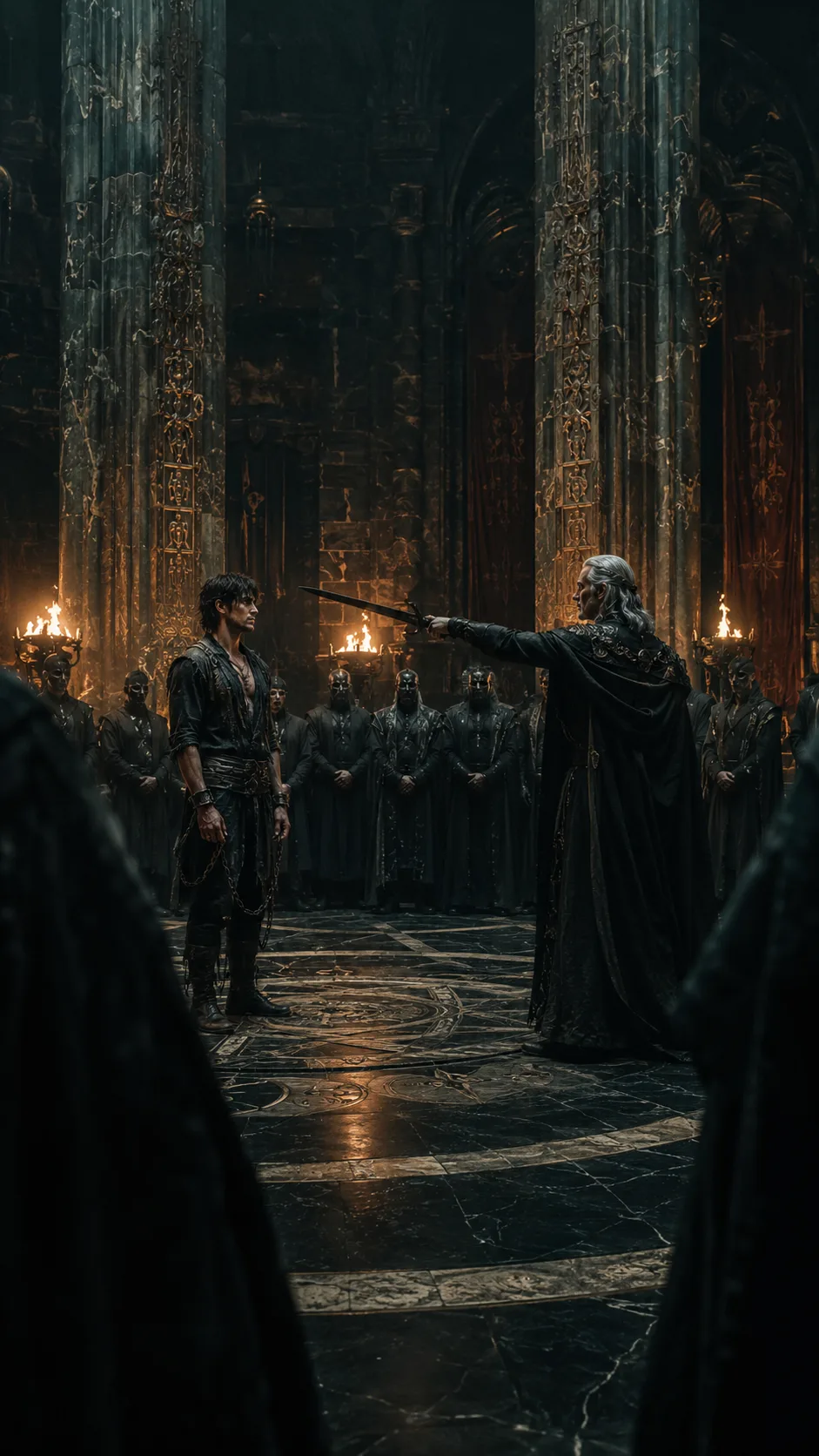
Kael heard the chisel strike stone before anyone opened the doors.
Chapter 1
Kael heard the chisel strike stone before anyone opened the doors.
Not a hammer. Not a sword. A chisel.
A thin, sharp sound from somewhere beyond the Grand Hall, tapping at the wall where the guild kept its records. Tap. Scrape. Tap. Scrape. The sound carried through the corridor like an insect trapped inside a skull.
They were removing his name.
Two masked guards walked on either side of him, their hands not touching him, their presence enough. The chains around his wrists were ceremonial, black iron polished until they reflected the torchlight. They had been placed on him in the lower chamber without a word. No one had asked him to confess. No one had asked him to defend himself.
The verdict had arrived before the trial.
The doors to the Grand Hall of the Ancients opened inward.
Heat came first. Torches lined the pillars from floor to vaulted ceiling, hundreds of small flames bending in the draft. The hall
smelled of smoke, old stone, and the oil used to clean blades. Across the black marble floor, masked assassins stood in perfect rows. No whispers. No movement beyond the faint shift of cloth and armor.
At the far end, beneath the seven carved stars of the old ceiling, Lord Veyran waited.
He wore the black mantle of the guild master, embroidered with silver thread at the collar. His long white hair was tied at the nape of his neck. His face held no anger. That was what made him dangerous. Veyran had never needed anger to ruin a person.
On the wall behind him, Kael’s name was already half-gone.
A stone scribe stood on a narrow ladder, chipping away the carved letters with careful hands. K. A. E. The L remained, thin and lonely, catching torchlight in the dust.
Kael stopped walking.
The guard to his left shifted one step
behind him.
“Forward,” the guard said.
Kael looked at the wall a second longer.
Then he walked.
The center of the hall held a circular sigil cut into the marble. Seven broken stars. A ring of old script. A crown-shaped mark split down the middle. Every apprentice had been told the same story: the sigil was a reminder of obedience, because all crowns fell before the guild.
Kael had believed it until he was twelve.
He had been brought to the citadel barefoot, with mud dried around his ankles and a stolen knife hidden under his sleeve. The guild found him in the outer market after he picked the purse of an elder and returned only the coin, keeping the tiny folded map inside. He did not know what the map was then. He only knew the elder had been afraid of losing it.
Veyran had studied him for a
long time that night.
“You stole from the wrong man,” he had said.
Kael had held out the map.
“Then take it back.”
Veyran had smiled.
Not kindly.
“Or perhaps you stole from the right one.”
That was how the guild took him in. Not with mercy. With interest.
For fifteen years, Kael learned how to move without sound, how to read lips across banquet halls, how to disappear into a crowd before a person finished turning their head. He learned poisons, locks, languages, court etiquette, funeral customs, coded ledgers, noble lies.
He learned faster than the others.
That became his first mistake.
His second mistake was reading what he was told not to read.
The old prophecy was not in the library. It was beneath the east stair, behind a stone panel that opened only when the moonlight touched the third raven carved into the wall. Kael found it by accident during a winter storm, when water leaked into the corridor and ran backward across the floor instead of down the steps.
Inside the hidden chamber, he found dust, broken candles, and a strip of blackened vellum sealed inside a glass tube.
The words were older than the kingdom.
Not all of them survived.
But enough did.
Beneath the citadel sleeps the crown that bows to no guild, no king, no blade. When the nameless one is cast from stone, the buried oath shall rise.
Kael read that sentence until the lamp burned out.
Then he read it in the dark from memory.
The next morning, he brought it to Master Orik, the only elder who still treated him like a person instead of a weapon. Orik had one blind eye and a limp from an old mission no one discussed. He listened without interrupting. Then he closed the chamber door and stood with his back against it.
“Who else saw this?”
“No one.”
“Keep it that way.”
“You know what it means.”
Orik looked older in the lamplight.
“I know what men do when buried things begin to breathe.”
Kael should have stopped there.
He did not.
He searched the citadel at night. He traced old drainage lines beneath the lower kitchens. He measured the Grand Hall with thread and chalk. He compared the map he had stolen as a child to the foundation stones beneath the east wing. Every line pointed inward. Every old passage turned toward the same place.
The center sigil.
The crown was real.
And the guild had built its entire order on top of it.
By the time Veyran summoned him to the upper council chamber, Kael had not slept properly in four nights.
The council chamber had no windows. Twelve elders sat behind a crescent table. Veyran stood behind the empty center chair, one hand resting on its back.
On the table lay the glass tube.
The vellum was gone.
Kael did not reach for it.
Veyran’s eyes stayed on his face. “You entered a sealed chamber.”
“Yes.”
“You removed an artifact.”
“I brought it to Master Orik.”
At the far end of the table, Orik did not lift his head.
Kael looked at him.
Nothing.
No denial. No defense.
Veyran’s fingers tapped once on the chair.
“The chamber was sealed by guild law.”
“The chamber held a prophecy about the citadel.”
“The chamber held a dead myth.”
“No,” Kael said. “It held a warning.”
An elder in a bronze mask shifted. Another leaned back. Those tiny movements meant more than shouts in that room.
Veyran picked up the empty glass tube.
“The vellum is missing.”
Kael’s jaw tightened.
“I didn’t take it.”
“No?”
“No.”
“Then perhaps the prophecy took itself.”
A few elders smiled behind their masks. Kael heard it in the breath. Small. Private. Cruel.
Veyran set the tube down.
“You were brought here with nothing. No house. No bloodline. No oath but the one we gave you.”
Kael said nothing.
“You ate our bread. Slept beneath our roof. Learned our arts. Carried our mark.”
Still nothing.
“And now you return our mercy with superstition.”
Kael glanced at Orik again.
This time, the old master’s hand moved. Just slightly. Two fingers pressed against the table, then released.
A warning.
Do not speak.
Kael spoke anyway.
“If the crown is myth, open the floor.”
The chamber went still.
Veyran’s expression did not change, but his hand left the chair.
“Say that again.”
Kael met his eyes.
“Open the floor beneath the Grand Hall.”
No one smiled then.
That was the first crack.
The second came two days later, in the training yard.
Kael was sparring with Jessa Vale, the fastest blade among the younger assassins and the only one who had ever beaten him twice in a row. Her copper hair was tied high, her sleeves rolled to the elbow despite the cold. She fought like she was insulting the air.
“You’re distracted,” she said, striking his shoulder with the flat of her practice knife.
Kael stepped back.
“You’re slow.”
“I hit you.”
“You hit where I let you.”
She swung again.
He caught her wrist.
She twisted free, and for one sharp second they stood too close, breath visible between them.
“You need to stop,” she said.
He lowered the practice knife.
“You know?”
“I know people are talking.”
“People always talk.”
“Not like this.”
Across the yard, two apprentices watched and pretended not to. Behind them, a masked elder stood beneath the archway.
Jessa saw Kael see him.
Her voice dropped. “They’re saying you forged the prophecy.”
“That makes no sense.”
“Sense doesn’t matter when Veyran gives people permission to be afraid.”
Kael looked toward the upper tower.
The stone scribe was working there too, repairing old plaques from the east wing. Dust fell from the wall in thin gray lines.
Jessa stepped closer.
“Orik left the citadel this morning.”
Kael turned back to her.
“What?”
“Escorted through the north gate before dawn.”
“Where?”
“No one said.”
The practice knife felt heavy in Kael’s hand.
Jessa’s face did not soften. It never did in public. But her fingers brushed his wrist once, quick as a passing shadow.
“Burn whatever you found.”
He shook his head.
“It’s too late.”
Her mouth pressed into a line.
“For what?”
Before he could answer, bells rang from the inner tower.
Three low notes.
A summons.
Not for council.
For judgment.
The Grand Hall filled before sunset.
Kael was taken from his cell below the archive and walked through corridors he knew better than the guards. One crack in the western passage held a hidden pin. One loose brick near the shrine covered a narrow crawlspace. The third torch before the main stair could be pulled down to open a servant route into the kitchens.
He passed them all.
Useless now.
The guild did not fear him escaping.
They wanted him seen.
At the threshold of the Grand Hall, the guards stopped. One removed the black cord from Kael’s shoulder, the cord every sworn assassin wore during formal judgment. Another took the small crescent blade from his belt. Kael let them.
The second guard reached for the old leather strip around his left wrist.
Kael’s hand closed.
The guard froze.
It was not a weapon. Only a strip of leather, cracked at the edges, tied with a tiny brass bead. He had worn it since he was brought to the citadel.
“Leave it,” Kael said.
The guard looked to Veyran.
Across the hall, the guild master gave one small nod.
A generous gesture.
A final insult.
Kael walked to the center sigil.
The last letter of his name came off the wall behind Veyran with a dry scrape.
Dust fell.
The stone scribe climbed down from the ladder and stepped aside.
Where Kael’s name had been, only a pale scar remained.
Veyran took the black exile blade from an elder in a silver mask. It was long and narrow, not meant for battle. Its edge was ceremonial, polished for judgment. Every apprentice knew its meaning.
To be marked by that blade was not death.
It was erasure.
Veyran stepped into the circle opposite Kael.
The assassins behind him stood in a half ring, masked and motionless. Jessa stood among them on the right side, her mask in place, her hands at her sides. Kael could not see her eyes through the slit of dark glass.
Veyran raised the blade.
“Kael of no house,” he said, his voice carrying cleanly through the hall, “taken from the gutter, trained under guild law, sworn beneath the seventh flame.”
Kael’s wrists hung in front of him.
The chain moved once.
“You are charged with entering a sealed chamber, disturbing forbidden relics, spreading false prophecy, and placing your ambition above the order that fed you.”
No one moved.
Veyran continued. “The council has judged you.”
Kael looked at the elders.
One by one, their daggers lowered.
Not raised.
Lowered.
The old sign of rejection.
Jessa’s dagger lowered last.
Her hand shook once before it stilled.
Veyran saw Kael notice.
His voice sharpened.
“Your name is removed from the records. Your oath is dissolved. Your shadow is no longer welcome beneath this roof.”
He turned the blade outward toward the great doors.
“Step beyond these gates, and no assassin shall speak your name again.”
The hall held its breath.
Kael said nothing.
That seemed to irritate Veyran more than defiance.
“You were never one of us,” Veyran said.
There it was.
Not law. Not judgment.
Truth, at least as Veyran understood it.
Kael looked past the blade, past the guild master, toward the wall where his name had been.
The scar in the stone looked fresh.
Almost wet in the torchlight.
Then Kael looked down at the sigil beneath his boots.
Seven broken stars.
A ring of old script.
A split crown.
The leather strip around his wrist warmed against his skin.
Not much. Enough.
He remembered being twelve, standing in this same hall, barefoot and trying not to shake. He remembered Veyran asking him if he could read. He remembered lying. He remembered looking down at the floor and tracing the broken crown with his eyes while every adult in the room decided what he was worth.
He remembered the brass bead on his wrist clicking against the marble when he knelt.
The bead had belonged to his mother.
He did not remember her face.
Only her hand tying it around his wrist and saying, “When stone speaks, listen.”
Kael had thought it meant nothing.
A child’s comfort.
A poor woman’s superstition.
Now the brass bead burned.
Veyran stepped closer.
“Kneel,” he said.
A small sound came from the crowd. Not a gasp. A shift. The kind that happens when people want cruelty but do not want to admit they are watching it.
Kael lifted his chained hands.
Not high.
Just enough for the iron links to catch torchlight.
“No.”
The word did not echo.
It landed and stayed.
Veyran’s eyes narrowed.
The black exile blade angled toward Kael’s throat.
“You mistake exile for negotiation.”
Kael looked at the blade.
Then at Veyran.
“Then why is the crown rising?”
For one breath, Veyran did not understand.
Then the floor cracked.
It began beneath Kael’s left heel, a thin white line cutting through black marble. A second crack ran across the crown-shaped mark. Then another split through the circle of old script, and green-gold light pushed up through the wound in the stone.
The nearest elders stepped back.
One dagger struck the floor.
The sound rang through the hall.
Veyran looked down.
Kael did not move.
The chains around his wrists lifted slightly, not pulled by his hands, but by something in the air. Dust rose in a perfect circle around him. The torches bent inward, flames stretching toward the sigil as if drawn by a silent wind.
The crack widened.
Stone plates shifted under Kael’s boots, slow and heavy, not breaking apart but opening like something designed to open.
Beneath the marble, stairs appeared.
No.
Not stairs.
Rings of carved stone descending into darkness.
The emerald-gold light came from below.
Veyran’s face changed for the first time.
Only a little.
His mouth lost its shape.
Kael heard movement from the crowd. Robes brushing. Boots retreating. Someone whispered a prayer and then stopped as if afraid of being heard.
The black exile blade lowered an inch.
Kael raised his chained hands higher.
“I touched nothing,” he said.
The crown rose from beneath the citadel.
Not quickly. Not like a thing summoned for spectacle. It emerged as if waking from a long sleep, shedding dust and fragments of ancient stone. Gold, but not the soft yellow of noble circlets. This was darker. Older. Its surface held veins of green fire, and seven points curved upward like the broken stars carved into the floor.
The crown turned in the air.
Toward Veyran first.
The guild master took half a step forward.
His fingers reached.
Every assassin in the hall saw it.
The crown stopped.
The green light inside it dimmed.
Then it turned away from him.
Veyran’s hand remained outstretched.
Empty.
Kael watched the crown drift toward him.
The chain around his wrists unlocked.
Both iron cuffs opened at once and fell to the floor.
The sound was not loud.
It was enough.
Jessa removed her mask.
One elder followed.
Then another.
The hall began to fill with faces.
Veyran’s hand closed slowly around nothing.
“No,” he said.
The crown hovered above Kael, close enough that he felt its heat along his brow.
Kael did not kneel.
He did not reach for it.
He let the whole room watch.
An elder in a bronze mask stepped forward, but not toward Veyran. Toward Kael. His dagger lowered point-first until the tip touched the marble.
A second elder did the same.
Then a third.
The assassins in the back rows did not move at once. That would have looked rehearsed. It happened unevenly. One lowered a blade. One took off a mask. One stepped away from Veyran’s side. One turned his body toward Kael instead of the guild master.
That was how power left a man.
Not with thunder.
With small withdrawals.
Veyran saw them all.
His grip tightened on the exile blade.
“The prophecy was sealed,” he said.
Kael looked at him.
“So you knew.”
The words cut deeper than accusation.
Veyran’s jaw moved once.
No answer came.
Behind him, the stone scribe dropped the chisel. It bounced on the floor and spun twice before stopping near the pale scar where Kael’s name had been.
Kael looked at the wall.
Then at the crown.
Then back at Veyran.
“You erased the wrong name.”
The crown lowered.
The hall light changed.
It was not brighter. It was clearer. The old runes carved into the pillars woke one by one, green fire threading through stone lines no living master had ever fully read. The ceiling stars glowed above them. Dust rained softly from the carved arches.
Veyran stepped back.
Only one step.
But everyone saw it.
The exile blade dipped until its point touched the floor.
Jessa walked out of the assassin line and stood beside Kael. She did not speak. She did not need to. Her mask hung from one hand, and her dagger stayed low at her side.
Veyran looked at her.
She met his eyes.
That was another withdrawal.
The crown settled above Kael’s head without touching him, its points casting shadows across his face.
The brass bead on his wrist cracked.
Inside it was a sliver of dark stone no bigger than a grain of rice.
It fell into his palm.
The crown flared once.
A memory struck the hall, not in words, but in sound.
A woman’s voice.
Soft. Tired. Close.
“When stone speaks, listen.”
Kael’s fingers closed around the sliver.
The elders heard it too. He saw it in their faces. Old shame. Old fear. Old recognition.
Veyran whispered something.
Kael almost missed it.
“Her line survived.”
The hall seemed to narrow around those words.
Kael took one step toward him.
“My mother.”
Veyran’s mouth shut.
Kael looked at Orik’s empty place among the elders.
Then the truth arranged itself.
Orik had not betrayed him. Orik had been removed before he could speak. The vellum had not vanished because Kael lost it. Veyran had taken it. The prophecy had not been dismissed because it was false.
It had been buried because it was true.
Kael turned to the council.
“Where is Master Orik?”
No one answered.
Not until an elder near the back removed a copper mask and lowered her head.
“The north tower,” she said.
Veyran turned on her.
She did not put the mask back on.
Kael’s hand tightened around the stone sliver.
“Alive?”
The elder nodded once.
The crown’s light pulsed above him.
Veyran lifted the exile blade again, but the movement had lost its authority. It looked like a man reaching for a door already locked from the other side.
“You do not command this hall,” Veyran said.
The old script around the sigil ignited beneath Kael’s feet.
Every torch in the Grand Hall went out.
Only the crown remained.
Green-gold light covered the marble, the pillars, the faces of the assassins who had come to watch an exile and found themselves standing before something older than their order.
Kael looked at Veyran.
“No,” he said. “I don’t.”
The crown rose slightly.
“But neither do you.”
The Grand Hall opened beneath the throne dais.
A hidden seam split the stone wall behind Veyran, revealing a narrow passage sealed by roots of black metal. The metal pulled back piece by piece. Cold air moved through the hall from the darkness beyond.
Veyran’s face went gray.
Kael understood then.
The crown had not only chosen.
It had remembered.
The passage led to the north tower.
Two elders moved before Veyran could stop them. Jessa went with them. No one asked permission. No one looked at the guild master.
Veyran stood alone in front of the scarred wall, the exile blade hanging useless at his side.
Kael stayed in the center circle until Orik was brought in.
The old master walked with help from Jessa and the copper-masked elder. His face was bruised at the cheekbone, his blind eye clouded as ever, his good eye fixed on Kael. He looked smaller than Kael remembered. Older. But when he reached the circle, he pushed away the hands supporting him.
He stood on his own.
For a moment, neither of them spoke.
Then Orik bowed.
Not deeply.
Just enough.
Kael hated it.
“Don’t,” he said.
Orik lifted his head.
“I should have spoken sooner.”
“Yes.”
No forgiveness came wrapped around the word. No comfort either.
Orik accepted it.
Veyran made a sound behind them, half laugh, half breath.
“You would hand the guild to a gutter child because a relic glows?”
Orik turned.
“No,” he said. “Because his mother was the last crown-bearer, and you knew it when you brought him here.”
There it was.
Not prophecy.
Not myth.
Record.
The room did not erupt.
It emptied around Veyran.
Assassins stepped away from him. Elders turned their shoulders. The stone scribe backed down from the wall and left the chisel on the floor.
Kael felt the crown above him, warm and silent.
His mother had not abandoned him to poverty.
She had hidden him.
The guild had found him because of the map.
Veyran had kept him close because a living threat was easier to watch than a lost one.
Kael looked at the wall again.
At the pale scar where his name had been.
“Put it back,” he said.
The stone scribe looked at Veyran first out of habit.
Then he looked at Kael.
That was the final withdrawal.
The scribe picked up the chisel with both hands.
“No,” Veyran said.
No one moved for him.
Kael stepped out of the center circle. The crown moved with him. The black chains remained on the floor behind him, open and useless.
He stopped in front of Veyran.
For years, he had imagined this distance differently. A blade between them. A confession. A strike. Something sharp enough to balance the years.
But Veyran looked smaller up close.
Not weak.
Worse.
Ordinary.
A man who had mistaken secrecy for destiny.
Kael held out his hand.
“The blade.”
Veyran’s fingers did not release it.
Jessa moved behind Kael, but Kael raised one hand without looking.
No.
This had to be Veyran’s choice in front of everyone.
The guild master looked around the hall. At the elders who no longer stood with him. At the assassins who no longer waited for his signal. At the open passage behind him. At Orik, bruised and silent. At the crown above Kael.
His hand opened.
The black exile blade fell into Kael’s palm.
Kael looked at it for a long time.
Then he turned and walked to the wall.
The stone scribe stepped aside.
Kael lifted the blade to the pale scar where his name had been erased.
For one second, the hall seemed to expect him to carve Veyran’s name away in return.
Kael did not.
He pressed the flat of the blade against the wall.
The crown’s light ran through the metal.
Stone softened beneath it like wax under heat.
Letters appeared.
Not carved by hand.
Remembered by the wall.
KAEL ARVAN.
The surname struck the elders harder than the crown.
Arvan.
The line no one spoke of.
The line Veyran had sworn ended before Kael was born.
Orik closed his eye.
Jessa looked at Kael as if seeing the final missing piece fall into place.
Kael lowered the blade.
The wall now held his name deeper than before. Not in the apprentice column. Not among the sworn blades.
Above them.
Beside the ancient oath.
Veyran stared at the letters.
His lips moved, but no sound came.
Kael turned back to the hall.
“Open the records.”
The scribe nodded.
“All of them,” Kael said.
A murmur moved through the assassins then. Not loud. Not rebellion. Something more dangerous. Agreement.
Veyran was taken from the Grand Hall without chains.
Kael ordered it that way.
Not from mercy.
From precision.
Let him walk through the same corridors he had ruled. Let every apprentice see him without the black mantle. Let every guard decide whether to look away or watch. Let the citadel learn the shape of a fallen man without spectacle.
The crown did not follow Veyran.
It remained above the sigil until dawn.
By morning, the hidden archives beneath the north tower were opened.
They found the vellum sealed inside Veyran’s private chest. They found names scratched from records for three generations. Children brought into the guild, trained, used, erased. Bloodlines hidden not because they were dangerous to kingdoms, but because they were dangerous to the guild master’s throne.
Orik spent three days giving testimony in the lower chamber.
Jessa stood guard outside the door and let no elder enter without surrendering a blade.
Kael did not sit in Veyran’s chair.
Not once.
On the fourth day, he ordered it removed from the council chamber and placed in the courtyard, where rain fell on it until the black wood split.
Some assassins expected him to take command.
Others expected him to leave.
Kael did neither at first.
He walked the citadel.
He visited the kitchens where he had stolen bread as a boy. The east stair where he had found the chamber. The training yard where Jessa had warned him. The record wall where his name now stood in ancient script.
At the base of that wall, the stone scribe had left the old chisel.
Kael picked it up.
It was lighter than he expected.
Jessa found him there near sunset.
“You could order someone else to do that,” she said.
Kael pressed the chisel to the stone beneath his name.
“I know.”
“What are you carving?”
He struck once.
A clean mark appeared.
“Not carving.”
Strike.
Dust fell.
“Restoring.”
She watched him work.
Name after name returned slowly beneath his hand. Some he knew. Most he did not. Orik brought old ledgers. The copper-masked elder brought memory. Apprentices came quietly at first, then in groups, reading names aloud as Kael carved them back into the wall.
No ceremony was announced.
Still, the hall filled.
By night, the torches were lit again.
Not for judgment.
For witness.
When the last missing name was restored, Kael stepped back. His hand ached. Stone dust coated his sleeve. The leather strip around his wrist hung loose now, the brass bead split open and empty.
Jessa stood beside him.
“What now?” she asked.
Kael looked at the Grand Hall.
The place where he had been erased.
The place where the crown had risen.
The place where the guild had learned that stone remembered what men tried to bury.
“Now,” he said, “we open the gates.”
The next morning, the citadel doors stood wide for the first time in living memory.
Not because the guild had fallen.
Because it had been seen.
Kael walked through the Grand Hall without chains, without mantle, without crown on his head. The ancient crown remained beneath the sigil again, sleeping in the stone, where it belonged.
It did not need to be worn to rule.
At the threshold, he stopped and looked back.
The scar where his name had been erased was gone.
In its place, the letters held firm.
Kael touched the leather strip on his wrist once.
Then he stepped into the light.
The stone stayed silent.
Chapter complete
You have reached the end of this chapter.
Continue reading
A few more worlds to get lost in after this chapter.